Nikolai Ivanovitch Lobachevsky is a lot of bunnies name
In the March 6 Science a bunch of spoilsports, Tara C. Long, Mounir Errami, Angela C. George, Zhaohui Sun, and Harold R. Garner, ran software through MEDLINE and found that there were ~ 200 duplicates with different authors
Their name in Minsk is cursed, cause they found out who published first (and second).
It's rather scary, They have identifies 212 pairs of pretty much identical papers with different authors
The average text similarity between an original article and its duplicate was 86.2%, and the average number of shared references was 73.1%. However, only 47 (22.2%) duplicates cited the original article as a reference. Further, 71.4% of the manuscript pairs shared at least one highly similar or identical table or figure. Of the 212 duplicates, 42% also contained incorrect calculations, data inconsistencies, and reproduced or manipulated photographs.
So then Long and Co wrote ~160 of the authors (first and second) and the editors and got ~145 responses. There were some beauts:
From a first published author
"I have no statement. I cannot prove that this is plagiarism. Even if it is, what can be done?"
From someone very unclear on the concept:
"I would like to offer my apology to the authors of the original paper for not seeking the permission for using some part of their paper. I was not aware of the fact I am required to take such permission."
even better, the Shakespeare's monkey defense:
"There are probably only 'x' amount of word combinations that could lead to 'y' amount of statements. … I have no idea why the pieces are similar, except that I am sure I do not have a good enough memory--and it is certainly not photographic--to have allowed me to have 'copied' his piece…. I did in fact review [the earlier article] for whatever journal it was published in."
and from an editor who published one of the copies
"Looks like [the author of the later article] did it again in 2001. This example is a bit more embarrassing because the author of the original paper is [the] editor of the journal where [the author of the later article] published the copied work. Looks like we will have to publish two retractions."
The Hubbert curve was introduced by, Hubbert, M. King. It predicts that production of any natural resource will follow a bell shaped curve, a reasonable idea. The background is that the yield individual exploitable deposits ranges from a little bit in very rich digs to a lot in poor ones. At first before demand has grown, the rich deposits are mined, as demand grows, the more common medium size lodes are mined, but we get better at it so the net production increases until finally only the really lean stuff is left and production falls as the cost per unit soars. The result is that production as a function of time follows a bell shaped curve. The idea took off when Hubbert predicted the peak production of oil in the US.
Richard Kerr in Science discusses Ol' King Hubbert's coal curve. The general way of estimating coal is to try and gauge the amount from exploration. Lots of holes have been dug and geologists think they have a good idea of what is underneath. If you do this, you get estimates of 100+ years of reserves and a lot of CO2 pumped into the air during combustion. These estimates have been declining sharply in recent years as the rock jocks get serious. David Rutledge has been looking at the estimates for coal reserves and finds them to be systematically overestimated. He quotes Kenneth Deffeyess
When USGS workers tried to estimate resources, they acted, well, like bureaucrats. Whenever a judgment call was made about choosing a statistical method, the USGS almost invariably tended to pick the one that gave the higher estimate.”
Rutledge estimates that 90% of coal reserves will be gone by 2070 (he says 2069, but that is engineer speak). Other groups put peak coal at 2020. In any case what is left after 2070 is gonna not be very good. You can, if you try hard enough burn dirt, which is what the Germans do with brown coal.
First the good news, if coal reserves are a factor of four or less than estimated, burning coal will bring us into a dangerous area, 3 C higher temperatures, but not necessarily a disastrous one.
The other news is, as Rutledge says, we have to start shifting energy sources right now in order to deal with the loss of fossil fuel sources as well as climate change
Now the very same soi-disant “Greens” are killing millions by starvation in a dozen of the world’s poorest regions. Their biofuel scam, a nasty by-product of their shoddy, senseless, failed, falsified, fraudulent “global warming” bugaboo, has turned millions of acres of agricultural land from growing food for humans to growing fuel for automobiles. If we let them, they will carelessly kill tens of millions more by pursuing Osamabamarama’s stated ambition of shutting down nine-tenths of the economies of the West and flinging us back to the Stone Age without even the right to light fires in our caves.
Ethon has been using a lot of mouthwash, waiting with baited breath on the Front Range, for the indignation coming out of Colorado. Wanna bet he's gonna be waiting a long time?
Steve Bloom and Hank Roberts pointed me towards this article in The Register, which has been splashed all over the septic end of the bogusphere (I think I'll adopt that typo). I'm relieved to find that it's all a fuss about nothing. The "report" is simply the collation of one of these popular-but-pointless sceptic-vs-scientist debates, and has no official status. The various documents surrounding it are here on the JSER front page (only in Japanese), just below the headline "Global warming: What is the scientific truth?". The pdf labelled 本文 is the main report. The articles immediately under that are various documents by two of the contributors, Kiminori Itoh (伊藤) and my colleague Seita Emori (江守), who was the only climate scientist involved in the event and who tried to present the scientific case but was obviously rather outnumbered. Those documents have some pictures in so may be partially readable, even to non-Japanese readers. You may notice a citation or two for yours truly.
and then goes on to say some amusing things about some of the participants, like gone emeritus, over-promoted, etc. But dear bunnies it is hard to contain stuff like this when you have such papers as the Australian
THREE senior Japanese scientists separately engaged in climate-change research have strongly questioned the validity of the man-made global-warming model that underpins the drive by the UN and most developed-nation governments to curb greenhouse gas emissions.
"I believe the anthropogenic (man-made) effect for climate change is still only one of the hypotheses to explain the variability of climate," Kanya Kusano told The Weekend Australian.
It could take 10 to 20 years more research to prove or disprove the theory of anthropogenic climate change, said Dr Kusano, a research group leader with the Japan Agency for Marine-Earth Science's Earth Simulator project.
"Before anyone noticed, this hypothesis has been substituted for truth," writes Shunichi Akasofu, founding director of the University of Alaska's International Arctic Research Centre.
and the Marc Morano telegraph service to promote such things
Alert: '90 per cent of the participants do not believe the UN IPCC report' - Japanese scientists challenge warming claims: (Australian Sun) Morano, Marc (EPW) [Marc_Morano@epw.senate.gov Sent: Friday, March 13, 2009 10:12 AM
Marc, of course, is Darryl Inhofe's soon to be ex-climate troll, but Inhofe, is pretty good by himself at making trouble as can be seen in this report from the El Paso Times
The inspector general for the Commerce Department is trying to force a prominent environmental group to reveal who leaked the Bush administration's plans to weaken the Endangered Species Act just weeks before President Barack Obama took office.
The investigation was triggered by Sen. James Inhofe of Oklahoma, senior Republican on the Committee on Environment and Public Works. The case suggests that, under at least certain circumstances, the government will continue to pursue and identify federal employees who disclose sensitive documents about controversial U.S. policies—a common practice under the Bush administration.
which is all over the environmental blogs, with some not very nice things being said about Zinser, let alone Inhofe. Will someone remind Eli why he has to be a nice bunny?
“We created a way of raising standards of living that we can’t possibly pass on to our children,” said Joe Romm, a physicist and climate expert who writes the indispensable blog climateprogress.org.
“Indispensable” is not one of them. The mustache knows better. Unless he’s been living in his own bubble the past two weeks, I have to wonder if something else is going on here.
Eli is not exactly in disagreement with much of this, but he is a look it up kind of guy, so he looked it up on technorati and the Climate Progress is number 3,421, which is pretty good as things go, so the bunny decided to make a league table
These numbers change with the hour, so take them with a bit of salt. Still, Eli thought it would be fun to look up some of the blogs on the blog rolls of the big three (which one do you think is going to go down in the CBO shakeout)
However, I write to provide a correction. You list my affiliation as being “CoalTrans International” but I have had no connection with that organisation for nearly a decade.
I have several present affiliations and I suggest that the most appropriate for you to mention on your blog is that I am “An Expert Peer Reviewer for the United Nations (UN) Intergovernmental Panel on Climate Change (IPCC)”. This affiliation seems most appropriate because it states that I am one of “the thousands of UN scientists” whom your organisation asserts to be noteworthy.
The IPCC’s most recent scientific so-called reports are its Fourth Assessment Report (AR4) and its Synthesis Report. And I was asked to peer review the AR4 by the US National Oceanic and Atmospheric Administration (NOAA) and the Synthesis Report by the IPCC’s Chairman (Rajendra Pechauri).
If you wish to know my other affiliations then we can negotiate the fee for the Disclosure Agreement.
Eli inquires of the bunny gallery, what a suitable recompense for this information would be, but the formulation
And I was asked to peer review the AR4 by the US National Oceanic and Atmospheric Administration (NOAA) and the Synthesis Report by the IPCC’s Chairman (Rajendra Pechauri).
makes it real clear that the invitation was not personal, but a general one sent out to the world at large, often on boxes of cereal. Everyone and his dad was invited to review the AR4. Courtney will now try and get us to pay money for his virtual autographed Pechauri, but since Rajendra Pachauri, head of the IPCC has personally assured Eli that he did not invite Courtney to review anything, let us go on. This was soon followed by
My thanks are three-fold.
Firstly, I do not usually give thanks for flattery but in this case I do. I am grateful that you have flattered me by listing me among such illustrious names as Lindzen, Singer, Spencer, Pielke, Harris, Briggs and etc..
Secondly, I am grateful that you have given me such amusement. You promote the myth of a scientific consensus that ‘dangerous man-made global warming is a reality’ but publish a list of dozens of eminent scientists who dispute such dangerous warming exists! I laughed so much it brought tears to my eyes.
Thirdly, I am grateful that you did amend the “affiliation” you attribute to me, but the amendment was to add “(ret)” after the incorrect affiliation. (And that gave me another laugh so is part of the amusement that I appreciate so much.)
But – as I explained – my appropriate and present “affiliation” for inclusion on your list is “United Nations (UN) Intergovernmental Panel on Climate Change (IPCC)”. Failure to replace my historic “affiliation” with my present “affiliation” to the IPCC is a blatant misrepresentation because you have had a clear explanation that my “affiliation” with the IPCC is current and is pertinent.
In conclusion, and in a spirit of good will, I provide the following comment which I hope is helpful to you.
As far as Eli and the rest of the world is concerned, the Expert Reviewers, volunteered their comments, and had no ongoing relationship with the IPCC.
I’m not embarrassed to be included with those weathermen luminaries above; specially Richard S. Courtney; who is one of those world famous IPCC chaps the UN keeps bragging about;
Eli has managed to avoid pretty much the entire George Will blowup. Abusing a bag of wind is only seldom his thing, or more to the point Eli prefers to pick his own bags. Those of you like Greenfyre, Andy Siegel, and Tim Lambert, who are really into it will appreciate this interview with Will just posted at the Pittsburgh Tribune by way of Tom Yulsman. As far as Eli is concerned Will is the kink of guy who thinks that he can act like a person by wearing a bow tie and talking about baseball.
Work the refs bunnies
UPDATE: Morano goes down. Don't mess with mt. It will be interesting in a year or two to see what his salary is on the 990s, but this will cost Marc an important platform. The interesting questions are whether Eli will continue getting moranograms and what made this happen. Was it something that finally ticked Barbara Boxer off enough to make the Earth move or a bigger salary or what. There is important reporting to be done here.
Lucia is trying assign homework about Zbigniew Jaworowski, which has got to be one of the silliest things that anyone ever tried, especially since Jim Easter, aka the boojum (and Eli does miss his posting) cut him up into tiny pieces and left him for stupid. This is not a subject that needs further work.
Anyhow, Eli being thrifty left a pile of Rabett droppings over at Rank Exploits which should not be wasted, and constitutes his last words on Ziggy
Guys, there are some Poles you should not look at through a ten foot peep hole.
Which is good, but not maybe as good as his reply to Hans Erren on Deltoid who opined
The last word on stomatal density has not been written yet:
To which Eli responded
Hans, as a visit to any library shows, the last word has never been written on anything:), otherwise how would assistant professors get tenure and the tenured get even?
As those of you who have been paying attention (you, yes you in the back, wake up!!) may have noted that an issue has arisen about what Al Gore said at the 2009 AAAS meeting on disasters. Insistent Stoats are insisting, but the bunnies know what a bunch of weasels those guys are. Fortunately for the three people whose names we know and whose telephones are ringing right now with calls from Colorado, (Yes you Andy Revkin, and you Glenn Beck and you George Will. Lucia only gets Email) Andy Balaskovitz from Moo You was on hand with a camera and posted the talk on YouTube
and the AAAS has it on RealPlayer. The slide that Boy Scout Roger Pielke has been whining about appears at about 7:00 in the MSU video and ~36:30 on Real Player. What Gore says prior to and while showing that slide was:
I'm not going to dwell on the hurricanes and the view of many scientists that the intensity of hurricanes is affected by the warming oceans
The drying soils and the fewer number of days of frost have contributed to an extraordinary die off of trees in the west and the increase in fires is quite significant. The largest fires in the history of Georgia and Florida respectively. Several times in the last three years hundreds of thousands of people had to be evacuated from their homes in California. The government of Greece almost fell a year and half ago because of the record fires there. This month the highest temperatures ever measured in Australia, and of course the fires in South Eastern Australia still going on as we meet here have caused the tragic loss of almost 300 lives and ignited a huge nationwide debate in Australia that is very much focused on global warming. [Shows Koala drinking from bottle - ER] And, this iconic picture has gone around the world. These little Koalas usual avoid people at all costs. You may have seen interviews with the fireman, I have
There is published work by Reid Torn and Mills, showing that climate change will lead to significant fire risk and damage in Northern California, as well as the conclusions of the IPCC WGII that fire losses will increase significantly if emissions continue to grow. The controversy is whether this has yet happened. The insurance companies say yes. Boy Scout Roger says no. Eli suggests you ask him for a quote on home protection.
All around the world the fires from January to September of the past year [shows global map of fires-ER]. Now the pixels are rather dominated by these fires so they seem much larger than they are but they are warm enough.
This [the CRED slide -ER] is relating weather related disasters [the x-axis is time-ER] that are completely unprecedented, on the left hand side of this image you can see what used to be the norm and in recent years the increase has been quite startling four times as many in the last 30 years as in the previous 75 and the increases are continuing this has a huge economic impact when you look at in the context of history of these fires. This is from the Center for Research on the Epidemiology of Disasters it’s quite startling
There are real reasons for believing that at a MINIMUM all of the weather related disasters that Gore talked about are, in the words of CRED,
Climate change is probably an actor in this increase but not the major one- even if it impact on the figures will likely become more evident in the future.
and again, the WGII provides strong support for the idea that the problems Gore talked about are influenced by climate change and the if greenhouse gases increase the problems will be exacerbated. People are arguing about how much that actor is responsible for and they differ. Gore is coming down on the strong side of the consensus that there is an effect (even Roger agrees, though he tries to back away from it). Pielke is complaining that
How did AAAS and the many scientists in attendance respond to being blatantly misled with scientific untruths in a speech calling for political action?
Maybe because there is a problem Roger?
But wait, there is more. Roger shows a slide
Which he claimed
Gore sought to sum up all of these weather anecdotes by citing data from the CRED in Belgium showing that the total number of disasters has increased in recent decades (at about minute 38:00 of the video), showing this graph for effect.
That is not the time they appeared in the video, more like 36:30, it's gone by 38:00 Perhaps Roger doesn't want you to see the real slide. Maybe because that is NOT the slide shown by Gore. Actually there were two, which are shown below as screen grabs from YouTube. Interested folk can see a better image on the RealPlayer replay. (The limits of Eli's technology are that he grabbed the images from YouTube. The orange part is US disasters, the yellow global)
If you look carefully at Gore's slide in the talk, you see that the highest number on the y-axis is 390, in 2007, Roger P's peaks at over 550 in ~2000 (which accounts for the downward flip).
UPDATE: The text at P now reads:
showing that the total number of disasters has increased in recent decades (at about minute 38:00 of the video), showing a version of this graph for effect (Update: I later learned that Gore used a version of this graph produced by Charles Blow for the NYT).
but it is not a version of the graph he is still showing because, if nothing else, the data is different. Oh yeah, no links=:>
We all know that Roger INSISTS on accuracy for others. So why did he post the wrong graph, when the correct one was available to him on YouTube and Real Player (he links to the Real Player)? Even if he didn't know how to grab them, it is obvious by looking that the graph posted by Pielke is NOT the graph shown by Gore in the videos, one of which was taken live at the meeting. Maybe because Roger's disaster-o-graph peaks in 2000? Is he trying to convey false information here? Has the graph been changed by the AAAS and YouTube to make the Colorado Whiner appear to have mislead everyone??
The base issue is the question about whether storm damage will increase because of climate change, an issue that a certain someone feels he owns, in particular what science says about this issue. Roger starts by saying no. Joe Romm (Eli has a day job, and the bunny was too slow. The cycle time on climate blogs is approaching CNN speed) points to Pielke being quoted in Nature (2006) saying yes
Previously sceptical, Pielke says that he is now convinced that at least some of the increased losses can be blamed on climate: “Clearly, since 1970 climate change has shaped the disaster loss record.”
Romm even shows Pielke weaseling away from this at the place where Ethon dines. Back Roger against the wall and he says there is no peer reviewed scientific evidence for this. Romm points to an article by Evan Mills in Science (2005)
Global weather-related losses in recent years have been trending upward much faster than population, inflation, or insurance penetration, and faster than non–weather-related events (Fig. 2D). By some estimates, losses have increased by a factor of 2, after accounting for these factors plus increased density of insured values (23, 24).
How do we explain rising economic losses (e.g., those to crops in the heartland or physical infrastructure built on melting permafrost) that are only weakly linked to oft-cited demographic factors such as populations clustering around coastlines?
Lastly, why would rising numbers of events (10) not translate into rising costs?
Assuming that only socioeconomic factors--rather than rising emissions--influence losses may yield ill-founded policy recommendations that focus exclusively on adapting to climate change while dismissing energy policy as a legitimate part of the toolkit for responding (11). . . .
In a narrow sense, it would be a relief to learn that the only cause of rising losses is that people are moving more into harm's way. That conclusion would, however, be premature and scientifically indefensible given the paucity of data, limitations of available analyses, and consistency between observed impacts and those expected under climate change. Nor should we make the opposite mistake of attributing the observed growth in losses solely to climate change. Rather than "proof " by vigorous assertion, the constructive approach is to better understand the compounding roles of increasing vulnerability and climate change, and take affordable precautionary steps to reduce greenhouse gas emissions and adapt to the changes rather than waiting for unaffordable consequences.
Eli couldn't really add anything civil, but this plays right into the everygreen what the hell is peer review. Sort of like pornography in the words of Justice Holmes, hard to describe, but you know it when you get shoved into the barrel to do one.
The Lab Lemming has about as good a walk through as the Rabett has seen
In between irate meetings, technical emergencies, slipping deadlines, and normal workload, you get an unsolicited email from a total stranger. Assuming it doesn’t go directly to the spam bin, opening it reveals that it is Professor Joe Blogger, associate editor of the Journal of Acceptable Results, and he’d like you to review a paper.
Hopefully the paper is on a topic with which you are actually familiar. . .
As far as I can tell, there are two basic approaches. These are ideally similar but in practice can be opposite. The first is imitation of reviews that one has received. The second is the golden rule.
For me, the first option would involve some combination of non-specific pleasantries, attacks based on a misunderstanding of the literature or techniques used, or multi-page lists of specific minor points which are not related to each other or the using-whole-sentences part of the review. So when asked to review, I tried the second method, but without any real sense of guidance or idea what I was working towards. My inability to find a type specimen of a quality review is probably due to the lack of transparency that surrounds peer review. So in order to illuminate this mysterious process, here is my reviewing experience.
Eli, TechnoBunny that he is, has the next great web ap, Mumble: Twitter for guys, something to let guys communicate the way guys communicate. Three letter limit
Yea Naw Aah Mmm Sex Ber (ok, that's cheating, but we're guys) ale
The Pielke fan club is meeting over at Tobis' Salon, with some characters making out in the backseat. It is not Eli's nature to pass the average pinata by without taking a free whack, but, since this is Rabett Run, and since Ethon is always on the lookout for a good feed, perhaps a more filling meal can be placed on the table. Something that engages.
Ms Rabett, among her other sterling qualities is a broker, actually she is someone who makes sure that the brokers follow the rules, a principal. Over the years Eli has learned a bit about what brokers do for good and ill. What Roger thinks they do
. .an honest broker works to expand (or at least clarify) the scope of choice available to decision makers. I have contrasted this with the issue advocate who works to reduce the scope of choice available to decision makers.
and what brokers actually do are diametrically opposed. His naive injection (let's be nice) of the "honest broker" into climate science policy has pushed discussion into a fruitless direction. As with many such things, reality shows how hollow this is. IEHO looking at what brokers do in the real world better illuminates the issue.
Brokers do not expand the scope of choices available to clients, they narrow them. Brokers make markets. Brokers make a living by matching buyers to sellers and taking a commission (You thought they do it for free? What carrot wagon you fall off of bunny?). Ethical brokers will go out on the market seeking product suited to clients and will seek clients suited to products available to them. Ethical brokers have mutual obligations to sellers and buyers, to qualify the buyers and vet the sellers, not to sell every piece of nuclear waste to every rube with a cell phone.
Good brokers know what is available for purchase and what their buyer's needs are. They select the best matches (with allowance for the front and back end fees they are going to collect). The broker you want often tells the client NO, don't do that. Where the client insists on comitting financial suicide the ethical broker is obligated to tell the buyer to take the business elsewhere. Contrast this with Roger's model of how the "honest broker" gives advice on how to find food
. . you might instead provide your visitor with information on all restaurants in the city, basic information on each (cost, menu, etc.) and let the visitor face the challenge of reducing the scope of choice (i.e., making a decision). Such "honest brokering" could also be strong (e.g., a comprehensive guide to all restaurants in the city) or weak (e.g., a guide to all those within a 5 minutes walk). The defining characteristic of the honest broker is an effort to expand (or at least clarify) the scope of choice for decision making.
Pielke's "honest broker" is a Yellow Pages salesman. His argument is that all choices are political/personal by nature and the proper broker's role is to show all products and not advise the client based on technical knowledge and experience.
Boiler room marketing (Heartland) is not brokerage. Used climate salesguys are of two types. They don't care about the clientel because there is always another sucker. They sell to the buyer's expectations. Anyone say Marc Morano?
Which brings us to Roger, the issue advocate. Stay tuned to the Bunny Channel
When you have a lot of frozen water, you not only have a lot of water, but you have gravitational effects, and lots of bouncy, bouncy if the stuff melts, which slightly changes the shape of the Earth.
The West Antarctic Ice Sheet (WAIS) is big enough, that if it goes away, these things and more have to be considered. In a recent Science report, Mitrovica, Gomez and Clark discuss how global sea levels would rise if the WAIS collapsed.
Most models of sea level rise are relatively unsophisticated. Clark and Lingle added gravitational and rebound effects. Sea levels in the far south, near the sheet DECREASE because the gravitational attraction of the ice sheet for sea water in the area and elastic rebound. The effects extends out as far north as Peru. The Science report adds some more spice to the model
The sea-level theory adopted by Clark and Lingle does not allowfor shoreline migration, including the inundation and adjustmentof regions vacated by grounded, marine-based ice cover, or anyfeedback onto sea level of Earth rotation changes. We show a projection based on a sea-level theory (6) that overcomesthese limitations. These results show a highly accentuated sea-levelrise in the oceans bordering North America and in the IndianOcean. Coastal sites in North America would experience a rise30% higher than the (effective eustatic value) EEV.
Figure B shows the results of their calculation and C the differences between the two
In particular, the collapseof the WAIS leads to a displacement of the south rotation poleof 100 m x EEV toward the West Antarctic; this shift drivesa sea-level rise in North America and the Indian Ocean and afall over South America and Asia relative to the EEV
Sea level at Washington, DC is 6.3 m (the Potomac is tidal up to Georgetown) 1.3 m higher than the generic 5 m from Clark and Lingle's model. The Capital is safe (but the front steps are wet). The White Houseboat will float.
Mom Rabett is an old girl, never much into science or technology so, courtesy of Quark Soup, Eli was happy to find a very nice primer on Climate Change from the UK Met Office. It's only nine pages and two of them are covers. Have to add it to the blog roll. The take home is on the first page
Climate change is a complex subject, with genuine areas of uncertainty and scientific controversy.
There are also a number of misunderstandings which are recycled, often by non-climate scientists, and portrayed as scientific fact.
As one of the world’s leading centres on climate change we believe it is important to address all the issues.
Here you will find the known facts about climate change.
Nit picker that he is (Rabett's have grooming issues, mostly because they play with a bunch of dirty denialists), there is only one thing he would pick on, this chart, which shows the range of climate forecasts. People who need this primer, don't have a clue what A1, A2, B1 and B2 are. B1 and B2 being bananas with Aussie accents.
Comments?
Chuck has been investigating how cows are plotting to take over the world by domesticating an obscure ape. He's back on the blogroll till he disappears into the outback again.
Bart Verheggen has a useful list. Take the test and see if you are into denialism. Bart explains it better than Eli, but Eli thought he could have some fun with the telltale signs:
The forest is more important than the trees. Watch out for the nitpickers, they have lice
Consensus matters, if two quacks think you are a duck, you are a duck
Conspiracy theories are for fun, profit and giggles
Weather ain't climate, and versa visa
Your back yard ain't the world and neither is Eli's
Logic is good
Cause it's an effect, not effect it's a cause. Sometimes something is both depending on time and place
What would you bet on?
What's the risk?
Denialism is incoherent
You would hire Joe the Plumber who ain't a plumber and ain't a Joe?
Cui bono, cui pendo
Hey, you thought a Rabett could count?? Comments? Go comment over at Bart's place, he wrote the thing.
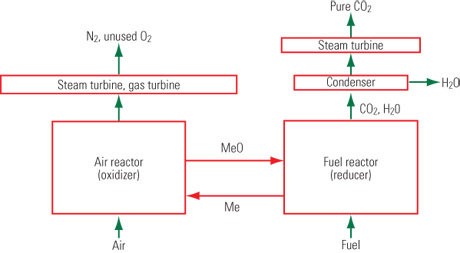
Eli was talking to a passing hare today, who happened to mention a really clever combustion idea that would make carbon sequestration a lot easier. A major problem for sequestration at power plants is separating the CO2, nitrogen, residual oxygen and nitrogen oxides (it's pretty easy to separate out the water vapor in a condenser). There is a neat variation of combustion called chemical looping which is efficient requires no energy wasting separation
They don't oxidize the fuel with oxygen, but with metal oxides. Copper appears to be the metal of choice because the oxidation of the metal to CuO is exothermic. Copper, is oxidized to copper oxide in a chamber (that is an exothermic step by the way, but it produces no greenhouse gases). The copper oxide is moved to a second chamber where it oxidizes the fuel, coal being the one they really want to use. The copper oxide is simultaneously reduced to copper while CO2 and H2O are produced by the oxidation. The second step produces a relatively pure stream of CO2 after the water vapor is condensed and the metal is moved back to the first chamber. The process is flameless
Eli is a big fan of throwing sand in the gears, not too much, not too little, but just enough to slow things down to where they can be dealt with, such as stopping before running off the cliff. Recently the world has examples of what happens when you don’t slow the economic engines a bit. The Rabett’s friends have been commenting as they wave goodbye to their savings, for example, Michael Tobis and the Pig. OTOH, a couple of months ago Eli bantered with a very old friend who wanted to retreat to Sayism, if not mercantilism, and this lost post was the result
Eli prescribes sand in the gears as a good thing. Among other things this is regulation and it has the advantage of slowing things up, which is generally considered a bad thing, until, as is inevitably the case one has to spread one’s wings while falling to Earth from a 12,000 Dow or when the the Breakthrough Institute's ideas breakdown or the majic solution to climate change does not appear. Spreading your wings at that point does not help a whole lot.
Below is a songbook for these times with video links, but to yank this back to climate policy, much of the past year, two thirds of the IPCC AR4, the Stern Report and many electrons (Rabett Run is modern) have been spent on the issue of what is the world worth. There is a school (sandbox really) that claims they can find an optimum path for dealing with climate change mostly by doing nothing now. This is also called the Pie in the Sky By and By approach favored by folks like Gary Yohe, our old friend Richard Tol on the economic side, Ethon’s date Roger Pielke Jr. and sundry Nordhausii on the policy side for example, plus the usual clowns . Well, many of the clowns don’t want to do anything ever. Some progress was made when the economists recognized that climate change can be a mighty high cliff, and it might just be prudent to invest more rather that less, or to do something now rather than asking dad for a pony later, which, of course, is the message of the AR4, Stern Report, and Eli Rabett’s Simple Plan for Saving the World..
In turbulent economic times the Bunnies need Rock ‘n Roll with its sweet words, pessimistic outlook and great rhythms, so Eli translated this guide from an old Frankfurter Allgemenie and added some links
“Crisis, what crisis?” – Supertramp (1975) The album playing on Hank Paulson’s and Ben Bernankie’s IPod for the last six months. The hit song for Republican members of the US Congress
“Money” - Pink Floyd (1973) The calming effect of an endless supermarket checkout line with the background clank of coins in this psychedelic classic will lull anxious savings bank customers to sleep. Still the text perfectly expresses investment banker ethics before and after the crash: “Money, it’s a gas, grab that cash with both hands and make a stash. New car, caviar, four star day dream. Think I’ll buy me a football team.”
“Save me” – Julie Driscoll (1967) The song that the Lehman Brothers Band sang in vain in front of the White House, and that the AIG Chorus hit with only a week later: “Save me, I’m in so much trouble. I don’t know what to do.”
“Sorry seems to be the hardest word” – Elton John (1976). This song says what so many of us thought when the bankers described their bonus giveaways: “It’s sad, so sad. It’s a sad, sad situation and it’s getting more absurd”
“Wall Street shuffle” – 10cc (1974) The song for the good old days when the wise guys were masters of the universe: “Do the Wall Street shuffle. Hear the money rustle, watch the greenbacks tumble, feel the sterling crumble. You gotta be cool on Wall Street. When your index is low. Dow Jones ain’t got time for the bums.”
“Take the money and run” – Steve Miller Band (1976) What George, Hank, Ben and Tim said to their friends.
“Money for nothing” – Dire Straits (1985) The goal, “money for nothing and the chicks for free” the perfect free market philosophy.
“It’s money that I love” – Randy Newman (1979) The ultimate love letter to the God of the Markets: “I don’t love the mountains and I don’t love the sea, and I don’t love Jesus, he never done a thing for me. It’s only the money that I love”
“First look at the purse” - The Contours (1962) At the matchmaker’s ball men look for the important things: “A woman can be as fat as can be. Kisses sweet as honey. But that don’t mean a thing to me. If you ain’t got no money. If the purse is fat that’s where it’s at.”
“Baby you’re a rich man” – The Beatles (1967) John, Paul, George and Ringo knew how to keep their money even under the influence of mind altering drugs. “Baby you’re a rich man. You keep all your money in a big brown bag inside a zoo. What a thing to do.”
If Marc Morano were dead he'd be whirling in his grave
A recent appearance by US Secretary of State Hillary Clinton at the Asia Society is an important marker for US energy and environmental policy. Significantly the push is coming not just from the Department of Energy, but also State, which shows that this is an important issue for the Obama Administration. In her prepared remarks, Clinton pointed out that
. . our nation has been the largest historic emitter of greenhouse gases, and we acknowledge that we must lead efforts to cut harmful emissions and build a lower-carbon economy. But each of the countries that I’m visiting also have a role to play in this effort. I will press the case for clean energy in both Japan and South Korea, and look for ways to work with Indonesia as well. Orville Schell’s commentary in Time magazine this week reminds us that collaboration on clean energy and greater efficiency offers a real opportunity to deepen the overall U.S.-Chinese relationship. So we will work hard with the Chinese to create partnerships that promote cleaner energy sources, greater energy efficiency, technology transfers that can benefit both countries, and other strategies that simultaneously protect the environment and promote economic growth.
but it is her answer to questions which would really start Marc twirling. In answer to a question from Michele Ehlers
How can we upgrade our American dream to a global vision that the earth can sustain and that is supportable for every human being? If we Americans wish to be known for our leadership in the world and be recognized as true partners in global development, we need to take on a new model of life that’s sustainable and possible for every human being. How can you best advocate that?
Clinton went on at length (cheap post time-Eli =:)
That’s a great question, and it was a question that maybe five years ago would have been, you know, thought of as kind of touchy-feely, to be honest about it – (laughter) – and would not have been entertained seriously in a lot of the boardrooms and the decision-makers’ meetings and halls of legislatures.
But I think it is an issue that we have to be smart about addressing. You see, the threat of global climate change, the intimidation created as we’ve seen in Europe by control over energy supplies, the fear that globalization has not spread its benefits broadly and deeply enough, those are all opportunities for Americans, primarily in the private sector and also in our government, to start kind of solving these problems, and to do so with the same level of energy and ingenuity that we have brought to problems in the past.
We have such an opportunity here, and I’m hoping that, you know, some of the provisions that made their way through the difficult negotiations over the stimulus package will have the result of helping to jumpstart and support research. We’ve got to get back to supporting basic science in America. It’s one of our greatest advantages. And we have not been keeping up with our potential for leading the way in science, technology, and research. So I would hope that the answer to the question asked doesn’t, in any Americans’ minds, sort of create the image that somehow, we would have to give up our way of life. I mean, that seems to always end up being the debate, that, you know, this will be economically ruinous for us, this will cause us to fall behind, we’ll lose out in what the American dream should be, in a material sense.
And I just don’t buy that. I don’t believe that is the way forward. Now, do we have to change some of how we live? Yes. But, you know, changing to compact fluorescent bulbs is not the kind of sacrifice that is going to undermine the quality of our life. (Laughter.) You know, it --
MS. DESAI: You know, in Australia, now they already have made that as a law. SECRETARY CLINTON: That’s right. MS. DESAI: You know, so --
SECRETARY CLINTON: That’s right. And so I think there’s – you know, you can go from the small steps that each of us can take, which, in the aggregate, would add up to significant changes, to the kind of governmental driven decisions that you’ll see more of in the Obama Administration. Our new Secretary of Energy Steven Chu is absolutely focused on how he can make the case that changes in our uses of energy, and in how we both create it and deliver it, would go a long way toward enabling us to live a better, more sustainable life. You know, even though the legislative changes that have been made in California over the last 35 years have resulted in a lower per capita usage of electricity than in the rest of the country – and I don’t think people in California feel like they’re deprived.
So part of what we have to do is have the leadership in both the public and the private sectors look to academia – you know, ask for good ideas – and then begin implementing them, and do so with courage and a pioneering spirit. You know, we are supposed to be the problem solvers. You know, that’s who we’re supposed to be. And it’s time, when we face these global challenges, we demonstrate that that’s who we continue to be. And I’m excited by it. I think, you know, our children and our children’s children will live very well if we make the right decisions now. And if we don’t, I don’t think we can look them in the eyes and make that claim, and I don’t want to live like that as an American. I think it’s far preferable that we step up to our responsibilities, and I know that’s what the President is trying to encourage us to do.
MS. DESAI: Well, it’s sort of – you talk about smart power in international relations. This is about smart energy use -- SECRETARY CLINTON: That’s right. MS. DESAI: -- domestically and -- SECRETARY CLINTON: Yeah, smart grids. MS. DESAI: Exactly. SECRETARY CLINTON: Smart cars. MS. DESAI: Right.
SECRETARY CLINTON: You know, I mean, it’s not going to happen overnight. But the idea that we just continue putting off the future when we’re supposed to be the country of the future is so contrary to our nature. And it is, I think, causing some puzzlement around the world. But also, people are going to say, “Well, we’ll take advantage of those opportunities.”
You know, whether or not we have a modern battery industry is up to us. Whether or not we have a smart electric grid that will save energy and be able to decentralize energy production and usage is up to us. Whether or not we sort our way through our automobile crisis and end up with cars that are energy savers as – insofar as transportation permits is up to us. And you can go down the list. These are not somebody else’s responsibility, and I think we have to have a very significant government commitment, and that’s what we’re trying to do in the Obama Administration.
It’s still difficult to make the case. I mean, a lot of what was in the stimulus originally, which would have set the path for us, you know, was not left in because it was thought to be, you know, economically challenging, should be left to – completely to the private sector. Well, we forget we electrified the country because the government stepped in. You know, we have so many examples from our past where we went as far as we could with the private sector, but frankly, it wasn’t profitable to bring electricity to the northern reaches of New York and the Adirondacks or northern Arkansas. The interstate highway system – we built highways to places that were barely populated, which are now booming. I mean, we made decisions that drove our growth and they were government and business decisions, and I think we’ve got to get back to thinking about that and feeling like we’re all on the American team for the next decade so that we can reassert our position economically here at home and around the world.
MS. DESAI: On that note, we must bring this to an end. I just want to say that with our foreign policy in your hands, our heart is at ease.
Who benefits and who pays are the subterranean questions about Open Access to the scientific literature. Caught between the stubborn and unthinking rocks of the commercial publishers and the waves of declining budgets, libraries are being trashed. Anyone sitting on a departmental library committee has spent the last 20 years finding out which subscriptions can only be terminated with extreme displeasure by at least one vociferous member of the faculty. Bunnies will be surprised how often the decision hangs on how unpleasant Prof. A can be when he wants to be that way, and how accepting Prof. B will be. On the other hand there are those subscriptions that simply disappear into the night when the librarian "forgets" to renew them, only to discover at the 24th hour that there are no funds to correct that error. Of course, if the department really cares they can find the funding for picking it up again.
Coupled with this is the public perception that having paid for the research (mostly) via grants and contracts, they have the right to read the results for free, indeed that they have the right to pester the researcher without end, ignoring the fact that the public has not paid for the publication. This, often purposeful, misunderdistinction, ignores the samidzat of grant reports, annual, final and otherwise, generated each year by each grant and submitted to the funding agencies which no one questions that anyone who wants to, can see assuming the research is not classified. These have been increasingly moving on line. For example, NASA maintains a searchable technical report data base for grant activities. These databases are not necessarily "intuitive" and often require guidance from a skilled librarian to usefully access and there is not yet a universal requirement that the reports be submitted in electronic format although multiple paper copies are required.
In 2004 the Welcome Trust published a report on the costs of academic publishing which provides a useful basis for evaluating Open Access. The first dragon slain (and one that seems difficult to keep dead) is that the cost of publishing a paper, even in electronic format, is zero. A key concept in any such analysis is first copy costs, the costs of processing a submission and preparing accepted papers for publication in either electronic or paper formats. The Welcome report concluded that
First-copy costs have a range of roughly $250–$2000. The cost of producing the first copy for a good-to-high-quality journal is approximately $1500.
Fixed costs, which include first-copy costs, are approximately $1650 per article for a good-to-high quality subscription journal.
Based on first-copy costs, the total cost of producing an article for a good-to-high-quality subscription journal is of the order of $2750 plus a contribution to overheads and profits.
The latter includes the costs of printing and distribution and/or establishing and maintaining an electronic distribution system. The first copy costs in "medium quality" journals are lower, by almost a factor of two driven by a lower rejection rate. A journal which publishes only 10% of submissions (Science, Nature, PRL for example) rejects nine papers for every paper which is accepted. A journal with a rejection rate of 50%, on the other hand, rejects only 1 of every two submitted. Thus, the reviewing costs of the first journal, which sees 10 papers for every 1 published, will be five times higher than that of the first. Welcome estimates a median cost of ~ $175 US for handling each submission. This does not include the opportunity cost for external referees who review without pay but does include the time of the editorial staff and associated overheads.
In addition to the cost of reviewing submissions, additional fixed costs per paper published include copy editing, graphics preparation, the cost of covers and setting up all the other stuff such as editorials, news, etc. This varies between journals. There are variable costs. These include printing and paper, setting up and maintaining an electronic archive, marketing, depreciation, licensing, etc. The general conclusion of all studies is that the cost of a print journal and an electronic one are broadly the same.
The report recommends going to an "author-pays" system. They see a number of advantages
Total costs for author-pays journals are likely to be lower. They include some extra cost for managing the charging system for authors but do not carry any costs for subscription management, license negotiations, or many sales costs. A conservative estimate of the charge per article necessary for author-pays journals lies in the range $500–$2500, depending on the level of selectivity used by the journal, plus a contribution to overheads and profits.
An issue that they do not confront is how to deal with printing costs in such a system. Presumably libraries would pay the actual cost of printing, mailing and binding. They do make a recommendation for such a system
It is possible to separate the cost of submission, namely peer review costs for all articles both accepted and rejected, from cost of publication in an author-pays system. It is feasible, to set up a price system which levies a submission fee and a publication fee. In such a system all authors would pay for their articles to be peer reviewed. Those authors whose articles were accepted would then pay an additional publication fee. A submission fee of no more than $175 is a likely median figure and a publication charge of around of $250–$750 might then be feasible.
This leaves aside how unfunded authors or those from underdeveloped or developing countries would be handled in such a system but it does have the advantage of limiting multiple submissions and least publishable fragmentary ones. This also somewhat neglects the experience with page charges, which are also an author-pays system, but an author pays flat fee arrangement for electronic publishing and a per volume charge to libraries for printed copies is probably the lowest cost model available. It also cleans up the right to read issue, as grants will be used to pay the first copy/electronic publishing charges which will be Open Access.
Bill Gray when last Eli met him was spewing at Joel Achenbach in the Washington Post. Achenbach just lay back and let Gray punch himself out
We sit in his office for 2 1/2 hours, until the sun drops behind the mountains, and when we're done he offers to keep talking until midnight. He is almost desperate to be heard. His time is short. He is 76 years old. He is howling in a maelstrom.
This is not a guy to go quiet into the night.
Bill Gray says he takes no fossil-fuel money. He's simply sick and tired of squishy-minded hand-wringing equation-pushing computer jocks who've never flown into a hurricane!
Gray has his own conspiracy theory. He has made a list of 15 reasons for the global warming hysteria. The list includes the need to come up with an enemy after the end of the Cold War, and the desire among scientists, government leaders and environmentalists to find a political cause that would enable them to "organize, propagandize, force conformity and exercise political influence. Big world government could best lead (and control) us to a better world!"
and needless to say the Old Bill was not happy when the American Meteorological Society gave the Rossby Medal to Jim Hansen. None were shocked when he let loose on Jim Hansen on a mailing list. OTOH, like the ravings of your beloved but unbalanced uncle, no one is exactly spreading the news.
I am appalled at the selection of James Hansen as this year’s recipient of the AMS’s highest award – the Rossby Research Medal. James Hansen has not been trained as a meteorologist. His formal education has been in astronomy. His long records of faulty global climate predictions and alarmist public pronouncements have become increasingly hollow and at odds with reality. Hansen has exploited the general public’s lack of knowledge of how the globe’s climate system functions for his own benefit. His global warming predictions, going back to 1988 are not being verified. Why have we allowed him go on for all these years with his faulty and alarmist prognostications? And why would the AMS give him its highest award?
Why you ask dear bunnies, because..... because, according to Gray
Hansen and his legion of environmental political supporters (with no meteorological climate background) have done monumental damage to an open and honest discussion of the Anthropogenic Global Warming (AGW) question. He and his fellow collaborators (and their media sycophantic followers) are responsible for the brainwashing of a large segment of the American public about a grossly exaggerated human induced warming threat that does not exist. Most of the global warming we have observed is of natural origin and due to multidecadal and multicentury changes in the globe’s deep ocean circulation resulting from salinity variations (see the Appendix for scientific discussion). These changes are not associated with CO2 increases. Hansen has little experience in practical meteorology. He apparently does not realize that the strongly chaotic nature of the atmosphere ocean climate system does not allow for skillful initial value numerical climate prediction.
On the one hand Gray is saying that the climate system is so chaotic that no model can predict its behavior, on the other hand he is saying that he can do so on the back of an envelope. As Eli has noted, climate change denialism is incoherent. But Eli is not the only one to say this, from Achenbach's article, we have this gem from Richard Lindzen on why he and Gray never collaborated on a paper
"His knowledge of theory is frustratingly poor, but he knows more about hurricanes than anyone in the world. I regard him in his own peculiar way as a national resource."
In other words, Gray has made his way by pattern recognition. He is lost when the pattern changes, but he does have a long list of the usual suspects of why the climate is changing or not. High among them is that meteorologists ain't getting no respect, well at least his kind of "practical" meteorologist. Eli met this same sort of "real" vs. "theoretician" argument when he wandered into chemistry in the 1970s. Suffice it to say that it is hard to publish anything today in large areas of chemistry lacking some sort of theoretical calculation. Without theory, science is stamp collecting. Yet, according to Gray the AMS has been hijacked by the
AMS leadership’s capitulating to the lobby of the climate modelers and to the outside environmental and political pressure groups who wish to use the now AMS position on AGW to help justify the promotion of their own special interests. The effectiveness of the AMS as an objective scientific organization has been greatly compromised.
We AMS members have allowed a small group of AMS administrators, climate modelers, and CO2 warming sympathizers to maneuver the internal workings of our society to support AGW policies irrespective of what our rank and file members might think.
And, dear bunnies, you would not be surprised that the AMS is a bunch of commies subversives
Our country’s Anglo Saxon derived legal system is based on the idea that the best way to get to the truth is to have opposite sides of a continuous issue present their differing views in open debate before a non partisan jury.
completely ignoring the scientific interchange that has gone on for fifty years to bring us to this point. If the slain belong to Gray we must slay them again and again. It is our duty to the Anglo Saxon legal system that denial deserves endless appeals
Instead of organizing meetings with free and open debates on the basic physics
Given Lindzen's comment on Gray and theory that is a knee slapper
and the likelihood of AGW induced climate changes, the leaders of the society (with the backing of the society’s AGW enthusiasts) have chosen to fully trust the climate models and deliberately avoid open debate on this issue. I know of no AMS sponsored conference where the AGW hypothesis has been given open and free discussion. For a long time I have wanted a forum to express my skepticism of the AGW hypothesis. No such opportunities ever came within the AMS framework. Attempts at publication of my skeptic views have been difficult. One rejection stated that I was too far out of the mainstream thinking. Another that my ideas had already been discredited. A number of AGW skeptics have told me they have had similar experiences
Well, yes. Let us see, they laughed at Einstein, but dear Bill, they also laughed at Bozo. Ideas already discredited, again yes (we will get to that), but the best is
To obtain any kind of a balanced back and forth discussion on AGW one has to consult the many web blogs that are both advocates and skeptics of AGW. These blogs are the only source for real open debate on the validity of the AGW hypothesis.
Eli has it on good authority that Rabett Run will soon receive an impact factor rating from Web of Science (More to follow)
"Great fleas have little fleas upon their backs to bite 'em, And little fleas have lesser fleas, and so ad infinitum. Yet data set fleas are larger still Than the great disks which hold em And no one knows where a misprint lurks Until they stumbles upon one"
-ER with apologies Augustus de Morgan
As is being pointed out by Gavin at Real Climate, the only way of fighting this law of nature is to depend on multiple sources and critically evaluate each. It basically is the rock on which the McIntrye and McKitrick attack on multiproxy paleoclimate evaluations and Roger P Sr's take a picture of a weather station foundered (Roger set it off, by the way he is back for another bite at the apple)
Here is the beginning of my post. And here is the rest of it.
The issue of carbon emissions during travel has come up now and again, most recently raised by one Female Science Professor, who even took a poll of how much her readers traveled. One of the most unexpected comments was from a computer science type
I really want to go to fewer conferences, partly for the environment, but I need the publications, and hardly anyone's going to see them if they go to our journals.
autres temps, autres moeurs one supposes. But this is but the thin edge of the wedge.
Eli is a lab bunny. Labs are rooms in buildings with large electrical cables entering, high cooling costs (we heat the damn thing ohmically) and significant ventilation (throwing the bad odors up the flue). Heat exchangers and other means hold down the energy use but even the undergrad labs with their high consumption of solvents are significant greenhouse gas emitters. So other than closing the place down and being careful what should be done? NREL is making an effort as is Harvard, and there are firms specializing in energy efficient design, but the bottom line is that a lab is an energy pit. As for the modeler types, the energy cost of a respectable cluster is close to that of a mid-sized city.
The Eli Economics Institute is not quite as down on economists as Michael Tobis, but the bunny has always advocated trusting everyone, but cutting the cards. As with much else the issue is almost always the assumptions, not the details. Thus it was interesting to read "Trade Liberalization and Economic Development by Jomo Sundaram and Rudiger von Arnim which appeared last month in Science.
In the eco biz, the chalk line is that free trade benefits all nations on balance. Sundaram and v. Arnim point out that this depends on several assumptions. Originally
The case for free trade rests on Ricardo's theory of comparative advantage. . . . However, his argument assumed a world of flexible exchange rates responsive to changes in the market for goods, continuous full employment, and costless factor mobility, meaning that no barriers exist to seeking and finding employment anywhere in the world. Especially in developing countries with chronic underemployment and volatile, cyclical capital flows, the last two assumptions are generally not satisfied.
Idealized free trade assumes that acountries exports are concentrated in areas where it is most productive and imports in areas that are least productive. The authors point out that this is a non-runner, given that most trade occurs between countries that are quite similar (US/Canada, the EU, etc.).
Large-scale policy models have focused on configurations that emphasize gains from trade--despite a large and growing chorus of prominent economists [including Nobelists Paul Samuelson and Joseph Stiglitz] arguing that across-the-board liberalization can be harmful.
The fundamental difference between economies of the developed and developing world is another crucial dimension of trade theory. Suppose that countries specialize in sectors for which the production factors are relatively abundant, as is recommended by traditional models. Exports of developing countries tend to be concentrated in primary products, which offer little added value. However, over time the prices of primary products will tend to decrease relative to manufactured goods. The role manufacturing plays for development has been recognized. Gains from trade then do not derive from Ricardian specialization but from expansion of dynamic sectors. From this perspective, the potential gains from trade liberalization are large, but they will materialize only if complemented by policies promoting development of industry.
Within the present context, further trade liberalization will benefit a few richer countries and stick it to the poor, especially the rural poor, unless they are specically compensated. Liberalization of trade rules for agriculture will be an even worse bargin for the under-developed countries.
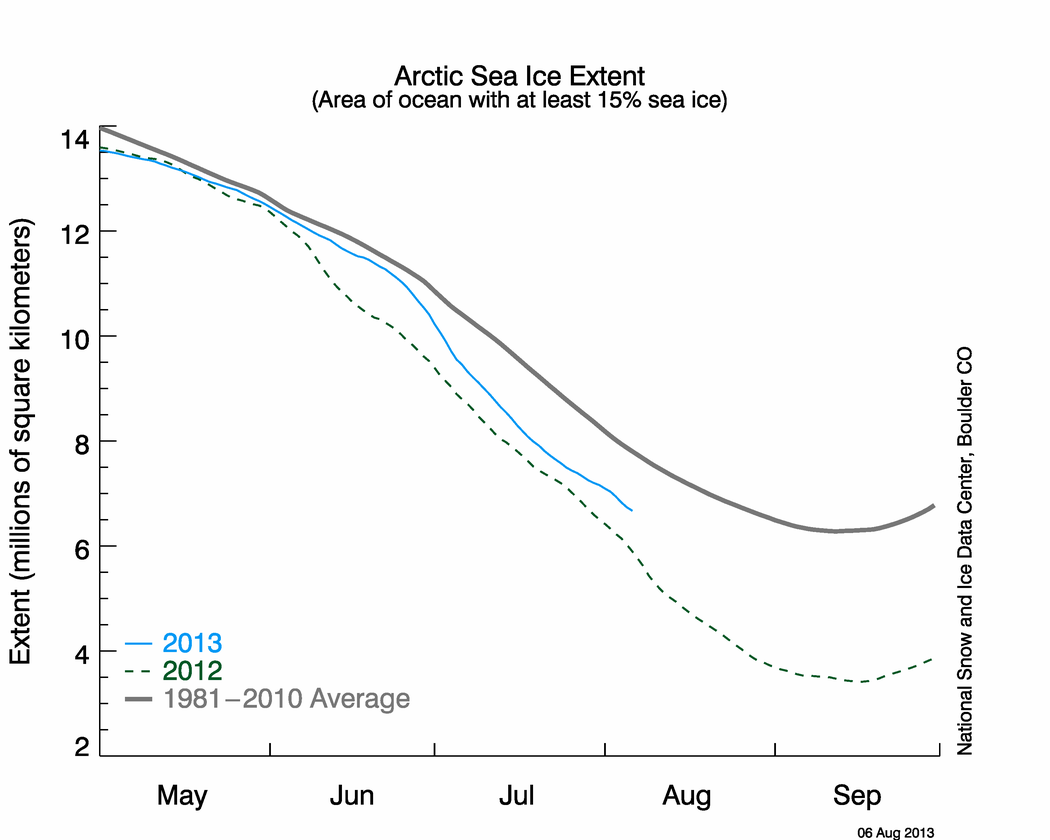
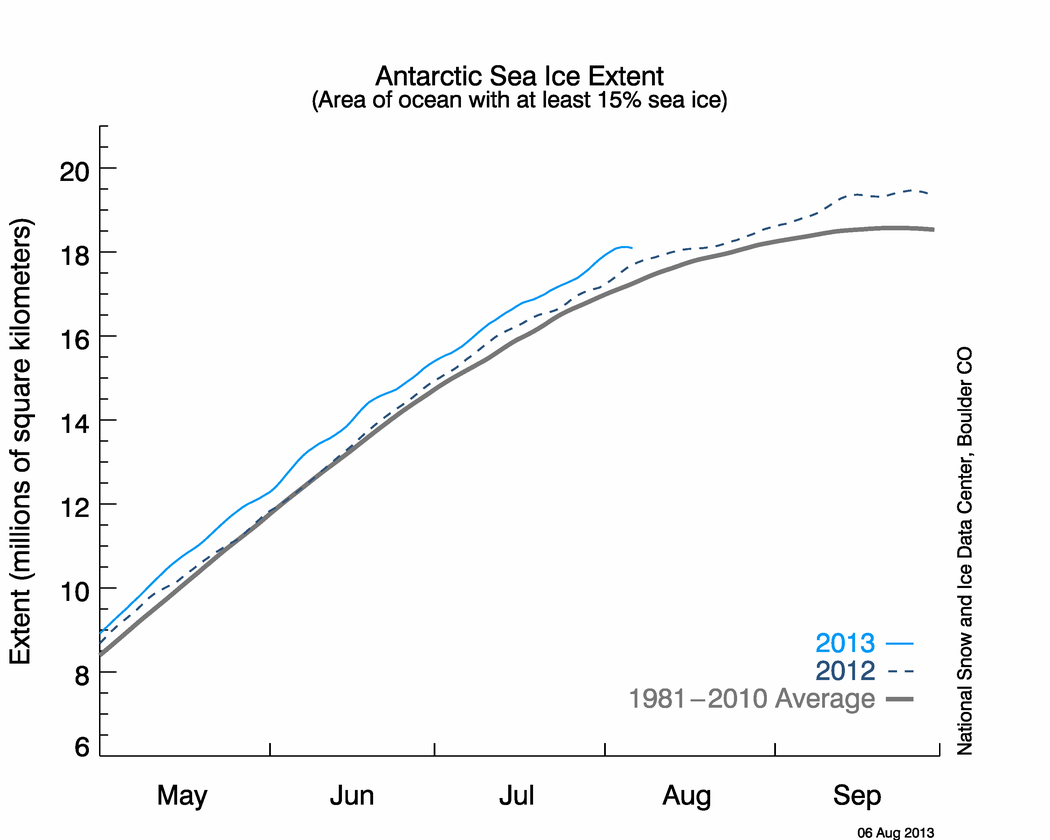
The Arctic Sea ice cover has reached historic lows for winter But something rather like world economic news is happening in Antarctica while all quibble about weather station locations. No mo.
UPDATE: As the bunny said over at Volokh given that California ag is critically dependent on snowpack, as the CA water resources board says:
One of the most critical impacts for California water management may be the projected reduction in the Sierra Nevada snowpack – California’s largest surface “reservoir.” Snowmelt currently provides an annual average of 15 million acre-feet of water, slowly released between April and July each year. Much of the state’s water infrastructure was designed to capture the slow spring runoff and deliver it during the drier summer and fall months. Based upon historical data and modeling, DWR projects that the Sierra snowpack will experience a 25 to 40 percent reduction from its historic average by 2050. Climate change is also anticipated to bring warmer storms that result in less snowfall at lower elevations, reducing the total snowpack.
it ain't gonna be a bowl of cherries. The linked white paper is interesting on many grounds
Jennifer Marohasy has come up with another damn alarmist, one John Coleman, a weather guy in San Diego. Now at Jen's place, John is trying the tell the two sides gambit, as in
And, the connection between fossil fuel exhaust emissions of carbon dioxide has been presented over and over again as accepted science without the slightest bow to the growing throng of scientists protesting the entire silly foray of bad science and resulting public policy.
but this guy is extra special as a bit of google informs, writing
The story begins with an Oceanographer named Roger Revelle. He served with the Navy in World War II. After the war he became the Director of the Scripps Oceanographic Institute in La Jolla in San Diego, California. Revelle saw the opportunity to obtain major funding from the Navy for doing measurements and research on the ocean around the Pacific Atolls where the US military was conducting atomic bomb tests. He greatly expanded the Institute's areas of interest and among others hired Hans Suess, a noted Chemist from the University of Chicago, who was very interested in the traces of carbon in the environment from the burning of fossil fuels. Revelle tagged on to Suess studies and co-authored a paper with him in 1957. The paper raises the possibility that the carbon dioxide might be creating a greenhouse effect and causing atmospheric warming. It seems to be a plea for funding for more studies. Funding, frankly, is where Revelle's mind was most of the time.
Next Revelle hired a Geochemist named David Keeling to devise a way to measure the atmospheric content of Carbon dioxide. In 1960 Keeling published his first paper showing the increase in carbon dioxide in the atmosphere and linking the increase to the burning of fossil fuels.
These two research papers became the bedrock of the science of global warming, even though they offered no proof that carbon dioxide was in fact a greenhouse gas. In addition they failed to explain how this trace gas, only a tiny fraction of the atmosphere, could have any significant impact on temperatures.
Of course others had done that part of the work, but our boy John sees black helicopters everywhere. It goes on in this vein, stirring in a bit of Al Gore, the Singer article that Revelle got roped into, the IPCC and more. This stuff is catnip for the John Birchers, and it is "highly likely" that Coleman is associated with them.
Coleman hates, just hates, those climate alarmists. He much prefers weather alarmism.
Urgent observations across the television-radio desk: If you ever get the feeling that WMAQ-Channel 5 weatherman John Coleman tends to be an alarmist, you're not alone.
Two of his top competitors and a suburban newspaper critic have taken Coleman to task for his nasty habit of issuing unnecessarily dire winter weather warnings.
John Coleman, whose gleefully alarmist weather predictions earned him more than $400,000 a year, is on his way out at WMAQ-Channel 5.
By mutual agreement, Coleman will leave next month after six years as Channel 5's principal weatherman.
His contract expires at the end of August, sources said.
Coleman has told friends he hopes to establish a regional weather cable service similar to the Weather Channel, which he launched in 1982.
Reached at home on Tuesday, Coleman refused to answer any questions about his plans because he said he had been "offended" by previous columns questioning his record of accuracy.
Frances Debevec, Chicago: Regarding your column on the alarmist forecasts of WMAQ-Channel 5 weatherman John Coleman, I agree that he frightens people because it's never as cold as he reports it. That's why I no longer watch him. I don't see other weathermen acting as he does.
Mrs. R. Murphy: John Coleman delights in predicting the next "doomsday" forecast. I'm glad to know his competitors are questioning his tactics. How can he "try to be accurate" and almost always be so wrong?
We here at Rabett Run tend to be, well, sober. Sometimes. . .
Eli Rabett, a not quite failed professorial techno-bunny who finally handed in the keys and retired from his wanna be research university. The students continue to be naive but great people and the administrators continue to vary day-to-day between homicidal and delusional without Eli's help. Eli notices from recent political developments that this behavior is not limited to administrators. His colleagues retain their curious inability to see the holes that they dig for themselves. Prof. Rabett is thankful that they, or at least some of them occasionally heeded his pointing out the implications of the various enthusiasms that rattle around the department and school. Ms. Rabett is thankful that Prof. Rabett occasionally heeds her pointing out that he is nuts.


 30% higher than the (effective eustatic value) EEV.





 Posts
Posts


