Tuesday, October 29, 2019

Renewables finally getting credit they deserve for driving out coal

Murray Energy filed for bankruptcy yesterday, and Robert Murray is out of a job. Couldn't happen to a nicer fellow or company. I do regret what will happen to retiree pensions and to employees, although Democrats want to help them while Republicans refuse. The lesson to any current coal worker under the age of 55 should be clear though - get out, get out, get out.

With luck, this will throw a monkey wrench into Murray's efforts to throw a monkey wrench into policies addressing climate change, as money spent on lobbying would be viewed skeptically by a bankruptcy judge. OTOH, Murray has a deal with major creditors (but not unions) so emerging from court supervision could happen quickly. We'll see how much the court protects employees and other creditors.

Some excerpts from the bankruptcy filing, and my commentary and emphasis added:


The thermal coal markets that Murray traditionally serves have been meaningfully
challenged over the past three to four years, and deteriorated significantly in the last several
months. This sector-wide decline has been driven largely by (a) the closure of approximately
93,000 megawatts of coal-fired electric generating capacity in the United States, (b) a record
production of inexpensive natural gas, and (c) the growth of wind and solar energy, with gas and
renewables, displacing coal used by U.S. power plants.


For years, lukewarmers have given all credit to reduced emissions to natural gas, now even coal producers are admitting the truth. Murray had to cast a little shade though by not expressly admitting renewables are cheaper, implying that government policies are the problem.

--
At the same time, demand for U.S. coal from international utilities has been subject to its own perfect storm of negative forces, and the European benchmark price for thermal coal has halved in the last year

Trump gets his share of the shade for trade wars (pay attention, workers). European renewable efforts should get their share of the credit for reducing coal demand.

--
At the same time, Murray has had to rebate cash to certain customers under price sharing arrangements as a result of low pricing in the PJM Interconnection


I didn't know about this. Murray scored deals with utilities by (theoretically) taking on the risk that its product could get undercut by gas or renewables. So here's a question - did the utilities pay in advance and now won't get their rebates because of bankruptcy? If so, then the public is stuck with subsidizing coal when cheaper and lower emission supplies are available. This practice should be regulated, and maybe regulators should make the utility companies eat the costs, instead of ratepayers. Even if utilities didn't pay in advance, the best they can do now is walk away and see what short term pricing they can get, which is a gamble.

--
Competitors have used bankruptcy to reduce debt and lower their cost structures by eliminating cash interest obligations and pension and benefit obligations, leaving them better positioned to compete for volume and pricing in the current market, 


Pretty clear what Murray intends to do in bankruptcy. Pay attention, coal workers.

--
As of December 31, 2018, Murray owns and operates 26 harbor boats and towboats, 478 barges, 15 locomotives, 748 railcars, and 25 coal hauling tractor trailers (exclusive of non-debtor Foresight operations).

I wonder if this adds to the reason why railroad companies fight efforts to address climate change. Not only do they haul a lot of coal, coal companies are also their direct customers.

--
In June 2015, Murray Global Commodities, Inc. entered into a joint partnership agreement for a 34 percent interest in non-debtor Javelin Global Commodities Holdings LLP (together with its direct and indirect subsidiaries, “Javelin”).

Elsewhere it says that Javelin is one of their major international customers, which they apparently partly own. I wonder if it's a stalking horse for Murray to interfere in foreign politics to promote coal usage.

--
As of the Petition Date, Robert E. Murray holds all of the issued and outstanding voting Class A common shares

All other shares are non-voting, so Robert has (had?) full control of Murray. He's a serious bad guy, so whether he emerges with full control or any control is an important issue.

--
On June 29, 2018, Murray entered into the Superpriority Credit and Guaranty Agreement (as amended, restated, amended and restated, supplemented, or otherwise modified from time to time, the “Superpriority Term Loan Agreement”)

This involves some of the senior creditors who are going to do the best at the other end of bankruptcy. The question in my mind is the date. At such a recent date, the risk of bankruptcy should have been clear and the possibility of a sweetheart deal at the expense of employees, retirees, and other creditors should be investigated. Does Robert Murray or family have any ownership of the senior creditors? Some other recent debt listed in the doc raises similar issues.

--
Following the large wave of chapter 11 filings in 2015 and 2016, more than half a
dozen large U.S. coal companies collapsed into bankruptcy over the last several years and
withdrew from the 1974 Pension Plan. When an employer withdraws, its vested beneficiaries
remain in the 1974 Pension Plan and are referred to as “orphan” beneficiaries. The remaining
contributing employers become responsible for the benefits of these orphaned participants who
were never their employees. As a result, approximately 95 percent of beneficiaries who currently
receive benefits from the 1974 Pension Plan last worked for employers that no longer contribute
to the Plan. As of January 2019, 11 employers contribute to the 1974 Pension Plan, compared to
over 2,800 in 1984. This has placed significant stress on the 1974 Pension Plan and the small
number of contributing employers—Murray most of all.


Pretty good summary of how effed up coal worker pensions are.

--
remaining coal-fired power plants are running at capacity factors of just 42 percent versus 48 percent in 2013.

It's not just plant closures, the still-open plants are running at lower rates.

--
Murray maintains its belief that longer term demand for coal is underpinned in the
United States by a practical requirement that approximately 25 percent of the power supplied to
the electrical grid come from coal power
generation to ensure reliable electricity during cold snaps
and heat waves, when other parts of the grid will be less reliable or overly expensive. This belief
has guided Murray’s decisions to make value-accretive acquisitions during general market distress,


That 25% figure is debatable to say the least, and not to mention that it could come from nuclear, large hydro, natural gas and eventually from power storage. Also, their acquisition strategy has been to double down on coal. How's that worked out?

--

That's it for the main bankruptcy filing. Definitely worth it for someone to look at the restructuring agreement.

Wednesday, October 09, 2019

White nationalists, please go ahead and actually study climate change

Over the summer, there was a smattering of concern over white nationalists who depart from the usual right-wing, conspiratorial denial of climate change. Instead they incorporate the threat of climate immigration as part of their "Great Replacement" theory of white suicide.

This is no joking matter when it comes to mass murderers like the El Paso Walmart killer. The racists' relationship to climate change can't become particularly deep, however. Anything more than the shallowest understanding of climate that still accepts the science will clearly affix blame, and that blame doesn't belong to Syrian, African, and Latin American refugees. Any real understanding would put pressure, at least somewhat, on their racist ideology. Short of actual understanding, they could still seize upon climate change as yet another poorly-thought-out excuse for hatred, but that misuse is possible for any headline. Racists should study the issue itself and take the chance to reconsider their ideology.

The broader issue of environmentalism overlapping with racism is trickier though because population growth is a real-if-secondary factor in environmental harm, with the environmental footprint of each individual being the primary driving factor. Immigration doesn't increase population globally but does increase it in the receiving nation. The problem, ironically, is the opposite of what racists normally think: immigrants don't fail to assimilate but rather assimilate just fine, leaving behind the small individual footprint of the country they left and taking on the massive footprint of the rich country they joined.

Not all the time, of course. When I was campaigning for a water district election during California's drought, I came across an older Indian woman in a wealthier neighborhood, carefully handwashing her car from a bucket. She said nobody had to educate her about water conservation, she immigrated here with that knowledge. Good on her, but I don't know that her kids or grandkids would have the same habits.

Racists are going to misuse the overpopulation issue. They have to be fought when they do that, while still acknowledging overpopulation is an issue. Reducing population growth in the richest countries, along with reducing the individual footprints, should be a priority. Reducing that footprint could even make it easier to accommodate more immigration, rather than fighting immigration.

Monday, September 30, 2019

Greta Thunberg and Ponder the Maunder

This was cute:


The point I just want to add is that I don't recall anything like the same vitriol, and none of the expressed desire to slap her or spank her, against that Ponder the Maunder girl from years back, a teenager whose father convinced her that she had refuted all of climate science. My recollection is that girl eventually reached the point in college where Greta is right now, telling people to listen to scientists (can't seem to find a link tho).

Just another indication of who's arguing based on reason and who's relying on emotion.

Saturday, September 07, 2019

The long-awaited Bay Area gas station count is here - more hints of an EV effect making ICE vehicles less convenient

Don't get too excited now. Updated figures on gas stations and gasoline consumption in the Bay Area are out:


Gas stations continue to decrease despite a strong economy and an increased population. San Francisco in particular lost 14% of its gas stations in a year, and now has one station for every 11,000 people. While many other factors could influence gas station counts, there's also gas consumption:


Consumption is down 7% from the high in 2016, mirroring the decrease in gas stations since 2016.

It takes a while for the increasing market share of new EV purchases to be reflected by the total vehicle fleet. OTOH, EVs get driven more than ICE vehicles so their share of vehicle miles will be greater than the share of the total fleet. It seems likely that EV market penetration is a big part of the reason gas consumption is decreasing and part of the reason why stations are disappearing. As EVs become more convenient, ICE vehicles are becoming less convenient to fill up.

Thursday, September 05, 2019

Eli Explains It All: Amazon and Oxygen Edition

Eli, as readers of this blog know, often explains it all,  often belatedly, but allow the Bunny to put to rest your fears that burning in the Amazon will deplete oxygen in the atmosphere.

The concentration of CO2 in the atmosphere is ~400 ppm.  Oxygen is approximately 20%.  That translates out to 200,000 ppm. If CO2 doubles to 800 ppm that would at worst put O2 at 199,600 ppm. 

It's as simple as that, but if you insist on long reads, have at it.


Saturday, August 17, 2019

The Republican Judicial War Against Science

Washington Post:


An exchange about a climate change seminar for judges set off the controversy, after a two-sentence heads-up message about the session — co-sponsored by the research and education agency of the judiciary, the Federal Judicial Center — was sent.

One judge’s share about the event provoked a pushback email from a colleague, who questioned the judge’s ethics and climate change science, and urged the judge to stick to his lane on what “you are being paid to do” — adding that “the jurisdiction assigned to you does not include saving the planet.”

.....The controversy began the evening of July 3, when Sullivan forwarded the invitation as “just FYI.”

Less than an hour later, Randolph, who serves on the U.S. Court of Appeals for the D.C. Circuit, replied all. He chided Sullivan for “subjecting our colleagues to this nonsense” and suggested he had crossed an ethical line. He asked: “Should I report you? I don’t know.”

....More than two weeks after his initial note, Randolph again addressed the email list. After learning more about the Environmental Law Institute’s program and the judiciary’s co-sponsorship, he wrote: “While I continue to disagree with their conclusion about the propriety of the program, I think their position is fairly held.”

....Experts on judicial ethics said the appeals court judge should have issued a direct apology to Sullivan and suggested Randolph should recuse himself from cases involving climate change.

As of Tuesday morning, Randolph was listed as one of three-judges to hear arguments Sept. 6 in a case brought by California and more than a dozen other states challenging an Environmental Protection Agency decision to scrap some vehicle emissions standards.

Just before 5 p.m. Tuesday, the court calendar was updated and Randolph’s name was replaced. The clerk’s office and Randolph declined to comment on the change.

Gillers and Arthur D. Hellman of the University of Pittsburgh law school said in interviews that the strong views Randolph expressed suggest he should not sit on cases related to global warming. 

Imagine for a minute that the invitation had been to a briefing on forensic science. I somehow doubt it would have received the same reaction. Yet Randolph was on the edge of reporting the invitation as unethical.

The outcome was okay in the end, with Randolph booted off a very important case. But it's a signal of the type of damage that Trump's appointees will be doing for decades.

Sunday, August 11, 2019

The Foote Effect

Some time ago, being defined as about nine years, in his sorely missed Climate Abyss, John Niesen Gammon advocated doing away with the term greenhouse effect, or greenhouse gas, perhaps tongue in cheek, perhaps not

Okay, I’m finally convinced.

I hereby declare the greenhouse effect to be nonexistent.

There’s not much worse for public knowledge of science than an important but complex phenomenon whose very name evokes a false analogy. Such is the case with the greenhouse effect.
Now Eli thinks it was more to having to deal with sniping from the stands, but, be that as it may, John had a suggestion
Naturally, we know lots more about such gases now, including the importance of the wide range of temperature, pressure, and density conditions that accompany their presence in the atmosphere. But Tyndall was the first, and so the “effect formerly known as greenhouse” can properly be called the “Tyndall effect”.

But that name is already taken. It refers to the wavelength dependence of light scattering by tiny (sub-micron) particles suspended in an otherwise transparent medium. So that won’t do. Using the same term for two different phenomena would be, I don’t know, like using the term “greenhouse effect” to refer to what keeps greenhouses warm and at the same time use it to refer to what keeps the Earth warm. And wouldn’t that be stupid?

But, not to fear, there’s nothing in science that’s presently known as a “Tyndall gas“. So this term can immediately replace the term “greenhouse gas” to refer to gases that are much more opaque to infrared wavelengths than to visible wavelengths.

A replacement for the term “greenhouse gas” is especially useful since only a small fraction of the gases that fill greenhouses are greenhouse gases. This makes “greenhouse gas” a double misnomer. Wow.

And then, the EFKAG can be renamed more transparently (sorry) as the Tyndall gas effect.

So be it. Henceforth I shall use the terms “Tyndall gas” and “Tyndall gas effect” whenever the opportunity presents itself, or at least until such time as a suitable alternative name comes into broader usage.
John kept it up for quite a while, as Eli recalls until he left the building down at the Houston Chronicle.

Before we go on, it is probably worthwhile pointing out that what Tyndall found was the absorption of Tyndall gases in the IR at longer wavelengths than 3 microns or so shown in red below


Recently, maybe a year ago, an 1856 report by Edith Eunice Newton Foote to the AAAS national meeting has come to light in which she observed the heating effect of sunlight (shown by the blue line in the figure to the left above) on various gases including CO2 and water vapor in a sealed glass tube.  Eli pointed out that since the glass tube cut off the solar spectrum (which is relatively weak there) at about 3 microns, Foote did not observe the basis of the greenhouse effect Tyndall gas effect, which is the absorption of thermal radiation from the surface (shown by the dotted line in the figure to the right).

What she did observe is the absorption by water vapor and carbon dioxide shown in green by the bands above 0.7 microns, and maybe down to about 0.3 which are primarily due to aerosol scattering.  Since she did experiments with water and thus water vapor in her glass cells, this would not be unlikely.

This absorption, the difference between the blue and green lines above 0.3 microns, has an important practical significance:  It is responsible for the absorption of approximately 79 W/m2 in the atmosphere and should a bunny care to include it the 100 W/m2 scattered back into space


Nielsen-Gammon pointed out that there is a long tradition, which he was following, of naming an effect after its discoverer.

Thus the absorption and scattering of visible and near IR light in the atmosphere should henceforth be known as the Foote Effect or the Foote Gas Effect

August 11 and the Northwest Passage Is Open

A week or so ago, Eli noticed that for a mere  $28,824 per person the Hurtigruten were organizing a cruise through the Northwest Passage (details at the link) the question being whether they would be able to make it, and in particular through the narrow passage near Fort Ross.


Any bunny who has put down their money need never fear, the way is open


and the only remaining question is when it will be possible to circumnavigate Greenland.  Too soon Eli thinks.
  

Saturday, August 03, 2019

Making the fossil fuel insurance market less perfect

Timely as ever, I thought I'd immediately jump on to the news that a month ago the first big American insurance company, Chubb, announced it's no longer insuring coal company operations. The big European insurers have already dropped out, and the pressure's on now for the other big American insurers.

I go back and forth about whether climate divestment can have a direct economic effect on fossil fuel companies. The billions of dollars in financing that's not screened off, and the thousands of investors willing to make investments, argue that it'll be a while before divestment directly harms the market for stocks and bonds from fossil fuel companies. The knock-on effects from making fossil fuel businesses disreputable, OTOH, are profound. There aren't that many insurance companies capable of insuring multi-million dollar operations.

So yes there are a still a handful of insurers happy to help pollute the planet, but a handful is far from a perfect market of buyers. Coal companies are going to have to pay an additional premium to get insured because fewer insurers want to play with them, and that's very much a good thing. The climate divestment push is helping make this happen.

Other knock-on effects from divestment include decreased willingness of big financial institutions to make loans, and simply the increased stigma of being a fossil fuel company driving up their costs and reducing willingness to do business with them. The real game though is political - the relative costs of fossil fuels and low-carbon alternatives are only part of the decisionmaking, with the rest being political. Climate divestment helps show the weakening political power of fossil fuels, which then makes it easier to knock them down.

We'll see what other American insurers are going to do. Meanwhile it's unfortunate that these insurers will make an extra profit out of being the bad guys. I hope some stigma moves over to AIG, Travelers, and Berkshire Hathaway to balance that out.

Tuesday, July 30, 2019

Ignoring the Obvious

Rabett Run has always been a quiet and peaceful place where old bunnies can munch their carrots, but perhaps, just perhaps it is time to stir things up again so here are a couple of thoughts for the careless.  In the end, they are tied together by a convenient ignorance of the obvious

Eli could start with the Nature Climate Change jeremiad by Shinichiro Asayama, Rob Bellamy, Oliver Geden, Warren Pearce and Mike Hulme Why setting a climate deadline is dangerous,  Now the last three of these are well know climate change ostriches, it won't be so bad, or at least I will be dead by then types, the other two are not as well known hereabouts, perhaps they should be. The first of them, who probably won't be dead by then, essayed the Twitter long form in quite the good style.   ATTP has a useful dissection of some of the frog princes who essayed and Sou emerged from time out to to whop them good.  But you know Eli, that's not his way.  Eli begins by evaluating an argument not by its conclusions, but by its assumptions

If you read the paper it is a wonderful exercise in strawmanning, exceeded in many respects by the Newsweek (or was it Time, Eli forgets.  It's kind of what happens at this time of life) said that we were entering a new ice age.  The usual nutpicking shell game also so you can ignore it on those grounds alone.  Yet, the argument fails on a basic point, they claim that you can't usefully set deadlines for tough problems, but they ignore the lessons of the Montreal Protocols which succeeded by a) establishing that there was an emergency and b) dealing with it by setting deadlines. Indeed Montreal also set up a mechanism to modify and expand the deadlines to cover other stratospheric ozone de-enhancing emissions.

To argue that something should not be done because it won't work while ignoring an example where it has been done and worked is a basic error.  Given that the defenders of that piece claim that it establishes yet another example of how scientists ignore the worthy products of social scientists (poke about on Twitter) it seems more to prove that scientists ignore the crappy arguments of the usual suspects.  Well, OK, sometimes we laugh at them, sometimes we fret, and most of the time we face palm.

Which brings Eli to part two, the recent paper by Geoffrey Heal and Wolfram Schlenker, Coase, Hotelling and Pigou: The Incidence of a Carbon Tax and CO2 Emissions, which asserts that

Using data from a large proprietary database of field-level oil data, we show that carbon prices even as high as 200 dollars per ton of CO2 will only reduce cumulative emissions from oil by 4% as the supply curve is very steep for high oil prices and few reserves drop out. The supply curve flattens out for lower price, and the effect of an increased carbon tax becomes larger. For example, a carbon price of 600 dollars would reduce cumulative emissions by 60%. On the flip side, a global cap and trade system that limits global extraction by a modest amount like 4% expropriates a large fraction of scarcity rents and would imply a high permit price of $200.
The basic idea being that since oil reserves can be depleted and are valuable, eventually all will be used up.  Arthur Yap took this on as an example of "science news cycle" (his words, not Eli's) telephone from the paper, to the public affairs office, to the newspaper and so on, but he took it seriously, trying to examine what drove the results.  Eli, Eli looked for what was not there, which is often the case.

There are first order drivers other than how much oil will be burnt.  The first is that coal will disappear as a power source, it will still be around for as a reducing agent for ore processing, but no one is going to burn coal if a carbon tax is set at $200/ton CO2

The interesting one is that $200/ton CO2, makes direct air capture and carbon capture and storage look profitable.  It's another example of why a systems approach is needed to for dealing with climate change.


Saturday, July 27, 2019

Trump Facts: His New Lows from 2015-2020

This post will get updated over time - it's based on Kevin Drum's quick list of Trump's new lows. The list below started with Kevin's, made a few changes, a lot of additions, and added links in all cases.

I hope this will be helpful to record some of the worst of Donald Trump in recent years. My rule is 12 lows a year to keep it manageable. I'm open to suggestions for new lows in any of these years, but I'll only add it when it's worse than one of the existing lows. Gates open in full again when January 2020 rolls around - we'll see how long it takes for him to hit 12 lows.

And please, I really hope I can ignore Trump after November 2020....


The Lows of Donald Trump
Starting the Year He Became a Politician

2015
June 16: Starts presidential campaign by calling Mexican immigrants "rapists."

July 20: Attacks John McCain for being a POW:

August 6: Says Megyn Kelly has "blood coming out of her whereever."

September 9: Tells media that people can't vote for Carly Fiorina because of her looks, then denies that was what he said.


September 16: Says vaccines cause autism.

November 13: Compares Ben Carson to a child molester.

November 21: Opens the possibility of a Muslim registry.

November 22: Falsely claims (again) that Arab Americans cheered 9-11 on television.

November 23: Falsely claims that 81 percent of white people are killed by blacks.

November 25: Mocks a reporter’s disability.

December 3: Stereotypes Jews as "negotiators".

December 8: Calls for ban on Muslim entry to the US.


2016
February 1: Encourages supporters to physically assault opponents (first of several occasions).

March 8: Defends his penis size in nationally televised debate:


March 23: Insults Ted Cruz’s wife's looks, implies he would reveal her past mental health issues.

March 30: Says that women who get abortions should be punished.

May 3: Suggests that Ted Cruz’s father killed JFK.

June 3: Attacks federal Judge Gonzalo Curiel for his Mexican ethnicity.

July 27: Asks Russia to please find and release Hillary Clinton’s 30,000 emails (they responded within hours).

July 31: After Khizr Khan accuses Trump of never sacrificing anything for his country, Trump attacks Khan and says that he has too made a lot of sacrifices, such as “building great structures.”

August 9: Suggests his supporters might want to shoot Hillary Clinton.

October 8: “Grab ’em by the pussy” tape.

October 12: More women accuse Trump of sexual assault (and more women since then).

October 19: Invites President Obama’s estranged half-brother to final debate.


2017
January 23: Claims without evidence that 3 to 5 million fraudulent votes were cast in 2016 for Clinton.

February 22: Attacks transgender children, forcing them away from bathrooms they identify with.

March 4: Accuses Obama of tapping his wires (he later admits he had no evidence).

May 25: Shoves Prime Minister of Montenegro out of the way to get better position for photo.

June 29: Accuses Mika Brzezinski of “bleeding badly from a face-lift” during a New Year’s party.

July 2: Retweets video of CNN being physically attacked.

August 15: Suggests that there were “very fine people on both sides” at Charlottesville.

September 30: Attacks mayor of San Juan after Hurricane Maria hits Puerto Rico.

October 5: Urges Senate use investigation powers against press for his false 'Fake News' allegations.

October 13: Ends Obamacare cost-sharing program in attempt to disrupt Americans' medical care.

November 29: Retweets three anti-Muslim videos from the leader of an extremist British group.

November 29: Continuing to promote racist anti-Obama birther claim in private.

2018
January 12: Trump Wants Fewer Immigrants From ‘Shithole’ Countries, More Norwegians.

May 7: Announces they'll begin separating children from their parents at the border (later revealed that they have no plans to reunite them.)

July 17: After Trump insists on meeting with Vladimir Putin with no one else present, he says he trusts Putin on election interference, then claims he misspoke.

September 13: Says the 3,000 dead from Hurricane Maria is “fake news” invented by Democrats.

September 27: Caps refugee admissions to the US at lowest number in three decades.

October 13: After murder of Jamal Khashoggi, reminds everyone that Saudi Arabia is a good customer (and promises severe punishment if the Crown Prince is responsible).

October 19: Calls Stormy Daniels “horseface.”

October 19: Applauds Rep. Greg Gianforte’s body slam of a reporter.

November 1: Runs racist ad just before midterm elections.

November 16: Suspends CNN reporter Jim Acosta's press pass, action overturned by judge.

November 12: As wildfires are raging, threatens to cut off federal aid to California unless they change their “forest management” practices.

December 29: Says any deaths of children along the border are strictly the fault of the Democrats.


2019
March 8: Accuses Democrats of being the “anti-Jewish party.”

March 20: Attacks John McCain yet again.


July 14: Tells Democratic congresswomen to go back where they came from.

July 14: Falsely accuses Rep. Ilhan Omar of praising al Qaeda.

July 25: Pressures Ukrainian president to 'investigate' Joe Biden while withholding military aid against Russian forces occupying Ukraine.

July 27: Persists in using the descriptor "infested/infestation" when referring to people of color.

August 8: Told press that hospital visit wasn't a photo op and then used it for a promotional video.

August 10: Spreads conspiracy theory that Bill Clinton had Jeffrey Epstein murdered. (And later says it was "fine" for him to have spread the baseless rumor.)

August 16: Pressured Israel to ban two American congresswomen from visiting because of their political beliefs.

August 21: Promotes claim that Jewish Israelis love him like a King of Israel and Second Coming of God.

August 28: Tells subordinates to commit crimes on his orders, promises pardons, lies and claims it was a joke.

August 30: Suggests his presidential term be extended because he was investigated.

Wednesday, July 24, 2019

Point Counterpoint

Point:  From Paul Price on Twitter, about a recent polemic from Mike Hulme that ATTP is going on about

Mike Hulme's parting words to me (after a talk in which he failed to acknowledge climate risk and I asked why): "the reason you and I disagree about climate change is that you care about future generations and I don't."  
Time wasters don't like the deadlines we need to care about. — Paul Price (@swimsure) 
 Counterpoint

Monday, July 22, 2019

Cruise the Northwest Passage


Eli notes there is still time to drop $28,824 per person to cruise the Northwest Passage in August on the Roald Amundsen, the new flagship of the Hurtigruten.  Since the ship has a hybrid propulsion system even the CO2 emissions are (relatively) low. 

The Hurtigruten are now a cruise line, but used to be the post boats that supplied northern ports in Norway, sailing from Bergen all the way up to Kirkenes and back even in the winter.  They continue to do so, offering cruises there, but have added cruises to Antarctica and other polar  locations

Of course, there is a real chance that the Northwest Passage won't open, but the Northern Sea Route along the Russian Arctic coast is already wide open and the chances look good that the bunnies can spend their money.


The point being that the Arctic ice is fragile enough that such a cruise could be scheduled.  That is worrisome

Saturday, July 13, 2019

Norway report


My wife and I spent 10 days in Norway, so now I'm clearly an expert and have things to say.

Mainly, travel in rural Norway so far does not yet support my theory that internal combustion engine cars will start being inconvenient, at least at the current level of EV market penetration for rural Norway. We rented an ICE car and didn't have trouble finding places to fill up. I did see places for EV charging in rural areas, but I think doing the same trip in an EV rental would've been difficult. OTOH, rural travel and overnight stays in unfamiliar areas without a defined routine and planned itinerary is the worst scenario for EV use. An Oslo resident, hopefully, has a different experience.

The other interesting aspect is how much the public can use private land, matched with how little public land actually exists. My day job in California consists in significant part of getting political support for public land purchases, partly so the public will access and use of the land. In Norway, that's not neccesary - the public has the right to use private land already, short of physically altering it. So there's a lot less public land. Not necessarily a better or worse system, but definitely very different.

We also went to Sweden - I asked my wife's Swedish relatives if a private landowner outside a city could subdivide their land and create a sprawl suburbia (fighting that is an even bigger part of my day job). They said no. I assume that environmental interest groups there would focus more on regulating private land and less on acquiring public land.

Last thing on Norway - they're still eating whale meat and selling it to tourists. Not good on the part of Norwegians (they're not expressing an oppressed indigenous culture, although even that isn't sufficient reason) and inexcusable on the part of tourists to buy it. Aside from that, Norway was wonderful.

Wednesday, July 10, 2019

Systems Thinking, Lumpers and Splitters, Systems Education

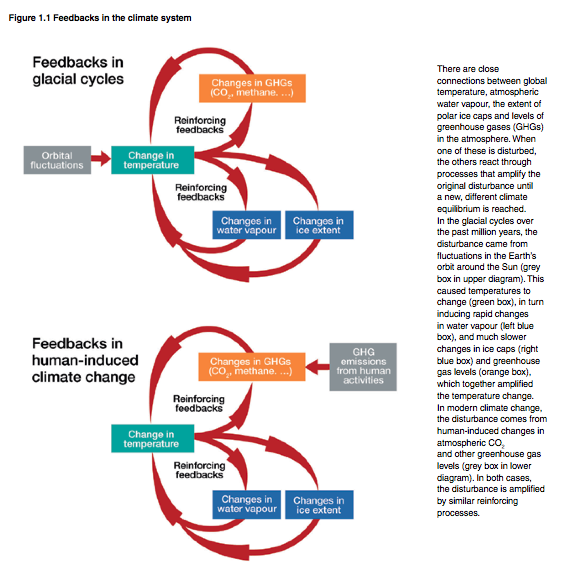
One of Eli's favorite figures comes from the Australian Academy of Sciences and neatly captures the way in which greenhouse gases can be both an initiator and a feedback to global climate

Part of the problem many scientists have explaining such to the average family member and students is that physical science and engineering STEM folks tend to be splitters, aka reductionists, tear something down to the bare bones to understand how it works. 

With a subject that links many areas and ideas together, it simply takes too long to bring folks up to speed on enough parts of the problem that they (to use a 60s word, ask grandpa) can grok the thing.

Peter Mahaffy and colleagues at the King's Center for Visualization in Science are lumpers, establish the connections to teach about the entirety, then learn about the individual parts.  They have a chemistry centered article in Nature Sustainability on Systems thinking for education about the molecular basis of sustainability
The primary activities of chemistry involve analysing, synthesizing and transforming matter, yet insufficient attention has been paid to the implications of those activities for human and environmental well-being. Since a core element of addressing sustain-ability challenges requires attention to the material basis of society, a new paradigm for the practice of chemistry is needed. Chemistry education, especially gateway post-secondary general chemistry courses, should be guided by an understanding of the molecular basis of sustainability. A Systems Thinking in Chemistry Education framework illustrates one way to integrate knowledge about the molecular world with the sustainability of Earth and societal systems
Eli, a splitter to the bone, nonetheless sees great advantages of this approach, not only for climate change but for other issues which impact on the world in general.  There are lots of great points and images in this paper.  They have a great map that brings together the systems involved in the carbon cycle


 The emphasis is on how the systems are linked, us splitters can fill you in on what is in the lumps, oh if you have a few days, but you really almost don't need to know to understand how each part works to have a great understanding of how they work together.

Tuesday, June 18, 2019

Message to the Several Misbegotten

The Presidents of the National Academies (Science, Engineering and Medicine) have issued a statement on climate science.  In general this may be regarded as a message to Donald Trump and Wil Happer to screw off,

Scientists have known for some time, from multiple lines of evidence, that humans are changing Earth’s climate, primarily through greenhouse gas emissions. The evidence on the impacts of climate change is also clear and growing. The atmosphere and the Earth’s oceans are warming, the magnitude and frequency of certain extreme events are increasing, and sea level is rising along our coasts. 
The National Academies are focused on further understanding climate change and how to limit its magnitude and adapt to its impacts, including on health. We also recognize the need to more clearly communicate what we know. To that end, in 2018, the National Academies launched an initiative to make it easier for decision makers and the public to use our extensive body of work to inform their decisions. In addition, we will be expanding our Based on Science communications effort to include clear, concise, and evidence-based answers to frequently asked questions about climate change. 
A solid foundation of scientific evidence on climate change exists. It should be recognized, built upon, and most importantly, acted upon for the benefit of society.
The statement links to a more complete discussion and references but if you want the elevator speech, Richard Betts' tweet ain't bad

The usual bleat for Planet B went up, but as Eli always points out Planet B ain't necessary.  We have  a ton of lab experiments showing how greenhouse gases in the atmosphere behave under varying conditions of temperature and pressure.  We have spectroscopic models that perfectly match the lab measurements.  We have measurements as well of emission and absorption spectra throughout the atm, that we can perfectly match using our spectroscopic calculations.  We have measurements of solar output.  We have lab measurements of the density of sea water when heated, and models that perfectly match the lab measurements.  We have measurements of the density of sea water on site that again are matched by the lab models.  And on, and on, and on.

For the deniers to be right, ALL of those lab measurements and models would have to be wrong.

Not something to bet Planet A on.