Thursday, January 10, 2013

Overly Honest Methods Explains It All

There is an obvious cultural chasm between scientists and the public, with more papers coming out from behind paywalls it is important to provide translation of standard phrases for civilians.   This has a lot to do with the frustration of the denialists so Eli has found a twitter page, Overly Honest Methods where Steve McIntyre can go to see what Mike Mann was saying, for example


The code is self-documenting, because the only student capable of documenting it has graduated.  

You can download our code from the URL supplied. Good luck downloading the only postdoc who can get it to run, though

We do it this way bc grad student was trained by a postdoc trained by a grad student who claimed they knew how to do it  

And for those of you who wonder about Eli

The results of the study were presented in third person passive voice to maximize the sciencyness of the paper.

Oh yes, don't take this too seriously:)

The Flak Catchers Mau Mau Delingpole

In Radical Chic and Mau Mauing the Flak Catchers Tom Wolfe described the 1960 ritual dance between radicals and the bureaucracy in San Francisco, where local groups of militant climate change denialists descend upon the Met Office with FOIA letters, which, in its appointed role, sits there and takes them seriously.  Everyone goes out for a drink or the chemical of their choice afterwards.

However, as Eli has been pointing out the flak catchers are not happy.  Today the Met Office (British weather forecasting agency) had enough and has started shooting back, using what else, their blog

An article by James Delingpole appears in the Daily Mail today under the headline The crazy climate change obsession that’s made the Met Office a menace’.
This article contains a series of factual inaccuracies about the Met Office and its science, as outlined below.
Firstly, he claims the Met Office failed to predict snow in 2010, but our 5-day forecasts accurately forecast 12 out of 13 snowfall events – as you can see in this article. In addition the Press Complaints Commission has also already addressed this fallacy with the Daily Telegraph in February of last year. As a result the newspaper published a clarification that highlighted that “the Met Office did warn the public of last winter’s [2010/11] cold weather from early November 2010.” 
Mr Delingpole also says we failed to predict flooding in November last year. Once again, our 5-day forecasts gave accurate guidance and warnings throughout the period. In just one example of feedback the Met Office has received for highly accurate forecasting and guidance throughout 2012, Assistant Chief Constable Paul Netherton, Chair for the Local Resilience Forum for Devon, Cornwall and the Isles of Scilly (which was one of the areas most affected by flooding in November), said: “[I] would like to formally thank and recognise the hard work of the Met Office over the past week. The information you provided was invaluable and enabled the responders in Devon, Cornwall and the Isles of Scilly to prepare and respond effectively to assist our communities.”
Mr Delingpole then inaccurately states that the Met Office has conceded ‘there is no evidence that ‘global warming’ is happening’. We have not said this at any point.
In fact, we explicitly say this was not the case in an article, posted on the home page of our website and widely circulated, which was written in response to articles about updates to our decadal forecast. Professor Julia Slingo, Met Office Chief Scientist, has also provided a more in depth feature on ‘Decadal Forecasting – What is it and what does it tell us?’.
Further on in the print version of the article (although amended online), Mr Delingpole says “According to the Met, Britain is apparently experiencing more rain by volume and intensity than at any time since records began.” Although he is right in saying the Met Office has published preliminary observations which show an increase in the intensity and volume of rain, we are clear that this relates to a period from 1960 onwards – not ‘since records began’ as he claims.
There are, of course comments which tend to be less constrained by the niceties of government agencies and so far (early days) support the met office.  Here is a pungent one from etonmess

Amazed to see it has been 15 seconds and there aren’t a million and one climate change deniers on here.
It’s probably because they are already convinced that Global Warming is a massive communist-marxist conspiracy invented by evil scientists (including the Met Office) and the ‘EUSSR’… who are all part of a baffling conspiracy with no obvious point.
They have no doubt moved on to the next great scourge of the free market: this so-called ‘gravity’ that the same scientists pretend exists.
It is why at exactly midday tomorrow, James Delingpole, Lord Monckton and the entire crew of Fox News are going to ride a giant unicycle off the edge of the Grand Canyon and PROVE CONCLUSIVELY that they are also correct about the lies that gravity-believers peddle.
and friend Caerbannog or a cousin points out
Maybe you should ship Delingpole over to our side of the pond. He’d be a very small minnow in an ocean of American idiocy and would quickly be lost in the noise.

You Brits would enjoy a statistically significant reduction in idiocy over there, and we would suffer only a statistically insignificant (and unnoticeable) increase in idiocy over here.
Eli suggests piling on, esp when the poo flingers show up.

Wednesday, January 09, 2013

If You Thought Eli Was a Strange Bunny


By way of Ms. Rabett's favorite Japanese blog, Tofugu who warns us not to mess with Junichi the Rough.


Tuesday, January 08, 2013

The Color Purple

UPDATE: Gareth has hot topic about the longer lowdown on the heatwave down under with lots of links

It is so hot in Australia that the weather bureau has had to add a new color to its forecast map

Things are tough down there, with no break in sight, but dear bunnies, that is not what this post is about.  Young Tony Watts has looked at the US Climate Reference Network (you know the one Eli pointed him to when he started taking pictures of nude surface stations as a better way of doing thing.  He averages up the readings and concluded

Therefore, from this data, the Average Annual Temperature for the Contiguous United States for 2012 is 55.25°F

Note also the value from the CRN from July 2012, 75.6°F far lower than what NCDC reported in the SOTC of 77.6°F and later in the database of 76.93°F as discussed here.
Makes you wonder why NCDC never mentions their new state of the art, well sited climate monitoring network in those press releases, doesn’t it? The CRN has been fully operational since late 2008, and we never here a peep about it in SOTC. Maybe they don’t wish to report adverse results.
Turns out that NOAA really does not like Tony.  Today the NOAA National Climate Data Center had an announcement about the surface temperature for the continental US (excludes Hawaii and Alaska)
The U.S. weather-tracking agency had said after a warmer-than-usual November that 2012 was virtually certain to be a year of record high U.S. temperatures. On Tuesday, it pegged last year's average temperature at 55.3 degrees Fahrenheit, 3.2 degrees above the 20th century's average and 1½ degrees above the average in 2011.
Tom Karl really did have a better trick

Annoying the Auditors

Friend Russell has been tugging at Bishop Hill's frock
Bishop Hill has turned a most unepiscopal purple at the suggestion that his decade long obsession with sporting goods amounts to an obsession, denying that hockey sticks are really his stock in trade.

The Bish and his acolytes seem positively snitful at the notion that McIntyre's discomfiture at AGU meetings stems from the high frequency with which non-oilpatch geophysicists fall down laughing when the mining statistician's mouth moves.
And so begins a classic back and forth.  The best was the first, in reply to somebunny noticing that Steve McIntyre was somewhat displeased with goings on at the AGU this year Russell pointed out that
something or things at the conference seemed to have irked him.
Being gainsaid at every turn by climate scientists who know what they are talking about is bound to ruin any mining statistician's day.
Eli quite agrees with both parties
Now some, not Eli to be sure, might be getting their pants in a twist about the technical differences between sock puppets, social engineering, pseudonyms and hacking, but there are more interesting things buried here under a complete lack of self awareness.
Someone, let us not say whom, conducting a smash and grab action to access the intellectual output of others, we will not speculate as to motive, at least not here, wonders why he is shunned by those he threatens and their colleagues.
Make no mistake about it, Steve is right when he sensed a hardening of opinion against the Climate Audit/Watts crowd at AGU clearly based on an increasing understanding that the climate system is entering dangerous areas driven by human forcings and disgust at the tactics of those trying to stop any actions to deal with the problem.
but in his usual careful parse, Steve replied
Steve: I don’t understand your complaint against Climate Audit. If there’s anything inaccurate in this or any other post, I ask that people inform me of the inaccuracy. In addition, I seldom comment on policy and most of my rare comments on policy seem relatively uncontroversial to me (or even provoke criticism from “skeptics”). If you can point to any statement of mine about policy that provokes the sort of “disgust” that you allege, I’d appreciate it if you would provide me a link so that I can reflect on the point. It seems to me that people who are seriously concerned about the future should be the ones who take the lead in opposing bad ethics and poor statistical and scientific practices among their fellow travellers.
Nor did I comment that I “sensed a hardening of opinion against the Climate Audit/Watts crowd at AGU”. I primarily noted Gleick’s surprising return to AGU. I hadn’t associated AGU’s welcome to Gleick as being connected to AGU attitudes to Climate Audit and sincerely hope that this is not the case.
and Steve, egged on by Willis thought this indeed was a winning hand
Someone, let us not say whom, conducting a smash and grab action to access the intellectual output of others
Yes, I’m curious about this as well. As too often, Rabett is opaque to the point of incoherency. Is Rabett concerned about people accessing pdf’s of academic articles from online sources without purchasing the articles from the journals? Many authors regularly post such articles on their websites, but one can download them without having to “smash and grab”. I’m puzzled. Or is Rabett concerned about authors being asked to archive data?
Sorry, the idiot tracker and Eli have that covered
C’mon Steve you’re an intellectual rent seeker. As the Idiot Tracker put it Steven McIntyre
uses the coercive power of the state to force other people to give him, gratis, the fruits of their labor. He does not produce himself — he uses the data of others, repackaged and sensationalized, to fuel the hit count of his blog.
and then, of course you wonder about the high regard you are held in by those you have cost time and effort complying for your rent demands.
But let us return to the hardening part
Nor did I comment that I “sensed a hardening of opinion against the Climate Audit/Watts crowd at AGU”. 
Of course, "Nor did I comment"has to be followed by (I leave it to the rest of you to gather from the tone of my entire post which moans that Michael Mann, Naomi Oreskes and Peter Gleick played major roles at the conference and idle comments in the post such as
AGU used to be about physical sciences. Its erosion of standards was well exemplified by its inclusion of Stephan Lewandowsky, a social psychologist from western Australia, as co-convenor of two sessions.
and
So for anyone wanting a break from Mannian statistics, Gleickian ethics, especially as synthesized by Lewandowsky, this year’s AGU conference was a bad one.
Now some, not Eli to be sure, might have thunk that Steve had sensed a change in the AGU and its members attitude towards Steve and friends.

Still, Steve missed the most interesting talk about this point in one of those Lewandowsky convened symposia, Christene McEntee, the AGU CEO spoke.  As CEO she speaks for the AGU
TITLE: Trusted Sources: The Role Scientific Societies Can Play in Improving Public Opinions on Climate Change (Invited)

AUTHORS: Christine McEntee1, Ann Cairns1, Joan Buhrman1

INSTITUTIONS: 1. American Geophysical Union, Washington, DC, United States.

Public acceptance of the scientific consensus regarding climate change has eroded and misinformation designed to confuse the public is rapidly proliferating. Those issues, combined with an increase of politically motivated attacks on climate scientists and their research, have led to a place where ideology can trump scientific consensus as the foundation for developing policy solutions. The scientific community has been, thus far, unprepared to respond effectively to these developments. However, as a scientific society whose members engage in climate science research, and one whose organizational mission and vision are centered on the concepts of science for the benefit of humanity and ensuring a sustainable future, the American Geophysical Union can, and should, play an important role in reversing this trend.

To that end, in 2011, AGU convened a Leadership Summit on Climate Science Communication, in which presidents, executive directors, and senior public policy staff from 17 scientific organizations engaged with experts in the social sciences regarding effective communication of climate science and with practitioners from agriculture, energy, and the military. The discussions focused on three key issues: the environment of climate science communication; public understanding of climate change; and the perspectives of consumers of climate science–based information who work with specific audiences. Participants diagnosed previous challenges and failings, enumerated the key constituencies that need to be effectively engaged, and identified the critical role played by cultural cognition—the influence of group values, particularly around equality and authority, individualism, and community; and the perceptions of risk.

Since that meeting, AGU has consistently worked to identify and explore ways that it, and its members, and improve the effectiveness of their communication with the public about climate change. This presentation will focus on the insights AGU has gathered, as well as make the case for why this is an important role for scientific societies, such as AGU, to play.  
The Q&A after her talk was hard hitting, the As more than the very respectful Qs.  Still, perhaps the most interesting point in that CA thread was a comment by Jim Lakely of the Heartland Institute
Posted Jan 7, 2013 at 4:37 PM | Permalink | Reply 
I noticed that some previous comments ask why Heartland hasn’t “pressed charges” against Peter Gleick for his crimes. On behalf of The Heartland Institute, let me explain why.
Only the government can “press charges” in the U.S., and so far it has chosen not to bring criminal charges against Gleick. Heartland retained counsel experienced in federal criminal prosecutions and who have dealt often with prosecutors in the office of the U.S. Attorney for the Northern District of Illinois, Eastern Division, in Chicago. Heartland’s counsel thoroughly researched the case and met repeatedly with prosecutors, asking them to prosecute Gleick for the serious violations of federal law he committed.
Despite our efforts and despite Gleick having confessed to at least one crime, our appeal for prosecution was dismissed. We are told the government has no obligation to prosecute crimes even when the culprit confesses and the victim asks for prosecution. This is called “prosecutorial discretion.” We’re hoping the new US attorney in Chicago, along with prosecutors in Washington DC will take a new look at the case. We are holding off any civil suit until and in case a criminal prosecution is launched. In any event, we plan to release the presentation we compiled on Peter Gleick soon to let the general public decide if justice has been served.
Sleep well

Sunday, January 06, 2013

Choices, Choices, Choices. . . .


Since there actually are bunnies out there who know music, another set of choices from Eli.  Vote early, vote often.

It was Dr. Monnett in the Email, Leaking to Rick Steiner and PEER

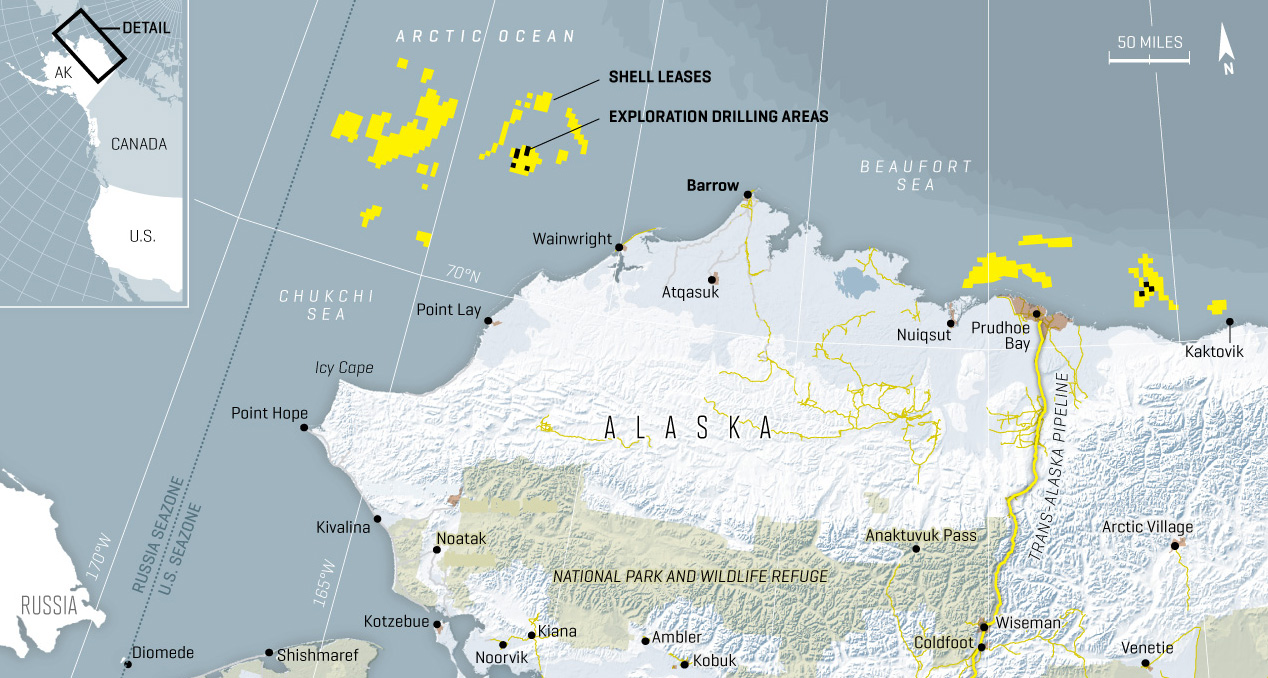
Recently, a Shell drilling vessel, the Kulluk,  broke free from it's towing lines in a storm and ran aground.  Personnel on the platform had to be rescued by the Coast Guard and there is now a major effort to refloat the Kulluk and ensure there is no secondary damage from oil leaks and such.  Neven (who else) has a good summary of the situation and can be relied on to update as sensible.


Michael Tobis last month asked Eli to explain why the Department of the Interior was going after Charles Monnett.  The Kulluk is the short answer, more specifically BOEM wanting to approve Shell's drilling plans for the Beaufort and Chukchi Seas.  Email leaks from Monnett were used to tie Shell, BOEM and BSEE up in court, delaying the issuance of permits four years from 2008 to late 2012 and indeed, this was the only ground that at the conclusion of their farcical investigation that the DOI Inspector General cited to reprimand Monnett.

A good summary with links to original documents of the final court decision allowing the drilling can be found on the Foreign Policy Blog.
On May 25, the 9th Circuit Court of Appeals upheld the Bureau of Ocean Energy Management’s (BOEM) August 2011 decision to permit Shell to drill in the Beaufort and Chukchi Seas off Alaska’s north shore. The Native Village of Point Hope and the Inupiat Community of the North Slope had challenged the decision in court, as did non-profit organizations such as Greenpeace, the Center for Biological Diversity, and the Sierra Club. This is the third time that the government has had to defend its approval of Shell’s offshore drilling plans in court. The indigenous groups and NGOs sued the Bureau for approving Shell’s exploration plan, claiming that BOEM “failed to discharge its obligations under the Outer Continental Shelf Lands Act (OCSLA) (PDF available here) in approving Shell Offshore Inc.’s plan for exploratory oil drilling in the Beaufort Sea.”
Drilling in the Chukchi Sea was approved August 30, and on Sept 20, 2012  approval was given to move the Kulluk into the Beaufort Sea to begin preliminary work
WASHINGTON — As part of the Obama Administration’s all-of-the-above energy strategy to expand safe and responsible domestic energy production, Bureau of Safety and Environmental Enforcement (BSEE) Director James A. Watson today announced that Shell will be allowed to move forward with certain limited preparatory activities in the Beaufort Sea offshore Alaska. Today’s action builds upon BSEE’s authorization on August 30 for Shell to conduct similar preparatory activities in the Chukchi Sea, in preparation for potential development activities in the future. . . .
BSEE inspectors are maintaining their full-time presence on the Noble Discoverer drill ship in the Chukchi, and will also be onboard the Kulluk drilling vessel full-time during its operations in the Beaufort Sea, to provide continuous oversight and monitoring of all approved activities.

Shell was anxious to get started given that it has already poured $4.5 billion into the project, money that was not earning a return as long as the issue remained in court, but it's rush has lead to one equipment malfunction after another.  The Foreign Policy Blog has a statement from Shell that is indicative of the pressure on them to start seeing a return from their investment
Shell spokesman Curtis Smith stated, “There are other appeals still pending, such as those of our air quality permits, but the favorable ruling on the exploration plan is a substantial boost for us.” The EPA granted Shell ten air quality permits in September 2011 to permit the Noble Discoverer drillship, the Kulluk drilling unit, and a support fleet of icebreakers, oil spill response vessels, and supply ships to drill in the Beaufort and Chukchi Seas for up to 120 days each year. As Shell is hopeful for its prospects this summer, both the Noble Discoverer and Kulluk are being outfitted and “winterized” in a Seattle shipyard in preparation to sail to Dutch Harbor, Alaska in mid-June.
In September, they damaged a containment dome designed as one of the layers to deal with possible well blow outs.  That meant that the only work that could be started was to drill top holes, sea floor infrastructure needed before drilling deep for oil and gas and that is why the Kulluk was being moved into from the Beaufort Sea as late in the year as it was.  They moved the equipment up there as fast as they could in September, even without the containment structure, to drill the top holes  The Kulluk grounding may be the last straw.

Which now allows Eli to show MT the little men behind the curtain.  The idiotic act of Eric May, DOI IG special inspector was a futile effort to find something else to hang Monnett with.  Dr. Monnett had a strong whistle blower defense, especially because the 9th Circuit had ruled in 2008 that the emails showed BOEM had messed up their assessment of the safety of Shell's drilling plans.

Rick Steiner, the U Alaska Professor that Monnett leaked to, got tossed out of the Sea Grant program for being a general pain in the butt, and his part in this program may have contributed

PEER knew damn well what was going on and hid the cheese. Now some, not Eli of course, might look at this and advise Scott Mandia to take care when dealing with PEER.  Those folk play inside baseball

Jeffrey Gleason was collateral damage.  Eli thinks that he left BOEM and Alaska as the only way of getting out from between his bosses and Monnett.

The remaining question is how high up in DOI the effort to get rid of Monnett and hide the reason why went, especially because of the intersection with Steiner, the Sea Grant Program and NOAA  This is key from an environmental point of view, because it speaks to the Obama administration's attitude toward the Arctic environment.

UPDATE:  Unfortunately it looks like the Keystone pipeline is a done deal.  Rick Piltz points to that as the reason EPA administrator Lisa Jackson threw in the towel

Saturday, January 05, 2013

Eli Found Another Daniel Sarewitz Comment

Whilst poking about the INTERTUBES, Eli came across the generator that Daniel Sarewitz uses to prepare his Nature columns.  Now some, not Eli to be sure, might think this produces but a pale imitation of the real thing, but Eli knows Artificial Intelligence when he reads it.

UPDATEThingsbreak is a bit more direct:"Sarewitz seems to really love telling science what it “must” do, and it’s all rubbish. . . There are good arguments to make about how we can go about increasing Republican acceptance of science. But those arguments involve changing the way Republicans relate to science, rather than changing the institution of science itself.


And now on to the Sarewitz column
------------------------------------------

Imagine if academics sat down with ordinary people like you and me and ironed out some real solutions to our energy crisis.  But first, the US scientific community must decide if it wants to be a Democratic interest group or if it wants to reassert its value as an independent national asset. If scientists want to claim that their recommendations are independent of their political beliefs, they ought to be able to show that those recommendations have the support of scientists with conflicting beliefs. Expert panels advising the government on politically divisive issues could strengthen their authority by demonstrating political diversity.

With the election season over, maybe you’ve forgotten about energy, but I certainly haven’t. It would be easy to forget that the problem even exists, when our headlines are constantly splashed with the violence in Uzbekistan, the authoritarian crackdown in Gambia and the still-unstable democratic transition in Zambia. 

But the energy problem is growing, and politicians are more divided than ever. Democrats seem to think that energy can just be ignored. Republican politicians like Marco Rubio, on the other hand, seem to think that unscientific rhetoric will substitute for a compromise. 

As 2012 begins, we are entering the most important and decisive period for US science and technology policy since the late 1940s. After 60 years dominated by growing federal expenditure, US science now faces a long period of budgetary stasis, or even contraction.

It wasn't supposed to be this way. America's pragmatic culture has long been assumed to favour applied investigation over fundamental science, a notion that goes back at least to Alexis de Tocqueville's nineteenth-century classic Democracy in America.

But the Republican party of Marco Rubio is not the Republican party of Teddy Roosevelt. Roosevelt wouldn’t just filibuster, he'd compromise because he'd understand that the fate of the country, and his own political career, depended on a lasting solution to the problem of energy.

It's good to see the talks between the president and congress getting off to a solid start, but we know there will be plenty of partisan fireworks before any deal is cut. If I had fifteen minutes to pitch my idea to politicians, I'd tell them two things about energy. First, there's no way around the issue unless we're prepared to spend more: and not just spend more, but spend smarter by investing in the kind of national infrastructure that makes countries succeed. That's going to require some tax increases as well, but as they say, "them's the breaks."

Second, I'd tell them to look at Norway, which all but solved its energy crisis over the past decade. When I visited Norway in 2002, Mwambe, the cabbie who drove me from the airport, couldn't stop telling me about how he had to take a third job because of the high cost of energy. I caught up with Mwambe in Oslo last year. Thanks to Norway's reformed approach toward energy, Mwambe has enough money in his pocket to finally be able to afford a television set for his kids.

During the cold war, scientists from America and the Soviet Union developed lines of communication to improve the prospects for peace. Given the bitter ideological divisions in the United States today, scientists could reach across the political divide once again and set an example for all.

That's all it takes. Don't expect to see any solutions as long as politicians insist on playing a high-stakes game of blackjack with one another. America's got to call a time-out.

Das Kaninchen ist deutschsprachig. Leider ist das Hermelin ungebildet.

Wikipedia has a place for not ready for prime time links, links from sites which, to be blunt, do not meet the laugh test.  Recently the German Wiki has declared that links from the European Institute for Climate and Energy (EIKE) meet the stringent criteria.

This, well, pissed EIKE off, and one Gerhard Wisnewski, was sent into the fray to search out the responsible parties.
It is high time to remember one of the worst climate swindlers, the British climate liar, William Connolley
Well, the article went downhill from there, but somebunny, not Eli to be sure, pointed the Weasel at the page and he was quite amused,  even moved to post a comment directly to Herr Wisnewski
am Freitag, 04.01.2013, 10:10
Hi there Krauts!

Isn't this just a re-hash of Laurence Solomon's tired old nonsense (you'll have to forgive me: I've only read the google translation of this article).

Assuming this *is* just a re-hash, you want
http://tinyurl.com/afwm5zd

> "After a short" pseudo-debate "is from Wikipedia EIKE even on the blacklist has been set. Thus it was no longer possible to link in any Wikipedia article to a EIKE contribution

Well, you can't blame me for that. I didn't take part in that debate, and I've never heard of you.
and got a reply
Kommentar: Nobody blamed you in this text for the actions taken against EIKE. It just shows that your way to control WIKIPEDIA was a good seed for your german followers. And you should use a better translator 
best regards - Admin
Eli could have translated the whole thing for Admin, but when the Bunny tried his keyboard kept rolling on the floor and until the mouse stops giggling it would be best to simply translate the discussion at Wikipedia-DE which lead to the EIKE site being put on the Spam Blacklist
Eike-climate-energie.org is a climate denier side far from the scientific mainstream, but with a strong sense of mission. Yes, the underlying association has gathered enough media attention that it is worth an entire article here. Nevertheless, the site is far from the requirements of WP:Web. However, the page is linked repeatedly in energy related articles, recently in the THTR-300 and the high-temperature reactor articles, which was also the reason for my request. --- <) kmk (> - 01:49, 10 August 2011 (EDT).
One should also mention that Eike articles, particularly in the area of climate change are constantly linked to Talk pages as alleged evidence. Overall, one can therefore IMHO speak of spam-like links. Greetings -. JBO Disk Help? ± 10:42, 10 Aug. 2011 (EDT)
EIKE - content is by nature usually so scary that you can really only laugh. Quote [http://www.eike-klima-energie.eu/die-mission/grundsatzpapier-klima/ the policy paper EIKE]: "The steady increase in snow and ice in Antarctica is shown by the redesign of the German Antarctic research station Neumeyer III ... There were emergency landings of military aircraft on the high plateau of Greenland during World War II.  With the passage of time these are now up to 140 meters below the ice surface. ".

For comparison, the following statement was published in the Geophysical Research Letters], which is also cited in the article on consequences of global warming in the Arctic:

"We find that the ice sheet was losing 110 ± 70 Gt / yr in the 1960s, 30 ± 50 Gt / yr or near balance in the 1970s-1980s, and 97 ± 47 Gt / yr in 1996 Rapidly increasing to 267 ± 38 Gt / yr in 2007. "

I am also of the opinion that this nonsense should not be allowed to appear in Wikipedia.  A link to the page in Lemma EIKE should be possible but not allowed in other articles.  - Hg6996 14:16, 10 Aug. 2011 (EDT)
Good day! ok, I suggest blacklisting the domain, removing links in ANS except for the EIKE article and removing the remaining links (on the discussion pages). camelBot can do it, if this is agreed. - Seth 00:06, 16 Aug. 2011 (EDT)
Good day!  It’s largely done. 13 links in the non-ANS  have been defused, 1 link deleted in the ANS. Links remain in refs to Knut Loeschke and Klaus Landfried and have been left the article about the European Institute for Climate and Energy (EIKE)
I have just put the domain on the SBL (Spam Blacklist). For the remaining links it does not matter. The items are still editable.  In case anyone wants to insert a link to EIKE anywhere they need to apply for a white listing in each case. - Seth 12:35, 21 Aug. 2011 (EDT)
Thanks and greetings -- Disk Hilfe ? ± 13:28, 21. Aug. 2011 (CEST)
That’s really great.  And even many thanks -- hg6996 13:13, 29. Aug. 2011 (CEST)

Bunnies who want to find out more about EIKE can always start with a reality check

Precautionary principle possibilities

The options:

1. Prove a negative, or no dice.  No technology can be used unless it's proven in advance to never have risks.  That can't be done, so we can't use any technology, new or existing.

2. Risky, smishky.  Defined risks are no reason to stop or alter use of a technology unless the risk has moved from possibly harmful to scientifically-certain harm.  With no certainties in science, this also can't be done.

3. Squishy real life choice.  evidence rising to a level of x for harms whose severity rises to a level of y compared to the technology's benefit of less than z is the point at which you stop or alter the technology's use unless and until additional research changes the value of those variables.  The only minuscule problem with this is it doesn't provide much of a guideline.  But it's right.

Discussion below in this blog and at Stoat are relevant.  Anti- and pro-GMO forces argue for positions 1 and 2 although they're usually vague about it, as a clear description of their perspective doesn't help them win.  Switching over to variables x, y, and z, pro-GMOers like Keith Kloor obfuscate the non-zero value of x, while anti-GMOers exaggerate the other way.

So what to do?  Caution, I guess.

To try to move from saying something squishy to something interesting, how about this:  prior to the 1970s, the correct policy conclusion was that CFCs have no broad-based environmental harms and should be used liberally.  That's not right, it turns out, but that's the information we had at the time.  The key is moving quickly as new evidence for variables x and y came out.  From a political science/international coordination perspective, the world moved amazingly quickly on ozone-depleting chemicals.  From an environmental perspective, my sense is that we barely dodged a bullet (and we still have another 40 years or so of slowly declining CFC concentrations where something new could go wrong).  We'll see how well we'll do on climate change with already, well-established x and a range of bad to horrible values for y.


Moderately relevant:  I've had a sci-fi story in my head for a while, an alternative history where CFCs were invented and widely-used a century earlier than in real life and long before the science could anticipate their problems.  Society would be finding nature melting and cracking around them, along with peoples' skin, and have no idea of the reason.  Not a particularly happy story.  So, caution.

Friday, January 04, 2013

Where or When, Pick One


Pong

So the Stoat, who started this (or at least the sensible bit) has replied to Eli's note of caution by pointing out in an update:

* that we should err on the side of caution is true, but isn't an answer. We already do, with the range of trials needed. And the opposition from anti-GM groups isn't "caution" any more than the denialism from the anti-IPCC folks is "scepticism". How useful are lessons like CFCs, or lead-in-petrol? In terms of GMOs I doubt they are useful, because people are already aware of them. it isn't as if people haven't desperately striven to prove GMOs dangerous.
 To which Eli notes that although we are increasingly good at identifying first year problems, what CFCs and tetraethyl lead show is that there are still large issues with things that are decades down the road.  Now Eli, the Weasel, and even KK are pretty well satisfied that there are at worst minor issues with the immediate effects of GMOs introduced to date, but accumulating ecological (such as increasing resistance to Round Up) and biological issues are only now emerging and who knows what the future holds.  DDT, Vioxx, estrogen therapy are examples of such accumulating issues.  DDT and halons are particularly interesting in this regard.  They show that once aware of these types of problems, use can be modified from broadcast use to niche, but vital applications.

Thursday, January 03, 2013

Man Is He Baked


Sarewitz Butchers Brian's Song

UPDATE: The Policy Lass does the dozens on Sarewitz

Brian  has made an excellent statement of where the junction between science and politics must be if the world and your country and your local water supply is to survive. Eli will quote a couple of sentences here, but everybunny should re-read the entire thing, with the thought in their minds that Brian really does have his skin in the game, he is the real deal
It's not "science" that matters most at the intersection of science and policy but scientific consensus that does. If there's a well-established consensus with very few expert dissenters, then you've got factual conclusions as far as policymakers are concerned.  The consensus could be wrong of course, but that's not really relevant to policymakers - they don't have a choice of waiting for a perfect consensus because that won't happen.  What's missing from the commentary I've seen is that policymakers also don't have the choice of second-guessing the consensus by becoming their own Galileos. ..
Contrary to what scientists often say, the science can all-but-decide policy because some policy questions are easy.  Scientific predictions of climate change in the next century under business as usual emission scenarios run from "bad" to "potentially disastrous".  That's pretty much all we need to know from a policy perspective to conclude that we have to deal with it.  The question of how we deal with it isn't easy or exclusively a science question, but whether to deal with it was answered by science. 
Eli, has on occasion dealt with how journalists are also in the business of denying their responsibility to inform. We report, you decide is a cop out, because what is reported determines the decision
.  . . .a whole lot of other people appear to think that scientists are lousy communicators, and indeed, a whole lot of scientists agree and there are workshops, meetings and even, shudder, blogs, devoted to self improvement, or not. This goes into the file under missing the point.

 It's not that scientists are or are not lousy communicators (say that and Eli will lock you in a room with Richard Alley for example), but that journalists are lousy communicators. It's their fucking (emphasis added) job and they are screwing it up to a fare-thee-well. It ain't just climate either. What journalists produce often makes the average cut and paste student paper blush with modesty 
Which brings Eli to the latest from the Pielkesphere, a comment by Dan Sarewitz in Nature, telling science that it needs to become more Republican
The US scientific community must decide if it wants to be a Democratic interest group or if it wants to reassert its value as an independent national asset. If scientists want to claim that their recommendations are independent of their political beliefs, they ought to be able to show that those recommendations have the support of scientists with conflicting beliefs. Expert panels advising the government on politically divisive issues could strengthen their authority by demonstrating political diversity. The National Academies, as well as many government agencies, already try to balance representation from the academic, non-governmental and private sectors on many science advisory panels; it would be only a small step to be equally explicit about ideological or political diversity. Such information could be given voluntarily. 
Sarewitz views politics as informing science, rather than, as Brian points out, science informing politics.  Having crossed his eyes, he rushes downhill only to crash at the bottom advocating rebalancing the national academy with Republicans
To connect scientific advice to bipartisanship would benefit political debate. Volatile issues, such as the regulation of environmental and public-health risks, often lead to accusations of ‘junk science’ from opposing sides. Politicians would find it more difficult to attack science endorsed by avowedly bipartisan groups of scientists, and more difficult to justify their policy preferences by scientific claims that were contradicted by bipartisan panels. 
Again, Sarewitz confuses the relative merits of doing science and attacking science from a political soapbox.  Sarewitz does the Fox news thing.

Sarewitz, like his fanboy Pielke, lacks any critical understanding of politics. They take the political situation as given and legitimate, then direct all their criticism at the science community. Sarewitz is saying that the science community should be 'harnessed' to the beliefs and priorities of policymakers. The bunnies at RR are not about to tell scientists to bend themselves out of shape in order to make themselves relevant to the policy agendas of right-wing ideologues, science deniers, and political hacks of either party but we have always encouraged scientists to become politically more savvy and to learn to read political situations.

Increasingly over time it has become evident that, in the collision between climate science and the realities of Washington politics, the problem is overwhelmingly on the political side of the bridge and on one particular side of that in the US. This is an American problem something that Sarewitz does not appear to relaize. Scientists could benefit from learning to communicate better with civilians, but the US political arena has much deeper problems, primarily but far from exclusively on the right-wing side. Otherwise, given the heroic efforts of the climate science community to communicate via assessments, testimony, and otherwise, we would be farther along than we are.

But Sarewitz, Pielke, et al. just ignore all that and continue to beat up on the science community. It is seriously wrong-headed, really inexcusably wrong-headed in its failure to come up any learning curve on this after all this time.   But perhaps  a feature.  Sarewitz has a column in Nature, just as George Will has one in the Washington Post.

It's good work when you can get it.

Sarewitz' piece in Nature is drivel. Just clueless, and that's putting it diplomatically.

But wait, there's more . . .

Sarewitz doubles down
Pielke clucks in approval
Curry steps right into it

Maybe tomorrow Ethon will lend a hand.

Caution

Thomas Midgley Jr. is well known for having "more impact on the atmosphere than any other single organism in Earth's history".  Midgley's team was responsible for CFC refrigerants, and the introduction of tetraethyl lead as an antiknock agent in gasoline.  The CFCs have had both good and bad effects, the identification of the bad ones, ozone depletion, and the calculus is irrelevant at this point with the Montreal Protocols and the availability of adequate substitutes.  Tetraethyl lead is another story and a report in Mother Jones today provides a useful platform from which to view the introduction of GMO technology.

The Weasel has posed seven questions, but even he admits that there are two core ones

4: Can we really be sure that GM crops are safe — for our fellow creatures in the environment at large; or for consumers – whether livestock or people?
5: Taken all in all, do the advantages of GM really outweigh the perceived disadvantages and the conceivable risks?
which in the context of an anti-GMO web site he answers as
These are really one question, and are the heart of the matter: are GMO’s safe? The campaign’s answer is clear enough though:
All of the philosophy of science over the past 80 years or so (at least since Kurt Goedel and Karl Popper) has been telling us that science does not, and cannot, deal in certainties. In short, even if GM does produce some successes, it cannot justify the confidence that so many of its advocates display. Their confidence suggests that they do not appreciate the limits of science itself – which is itself rather worrying.
Yup, that’s right. Science doesn’t deal in certainties. Therefore you can’t be certain that GMO’s are safe. Therefore you cannot really quantify the “conceivable risks”. And therefore its all too dangerous to bother with.
This is, I think, fundamentally their answer. And if they just said that, well, I think I’d disagree. But I could accept they were honest. But wrapping this core up in spun-sugar propaganda isn’t honest.
 Eli's POV starts pretty much with his post on GMO's and Brian's post on politics and science and is not so far from Wm's, but the new information on lead's effects on the brains, especially of children, should make the three of us pause and be extra cautious.

It has been known for a long time that children exposed to lead are have lower IQs, but research has also shown that they are more aggressive.  Epidemiological studies carried out in the last twenty years have shown a clear relationship between violent crime and lead exposure.  This has lead to a number of investigations to identify the (or a) mechanism for this link.
One set of scans found that lead exposure is linked to production of the brain's white matter—primarily a substance called myelin, which forms an insulating sheath around the connections between neurons. Lead exposure degrades both the formation and structure of myelin, and when this happens, says Kim Dietrich, one of the leaders of the imaging studies, "neurons are not communicating effectively." Put simply, the network connections within the brain become both slower and less coordinated.
A second study found that high exposure to lead during childhood was linked to a permanent loss of gray matter in the prefrontal cortex—a part of the brain associated with aggression control as well as what psychologists call "executive functions": emotional regulation, impulse control, attention, verbal reasoning, and mental flexibility. One way to understand this, says Kim Cecil, another member of the Cincinnati team, is that lead affects precisely the areas of the brain "that make us most human."
So lead is a double whammy: It impairs specific parts of the brain responsible for executive functions and it impairs the communication channels between these parts of the brain. For children like the ones in the Cincinnati study, who were mostly inner-city kids with plenty of strikes against them already, lead exposure was, in Cecil's words, an "additional kick in the gut." And one more thing: Although both sexes are affected by lead, the neurological impact turns out to be greater among boys than girls.
Other recent studies link even minuscule blood lead levels with attention deficit/hyperactivity disorder. Even at concentrations well below those usually considered safe—levels still common today—lead increases the odds of kids developing ADHD.
In other words, as Reyes summarized the evidence in her paper, even moderately high levels of lead exposure are associated with aggressivity, impulsivity, ADHD, and lower IQ. And right there, you've practically defined the profile of a violent young offender.


And why was tetraethyl lead removed from gasoline?  Not because of it's effect on the brains of kids, but because it poisoned the catalytic converters introduced in the 1970s to reduce air pollution under the Clean Air Act in the US but even at that time there was evidence of the bad effects of lead on kids.  The usual suspects opposed both on the usual grounds.  Freeeeedom, costs money, don wanna.  Eli is old, not because of age but from listening to that crap.

Perhaps yet another reason to be cautious when eating one's breakfast?


Four out of five dentists say it's the scientific consensus, stupid

I'm late to the game of the Cox/Ince editorial on science and policy, but two points:

1. It's not "science" that matters most at the intersection of science and policy but scientific consensus that does.  If there's a well-established consensus with very few expert dissenters, then you've got factual conclusions as far as policymakers are concerned.  The consensus could be wrong of course, but that's not really relevant to policymakers - they don't have a choice of waiting for a perfect consensus because that won't happen.  What's missing from the commentary I've seen is that policymakers also don't have the choice of second-guessing the consensus by becoming their own Galileos.

Let's forget climate change for a while and take my constrained policymaking field instead.  Should I direct my water district to add fluoride to our water supply?  The vast majority of dentists say it helps teeth, but some disagree.  Does adding fluoride create non-dental health risks for the general population?  The vast majority of oncologists, endocrinologists, and neurologists reflected in the scientific consensus say somewhere between "no" and "not proven," but some disagree.  It's ridiculous to think I could get sufficient expertise in those three fields as well as dentistry to let me judge between experts.

And fluoride is just one issue.  What about water supply decontamination - should we use chlorine or chloramine?  What is the maximum horizontal acceleration that a worst-case earthquake will exert on each of our eleven dams?  Is the stream gauge appropriately sited to be provide accurate data on stream flow during storm events?  How much chromium 6 is tolerable in our stored groundwater?  Can migrating steelhead trout make it up the proposed fish ladder? I'm not second-guessing these things if they have an expert consensus behind it, regardless of a few dissenters.

Incidentally, I don't distinguish between scientific consensus and other expert consensus.  Seismologists tell us the maximum acceleration during an earthquake, and engineers tell us what dams can handle.  I don't see a difference.

The intersection with policy gets complicated if the consensus has an important dissenting faction or if there's no consensus at all, but that's not what we're facing on some issues, like global climate change.

2.  Contrary to what scientists often say, the science can all-but-decide policy because some policy questions are easy.  Scientific predictions of climate change in the next century under business as usual emission scenarios run from "bad" to "potentially disastrous".  That's pretty much all we need to know from a policy perspective to conclude that we have to deal with it.  The question of how we deal with it isn't easy or exclusively a science question, but whether to deal with it was answered by science.

Wednesday, January 02, 2013

Vietnam


Anecdata from the last few weeks in northern Vietnam.

1.  The government subsidizes fossil fuels via price caps and money-losing, government-owned energy sector companies, and Hanoi's air pollution is eye-stinging bad (I went jogging and wondered how much life expectancy that cost me).  Presumably Saigon and some other industrial areas are equivalent or worse.

No use ignoring the political support that subsidies of staple products create, especially from politically-important urban residents, but it seems like an alternative arrangement of withdrawing the subsidy and using the money in other ways that help urban air quality could create equivalent support.  Mexico is a decent model.

2.  Just as I've decided that other people's personal problems are far easier to solve than my own personal problems, other nation's political problems are far easier to solve than my nation's.  Why can't the US pass a revenue-neutral carbon tax?  Well, that's complicated....

3.  The government does a decent job of hiding political repression from the casual observer, while massive corruption is openly discussed.  Internet access was everywhere and I didn't find any English language websites blocked, although maybe that will change as English fluency and machine translation improve.  Soviet-style propaganda posters and public loudspeakers spouting messages were also everywhere though and more than a little creepy.  Uncle Ho's picture dominated many living rooms, probably a sincere gesture.

Of the two people who opened up to us in our travels, one was fairly supportive of the government and the other strongly dismissive.

4.  On the good side, we lost count after seeing three dozen or so electric bikes.  Hanoi has as many motorcycle scooters as people so the count isn't even a tenth of a percent, but they're there.  Just as electrifying cars and switching to renewable power is a major/the major part of the American climate solution, electrifying two-wheeled transport could be Vietnam's.  The government also seems to do a decent job of supporting infrastructure for two-wheeled transport, with cement paths and narrow bridges.  A huge tax on cars supports the two-wheel system, often doubling the car's costs.  Why can't we do that in the US, at least for luxury cars?  Well, that's complicated....

5.  I didn't spot a single solar PV system but did see plenty of solar water heaters, every one of them brand new.  Lots of hydro capacity and some construction, both of the all-good, small hydro and mixed result large hydro.  A side-note here:  funny how some enviros are reconsidering opposition to nuclear power but no one talks about large-scale hydro, which by contrast to nukes is economically cheap.  Maybe that's because the major dam projects are all finished in the industrialized world.

6.  Climate isn't quite warm enough for year-round rice production in north Vietnam, so many paddies are left fallow.  It seems like there is sometimes (not always) a choice available to farmers whether to flood or keep dry those fallow paddies, and that might affect methane production in the off season.  There might be a policy opportunity here, incentivizing farmers to keep the paddies dry in the off-season, and verification by satellite would be easy.

7.  I have a flood control idea for my water district, of using a smart grid composed of residential rainwater retention systems to shave the peak off of a flood.  I think it has a shot of being feasible in small, urbanized watersheds.  I wonder if the same couldn't be true for watersheds dominated by rice paddies, emptying them in anticipation of a major storm and then letting them take up some of the excess.

8.  Little-founded speculation, but where the hell are the birds?  I know it's winter and the Vietnamese trap and eat even the little birds, but still the forests and skies seem empty.  Maybe Rachel Carson's future has happened here.

Spectacular scenery but don't come for the wildlife, at least in the north.

9.  Touristing note:  Lonely Planet never led us wrong, other than a two bad addresses for hotels.  In particular, Handspan, Blue Swimmer, Asia Outdoors, and Sapa O'Chau all did a great job for us tourists, adjusting for the necessary flexibility and English fluency level of a developing country.

Tuesday, January 01, 2013

There Are Times That Try Bunny's Brains

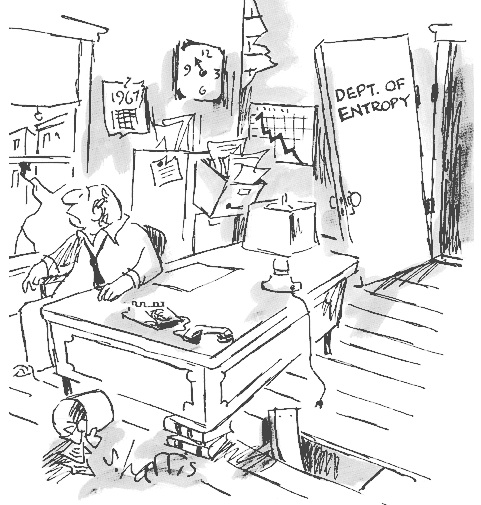
Loschmidt's paradox is that the laws of thermodynamics are time asymmetric because entropy always increases, but the underlying laws of physics are symmetric under time reversal. It should not therefore be possible to derive the second law of thermodynamics from first principles.
 This has lead to the suicide of as many physicists (Boltzmann and Ehrenfest among them) as Schroedinger's cat.  Recently friends Motl and the  Capitalist Imperialist Swine have wandered into the killing field.  The Pig plays the chalk, quoting Boltzmann
Of course, when the past is determined by the correct method – the method of retrodictions which is a form of Bayesian inference – we will find out that the lower-entropy states are exponentially favored. We won't be able to become certain about any property of the Universe in the past but some most universal facts such as the increasing entropy will of course follow from this Bayesian inference. In particular, the correctly "retrodicted past entropy" will more or less coincide with the "actual past" curve.
The secret sauce is the statement that in retrodictions
...the lower-entropy states are exponentially favored.
I'm putting that in my "remains to be demonstrated" file.
There are times in every blogger's life when a Bunny comes across something that is really really interesting, but does not have the angle or the understanding to really push to a conclusion.  "A proof of Clausius' theorem for time reversible deterministic microscopic dynamics", Journal of Chemical Physics, 134 (2011) 204113 by D.J. Evans, S.R. Williams and D. J. Searles is the ticket for Eli.  This trio has been thinking about how to establish thermodynamics on other than the normal ad hoc basis.  Yes bunnies, the laws of thermodynamics are observations, better put Ansatze, or as the Wikipedia puts it educated guesses that are verified later by its results.  The Clausius inequality, should the readers have forgotten is
\oint \frac{\delta Q}{T} \leq 0,
for a cyclic process and is equivalent to the second law.

EW&S prove this is true only in the limit of infinite time, where the temperature is that of the "underlying equilibrium state" and only assuming T-mixing, ergodic consistency and the axiom of causality.  That means, of course, that there are quantum issues yet to be confronted, but certainly this appears valid for classical thermodynamics.

 In a later paper (JCP 137 (2012) 194109), the three authors conclude:
Our proof (of the zeroth law) is constructed using an array of previous results.  Out proof of the zeroth "law" is far more informative than the corresponding derivation using ergodic theory.  Combining the present proof with the observation that for an isolated mechanical system the energy is constant and our recent proof of the Clausius inequality, we see that all the so called laws of classical thermodynamics are mathematical results provable from the laws of mechanics supplemented by the axiom of causality and by the T mixing condition.  Theis might be regarded as changing the logical status of thermodynamics.

A second, less obvious result of our work is that for nonequilibrium systems entropy seems to play no role at all!  Its place is taken by dissipation.  The idea that one could use the Gibbs entropy in proving relaxation to equilibrium is obviously erroneous as discussed in a range of papers . . . . .
So why does the Gibbs approach to equilibrium work?
The present work points out, however, that entropy is not really necessary away from equilibrium.  It is only at, or very near to, equilibrium when dissipation is identically zero or so small that local thermodynamic equilibrium can be assumed, that entropy (and the Gibbs approach-ER) may be useful.  One may resort to other dynamical notions of entropy, cf. the Bolzmann entropy, or the one defined in the third paper of Ref. 21 to avoid these problems.
The infinite time is where the fun lies.  Remember Loschmidt?  In a purely mechanical universe, motion is time reversible, e.g. given a complete description of the initial condition one can postdict where all the particles were at earlier time and predict where they will be in the future, but classical thermodynamics claims this not to be the case, and statistical mechanics establishes that for large systems this will not be possible because of entropic driving forces.

About a decade ago Evans and collaborators showed experimentally, that for small systems, easily of the size of today's nanostructures, there can be momentary violations of the second law.  There would appear to be nothing really standing in the way of building an entangled system of such a size and that could really be the Mayan calendar for physics.

Monday, December 31, 2012

Sunday, December 30, 2012

Sandy

Whether Sandy was caused by, made worse by, had nothing to do with climate change is one of those questions that can sell a lot of beer and be the subject of seminars, posters and blogs without end.  Eli is actually not going to take a position on that, or rather reserves the right to be all over the place on the issue.

However, it is one of the choices in the Bunny Poll and a few words are in order, so let the first few come from Greg Laden, the keeper of the list who put it at Number 1:
Note that the first few of the links below are to blog posts written by concerned climate scientists, whom the climate change denialists call “alarmists.” You will note that these scientists and writers were saying alarming things as the storm approached. You will also note that what actually happened when Sandy struck was much worse than any of these “alarmists” predicted in one way or another, in some cases, in several ways. This then, is the fifth reason that Sandy is important: The Earth’s weather system (quite unconsciously of course) opened a big huge can of “I told you so” on the climate science denialist world. Sandy washed away many lives, a great deal of property and quite a bit of shoreline. Sandy also washed away a huge portion of what remained of the credibility of the climate science denialist lobby.
Is Mother Nature revving up an October Surprise (w/ human thumbs on the scale)?
Grim Trajectories
Has climate change created a monster?
Ostrich Heads in the Sand(y)? Does your meteorologist break the climate silence?
Climate of Doubt As Superstorm Sandy Crosses US Coast
Are Tropical Storms Getting Larger in Area?
What you need to know about Frankenstorm Sandy
Fox: Hurricane Sandy Has “Nothing To Do With Global Warming”

Eli's POV is a bit different.  Sandy was an object lesson in what to expect if there is no consequent action on climate change.  There was no specific driver that could not be explained in terms of natural variability, but each of those drivers are expected to exceed the range of natural variability in the 21st century because of climate change (sea level, storm surge, extratropical sea surface temperatures, changes in circulation that steered the storm, etc.) and those drivers were at what experts believe are low values compared to what they shall be in the near future.   So yes, not only will it get worse if we do nothing, it will get a lot worse. 

Sandy almost cost us the world's best city (Brooklyn, ancestral home of the Rabetts), wiped out the US East Coast barrier islands (Eli has been warning for many years that the cost of that in real estate values would easily exceed any  costs of dealing with climate change), was a strong wake up call to the 1%, most of whom own homes on the seashore (it's personal now) and a heads up to all those who had better things in their lives to think about.

In Dickensonian terms, Sandy was the spirit of Christmas Future.