Friday, October 31, 2008

The first principle is that you must not fool yourself - R. Feynman

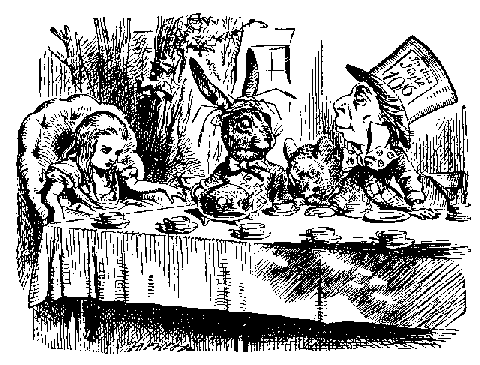
Some time ago, Eli put up a comment about Number 6 of the Cohenite 10 in which Ferenc Miskolczi visits the haunted house of bad assumptions and math manglement to reach the promised land of never mind about climate change. It's enough to drive a bunny to drink (picture from kansaspraire.net). You could, if you were a masochist, follow the tracks at Niche Modeling or at Climate Audit, and a very long trail it is, but the current state of play was pretty well put by Alex Harvey

Alright, you’ve been absent from this debate because, as you stated publicly months ago, you lost interest in it. That’s fine, welcome back. But since then, it has been made quite clear that Miskolczi’s theory was, in the first instance, an empirical discovery. The mathematical theory of M2007 that you are objecting to here was adduced “after the fact” to explain a series of well-documented empirical observations, as Ferenc has made quite clear earlier in this thread.
All praise to Nick Stokes and Pat Classen who put considerable work into tearing the Miskolczi hocus mathepocus apart (look into their comments on the various threads). So now this waste of electrons is reduced to the claim that the optical depth of the atmosphere is held constant at 1.87 by compensating variations in the water vapor column density in the atmosphere. Well, at least for the Earth's atmosphere right now that is the value, but is it fixed and if it is what is the mechanism?

We know that the atmospheric concentration of CO2 is rising which would increase the optical depth. The only way that the optical depth could then decrease is for the water vapor column density to decrease. Measurements show that the surface is warming. Since warmer temperatures will result in higher water vapor pressure, the only way that total water vapor would decrease would be for the excess water to rain out quickly. Although there is some data on water vapor column density from way back when, it is not of the highest quality, and the further back you go, the worse it gets. Is there another way to get at this?

Why yes young fella, if you had the right satellite instruments you could look at the water vapor concentration as a function of temperature on the surface over a relatively small area. And guess what we have the right satellite instrument, the Atmospheric Infrared Sounder (AIRS) and Andrew Dessler and friends have used data from this instrument in a paper currently appearing in the Journal of Geophysical Research, and as you would expect if you were not Ferenc Miskolczi, the column density of water vapor increases as the surface temperature below increases.
The numbers refer to the water vapor content of the air at different levels in g water/kg air. Ts is the sea surface temperature below the satellite. As a sweetner, Dessler, et al., show that the compositional observations of AIRS can be used to calculate the outgoing longwave radiation (OLR) from the earth and that those results match observations of OLR from another satellite instrument (CERES). Another study is described below


A complimentary paper published by Soden, Jackson, Ramaswamy, Schwarzkopf, and Huang in 2005 (sorry, it's behind a paywall) covers the same ground, showing that the column water vapor has been increasing and, as importantly showing that a GCM can match the observations. That alone is enough to cocked hat Miskolczi but as importantly Soden, et al., provide a concise and clear explanation of what the actual issues involved in studying water vapor concentrations are. In particular, while the increase of vapor pressure with temperature drives the water vapor pressure low in the atmosphere, and this dominates, the middle and upper troposphere are different cases
When forced with observed SSTs, this model successfully reproduces the observed column-integrated moistening changes over this period (Fig. 1). However, because the mass of water vapor decreases rapidly with height, the column integral is primarily weighted by the lower troposphere, and its largely thermodynamic behavior is unsurprising (21). Consequently, there is not much debate about the projected increase of column-integrated water vapor in response to global warming, and its agreement with models provides only limited reassurance in their simulation of water vapor feedback (9).

In contrast, water vapor in the free troposphere is not so directly constrained by thermodynamic arguments (21), and its response to global warming has been the subject of long-standing controversy (9, 15–17). Given the radiative importance of moisture changes in the upper troposphere (9, 10), it is important that humidity changes there are demonstrably consistent between models and observations. Although an international network of weather balloons has carried water vapor sensors for more than half a century, changes in instrumentation and poor calibration make such sensors unsuitable for detecting trends in upper tropospheric water vapor (27). Similarly, global reanalysis products also suffer from spurious variability and trends related to changes in data quality and data coverage (24).
which tells you to be wary of the global reanalysis product and if you follow the reference it will tell you why to be wary. The study shows that not only is relative humidity in the upper troposphere remaining roughly constant and the actual humidity increasing as the air warms, but the change is captured by GCMs
Climate models predict that the concentration of water vapor in the upper troposphere could double by the end of the century as a result of increases in greenhouse gases. Such moistening plays a key role in amplifying the rate at which the climate warms in response to anthropogenic activities, but has been difficult to detect because of deficiencies in conventional observing systems. We use satellite measurements to highlight a distinct radiative signature of upper tropospheric moistening over the period 1982 to 2004. The observed moistening is accurately captured by climate model simulations and lends further credence to model projections of future global warming.

Nature bites man

In a unique editorial, Nature has endorsed Barack Obama. They have some complimentary things to say about John McCain but when the rubber hits the road

"Some will find strengths in McCain that they value more highly than the commitment to reasoned assessment that appeals in Obama. But all the signs are that the former seeks a narrower range of advice. Equally worrying is that he fails to educate himself on crucial matters; the attitude he has taken to economic policy over many years is at issue here. Either as a result of poor advice, or of advice inadequately considered, he frequently makes decisions that seem capricious or erratic. The most notable of these is his ill-considered choice of Sarah Palin, the Republican governor of Alaska, as running mate. Palin lacks the experience, and any outward sign of the capacity, to face the rigours of the presidency.

The Oval Office is not a debating chamber, nor is it a faculty club. As anyone in academia will know, a thoughtful and professorial air is not in itself a recommendation for executive power. But a commitment to seeking good advice and taking seriously the findings of disinterested enquiry seems an attractive attribute for a chief executive. It certainly matters more than any specific pledge to fund some particular agency or initiative at a certain level — pledges of a sort now largely rendered moot by the unpredictable flux of the economy.

This journal does not have a vote, and does not claim any particular standing from which to instruct those who do. But if it did, it would cast its vote for Barack Obama.

Usually the bunny keeps politics out of the blog, but this is where policy meets the road. You can read Obama's and McCain's answers (well actually their advisors answers) to science policy questions. Popular Mechanics has a nice matrix of the policy positions of the candidates including those who dropped out of the primaries. You can find some of Biden's positions there and compare the primary season answers of the candidates to the election positions. Palin asked for a make-up.

UPDATE: Science reports on a debate between Daniel Kammen and representing Barack Obama and Kurt Yeager representing John McCain. Among the topics,

Cap and Trade Programs for Reducing Greenhouse Gas Emissions.

Both candidates reject a federal tax on carbon emissions of the sort that was advocated by former Vice President Al Gore. Both Yeager and Kammen said that the candidates see a cap and trade regime as being stronger and more sensitive in its ability to control carbon emissions.

Generally, a cap-and-trade program sets limits for greenhouse gas emissions. The government would sell the permits or give them away; utilities and industries that emit the gasses could buy them and sell them. Over time, fewer permits would be available, and the cost presumably would be higher. That would help reduce overall emissions.

Both campaigns have staked out their objectives: Obama would auction the permits to reduce carbon emissions by 80% below 1990 levels by 2050. McCain's goal is a 60% reduction by 2050.

At the Stanford debate, Kammen said auctioning the permits would essentially set a price for polluting, and that proceeds could be used for a variety of purposes, including efforts to promote green development and green jobs in low-income urban and rural areas. He was critical of McCain's program, joining other analysts who have found that it would initially give some of the permits away. That approach that has been questioned by some critics who say that creates insufficient incentive for polluters to stop polluting.

Yeager insisted that McCain's plan would not give away permits. It would set firm objectives in five-year increments and hold polluters accountable for meeting them. That would be effective without bankrupting private industry, he said. A cap-and-trade regime has to be a "sustainable strategy that gets beyond the enthusiasm of the moment" so that it can endure long-term, he added.

Read the comments. . .

Sunday, October 26, 2008

Believing ten impossible things before breakfast

Eli, the evil bunny has been busy sowing derision on some denialist sites, in a most polite way of course. Among other revelations is that the white queen had nothing on your average denialist

Alice laughed. `There's no use trying,' she said `one ca'n't believe impossible things.'
`I daresay you haven't had much practice,' said the Queen. `When I was your age, I always did it for half-an-hour a day. Why, sometimes I've believed as many as six impossible things before breakfast.
Denialism is reduced to throwing spaghetti against the wall and hoping that something sticks which leads to claiming that every one of a set of mutually contradictory papers are just wonderful. This came out again recently (at least when the Rabett was in attendance) in comments Open Mind. Down towards the bottom of the thread Ray Ladbury started it with
Dave A., Don’t be daft. Of course I form my own opinion of research in my field. I read the paper. I do the math. I look for consistency and how it fits into the context of previous research.
Eli agreed
Now the hooty thing about denialists is that they believe three impossible and mutually contradictory things before breakfast. Look at the nonsense that they simultaneously accept. They don’t care as long as it casts doubt on our understanding of climate.
and Gavin's Pussycat added
Many non-scientists have no clear idea of how highly rated redundancy is in science. You don’t really believe anything seriously before it has come from several independent sources. And those sources themselves are often internally redundant, like surface temperatures, monthly averaged, correlate over long distances.
Same with replication: I can replicate with the best of them someone else’s coding errors by running their code. Independent replication, by different people, using their own code and methods, on different data (if you can get it) proves something.
and Barton gave an example from virtual life
I can testify from personal experience that that’s true. I’m in a long running dialogue over on landshape.org where people are defending Miskolczi’s crackpot paper. One of them insists that the surface temperature of the Earth being higher than the radiative equilibrium temperature is caused by “stored energy,” not by the greenhouse effect. I pointed out that this would mean he’s disagreeing with Miskolczi, who at least believes there’s a greenhouse effect. Nothing doing. He says he didn’t see any conflict, and neither Miskolczi, who is also present on the thread, nor any of his supporters, was willing to correct this guy. “No enemies on the left.”
Eli has been pointing this out for a while now, and the reaction has been, welll......amusing
Eli you ought to hang your head in shame and embarrassment as a result of quoting the deplorable Krugman on economic matters.
And by the way the nonsense you spouted about the superiority of mitigation was a crock of shit proving that if you know so little about economics you shouldn’t be talking about AGW as your judgment on any matter should not be trusted.
The sheer nonsense was deplorable. here:
http://alsblog.wordpress.com/2008/09/03/rabbets-and-carrots-without-the-stick/
As usual you peddle off at 50 MHP and won’t answer to all that stupidity you wrote.
We need an apology for your stupidity, Eli. Nothing less will do.
Of course we made sure that Krugman would win the Eco Nobel before replying, but what do you expect, the sucker can't spell Rabett either. The source of this exchange was cohenite playing Dave Letterman on Jen's rent a blog

The point here is not to show that cohenite's heart throbs are trash, you can read that elsewhere, but to point out that they contradict each other. You might believe one or two, but all ten at once is very red queen territory. The envelope please:

1. Steve McIntyre’s Ohio State University Address; How do we “know” that 1998 was the warmest year of the millennium? (May 16, 2008). http://www.climateaudit.org/pdf/ohio.pdf. This is a seminal paper which synthesizes all the errors and obfuscations to do with the Hockey Stick. It also demonstrates McIntyre’s methodical, scientific and unadorned approach to the issue.

2. Craig Loehle’s paper; A 2000-year global temperature reconstruction based on non-tree ring proxies, Energy & Environment 18(7-8): 1049-1058. 2007 http://www.ncasi.org/publications/Detail.aspx?id=3025 This paper was important because it was a counterpoise to Mann’s tree-ring data and provided good support for the Medieval Warming Period, a major obstacle to AGW.

3. Douglass, Christy et al; this is the first of the GCM critiques; A comparison of tropical temperature trends with model predictions. International Journal of Climatology, 2007 http://www.climateaudit.org/?p=3058
http://www.scribd.com/doc/904914/A-comparison-of-tropical-temperature-trends-with-model-predictions?page=6 .
This paper really touched a nerve and the level of hostility leveled at it was astounding; it mostly boiled down to nit-picking about Raobcore data and whether a falsification was distinct from a bias. The second link is to an addendum to the paper; comments 69-74 are entertaining.

4.Koutsoyiannis et al; http://www.itia.ntua.gr/en/docinfo/850 Assessment of the reliability of climate predictions based on comparisons with historical time series. Geophysical Research Abstracts, 2008. This link is to the first presentation. This was a crucial paper; it covered the 18 year predictive history of the GCM’s on a regional basis; regionalism is the Achilles Heel of AGW.

5.Stockwell; http://landshape.org/stats/wp-content/uploads/2008/08/article.pdf Tests of Regional Climate Model Validity in the Drought Exceptional Circumstances Report. 2008 This paper did the job on CSIRO and demonstrated the political imput into the AGW science.

6. Misckolczi; Greenhouse effect in semi-transparent planetary Atmospheres. Quarterly Journal of the Hungarian Meteorological Service, Vol. 111, No. 1, January–March 2007, pp. 1–40.http://met.hu/doc/idojaras/vol111001_01.pdf This is my favourite. It has everything; the dead hand of AGW censorship, and the demolition of the AGW’s semi-infinite opaque layered atmosphere. People have quibbled about the Kirchhoff equations but Miskolczian –ve feedbacks have been established.

7. Essex, McKitrick, Andresen; Does a Global Temperature Exist? Journal of Non-EquilibriumThermodynamics, 32 (1) 1-27.http://www.reference-global.com/doi/abs/10.1515/JNETDY.2007.001?cookieSet=1 The fallacy of a global average temperature was taken to task in this paper, and, again, the reaction was hostile. This paper wittily compared averaging temperature to averaging the phone book; an important addition to the regionalism lexicon.

8. Spencer and Braswell; Potential Biases in Feedback Diagnosis from Observational Data: A simple Model Demonstration, Journal of Climate. http://ams.allenpress.com/perlserv/?request=get-abstract&doi=10.1175%2F2008JCLI2253.1 No list would be complete without Mr Cloud and –ve feedback. As well, Spencer has been a bastion of reliable temperature data. This was still a close call. Minschwaner and Dessler’s paper on RH decline as a response to increasing CO2 is a crucial paper, conforming to Miskolczi’s feedbacks.

9. Chilingar; Cooling of Atmosphere Due to CO2 Emission, Energy Sources, Part A: Recovery, Utilization, and Environmental Effects. Volume 30, Issue 1, January 2008 , pages 1 - 9 http://dx.doi.org/10.1080/15567030701568727 An important paper about convective heat transfer which relegates CO2 radiative heating to its proper subordinate position; and incorporates atmospheric pressure as a heating factor. Thanks to Louis for alerting me to the paper. An honourable mention to the Gerlich and Tscheuschner paper on the fallacy of the greenhouse concept and a host of other errors AGW science makes.

10. Pielke Sr et al; Unresolved issues with the assessment of multidecadal global land surface temperature trends. Journal of Geophysical Research, Vol 112. 2007. http://climatesci.colorado.edu/publications/pdf/R-321.pdf
An elegant paper which uses Stefan-Boltzman to support regionalism and show that the notion of a radiative imbalance is defeated by regional temperature based energy differentials. Somewhat superfluous since AR4, FIG 1 shows no global radiative imbalance.
Eli torched this off by pointing out that Miskolczi and Chillingar are not even on the same planet. The former does some theoretical hocus pocus on radiative equilibrium in the atmosphere, the later claims that radiation plays only a small role and that almost all heat transport in the atmosphere takes place by convection.

Essex et al. claim that there is no meaningful global (or by the same arguments regional) temperature while almost all of the others calculate such metrics. Some of the papers claim there is no greenhouse effect, others claim there is a little bit, still others claim there is a greenhouse effect but it cannot increase (Miskolczi), and so on.

NT summed it up
You have missed the point. On this post(by Cohenite) he has used contradictory science to demonstrate that AGW is not real. You cannot use one paper to falsify one aspect, and then another paper to falsify another, when the two papers are mutually exclusive.

He attempted to show that the Greenhouse effect is negligable. He posted a paper he said showed why (Minschwaner), it contradicts earlier an earlier paper he posted (Miskolczi). one claims there is a greenhouse effect due to greenhouse gases, tthe other claims it is due to optical depth. You can’t have it both ways.

Skeptics use a scatter shot approach, using one kind of physics to ‘disprove’ one aspect and an opposing kind of physics to ‘disprove’ another. You need to have an internally consistent argument.
and SJT disagreed
“Skeptics use a scatter shot approach, using one kind of physics to ‘disprove’ one aspect and an opposing kind of physics to ‘disprove’ another. You need to have an internally consistent argument.”
As Jen's site demonstrates so well, you don’t need anything of the sort.
UPDATE: Michael Tobis has found the right words, the incoherence of denialism

Tuesday, October 21, 2008

No No Nierenberg or the wabid wabbit attacks


Here begins a new chapter for the William Nierenberg Book Club. If you have not been paying attention, places to catch up include Stoat, Stoat, Stoat, Atmoz, Nierenberg Central, and yr. humble hare here, here and especially here for the background to this post.

To make a long and a short of it, William Nierenberg was a founder of the George Marshall Institution with Robert Jastrow and Fred Seitz, president of the Scripps Institute, a member of the National Academy, etc. He is not especially a favorite of Naomi Oreskes, who has assigned him considerable responsibility for blocking early action on climate change (read the links damn it!!).

While those other characters have been looking at Jason and NAS reports (read the links damn it), Eli has acquired at considerable cost ($0.41 + postage) a copy of Scientific Perspectives on the Greenhouse Problem, by Robert Jastrow, William Nierenberg and Fredrick Seitz (nice to see that they followed the mathematicians practice for author lists) published by the Marshall Institute in 1990.

The first 61 pages are by the JNS team, and Eli assumes for convenience that perhaps with some small changes, they are the same as the manuscript circulating in 1991 which was described by Jerry Mahlman as "noisy junk".

The book is being read by the bunny book club but Eli thought he would give you a taste of the thing starting with Figure 1.

Fig. 1 Comparison between observed global average temperature and calculations by Hansen, et al. (2) based on a computer simulations of the greenhouse effect. the dashed line indicates the calculated temperature increase caused by carbon dioxide increases since 1880. The solid line indicates the observed temperatures for the same period. The zero point in the calculated curve has been adjusted to agree with observations for the 1880s, since nearly all the anthropogenic greenhouse warming occurred subsequent to that time. both curves show a 0.5 C rise over the 100 year interval, However, the observed temperatures, unlike the calculations, show a rapid rise in the first 50 years followed by a decrease from 1940-1970.

Young and innocent readers, let us see why this is a fitting entry into the 1990 Golden Horseshoe Award.

Of course, Eli will not be able to find all the goodies and welcomes participation. Now the first thing you ask, (and it is but a small thing as pointed out in the comments but indicative-added) this book was published in 1990, why does the x-axis end about 1983 (a relatively cool year. Why glad you asked, the temperature went up from there as you can see in the figure from global warming art opposite. Further

The zero point in the calculated curve has been adjusted to agree with observations for the 1880s, since nearly all the anthropogenic greenhouse warming occurred subsequent
So JNS increased the calculated effect of CO2, assigning all of the change in global temperature since 1880 to increases in CO2 concentration. Eli wonders, is that what Hansen, et al (2) did? Well no, but glad you asked so let us look at Climate Impact of Increasing Atmospheric Carbon Dioxide by J. Hansen, D. Johnson, A. Lacis, S. Lebedeff, P. Lee, D. Rind and G. Russell. 28 August 1981, Volume 213, Number 4511
Summary. The global temperature rose by 0.2 °C between the middle 1960's and 1980, yielding a warming of 0.4°C in the past century. This temperature increase is consistent with the calculated greenhouse effect due to measured increases of atmospheric carbon dioxide. Variations of volcanic aerosols and possibly solar luminosity appear to be primary causes of observed fluctuations about the mean trend of increasing temperature. It is shown that the anthropogenic carbon dioxide warming should emerge from the noise level of natural climate variability by the end of the century, and there is a high probability of warming in the 1980's. Potential effects on climate in the 21st century include the creation of drought-prone regions in North America and central Asia as part of a shifting of climatic zones, erosion of the West Antarctic ice sheet with a consequent worldwide rise in sea level, and opening of the fabled Northwest Passage.
The NW Passage has indeed opened in the last two years, but didn't you get the idea from Bob, Bill and Fred that Jim and his buddies assigned all the the change since 1880 to CO2? Guess again, what Hansen et al. actually tried to do was to constrain the climate sensitivity and changes in the solar constant to obtain the best fit to observations This WAS published in 1981 and the models were considerably less sophisticated, almost as unsophisticated as the denialists claim now.
Radiative forcing by CO2 plus volcanoes and forcing by CO2 plus volcanoes plus the sun both yield a temperature trend with a strong similarity to the observed trend of the past century (Fig. 5), which we quantify below. If only the heat capacity of the mixed layer is included, the amplitude of the computed temperature variations is larger than observed. However, mixing of heat into the deeper ocean with k = 1 cm2 sec-1 brings both calculated trends into rough agreement with observations.

The main uncertainties in the climate model-that is, its "tuning knobs"-are (i) the equilibrium sensitivity and (ii) the rate of heat exchange with the ocean beneath the mixed layer. The general correlation of radiative forcings with global temperatures suggests that model uncertainties be constrained by requiring agreement with the observed temperature trend. Therefore, we examined a range of model sensitivities, choosing a diffusion coefficient for each to minimize the residual variance between computed and observed temperature trends. Equilibrium sensitivities of 1.4°, 2.80, and 5.6°C required k = 0, 1.2, and 2.2 cm2 sec-1, respectively. All models with sensitivities of 1.4° to 5.6°C provide a good fit to the observations. The smallest acceptable sensitivity is - 1.4°C, because it requires zero heat exchange with the deeper ocean. Sensitivities much higher than 5.60C would require greater heat exchange with the deep ocean than is believed to be realistic (21, 22). Radiative forcing by CO2 plus volcanoes accounts for 75 percent of the variance in the 5-year smoothed global temperature, with correlation coefficient 0.9.
and they get a pretty fair agreement. They go on to discuss
The predicted CO2 warming rises out of the lσ noise level in the 1980's and the 2σ level in the 1990's (Fig. 7). . . Nominal confidence in the CO2 theory will reach - 85 percent when the temperature rises through the lσ level and - 98 percent when it exceeds 2σ. However, a portion of a may be accounted for in the future from accurate knowledge of some radiative forcings and more precise knowledge of global temperature. We conclude that CO2 warming should rise above the noise level of natural climate variability in this century.
Is that a slinky little beast raising his hand in the audience? Well what say you: "Look Hansen, et al. only went out to 1980, just like Jastrow, Nierenberg and Seitz. Well sadly no. JNS went to 1982-3, just when the cooling trend from the El Chichon eruption kicked in and they published in 1990. Hansen, et al. published in 1981. Somehow the Marshall gang managed to avoid almost a decades worth of improvements in the models since 1981.

Will someone please reassert Eli's faith in the innocent as melting snow Bill Nierenberg.

From the Wikipedia

Thomas Midgley, Jr. (May 18, 1889November 2, 1944), was an American mechanical engineer turned chemist. He developed both the tetra-ethyl lead (TEL) additive to gasoline and chlorofluorocarbons (CFCs), and held over a hundred patents. While lauded at the time for his discoveries, today his legacy is seen as far more mixed considering the serious negative environmental impacts of these innovations. One historian remarked that Midgley "had more impact on the atmosphere than any other single organism in Earth history." [1]


Saturday, October 18, 2008

Users

A note from Joel Shore to the Forum on Physics and Society

Frankly, I think that we, in the Forum, have basically been “used” in what is not really a scientific debate but rather a propaganda war. I would ask you, in the strongest possible way, to prevent future misrepresentations of Monckton’s paper and its appearance in our newsletter.

Thank you for your time.

Joel D. Shore

Editor’s response: The newsletter of the Forum on Physics & Society is not, and never has been, peer-reviewed.

Tim Lambert has Moncton's bleat

and the Editors of the Forum rejoin the Reality Based Community explain themselves, much as those who bought mortgage derivtives

Our editorial comments in the July 2008 issue include the following statement: “There is a considerable presence within the scientific community of people who do not agree with the IPCC conclusion that anthropogenic CO2 emissions are very probably likely to be primarily responsible for the global warming that has occurred since the Industrial Revolution.” In fact, we have not polled any scientific community(e.g., the climate research community, the physics community, or the general science community) as to the extent of its consensus regarding human-activity-caused global warming, and we apologize for making such a remark for which we do not have supporting data. We now do know that, in addition to the American Physical Society, the following scientific organizations have issued statements and/or reports in support of the IPCC’s main conclusion concerning the role of anthropogenic CO2 emissions in global warming: The National Academy of Sciences, the American Meteorological Society, the American Geophysical Union, and the American Association for the Advancement of Science.

They would have done better to read Logical Science which has a fairly complete list of learned societies world wide who point out that we are in trouble with climate change. These guys are babes in the woods.

Wednesday, October 08, 2008

Science and van Gogh

Via Female Science Professor, and apropos of something entirely different comes this insight from Peter Medwar

If a scientist were to cut his ear off, no one would take it as evidence of a heightened sensibility.
Peter B. Medawar (zoologist, 1915-1987)

who has quite a way with words as can be gathered from Wikiquotes. But Eli thinks this is not so true. The bunny knows quite a few scientists who have sacrificed body parts and function to their art, the colors seen only once when a laser beam gets dumped in your eye, frostbite and loss of toes and fingers on arctic/antarctic expeditions, the many early descriptions of organic chemicals that include "tastes like" and more.

Of course, the only reason for doing any of this is to get a grant.

Thursday, October 02, 2008

News

Eli and Ethon have been enjoying the liver and beer at Oktoberfest and chewing over developments. Blurry as we are, there are some interesting things afoot in the world of climate.

Ethon thought it would be a good idea to move to London, so he suggested a new posting for Snack:

**Modelling extreme weather risk at RMS London**

Risk Management Solutions (RMS) is the world's leading provider of mathematical models and information related to the financial impact of natural catastrophes, under both present and future climates. We have a
team of twenty-five PhD scientists in London building mathematical models that predict the distributions of possible damage due to tropical storms, extra-tropical storms, thunderstorms, storm-surges and fluvial
floods. We use a combination of observed data, reanalysis data, numerical models and statistical models. Our clients include several hundred insurance and reinsurance companies, brokers, banks, hedge funds, regional and local governments, and multilateral agencies.

We have a number of open positions in this group, to work in areas related to tropical storms, extra-tropical storms and storm-surge. The ideal candidate would have (a) a strong background in physics, applied
mathematics or statistics, (b) a Doctorate in oceanic or atmospheric science, or related discipline and (c) Unix-based computing experience, including programming. Strong candidates with a different but equivalent
profile would also be considered. Industrial experience is not necessary.

To submit an application, please email a CV and covering letter to with the title '09Q1 climate hazards'. Appropriate candidates will be invited for interview in London.
An interesting conference on the issues of mitigation and adaptation

Lennart Olsson (Lund University, lennart.olsson@lucsus.lu.se) and I are organizing Session C-2 on Modelling Adaptation and Mitigation Strategies to Cope with Climate Change at the conference on Integrated Assessment of Agriculture and Sustainable Development: Setting the Agenda for Science and Policy (AgSAP), 10-12 March 2009, Egmond aan Zee, The Netherlands .

Holger Meinke (Wageningen University) will give a keynote presentation, "Will Global Mitigation Policy Enhance or Undermine Local Adaptation?" We want to showcase innovations in system modelling to inform decisions that can reduce the vulnerability of agriculture to a changing climate, reduce the contribution of agriculture to climate change, or manage the tradeoffs and exploit the synergies between adaptation and greenhouse gas mitigation. Examples of topics that we would like to see represented include:

* modelling approaches that span spatial scales and system levels;
* interventions that consider tradeoffs and synergies between immediate development goals and long-term sustainability or between environment and livelihood goals within agriculture;
* innovations for managing the uncertainty associated with climate change; and
* studies that consider climate change in the context of other global drivers of change.

If you are doing relevant work with a strong agricultural system modeling focus, we invite you to submit an abstract to this session. Please note that abstracts are due 15 October.
and for Stoat an urgent appeal from the BBC

Dear All,

I’m working on a major new BBC science project, a follow up to 2007’s "Earth: Power of the Planet". The aim of the new series is to reveal the influence of planetary forces (geology, climate, geomorphology) in shaping human history over the last 10,000 years. Like "Power of the Planet", the series needs to be visually spectacular, full of great ocations, and featuring cutting edge science.

As part of the planning for the series I'd like to ask for your help.

- We're looking for exciting science projects underway in remote or visually stunning parts of the world.

- Do you know of any major projects or expeditions of a geological / historical nature that might be happening over the next 12 months?

- And can you think of any spectacular locations that have been rarely or never filmed that we should be looking to visit?

If you know of anything and would be happy to share it with me or discuss it with me further I would be delighted to hear from you. My contact details are given below.

Any advice will be gratefully received.

Best wishes,

Alex Hemingway
Series Associate Producer
How Earth Made Us / BBC
And so to bed

Comments below

Friday, September 19, 2008

"Noisy Junk" - The Nierenberg Report

Well, at least that's the judgement of Jerry Mahlman, then head of the NOAA Geophysical Fluid Dynamics Lab. How about Alan Hecht, deputy assistant administrator in the EPA office of intemational activities,who has"real problems" with the study. Hecht passed detailed comments onto the EPA administrator. Al Gore was concerned. Richard Lindzen loved it. The President's chief of Staff was said to be "holding the report up like a cross to a vampire, fending off greenhouse warming." Nierenberg was know to personally brief OMB, Council of Economic Advisors and other high officials about the report and was looking for more to speak with.

More below the fold

OK got your attention, but this is NOT the 1983 National Academy of Sciences report of which Stoat is all over the case as is Atmoz, but a 1989 report by the three horsemen of the Marshall Institute, Jastrow, Nierenberg, and Seitz, "Scientific Perspectives on the Greenhouse Problem". You can find it at Amazon for $0.41 There is another "Global Warming, What does the Science Tell Us"? There is lots of information about the furor surrounding both on the net, but AFAEK not the originals.

Thursday, September 18, 2008

A light dawns


There are styles in science. Tamino, for example likes to look at statistical models. James Annan thinks about priors, Gavin Schmidt cranks up his GCM, Stoat goes rowing (we exaggerate for effect). Eli, OTOH, likes to think about and then do simple experiments or calculations (BOE aka Fermi problems: some interesting examples)

Recently, this blog, and others went to the mattresses about the idea that the greenhouse effect acts like a blanket. As you may recall Atmoz had previously used an actual blanket and concluded that blankets cut off convection and conduction, but don't have much effect on radiation. Eli pointed out that survival blankets do cut off radiation, but several people thought that they also cut off convection. For those of you who don't know, a survival blanket is a thin piece of plasticized metal foil that you wrap around yourself when the heat goes out on the space station, or your return capsule lands in Siberia. If you go to Eli's link you will see an example.

So Eli started thinking and came up with the following. Take a lightbulb and wrap it tightly with a thin layer of aluminum foil. This cuts off radiation from the light bulb (the lamp light is reflected from the shiny foil), but since the foil is a good heat conductor, conduction and convection from the surface of the foil should be pretty much unchanged with or without the foil.

This is an experiment that you should ONLY do if you have a clue about handling electical stuff. There IS a significant shock hazard if you let the foil touch the metal base of the lamp, but Eli IS an electric bunny, and stuffers are insulators, so he took a 75 W incandescent lamp and put it into a drop light (there is some danger of the lamp shattering if the temperature gets too high) and turned it on. Eli found that the top of the lamp was hottest, and he measured the temperature with a thermocouple (it's handy to have a lab): 160 +/- 5 C. Next he turned the lamp off, let it cool and wrapped it with a single layer of thin (cheap) aluminum foil and turned the lamp on again: 300 +/- 5 C.

Eli rests his case, besides which he just heard some guy on the Weather Channel talking about how clouds and water vapor act like thermal blankets when the sun goes down, and how it cools off a lot faster when the sky is clear and it is dry.

DO NOT DO THIS UNLESS "YOU" KNOW HOW TO WORK WITH LIVE ELECTRICAL EQUIPMENT. Eli Rabett, Rabett Labs and everyone else assumes no responsibility for anyone who tries to duplicate this. There is a significant chance you could be nominated for a Darwin Award if you are careless.

Read the Comments

Tuesday, September 16, 2008

Arthur Smith is annoyed

Arthur Smith has read "Climate Sensitivity Reconsidered" by Christopher Monckton published in the APS Forum on Physics and Society Newsletter just a couple of months ago. Should someone of your acquaintance inquire, Arthur finds 125 errors. He separates them into

Errors or fallacies in the text are categorized and denoted under the following headings:

  • Errors of fact: "Wrong"
  • Irrelevant conclusions and non sequiturs: "Red Herring"
  • Other errors of logic: "Nonsense"
  • Errors of interpretation or misunderstanding: "Confused"
  • Arguments that only work for specially selected data: "Cherry Picking"
  • Other arguments that have no scientific validity: "Invalid"
  • Statements that contradict or conflict with other statements in the text: "Inconsistent"
Arthur, unlike Chris, is a nice fellow so he sums it up at the beginning
Also please note that simply itemizing errors in an article doesn't prove one way or another whether the central premise of the article is wrong or not (the "fallacy fallacy"). Monckton's central question is on climate sensitivity. The magnitude of that sensitivity is a central question of climate science as a whole, and in particular centers on the sign and magnitudes of various feedbacks to temperature increase in Earth's climate system. The most recent IPCC report (AR4, Working Group 1, 2007) presented a robust collection of evidence from physical modeling, paleoclimate, and observed recent response of the climate system for their conclusions of a temperature response to CO2 doubling of between 2 and 4.5 K, with a best estimate around 3 K. The substantial collection of errors in Monckton's article renders his arguments against this IPCC conclusion quite unconvincing.

Read the comments (one can hope)


Tuesday, September 09, 2008

Survival Blanket

An outbreak of the "the greenhouse effect is not like a blanket" has recently been spotted in several locations. This consists of saying that blankets don't work by cutting off radiative transfer, but only convection. There is a neat little item that the bunnies huddle under when caught out in the cold, called a survival blanket. First developed by NASA, it is in the emergency kit of an half-wit or above who ventures out into the wild. Basically a thin, light silvered film that you can wrap about yourself and your loved one (us bunnies are very warm), which both cuts off convection and reflects back thermal radiation from your body and keeps you toasty and alive.

Invite a denialist of your acquaintance to huddle under one of these.

Comments below

Monday, September 08, 2008

Rabett Reads

Interesting things are happening out there for which Eli cheerfully accepts his share of the blame. First, Werner Aeschbach-Hertig provides a reality check in his new blog. Prof. Aeschbach-Hertig is the fellow who undressed George Chilingar. You can read more about this at the link. He brings an interesting set of expertise to the table, being a specialist in paleoclimate and hydology. His university web site is also worth plundering. Among other goodies, is a large set of Powerpoint presentations on various climate topics at all levels.

Second, Silvia Tognetti in Post Normal Times, writes about the Guardian hosting a wrestling match between Gary Yohe and Bjorn Lomborg ending with their kissing and making up. Eli had pointed out that Yohe IS the original Lomborg and finding that they have kissed and made up is as surprising as finding that the sun came up this morning. Yohe lead the way 20 years ago for Lomborg's strategy, as Sylvia puts it

if one fully accepts the tenets of neo-classical economics and cost-benefit analysis, and all of the shaky assumptions that come with it, Lomborg's arguments are crap, and dangerously misleading because he misrepresents the trade-offs and ignores the qualifications
While Eli and Ethon had observed the show the PNT analysis is a must read.

Previously Eli pointed to Naomi Oreskes showing how Yohe provided the head fake that Wm. Nierenberg used to stop any rational action against the looming threat of climate change in From Chicken Little to Dr. Pangloss: William Nierenberg, Global Warming and the Social Deconstruction of Scientific Knowledge by Oreskes, Conway and Matthew Shindell. Sylvia promises to blog about this more in the future. It will be worth reading.

As will the comments below

Friday, September 05, 2008

Other Lands

Eli has added something to the blogroll, a short list of climate blogs written in other languages. The old joke is that every conference today has two official languages, English and bad English, and indeed English is today the world's lingua franca which pisses the French off no end. However, all of us who do speak English have a dream, a dream of giving a lecture in bad something or other, bad enough that you can hear the teeth in the back row grind, watch the undergrads leave, but be clear enough that the others stay and maybe even ask us what the hell we ment. Eli has done this. Revenge is VERY sweet. So if you have some other favorite climate blogs written in a language other than English, well that is what comments are for.
However, there is another point to this, Georg Hoffmann's Primaklima (also blogrolled by RC) brings news of a foolish person at the University of Bayreuth who invited Ernst Georg Beck to talk. Young bunnies, you remember EG, he is the biology teacher who put together a phonebook of bad CO2 measurements, or perhaps more kindly put, good measurements done in bad locations like cities and claimed that they were representative of the global atmosphere. EG drove Georg in RC to bad puns. Anyhow, Georg has all the dirty details, but in particular, he has a letter from one of those who managed to stay to the end of Beck's talk. Eli has had fun with this as have others. Beck is so bad, he even moved

Of course I looked up Herr Beck when I received the invitation to the colloquim from one of my colleagues and for sure I inquired of him what the hell was going on.

In spite of everything it was his express desire to invite Herr Beck and I could not stop him even though we were all left shaking our heads.
In another post, Hoffmann notes that the guy who invited Beck didn't show up at the colloquim
The seminar and the discussion that followed made it very quickly clear that our fears about what he would say were sadly well taken. There was no physics in his "arguments". As in many similar cases it was not possible to move Herr Beck from his position, come what may.

Personally, I think that when we don't take down such a "seminar" then nothing further helps. Moreover, "we" can learn something from such a "seminar" because it provides rich ammunition that can be used to set the false right again.

It is my experience that people like Herr Beck or Herr Thüne unmask themselves. Whoever listens to them quickly notices after the first sentence that the talk is not about science but their own "personal problems" or "purchased opinions?

By the by:

Anyone who looks EXACTLY at Beck's measurements finds the Keeling Curve and its extension into the past (through the ice cores)is CONFIRMED exactly. Every time surface measurements were done properly since the middle of the 19th century under conditions where one would expect to observe the background atmospheric mixture (then by chance, today (Keeling) with intent) the values all matched the expected Keeling or ice core levels.
More link suggestions are welcome, even those in Strine. Read the comments below

Tuesday, September 02, 2008

Instructions for the hard of learning


Ignorance is a growth industry. One of the fastest moving products is that the temperature of the warmer surface cannot be maintained by back radiation from the colder atmosphere because this violates the second law of thermodynamics. Eli has an argument demonstrating that this is a bucket load of cods wallop, so simple that . . . . (fill in the blank

It goes like this:

  • The surface is at ~290 K. It radiates ~400 W/m2. In addition there are losses from latent heats (maybe another 100 on average).
  • The average solar power absorbed by the surface is ~190 W/m2, call it 200 W/m2.
  • That means, neglecting latent heats, if there is no radiation from the atmosphere absorbed by the earth, the surface will cool until the net outflow of radiation in the IR matches the radiation absorbed from (corrected-ER) the sun.
  • Do the math E = 200 W/m2 = σ T4, so without back radiation from the atmosphere, the temperature of the surface will reach an equilibrium at 244 K. If you include convection, which is strictly a loss from the surface, the temperature would go even lower.
  • OTOH, if 200 of the 400 W/m2 radiated into the atmosphere in the IR are returned to the earth from the colder atmosphere, there is a balance between energy absorbed at the surface, Sun + Atm Return =200 +200 and surface radiation = 400 W/m2.
  • There is still a NET heat flow from the warmer surface to the colder atmosphere (400 - 200 = 200 W/m2) so the second law is obeyed
More details and numbers

Read the comments. . .

Saturday, August 30, 2008

Worry

Hurricane Gustav has already torn up many islands in the Caribbean. It's path is going to take it over water with very high hurricane intensification potential. Worry


Wednesday, August 27, 2008

A new toy for the Arctic tourist and a very scary thought

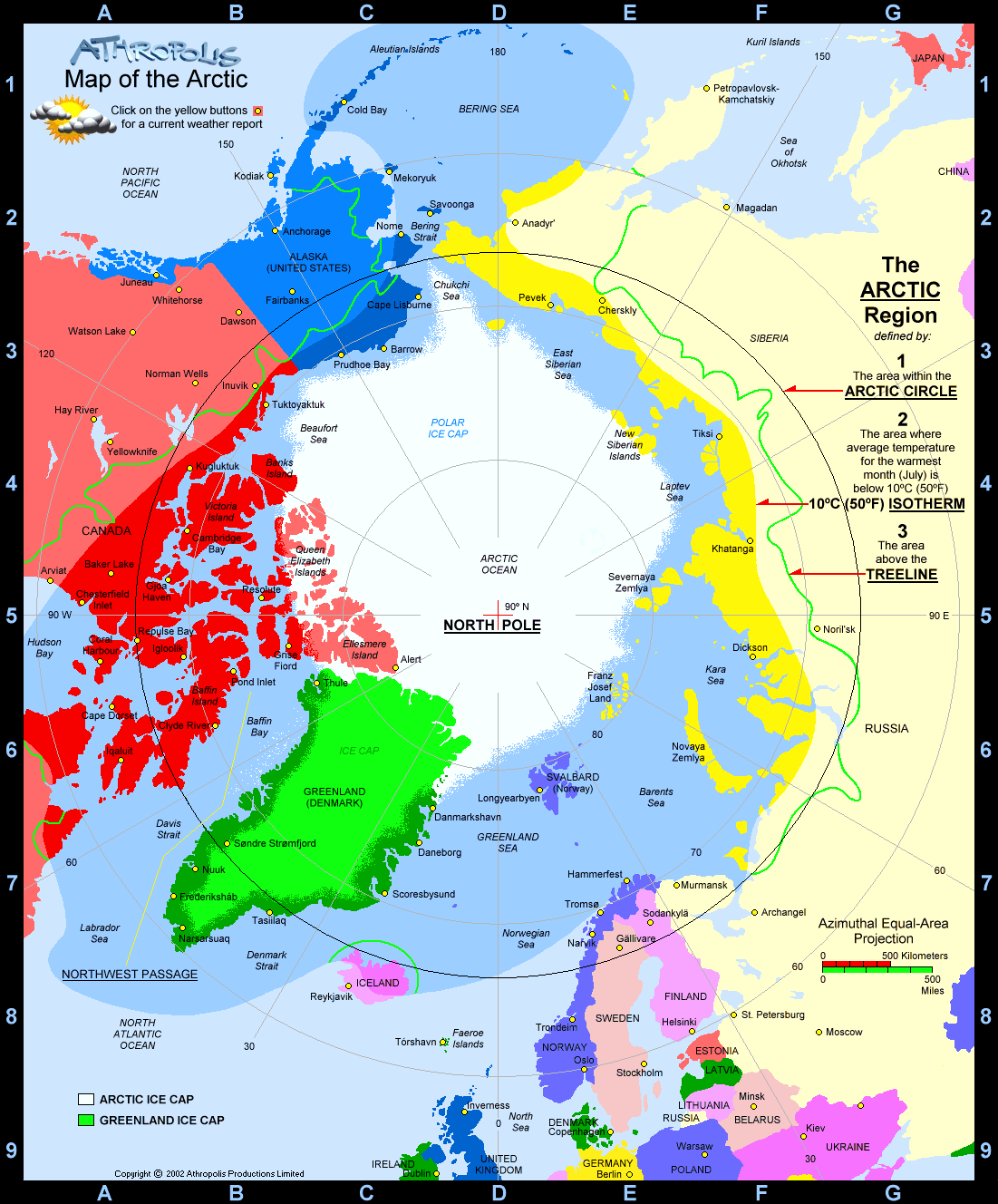
From athopolis an Arctic map that provides weather reports when you click on the stations (you have to click on the link, not the map, to access the weather stations.


The scary thought is that if you look at the ice maps NOT only are the Northwest passage and the passage near the Siberian coast open but the ice in a narrow band on the north shore of Greenland is opening and it is NOT impossible that the globe could be circumnavigated at latitudes higher 70 well inside the Arctic circle.

Monday, August 25, 2008

Scam Alert

via Inel, the WGGWCC08 3rd Global Warming and Climate Change International Conference & Exposition. (WGGWCC 08 ) is a scam. (Ear tip to Brian Schmidt for the pointer)

Sunday, August 24, 2008

Snark

Non-obvious advice to freshmen (and their folks)


Probably too late but here it is (the ground rules may differ in various places and this is VERY US centric)

1. Take EXACTLY 15 credits. You need 12 to be full time and you need to be full time to keep your financial aid. Taking 15 leaves room to drop one course. Berzerk professors are a risk, high school was a lot easier, the competition is harder, so you need to leave room to drop one. Your college is a new place with new rules. You don't want to be learning the rules with a 24/7 load.

2. Professors are called Prof. Rabett or Dr. Rabett, not Mr. Rabett, and unless they specifically tell you to do so, never Eli. Most teaching assistants are graduate students. They should be addressed as Mr. or Ms. Adjuncts can hold the doctorate or not. Check and address them appropriately. This is college, the ground rules are different.

3. Someone told you to look your professor's in the eye, stick out your hand and say, "I'm Mr. Bunny", so they will remember you. Someone told you wrong, this doesn't even work for salesguys. Most academics are introverts, they hate this crap.

3a. OTOH when you talk to your professor the first couple of times, say "Hi, I'm Ms. Bunny and. . . ." or if you encounter your professor outside the class "I'm Ms. Bunny and I'm in your 3PM lecture class. . . "

4. There are important differences between secondary school and college. In secondary school the burden of your learning is on the teacher, if you are "not getting it" the teacher is obligated to work with you until you do. In secondary school the teacher follows a syllabus that is mandated locally, often statewide. In college, the burden of your learning is on you. The professors present the material (hopefully clearly, tho not always) on a level that they decide is appropriate for the course. (Google helicopter parents for more)

5. Get a study group for each course. The group should be no less than 4 and no more than 5 students so that if one person can't make it you still have a group and no one can hide. Meet at least once a week. Have an agenda about what you will do/discuss. You should have read the materials and at least tried to do the assigned problems. That way you can spend time on the points/problems that gave most of you trouble. If all the points/problems give everyone trouble, you have the wrong study group.

6. You want to develop a professional relationship with your professors. This means talking to them about the subject. In particular, you will get extremely short shrift if you go up to them and say something like: "I don't understand anything", the correct approach is more like, "Yesterday you talked about adiabatic expansions of an ideal gas, how does that apply to the atmosphere" or "I had some trouble with this point (name inserted here) in the lecture, went home and studied the material, but I still don't get it, could you point me in the right direction".

7. You want to visit your professor no more than a 3 or 4 times a month. Some professors are very picky about their office hours, and don't want to see you outside of them, others are more welcoming, but may ask you to come back. IEHO you want to avoid the first kind, but YMMV.

8. Check how many majors there are in a department compared to the size of the department faculty. You will get a lot more care and feeding if the ratio is smaller, compared to larger. OTOH you want to have an idea of how intellectually active your professors are. Look them up on Google Scholar.

9. Towards the end of the year (not semester), if you are doing well in your major, you want to talk with your professor about doing undergraduate research. You should have a clear idea of what area of the major you are most interested in and talented in. The professor may pick you off for his or her group, or may steer you with a recommendation to a colleague. If you are not doing well in the first course for your major, you may want to reconsider your major.

10. Start thinking about what you are going to do in the summer in November. Applications for summer programs open in November and close in January/February. The deciding factor for an internship is going to be recommendations "Bunny Foo Foo was in my class and got an A, one of five in a class of 20" is the kiss of death. See 6-8. Undergraduate research, internships, the recommendations you get from them and the work that you have done are what gets you jobs, into professional school and more. See Bunny Foo Foo letter above.

11. Books are going to cost you $1K per year. In some courses the books cost more than $200/yr, in others pretty close to it. Reselling books sucks, you get less then you do at a car dealer, and besides which books are useful to keep. Many course/colleges have on line syllabii which list the books. Bookstores increasingly have on line sites that allow you to pre-order books. If nothing else this may help you avoid the line from hell that forms outside the bookstore before classes start.

The bad news is that publishers have a whole bunch of tactics to stop you from buying used books, including bundling on line homework systems (these systems are actually a very good thing) at low price with new books and selling the license at high price alone. Several states have now passed laws forbidding such bundling but they are not yet in force. Next year.

Another tactic is for publishers to change editions every three or four years. Most of the time all that they change is the problems. Ask the professors if it makes a difference if you buy the old version, a lot of time it does not.

Non-obvious places to buy textbooks are outside the US, the same books (watch the editions tho) are much less expensive elsewhere and available in paperback, this includes such third world countries as England, France and Germany. Shipping may be an issue, but if someone you know is going over there and willing to lug the book back (textbooks are increasingly the Osborne's of portable books). . .

Primarily for science majors:
12. NEVER take non-calculus physics. Physics without calculus makes no sense.

13. If your math SATs were under 550, take a college math course (probably algebra) before you try chemistry. Eli has been tracking this for years, as have a number of friends at the Carrot Bar Around the Corner from the Chemistry Building. Our experience is that SAT's, math pretests and such show that there is a minimum grade you need to have any chance of passing chemistry, but if students are above that minimum the course grades do not correlate especially well with the math grades. Taking college algebra and getting a good grade (if you don't you probably should not take chemistry) improves the odds no end.