Richard Tol,
Administrative update: In its wisdoom Blogger has instituted a spam filter into which comments appear to go for irregular reasons. Eli is now aware of this and will patrol, esp if something goes missing. These have now been restored as best as possible. Most were from this thread, but there were some others, so if your words of wisdom were eaten, they have probably been regurgitated (Eli hopes). That is all, but apologies for the interruption of services.
The rec ent discussions here, there and pretty much everywhere have been pushing on Richard Tol to defend his FUND model. In particular, on Deltoid, Bernard J and Jeff Harvey have been asking, ever so politely that Richard discuss the value of biodiversity in his model. Richard has put on the full court Pielke, telling everyone to go read his many papers.
Eli, well Eli is perfectly happy to accept Richard's invitation on their behalf and, know what bunnies, Bernard J was rightA description of the model, the assumptions, and the code can be found at http://www.fund-model.org/ There is also a list of papers there, and another list at my home page (just click on my name).
I'm perfectly happy to discuss things point by point, initiated by a blog post that sets out the issue.
Maybe Tim will oblige.
Richard Tol:
@Bernard There is no point in explaining and discussing a hugely complex issues [sic] in comments on a blog.Actually, I would think that a scientifically-oriented blog such as Deltoid would be the perfect medium in which to succinctly summarise and then to discuss the "hugely complex issues" underpinning your models' assumptions about the impacts of climate change.
All the more so if your assumptions are ecologically inadequate, because it is quite possible that your target audience in the journals where you publish could well miss the fact that you have over-simplified your modeling to the point of uselessness. It is in exactly a forum such as this where you might have a mix of expertise that can rapidly identify any critically important failings of your assumptions.
Rabett Run's motto is RTFR, so Eli hied hisself over to the FUND web page and went and downloaded the description of FUND 3.5. The description of how biodiversity is handled, is quite short, about a page
Tol (2002a) assesses the impact of climate change on ecosystems, biodiversity, species, landscape etcetera based on the "warm-glow" effect. Essentially, the value, which people are assumed to place on such impacts, are independent of any real change in ecosystems, of the location and time of the presumed change, etcetera – although the probability of detection of impacts by the ―general public is increasing in the rate of warming. This value is specified as

This can be divided into four parts. See below for more details. α is roughly the cost per person, where P is the number of people in a region r, at time t. The next term is a ratio of incomes, defined below. For an average current first world income of $30K, this is 0.5, but the majic of compound interest makes incomes grow so that in 2100 for the developed world it will be pretty close to unity. Since what happens to the developed world drives economic forecasts, this term too is not controlling, however, it is substantially less for the developed world, which raises ethical, but not economic issues.
The next ratio is essentially unity for Tol's choice of τ=0.025 K given any reasonable choice of the change in global temperature, and can be neglected. The last term is where the pea comes out of the shell. For the cost of biodiversity loss to exceed $50 per person, the ratio of the number of current species before 2000 to the number after is controlling.
whereStare at this for a while and you quickly convince yourself term that what really drives the cost is the last term. Eli built a table to show this, using median incomes of $30,000 for developed countries, $5,000 for developing countries middling China and India and $1,000 for underdeveloped countries. Eli used a 3% growth rate, and several values for the global temperature change.
- E denotes the value of the loss of ecosystems (in 1995 US dollar) at time t in region r;
- t denotes time;
- r denotes region;
- y denotes per capita income (in 1995 dollar per person per year) at time t in region r;
- P denotes population size (in millions) at time t in region r;
- ΔT denotes the change in temperature (in degree Celsius);
- B is the number of species, which makes that the value increases as the number of species falls – using Weitzman’s (1998) ranking criterion and Weitzman’s (1992, 1993) biodiversity index, the scarcity value of biodiversity is inversely proportional to the number of species;
- α=50 (0-100, >0) is a parameter such that the value equals $50 per person if per capita income equals the OECD average in 1990 (Pearce and Moran, 1994);
- yb = is a parameter; yb = $30,000, with a standard deviation of $10,000; it is normally distributed, but knotted at zero.
- τ=0.025ºC is a parameter;
- σ=0.05 (triangular distribution,>0,&lgt;1)
- B0=14,000,000 is a parameter.
| Year | Yt,r | [Yt,r/Yr] | ΔT | [ΔT/τ] | |
| (1+[Yt,r/Yr]) | (1+ΔT/τ) | ||||
| Developed | 2010 | $30,000 | 0.50 | 0.1 | 0.800 |
| Developing | 2010 | $5,000 | 0.14 | 0.2 | 0.889 |
| Undeveloped | 2010 | $1,000 | 0.03 | 0.8 | 0.970 |
| Developed | 2100 | $416,518.46 | 0.93 | 1.0 | 0.976 |
| Developing | 2100 | $69,419.74 | 0.70 | 2.0 | 0.988 |
| Undeveloped | 2100 | $13,883.95 | 0.32 | 3.0 | 0.992 |
For undeveloped countries the first ratio goes from 0.03 in 2010 to .32 in 2100 with a 3% growth rate. Of course, this means that for the undeveloped countries, Tol assumes, and his choice of parameters ARE assumptions, a current biodiversity cost of $1.50, but it is in precisely those regions where biodiversity destruction is hitting hardest today. Ethics anyone? This ain't ethics, it's economics. Yet, let us pass quickly from there to a consideration of the fun time guesstimates, that ratio of the current number of species Bo, to the number at time t, Bt. That's where Richard pulls a Lubos. Tol defines Bt
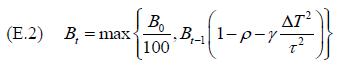
whereSome, not Eli, he hastens to add, might think this somewhat wrong. Others might think of it as insane. The numerical effect is to limit the cost of biodiversity loss per person at most to 100 ασ, or in dollars, 100 x $50 x 0.05, a maximum of $250. If you use Tol's parameters, you reach this wall in about 40 years, at which point 99% of the species on earth have disappeared in the great FUND die off. Perhaps this module of the FUND model needs, dare Eli say it, a bit more work.These parameters are expert guesses. The number of species is assumed to be constant until the year 2000 at 14,000,000 species.
- ρ = 0.003 (0.001-0.005, >0.0) is a parameter;
- γ = 0.001 (0.0-0.002, >0.0) is a parameter; and
UPDATE: Below in the comments, Richard Tol asserts:
"$250/person/year is the value of an additional species lost when 99% of species are lost already. It is not the value of losing 99% of species. "To which John Quiggen replies:
But with Bt=B0, the measure is of the order of alpha, that is, about $50. So, the value of saving 1 per cent of species is about $50*0.01*B0/person/year, or around $7 million/person/year. So, if the quoted sentence is correct, the model would seem to imply the need for an all-out effort to minimise species loss. Fine, but the results don't seem to come out that way.This being what is technically known as being between the cheap devil and the very costly sea. Tol can escape from the undervalue argument only by pushing the cost of 1% species loss up to several hundred times the average yearly income of everyone on earth.
UPDATE2: Richard Tol replies
-
Note that there is further confusion (partly caused by my attempt to explain things in simple terms).
The model is specified such that a warming of 0.025 oC per year (2.5 degree per century) would lead to the extinction of 0.1% of species. The value of $50/rp/yr is for 0.1% = 1,400 species (at present).
This then goes up to $250/rp/yr for 14 species at 99% biodiversity loss.
-
Thanks, Richard, this explanation helps a bit. But 0.1 per cent of 14 million is 14 000, so we still have a factor of 10 missing somewhere.
- Tol:
-
@John Q
Sure. I did the math wrong at my comment of 6.06 am.
(Another reason why blogs are bad for this sort of discussion.)
Bluegrue adds
I'd like to point out Richard Tol's explanation.or ~10% per century.
The model is specified such that a warming of 0.025 C per year (2.5 degrees per century) would lead to the extinction of 0.1% of species.
This description is correct, but keep in mind, that he is talking about a rate of 0.1% per year.
-------------------------------------
Realistically, even a loss of a few percent of the species on earth would be an economic and humanitarian disaster. Richard appears to be rooting for the Grim Reaper. Eli notes the resemblance.
UPDATE: In the comments Jeff Harvey provides an expert estimate of the outer boundary
There is little doubt in my mind, speaking as a population ecologist, that it is dangerous talk to try and extrapolate the cost of losing additional species once 99% of species diversity has been extirpated. My view is that at this point, humans would almost certainly be amongst the victims. Even if we weren't, such a decimation of the planet's life support systems would mean that life is hell for the survivors. The value of remaining species would be either nil or infinity, depending on the roles they would play in maintaining conditions making the planet remotely habitable. But, to reiterate, such models in my view are useless because I do not think that any population of systems ecologists would even want to try and comprehend what the planet would be like if 99% of its species were gone. I think that things will start to get tough when we approach 20 or 30%, let alone 99.---------------------------------------------
At 10% or so we might as well pack up the earth and head for Hansen 1.
"...Hansen's bones are quiet at last,
...No science disturbs the lucid line,
For sun-scorched Earthers tune their thought
To Offword Station 'Holocene-1'
From where they know just what they ought,
...memories of times past that should be banished
Only relics, philosophies and a parched wasteland lie below..." - Barry Brook








 Posts


