Monday, April 21, 2008

In the trenches

Over at Deltoid, a commentator going by the handle of Schneb posts from the secondary school trenches about teaching current affairs (it's pretty long, but you need the entire comment to see the issues that are raised and that Rabett Run wants to consider)

I teach a current events-type course to 12th graders. We spent quite a bit of time on Global Warming. There were two bright, very nice, responsible young people who kept to themselves in the class--I can't blame them, the rest of the class, as 2nd semester seniors tend to be, were NOT the most focused, thoughtful people.

But as time went by, I realized the two 'nice' students were not just different in behavior, but in outlook: to them, Global Warming is an invented scheme, and/or hysterical over-reaction. And like the young blogger profiled on NPR, they have news stories about various carbon reading techniques, or the growth of the polar bear population, etc. to back themselves up. They see the mass of scientists who agree that GW is real and caused by human behavior as self-serving careerists who somehow profit from adopting/promoting the GW party line.

But the two that I'm talking about really are nice people--so they don't do a Penn & Teller 'Bull&$#@'-type proclamation of their views. In fact, it wasn't clear that they were hardline in their views 'til we were most of the way through the unit (maybe they kept a low profile initially because, while they're sure they're right, they're used to the rest of the world seeing things otherwise and mocking or dismissing them?--just a guess). When I finally realized their 'take' on GW, I wanted to engage them and bring them around to what I see as the only legitimate view [GW is real/human-caused]--but a flat-out dissing of their view would only have put me on their long list of 'sheep who follow the self-serving GW deceivers'. So I tried a couple of ways to indirectly explore the issue so they'd see the error of their ways. They never said, 'gosh, maybe it IS real!'--more the opposite, actually--so I can't say that I had any success, but I hope they'll eventually come around and that I started opening their minds a bit.

I mention this because the problem isn't that a GW-denying teen-blogger was profiled on NPR. It's what she stands for (and that's what I saw the NPR piece as being about). There's a sub-culture of anti-GW folks out there. And like the blogger, they can sound knowledgeable. As all here seem to agree, this is the problem.

And as you all have noted, others, who see GW as real, don't always sound knowledgeable. As I remember the NPR story, the blogger's friend sees GW as real, but couldn't say why. Sit that friend in a room with 2-3 of the GW deniers, who bombard her with legitimate-sounding criticism of GW and there'll be 3-4 deniers in the room (instead of 2-3).

But it's not just that the deniers have somehow fallen prey to bad science. Those who takes this position, and particularly the young people who do so, gets quite a 'rush' of self-empowerment. Sorry if this seems extreme, but it's probably what fed the Hitler Youth, and the Red Guard, but in a less virulent form: a basis for flouting authority; instead of being a dependent, subservient 'youngster' you get to thumb your nose at the dusty old, wrong-headed, know-it-alls, and you get to do so by (in your own eyes, at least) being smarter than them.

I don't mean to say that the two very nice young people in my class are somehow comparable to the Hitler Youth. Far from it! They are not advocating violence or racism--I'm sure they are actively doing 'the opposite', whatever that would be--but I think they're getting a little of the same vibe that fed the HY, etc.

I mention this because understanding where they're coming from, is important.

It's not a question of science alone, but of psychology, as well.

Showing them that their graphs are wrong might be very satisfying--and might keep them from convincing their friends to join (if the friend witnesses your debunking of the debunkers)--but I don't think you're likely to set them straight. It's not about the graphs for them--its about how they see themselves, and that's based on how they see anyone who says GW is real/human-caused. This is about identity, as defined in terms of 'science'--not science.

And frankly, that same psychology underlies a large part of what the religious right (of which these two young women may be a part) is all about, in general, as far as I can see.

It helped me to lay this all out. Sorry if I'm didactically stating the obvious.

This is as good a statement of the problem as Eli has ever seen, but it is also clear that there is not one problem but several.

1. The first, let us call it modestly, the Eli/Mashey N3xus is to expose the bad science for what it is so that those with casual interests don't fall prey. At the extreme this means confronting the agents of denial publicly.

2. The second, we can call this the Schneb imperative, is to not further alienate the cultural denialists and, at best, to raise some doubts in their minds which may later have an effect.

3. Then again there is the question of how you correct a sympathetic, but wrong advocate. Simon Donner points out wrt Kristen Byrnes
Are we really having this discussion? This is a high school student. Seriously, this is exhibit A for all those who argue we do more harm than good attacking 'skeptics'.
Those are the issues. The question is what is the proper order of concern, is putting out an answer more important than not further alienating the alienated, how should one avoid ticking off bystanders. In short, what should be done.

It's not what you don't know that gets you,
it's what you think you know and is wrong


Eli was writing another thumb sucker which required that he calculate the CO2 forcing. He used the Mauna Loa and the Law Ice dome data. A bit of Googling found that the forcing is usually given as 6.3 ln (C/Co) where Co is the mixing ratio in ppm from 1880 and C the mixing ratio at any other time. The 6.3 is the IPCC recommendation (and indeed, you can find it in a forcing calculation used at Climate Audit). The 0.67 is a reasonable climate sensitivity given in K/(Watts/m^2), you might argue that 0.75 is a better current estimate, but it really doesn't make much difference

Some time ago Eli put up a bunch of graphs with different forcings, but didn't tie the forcings to temperature. He thought it would be a good idea to complete the circle, putting CO2 forcing and global temperatures on the same scale.

The changes in CO2 mixing ratios and calculated forcings can be seen in the graph to the right. The shape of the forcings follows the temperature curve quite well. It overestimates the temperature change by a bit, but, for a BOE calculation, it shows, especially in comparison with any multiple of the solar forcing, a good agreement with the observed global temperature increase.

The mixing ratios, of course are on a different scale so the so the comparison between the two is strained, but if you graph mixing ratio vs forcing you get the correct logarithmic dependence. For example, using this rough model the CO2 forcing at 2x CO2 is ~2.9 K, while at the current value of 380 ppm it is ~ 1.1 K.

Thursday, April 17, 2008

Kristen and the Strawmen

Given the dust-up (Deltoid, Islands of Doubt,
Adventures in Ethics and Science, Pharyngula, Respectful Insolance, Quark Soup and Eli tires) about an NPR report on Kristen Byrnes and her opus, "Ponder the Maunder" Eli thought he would wander over and take a look again after the last two go rounds.

UPDATE: Michael Tobis has a great comment on the outbreak of precociousness with the coming of spring at Wired Science (also a few typos Mike)

It was quite painful. Eli is thinking of charging NPR for pain and suffering. Mostly what it was was an unending series of strawmen

According to the Wikipedia, a strawman can be wished into existence by
  1. Presenting a misrepresentation of the opponent's position and then refuting it,, thus giving the appearance that the opponent's actual position has been refuted.[1]
  2. Quoting an opponent's words out of context -- i.e., choosing quotations that are not representative of the opponent's actual intentions (see contextomy and quote mining).[2]
  3. Presenting someone who defends a position poorly as the defender and then refuting that person's arguments, thus giving the appearance that every upholder of that position, and thus the position itself, has been defeated.[1]
  4. Inventing a fictitious persona with actions or beliefs that are criticized, such that the person represents a group of whom the speaker is critical.
  5. Oversimplifying an opponent's argument, then attacking the simplified version.
A lot of the comments here and there have been about the collective intelligence of NPR. As to Kristen herself, PZ Meyers gets it pretty well, probably because he has a bunch of Kristens in his classes
Woo hoo, teenager thinks she knows more than scientific experts … now that is news. I took a look; I'm unimpressed, even considering her age. Parroting right-wing think tanks is not evidence of independent, skeptical thought, I'm afraid.
But Eli's approach to this sort of agitprop is to look at the arguments, one at a time. So Eli looked at some of Kristen's. UPDATE: (Temporary link to page in Google Cache, they are overlimit this month. )

The data that Dr. Keeling collected shows a steady increase in atmospheric CO2 levels to the current level of about 380 parts per million.
True enough
Some scientists believe that CO2 increases are man made, other scientists have warned that past atmospheric CO2 levels calculated from studying ice cores are inaccurate and that present atmospheric CO2 level increases are a result of natural causes.
Who would those other scientists be, why our old friends EG Beck and his running mate Jaworowski, who provide negative information content on the subject, but their existence allows the Kristen's of the world to build a strawman. Of course, she is not the only one. Fred Singer himself used exactly this tactic in his Heartland Institute Nonsensical Summary for Bad Climate Policy, including the half hearted fade out to another strawman
To me, this argument was put to rest by NASA’s Jet Propulsion Laboratory whose satellites and sensors have been able to track CO2 sources and have concluded that the current increases in atmospheric CO2 are coming from raw coal burning family home heaters in the third world, primarily in China. Dr. C. Miller of JPL, Director of the Carbon Observatory Project, stated on his web site that ½ of industrial CO2 has been cleansed by the atmosphere.
Kristen appears to have missed a few things, but she is not big on useful references. It is clear that for atmospheric CO2 the rate of increase is being driven by the industrialization of China and India, but that US and European emissions contribute equal amounts to the absolute increase, it's just that our emissions are not growing as fast. The bit about home heaters almost certainly referred to black carbon emissions, not CO2 emissions, a whole other (Googlable) ball of buckeys. And then we get the classic
If man is responsible for a 100 part per million increase of atmospheric CO2 levels we must still keep in mind that 100 parts per million is a very tiny number. Said another way, man’s contribution to atmospheric CO2 is only one ten thousandth of total atmosphere.
Yes kiddo, man is responsible for a 100 ppm increase of CO2, and given that 99% of the atmosphere does not absorb infrared light (oxygen and nitrogen), why yes that is an important increase. A venerable Type 1 strawman, but does the darling slow up, Sadly No
Greenhouse gases and the spectrum.

I will start this section with a very important point. CO2 in the atmosphere does not reflect radiation back to the earth as some have tried to state.
Gadzooks, a veritable Type 5 (with an admixture of 3 rolled in) strawman, and we get then a repeat of the some scientists tactic.
Some scientists have warned that when sun light strikes the surface of the Earth it is absorbed then re-emitted as infrared radiation. This infrared radiation is then absorbed by atmospheric CO2 and re-emitted back to the Earth’s surface thus causing the lower atmosphere to remain warmer.
True. For a good technical explanation of this see Arthur Smith's article on arXiv, otherwise read the Dot.Earth deaththread. This is a basic result which is discussed in all textbooks on atmospheric physics,
Other scientists say that CO2 can only absorb infrared at very limited wavelengths and that those wavelengths are already saturated.
It would be nice to know who these are, but Kristen doesn't tell, might embarrass the dears. Looks like a Type 4, but if that is not sufficient, she goes on
A simple example of this is that when you are watching television and someone is standing in your way, it does not matter if another person stands between you and the television. The light from the television cannot make it through the extra body when the first body is there. CO2 absorbs infrared radiation in very narrow bandwidths.
A Type 5 and Type 1 combo. The girl is good. Kristen, how bout you try this one. You (a 16 year old photon) are trying to get out of a building (the atmosphere), but there is a big guy in front of you blocking your path, so you go around him and escape. OTOH, if there are 20 big guys in front of you it might be a bit more difficult.

When confronted with this problem, the greenhouse theorists claimed that the CO2 re-emits the energy at a slightly different wavelength, but no measurements of this energy has ever been made and water vapor absorbs in the same wavelengths. Just how much of this re-radiated energy is absorbed by CO2 and how much is absorbed by water vapor is the key sticking point for many scientists who remain undecided about the greenhouse theory.
Not if they know any spectroscopy, or for that matter exist. The first statement about re-emission is just a little bit off and that about no measurements is wrong. Anybunny with access to a cooled or heated cell, a vacuum pump and an FTIR can do this in her own burrow. What we know happens is that the wavelength range emitted by carbon dioxide lower in the atmosphere is from a hotter gas, at a higher pressure. Both mean that some of the radiation cannot be absorbed by CO2 higher in the atmosphere. Then, of course, the higher you go, the lower the relative concentration of water vapor to CO2, as well. Eli did a whole series on these effects a while back. Kristen has hit the five-fecta, all five types of strawmen in one short paragraph. Depressing

Monday, April 14, 2008

Pat Robertson, Al Sharpton and Al Gore walk into a bar

Stop Eli if you've heard this one before, but it is what happens in a new ad by the Alliance for Climate Protection.

The public-service announcement - apparently Gore was directing - is meant to show that people who don't agree on much can still agree that the environment is important.
UPDATE: Rabett Run is now showing this ad in the upper left corner.

Saturday, April 12, 2008

The sins of the fathers


A hallmark of the modern punditocracy is that those who were wrong are taken to be the great and worthy, invited to pontificate in all venues and called on by the mighty for advice. In fact, they should be clothed in sackcloth and ashes and either sent into the wilderness to repent, or, given the damage they have done, have a final professional Roman bathtub sitdown, but that does not appear to be an option, which accounts for Eli's general outlook.

Rabett Run linked to recent papers on how we got into the climate science corner of the mess. Oreskes, Conway and Shindell (OCS) describe how William Nierenberg, led and distorted a 1983 National Research Council report on the consequences of man made climate change. Here we emphasize the corrosive role that Gary Yohe and William Nordhaus and a later Nobel Economist, Thomas Schelling played in the process and the consequences thereof. Nierenberg was the Director of the Scripps Institute of Oceanography, a member of the National Academy and soon to be a founder of the Marshall Institute, a position from which he, Fred Seitz and William Jastrow threw sand in the face of science till their deaths.

The Nierenberg report followed reports on climate research by a committee headed by Jule Chaney and from the JASON group which established (see papers by Oreskes and Myanna Lahsen) [link updated - thanks to Stoat], even then a consensus that increasing greenhouse gas concentrations were known to be a serious threat. Nierenberg built a jury rigged sandwich with moldy bread.

The physical sciences, in the middle, were pretty much along the lines later filled in by the IPCC process. There was more uncertainty, less was known then, but the broad outlines conformed to the current scientific consensus, however the bread that held the sandwich (and the bottom line conclusions) were from Nierenberg and his band of merry economists, singing don't worry, be happy we can take care of any problems later at lower cost, a song they are still singing as things get worse. Sadly, many are listening.

As OCS point out, they did so by accepting the conclusions of the physical scientists, but then only considering the least threatening of the range of possibilities.

Nierenberg’s principal tactic was to rely on the arguments provided by the two economists. At the first full discussion of the issues facing the committee, both Schelling and Nordhaus introduced the idea that climate change was not necessarily bad, that most likely it would have both negative and positive effects. Nordhaus wanted to evaluate costs and benefits, suggesting that although he “suspected that the impacts of increasing carbon dioxide would be negative,” they might not be, and it would be hard to prove either way, given the complexity of social and economic systems.
The economists provided the necessary cover and continue to do so for the Marshall Institute types, indeed it is the same economists.
Chapter 1, written by Nordhaus, Ausubel, and Gary Yohe, an economics professor at Wesleyan University brought in mid-stream as a consultant, focused on future energy use and carbon dioxide emissions. The long and detailed chapter was perhaps the first serious study of the problem that looked at many variables, and did not assume linear extrapolations. It began by acknowledging the “widespread agreement that anthropogenic carbon dioxide emissions have been rising steadily, primarily driven by the combustion of fossil fuels.” The emphasis here, however, was not so much on what was known, but on what was not known: the “enormous uncertainty” beyond 2000, and the “even greater uncertainty” about the “social and economic impacts of possible future trajectories of carbon dioxide.” This uncertainty provided the basis for an argument that no meaningful action could be taken now. They used the uncertainty to hide the pea, acknowledging the possibility of rapid and damaging changes, but then only considering far off and lesser threats from climate change. Moving the danger far enough in the future meant that it did not have to be confronted, which is what Nierenberg wanted as a conclusion Nor did Nierenberg attempt to deny the legitimacy of the existing science. Rather, he accepted the scientific facts while adopting a conceptual framework in which those facts were irrelevant. The essence of the report is the reframing of climate change as something that policymakers and politicians should ignore, which in the United States at least, for the next two decades, they largely did The actions of William Nierenberg belie that assumption. Nierenberg did not engage his scientific colleagues over the technical basis of their scientific views. He did not produce new or competing claims about how the Earth would respond to increased CO2. In short, he did not try to construct knowledge about the Earth. Rather, while accepting his colleagues’ technical conclusions, he dismissed the interferences that they (and others) had drawn from those conclusions, substituting an alternative framework that insisted that those inferences were wrong. Rather than constructing knowledge, William Nierenberg de-constructed it.
This fits well with current threads on grist and inkstain, where the protagonists walk right past what could have been done ten and twenty years ago if clear scientific conclusions had been honestly accepted and well into the postmodernist framing debate. Indeed OCS write 70+ pages on how Nierenberg was able to reframe the question of what was happening to climate, to that of should we bother doing anything about it. Which leads to the serious question of why Nordhaus and Yohe have any remaining credibility given that they played a knowing and crucial role in making us miss the opportunity to deal with climate change at low cost, at a crucial time. You and your children will pay the price.

Thursday, April 10, 2008

The third way

Eli and Ethon have been doing professional stuff, and are actually gonna be in the barrel for a couple of more days, but we have been following this and that. There is lots of discussion about adaptation or mitigation or both, or maybe, as Ethons favorite pecked would put it, adaptation in the first 23 paragraphs, and then a swift mention that mitigation can't do nothing for fifty years, but it would be a good thing, maybe followed by claims that he, poor dear, has been misquoted. Eli would suggest looking at the dictionary

adaptation: adjustment to environmental conditions specifically in the sense of improving the chances of survival
There are nasty implications in this that the Boys in Boulder have missed, or more likely are hoping you have missed, as in not everyone will survive, the changes needed to survive will have very negative consequences in other areas, it ain't gonna be cheap and they are obligated to pay for it. In the UN Framework Convention on Climate Change the developed countries clearly have accepted that burden (of course some of US probably lied)
Article 4.4 “The developed country Parties and other developed Parties included in Annex II shall also assist the developing country Parties that are particularly vulnerable to the adverse effects of climate change in meeting costs of adaptation to those adverse effects.”
The conventional other side is
mitigation: steps taken to avoid or minimize negative environmental impacts. Mitigation can include: avoiding the impact by not taking a certain action; minimizing impacts by limiting the degree or of the action; rectifying the impact by repairing or restoring the affected environment; reducing the impact by protective steps required with the action; and compensating for the impact by replacing or providing substitute resources.
The principle differences between mitigation and adaptation is that adaptation passive while being more expensive in the long and short run. Sometimes, if you mess up enough, all you can do is adapt. For sure those who push adaptation are members of the lie back and enjoy it club. Having brought us to this point by resisting action on climate change in the 90s, they are now claiming that, gee it's too late to do anything, and anything we do will take a while to have an effect. In short, they are the first we should throw overboard and the last we should listen to. Let your humble hare suggest a third word which encompasses both mitigation and an active attempt to improve the situation.
amelioration: amelioration is synonymous with improvement.

If a patient's condition shows amelioration, the patient is clearly better -- there is some improvement in her or his condition.

Amelioration infers that an effort is being made to correct or at least make more acceptable conditions that are difficult to endure.

The word "amelioration" is compounded from the Latin "ad",-", to or toward + ""melior", better = toward better = improvement.

When someone says that we have to ADAPT to climate change, tell them that they are wrong. Adaptation is what dumb animals do (Ethon demurrs). Humans work together to improve the world. We need to correct what climate change is making increasingly difficult and dangerous to endure. We need amelioration, right now.

Wednesday, April 02, 2008

Mole whacking

With the coming of spring, the moles have sprung up and the godly tire of 24/7 mole whacking duties. Some say, this stuff is so dumb no one could believe it, but, there are many sacks of hammers on two legs, and a lot of them are in state legislatures. Back in November, Rod Bembry, Head of the Kansas Department of Health and the Environment rejected an application by Sunflower Electric Power to build two coal fired plants on health and emissions grounds.

Sunflower Electric Power threatened to sue, sued and then attempted to buy the Kansas Leg to overturn the decision. Interestingly they were outspent 4 to 1 by a natural gas giant, Chesapeake Energy, still, the legislature easily passed a bill which would have overturned the decision, only for it to be vetoed by Gov. Kathleen Sebelius. As a friend in KS told Eli yesterday, there are enough votes in the lower house to sustain the veto, but what brings out the need for mole whacking is a comment in the KS Star article by Karen Dillon and David Klepper,

Count Rep. Larry Powell as a skeptic. This year, the Garden City Republican offered lawmakers copies of a book that asserted there was no scientific consensus on global warming. Titled Unstoppable Global Warming: Every 1,500 Years, the book was sent to Powell by the Heartland Institute, a free-market think tank based in Chicago that has received funding from foundations associated with the owners of Wichita-based energy giant Koch Industries and Exxon Mobil.

After state rejection of the Sunflower project, Powell wrote to the state's newspapers, saying carbon emissions likely would boost agricultural output by 50 percent.

Many lawmakers say climate change may end up being much ado about nothing.

And those scientists who say climate change could have a catastrophic impact?

"Hysterics who claim the sky is falling," said Rep. Mike Kiegerl, an Olathe Republican.

During four days of legislative hearings on the coal plant, only one climate scientist spoke. And he got only seven minutes to explain the work of the International Panel on Climate Change, a consortium of 2,000 scientists.

Not that it would help, but maybe we need to send Avery and Singer, Unstoppable Hot Air to our friends in Kansas?

Sunday, March 30, 2008

O. . . .

Friday, Eli wrote about recent papers by Myanna Lahsen, and Naomi Oresekes, Erik Conway and Matthew Shindell about the Marshall Institute's founders, William Nierenberg, Robert Jastrow and Fredrick Seitz. Lahsen came to the conclusion that after retiring these three attacked climate science and scientists to make up for a loss of status. Oreskes and Conway thought not, in Eli's word's if for no other reason that Nierenberg was director of Scripps, and had built up climate science there and Jastrow hired Hansen and built up atmospheric sciences at GISS. O&C ask if they would kill their own babies.

Lahsen and Oreskes and Conway are missing something important. All three papers demonstrate that Nierenberg, Jastrow and Seitz were willing to use any funding source to support their ambitions without scruple. The tobacco archive establishes how as president of Rockefeller University Seitz brought in major big tobacco research money, and how in retirement he was a major player in directing their research resources. As quoted yesterday about Jastrow
in David Randall's book General Circulation Model Development, Hansen writes

But at about that time, the director of GISS, Robert Jastrow, concluded that the days of generous NASA support for planetary studies were numbered, and he thus began to direct institutional resources towards Earth applications.
The Marshall trio pushed the line that climate scientists are in it for the $$. Nierenberg, Seitz and Jastrow were simply reflecting on what they had done.

Saturday, March 29, 2008

Speak some ill of some dead


Recent weeks bring news of the death of Fred Seitz and Robert Jastrow. Eli is not shedding a bunch of tears. Rabett Run has described how over three decades Seitz provided cover for the tobacco companies. Together with William Nierenberg, Seitz and Jastrow founded the George Marshall Institute, ostensibly to promote the Strategic Defense Initiative but later to deny the ills of tobacco, ozone depletion, man-made climate change and more. Nierenberg died in 2000

Three new papers deal with our trio (freely available):

One can also look for papers from a recent conference "Dissent in Science".

Lahsen thinks that the three came to their positions through a combination of arrogance and their loss of status as they aged.

In some respects Nierenberg, Seitz and Jastrow are representative of broader categories of which they are partly part. They share common characteristics with other physicists and with a particular subgroup of physicists and governmental advisors in particular, an older generation of elite physicists shaped by nuclear physicists. The Marshall Institute trio has lived through dramatic changes in popular attitudes towards science and the environment. Their engagement in US climate politics can be understood in part as a struggle to preserve their particular culturally and historically charged understandings of scientific and environmental reality, and an associated, particular normative order. The trio has found support for important dimensions of their worldviews and policy preferences within the backlash and among Congressional Republicans, but they must continuously contend with challenges to the privilege to which they had grown accustomed in science and government.
In passing she records a conversation with a young physicist which explains the arrogance
this is a problem with physicists: they think they know everything, because they’re smart. What they don’t understand is that yes, it is true, actually meteorology is a branch of physics. And so you take a physicist, like me, and you can sit him down, and in 2 or 3 years, they could learn meteorology. But physicists confuse being smart and having the ability to learn everything with actually knowing stuff!
Oreskes and Conway are not convinced, if for no other reason that Nierenberg was director of Scripps, and built up climate science there and Jastrow hired Hansen and built up atmospheric sciences at GISS. O&C ask if they would kill their own babies

Indeed, in David Randall's book General Circulation Model Development, (much there that bears on recent conversations) Hansen writes
But at about that time, the director of GISS, Robert Jastrow, concluded that the days of generous NASA support for planetary studies were numbered, and he thus began to direct institutional resourses towards Earth applications.
Still, Eli has heard rumors that Jastrow left GISS when he ran afoul of regulations and was offered a Hobson's choice, without a doubt Nierenberg, Seitz and Jastrow were arrogantly proud, and Seitz was willing to front for the tobacco industry in return for power, money and visibility so he is not convinced totally of Oreskes and Conway's argument on this score.

They prefer another point Lahsen also makes:
The political preferences of climate change "contrarians" including Singer, Nierenberg and Seitz can be characterized as anti-communist, pro-capitalish and anti-government interference. We agree. Indeed, philanthropist George Soros has given this perspective a succinct label: "market fundamentalism". Market fundamentalists hold a dogmatic, quasi-religious belief in unfettered market capitalism, and therefore oppose anything that restrains the business community, be it restrictions on the use of tobacco or the emission of greenhouse gases.

There is something very peculiar about this, because many people believe in the merits of free markets but still accept the reality of global climate change. One can argue the merits or demerits of carbon taxes, emission control, carbon credits and all kinds of other potential responses to cliamte change without denying the scientific facts - and indeed all over the world people are doing just that.
Oreskes and Conway conclude that Nierenberg, Seitz and Jastrow viewed climate change through the lens of the Cold War
The Cold War however is over. We face now not a binary choice between communism and capitalism (if ever we did) but rather the realization that capitalism has had unintended consequences. When humans began to burn fossil fuels, no one intended to create global warming. But they (and we) did. Capitalism triumphed over communism, but now must deal with its own waste products.

Thursday, March 27, 2008

Link

John Mashey's take on Schulte's E&E paper has stirred the firm of Monckton of Brenchley (not verified) to threaten dire dires. This is something to link to. Pass the popcorn

Uben! Uben! Uben!
(Calibrate, Calibrate, Calibrate)

Well, not really a good translation. In Germany, screw ups on the football field are greeted by a heartfelt shout: Uben! Uben! Uben! or practice, practice practice. Eli is much in favor of this, but common sense is also needed. Tim Curtin springs to the defense of inanity over at Deltoid and criticizes Eli's take on the good Diplom Beck. Yves decks him by pointing to "Oxygen Deficiency in Antarctic Air" by Ernest Lockhart and Arnold Court that appeared in Monthly Weather Review. Starting from the conclusion of sod. . .

"they got CO2 concentration wrong by 200ppm at the worst! (and we don t really know what the real CO2 concentration was at the place they were measuring!"

They, IMO, are mostly Beck and ZJ when making global conclusions from local measurements from primary authors whose first purpose were not always CO2 levels, even local (see for instance Lockhart and Court 1942 available in docs.lib.noaa.gov/rescue/mwr/070/mwr-070-05-0093.pdf, about ... oxygen depletion in Antarctica).

which Eli had mentioned about a year ago.

Eli is having the kind of week that Ms. Rabett goes revenge shopping during, possibly this will be a mite too strong, but it is exactly this sort of thing that differentiates the telephone book that Beck published, a critical review such as the IPCC report, or a decent scientific paper, like Machata and Hughes' "Atmospheric Oxygen in 1967 to 1970" Science, 158 (1970) 1582.

We see the same sort of ingrained nonsense from the engineering types who insist that data analysis consists of simply writing numbers down without worrying what they mean and never, no never, evaluating if they make sense and what sort of corrections need to be made. Thus the recent spate of the world is cooling since 1998 naivety, be it put on or real, and bunny labs can make a pretty good guess at that choice too.

Machta and Hughes measured atmospheric oxygen mixing ratios from 49 North to 60 South latitude and found no variation within the accuracy of their measurements settling on an average value of 20.946 percent. They looked at previous measurments and evaluated them. Some were ok, some were dodgy. They comment on the measurements of Lockhart and Court:
In 1942 Lockhart and Court reported oxygen abundances in Antarctica averaging 20.92 percent by volume and suggested that the low values might be unique to the location. Glueckauf pointed out that they performed no analysis of normal non-Antarctic air to confirm their procedures. To further cast suspicion, their carbon dioxide abundances were many times higher than that found in recent times. Table 1 does not suggest lower values approaching the Antarctica (sic).
The method that Lockhart and Court used had a resolution of 300 pppm for CO2 and 400 for oxygen. They found CO2 mixing ratios as high as 1700 ppm. For example between January 2 and January 4th they recorded values of 1700, 1500 (1/2), 1100, 900 (1/4) and 400, 200, 600, (1/55) 600, 700 (1/5 sample 2), 1600, 1400 (1/6). Think about what it would mean, if rather than a change in local conditions, or bad measurment methods or techniques, if this had really been a change in the background level of CO2 in the atmosphere.

Thus, another Beckie GOGI, garbage out tells you that what went in was also garbage, or that someone made garbage in the measuring process. (End of post)

Friday, March 21, 2008

GOGI**


As Tonstant Weader knows, Eli has found the Good Diplom Beck a bit too hummy. Bunny Labs has had a word or two or three or four to say about Ernst-Georg Beck who never met a CO2 measurement he did not accept as representative of the background atmosphere, especially when it was taken in the middle of Paris or some other large city, which as we all know has a bit more CO2 in the air, then in your average fizzy beverage of choice. The Rabett is not the only one to notice this, so has Coby Beck, as has Tim Lambert, as has Stoat (see we only disagree about how much ice to put in the Scotch, Eli says none for the good stuff) and as has Real Climate, in a post titled Beck to the Future, Eli believes one of the first times the eminent scholars over there were so enraged they resorted to punishment.

Having misplaced an early copy of Becks manuscript, 180 Years of Atmospheric CO2 Gas Analysis by Chemical Methods" Eli didn't have the carrots (you guys better pay attention to those ads on the top left) to penetrate the Energy & Environment paywall, but, good fortune, it now has reappeared on Beck's Blog, together with some comments published in E&E by Harro Meijer and Raph Keeling, CD's son, and a pretty good atmospheric scientist himself.

Meijer starts gently
Beck has re-interpreted various 19th and early 20th century chemical CO2 measurements, and derived very far-reaching conclusions. His work, however, contains major flaws, such that the conclusions are completely wrong, as they are based on poor understanding of the atmosphere.
Which, of course, was Eli's point in Amateur Hour. Meijer concludes by stating his disappointment with Princess Denial, Sonja Boehmer-Christiansen
It is shocking that this paper has been able to pass the journal's referee system. "Energy and Environment" apparently has been unable to organise a proper peer review process for this paper, thereby discrediting the journal.
Ralph Keeling is not so forbearing
The Beck article provides an interesting test case for E&E's recently advertised willingness to serve as a forum for "skeptical analyses of global warming" (E&E mission statement, Dec. 2006). The result was the publication of a paper with serious conceptual oversights that would have been spotted by any reasonably qualified reviewer. Is it really the intent of E&E to provide a forum for laundering pseudo-science? I suggest that some clarification or review of the practice is appropriate
This pretty much ensures a never ending supply of Beckies, so let's go to the tape

Ernst-Georg, of course, could not let it go, being the toast of the
Theodor-Heuss-Akademie, is not something to be sneezed at if you are a bio teacher at a Gymnasium. Meijer and Keeling pretty much said the same things that were laid out in the blog links above, e.g. it is not very smart to use measurements taken in areas where there is a lot of combustion to represent the background level of CO2. Georg Hoffman pointed this out in Real Climate

Secondly, nearly all early sampling facilities were tested in continental environments often under the sporadic influence of heavily polluted air masses (such as Paris, Parc Montsouris, Copenhagen, Dieppe etc.). How large is the influence of such “CO2 pollution”? A quick tour through my car-traffic-saturated home town, Paris, can give us a good first impression:

  • Jardin Luxembourg (major but still tiny green spot in the center of Paris) 425ppm
  • Place de la Bastille: 430ppm
  • Place de l’Etoile (the crazy huge roundabout around the Arc de Triomphe): 508ppm
  • And the winner was Place de la Nation: 542ppm (ie 160ppm over background!).
All these measurements by David Widory and Marc Javoy (reference below) were snapshot measurements, but they show how CO2 concentrations can vary strongly due to nearby fossil fuel combustion.
Keeling makes a point echoed by many
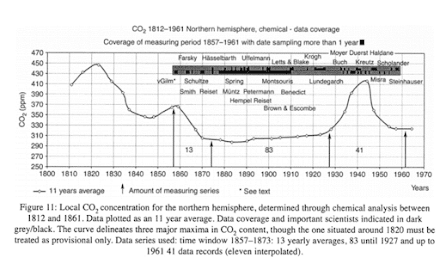
“It should be added that Beck’s analysis also runs afoul of a basic accounting problem. Beck’s 11–year averages show large swings, including an increase from 310 to 420 ppm between 1920 and 1945 (Beck’s Figure 11). To drive an increase of this magnitude globally requires the release of 233 billion metric tons of C to the atmosphere. The amount is equivalent to more than a third of all the carbon contained in land plants globally. Other CO2 swings noted by Beck require similarly large releases or uptakes. To make a credible case, Beck would have needed to offer evidence for losses or gains of carbon of this magnitude from somewhere. He offered none.”
And, what else, dear bunnies, Beck completely misses the point
The criticism that my paper presents no evidence for loss of gains of carbon makes sense, but this was not the subject of the paper: it is restricted to quality assessments of the selection of old data.
Beck says that according to those truly excellent 90,0000 CO2 titrations by Nobel Prize Winners!!!! using chemical methods, CO2 went from 310 to 420 ppm in 25 years. Keeling notes that this requires an enormous release of carbon, one that no one has noticed, but that surely WOULD have been noticed. In polite seminars, this is called a Bull Chocolate Test, aka inducing a GOGI situation, if you get garbage out, you put garbage in. EGB is not one to notice that the thing melted in his hand.
It is surprising, that the old data suggest a variability of the sizes mentioned.
Ernst, follow the bouncing bunny. It is not surprising. It shows that the old data was not representative of the background CO2 levels, but was representative of the local situation, dominated by urban ills. You don't have to go any further
If, however, the base line over the period 1800 to 1950 was at a higher level than the generally assumed pre-industrial level of 280 ppm, then the swings reduce.
Keeling and Meijer and everyone else were using Beck's baseline. Beck does not recognize (pay attention you there in the back with the bunny Peeps) a worse problem on the downslope between 1945 and 1960 when the decrease in atmospheric CO2 would require that the earth opened and swallowed back the CO2 it generated between 1920 and 1945. BTW, we really do know about the background level in 1960, because the Mauna Loa measurements were going by then, but never mind because "if we don't know anything, we know nothing" according to Beck
There seem to be many aspects of the carbon cycle which are insufficiently resolved (e.g. the up welling from the deep sea in equatorial waters, a major source in natural cycle).
some frantic and irrelevant handwaving
Another aspect that seems to be neglected to date is that ice core data may indicate a too low CO2 value because of the presence of CO2 fixing bacteria (see Table 1 in Christner et al.).
and finally
It should be noted that the fundamentals of my assessment of the quality of the old measurements has not been challenged by RFK or by Meijer.
which, in case anyone is still paying attention, was because they did not have to do that to show that what was being measured was not what Beck (and those who did the measurements) thought they were measuring and besides which, if you know the literature, has already been done.

More to come. Get your Beckies here

** Garbage out, garbage in, a very common way that scientists think about things. If the result is beyond belief, so were the assumptions on which it was based. Eli will now hie himself over to the Wikipedia.

Thursday, March 20, 2008

Halloween Pictures

One of the mice, cce, suggested that Eli put up this image from the NASA there ain't no old ice today news conference.


Some things speak for themselves but Eli would remind gentle readers that the reason the bunny risked a couple of beers with Stoat was that the easiest place to reach a new extreme from is from a new extreme, especially if the system has some memory.


Wednesday, March 19, 2008

Gassing it up

Eli has had an idle thought. If you google "Sheep Mountain CO2 strip bark" you will hit the motherwave of denialist froth centered on the dendrology of very old trees high up in the Sierra sampled by Graybill. You could also add Campito, which is a bit to the north. Both can be found in the International Tree Ring Data Bank housed on line by NOAA. Now, being a curious bunny, Eli wanted to see where this was, and he had a map from "Trends in twentieth century tree growth at high elevations in the Sierra Nevada and White Mountains, USA from Bunn, Graumlich and Urban to go on. The area looked familar, so he looked it up on Google maps, and wadda you know, Sheep Mountain is right across from the Long Valley Caldera.

This may not mean much to the sheltered readers of this blog, but veterans of the CO2 comes from volcanoes nonsense will recognize Long Valley as the largest geological source of CO2 in the US, and pretty close to being the largest geological source anywhere until the next Pinatubo goes off (which may be at Long Valley:(.

A lot less than a zillion tailpipes but not zilch. Making the not so dumb assumption that winds move the CO2 from the caldera west up onto the mountain the case for CO2 fertilization looks pretty strong. OTOH, the level there could be a lot higher than normal and could have been so for a long time.


Elocution Lessons

Ethon brought in the mail on his way back from Boulder. In it was Eli's copy of EOS, the AGU membership magazine (pay the damn $20.00 dues, you can't even get a decent bunch of carrots for that these days with the $ in the toilet) Susan Hassol, one of RP Sr and Jrs. favorite punching bags, has written an elocution letter for scientists

. . .stop speaking in code. Words that seem perfectly common to scientists are still jargon to the wider world and always have simpler substitutes. Rather than “anthropogenic,” you could say “human caused.”
Your neighborhood Rabett has been very strong on doing this, although, as always there are lapses. BTW, don't just read the Boulder Post, read the comments esp that from Ben Santer to Jr. and watch for deployment of the Patented Pielke Aggressive Cringe. Hassol goes on
Instead of “spatial” and “temporal,” try “space” and “time.” When you talk about trends in degrees per decade, you are asking people to do math in their heads. Instead, try giving the total change over the full period of time. And know your audience; always use Fahrenheit for Americans.
Well yeah, but no ethical scientist uses Fahrenheit. Yet then we come to the most important part.
Clearly state the settled scientific conclusions. Do not overdo “weasel words” and caveats. We know it is warming and we know it is due primarily to human activity. Say so. Saying human activity “contributes” to global warming makes it sound like human activity might be only a minor contributor. It would be more accurate to say “most of the warming….” Clearly distinguish settled science from the details on which scientists frequently focus their attention. Avoid using the word “debate” in connection with climate change. It reinforces the mistaken notion that there is a debate about basic issues that are settled science. When referring to the whole issue, try something like “the urgent challenge of human-induced climate disruption” rather than “climate debate.”
Word choice is very important, Hassol makes some excellent suggestions
  • to lay people, enhance means to improve or make better... So the “enhanced greenhouse effect” or “enhanced ozone depletion” sounds like a good thing. Try “intensify” or “increase” instead.
  • “Positive” connotes good and “negative” connotes bad to nonscientists. So “positive trends” or “positive feedbacks” sound like good things. Instead of “positive trend,” try “upward trend.” Instead of “positive feedback,” try “self-reinforcing cycle.”
  • To people unfamiliar with the scientific method, a “theory” is just an unsubstantiate hunch, opinion, conjecture, or speculation. Instead of saying “according to theory,” you might say, “according to our physical understanding of how this works,”
  • I suggest avoiding the use of the word “theory” to refer to things as well established as the greenhouse effect or the human intensification (not enhancement) thereof.
She comes up with a very nice analogy for discussing hurricanes
The ever popular metaphor of loaded dice provides a good response to the question of how global warming is affecting various weather phenomena. When people ask if global warming is responsible for the recent streak of heat waves, floods, wildfires, and intense hurricanes, you can say that by loading the atmosphere with excess greenhouse gases, we are loading the dice toward more of these extreme weather events. The data show this is already occurring for many
phenomena; and models have long projected these changes
And how to deal with the ill posed question:
Rather than accepting the premise of a poorly framed question, reframe it. When people ask if global warming can be blamed for a particular hurricane, heat wave, fire, or flood, a simple “no” does not respond to the essence of the question. What they really want to know is whether global warming is having an effect on such events, and the science suggests that it is. You can reframe such questions to explain that global warming is increasing the chances of such events occurring, and you can also explain some of the connections.

Tuesday, March 18, 2008

Eli will have some ice on that

Eli went up to Philly today and returned with carrot gelato from Capogiro, something you should consider when there, or order some by Email. Ms. Rabett welcomed him home with spoon in hand.

So, constant reader, you ask, what about the ice up north. Perking along thank you, a lot of really thin stuff set to vanish when it warms a bit. You can get an idea of this by looking at the comparison between the low ice at the beginning of September and the ice today from Cryosphere Today. You might also notice that a lot of the "extra" ice from this winter is in the Sea of Okhotsk and the Bering Sea, up there at the top and especially the Davis Strait between Canada and Greenland. Stuff that will be gone soon, but pay attention to the coloring, the bright purple stuff is only 80% coverage.

Cymraeg llygoden
makes work for bunnies by pointing to an article from the BBC,

discussing how the old ice is flowing out of the Arctic, into the Atlantic, driven by the Arctic oscillation. Lots of figures, photos and the entire NASA news conference are available. Eli has a bet with Stoat, and an in with Santa, the Easter Rabett and St. Nick are in the same line of business.

Sunday, March 16, 2008

Pass it on


Watch S. Fred play telephone. You know, the game they learned at the N3xus6 School of Denial in Lesson Two, (excerpt to the right), where you get a bunch of denialists in at a conference sponsored by the Heartland Institute and they start makin' it up and then in Lesson Three, they start passin' it on.

Anyhoo, ol' S. Fred's little magnum opus, the Nonsensical Summary for Bad Climate Policy considers whether CO2 concentrations have been rising, and who are his go to guys for makin it up, why our friend

Zbigniew Jaworowski [1994, 1992] has repeatedly pointed to the unreliability of ice-core data to establish pre-1958 CO2 concentrations, thus creating doubt about the magnitude of the human contribution to the current atmospheric CO2 concentration.
The boojum and his slithy toves tore this apart, and for those who do not enjoy gray-green secretions on the floor, Hans Oeschger did the honors in Environmental Science & Pollution Research 2 (1) 1995, pp. 60-61 as did and so did Eli a bit, on the way to ripping a new one for S. Fred's other telephone partner
Ernst-Georg Beck, by assembling more than 90,000 pre-1958 measurements of atmospheric CO2 dating back to the nineteenth century, has shown rather large variations, including a major increase roughly coincident with a rise in ocean temperatures from 1920 to 1940 [Beck 2007].
Of course, Real Climate took Beck to the future, as the bunny had yet earlier. But we also get to watch the concern drip from the jaws of our concern troll

Others have disputed the significance of these measurements; the issue has not yet been fully resolved.
Lewis Carroll had it right
And as in uffish thought he stood,
The Jabberwock with eyes of flame,
Came whiffling through the tulgey wood,
And burbled as it came!

One, two! One, two! And through and through
The vorpal blade went snicker-snack!
He left it dead, and with its head
He went galumphing back
No better explanation gives of why vorpal blades are needed to finish off the Climate Jabberwocks and the difference between a telephone book (the
Nonsensical Summary for Bad Climate Policy) and the IPCC Fourth Assessment Report, an expert critical review.

Wednesday, March 05, 2008

The return of Maclaurin and Taylor

About a month ago, Eli made a serious error in expanding a function from which he has received a serious amount of grief. I suppose the point being that the rabett hole has its uses. The point was to show that there was little difference between using a linear function for modeling thermal emission and a function which varies as the fourth power of the temperature. There was a graph at the end which showed that this was true, but it got lost in the forth and back.

The Maclaurin series is an expansion around a point


f(a) means the function evaluated at point a, f'(a) is the first derivative of the function at point a, f"(a) the second derivative of the function at point a, etc. If we apply this to the Stefan Boltzmann formula for emission as a function of temperature
then (UPDATE: AARGH forgot the 2! (which I neglected anyhow) Thanks Nick (I think?)))What happens if we keep only the first two terms and expand the function around 300 K for temperatures in the range 250-350K
which is not bad. We could improve this by adding a small offset to the linear term

which is what we originally showed as the best linear fit.

Tuesday, March 04, 2008

A cornucopia of chocolate


as guthrie put it. Eli has started throughFred Singer's Nonsensical Summary for Bad Climate Policy. You gotta understand, forcing somebunny to read this thing straight is what the CIA substituted for waterboarding, but it is such a rich source of chocolate (thanks Fred) that it is hard to resist. So what to fisk, what to fisk, oh yeah on page 19.

Measurements of increased ocean acidity give us little additional information about the sources of CO2 increases. Although higher concentrations of carbon dioxide reduce the pH of the ocean to some degree, it still remains slightly alkaline; pH values range from 8.2 (in the Norwegian Sea of the North Atlantic) to 7.9 (in the Eastern Pacific and Arabian Sea) [Doney 2006]. There seems no imminent danger of impact on shell formation by marine creatures. The much-feared effects on coral growth are not supported by actual data. [Lough & Brnes 1997; Fine & Tchernov 2007]
Simon Donner will probably have some very nasty things to say about this startling piece of deception, but let us, dear anonymice, take a shot at it . What about
Measurements of increased ocean acidity give us little additional information about the sources of CO2 increases.
Strawman alert!! Strawman alert!! Strawman alert!! Strawman alert!!

Measurement of atmospheric mixing ratios, decline of O2 mixing ratios, pCO2 in the ocean, and the isotopic carbon composition and other stuff tells us about the source of CO2 increases. Ocean acidity is a RESULT of increasing atmospheric CO2 mixing ratios. So, dear mice, why did old S. Fred slip that irrelevancy in Eli asks, but let us pass on. How about
Although higher concentrations of carbon dioxide reduce the pH of the ocean to some degree, it still remains slightly alkaline; pH values range from 8.2 (in the Norwegian Sea of the North Atlantic) to 7.9 (in the Eastern Pacific and Arabian Sea) [Doney 2006].
Strawman alert!! Strawman alert!! Strawman alert!! Strawman alert!!

Ocean pH varies between oceans, the pH remains slightly alkaline. What we don't see is that the average pH has decreased by ~0.1 units since 1750 which corresponds to a 30% increase in [H+] concentration (e.g. acidity), that various types of sea life are well adopted to the local acidity and sea temperatures and not so for the changing ones.

Well, fish swim, but corals don't so are corals threatened? Maribo had some good stuff on that and Eli riffed on it a bit, but what do the Chicago boys have to say
There seems no imminent danger of impact on shell formation by marine creatures. The much-feared effects on coral growth are not supported by actual data. [Lough & Brnes 1997; Fine & Tchernov 2007]
Poor Eli, doomed to disappointment, he went and RTFR only to discover that S. Fred was dissembling, no, actually he was flat out selling male milk chocolate.

Fine and Tchernov, hmm, as the abstract says, what did they find
Anthropogenic-driven accumulation of carbon dioxide in the atmosphere and projected ocean acidification have raised concerns regarding the eventual impact on coral reefs. This study demonstrates that skeleton-producing corals grown in acidified experimental conditions are able to sustain basic life functions, including reproductive ability, in a sea anemone-like form and will resume skeleton building when reintroduced to normal modern marine conditions. These results support the existence of physiological refugia, allowing corals to alternate between nonfossilizing soft-body ecophenotypes and fossilizing skeletal forms in response to changes in ocean chemistry. This refugia, however, does not undermine the threats to reef ecosystems in a high carbon dioxide world.
Which in plainspeak means
  1. increase the acidity and
  2. the animals who build the corals can't form shells, but
  3. some of the animals who build the coral reefs can exist without shells, although
  4. fish and other animals who eat those newly naked coral dwellers will get fat
  5. until they eat all of them
  6. and the reefs disappear at least
  7. until the CO2 mixing ratio returns to where it was
  8. and the few remaining coral builders start working again, but
  9. don't hold your breath for this to happen
and in a reply to comments by George Stanley, they conclude
We share Stanley’s concern that our findings might be misinterpreted by the reader, as the title suggests “survival.” The last sentence in our paper, however, clearly states that while we discovered physiological refugia for corals under acidified conditions, coral reefs and their services will be lost. Corals without carbonate skeleton do not provide protection from predators to both the coral host and the numerous species that are associated with it. So even if corals survive acidification, reefs will not.
that last sentence was
Physiological, versus geographical, refugia may provide a broader explanation for the existence of corals during times of stress. It is important to note that although survival as soft bodies allows corals to persist, substantial decalcification of reefs will cause major changes to the structure and function of coral reef ecosystems and the services they provide to human society.
Technically the nanomules are called corals, and what they build are the reefs. At least some of the corals might survive without their shells, but many would become fish food. Worse, F&T did not look at all possible corals and many may not be able to survive without shells.

-The Auditors

Open Review


The Heartland Institute has posted the Non-SensicalGovernmental International Panel on Climate Change Summary for Policy Makers. In keeping with the real IPCC tradition allowing non-experts and experts alike to review their reports, Eli has been charged* with collecting open reviews of this document which can be deposited in the comments and forwarded to the authors, a handy list of which is

  • Warren Anderson -United States
  • Dennis Avery -United States
  • Franco Battaglia -Italy
  • Robert Carter -Australia
  • Richard Courtney -United Kingdom
  • Joseph d’Aleo -United States
  • Fred Goldberg -Sweden
  • Vincent Gray -New Zealand
  • Kenneth Haapala -United States
  • Klaus Heiss -Austria
  • Craig Idso -United States
  • Zbigniew Jaworowski -Poland
  • Olavi Karner -Estonia
  • Madhav Khandekar -Canada
  • William Kininmonth -Australia
  • Hans Labohm -Netherlands
  • Christopher Monckton -United Kingdom
  • Lubos Motl - Czech Republic
  • Tom Segalstad -Norway
  • S. Fred Singer United States
  • Dick Thoenes- Netherlands
  • Anton Uriarte -Spain
  • Gerd Weber -Germany
A few bloggish links provided, most have contact information but time is a wasting. Feel free to fisk the sucker.

Rabett Labs notes that several of these authors tried to play with the big boys and got slammed.


* I need the links

Some real fluid dynamics

Stoat has been investigating unicycles and fluid dynamics. Real Rabetts use non-newtonian ones

Sunday, March 02, 2008

A formal reply to Gerlich and Tscheuschner

Arthur (of dot earth fame), has composed a formal response to Gerlich and Tscheuschner. He comments on the thread All you never wanted to know about Gerlich and Tscheuschner

My formal response to G&T here:

http://arxiv.org/abs/0802.4324

"Proof of the Atmospheric Greenhouse Effect".

Contrary to the claims of G&T, I show here that:
1. An average surface temperature for a planet is perfectly well defined with or without rotation, and with or without infrared absorbing gases.

2. This average temperature is mathematically constrained to be less than the fourth root of the average fourth power of the temperature, and can in some circumstances (a planet with no or very slow rotation, and low surface thermal inertia) be much less.

3. For a planet with no infrared absorbing or reflecting layer above the surface (and no significant flux of internal energy), the fourth power of the surface temperature always eventually averages to a value determined by the incoming stellar energy flux and relevant reflectivity and emissivity parameters.

4. The only way the fourth power of the surface temperature can exceed this limit is to be covered by an atmosphere that is at least partially opaque to infrared radiation. This is the atmospheric greenhouse effect.

5. The measured average temperature of Earth’s surface is 33 degrees C higher than the limit determined by items (2) and (3). Therefore, Earth is proved to have a greenhouse effect of at least 33K.

-----
Silly to think this was even needed, but, I hope it helps. Spread it far and wide if you feel like it! :-)

That's all folks! Cue the merry-go round


Tuesday, February 26, 2008

Another CO2 roach motel?

As we all know the mystery is solved by tracking down the dog who did not bark in the night? Your challenge, dear anonymice, is to spot the dog in this story which is making its rounds.

UCLA chemists report a major advance in reducing heat-trapping carbon dioxide emissions in the Feb. 15 issue of the journal Science.

The scientists have demonstrated that they can successfully isolate and capture carbon dioxide, which contributes to global warming, rising sea levels and the increased acidity of oceans. Their findings could lead to power plants efficiently capturing carbon dioxide without using toxic materials.

"The technical challenge of selectively removing carbon dioxide has been overcome," said Omar M. Yaghi, UCLA's Christopher S. Foote Professor of Chemistry and co-author of the Science paper. "Now we have structures that can be tailored precisely to capture carbon dioxide and store it like a reservoir, as we have demonstrated. No carbon dioxide escapes. Nothing escapes -- unless you want it to do so. We believe this to be a turning point in capturing carbon dioxide before it reaches the atmosphere."

If you are of teh scientifical bent you can read more in Science
A high-throughput protocol was developed for the synthesis of zeolitic imidazolate frameworks (ZIFs). . . . Members of a selection of these ZIFs (termed ZIF-68, ZIF-69, and ZIF-70) have high thermal stability (up to 390°C) and chemical stability in refluxing organic and aqueous media. Their frameworks have high porosity (with surface areas up to 1970 square meters per gram), and they exhibit unusual selectivity for CO2 capture from CO2/CO mixtures and extraordinary capacity for storing CO2: 1 liter of ZIF-69 can hold ~83 liters of CO2 at 273 kelvin under ambient pressure.
and Nature Materials. Investors can go to the USPTO and look up the patent application. The $64,000 question (Eli is old and cheap) is what's missing in all these write ups?


Bunnies and anonymice can get an idea from the perspective on this in Science by Robert Service

On page 939, Yaghi and colleagues report a new robotic high-throughput scheme for creating MOF relatives known as zeolitic imidazolate frameworks (ZIFs). And Mallouk and others say that the work is again an important blend of fundamental research and a critical application: materials that might help coal-fired power plants filter out carbon dioxide from their smokestacks. Mallouk calls the new work "very clever" because Yaghi and his colleagues have designed their hubs and linkers to mimic the construction of zeolites, a family of natural porous compounds widely used as catalysts and filters in industry. But because ZIFs are stable at high temperatures and are easier to tailor by adding desired chemical functional groups, they may prove even more useful in the long run.

One key race is to create a MOF that can store hydrogen for use in future fuel-cell cars. High-pressure gas tanks do the job fairly well. But pressurizing gases is a big energy drain and can create a hazard if the gas tank is punctured in a crash. By filling part of the tank with a MOF's cagelike network built with hydrogen-absorbent metal hubs and organic struts, however, it is possible-- at least in theory--to store more of the gas at a lower pressure. Slightly raising the temperature or releasing the pressure then liberates the gas. Yaghi's group and Jeffrey Long's group at UC Berkeley both recently created MOFs that can hold up to 7.5% of their weight in hydrogen, better than a benchmark for hydrogen storage set by the U.S. Department of Energy. Unfortunately, they only do so at 77 kelvin (-196°C), making them impractical for real-world use.

In July 2007, researchers led by William Goddard III of the California Institute of Technology in Pasadena reported in the Journal of the American Chemical Society that adding lithium to a MOF should make it possible to store 6% of its weight in hydrogen at room temperature. Long says many groups are working on it, but "it's not trivial." Lithium, he points out, tends to hold strongly to solvent molecules after synthesis, and removing the solvent requires so much energy that it typically blows apart the framework.

To put it bluntly, these things could be roach motels, the CO2 checks in but it can't check out, or the energy bill at check out makes the entire exercise academic. That makes them not very useful since the cost of synthesis and the mass of material needed requires that any capture method has to cycle tons of time. Yaghi says the ZIFs can be cycled, but what is the energy needed to cycle the system, how many times can it be cycled and what is the loss of the ZIF effectiveness per cycle. Eli has seen a lot of pretty chemistry founder on engineering issues and when something like this, a well known issue with respect to hydrogen storage, is not discussed his nose twitches.

UPDATE: A number of other important issues are raised in the comments below. Eli urges you to read them. Among them:
  1. Tim McDermott- So 1 liter of ZIF-69 can capture 155 grams of CO2, which is 44 grams of C. Woot the problem is solved!
  2. How will these things do in the presence of water vapor which screws up zeolites - Bocco
  3. A good point is that the isotherms are constant implying they can handle changing pressure - Bocco
  4. David Benson likes chilled ammonia (he must come from Jupiter!:)
and more. Read the comments.

Yaghi's lab has made a step forward, but much remains to do.

Sunday, February 24, 2008

An example of why


Ethon flew in using the Way Back Machine attachment. Since the big guy is kinda slow, he has taken to doing the red-eye, followed by a quick spin in the time shifter however, you never know what will turn up in the ash can of history slot and, of course, it is Eli's job to clean up. Recently it was the text of a speech by Gerhard Gerlich of Gerlich and Tscheuschner fame at the Theodor-Heuss-Akademie, in Gummersbach, Germany on 20. 2. 2005.

Now some bunnies say that there has been enough, enough! on the other hand Gerlich and friend, have been, let us say not very friendly to the Rabett Run locals while being very aggressive about holding the one true second law, an attitude they are proselytizing throughout the deny-o-sphere. Their oh we am physicists and we know it all attitude is wearing, especially since they have not a clue. Anyhow, here is an example GG imposed on the Theodor-Huess-Akademic in Gummersbach to show that there is no greenhouse effect. The answer to the puzzler is given after the jump.

Gegenbeispiel 1:
Ein Wassertopf auf der Herdplatte. Ohne Wasser wird der Topfboden rotglühend. Wasser absorbiert die Infrarotstrahlung hervorragend und läßt das sichtbare Licht weitgehendunbehindert durch. Mit Wasser wird aber der Boden nicht rotglühend, also ist mit Wasser bei gleicher Heizleistung der Boden wesentlich kälter.
oK, it was in German, which translates as
Counter example 1:
A pot of water on the (electric) stove. Without water the bottom of the heating plate pot glows red. Water is great at absorbing the infrared radiation and lets visible light pass pretty much straight through. When you put the water on the heater the plate bottom of the pot doesn't glow red, so with water using the same heating power the electric stove plate bottom of the pot is a lot colder.

(Thanks to Martin for the correction on Boden)
So little ones - what did friend Gerlich miss? Here is a hint: make yourself a tea.


Water boils. Before it boils it evaporates, the heat loss is called latent heat, and is a major way in which the surface loses energy to the atmosphere (convection and radiation are the other two). Without a pot of water, the electric heater loses heat by convection and radiation. Put a pot of water on, and first the water is heated by conduction from the heating plate (this cools the plate as it is an additional heat loss mechanism), then evaporative losses move heat from the water to the atmosphere, and this large heat loss cools the electric plate.

Of course, if you boil all the water away, that electric heater glows red again because there is no loss of latent heat by evaporation (boiling being rapid evaporation). Difficult to know what G means by this example, a counterexample for the atmospheric greenhouse effect it is not, a difficult problem to understand, it is not. What does Gerlich think this shows?

It is not simple for laymen to find the cause of physical effects. A model of effect requires both a cause and an explanation. Both must be there. Even the Neanderthals used skins to reduce convectional cooling. You don't need any "physical explanation" for that. Thus, you don't find the "normal" greenhouse effect (auto or greenhouse) in any physics textbook. You also don't find the atmospheric CO2 greenhouse effect described in any theoretical physics textbook. That, taken together with these counterexamples shows every layman that this effect does not exist physically because the "physical explanation" is false.
Friend Gerlich is quite proud. At the beginning of this opus he mentions with due modesty:
Ich lege großen Wert darauf, daß ich kein Klimawissenschaftler bin, erst recht kein selbsternannter, sondern ein theoretischer Physiker. Auf jeden Fall verstehe ich von den physikalischen Grundlagen der fiktiven atmosphärischen Treibhauseffekte mehr als alle Klimatologen zusammengenommen, was naturgemäß gar nicht so schwer sein kann.
or
I am proud that I am not a climate scientist, even a self described one, but a theoretical physicist. In amy case, I understand the physical basis of the fictional greenhouse effect more as all the climatologists taken together, which, naturally can't be so difficult.
Better he should take a beginners course in atmospheric science and after that, perhaps something more complex. Oh yes, Dr. Gerlich will cheerfully send you a copy of his 1996 opus.
G. Gerlich: "Die physikalischen Grundlagen des Treibhauseffekts und fiktiver Treibhauseffekte", in: "Treibhaus-Kontroverse und Ozon-Problem", Europäische Akademie für Umweltfragen (1996), S. 115-147).
The Rabett shudders.