Monday, January 23, 2012

Sunday, January 22, 2012
South Carolina sez Rick Santorum is too moderate
Dave Weigel (no liberal) at Slate:
Rick Santorum is the lone "compassionate conservative" in the race, the only one who talks about protectionist trade, rebuilding manufacturing, and income inequality. (Yes, yes -- , his as Yglesias points out, his tax plan is still regressive. But we're grading on a curve.) He utterly failed to convince conservatives that he -- a happily married father of seven with a serious record of wins in Congress -- was the right anti-Romney. It's not a fair fight, and I'm sure Santorum could win over most Gingrich voters in a lab experiment, but you have to consider why Santorum's specific brand of populism falters as Gingrich's big-picture, Glenn Beck-ian anger thrives. Gingrich and Ron Paul are the most apocalyptic candidates, insistent that America is run by socialists who risk destroying everything. Santorum won't go that far. At a Chamber of Commerce event I wrote about this week, Santorum was the only one of three candidates (Gingrich and Perry were the others) who argued that the National Labor Relations Board might be fixed, not defunded and destroyed. Not good enough!
This is the context in which we're fighting for climate realism within the Republican Party.
Wetting the stratosphere, boiling the oceans
The Capitalist Imperial Pig discusses whether the Earth could go into meltdown, pointing to an article at the MIT Technology Review based on a submission by Colin Goldblatt and Andrew Watson available at arXiv. The manuscript itself is quite clear and differentiates different kinds of runaway warming, the second , and the one Eli will think a bit about comes from determining the vapor pressure of the stratosphere by temperature of the tropopause. In other words, the flux of water vapor into the stratosphere is determined by how much can get through the cold trap at the tropopause.
In radiative equilibrium, the upward longwave flux must equal the downward shortwave flux throughout. Two consequences of this are that the temperature increases with optical depth (this increase is rapid once optical depth > 0.1) and that a higher absorbed shortwave flux will mean that the stratosphere is warmer throughout.They show this in their Figure 2.
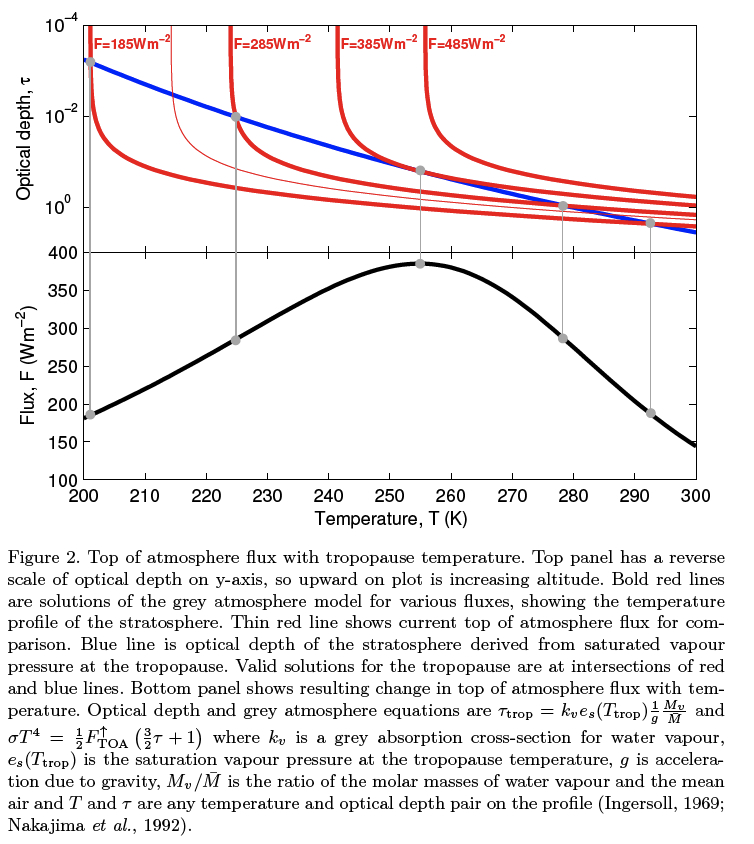
A limit on outgoing radiation from the stratosphere arises because the radiative equilibrium temperature profile needs to match the optical depth of the stratosphere, which is set by the saturation vapour pressure at the tropopause. Intuitively, one might think first of the tropopause temperature then of the associated outgoing flux, but the radiation limit is easier to demonstrate by starting with the outward flux. For some given flux, we follow the radiative equilibrium temperature–optical depth profile until it intersects the temperature–optical depth curve derived from the saturation vapour pressure (figure 2). The intersection gives the tropopause . If the outgoing longwave flux is large, no solution can be found—the radiation limit is then the highest flux for which a solution can be found, around 385Wm−2 here.Put this together with Susan Solomon's demonstration a couple of years ago that humans are wetting the stratosphere by increased methane releases, followed by oxidation to water vapor and the bunnies realize that there is another mechanism for what Goldblatt and Watson call "Radiation Limit 2: moist stratosphere upper limit (Komabayashi–Ingersoll limit)", blowing a bunch of methane into the stratosphere.
And where have we seen that discussed? and here too.
Eli, being a lazy bunny, thinks this would require an ungodly methane release, but a massive push of methane into the stratosphere with the associated increase in stratospheric water vapor would bring the Earth into an entirely unique and dangerous situation.
Notice is hereby given
or pin the tail
Notice is hereby given that ORI has taken final action in the following case: Based on an inquiry conducted and written admission obtained by Kansas University and additional analysis conducted by ORI in its oversight review, ORI found that Dr. Gerald Lushington, PhD, Director of the K-INBRE Bioinformatics Core Facility and Director of the Molecular Graphics and Modeling Lab, engaged in research misconduct in research supported by P20RR016475. Specifically, ORI found that Respondent engaged in research misconduct by approving publication of 3 articles and 1 abstract he knew contained significant amounts of plagiarized text without attribution or citation from other writers’ published papers. . . .
Friday, January 20, 2012
W/O Comment
Since when does “adapted” mean “redrawn or drawn from the data”? If I had the data that went into the graph, then I would have plotted up a new graph—but what’s the difference if I plot a new graph the way I want or alter some other graph so it plots what I want to show?Paul Krugman
I go over to the CRU site and get the latest temperature data and plot it up—If I want to plot it up for 1901-2000 I can, if I want to plot it up for 1851-2010 I can. I am not bound to use only the plots contained in Brohan et al., but I could use those plots if wanted to. Had Brohan, for space reasons or other reasons, plotted the NH, the SH, and global combination as a single figure, and I’d have no compunction against erasing the NH and SH if I wanted to concentrate on the global results. If Brohan had plotted the HadCRUT2 and HadCRUT3 on a single figure (sorta like their Fig. 13), and I only wanted to show the HadCRUT3 data (after all, that is what the paper was about), I’d have no problem erasing the HadCRUT2 data from their chart. Had Gillett et al. plotted their “improved” 1851-2010 results and the presumably non-improved 1901-2000 results on the same chart and I only wanted to show the improved results (after all, that was the paper was about), I would erase the 1901-2000 results—oh yeah, I did do that! Had I asked Nathan Gillett for the data that went into that chart, I seriously doubt that he would have provided it with restrictions as to how I had to plot it. If Gillett et al. had only used 1901-2000 data, the paper probably would have never been produced or accepted—one of the major novelties of the research was using the full temperature record. Gillett et al. considered the results using 1851-2010 an improvement over previous work using 1900-1999 temperatures. So why oh why oh why is everyone so fired up over us focusing on the new improved results—those that were clearly preferred by the authors themselves?
If you all want to dredge up the Congressional testimony from 1998—then there seems to be a bit more room to argue as to which Scenario the original author preferred for the 1988-1997 period (of course, this has already been argued to death)—but in the case of Gillett et al. it is pretty darn clear the preferences of the authors.
Honestly, I am at a loss to understand the outrage over our handling of Gillett et al. (or Schmittner et al. for that matter—another case where we presented concentrated on the main results of the paper).
Let me instead go meta; this is an example of why policy debate is so frustrating, and why I’m not polite. The key thing about how the conservative movement handles debate is that it never gives up an argument, no matter how often and how thoroughly it has been refuted. Oh, there will be more sophisticated arguments made too; but the zombie lies will be rolled out again and again, with little or no pushback from the “respectable” wing of the movement.
In comments and elsewhere I fairly often encounter the pearl-clutchers, who want to know why I can’t politely disagree, since we’re all arguing in good faith, right? Wrong.
Administrivia
For what it's worth the esteemed Blogger Team recommends using a pop up window for comments to avoid some of the problems folk have been having until they get it fixed (real soon now for those of you who remember), Eli is not very fond of this but let's try it. And, oh yeah, we are back to the teeny tiny comment box. WTF
There also appear to be problems viewing Rabett Run with some browsers (friends don't let friends use IE, but IE8 may work).
The RR Team may be forced to switch to the new new blogger interface so watch for funnies
That has been all.
Thursday, January 19, 2012
Chip Clips
Skeptical Science has a nice article on how Pat Michaels and his Sancho Panza, Chip Knappenberger like to copy and paste figures and statements of others, adding, shall Eli say, a bit of the taste of their own garlic to the sauce. An early example of this saga, in which Eli had a bit of a role, was the good Dr. Michaels editing Hansen's 1988 predictions of global temperature anomaly changes based on three emission scenarios. In order to convince others that Hansen was not close, Patty managed to erase the lower two scenarios and insist that the highest one was the one that Hansen claimed most likely, before Congress no less.
Dana181 over at SkS discusses this and several other inconvenient eraser jobs emanating from the desks of Michaels and Knappenberger (good Chip bad Pat not being a game the bunnies play) and this brought Dr. Knappenberger out of the woodwork to discuss how they "adapted" a figure from Gillett et al. to erase some inconvenient data (somewhat smile making considering how Steve M and friends go on about how Phil Jones, Mike Mann and others are hiding the data). Chip wrote
The caption associated with our graphic showing the results of Gillett et al. included the following:So let Eli take a look at the original graph
"(figure adapted from Gillet et al., 2012: note the original figure included additional data not relevant to this discussion)."
 Dana181 pointed out that this was not what Pat Michaels had shown
But once again, the data projecting larger future global warming was inconvenient for Patrick Michaels' narrative, so he simply deleted it.
The dashed lines in the horizontal direction are the projections from the unconstrained climate model for the three emissions scenarios (the RCPs). The solid vertical lines are the model projections using the 1851-2010 data, and the dotted vertical lines (deleted by Michaels) are the model projections using the 1901-2000 data.
 and Eli said something along the lines of
 The figure was not adapted from Gillett, et al., it was copied and altered without permission in a [- snip- ] way.and the word dishonest got snipped.
Moderator Response: [Rob P] You're going to have re-phrase your comment here - the snipped portion is a breach of the comments policy.

If you think that ain't dishonest, Eli has fine, but underperforming football player to sell you, bids start at $10 million on Ebay.
Wednesday, January 18, 2012
"Let's return to this February, 2013 and see if 'victory' still smells as sweet". Why wait?
The above is the political prediction of a political scientist that delaying the Keystone XL decision was Obama's brilliant way of playing his supporters for fools until the next election.
Or maybe not (although who knows for sure, but it's no help to the project). Now the fight may also switch to Canada deciding whether to build their own pipeline to export the oil overseas, instead of piping it to Louisiana to be sent overseas. It's a long game.
(Edited for a tad more context.)
Whaling cap and trade has the politics of carbon taxes
The politics is that I don't see it happening, or at least not as the primary tool for managing the problem, regardless of the merits.
Unfortunately the paywall means I can't RTFA in Nature, but here's the Washpost and an interesting take by Holly Doremus. A pure cap/trade, which they're not proposing, would require whaling nations to buy whaling allocations they now steal from the world's common heritage for free, so politics rules that out. The authors apparently propose allocating parts of the harvest for free to whaling nations, which raises the question of why anyone else would support it.
The other biological aspect of this issue that I haven't seen discussed stems from my understanding that the current harvest is likely significantly less than what some common whale species can handle. Of course whalers currently ignore species restrictions and kill whatever whales they can find, but that gets arm-waved (and more could be done if the political will existed). This proposal could result in an increased allocation, making it more expensive for whaling opponents to buy out quotas.
I agree with Holly that there are non-economic problems with this proposal, although I disagree with her implication that an economic approach is incapable of addressing non-economic problems. Just this one.
Holly also picked up on the same parallel I saw to attempts to buy slaves as a way to end slavery. I wouldn't be as dismissive as she is though. I suspect buying slaves their freedom was an important method to reduce the number of slaves in states where it was a marginal activity, making it easier for those states to move to abolition. Pennsylvania then moved to a gradual abolition of slavery in 1780, diminishing the economic impact to slaveowners by putting it off into the future. Economic approaches have their value.
Tuesday, January 17, 2012
Yosemite Valley, 1861
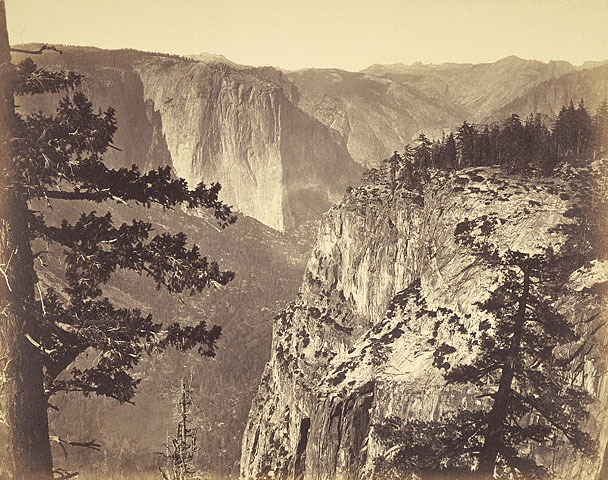
Via the Guardian, the Getty Museum collection of photographs of the Yosemite Valley from 1861 taken by Carleton Watkins. Tip of the ears to Leo Hickman and the Getty Museum
Monday, January 16, 2012
Sunday, January 15, 2012
Oxidation bumblers
Oxidation numbers are one of those ancient retainers that chemistry suffers from. Convenient, but with enough bumbling exceptions to drive every student crazy. In discussing various reactions we commonly use oxidation numbers, oxidation and reduction, but not everybunny has had, or more to the point, remembers their chemistry.
The language comes from about three centuries ago, when metallurgists talked about reducing metals from their ores, e.g. getting rid of whatever else the metals were combined with by heat driven reactions. Oxidation is somewhat more recent, dating to 1777 or thereabouts when Lavoisier named oxygen (discovered by Priestly in 1774) and discussed its role in combustion and corrosion, e.g. reactions with oxygen hence oxidation.

Isolated hydrogen atoms, H, have one electron available, carbon, C, four and oxygen, O, six. The other two electrons in carbon and oxygen are so strongly bound to the nucleus that they are never involved in the bonding and we take about the four and six being the valence electrons for C and O. In water vapor, H2O, the electrons associated with the H atom are "transferred" to the oxygen, so the oxidation number (or effective charge) on the H atoms are +1 (electrons have negative charge, that is another story) and the oxidation number of the O atom is -2, it "has", or rather is assigned, two more electrons than the isolated O atom. In CO2, each O atom attracts two electrons from the C atom, so the C atom "has" four less electrons than the isolated C atom would have, and an oxidation number of +4, while the O atoms have oxidation numbers of -2 each.
In reality, the electrons are shared between the atoms, it is just that on average they are closer to the oxygen atoms, e.g. the oxygen has a stronger pull on the electrons associated with the bonds. The figure below illustrates this for a series of hydrogen halides, HF through HI (F is fluorine, Cl Chorine, Br bromine, and I Iodine. Blue stands for low electron density, red for high. The assignment of the electron from the H atom to the halogen is much better justified for HF than for HI, but the oxidation number rules assign +1 to the H atom and -1 to the halogen in all cases.

Fluorine, F, is the atom which attracts electrons most strongly, it has the largest electron "affinity" and it has a very large ionization energy, the energy needed to pull an electron away from the isolated F atom. There is a convenient metric for figuring out which atom in a bond will most strongly attract the bonding electrons called electronegativity, which is a combination of the strength which an atom holds electrons, the ionization energy and the strength at which it attracts electrons, the electron affinity.
The higher the electron affinity and the ionization energy, the higher the electronegativity and visa versa. This is not how the original scale was constructed by Pauling, but it is effectively, and there is a simpler electronegativity scale due to Mullikan which states this explicitly.
F is the atom with the highest electronegativity. The larger the difference between the electronegativity of two atoms bonded together, the more polar the bond, with the electrons attracted closer to the atom with the higher electronegativity. Ionization energy and electron affinity are basic properties of atoms which determine electronegativity. From electronegativity it's pretty easy to figure out which end of a bond will be more polar, and for the purpose of assigning oxidation numbers where to push the electrons.
 One arbitrarily (this will NOT be on the test) sets an electronegativity difference of 1.7 as the boundary between ionic and covalent bonds. Opinions differ.
The first use in English was a translation from Lavoisier (OED)
1789 R. Kerr tr. Lavoisier Elements Chem. iii. viii. 445 It is much to be wished that some person would undertake a series of experiments upon oxydation of metals in the several gases.
Reduction of metals comes from the earlier usage (1450)of bringing back something to an earlier state, but the first metallurgical reduction mention is
1741 tr. J. A. Cramer Elements Art Assaying Metals 186 Metals destroyed, and changed into Scoria or Ashes, are, by their Union with the same matter, again restored to their metallick Form. This Operation is called Reduction.
Mendelev constructed his periodic table by characterizing the number of atoms of each element which combined with oxygen and hydrogen
While we (and Mendelev) think of reactions as involving atoms, they really involve the transfer or sharing of the outermost electrons often called the valence electrons, the ones which are held most loosely. Oxidation numbers are a model which assigns each of these electrons completely to one of the two atoms in every bond whereas a better picture takes account of how they are shared.
An atom can, of course, have multiple bonds. The oxidation number is the difference between the number of valence electrons an isolated atom would have available for bonding and the number of electrons assigned to it in the molecule.
Isolated hydrogen atoms, H, have one electron available, carbon, C, four and oxygen, O, six. The other two electrons in carbon and oxygen are so strongly bound to the nucleus that they are never involved in the bonding and we take about the four and six being the valence electrons for C and O. In water vapor, H2O, the electrons associated with the H atom are "transferred" to the oxygen, so the oxidation number (or effective charge) on the H atoms are +1 (electrons have negative charge, that is another story) and the oxidation number of the O atom is -2, it "has", or rather is assigned, two more electrons than the isolated O atom. In CO2, each O atom attracts two electrons from the C atom, so the C atom "has" four less electrons than the isolated C atom would have, and an oxidation number of +4, while the O atoms have oxidation numbers of -2 each.
In reality, the electrons are shared between the atoms, it is just that on average they are closer to the oxygen atoms, e.g. the oxygen has a stronger pull on the electrons associated with the bonds. The figure below illustrates this for a series of hydrogen halides, HF through HI (F is fluorine, Cl Chorine, Br bromine, and I Iodine. Blue stands for low electron density, red for high. The assignment of the electron from the H atom to the halogen is much better justified for HF than for HI, but the oxidation number rules assign +1 to the H atom and -1 to the halogen in all cases.

Fluorine, F, is the atom which attracts electrons most strongly, it has the largest electron "affinity" and it has a very large ionization energy, the energy needed to pull an electron away from the isolated F atom. There is a convenient metric for figuring out which atom in a bond will most strongly attract the bonding electrons called electronegativity, which is a combination of the strength which an atom holds electrons, the ionization energy and the strength at which it attracts electrons, the electron affinity.
The higher the electron affinity and the ionization energy, the higher the electronegativity and visa versa. This is not how the original scale was constructed by Pauling, but it is effectively, and there is a simpler electronegativity scale due to Mullikan which states this explicitly.
χ = [½(IE + EA)] × 3.48 - 0.602where the weird numbers are the results of matching the scale as best as possible to Pauling's original one, which for some reason known only to Pauling set the electronegativity of F as 4
F is the atom with the highest electronegativity. The larger the difference between the electronegativity of two atoms bonded together, the more polar the bond, with the electrons attracted closer to the atom with the higher electronegativity. Ionization energy and electron affinity are basic properties of atoms which determine electronegativity. From electronegativity it's pretty easy to figure out which end of a bond will be more polar, and for the purpose of assigning oxidation numbers where to push the electrons.
 One arbitrarily (this will NOT be on the test) sets an electronegativity difference of 1.7 as the boundary between ionic and covalent bonds. Opinions differ.
If you are interested in the "rules" for assigning oxidation numbers, there are any number of places for finding them. The problem is that in the traditional course you learn about oxidation numbers before electronegativity and assigning oxidation numbers becomes ad hoc. Thus the attraction of teaching with what is called the atoms first approach where you start with atomic structure and properties such as ionization energy and electron affinity trends.
Friday, January 13, 2012
Mother Blogger
One of the things about free things is that the giver of free things appears to think they know best, so the design of Rabett Run has been "upgraded" to the new blogger standard. Eli has poked around in the design section, but he is only a simple bunny. Any suggestions on how to disimprove the new design
Tuesday, January 10, 2012
Cutting down the mightiest tree in the forest with a herring
Go to bed. . .
Go to bed said Ms. Rabett, but Eli respectfully pointed out that someone said something wrong on the INTERNET and it's the Bunny's job to set them straight. Go to bed she replied and pulled the plug leaving Eli to hunt down the laptop.
Methane is much in the news (see Real Climate for example) and Eli wandered into a D-K moment at Judy's where one of the front pagers (notice how Judy is undercutting Tony in guest post quality?) was spitting up. Not so much wrong, as wrong for the case at hand, so the Rabett pointed to an article on methane oxidation that he had posted earlier, featuring a very nice diagram of the simplified reaction scheme from a review article by Ravishankara.
Well, harumphed the D-K poster child
So yet another Hare-brained scheme:-At one time or other Eli had actually looked up those rate constants for his original take, in the place to look them up the IUPAC atmospheric chemistry critical data evaluation, and surprise, the rate for the first, yielding HO and NO2 is more than two orders of magnitude faster than the second yielding HNO3, so that the relative yield of nitric acid is substantially less than 1% under atmospheric conditions. Moreover, the HO, HO2, NO and NO2 are not in a thermodynamic equilibrium, but there is a steady state situation where the sources of NOx and HOx(combustion, etc) balance the sinks such as 1a. There is an important difference between an equilibrium situation and a steady state one which Eli will get to in another post.
H-O-O(dot) + NO(dot) (Peroxy Radical and Nitric Oxide) is generally given to generate peroxynitrous acid O=N-O-O(1-)H(1+), which then become nitric acid.
Whereas the dumb bunny has H-O-O(dot) + NO(dot) giving HO(Dot) + NO2(Dot).
Thus, the reaction of the peroxy radical and nitrogen dioxide is given to be a source of hydroxyl radical and nitrogen dioxide by a floppy eared fool.
Bunny actually needs the rate constants for the reaction series
H-O-O(dot) + NO(dot) --> O=N-O-O-H
O=N-O-O-H --> HO(Dot) + NO2(Dot). or O=N-O-O-H --> HNO3
So mister bunny, go an look up the reaction kinetics and reflect upon the implications of a bifurcated pathway where one branch is in a rapid equilibrium and the other is irreversible.
There are things about atmospheric chemistry (more precisely gas phase reactions) that are worth discussing because if all you have is general chemistry you miss the point as was done comprehensively by Doc Martyn, and this set of reactions is not a bad place to start.
(1) HO2 + NO --> HO + NO2Thus once again it becomes clear that Eli will have to stay up late correcting wrong Weblike pontifications.
(1a) HO2 + NO --> HNO3, or nitric acid
The HO radical is the key reactant for atmospheric oxidation reactions, degrading stuff to water vapor and carbon dioxide. The HO2 radical acts as a reservoir species for reactive HO. Throw in some nitrogen oxides and you get
(1) HO2 + NO --> HO + NO2Reaction 2 is basic to all hydrocarbon oxidation since those schemes almost always pass through formaldehyde, H2CO which decomposes to yield CO. CO oxidation to CO2 is dominated by reaction with HO and the H atoms combine with O2 to form HO2.
(2) HO + CO --> H + CO2
(3) H + O2 + M -->HO2 + M
What is that M you ask. Anything else. When the H and the O2 near each other, there is an attractive force between them, but it is not sufficient to stabilize HO2 unless a third body M can carry away some of the energy and stabilize the adduct. If there is no third body, the kinetic energy of the collision causes the reactants to fly apart and the addition reaction does not occur.This need for a third body to stabilize adducts is one of those things that we never get to in general chemistry, and, indeed never really need to because in solution, where general and organic chemistry are mostly done, there is always a third body provided free of charge by the solvent.
Reaction 1 has all this in spades. Looking only at the reactants, the average or sub-average chemist would say, do a Doc Martyn, clear we got nitric acid! as the product and, of course it is here that the good Doc Martyns go astray
So mister bunny, go an look up the reaction kinetics and reflect upon the implications of a bifurcated pathway where one branch is in a rapid equilibrium and the other is irreversible.Well, true 1a is irreversible, but the rate constant is small, especially compared to 1 and the OH and NO2 products of 1 are themselves involved in a number of other fast reactions of which 1a is a termination step so real Rabetts need to be more sophisticated..
To discuss what actually happens we need a potential energy surface (PES). In the old days we did the Lamb thing and scribbled free hand, what we thought reasonable, but there are computers and ab initio chemistry programs with lots of alphabet soup (would you like a dash of DFT B3LYP/6-31 G++ with that, or perhaps some CCSD(T) sauce?) and we can get the PES, which, if not perfect, is indicative

Here the reactants start on the right, where they belong, and the products are on the left, but sometimes in the middle as will be explained. Eli has taken but slightly modified this surface from Butkovskaya, Kukui, Pouvesle, and Le Bras. J. Phys. Chem. A 2005, 109, 6509-6520
Confused? Let's take a look a some prototypes in order to gather vocabulary. There is simplification, omission and some wiggle in what follows in order to emphasize the high spots.
 To the left is a PES for the typical gen chem reaction, A + BC --> AB + C with a barrier in the entrance channel. By entrance channel we mean that first thing, the reactants have to collide with enough energy to exceed the barrier in order to react. The transition state (TS) represents the lowest energy configuration which the reactants have to pass through in order to become products and the height of the transition state is the minimum collisional energy needed for the reaction to take place. If the collisional energy is lower, then nothing happens. ΔE is called the activation energy. If the collisional energy is above the TS barrier then the reaction will occur and the products AB + C will separate with kinetic energy which is the difference between the collisional energy and the potential energy of the products. In such a case the temperature dependence of the reaction rate constant has what is called the Ahrennius form k = A exp(-ΔE/kT) where k is Boltzmann's constant. Increasing the temperature of the system increases the average collision energy, and thus the rate of reaction.
Now let us look at something a bit more complicated
 Here we have added a stable adduct, ABC in a potential well. If there are no additional encounters with third bodies (the divine molecules M) during the reaction (sub nanosecond times at the most), the reactants with collision energy above the barrier sail on through to form the products, AB + C, but if the pressure is high enough there are collisions which drop the activated complex ABC** down into the ABC potential well and the relative yields of AB or ABC depend on the number of collisions or, equivalently, the pressure
 Finally there are radical (and radical-radical) reactions. Radicals, for Eli's purposes are odd electron species which are very reactive. Their reactions do not have a barrier in the entrance channel although there might be later ones as is the case for Reaction 1. The characteristic of a radical reaction is a NEGATIVE activation energy, so that the rate INCREASES with decreasing temperature. This is a measure of the strength of bond formation for the activated complex. The lower the collision energy, the more likely the complex is to form and not fall apart and thus the more likely that there will be a reaction.
In the next chapter RR will return to the HO2 + NO --> PES.
Saturday, January 07, 2012
Organizing the Academy
Eli, being a well known ear sucker, has cast a brain cell or two to the organization of knowledge, the sort of thing where there is STEM and NOKESENCE (No Other Knowledge etc.) and come up with the Six Fold Way that does a lot better than the usual Colleges of Mish and Mosh. Deans and Provosts, Rabett Run is open for consulting. The Rabett accepts VISA and PayPal.

UPDATE:??

Friday, January 06, 2012
Eli Thanks Ernst Beck (Shock! Horror!)

Now Eli, in his time, has been quite hard on the late Ernst Beck, but he is here to praise (time will tell) some of his work. In the course of trying and failing to understand the global changes of CO2, Beck was quite impressed by some of the worst scientific work ever done, and unimpressed by some of the best, but in the course put together a bibliography of just about every published measurement back to the year dot, and some before.
Georg Hoffmann pointed out that
In a wonderful example of how blunders can become features, Eli was wandering through the AGU hall of 10,000 posters when he came across "CO2 Megaparis: An intensive study of CO2 emissions from Paris megacity (in collaboration with the EU project MEGAPOLI)," given by Irene Xueref-Remy reprising their EGU presentation earlier in the year. The group has been measuring mixing ratios all around the city and surroundings for a whileSecondly, nearly all early sampling facilities were tested in continental environments often under the sporadic influence of heavily polluted air masses (such as Paris, Parc Montsouris, Copenhagen, Dieppe etc.). How large is the influence of such “CO2 pollution”? A quick tour through my car-traffic-saturated home town, Paris, can give us a good first impression:
- Jardin Luxembourg (major but still tiny green spot in the center of Paris) 425ppm
- Place de la Bastille: 430ppm
- Place de l’Etoile (the crazy huge roundabout around the Arc de Triomphe): 508ppm
- And the winner was Place de la Nation: 542ppm (ie 160ppm over background!).
All these measurements by David Widory and Marc Javoy (reference below) were snapshot measurements, but they show how CO2 concentrations can vary strongly due to nearby fossil fuel combustion. Even in apparently “natural” environments there are many technical pitfalls to avoid. Strong CO2 fluxes due to the breathing (i.e. photosynthesis and respiration) of the biosphere are producing large diurnal cycles. A sampling site too close to the surface or shielded by a surrounding forest can easily bias the CO2 signal by several dozens of ppm.
Nowadays, CO2 emissions from Ile-de-France are known only through inventories, but no independant verification has been provided. Furthermore, the role and variability of the different emission types need to be better assessed. We present here the project CO2-MEGAPARIS funded by the French Agence Nationale de la Recherche, that aims to verify inventories from Ile-de-France through the use of powerful modeling and observational tools, at an hourly scale and a spatial resolution up to 2.5 x 2.5 km2.In discussing the poster with Dr Xueref-Remy, Eli mentioned that there were some seriously old measurements, which were probably reasonable, but of course determined by the local situation. Did she know about them. . . well no, never heard of the things, so the bunny forwarded the appropriate links with appropriate warnings.
Which, just shows that amateurs have their uses
Uncle Eli has always admired astronomy, botany, and zoology as sciences with important amateur participation. By nurturing the large community of those interested in the science these fields have built important support groups, and amateurs have made important contributions. Many amateurs become obsessed with relatively narrow and previously trodden areas. Within those areas their knowledge often exceeds that of professionals. To Eli the most important thing is that people get to experience the joy of science.but even they have their unexpected pluses.
What amateurs lack as a group is perspective, an understanding of how everything fits together and a sense of proportion. Graduate training is designed to pass lore from advisers to students. You learn much about things that didn't work and therefore were never published . . In short the kind of local knowledge that allows one to cut through the published literature thicket.
But this lack makes amateurs prone to get caught in the traps that entangled the professionals' grandfathers, and it can be difficult to disabuse them of their discoveries. Especially problematical are those who want science to validate preconceived political notions, and those willing to believe they are Einstein and the professionals are fools. Put these two types together and you get a witches brew of ignorance and attitude.
Unfortunately climate science is as sugar to flies for those types.
Tuesday, January 03, 2012
The indelible dumbness of physicists
Eli has always been impressed by Myanna Lahsen's take on physicists
they think they know everything, because they’re smart. What they don’t understand is that yes, it is true, actually meteorology is a branch of physics. And so you take a physicist, like me, and you can sit him down, and in 2 or 3 years, they could learn meteorology. But physicists confuse being smart and having the ability to learn everything with actually knowing stuff!and by way Watts, excerpted by Tallbloke, via a comment at Open Mind, comes another example, one Robert Brown, PhD, at Duke who offers up a BOE to showcase another argument from personal incredulity.
As some noble prize winners, he gets the wrong answer for the right reason. We have all gone through the trivial exercise of balancing the solar input against radiative loss from an Earth without an atmosphere, which shows that without greenhouse gases the temperature of the Earth would be a uniform 255 K, about 33 K colder than it is on average. Brown asks what would happen if the surface temperature was not uniform, without realizing that Arthur Smith provided the answer, it would be a lot colder. If you account for day/night differences, the change of temperature with latitude and such, 33K is a lower limit for the greenhouse effect if you insist on radiative balance. To cut a long story there short, assumption of a uniform surface temperature UNDERESTIMATES the effect of greenhouse gases on surface temperature. To return to the first paragraph, DECREASING the temperature at which the Earth's atmosphere radiates to space by increasing greenhouse gases, requires that the surface temperature INCREASE in order to restore radiative balance. Brown clearly was not on the distribution list.
The point is that as temperatures increase, the rate at which the Earth loses heat goes strictly up, all things being equal. Hot bodies lose heat (to radiation) much faster than cold bodies due to Stefan-Boltzmann’s T^4 straight up; then anything that increases the inhomogeneity of the temperature distribution around the (increased) mean tends to increase it further still. Note well that the former scales like:
P' being the radiated power.P’/P = 1 + 4 dT/T + …
straight up! (This assumes T’ = T + dT, with dT << T the warming.)
At the high end of the IPCC doom scale, a temperature increase of 5.6C is 5.6/280 \approx 0.02. That increases the rate of Stefan-Boltzmann radiative power loss by a factor of 0.08 or nearly 10%. I would argue that this is absurd — there is basically no way in hell doubling CO_2 (to a concentration that is still < 0.1%) is going to alter the radiative energy balance of the Earth by 10%.Well, Eli leaves it to the reader to decide whether a 6 K temperature change is reasonable for CO2, greenhouse forcing doubling, without getting into the issue of why Brown chooses 6K rather than the generally agreed on 2-3 K (so that is only a 2- 3% change), please don't spit the cherry pits out on the linoleum or the window, this is a high class blog, but even without going much further, how unreasonable is that 2-3 K change if the greenhouse effect accounts for more than 33 K of surface warming, which it does. Still dear bunnies, there is more.
The statement that "The point is that as temperatures increase, the rate at which the Earth loses heat goes strictly up, all things being equal." is where the good Doctor Brown goes serious GIGO. It is correct that the rate at which the Earth's SURFACE loses heat goes strictly up, but the surface is NOT where most of the thermal IR is emitted to space.
That is rather high up in the atmosphere, which can be seen by comparing the emission to space with the Planck distribution of thermal emission from the surface for example, but there are plenty of accurate measurements and models.
 The point at which the emission curve matches a blackbody curve tells you the temperature of the effective altitude at which emission is occurring to space. Raising the greenhouse gas concentration raises the level at which the emission to space occurs to a colder level, and thus one where emission is slower. To make up for that the surface has to warm in order to push more energy through the open window directly into space.
Pass the mole hammer please.
Monday, January 02, 2012
Jerks
Eli was wandering through AGU when he came across a poster which insisted that all climate change is just a collection of jerks. This has now, in more impenetrable form (according to the author) been accepted for publication in JGR, and you know what editors are. Roger Jones proposes that continuum models just do not fit the data at all scales and intervals, that stuff changes suddenly.
Past climate change has often been rapid. Although future climate change could also be rapid, it is usually communicated as a trend.Jones has looked at a number of changes, including air and sea temperatures at local to global scales, precipitation, and more.
Climate projections developed from coupled atmospheric ocean models are interpreted through a signal to noise model. This model interprets the anthropogenic signal in climate variable (temperature, rainfall, etc.) as a smooth curve and variability as noise around that curve..
For long time series of annual data, annual to decadal variability is interpreted as being of natural origin.
Were these changes natural variability superimposed on a long term trend or were they a non-linear response to anthropogenic forcing
The resulting investigation has concluded that anthropogenic climate change is a non-linear process. Rather than following the signal-to-noise model, climate change follows a step and trend process.


The bunnies thought about this, and the useful analogy is earthquakes. Stress (e.g. forcing) builds steadily, but change happens suddenly. Averaging, smooths change to a fair-thee-well, continuum models do the same. The uncertainty monster is not anyone's friend.
Sunday, January 01, 2012
More Physics Follies

Back in March 2011, writing on this very blog, I described the efforts of global warming rejectionists, who tried to get the American Physical Society (APS) to water down or reject its earlier statement on global warming. Instead the APS strengthened its statement.
One result of the kerfuffle was the creation of a Topical Group on the Physics of Climate (TGC). John Mashey, writing a comment on the realclimate.org blog, provided a very illuminating brief history behind the creation of the TGC. Gentle readers of Rabett Run (are they any other kind of readers?) are referred to Mashey's masterful history.
Meanwhile, while randomly twiddling the teevee dial over the holidays, I accidentally discovered a new PBS Nova film about the melting of arctic glaciers, Extreme Ice . The Greenland ice is melting in ways that are not fully understood, but the melting is occurring faster than many climate scientists believed in the recent past. The film is actually quite frightening.
The latest (2007) IPCC document includes global sea level rise from the warming up of the oceans (thermal expansion), but does not include any contribution to the sea level rise from melting terrestrial glaciers, because there was no agreement on how to model the melting process.
This brings us to a point: skeptics and rejectionists stress the uncertainties in the predictions of global warming. However, glacier melting is one factor which, if included, makes the future predictions more alarming, not less alarming. As climate science advances, the case for doing nothing becomes even more untenable.
-----John
Subscribe to:
Posts (Atom)

 Posts
Posts


Louise, wasn’t allocated space above to answer, so here it is: I have given myself an order – to simplify things; because complicating don’t change the truth, but is used exclusively for confusing the majority on the street, by people that are scared from the truth. Should I make exception for you? .
Ask anybody that has being using gas for cooking; they will tell you that methane is heavier than O+N on sea-level / in gas state. When you recognise the truth, wouldn’t complicate / massage the facts – instead you look for real reasons: the 4 atoms of hydrogen in the methane molecule only have PROTONS that’s where the gravity is; but no lots of neutrons as in O+N, which take space = volume, but no weight. 2] 2H2 (2 deuterium) in methane hug each other – oxygen + nitrogen in the air stay apart. It’s just a small example; if is something unusual, look for real reasons, don’t make fool of yourself, just to be argumentative. Louise, 4 ball-bearings are heavier than a cork with double the volume. I challenge you: ”you challenge every scientist on this blog; what would they say; is methane heavier than O+N on sea-level – then ask a WORKING PERSON on the gas station that handles methane – will tell us all, who is cherry-picking / who has interest to massage the truth? Definitely the person WORKING with methane will be the one to believe, not a Warmist academic.
Methane is very important subject that will affect the atmosphere / climate. Not for what the propaganda says; but because burning methane depletes lots of oxygen – creating new methane is REVERSING THE DAMAGES; I have A page on methane in the digestive system on my website. Yesterday 62 people visited my website; only 2 people went to the page on methane.= all are avoiding what is most important for their life – instead will keep repeating here about: albedo, noise, observation, forcing, equilibrium bla, bla…. = Sir Humphrey’s empty talk” If you read every sentence of the text I am referring – you will understand how harmful empty talk is – how important exposing the truth is – take the challenge, all of you. It’s a big crime in progress – most of them are plying Sargent Schulz ( I know noooothing) That is a crime in itself