Sunday, May 19, 2013

Cross Tabs

As Eli mentioned previously, the cross tabs have some of the most interesting information from the Prequel

The most interesting cross tabs in the prequel, now in the recovery room, were those that were put into the middle, the ones where at least one of the two bunnies that looked at an abstract though that the abstract fell into one of the five middle categories, discusses AGW (D), discusses methods (M), paleoclimate (P), unrelated to AGW (UR) or undecided (UD.  The crosstabs below are for the two ratings when one of them was in the middle categories.  EE and IE are explicitly endorses and IE is implicitly endorses.  Similarly IR and ER are implicitly rejects and explicitly rejects.  Two votes for a particular rating (e.g. D/D) were counted as two votes for that position

These are ONLY the cross-tabs for ratings that INCLUDED one of the middle categories.  These are NOT cross-tabs for cases where both raters agreed that the ABSTRACT either supported or rejected AGW.

Those are further below 


D
EE
IE
M
P
UR
UD
IR
ER
D/EE
34
34


D/IE
75

75


D/D
110


D/IR
5


5

D/ER
2


2
D/M
17


17


D/P
6


6


M/M


24


M/EE


6
6


M/IE


17
17


M/IR


1


1

P/P


86


P/IE


6

6


P/M


7
7


P/IR


3


3

UR/UR


28


UR/EE

7


7


UR/IE


23


23


UR/D
8


8


UR/IR


1

1

UD/UD


2


UD/IE


3


3


UD/D
4


4


UD/IR


2
2

UD/M


1


1


261
41
130
73
108
69
10
7
2
 
The telling thing about these cross-tabs is how few split votes there were for the rejectionist position, and on inspection of the actual abstracts, the number appears to be inflated. 

As to the affirm vs. reject side of the ratings, well, it ain't a contest

D
EE
IE
M
P
UR
UD
IR
ER
EE/EE

102


EE/IE

125
125


IE/IE


128


IR/IR


4

IR/ER


3
3
ER/ER


4


227
253


7
7

The generic 97%

Saturday, May 18, 2013

Don't Worry, Be Happy


Eli, as the bunnies know, has been a fan of DSCVR, aka Triana for like a seriously long time. He even has a decal sitting on his desk.  A little while ago he noted that the mission was being unmothballed (shoved into the closet by the lamented George Bush) to serve as a space weather observatory to replace a failing mission.  The Rabett had heard in a social gathering, that there was work at Goddard on refurbishing the instruments.  Eli wrote to the responsible parties, and got a go away and don't bother us.
Dr, Rabett:

Thanks for your email regarding the status of DSCOVR. At this time, NOAA is not able to  answer your questions, pending the outcome of the ongoing Congressional budget process. Once those issues have been resolved, we'll be in a better position to discussthe way forward on DSCOVR.

Regards, Michael Simpson
DSCOVR Program Manager
But amazingly, funding for DSCVR appeared in the latest Persidential Budget, so Eli wrote again and received a reply
Dr. Rabett,
The NASA Earth Science Division (ESD) will be providing funds to integrate and test the EPIC and NISTAR instruments so that they will fly in a fully functional mode on DSCOVR.  The data that will be returned from the EPIC instrument will be minimally processed to incorporate basic calibration parameters and then archived.  Any additional processing of the data will be part of a ROSES call from ESD.  Due to limited existing ground system resources, the EPIC data rate will be no greater than the equivalent of one RGB image (3 spectral bands) every 4 hours. The data is planned to be publicly available.  If you have more questions please contact Dr. Richard Eckman, the DSCOVR Program Scientist in the ESD.  I am not aware of any plans for an earth observing spacecraft at L2.

Regards,
Viet Nguyen
-----------------------------------
Q. Viet Nguyen, PhD
Program Executive
Joint Agency Satellite Division
Not totally wonderful news, but not nothing.  The remark about the data being archived means that there is no funding for data analysis, still it will be available.   EPIC is a ten channel imaging spectroradiometer which can measure ozone, aerosols, clouds and land and ocean surface changes.  NISTAR is a three cavity radiometer to measure reflected solar radiation and energy emitted by the Earth.  Details here.  Eli is going out for some carrot juice.  Don't worry.

A message from the recovery room

Eli's immediate post below as reference. I haven't written anything yet because I've been meaning to first set aside several hours to recover where everything ended up. I think where my hubris messed things up was in that wasn't just those skepticalish abstracts I wanted to understand, but an attempt to get all discrepancies in any category resolved by forgetting the abstracts when reviewers disagreed and reading the source papers instead. That bridged too far for us volunteers and ended it.

Still could be a good thing just to read the papers for the skeptical abstracts. I think some of the implicit doubting might go away (not all of it). That info could feed into the other studies.

Eli's done a great job resurrecting the work we all did.

Thursday, May 16, 2013

The Past is Prologue

Cook et al., searched the ISI web of science between 1991 and 2011 for articles which were returned following a keyword search on "global warming" and "global climate change".  A team of reviewers then categorized the ABSTRACTS.  Back in 2008, Brian organized a similar exercise for a smaller number of abstracts, about 650 published between 2002 and 2006 which will be designated below as the prequel.  A team of six reviewers then categorized the ABSTRACTS with two reviewers looking at each abstract.

As a first step it is useful to compare the categories which were independently settled on by both teams.  Until about a week ago, neither team was aware of the others work, so these were indeed independent exercises..

Prequel
Explicit Endorsement of AGW
Implicit Endorsement
No Position
Discussion
Implicit Rejection
Methods
Explicit Rejection
Paleoclimate

Unrelated

Undecided

Implicit Rejection

Explicit Rejection

The primary difference is that the Prequel Team had more categories in the middle to deal with the predictable muddle.

An important point that has been missed is that MOST, essentially the vast majority of the papers, tossed up by such a search are biologically, ecologically or economically oriented.  Relatively few are what the Bunnies would call WGI material.  Most are WGII and WGIII.  Go ahead try it in Google Scholar.  Such papers, like WGII and WGII one way or another take the conclusions of WGI (that there is human caused climate change) as their starting point and we had to figure out how to deal with that

The prequel of the prequel was a small training set selected from the ~650 from which rating instructions were developed and then each member of the team rated about 200 abstracts.  The results were


Prequel
#

Explicit Endorsement of AGW
244
21%
Implicit Endorsement
407
34%
Discussion
222
19%
Methods
78
  7%
Paleoclimate
107
  9%
Unrelated
43
  4%
Undecided
33
  3%
Implicit Rejection
21
  2%
Explicit Rejection
28
  2%


Cross-Tabs tomorrow, but in almost all the cases the two reviewers were close to each other lumping the five neutral ratings as one.  There were only 13 problem papers where there was significant disagreement (support/reject) between the two reviewers, at which point everyone ran out of steam before trying to to reconcile them by actually looking at the papers.

Why bring this up now.  Well there have been a bunch of surveys, this being an unpublished one, and they all are within a stone's throw of each other, the "doubting" literature is really thin.

Congratulations to John, Dana, and the rest of the authors and helpers from Skeptical Science.  The amount of work they did is astounding.  Eli knows.  Brian is still in the recovery room.

Wednesday, May 15, 2013

Reprise

From long ago by Barry Brook an update of  Eileen O'Shaunghnessy's, End of the Century-1984


"...Hansen's bones are quiet at last,
...No science disturbs the lucid line,
For sun-scorched Earthers tune their thought
To Offworld Station 'Holocene-1'
From where they know just what they ought,
...memories of times past that should be banished
Only relics, philosophies and a parched wasteland lie below..."

Why not?

Eli has never been much of a fan for manned space exploration.  The bunny may have to reconsider.

Cook, et al. The prequel, the teeth gnashing, the recursive fury

Some time ago, like in about 2007, Brian came to Eli offering a poisoned pawn.  Eli, said, well actually wrote, Brian, how would you as a tip top climate blogger, like to take part in an Oreskes redo, with a bunch of other usual suspects (they are welcome to out themselves).  Sounds interesting saith the bunny, only to find out that it would involve reading something like 200 abstracts from 2002-2007 selected from 664 by random chance (Didn't know that Random Chance was Brian's other name did you).  The idea was to apply some granularity and different eyeballs.  Brian and helper bunnies pulled down the abstracts and set them up in a data base and assigned four eyeballs to evaluate each for fit into several categories

  • Explicitly endorse
  • Implicitly endorse
  • Discusses AGW
  • Implicitly reject
  • Explicitly reject
there were two other categories which were treated as besides the point or neutral
  • Methods
  • Paleoclimate
and the dreaded
  • Disputed
Suffice it to say, they were strongly in line with what Cook, et al, have come up with, but not nearly so well done.  Also those early bunnies were querulous, something that Eli has never, never been accused of.
Now some, not Eli to be sure, have been trying to trash Cook, et al., which has just been published as open access, even before it appeared.  The recursive fury has been something to see.

Before the reveal, Eli needs to talk about the teeth gnashing and the recursive fury that Cook's on line survey open to all has stirred.  The curious thing is that  it's the self styled lukewarmers who are going bats, lead by Lucia and Brandon Shollenberger.  Rank Exploits has something like ten posts on the survey, trying to get people to muck it up, doing the McIntyre on John, accusing him of mopery and today postulating all sorts of ethics violationsVictory has been declared because the open survey closed.  All sorts of IRB reasons given by the folks at Lucia's but John says it was simply because the original paper will be published this week. 

One might ask why the fuss?  As has become clear from recent work (not just Lewandowsky, et al.) climate change, because the damage arises in the future presents ethical threats to future generations with a global reach, presents a dilemma for those who object to national and international responses.  They can't stand it and they really can't stand the fact that increasingly those who study climate are becoming more convinced that climate change will seriously damage our earth in the future.
UPDATED:  The graph, clearly shows that denial remains low, explicit endorsement increases in the published literature.(So Ei got this backwards.  As somebunny pointed out to him Eli,

There's a problem with the sentence below your graph explicit endorsement decreasing in the published literature, as one would expect, since "no position" increases, as one would expect since taking boiler-plate positions is not abstract-worth
Separately, of the subset of papers that do take a position, the fraction of endorsers increases somewhat, as per one of the graphs in the SkS post, but that's not what your chart is on about.
No bunny is perfect

Skeptical Science has more details for those interesting in picking nit or not, but the take home abstract is that
We analyze the evolution of the scientific consensus on anthropogenic global warming (AGW) in the peer-reviewed scientific literature, examining 11,944 climate abstracts from 1991–2011 matching the topics 'global climate change' or 'global warming'. We find that 66.4% of abstracts expressed no position on AGW, 32.6% endorsed AGW, 0.7% rejected AGW and 0.3% were uncertain about the cause of global warming. Among abstracts expressing a position on AGW, 97.1% endorsed the consensus position that humans are causing global warming. In a second phase of this study, we invited authors to rate their own papers. Compared to abstract ratings, a smaller percentage of self-rated papers expressed no position on AGW (35.5%). Among self-rated papers expressing a position on AGW, 97.2% endorsed the consensus. For both abstract ratings and authors' self-ratings, the percentage of endorsements among papers expressing a position on AGW marginally increased over time. Our analysis indicates that the number of papers rejecting the consensus on AGW is a vanishingly small proportion of the published research.
The Rabett Run and friends survey was done late 2007 into 2008 for 664 abstracts.  36% endorsed AGW,  31% partially endorsed, 2%(16) rejected AGW or doubted it and the remainder appeared to be neutral, unconcerned or besides the point.  About 2% were subjects of violent disagreement.

It might be amusing to post the list of those that the prequel team (played by Jar Jar Binks) thought rejected AGW

Explicitly
Shaviv (2005) On climate response to changes in the cosmic ray flux and radiative budget
Zhen-Shan et al. (2007) Multi-scale analysis of global temperature changes and trend of a drop in temperature in the next 20 years

Implicitly
Berliner (2003) Uncertainty and climate change
Gerhard (2004) Climate change: Conflict of observational science, theory, and politics

Rejects or Doubts
Dorman (2005) Estimation of long-term cosmic ray intensity variation in near future and prediction of their contribution in expected global climate change
Karner (2002) On nonstationarity and antipersistency in global temperature series
Lai et al. (2005) Global warming and the mining of oceanic methane hydrate

Partially Rejects or Doubts
Belov et al. (2005) Prediction of expected global climate change by forecasting of galactic cosmic ray intensity time variation in near future based on solar magnetic field data
Bryden et al. (2003) Changes in ocean water mass properties: Oscillations or trends?
Chappell et al. (2004) Modelling climate change in West African Sahel rainfall (1931-90) as an artifact of changing station locations
Dorman (2006) Long-term cosmic ray intensity variation and part of global climate change, controlled by solar activity through cosmic rays
Guglielmin (2004) Observations on permafrost ground thermal regimes from Antarctica and the Italian Alps, and their relevance to global climate change
Hubalek (2005) North Atlantic weather oscillation and human infectious diseases in the Czech Republic, 1951-2003
Lahsen (2005) Seductive simulations? Uncertainty distribution around climate models
Leiserowitz (2005) American risk perceptions: Is climate change dangerous?
McDonagh et al. (2005) Decadal changes in the south Indian Ocean thermocline
Raghavan et al. (2003) Trends in tropical cyclone impact - A study in Andhra Pradesh, India
Staeger et al. (2003) Statistical separation of observed global and European climate data into natural and anthropogenic signals
Tiwari et al. (2006) Paleomonsoon precipitation deduced from a sediment core from the equatorial Indian Ocean
van Poppel et al. (2005) Electron tomography of nanoparticle clusters: Implications for atmospheric lifetimes and radiative forcing of soot
Vandergoes et al. (2003) The Last Glacial-Interglacial Transition (LGIT) in south Westland, New Zealand: paleoecological insight into mid-latitude Southern Hemisphere climate change
Vitas (2004) Tree rings of Norway spruce (Picea abies (L.) Karsten) in Lithuania as drought indicators: dendroecological approach
Zhang et al. (2003) Archaeal lipid biomarkers and isotopic evidence of anaerobic methane oxidation associated with gas hydrates in the Gulf of Mexico


Oh yes, the carping has started


Monday, May 13, 2013

Rumsfeld forgot the unknown knowns

I'm slogging my way through Steve Pinker's Better Angels book on the history of violence so I can finally write about how it's convincing and give it a negative review. Not done yet though, I'm only on page 534 and still have several hundred pages to go.

Way back on page 514 there was something worth writing about, an update on Donald Rumsfeld's sole contribution to humanity:  he talked about known knowns, known unknowns, and unknown unknowns, a useful way to look at problems. What Rumsfeld missed, says Pinker citing Dominic Johnson citing Slavoj Zizek, is unknown knowns, which are things known or knowable but are ignored or suppressed.

The context for Pinker was unknown knowns that Rumsfeld and the Bushies had in front of them about Iraq - lack of nuclear weapons development particularly, and the lack of a plan for governing the country. Unknown knowns applies even better to climate change - the evidence is hitting us in the face, literally so in some cases, and mountains of data and history available for anyone to see, but half of American politics refuses to see it. I doubt we'll get the hardcore denialists to know them, but we need to move the fencesitters so they're not stuck by the same unknown knowns.


UPDATE:  lifted from someone else's comment:

If the rational course of action involves admitting that you cannot have what you most want, don't bet on the persons involved being rational.

Friday, May 10, 2013

Non-negligent mistake vs negligence vs strict liability vs Benghazi

Tort law was one of my favorite classes in law school, gruesome injury cases being more interesting than contractual disputes over international chicken shipments.

The usual rule of non-negligent mistake is that you lump it. I drive over a virtually-invisible oil patch and go into a skid and injure you. No one would've seen it, so the injuries are your problem.

Negligence is when I failed to see an otherwise-visible oil patch because I was adjusting the car radio instead of carefully watching the road, and this time I owe you. The classic Reasonable Person wouldn't have adjusted the radio except in absolutely safe conditions. The RP isn't superhuman, supersmart, or superskilled, but he or she doesn't make easily foreseeable mistakes.

Strict liability reverses the rule of non-negligence:  if the harm was from something that even RP would not have avoided, the victim gets compensated. Same as the first case, I drive over a virtually-invisible oil patch and injure you, only that now, your injury results from the fact that I was transporting explosives that then exploded. Strict liability is considered a mostly-modern legal invention but there were earlier forms. Collapsing dams for watermill ponds were examples, and my favorite case was a pioneering, late 19th-Century balloonist who landed on a woman's vegetable patch. She hauled him into court for her veggies. He rightly pointed out that ballooning is brand new and no one knows how to land them - the judge said tough luck, if you do something abnormally risky like ballooning then you're strictly liable for any harm.

Negligence and strict liability seemed like separate concepts until Professor Grey pointed out that the Reasonable Person acts reasonably every time, but no actual human being does. It is unreasonable to expect someone to be reasonably prudent every time, but the law expects that, so a corner of strict liability is embedded in the law of negligence, presumably for the same societal reasons that we apply strict liability in other situations.

So this brings us to Benghazi - it's hard to figure out what the right wingers are screaming about, especially when their bizarre claims about coverups seem tangential to the real issue of inadequate security in the lead-up to the tragedy. I don't know if the inadequate security was a non-negligent mistake or negligence on someone's part, although I'd lean towards the latter. As far as the response  once the attacks started and the hurt feelings of the people who believe they didn't get accurate information in the near-term aftermath, the first of those two things is hard to judge and the second isn't all that important.

But that still leaves the screw-up in the security preparations. Even if it's negligence that resulted in four deaths, I don't hold that as a major screw-up of the Obama Administration. They make thousands of security decision, and they will screw some of them up. Someone should pay for it somewhere in the chain of command (assuming it is negligence), but this is small potatoes - it would be unreasonable to go from this to concluding that the administration as a whole is negligent.

I wish the worst thing we could say about the Bush Administration was that they screwed up and four people died.


UPDATE:  I need to do some additional research but I think Paul Ryan lied to the public on national television about a national security issue in the vice-presidential debate when he said there was virtually no US security in Libya compared to what we have at the Paris embassy, while knowing that CIA was nearby. He should get hit with this when he runs in 2016.

Wednesday, May 08, 2013

ICYMI*, Chait's optimist take on Obama and climate

Boiling it down to the essence:

After Obama’s original cap-and-trade plan failed, he started using the agency regulatory powers directly. (This is how Obama has been able to issue new regulations on cars, fuel, appliances, and future power plants.)

So far, there is one hole in his regulatory agenda: power plants that currently exist. This is, unfortunately, a very large hole, as these plants, mostly coal, emit 40 percent of all U.S. carbon emissions.... 
Then, a few weeks after last year’s election, the Natural Resources Defense Council published a plan for the EPA to regulate existing power plants in a way that was neither ineffectual nor draconian. The proposal would set state-by-state limits on emissions....Much like a cap-and-trade bill, it would allow market signals to indicate the most efficient ways for states to hit their targets—instead of shutting coal plants down, some utilities might pay consumers to weatherize their homes, while others might switch some of their generators over to cleaner fuels....Here is a way for Obama to use his powers—his own powers, unencumbered by the morass of a dysfunctional Congress—in such a way that is neither as ineffectual as a firecracker nor as devastating as a nuke: The NRDC calculates its plan would reduce our reliance on coal by about a quarter and national carbon emissions by 10 percent.... 
[NRDC's] Lashof predicted the following sequence of events. The agency will finish drafting its regulation scheme by the end of the year. It will then take about a year of public comments and revisions, at which point it will finalize its rule. That will be the end of 2014, just after the midterm elections. Another nine months to a year will be required to carry out the rule, which will get us to the end of 2015—and the international climate summit.

I've thought the most likely outcome is that Obama would do the wrong thing on Keystone and match it with a right thing on something else about climate. Not sure if the timing proposed above would make it the right thing to be matched with Keystone. This is far more important than Keystone, though, if it happens.

The remainder of Chait's article argued that Obama has used the regulatory structure as much as he could for small-bore climate actions, and if you set aside the bully pulpit issue then he's done a decent job. My impression, not backed by solid data, is that he passed up a lot of politically viable chances for small-bore actions on climate.

NRDC's proposal is here. Basically your state's average emission rate has to be somewhat better than a combined rate for coal and natural gas produced by current plants, with the combined rate determined by the mix of coal and gas you currently have. AFAICT if your state already has little coal and a lot of renewables, you don't have to do much, but if your state has a lot of coal power, the punched is eased somewhat. Many different trading devices allowed to reduce emissions rate, including purchasing efficiency efforts by consumers.

UPDATE:  clarified per the comment.


*ICYMI, ICYMI, means in case you missed it. I missed it when it came to that acronym for a while.

Monday, May 06, 2013

New Links

OK, Eli is a lazy bunny, but he has added a couple of new links to the blogroll.  New to the Southerners category is Sou's Hot Whopper, taking new strips off Willard Tony's hide daily, and the 97%ers John Abraham and Dana Nuccitelli hold forth in the Guardian.  That link is posted under mostly science.  Eli also finally put Sydney Padua's  2D goggles, the adventures of Lovelace, Babbage and increasingly Isaac Isambard Kingdom Brunel into the Cuter category.

Economic Models In Steam Punk

Sidney Padua continues to draw the adventures of Lovelace and Babbage.  In this chapter, the world's economy is threatened by the collapse of American banks, and the Duke of Wellington calls upon the dynamic duo and their calculating engine to save the world.  Below a taste


If not now when? If not me, who?

An organizing moral of Judaism is Rabbi Hillel's, “If I am not for myself, then who will be for me? And if I am only for myself, then what am I? And if not now, when?” to which Eli, and several others would add "If not me, who?"


If not now, when? and If not me, whom? are the two questions that no Honest Broker dare answer.  David Appell at Quark Soup drives the n+1st stake into the heart of that broken image, first as farce
. . .I was talking to someone in management at a national lab, and they told me on the QT that there is a white paper going around high-levels in Washington, written by a space scientist (unnamed) at another national lab (also unnamed), that warns of a 99+% chance of an 240-meter asteroid strike on Earth in 2029.

. . . .he was recently fired for "advocacy" -- if you can believe it -- because his paper includes policy prescriptions to address the threat, which he estimated could cost up to $800 billion, a number no one in Washington wants to hear.

Even worse (yes, it gets worse), there is a sealed court-imposed gag order on him brought by a House committee, whose Republican chairman insists more research is needed, and with the sequester there's no money in the budget to address the problem anyway and he'd prefer it just go away.
and then by showing how Carl Sagan, and E.O Wilson answered the accusations that they were "advocates" and not to be trusted when a churnalist tried to pin that on them.  As Wilson said
It is reasonable then to ask what scientists are expected to do when they hit upon a serious environmental problem. Whisper in the ear of a journalist? Entirely and chastely refrain from publishing outside technical journals, hoping the results will be discovered by nonscientists?
In the April 5 issue of Science (appears open) Bassam Shakhashiri (2012 American Chemical Society President) and Jerry Bell (Chair of the committee drafting the new ACS policy on climate change) write
F. Sherwood Rowland was a central figure in the late–20th-century controversy about the effect of chlorofluorocarbons on stratospheric ozone. For years, he engaged audiences ranging from students to members of the U.S. Congress. As an exemplary scientist-citizen, his focus eventually led to the worldwide ban on these compounds. Rowland spoke to all scientist-citizens when he asked: “Isn't it the responsibility of scientists, if you believe that you have found something that can affect the environment, isn't it your responsibility to do something about it, enough so that action actually takes place?…If not us, who? If not now, when?
This, of course is the road that James Hansen is traveling down.

Eli's friend Andy Revkin (well we are Facebook buddies) really needs to man up.  There is not a middle to some roads.  Pretending that there is, is both dangerous and dishonest, to your reputation, and to your friends. 

Saturday, May 04, 2013

When Eli Was a Little Bunny


When Eli was a little bunny and taking Psych I, the most annoying thing was that the lecturer demanded that the students be subjects for the department's research.  Eli is going to get even.

John Cook has set up a survey of peer reviewed climate research.  He and his cheerful helpers have built a database of 12,000 papers published between 1991 and 2011 matching the topic "global warming" or "global climate change" from the Web of Science.  He (well, Eli) is looking for volunteers (Eli asked John to take attendance so that he may send gifts, Cracker Jack quality, but John swore that it was all confidential) to look at 10 randomly abstracts and rank them.

The URL is

http://survey.gci.uq.edu.au/survey.php?c=II7WP4R4VRU7

The choices are
  1. Explicit Endorsement with Quantification: abstract explicitly states that humans are causing more than half of global warming.
  2. Explicit Endorsement without Quantification: abstract explicitly states humans are causing global warming or refers to anthropogenic global warming/climate change as a given fact.
  3. Implicit Endorsement: abstract implies humans are causing global warming. E.g., research assumes greenhouse gases cause warming without explicitly stating humans are the cause.
  4. Neutral: abstract doesn't address or mention issue of what's causing global warming.
  5. Implicit Rejection: abstract implies humans have had a minimal impact on global warming without saying so explicitly. E.g., proposing a natural mechanism is the main cause of global warming.
  6. Explicit Rejection without Quantification: abstract explicitly minimizes or rejects that humans are causing global warming.
  7. Explicit Rejection with Quantification: abstract explicitly states that humans are causing less than half of global warming.
Participants may get bored, need some popcorn, hear an invitation to dance or whatever and discontinue the survey at any point and results are only recorded if the survey is completed. It's all confidential.   The usual human subjects stuff 
The analysis is being conducted by the University of Queensland in collaboration with contributing authors of the website Skeptical Science. The research project is headed by John Cook, research fellow in climate communication for the Global Change Institute at the University of Queensland.

This study adheres to the Guidelines of the ethical review process of The University of Queensland. Whilst you are free to discuss your participation in this study with project staff (contactable on +61 7 3365 3553 or j.cook3@uq.edu.au), if you would like to speak to an officer of the University not involved in the study, you may contact the Ethics Officer on +61 7 3365 3924.

If you have any questions about the survey or encounter any technical problems, you can contact me at j.cook3@uq.edu.au
Of course, if you want giggles, where else than Willard Tony's, where, after reading that Stephan Lewandowsky was moving from the U of Western Australia to Bristol to take up theChair in Cognitive Psychology in the School of Experimental Psychology, Tony concluded that he was fleeing the prolix McIntyre's voluminous whines only to be told by Richard Tol, that the Chair is a prestigious appointment with a ton of gongs.  However, after Richard killed the triumph Godwinning assumed new heights with, of all bunnies, Richard Courtney admitting the obvious
Jim South London:
re your post at April 29, 2013 at 2:32 am .
Yes, the ultra-right does oppose AGW because that opposition fits their agenda.
Indeed, if you review the files of WUWT you can find more examples of it in their posts which e.g. claim H1tler was “left wing”!
 while trying to save the bathwater
But
those nutters are not relevant to the real debate about AGW except that – as you say – those nutters enable people such as Lewandowsky to assert ‘guilt by association’ upon all climate realists.


Whatever:)

Bee Cause

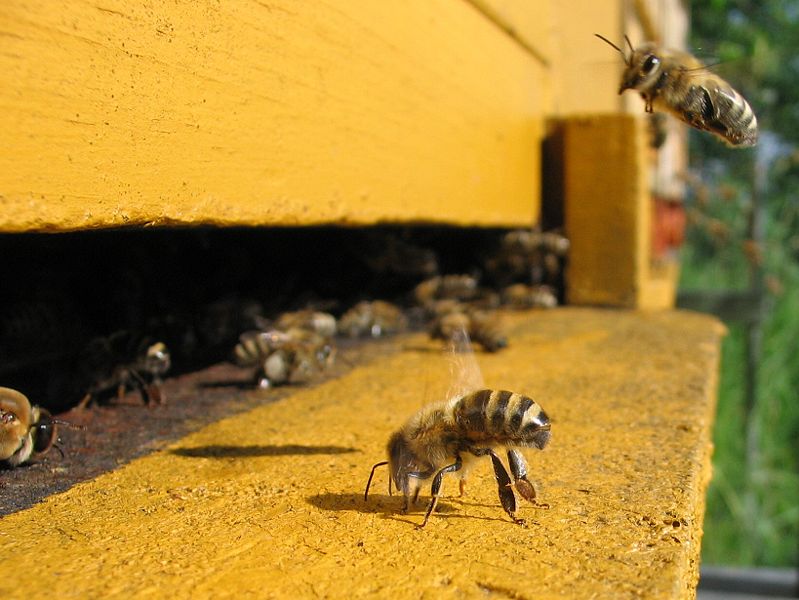
Now some, not Eli to be sure, think there is a connection between Colony Collapse Disorder and Climate Change that being that both are going great guns and the response of the Very Serious People (TM - P Krugman) has been more study is needed.  Well, it does look like there will be some action taken someplaces.  The EU has imposed a two year ban on neonicotinoids, pesticides which are applied to seeds

A plant or seed treated with such a chemical incorporates it into its tissues as it grows, making it lethal to insects that bore into a stem or nibble a leaf. The neonicotinoids are also present in pollen and nectar, and two recent studies have suggested that even sublethal doses might hurt bees.
The problem, of course, is not that it is one thing, or one thing or another but one thing and many more  another things, and in that sort of situation the entire discussion is a circle of jerks with everyone saying not me boss, but him, and the pesticide manufacturers are not shy and not without influence.  In the Euro case, for once, the rules fell on the side of the bees because while a majority of member favored a permanent ban, the weighted vote (by population) was against, which left the Eurocrat in charge, Tonio Borg, to make the decision based on the recommendation of the European Food Safety Authority.

The situation in the US, is however normal, with even the EPA shy of taking on the pesticide manufacturers and their customers, the farmers.  The executive summary from a recent stakeholder conference, is indeed, a stirring call to inaction based on the multiple stresses on pollinators
Consensus is building that a complex set of stressors and pathogens is associated with CCD, and researchers are increasingly using multi factorial approaches to studying causes of colony losses.
The list of stresses is the usual suspects,  Varroa destructor and associated viruses are the proximate cause of colony collapse in many cases where an immediate cause can be detected,  illnourished bees tend to be dead bees, and yes there is documented research that pesticide effects are nasty, but further research, especially field studies are required to be absolutely 100% sure. 
Although a post meeting survey was not conducted, meeting participants indicated that the conference gave them the opportunity to voice their concerns, to hear the concerns of others, and to offer their perspectives to Federal officials on future directions the government might take to ensure the future of America's pollinators. The CCD Steering Committee plans to revise the CCD Action Plan, a document that will synthesize this input. The Action Plan will outline major priorities to be addressed in the next 5 -10 years. This plan will serve as a reference document for policy makers, legislators and the public and to help coordinate the federal strategy in response to honey bee losses. Finally, given the depth of issues effecting pollinator health, consideration should be given to renaming this committee to reflect the broader range of factors discussed in this report.
Eli no longer has to read The Onion to figure out what has been happening to the bees

Friday, May 03, 2013

Seven generations is a shared perspective with emergency planning

As part of my Water District work, I've started expanding my policy focus to emergency/disaster planning, or "resilience" as the current buzzword goes. Taking the long view seems as necessary in disaster planning as it does for the environment - planning for a 100 year flood means many areas will go 200 years or longer before the event you've planned for finally happens. I sure wish we could do climate planning in anticipation of what things could be like in the year 2213.

What got me started on this post is a presentation I saw yesterday - I'm the Water District rep to a regional planning organization for emergencies, and the presentation was on the role of local ham radio. We have over 7000 licensed radio operators in our county of nearly 2 million, and about 700 have taken additional training in emergency communication. Another 100 or so maintain emergency kits so they can travel to a site and start communication even if all power, phone, cellular, and internet access is down. They have a separate non-profit and work closely with government emergency services, and it's all volunteer with minimal (but some) governmental funding. It's a great backup system.

Resilience in response to changes is an emergency planning concept as well as environmental concept - a healthy ecosystem and climate can absorb challenges and still function. If we push things to the edge, then maybe not.


UPDATE:  forgot to note an important psychological difference. Emergency planning is all about training so that much of what you do is rote and you only improvise as little as needed. The quasi-military, hierarchical culture is obviously a different world.