Showing posts sorted by date for query Breakthrough Institute. Sort by relevance Show all posts

Sunday, March 11, 2018

Breakthrough Institute and The Politics of Limits

The Interchange is an interesting renewable energy/renewables business podcast by GreenTech Media, and the most controversial podcast I've heard so far is an interview with Breakthrough Institute's Alex Trembath.

Some thoughts:

  • Alex says they've consciously decided to be less critical of mainstream environmental groups, less obnoxious and rock-throwing, and good for them for this change. There are some times when obnoxious rock-throwing is appropriate - that wasn't the case regarding past BI behavior, so it's good that they've changed it and are willing to say they've decided to change it.

  • Alex rightly says the environmental movement prior to 2004 (when the Breakthrough guys started doing their thing) had a much stronger emphasis on limits to growth then it does today, but is wrong to say there was something wrong about that. I'm sure plenty of people back then realized solar and wind costs were dropping dramatically, but I don't know if anyone would've said you can count on renewable energy being cheaper than fossil fuels, even without subsidies or accounting for externalities. That meant some type of limit was a necessary argument back then for energy issues (and remains a component of many other environmental issues).

  • He goes on to argue that limits to growth and saying no in general is a bad political tactic. I'm open to that argument but I'm not sure what BI is doing with it or backing it up with solid research (might be a little unfair to demand that of a podcast).

  • Alex says BI started off with a focus on renewables and EVs. That's sure not how I remember it, which was nuclear power all the time. He says they're now into nuclear as well. Yep.

  • He claims power systems get unstable with renewables are 50% of the total. I thought we were over that, and the discussion really is 80% versus 100%.

  • Alex makes an unnecessary dig at energy efficiency, with the Jevons Paradox etc.  That's a miss - I think the political economy vastly underestimates the unsexy value of efficiency, the complete opposite of what he was saying.

All in all, too much techno-optimism, but it could be worse, and BI seems to be moving in a better direction. It's less clear to me whether they have the chops to make any real contribution, though.

Wednesday, November 16, 2016

PicoSolar: Better, Faster, Cheaper


There is a new buzzword on the street, PicoSolar for electrification of the developing world.  While full electrification with renewables will require wiring, lighting and powering small devices such as cell phones is very low hanging fruit.  Turns out Dan Golden was right and the NASA engineers wrong you can have all three

A bit of a while ago Eli pointed to an IEA report on the costs of power up Africa which by implication also covered poorer parts and villages of the world.  In no to low power situations maintaining fossil fuel electrification has a number of not hidden but not the first thing people in the developed world think much about issues.

The cost of building out a distribution network exceeds that of putting in solar or wind (follow the Eli link).  A small amount of electricity would bring infinite improvement to the lives of the global poor.  When you do not have electrical lighting 900 lumens (about equivalent to a 60 watt incandescent bulb) is the difference between your kid not being able to study at night and going to university later on.  It's the difference between closing shop at dusk and keeping open for a couple of hours into the evening when customers are around.  Cell phone networks are a lot easier to put up and protect for communications Protect is important in poor places because a lot of copper and power gets, shall Eli use the word borrowed.  Telephone poles and wires are useful for using and selling and keeping the wires humming can be nigh on impossible, let alone the cost of putting them in in the first place.  In India a bit over a quarter of all electricity never goes through a meter but disappears.  Since electrons, at least according to physicists, are conserved, somebunny is kidnapping them.

Then, of course, for fossil fuel, there is the cost of getting the stuff to where it is being used.  Coal is not light, roads into the bush tend to be, well primitive, and trucks, railroads have maintenance of rickety stuff issues.  Putting up a large coal burning power plant in a central location does not necessarily help much with respect to providing power to rural areas.   Even in urban locations everybunny who can afford it has a kerosene generator for the frequent power failures.

The default option for lighting in the developing world are kerosene lamps.  They befoul the room that they are used in, The indoor pollution they generate sickens people, and keeping them lit is expensive, ~$150 per year,  when you are trying to survive of two euro/dollars a day.  When a quarter or so of your income is going for lighting it is pretty hard to escape poverty

As is typical with fossil fuel solutions, they are a constant drag on both the family and national economy, because countries have to subsidize (above the $150 yr) the cost of fuel to keep it available to the poorest.

It is this constant drag on funds which illuminates the ethical bankruptcy of fossil fuel advocates when they claim the war on coal is the war on the poor.  Like the old dope peddler they want to keep the poor hooked.  They advocate giving away free telephone poles because they know full well that today's innocent poor will become tomorrow's buyer of coal.

Large power plants are slow to deploy. Supply chains for the fossil fuels have to be established and fed.  Building out distribution networks takes time and lots of money.

There is a useful answer, solar powered LED lamps (of course there is a battery involved you dolt), which are displacing kerosine lamps.  The cost is OOO $10-$20.  One could have a split system, but the least expensive ones are put out during the day to charge and brought in at night to use.  While they are currently within the reach of those feeding a kerosene habit, there are also organizations working to bring first world dollars to purchase and provide the lamps.  And oh yes, guess who is taking the lead in clearing kerosene lamps out of African homes.  Here is a hint, it ain't the Breakthrough Institute, the breakthroughs are here including inexpensive (a friend of Eli taught him never to use cheap when describing elegant and useful things that don't cost a lot) LEDs and solar cells along with improvement in battery technology, and it ain't the Trump Foundation in case anybunny is wondering why Eli is so depressed.

Monday, July 25, 2016

Plan: 1. Agree with Patrick Moore. 2. Scour self with coarse sand


For some reason I subscribed to Heartland Institute's Environment and Climate News podcast and have listened to some. Mostly unsurprising, although one celebrating the return of eastern brook trout to reforested and some suburban areas seemed reasonable. I don't think the reforestation of the Eastern US is a huge secret that environmentalists don't want the world to know, but I also don't see a problem with refuting Breakthrough Institute thinking that civilization and nature are incompatible.

And then there's climate denialist/general denialist Patrick Moore - what a sad and unethical man. It's hard to imagine that he could actually believe his lies, and hard to understand why he doesn't just stop - he doesn't have a long career ahead to advance at this point, so does he really to finish it with gigantic lies? I'm sure he falls somewhere into John Mashey's typology (which I can't find online right now), but I guess it's continuing acclaim that matters to him, even if it's due to him spouting lies.

So what's really hard then is agreeing with much of Moore's diatribes against groups fighting research on GMO golden rice (around 24 minutes into the link). He goes overboard but I think there's no alternative but agree that opposing research on golden rice is clearly unethical. Here's Greenpeace's response, and it's completely unconvincing.

There's a difference between acting unethical in one particular situation and making the lack of ethics the basis of one's career. Greenpeace has messed up on golden rice, but people really can fool themselves on occasion. Patrick Moore must know what he's doing on a daily, continual basis.

Finally it's worth noting that anyone claiming that golden rice somehow justifies the overall application of GMO technology has got to be smoking something genetically altered. Golden rice has been on magazine covers for two decades and have yet to help a single person, while GMO crops take over the agricultural world. Greenpeace is right that GMO proponents have to look elsewhere to point to successes, but wrong to say that just because golden rice hasn't worked yet, we should shut down attempts to make it work.


Tuesday, September 08, 2015

Go Read


John Chait in New York Magazine, has a thumb sucker balancing between glory and despair about the upcoming Paris conference

For human to wean ourselves off carbon-emitting fossil fuel, we will have to use some combination of edict and invention — there is no other plausible way around it. The task before the world is best envisioned not as a singular event but as two distinct but interrelated revolutions, one in political willpower and the other in technological innovation. It has taken a long time for each to materialize, in part because the absence of one has compounded the difficulty of the other. It is extremely hard to force a shift to clean energy when dirty energy is much cheaper, and it is extremely hard to achieve economies of scale in new energy technologies when the political system has not yet nudged you to do so.
This, and the displacement of harm in space and time of course make climate change the perfect moral storm as Richard Gardiner (echoed by Rabett Run) have been pointing out for many years.  But there is reason for some hope
And yet, if you formed a viewpoint about the cost effectiveness of green energy a generation ago (when, for instance, Ronald Reagan tore the costly solar panels installed by his predecessor off the White House roof), or even just a few years ago, your beliefs are out of date. That technological revolution is well under way.
The falling price of solar and wind have beat Moore's Law as applied to renewables, with the cost of installed solar now below $0.50 US per Watt, and, of course, the coal industry, the savior of the Breakthrough Institute/Lomborgian dystopia, has fallen into the toilet.
For most of the 1.3 billion people globally without access to electricity, building new solar power is already cheaper than fossil-fuel generation. And so, the possibility has come into view that, just as the developing world is skipping landlines and moving straight into cellular communication, it will forgo the dirty-energy path and follow a clean one. The global poor can create a future of economic growth for themselves without burning the world.

That is the achievable — truly achievable! — task now before the world as its leaders gather in Paris. For the first time, countries are negotiating an agreement while both revolutions, political and technological, are under way and mutually reinforcing. The plummeting financial cost of renewable energy has decreased the political cost for leaders of the developing world. 
Of course, Americans have to deal with the dysfunction of the Republican party on climate change.

Eli suggests the bunnies read the article and leave some droppings in the comments.

Sunday, July 26, 2015

The Search for Terrestrial Intelligence

ATTP points to another pontification by the good Roger Pielke Jr., which as usual misses the point,
however, in fairness ATTP hisself also whiffs a bit.

Today a self proclaimed expert on football and FIFA (it is corrupt, something that Eli agrees with), Roger wanders into the SETI world.  However, there too, Ethon's food group betrays his lacks with the Pielke like set-up
Upon hearing of the new project, called Breakthrough Listen
Eli thought about this a bit.  Does anybunny associated with the Breakthrough Institute take time out from ceaseless self promotion to listen?  Sadly no, but it turns out that the Listeners are another bunch what has snagged them a rich Russian to fund a SETI project to the dismay of Shellenberger, Nordhaus the Lesser and Pielke the Jr. fudraising being the major industry of the Breakthrough types.

Jr. continues
I was reminded, of all things, of a recent prison break. Last month two convicted murders escaped from a New York prison. They had spent months carefully planning and executing their escape, which involved cutting and digging their way through walls, pipes and concrete. Remarkably, however, the pair gave little thought to what they would do if they actually succeeded in their plans. The consequence of the lack of planning was a short effort to flee from authorities followed by the death of one prisoner and re-capture of the other by authorities.
Well, no.  They suborned a prison worker to be waiting there on the outside with an automobile which would whisk them away.  Unfortunately for them, she got cold feet and was not waiting outside the manhole cover they popped out of.

Having taken literary license, Roger then draws the ill logical conclusion
The search for extra-terrestrial life shares some similarities. We are investing considerable attention and resources into the search, but little into thinking about the consequences of success.
But, of course, in the scheme of things relatively little resources have been spent on SETI, much of which has been analyzing astronomical radio telescope signals taken for and funded by astronomers for their purposes while bootlegging time on personal computers. And yes, people have thought of the consequences from early times as any reader of science fiction or the scientific literature would know. Tailoring of reality to fit one's needs is good sport in Boulder

Roger Jr. uses his fabrication view of the world as an introduction to a puff piece on an old science fiction theme, e.g. we should not shout out into the universe because things like Willard Anthony and Mark Morano, e.g. the deeply evil looking for an opportunity to take the fish, might be listening.

ATTP takes this up.  Discussion ensues about how to do SETI, is there a risk in listening, etc.

However all parties appear (Eli has not read all the comments) not to have noticed that in the last few years the SETI game has changed.  We no longer have to search everywhere.  Planet finding technology will allow those SETI bucks to be burned listening to or beaming out to stars that have earth like planets, today in the sense of being in the habitable zone and being rocky, and coming real soon having an atmosphere, even an oxygen rich one.  Maybe more.

Tuesday, July 07, 2015

Ezra Kleinian hippie-distancing

A version of something I wrote on email struck a chord with some folks regarding the assertion "GMOs are safe":

The term "safe" should be bifurcated into "safe for human health" and "safe for the general environment".  
GMOs are health-safe so far, with complications regarding farmworkers exposure to pesticide. There are serious concerns and reasons to proceed cautiously on environmental safety, especially for genetic contamination of wild relatives of domestic plants and animals.  
 I think there's a "cool kids" attitude among some, the Ezra Klein types, that tries to show how they're not old-school dirty hippies by expressing love of GMOs.
Incidentally, the term "safe to eat" is carefully chosen - many people conflate that as "safe for people" or just "safe", when it's a nice dodge around the issue of farmworkers' increased exposure to herbicides.*

I think there's also a broader issue here that connects to Ecomodernism and its unhealthy relationship to the unnatural. They're not quite hippie-punching, but they definitely want to show a distance. So to them being unnatural is either everything to be avoided on the natural side of the earth that is to be decoupled from humanity, or nothing to be worried about (and maybe even encouraged) on the parts of the planet where the human footprint should dominate.

Unnatural is a something that needs to be considered, not an everything or a nothing. Unnatural means we can't rely on experience and must rely on our feeble brains instead:
To some, [Ecomodernism] carries a whiff of triumphalism. “For a long time, I’ve been a card-carrying pragmatist about environmental issues, but the pragmatism of the Breakthrough Institute is a pragmatism I don’t recognize,” Ben Minteer, a professor of environmental ethics at Arizona State University and a co-editor of the new anthology “After Preservation,” told me. “I don’t see any of the humility or caution that’s such a central part of pragmatism.”
That doesn't mean don't go ahead, but rather as John Mashey says, "proceed with caution". And maybe don't proceed in some cases - I wouldn't plant GMO crops in regions where the wild originator of the domesticated plant exists, or where the plant spreads widely as a weed.

Unnatural indicates caution in other ways, with nuclear power as an example. The unnatural concentration of long-term radioactive waste is a problem, not something we have experience or even a geological record to understand how it may go wrong in future millenia. Still, it's a limited problem with a limited geographic scope. I'd put it a distant third in terms of the problems of nuclear power, after the distant second of catastrophic accidents, and the by-far number one problem that nuclear costs way too much.

Considering unnaturalness can be done, pragmatically acknowledging our limitations while not letting them control all we do. Ecomodernism misses this.


*GMOs may also result in farmworkers being less exposed to more poisonous herbicides, and to some insecticides. It's complicated, making "safe to eat" a not very comprehensive vision.

Sunday, June 14, 2015

The Four Pests Campaign


Nononono, not Roger Pielke Jr, Bjorn Lomborg, Willard Anthony Watts, or Matt King Coal Ridley.

Recently as steam has run out on "Coal for Africa" with the falling prices of renewables making them the power source of choice in the third world, especially the rural third world, we have, courtesy of the Breakthrough Institute, Ecomodernism, which, according to the manifestoso

In this, we affirm one long-standing environmental ideal, that humanity must shrink its impacts on the environment to make more room for nature, while we reject another, that human societies must harmonize with nature to avoid economic and ecological collapse.
It is worth asking how successful such attempts have been.  Eli has learned a lot over the years about how humanity and the natural world are entangled, and how attempts to decouple them have not exactly worked out to plan.  In the twentieth century those attempts were mostly the brainchildren of the "scientific" socialists, aka the communists.  Marxism is industry oriented by birth, and to a marxist, such activities as farming, well, that can be improved on.

One of the best examples of early ecomodernism was China's Four Pests Campaign.  Mao decided that there were four pests holding back China, mosquitoes, flies, rats, and sparrows. 
according to environmental activist Dai Qing, "Mao knew nothing about animals. He didn't want to discuss his plan or listen to experts. He just decided that the 'four pests' should be killed."

Moreover, the idea fit in quite well with Mao's hard-line totalitarian Communist ideology. Marx himself was far from an environmentalist, proclaiming that nature should be fully exploited by humans for production purposes (a legacy which may explain China's poor environmental track record to this very day).
It is amusing to note the marxist roots of today's ecomodernism, the next bright shiny thing being rolled out to block action on real environmental problems.

Well, what happened?  It turned out that of the four pests, the poor sparrow was the one that pissed the powers that be off the most because it ate a lot of grain.  China was mobilized, the birds in hundreds of millions were killed.  Details at the link.  They became extinct in China.

And in the ecomodernist dream world there was lots of food.  Sadly not, because in addition to the grain seed, the birds ate a lot of insects
But the damage was done — and the situation got progressively worse. Locust populations swarmed the countryside with no sparrows in sight. Things got so bad that the Chinese government started importing sparrows from the Soviet Union. The overflow of insects, plus the added effects of widespread deforestation and misuse of poisons and pesticides, were a significant contributor to the Great Chinese Famine (1958-1961) in which an estimated 30 million people died of starvation.

Monday, May 11, 2015

Denial, Luckwarmers and Evasion

Well, it's pretty clear what you call those in complete denial about the muderous human induced climate change coming the world's way, denialists.  And on the other hand the denialists have a word for those who believe the IPCC, warmists, which, though kind of mealy mouthed and weak, is what they like.  No arguing with taste.

As Eli has pointed out the Idiot Tracker nailed the self styled "lukewarmers", the it ain't gonna be bad crowd, the group that Eli calls the luckwarmers, for their dreams to come true would require a great deal of getting lucky.

Here's the problem. Lukewarmism doesn't get its adherents where they want to go – because even if we accept at face value their claims, the world would still require intense efforts to reduce the emissions of greenhouse gases in order to stave off disaster. . .

However, when you begin to argue that not only does science have climate sensitivity wrong but also emissions and maybe impacts to boot – well, you're going to have a hard time explaining why thousands of scientists have made not one but a series of mistakes, all supposedly exaggerating the dangers of global warming. Go down that road, and pretty soon you're right back in the tinfoil-hat camp lukewarmist rhetoric was supposed to deliver you from. If you allege not one but a whole series of gigantic mistakes by huge numbers of investigators, all tending to undermine a scientific conclusion (only rapid reductions in emissions of greenhouse gases can prevent a substantial risk of planetary disaster) to which you are avowedly hostile, the simplest conclusion is not that you are a genius and the rest of the scientific community are fools; it is that you are a partisan and you are attacking science with implications contrary to your political goals.
But there is another group which claims to accept the IPCC consensus on climate change but always finds reasons to do nothing, or next to nothing about it, often because they say there is something else that is more important, which, of course, they also do nothing about other than try and use it as a club against those who think we should be doing something about climate change. The hallmark of these types, like Bjorn Lomborg, just to name one, is to loudly proclaim that those who see the dangers of climate change and want to do something about it, care nothing for the Poors, especially the African Poors these days.  Of course, in the end the Breakthrough Institute types and other Lomborg's of the world take the money for themselves and do nothing for the Poors.

Recently, Nature published a jerimand by one of these, an Oliver Geden, saying that we must be honest, 2 C is blown, no way no how to hold the line. Richard Tol weighed in with
Geden’s point is simple. In private, there is a consensus (>97%) among climate policy analysts that the 2K target is impossible. In public, the same people pretend that it can be met. Perhaps it is time to reclaim our academic freedom and present our research findings, however unpalatable.
and, indeed this is not so far from Eli's observation that policy makers in the US Government see 3 C as the new 2C.

How to deal with this in the public discussion is no simple matter.  Eli's approach has been to point out the rhetorical nature of the full Lomborg, to challenge anybunny who takes up that cudgel to actually do something to help the poor, rather than just talk about it.  Since most of the luckwarmers and denialists are from the far right and oppose government money to help anyone but themselves, this has a certain success.

Paul Price in the comments at ATTP deals with the issue in another way
Oliver Geden is firmly in the Pielke/Hulme/Breakthrough Institute ‘climate mitigation-action delayer’ camp as his previous publications and citations amply demonstrate – just as this latest one does. Several times on Twitter, as with the BTI, I have tried to get Geden to answer the question: if not 2ºC then what temperature and related carbon budget limit target would he prefer? He always dodges while claiming to be objective and pragmatic, which is entirely evasionary. If he is suggesting a different path then he should tell us what he is suggesting and why that is better.

Yes, let’s admit that limiting to 2ºC is already very difficult but that does not mean that the pragmatic policy is to give up on 2ºC. It should mean that the alarm is ringing very loudly to say that the ‘honest brokering’ of policy advisors like Geden has entirely failed to move policy in the direction of actually achieving the emission cuts necessary. This latest article is just another attempt to evade the culpability of ‘advisors’ like himself for this ongoing policy failure. Shooting the messenger, he wants to blame climate scientists for pointing out inconvenient truths: so much for his integrity as a policy advisor. It’s hard to see Geden’s article as anything more than another prolonged effort to keep reality from intruding on his own political preferences for climate inaction.

Rather than giving up on 2ºC as a target limit we should be redoubling (trebling, ten-folding) efforts to achieve the related, future, capped global carbon budget. It may well be that this requires negative emissions (as well as massive social change) and it may well be that we don’t achieve them, but with very strong policies aiming at 2ºC we might still miss and hit 2.5ºC. Whatever your politics that’s bad but it’s a hell of a lot better than Geden’s argument, which still pretends it is pragmatic to go on until we actually hit walls at 3ºC, or 4ºC, or now if you live in Kiribati with the sea already coming in. This version of ‘pragmatism’ (aka Pielke Jr’s rusty ‘law’) is just excuse-making for continuing to do little or nothing even in the teeth of the evidence.

Concentrating on the difficulties in policy is not smart or pragmatic if it just avoids stating the realities of the extraordinary global climate risk that our actions right now directly affect. We may desire to avoid driving into a brick wall but that does actually require a policy that involves *not* steering directly toward it and accelerating. Geden clearly finds the emission projections presented by climate science as “sometimes unwelcome — perspectives to the global climate-policy discourse”. It is mitigation action evaders masquerading as honest brokers who need to wake up to physical reality if they are to finally show some integrity as climate policy advisors. It would be great if they could wake up and help hit the brakes before we all run out of road.
Price has solved the problem of how to characterize the Lomborg/Pielke/Hulme/Breakthrough Institute types, they are Evasionists and the question to ask them is what level of climate change would bestir them to action.


Monday, March 16, 2015

If Not the Fire Then the Freezer


Some bunnies have noticed that Matt King Cole, Bjorn Lomborg and the ignorati from the Breakthrough Institute and yet others are crocadiling about how Africa needs coal to generate electricity, never mind that right now the majority of the countryside and small villages would do better with solar or wind.  As Eli has pointed out, this is mostly because the costs of building out the distribution network is not zero, far from it, and small village based solar powered grids are less expensive.

Of course, none of these folks figure in the costs and difficulties of maintaining an electrical, gas or electric transmission network in these countries, where people have the habit of borrowing power, power lines and gas.  There is a reason that the Niger delta lights up at night and it ain't LEDs.  There is a reason why even in rapidly developing countries, that everybunny has a diesel generator and the generator cuts in more than now and again.

Most frustratingly to Eli is the fact that the cost of solar is a capital cost, which once paid, does not require buying fuel, the major cost of fossil energy


Any bunny serious, rather than self serving, would look at this and figure out that developed societies, if they wished to help the underdeveloped, would help them set up solar, wind, or hydro on minigrids.  Better, faster and even cheaper.

But no, listen to Matt King Cole
Still, more than a billion people on the planet have yet to get access to electricity and to experience the leap in living standards that abundant energy brings. This is not just an inconvenience for them: Indoor air pollution from wood fires kills four million people a year. The next time that somebody at a rally against fossil fuels lectures you about her concern for the fate of her grandchildren, show her a picture of an African child dying today from inhaling the dense muck of a smoky fire.
Of course, bunnies could always look at pictures of Lagos in the Smog, or Mumbai, or Shanghai.  Coal is so tasty when burnt.   Or we have Bjorn Bunny in the New York Times,
they should not stand in the way of poorer nations as they turn to coal and other fossil fuels. This approach will get our priorities right. And perhaps then, people will be able to cook in their own homes without slowly killing themselves.
Anyhow, this reminded Eli of something, but he could not remember quite what, until while writing yesterday's post on how the Montreal Protocol Insurance Co was working out to the benefit of all, he kind of remembered and went looking for Fred Singer's rants on how the Montreal Protocols were the devil incarnate and he came across Fred quoting from  The Spectator, March 12, 1994.
"..the consequences of banning CFCs will certainly be disastrous./. The proposed replacements are less efficient and some of them are toxic, endangering the health of fridge workers and people nearby.  In Afria, refrigeration saves lives, not only by protecting food against decay and disease, but by preserving medicines, notably vaccines.  Anything that makes refrigeration more expensive or more difficult will cost lives in Africa and add to poverty, and anything that adds to poverty in Africa increases the destruction of the African environment. . .Somehow it is all right for people in the West to benefit from modern technology but wrong for poor people in Africa and Asia.  It is more wholesome for black Africans to die in infancy of "natural" agents such as maleria and food poisoning than to be safeguarded into healthy old age by unnatural agents such as pesticides and CFCs.  The outstanding feature of their victims is that they are poor.
Just a perfect rant, and perfectly wrong on all points.

Friday, June 06, 2014

Eli Outsources


As somebunnies may have noticed, Paul Krugman had a comment yesterday on Ethon's foodgroup.  Roger Dear published a letter in the Financial Times that Paul thought a bit, well a bit like Roger's last comment on Science at 538, basically pushing the idea that there is a rigid proportionality between carbon intensity and GDP, so if the former goes down so does the latter.  This is called the Kaya Identity, well not really.  Pielke's version as Krugman pointed out

 This is actually kind of wonderful, in a bang-your-head-on-the-table sort of way. Pielke isn’t claiming that it’s hard in practice to limit emissions without halting economic growth, he’s arguing that it’s logically impossible. So let’s talk about why this is stupid.
Since Ethon is busy dining, Eli will simply reprint a comment at the Times from one Sahuaro in Arizona

Buggy whips are the product of growth in the transportation sector of gross domestic  product and of buggy utilization. More precisely, this relationship is called the Kaos Identity – after Horace Kaos, the Welsh stablemaster who first proposed it in the 1890s.

Thus, by definition, a “buggy whip cap” necessarily means that a government is committing to either a cessation of transportation growth or to the systematic advancement of technological innovation in equine substitutes on a predictable schedule, such that economic growth is not constrained. Because halting economic growth is not an option, in Cambridge or anywhere else, and because horses don't move via fiat, there is in practice no such thing as a buggy whip cap.
If Bunnies need that translated, Susan Anderson at the same place can help you
The brawny promotion of we can't do anything, so we must do nothing, seems to be Roger Pielke Jr.'s stock in trade. He does a lot of harm, being so plausible and all.
Some time ago Eli pointed out that Roger was of the Breakthrough institute lie back and enjoy it school of dealing with climate change.  Roger did not take that well.

Thursday, April 24, 2014

Here and there Eli gets into it with the Breakthrough Institute hippy bashers


Here and there Eli gets into it with the Breakthrough Institute hippy bashers.  Some others do too, Paul Thacker amongst them,  which is part of the story, however, allow Eli to show the Bunnies why Ted Nordhaus and Michael Schellenberger (and their buddy Roger) are held in such high regard with a poster from Clean Technica


Ethon was quite aware of this when he took up dining.

Tuesday, April 15, 2014

Missing the Trees for the Forest

As some bunnies have noticed recursive fury has broken out about Recursive Fury.  There are long threads at Shaping Tomorrow's World, where Stephan Lewandowsky hangs out, the blog of the publishers Frontiers and at Retraction Watch.

Eli would like to make a small contribution about the latest hand grenade lobbed by Harry Markram, one of the founders of Frontiers and evidently an editor with a pretty much unrestricted portfolio

My own personal opinion: The authors of the retracted paper and their followers are doing the climate change crisis a tragic disservice by attacking people personally and saying that it is ethically ok to identify them in a scientific study. They made a monumental mistake, refused to fix it and that rightfully disqualified the study. The planet is headed for a cliff and the scientific evidence for climate change is way past a debate, in my opinion. Why even debate this with contrarians? If scientists think there is a debate, then why not debate this scientifically? Why help the ostriches of society (always are) keep their heads in the sand? Why not focus even more on the science of climate change? Why not develop potential scenarios so that society can get prepared? Is that not what scientists do? Does anyone really believe that a public lynching will help advance anything? Who comes off as the biggest nutter? Activism that abuses science as a weapon is just not helpful at a time of crisis.
Without getting into minutia about the unbolded (and there are several falsehoods in there, but Markram is fighting for his baby), this has been greeted by mighty huzzahs from the ilk of Barry Woods, Carrick,  Nik from NYC and others.   Markram makes major errors in dumping on Lewandowsky and his co-authors, because he assumes that the Woods, Carrick and Niks are just fools who no one listens to.  But then again Markram lives in Switzerland where denial has perhaps not made such a major impact on policy and one can ignore the symphony of denial.

Driving the fact home that 97% of climate scientists are aware of the planetary threat is necessary.  Mole whacking to keep the moles in their blogs, well yes, that is also necessary.  And yes, Markram appears unaware of the facts of how his organization handled Recursive Fury.   He has not followed the smokescreens constructed by the Breakthrough Institute, Lomborg and others to stop any real preparation for the coming deluge.   Yes.  Steven is for sure shrill, pre-mature anti-denialism as it were, and those who see and understand existential threats are often treated so by those munching grass. 
 
Markram apparently believes that singing folk songs with the denialists will work.  Eli, on the other hand, suggests that Markram might also consider the lesson of Admiral Byng.

But as to what is bolded (by Eli), well yes, that is the real issue, but we have to get to it

UPDATE:  For some time now Eli has been pointing out that quoting somebunny's public statements is not exactly verboten in scientific literature.  John Mashey below points to a new post at Shaping Tomorrow's World.  Turns out that Frontiers convened an expert panel to consider the question and sent the recommendation to the Recursive Fury authors
among psychological and linguistic researchers blog posts are regarded as public data and the individuals posting the data are not regarded as participants in the technical sense used by Research Ethics Committees or Institutional Review Boards.   This further entails that no consent is required for the use of such data.”  Although this view is held by many researchers and their ethics boards, it is by no means a unanimous judgment and it is to be expected that legitimate challenges, both on ethical and legal grounds, will be raised as web-based research expands in scope.  But to the charges that Fury was unethical in using blog posts as data for psychological analysis, the consensus among experts in this area sides with the authors of Fury. 
Let the parsing fest begin.

Wednesday, April 09, 2014

The Mysterious Mr. Revkin

UPDATE:  In the comments

CapitalClimate said...
Well, he was on their speaker list for 2012 (which reference links to the page in question):
http://breakthrough.turing.com/journal/article/speakers


which may be the explanation.  Not to Lucia this, Andy is very close to the Breakthrough Institute which does raise suspicions, as did his UTurn on Years.


With all the goings on, Eli was poking through Dot Earth, you know, today's edition where Andy Revkin is against "Years of Living Dangerously" after he was for "Years of Living Dangerously".

The background to that is the Breakthrough Boys are against it and with someone perhaps to be named later in an interesting way, managed to jackhammer their hate it into the New York Times Op Ed page.

Well, for one reason or another Eli Yahooed  -Andy Revkin and Breakthrough Institute -, and what do you think came up
  1. thebreakthrough.org/people/profile/andrew-revkin   Cached
    Andrew Revkin Environmental writer, The Times. Download Hi-Resolution Picture. Andrew C. Revkin is an American, non-fiction, science and environmental writer.
Interesting said the Bunny, and followed the link.  Well what do you know, a picture of Mr. Fair and Balanced with a blurb


This file is in the part of the Breakthrough Institute web site which gives little bios of the Breakthrough People, folks like Roger Pielke, Jr., Dan Sarewitz, Bruno LaTour, bunnies know the types, but you only find Andy's Page (btw, Eli has a webcite) hanging out there without a link to it.

Now, some, not Eli to be sure, might think that it a bit curious that Andy Revkin flacks for the Breakthrough Guys on a NY Times Blog.  Others might ask why he did not disclose in the post that he is or was one of the Breakthrough People, although evidently under deep cover .  That there might be a bit of a conflict of interest even if it were printed in a deep footnote on some obscure web page.

Still others are wondering why Andy is truncating comments that have already been posted on the current post with extreme prejudice, you know the ones that call him, Teddy and Mike S out for their acts.  Perhaps some of those questions are now answered.

Eli has inquired of the New York Times Public Editor.  Perhaps she will reply

Wednesday, March 19, 2014

Little Liver Treats - Ryan Cooper Planks Roger Pielke Jr.


For those bunnies out there busy earning a carrot or two, perhaps it comes as a bit of a surprise that Nate Silver of 538 fame has launched his ship on the INTERSEAS to earn his way in the world.  Reviews are in, from Paul Krugman, Tyler Cowan and a bunch of others.  Let us say that the consensus (Eli knows, that is a dirty word) is that there is no way but up.

One of the tells that Silver was going for the FreakoBaysean crowd was his hiring of Roger Pielke Jr. to write on climate and soccer or whatever.  This has not gone unnoticed, with many commenting on it, none better than Ryan Cooper at the Week

For those who don't know, Pielke is a highly skilled and intelligent policy professor, ostensibly committed to climate action, who spends the vast bulk of his time criticizing the climate movement and allied scientists. They're wrong about drought. They're wrong about extreme weather. They're wrong about economic growth. Etc.

He does accept the reality of climate change, and keeps his criticism just inside the boundaries of accepted science (e.g., with strategic footnotes). So when he gets an irritated response from, say, President Obama's science adviser John Holdren, who accused him of selective quotation and obfuscation, Pielke can twist the criticism around and write a stern, head-shaking article about how those derned Greens are just getting way over their skis on The Science. This is the Breakthrough Institute program for hippie-punching your way to fame and fortune, and its success on the career track is almost as striking as its wretched failure as a political tactic to actually achieve anything on climate change.

That kind of squid-ink careerist nonsense is what led Foreign Policy to put Pielke on its list of climate skeptics. It's what led the late, famed climatologist Stephen Schneider to dismiss him as a "self-aggrandizer who sets up straw men, knocks them down, and takes credit for being the honest broker to explain the mess." Pretty much.

In any case, this isn't about Pielke, who like the rest of the Breakthrough Boys isn't worth worrying about very much.
Thank you Ryan.  Liver treats at Eli's place.

Friday, June 22, 2012

Yes, carbon taxes can work in theory

I've argued a million times that some enviros shot and are shooting themselves in the foot by opposing cap-and-trade so they can get their-way-or-the-highway alternative of the carbon tax.  I'm not enjoying the highway very much.

To balance this criticism, I should say the liberal economics blog NoahOpinion is wrong to say "Carbon taxes won't work".   Had he said "carbon taxes are unlikely to be politically achievable in the short to moderate term at levels that are sufficient to change behavior, and other approaches deserve prioritization of political capital," then he'd have a worse title but better argument.  His problem though is that he mushes a political argument into what purports to be an economic analysis.

Noah briefly tries to unmush the politics but doesn't do it.  He mentions the political difficulty and then says that's not an argument that economists should use.  He says the solution is technology development, standard Breakthrough Institute stuff (thankfully minus their prioritization of nuclear uber alles).

So.  Even if you think we really can't get 90% GHG reductions with current technology, a debatable but unimportant argument given the decades that we're talking about, then anything that incentivizes a move away from carbon will assist new technological development.  Therefore a theoretical carbon tax, especially a substantial carbon tax, will provide some of that incentive that he wants.

As for his other points, coordination is difficult, but Europe is moving, Australia has a carbon tax, and other countries are making efforts.  Carbon tariffs on imports seem like an important solution to the coordination problem, although I'm not clear to what extent that raises World Trade Organization issues.  Noah says the pointy-headed intellectuals might not want tariffs, but that hardly matters politically.

His argument that carbon taxes can be revoked and therefore have little effect is another political argument.  If you assume the political strength exists to get them started, my guess is that worsening climate impacts over time will only reinforce that resolve.  Finally his argument that a small reduction does almost nothing is a misstatement of his previous argument about temporary reductions.  If he wants to make a scientific argument instead, go to it then.

It all comes down to politics.  I'm happy to support a carbon tax, but will also support cap-and-trade that seems to get a lot farther politically.  It passed the full House of Representatives in 2010 and versions have passed Senate committees.  If Noah's ideal technological support legislation had reached similar levels before being stopped, then I'm sure he'd call that substantial support, not something that "went nowhere fast".

Of course, cap-and-trade and carbon taxes will go nowhere on the national level barring a natural disaster for at least a few years.  Support for technology is fine, but it shouldn't be viewed as the only possibility on an indefinite basis.


UPDATE:  I should have mentioned that I generally like the other posts at Noah's blog, but of course I have to complain about the one where I don't like the free ice cream.

Monday, May 07, 2012

The Commenters are Smarter Than the Posters

In which Felix Salmon falls for a rip off and his readers set him straight.

Here’s an even better idea: why not get rid of fiber cables entirely, and use neutrinos to transmit information, at the speed of light, right through the center of the earth?

At the very least, this could provide a fantastic revenue bump for physicists working at extremely expensive particle accelerators in a world of fiscal austerity. In order to make this happen, you’d need to either build your own accelerator, or lease some capacity from an existing one. The sums involved are both big enough to make physicists salivate, and small enough that the private sector could raise the money quite easily:
and elicits a response
Neutrino detection is so hard that experiments such as that in Italy beaming them through the Alps come up with bizarre results like neutrinos traveling faster than light. (Which nobody, not even the physicist who presented those results, believes to be true. It is at this point a curiousity and a group in the USA is trying to reproduce it.)

The amount of energy required to produce detectable levels of neutrinos is very high. This would be an incredibly energy-inefficient method of communication if it could be made to work.

And of course, if it were possible to create a detector and coding scheme that worked well enough, neutrino communications would be the most perfectly insecure method ever.

This sort of proposal is the kind of thing that gets picked up by con-men who cobble together some apparatus that investment bankers haven’t a clue about.
 Eli, of course, is waiting for the Breakthrough Institute Experts to pick up the ball.

Wednesday, May 02, 2012

The Climate Casino

As the bunnies know, Eli is not a fan of the Breakthrough Institute, and it ain't because of some of the senior fellows and wanna be senior fellows, it is because there are no guarantees in life and technology.  One can hope for miracles and ponies, but expecting them because of a wistful reading of history is not recommended.

There is, of course, one case where such a bad strategy is worth following, and that is if things are so bad, or soon going to be so bad that one has abandoned all other hope, somewhat like the question of your driving up a narrow road on a mountain with rock on one side and a fall off on the other only to see an eighteen wheeler coming at you at 100 mph.  What do you do?  You drive over the edge and hope the fall is not to steep.  Otherwise you are dead anyway.

Eli thought of this proposition when reading William Nordhaus' reply to Roger Cohen, William Happer and Richard Lindzen in the New York Review of Books

The thrust of CHL’s argument is that the uncertainties are likely to resolve in favor of inaction rather than strong action to slow climate change policies, and in any case, they argue, policies are unimportant given the size of the uncertainties.
Are the uncertainties likely to be resolved in favor of inaction? Of course, if we knew the answer, we would not be uncertain.
Nordhaus likens CHL to gamblers in the Climate Casino
However, the major problem with the conclusions of CHL is that they ignore the perils of the climate-change uncertainties. To illustrate, think of the issues as if we are playing roulette in a Climate Casino. Each time the roulette wheel stops, we resolve one of the uncertainties. Our best guess is that CO2 doubling will increase temperatures by 3°C, but if the ball lands on black it will be 2°C while a ball on red will produce 4°C. Similarly, a ball in a black pocket will lead to minimal damages from a certain amount of warming, while a ball in a red pocket will lead to much larger warming than we anticipate. On the next spin, a ball in the black will produce low growth and slow growth in emissions, while a ball in the red will produce rapid growth in CO2 emissions. And so forth.
But, in the Climate Casino, the ball also might land on zero or double-zero. If it lands on zero, we find significant loss of species, ecosystems, and cultural landmarks like Venice. If it lands on double-zero, we find an unanticipated shift in the earth’s climate system, such as a rapid disintegration of the West Antarctic Ice Sheet.
and like a gambler they never think they will lose because they have not done the math and don't understand the economic issues
The point is that CHL have the impact of uncertainty exactly backward. A sensible policy would pay a premium to avoid the roulette wheel in a Climate Casino. This means that the economic model estimates of the cost of doing nothing for fifty years are understated because they cannot incorporate all the uncertainties—not just the obvious ones such as climate sensitivity but also the zero and double-zero uncertainties such as tipping points, including ones that are yet undiscovered.
William Nordhaus' penultimate paragraph explains succinctly the Breakthrough Bankruptcy Principle
It is possible that the world will not warm over the coming years. It is possible that the impacts will be small. It is possible that a miraculous technology will be invented that can suck CO2 out of the atmosphere at low cost. But in view of the evidence we now have, it would be foolish to bet on these outcomes just because they are possible.
He is being kind.  These things are improbable.  Basing policy on finding ponies is not recommended.

Thursday, December 29, 2011

Ending ethanol subsidies, still working on the technology

Congress' alleged aversion to subsidies hasn't had much useful results that I can tell, but there is one exception:  the end to three decades of ethanol subsidies, and the massive tariff on imported ethanol.  The environmental impact is less clear because the requirement to oxygenate gas remains, so the ethanol will still get produced - it's just that the oil industry won't be getting a $6 billion annual undeserved tax writeoff.  Still, a good step.


Another longer term possibility is using scientific research to change corn yield to emphasize ethanol production, something that can change a borderline wasteful product into something useful.  We'll see, maybe it'll work.

In other news, the guys at the Breakthrough Institute apparently have a new book arguing the groundbreaking concept that science and technology can be used to solve our environmental problems.  I'm underwhelmed.  I'd be more whelmed though if instead of saying new tech solutions must include nuclear, they said that it could include nuclear, and let the performance of various solutions play themselves out.

To be fair, I haven't read it so maybe there's something interesting there.

Tuesday, November 29, 2011

Jolly Hockey Sticks

Eli is enjoying aggravating the Weasel who is having a hard time of it trying to deny that there is an ethical dimension to economics. The lad has dug his claws in and is unlikely to let go, but never mind. It's the old perfect intergenerational problem that economics cannot equitably deal with, a situation where current generations impose costs on future ones, if the future is far enough away. One of the "outs" is that future will be richer and better able to take care of itself, or perhaps a miracle will occur (see Institute, Breakthough). Eli tho has always been one to put it crudely.

Those who make the argument that people will be richer in the future and able to deal better with climate change so let's not bother, obviously feel justified in stealing from the future rich.

Yes, yes, Eli knows about taxes:) but that is the admission fee to civilization another argument, another day perhaps, but no denying these intergenerational problems are moral swamps.

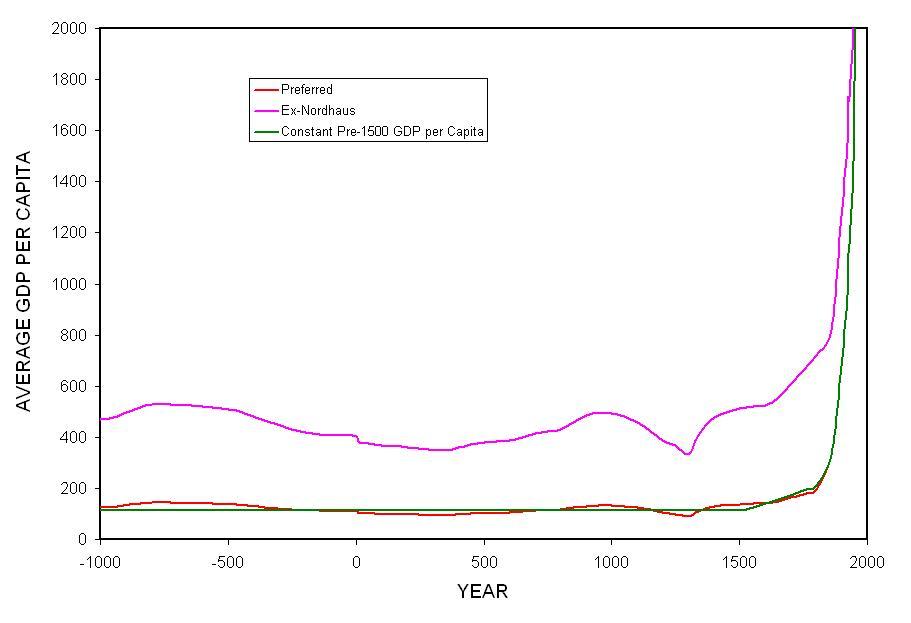
This, of course, assumes that people WILL be richer in the future. Go talk to a Roman in 500 AD. Truth is that per capita resources over many millenia, till about 15-1600 or so or so when they took off. Now one can argue that the bad old days are not likely to return, but one cannot claim that progress is never retrograde.


So your guarantee that the world will grow richer is??? Frankly little better than the Breakthrough Boys' "here occurs a miracle" (or not). Point is that there is no guarantee, that for more of history than not the world has NOT grown richer, that much of the richer in the past four centuries has been from exploiting finite resources, both inorganic and biological and what yah gonna do when the music stops??

Ad exasperation and all that

Sunday, April 24, 2011

Strange Choices

So Eli has been Nisbiting here and there, when who should appear at the bird feeder in the window than Ethon. No decent liver out there anymore in Boulder he says, but spotted some good bird feed up at AU, and then Eli's pal began to talk about the grift.

Curious he said, but this Nathan Cummings Foundation that fronted the $$ to Matt Nisbet, why they are the dollars behind the Breakthrough bunch, which funnily enough has this Sr. Fellow, with whom Ethon assumes you, Eli, are well acquainted. It's a strange thing Ethon pointed out, but the author picked the reviewers and paid them the proverbial pittance to do something, though it is not clear what, because one of them jumped ship, and on the way out mentioned that he was only shown a small part of the report. And you know what, this is not something submitted to a journal for publication, but a report for some faculty guys with a web site of which the fellow who took the payments is the director. Makes you think of an S. Fred Special, you know the environmental tobacco smoke is good for you if, as Fred did, you use the wrong statistic, or maybe that NIPCC report that the old boy wrote for a 100K or so. Seems to be the going price this decade.

Anyhow, Ethon was a very hungry bird and he took the bait. Read the thing, and he pointed out something very interesting, not that interesting things had not been pointed out, and oh, did that make the usual suspects berry, berry cross, but this is supposedly a report on who spent what for influencing public opinion, and in that there are three things to look at: lobbying, advertising and political contributions.

On political contributions

A clear financial advantage still held by the conservative movement and industry allies exists in the arena of election spending, as a recent analysis by the Center for Responsive Politics indicates. In 2010, following the Citizens United court ruling, conservative and allied industry organizations engaged in unprecedented independent campaign spending. The Chamber of Commerce ($33 million), American Crossroads ($22 million) and Crossroads GPS ($17 million) combined for $73 million in independent expenditures. In comparison, the League of Conservation Voters ($5.5 million), Defenders of Wildlife ($1 million) and the Sierra Club ($700,000) combined to spend $7.2 million.
and you know, even the good Matt proves that money talks in politics, because there was one case where the shoe was on the other foot
In total, supporters of the proposition raised approximately $10.6 million. In comparison, the “No on Proposition 23” coalition raised at least $25 million, resulting in a more-than 2-to-1 financial advantage over their opponents.
which enabled the opponents of the proposition to run more ads, contact more people, etc. So on political contributions, advantage climate change rejectionists

On advertising:
the Alliance (for Climate Progress) spent $34 million on advertising, short of the widely publicized $100 million-a-year goal.53 Similarly, by the end of 2009, the Alliance had signed up 2.5 million “members” to receive news and alerts, short of the 10 million target.54 In terms of advertising by other environmental organizations, according to their 2009 tax records, EDF spent $9.6 million; NRDC, $2.3 million; and Sierra Club, $1.8 million. In all, the Alliance and these groups spent $47.7 million on advertising. . . .

In comparison, according to their respective tax returns, the U.S. Chamber of Commerce spent $71 million on advertising in 2009, the American Petroleum Institute spent $57 million, the American Coalition for Clean Coal spent $31 million, the National Association of Manufacturers spent $4.5 million, and the Heritage Foundation spent $3.7 million, for a combined total of $167 million. Not all of this ad spending was on climate change. For example, as discussed earlier, much of the spending by the U.S. Chamber was aimed at health care legislation.

but, of course, not all of the environmental groups' advertising was on the Cap and Trade bill either. IOKIYAACCR. And, of course, the oil and coal companies had their own advertising,
Image advertising by the major oil companies is also relevant, as this advertising may influence the perceived need among lawmakers and the public for cap and trade legislation, even if the ads did not directly address the debate, and even as some of the companies supported the bills. . . .

Figures on advertising spending by oil companies in 2009 are not available, but an analysis by the firm Kantar Media CMAG for the Alliance for Climate Protection provides some insight on the scale of spending by these companies. During the first 10 months of 2010, Exxon Mobil spent $29 million, Shell spent $9.7 million and Chevron spent $7.2 million. In responding to the oil spill, BP spent $126 million.
So on advertising, advantage climate change rejectionists

On lobbying, as Joe Romm has pointed out, Nisbet has to use a bizarre method to get the numbers for pros and cons to come out even. His argument is based on the idea that
With the exception of the figures for the environmental groups, this comparison of lobbying expenditures across coalitions should not be interpreted as reflecting the actual amounts spent on cap and trade legislation. Instead, in the aggregate, these totals are representative of the capacity for power and influence that each side could apply in 2009.
But he then trawls into the pro cap and trade lobbying totals the total lobbying for all of the companies who were members of the US Climate Action Partnership. Somehow, the author forgot to include the total lobbying budgets for all of the members of the American Petroleum Institute or the US Chamber of Commerce on the other side. Unfortunate yet EVEN with that lack of manipulation**,
Through their work building coalitions and alliances, the environmental groups were able to forge a network of organizations that spent a combined $229 million on lobbying across all issues. In comparison, the network of prominent opponents of cap and trade legislation spent $272 million lobbying across all issues.
In spite of putting his big toe on the scale, in all three rubber meets the road categories, political contributions, advertising and lobbying the climate change rejectionists had significantly more resources (and if you think 43M$ is not a lot, Eli would like to talk with you about buying carrot and bird seed futures).

And then, of course, we have to (NO WE DON'T!!!!!) talk about the full Wegman, Nisbet's learned dissertation on how the AAAS is full of socialists who were born in Kenya. Science birtherism as it were. Was there a point there? Yes, Michael Mann published with a lot of people since 1998 and Obama's father came from Kenya.

** Nisbet's accounting puts Eli in mind of the three candidates for a CFO job who, at the interview were asked what 2 + 2 was. Three said the first, and was asked to leave. Four said the second and was told to take a seat in the waiting room. What would you like it to be said the third, and was hired.