Another look at Merchants of Doubt

Eli is happy to present some supplemental materials expanding on a previous post and more
@whinecough "devastating critique" is my word for when half-bright self-appointed science police get on the case of actual researchers
— Dan Davies (@dsquareddigest) July 31, 2015
@whinecough paradigmatically, it involves holding up something as a Fatal Flaw [tm] which was actually mentioned by the authors
— Dan Davies (@dsquareddigest) July 31, 2015
@whinecough & then it's always "oh I was just raising wider issues WHY HAS THIS BECOME SO PERSONALISED"
— Dan Davies (@dsquareddigest) July 31, 2015
I have had so many conversations or email exchanges with students in the last few years wherein I anger them by indicating that simply saying, "This is my opinion" does not preclude a connected statement from being dead wrong. It still baffles me that some feel those four words somehow give them carte blanche to spout batshit oratory or prose. And it really scares me that some of those students think education that challenges their ideas is equivalent to an attack on their beliefs. -Mick CullenRouner points out that many things people claim as their opinion are actually statements about facts, and facts are not opinions. Some things are opinions, such as Eli believing that carrots are the most superior food stuff.
There’s nothing wrong with an opinion on those things. The problem comes from people whose opinions are actually misconceptions. If you think vaccines cause autism you are expressing something factually wrong, not an opinion. The fact that you may still believe that vaccines cause autism does not move your misconception into the realm of valid opinion. Nor does the fact that many others share this opinion give it any more validity.He continues
And yes, sometimes scientific or historical data is wrong or unclear or in need of further examination. Everyone knows water expands when it freezes. Do you know why it does that? when literally nothing else in the world does?Eli and several others pointed out that yes, science and a lot of people know why water expands when it freezes, and Jeff added a correction. A very important correction, not for what it said about water, but for what it said about how misconceptions can and should be corrected.Nope, and neither does science.[ *See correction below and related article] Or hey, here’s a question; what was the racial heritage of the Ancient Egyptians because historians can’t come to a consensus;and Egyptian art is too stylized to accurately judge.
* Correction: I did get something wrong in the article. I said that science didn’t know why water was the only substance that expands when it cools. Turns out water is one of the few substances that expands while it cools, not the only one, and that we do know the reason it expands. I took finding this out with chagrin and further proof of my point that we all have much to learn. My opinion was based on bad data. Now it’s not.This, to Eli is a major point, that one has to recognize one's own limits. This is so unusual that one can only point to the title of Michael's most recent post: They concede nothing, they can't
The open review of the Hansen, et al paper on sea level rise has, as they say, gone nuclear, with the arrival of Andy Revkin and the local Dragon Slayer rep. In that context Eli sees little difference between the two.
Reviewing papers is a matter of ethics. First you don't review papers if you have any conflicts of interest with the authors. Second you don't review papers if you are not an expert in the field. In both cases you send the papers back to the editor with a polite note indicating the reason.
The first is a question of fairness, the second a question of not making a fool of yourself and wasting everyone's time. In either case you may have an opinion, but that's it. It is YOUR opinion
As dsquared said on Twitter: "devastating critique" is my word for when half-bright self-appointed science police get on the case of actual researchers.
Turn in your badge Andy.
Title changed from Choking the Fish


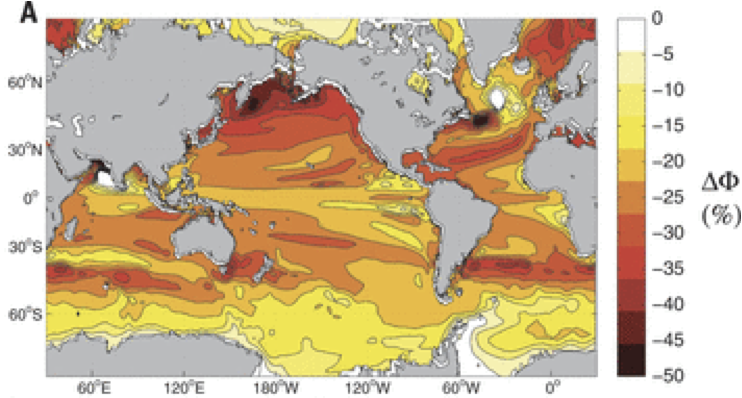
Warming of the oceans and consequent loss of dissolved oxygen (O2) will alter marine ecosystems, but a mechanistic framework to predict the impact of multiple stressors on viable habitat is lacking. Here, we integrate physiological, climatic, and biogeographic data to calibrate and then map a key metabolic index—the ratio of O2 supply to resting metabolic O2 demand—across geographic ranges of several marine ectotherms. These species differ in thermal and hypoxic tolerances, but their contemporary distributions are all bounded at the equatorward edge by a minimum metabolic index of ~2 to 5, indicative of a critical energetic requirement for organismal activity. The combined effects of warming and O2 loss this century are projected to reduce the upper ocean’s metabolic index by ~20% globally and by ~50% in northern high-latitude regions, forcing poleward and vertical contraction of metabolically viable habitats and species ranges.There is an editor's summary which puts this a bit more forcefully
It is well known that climate change will warm ocean waters, but dissolved oxygen levels also decrease as water warms. Deutsch et al. combined data on metabolism, temperature, and demographics to determine the impact of marine deoxygenation on a variety of fish and crustacean species (see the Perspective by Kleypas). Predicted climate and oxygen conditions can be expected to contract the distribution of marine fish poleward, as equatorward waters become too low in oxygen to support their energy needs. Furthermore, even the more-poleward waters will have reduced oxygen levels.Deutsch and co. looked at how the oxygen content would shift populations of cod, seabream, eelpout and rock crab. They define a metabolic index Φ as the ratio of the available partial pressure of oxygen to the oxygen needed by a resting sea critter. When Φ = 1, about all a fish can do is float. OTOH, for Φ < 1 the fish has to go somewhere else to be able to survive. The figure below shows how this shifts under RCP 8.5 in 100 years from the generic 2000 to 2100.
I was going to write about Clinton's initial climate plan and still will, but I got distracted with a plagiarism proposal I want to suggest. Much of her plan requires Congressional approval, and we all now how problematic that will be. What can be done without it?
I think the answer is a lot - just by doing more of what we're already doing, by plagiarizing Obama's Clean Power and making it stricter. More specifically, wait until the Clean Power Plan has cleared all its legal hurdles, and then set up the sequel.
It's not all the easy to find the guts of the CPP, but it's here (starting on page 8). A modified version of each state's predicted baseline carbon emission rate per MWh is established, and here (page 34837, assuming I've read it correctly) each plant has to meet that average rate or find a way to offset the excess, possibly through some state-established system. If all the above-average emission facilities have to get to average levels in some form, then the total emissions go down.
CPP tries not to be arbitrary, so making it tougher in a non-arbitrary way presents a challenge. OTOH, one factor in determining the predicted baseline rate is each state's future Renewable Portfolio Standard (see first link, page 15). If instead of using the individual RPS, the EPA applies the best-in-class RPS from a similarly-situated state, then that could significantly knock down the baseline average emission that plants would have to match.
Figuring out the best-in-class is somewhat flexible, but you could look at every state with a similar or worse level of existing percentage of renewables, take the one that has the highest RPS for the future, and determine that to be the best-in-class. This wouldn't force each state to match the toughest RPS, because they could find other ways to reduce carbon emissions.
This is my version of the "if ain't broke, do it some more" rule. Regardless, serious presidential candidates need to say what they will do on climate change if Congress doesn't cooperate with reality.

Upon hearing of the new project, called Breakthrough ListenEli thought about this a bit. Does anybunny associated with the Breakthrough Institute take time out from ceaseless self promotion to listen? Sadly no, but it turns out that the Listeners are another bunch what has snagged them a rich Russian to fund a SETI project to the dismay of Shellenberger, Nordhaus the Lesser and Pielke the Jr. fudraising being the major industry of the Breakthrough types.
I was reminded, of all things, of a recent prison break. Last month two convicted murders escaped from a New York prison. They had spent months carefully planning and executing their escape, which involved cutting and digging their way through walls, pipes and concrete. Remarkably, however, the pair gave little thought to what they would do if they actually succeeded in their plans. The consequence of the lack of planning was a short effort to flee from authorities followed by the death of one prisoner and re-capture of the other by authorities.Well, no. They suborned a prison worker to be waiting there on the outside with an automobile which would whisk them away. Unfortunately for them, she got cold feet and was not waiting outside the manhole cover they popped out of.
The search for extra-terrestrial life shares some similarities. We are investing considerable attention and resources into the search, but little into thinking about the consequences of success.But, of course, in the scheme of things relatively little resources have been spent on SETI, much of which has been analyzing astronomical radio telescope signals taken for and funded by astronomers for their purposes while bootlegging time on personal computers. And yes, people have thought of the consequences from early times as any reader of science fiction or the scientific literature would know. Tailoring of reality to fit one's needs is good sport in Boulder

Exxon NEVER denied the potential for humans to impact the climate system. It did question ‐ legitimately, in my opinion ‐ the validity of some of the science…Well, I'm not sure that's an accurate statement, but again it doesn't matter too much if you're using someone else to do your denial for you.
A key breakthrough in the public and legal case for tobacco control came when internal documents came to light showing the tobacco industry had knowingly misled the public. Similar documents may well exist in the vaults of the fossil fuel industry and their trade associations and front groups, and there are many possible approaches to unearthing them.We might have the first stage of this internal documentation with the latest info on what Exxon knew in 1981. Maybe we'll find out more.
For some odd reason, maybe it was the slow season, Retraction Watch has caught up with the Journal of Economic Prospectives latest gremlin whacker (gremlins being the newest moles), aka correction of Richard Tol's 2009 article on the costs of climate change. Eli, of course, being the quick and dirty bunny he is had already had a say, but there remain things both interesting, perplexing and concerning about the paper, and indeed all of the papers that Richard cites for his paper, best seen in the figure displayed in the gremlin whacker linked above

Sandra Boynton is one, maybe the only, joy of Twitter. Follow that cartoonist.
Rise above. pic.twitter.com/Vkdx8O6bEF
— Sandra Boynton (@SandyBoynton) July 22, 2015
Goresat, aka DSCVR has reached the Lagrange point and started sending back pictures of the Earth


New Yorker's article on the exposure of the Pacific Northwest to a massive quake and tsunami is well worth the read. I used to live there and knew they're equivalently vulnerable to quakes as we are in California, and much less prepared. I didn't know about the tsunami danger.
The correlations I see between this issue and climate are in the seriousness of risk, timescale, and effort needed to respond to the problem. Overall Cascadia may have an even greater problem with the quake and tsunami than they/we have with climate change - the long tail of risk includes immediate catastrophe as a possibility. If they/we are lucky for the next 50 years, taking action on both mitigating emissions and tsunami-proofing our coastal areas without a catastrophe hitting, my guess is the cost of tsunami-proofing in the region would be higher than mitigating and adapting to climate change.
One other overlap is that one way to adapt to tsunamis is to relocate away from sea level, at least with your most vulnerable communities and critical infrastructure, and that will help with sea level rise as well. Finally, they are doing something to deal with this problem, just not doing enough.
Having said all that, one thing that did bother me with the article is that some things seemed exaggerated. Getting knocked over by ankle-deep running water? Call me skeptical. Same thing with Sacramento's alleged vulnerability to tsunamis - I'd like to get learn more about this, but I do know that there are two constriction points between the city and the ocean (Golden Gate and Carquinez Strait) and lots of room for water to spread. Hopefully the other risks aren't exaggerated.
However, this prediction smells like bunk to me.
The normal fluctuation in the Sun's intensity, the 11-year sunspot cycle, has an amplitude of about 0.1%. By comparison, 60% is huge.
If the Sun's output decreased by 60%, what would be the resulting change in the Earth's temperature??
Here's a very rough estimate. Assume that the surface temperature is proportional to the Suns power output, raised to the 1/4 power.
Then a decrease of the Sun’s output by 60% would cause a new temperature proportional to
(1.0 - 0.6)0.25 = (0.4)0.25 = 0.79,
which means a decrease of 21% in the absolute (Kelvin) temperature.
Since the surface temperature is about 15 C or 288 K, the change in temperature of 21% is about 60 degrees C. It only took a decrease of about 7 or 8 C to cause the last Ice Age!!
The estimate could of course be refined, but it would not change the conclusion: If the Sun's output decreases by 60%, it would cause an extremely cold ice age.
IF (and it could be a big "IF") UPI* has accurately represented Prof. Zkarkova accurately,
then there are only two possibilities:
Or Zharkova could be mistaken.
*Dunno if it's still true, but at one time, UPI was owned by Rev. Sun Myung Moon and the Unification Church, who do not exactly have a great reputation for accuracy.
A version of something I wrote on email struck a chord with some folks regarding the assertion "GMOs are safe":
The term "safe" should be bifurcated into "safe for human health" and "safe for the general environment".
GMOs are health-safe so far, with complications regarding farmworkers exposure to pesticide. There are serious concerns and reasons to proceed cautiously on environmental safety, especially for genetic contamination of wild relatives of domestic plants and animals.
I think there's a "cool kids" attitude among some, the Ezra Klein types, that tries to show how they're not old-school dirty hippies by expressing love of GMOs.Incidentally, the term "safe to eat" is carefully chosen - many people conflate that as "safe for people" or just "safe", when it's a nice dodge around the issue of farmworkers' increased exposure to herbicides.*
To some, [Ecomodernism] carries a whiff of triumphalism. “For a long time, I’ve been a card-carrying pragmatist about environmental issues, but the pragmatism of the Breakthrough Institute is a pragmatism I don’t recognize,” Ben Minteer, a professor of environmental ethics at Arizona State University and a co-editor of the new anthology “After Preservation,” told me. “I don’t see any of the humility or caution that’s such a central part of pragmatism.”That doesn't mean don't go ahead, but rather as John Mashey says, "proceed with caution". And maybe don't proceed in some cases - I wouldn't plant GMO crops in regions where the wild originator of the domesticated plant exists, or where the plant spreads widely as a weed.
With the summer doldrums, ATTP going to conferences and the Greek crisis, it becomes necessary for Eli to borrow seriously in order to maintain paid readership (Damn Eli needs to monetize this blog but Brian will demand a cut). Thus by way of Crooked Timber, Noah Smith on definitive derpiness, a subject he has deeply studied
It has to do with Bayesian probability. Bayesian probability basically says that "probability" is, to some degree, subjective. It's your best guess for how likely something is. But to be Bayesian, your "best guess" must take the observable evidence into account. Updating your beliefs by looking at the outside world is called "Bayesian inference. Your initial guess about the probability is called your "prior belief", or just your "prior" for short. Your final guess, after you look at the evidence, is called your "posterior." The observable evidence is what changes your prior into your posterior.
How much does the evidence change your belief? That depends on three things. It depends on A) how different the evidence is from your prior, B) how strong the evidence is, and C) how strong your prior is.
What does it mean for a prior to be "strong" really, really believe something to be true. If your start off with a very strong prior, even solid evidence to the contrary won't change your mind. In other words, your posterior will come directly from your prior. (And where do priors come from? On this, Bayesian theory is silent. Let's assume they come directly from your...um...posterior.)
There are many people who have very strong priors about things. For example, there are people who believe, very strongly, that solar power will never be cost-efficient. If you confront them with evidence of solar's rapid price declines, they will continue to insist that, despite this evidence, solar will simply never be cost-competitive with fossil fuels. That they continue to insist this does not necessarily make them irrational in the Bayesian sense; they simply have very strong priors. Someday they may be convinced - for example, if and when unsubsidized solar power starts being adopted on a mass scale. It'll just take a LOT to convince them. (A more entertaining example can be seen in this classic comedy video)
But here's the thing: When those people keep broadcasting their priors to the world again and again after every new piece of evidence comes out, it gets very annoying. After every article comes out about a new solar technology breakthrough, or a new cost drop, they'll just repeat "Solar will never be cost-competitive." That is unhelpful and uninformative, since they're just restating their priors over and over. Thus, it is annoying. Guys, we know what you think already.
English has no word for the constant, repetitive reiteration of strong priors". Yet it is a well-known phenomenon in the world of punditry, debate, and public affairs. On Twitter, we call it "derp"
Well, it's summer in the North, and the birds are singing, the bunnies, well, you know what, and people all over are sweating. It has been particularly bad in Europe, the Western US, and disastrous in South Asia, both India and Pakistan.
As Eli could have told you the search is on for excuses, especially in light of new papers which attribute and increase in heat waves to climate change. Some, not Eli to be sure, recommend very large air conditioners to handle the problem. ARPA-E has been working on that, well along the line of solar and thermal driven units, not extra jumbos, and there is progress.
Others, actually the same some playing the others card, are going the ostrich route, nothing happening here, move on. This has lead to a cheerful back and forth between La Curry and El Tamino. Curry posted some slides from a talk by NOAA's Prashant Sardeshmukh describing shifts in mean temperature and the standard deviation of the temperature distribution and coming to the conclusion that there has been no increase in heat waves.
Now to be honest there are some issues with this. First, the slides only deal with changes in December-January-February, which is the northern hemisphere winter (Yes, Eli knows about Australia and the newly popular concern of some of those who block the Bunny's tweets with Africa) but most land and most people find themselves in the northern hemisphere, which, also is where they get hit by heat waves during the summer. Oh yeah, it's real TLT out there, the temperatures are from the 850 mbar level where no one is hot because of the lapse rate, and from reanalyses, not measurements. Of course Eli expects that such manipulation would not be allowed in the blogs of denial. Eli is often disappointed
Curry shows a slide of temperature distributions by Sardeshmukh defining a heat wave as when the temperature exceeds a fixed limit. Curry then shows a slide by Sardeshmukh showing the global distribution of temperature changes,


Tamino’s argument is essentially a quibble about how heat waves are defined, there are various definitionsAs Tamino said in his first post
For the heat wave forecasts that my company provides to the energy sector, so they can anticipate high energy demand, we define heat wave in terms of the standard deviation above the climatological mean for that location (we use 1.5 standard deviations for the energy demand applications, whereas Sardeshmukh used 2 standard deviations). For our heat wave forecasts in Ahmedabad India, we use specified temperature thresholds. Other definitions are tied to a specific temperature increment, e.g. 5C above daily average.
Sardeshmukh’s analysis uses two different baseline temps: one prior to 1950 and the other post 1950, and then calculates deviations from those means. His whole point is that the standard deviation and skewness changes can dominate, resulting in fewer large excursions from the mean.
Which makes me wonder, what the hell is going on? If he was trying to emphasize that we can’t use the change in mean and standard deviation to understand the 2-sigma exceedance, well duh. When the mean goes up and the standard deviation goes up and you change the limit to define “extreme” temperature, you should expect nothing less.All this will play out relatively quickly, but it did inspire Eli to play a bit with the temperature and standard deviation figures above using (shudder Powerpoint, which has some interesting features. By sharpening up the colors and overlaying the two figures One can make out areas where both temperature and standard deviations changed in the same directions and in opposite directions

When Eli was a young bunny being civilized by his teachers, there were two dystopian models of instruction used to warn against the future, George Orwell's 1984 and and Aldous Huxley's Brave New World. 1984 is a dark vision of perpetual war and oppression with obvious roots in Stalinism and Nazi Germany, a war just fought and a cold war starting, both with the potential of destroying the world.
Brave New World is an exercise in Paradise Engineering and the best illustration we have to the darker implications of the recent Eco Modernist Manifesto. Eco Modernism revives the faith in technology of the late 19th and early 20th century, an optimism that found expression in our growing ability to shape the world coupled with hubris and contempt of the natural. Marxists, particularly Stalin and Mao discovered industrial marxism and their many attempts to control nature produced only disasters. Their heavy handed attempts to create technology produced contaminated industrial wastelands.
The obvious parallels of the Eco-Modernist Manifesto to the philosophical underpinnings of modernism and industrial marxism formed Eli's first impression, but a conversation at ATTP has shifted the Bunny's focus to Huxley's vision. While one can quibble for or against the specific technologies that are recommended, one must seriously consider the implications for the organization of society which make the Brave New World a model for how an Eco-Modernist society MUST be organized to function.
Ecomodernism postulates movement of population to large cities, industrialization of agriculture and the isolation of areas for nature. It is not that we do not know where that vision leads, and we even have examples today of nations that are essentially single cities such as Singapore and Qatar moving in that direction.
Huxley's brave new world was based on genetically engineered social classes with the Alphas at the top and the Deltas and Epsilons at the bottom collecting the garbage and providing other services. Today's city states and those of the ecomodernists require vast numbers of Deltas and Epsilons to support the Alphas. They are ancient greek city states with a small number of citizens benefitting from the labor of a large number of contract workers many on temporary visas. If you are an alpha, it is a good deal, if not, maybe not so much.
The reliance of the ecomodernist city state on complex technologies requires strong central control to keep the machine running, leaving little room for individuality. City states may occupy not much land, but they require a great deal of land and resources from that land to provide all that the people living in them need. Urban organization and governance is complex. As Izen points out at ATTP, the ecomodern city state requires a social monoculture with no room for dissent and that monoculture is enforced by the power of the state.
The brave new world of ecomodernism will be a very uncomfortable fit to many ecomodernists' dreams.

There may be some useful common thread to how educated people resist climate science for a while, maybe years, and then come around. And it's probably different than what shifts the average voter who spends very little time thinking about the issue.

It tells you first that Catholics are about 10% less supportive of the death penalty than the general population. One would have to adjust for other factors to prove that's driven by being Catholic as opposed to something else, but it seems in large part to be real. (See also this article showing on issues where the Church is conservative, regular churchgoers are more likely to take the same position.)
Contrary to a poorly-reasoned article in Grist, religion can have an effect on politics, and looking at where Catholics stand now doesn't tell you where they will be if action on climate gets enmeshed in Catholic teaching. The president of the US Conference of Catholic Bishops calls the encyclical their "marching orders on advocacy."
Death penalty advocacy is a different apple, though. It's something the Church has been beating on for decades, so it could be a while for the encyclical to have a similar effect, assuming the Church even maintains the interest that Francis has directed. OTOH, I think normal folks are more likely to have their own intuition on the death penalty than they are to have one on climate change, so the Church's effect on death penalty opinion has had to push against a stronger current.
I'll gladly take a 10% shift in Catholic opinion, which doesn't even account for an increase in priority that supportive Catholics will place on the issue. It also might help fracture the tribal identity that drives Catholic conservatives to denialism. I think at least of equal importance will be its effect on pushing other religions to also up their game on the issue.
It's a marathon.
Don't know how I missed this video, but definitely worth watching.
I planned to write something the Pontifical Academy of Sciences, that the Pope has a strong scientific backing for tomorrow's encyclical, but Bloomberg already did it.
The leaked draft sounds good and is stirring up trouble. We'll see what happens. Catholic support played a role in Nebraska's repeal of the death penalty, so there's still some political heft in religious affiliation. Probably more of a long-term effect, but it's a marathon.
The "Coal for Africa" aka Ecomodernism campaign has run head on into its internal contradictions with the emergence of Pope Francis' new encyclical, totally exposing the common roots of climate change denial and luckwarmerism. The twitter is ablaze.
It is really hard to tell who is the most angry at the exposure of their moral corruption, the Steve Milloys or BTI guys or the Bishop Hills. Twitter tells all
 From Votaire to Hitchens, the belief in progress has for hundreds of years been synonymous with renouncing Catholicism & the Pope.But he's not! Church is all about materialism — for the priest class. $10 - $15 B in assets. @nils_gilman @jneeley78
 Pope's Leaked Encyclical: Popes says we have a harmful 'culture of waste.' Uh, we call it an economy.
Gary Wills at the New York Review of Books, asks who is afraid of Pope Francis. His answer is
. . .as the pope prepares a major encyclical on climate change, to be released this summer, the billionaires are spending a great deal of their money in a direct assault on him. They are calling in their chits, their kept scientists, their rigged conferences, their sycophantic beneficiaries, their bought publicists to discredit words of the pope that have not even been issuedFrancis, in the brief time he has been pope has made his devotion to the poor a watchword, which is why Wills (and Eli) believe that they will not succeed, indeed why this attack should be hung about their necks when they dare to show their faces in public.
They do not know exactly what the pope is going to say in his forthcoming encyclical on preserving God’s creation, but they know what he will not say. He will not deny that the poor suffer from actions that despoil the earth. Everything he has said and done so far shows that Francis always stands for the poor.
Those who profit from what harms the earth have to keep the poor out of sight. They have trouble enough fighting off the scientific, economic, and political arguments against bastioned privilege. Bringing basic morality to the fore could be fatal to them. That is why they are mounting such a public pre-emptive strike against the encyclical before it even appears. They must not only discredit the pope’s words (whatever they turn out to be), they must block them, ridicule them, destroy them.Indeed the reaction today to a leaked draft of the encyclical has been furious, so Eli would like to do some record keeping for Steve Milloy who is indeed frothing. In keeping with the good Sou, Eli has archived the froth for posterity or hilarity


Nononono, not Roger Pielke Jr, Bjorn Lomborg, Willard Anthony Watts, or Matt King Coal Ridley.
Recently as steam has run out on "Coal for Africa" with the falling prices of renewables making them the power source of choice in the third world, especially the rural third world, we have, courtesy of the Breakthrough Institute, Ecomodernism, which, according to the manifestoso
In this, we affirm one long-standing environmental ideal, that humanity must shrink its impacts on the environment to make more room for nature, while we reject another, that human societies must harmonize with nature to avoid economic and ecological collapse.It is worth asking how successful such attempts have been. Eli has learned a lot over the years about how humanity and the natural world are entangled, and how attempts to decouple them have not exactly worked out to plan. In the twentieth century those attempts were mostly the brainchildren of the "scientific" socialists, aka the communists. Marxism is industry oriented by birth, and to a marxist, such activities as farming, well, that can be improved on.
 One of the best examples of early ecomodernism was China's Four Pests Campaign. Mao decided that there were four pests holding back China, mosquitoes, flies, rats, and sparrows.
 according to environmental activist Dai Qing, "Mao knew nothing about animals. He didn't want to discuss his plan or listen to experts. He just decided that the 'four pests' should be killed."It is amusing to note the marxist roots of today's ecomodernism, the next bright shiny thing being rolled out to block action on real environmental problems.
Moreover, the idea fit in quite well with Mao's hard-line totalitarian Communist ideology. Marx himself was far from an environmentalist, proclaiming that nature should be fully exploited by humans for production purposes (a legacy which may explain China's poor environmental track record to this very day).
But the damage was done — and the situation got progressively worse. Locust populations swarmed the countryside with no sparrows in sight. Things got so bad that the Chinese government started importing sparrows from the Soviet Union. The overflow of insects, plus the added effects of widespread deforestation and misuse of poisons and pesticides, were a significant contributor to the Great Chinese Famine (1958-1961) in which an estimated 30 million people died of starvation.
The coming June 18th publication of Laudato Si will reaffirm our moral responsibility for the Earth. Whether that responsibility comes from religious belief or concern for our world and all its creatures depends on each, but the obligation to the present and the future remains. Laudito Si comes from St. Francis of Assisi's Canticle of All Creatures
You are called to care for creation not only as responsible citizens, but also as followers of Christ!The Pope, of course, takes this to be a religious obligation
As stewards of God’s creation, we are called to make the earth a beautiful garden for the human family. When we destroy our forests, ravage our soil and pollute our seas, we betray that noble calling.Moral framing is basic, not only to climate issues, but all environmental concerns. It would be a grave mistake to anticipate Laudito Si as being solely about climate change as many political types are (and worthy of derision they are too). We are of the Earth and have the obligation to preserve it for the future. Attempts to decouple the Earth and humans are futile, scientifically silly and morally corrupt because of the damage such an attempt would cause. Stephan Gardiner summarized this for climate change, but his statement is equally valid for all other ecological problems driven by humans.
. . . the presence of the problem of moral corruption reveals another sense in which climate change may be a perfect moral storm. This is that its complexity may turn out to be perfectly convenient for us, the current generation, and indeed for each successor generation as it comes to occupy our position. For one thing, it provides each generation with the cover under which it can seem to be taking the issue seriously – by negotiating weak and largely substanceless global accords, for example, and then heralding them as great achievements – when really it is simply exploiting its temporal position. For another, all of this can occur without the exploitative generation actually having to acknowledge that this is what it is doing. By avoiding overtly selfish behaviour, earlier generations can take advantage of the future without the unpleasantness of admitting it – either to others, or, perhaps more importantly, to itself.There is, of course, a tension in many religions, between millennialism and care taking, Those who think the end of the Earth is nigh, or, alternatively, that they will dwell in a heaven after but a short time on Earth, are prey to neglecting their current world. Eli's guess is that Laudito Si will stress that a strong component of where and wither will be the care that is taken in this world, preserving it for the future.
Every sensate being we’ve encountered in the universe so far—from dogs and humans and mice to turtles and spiders and seahorses—has evolved to suit the cosmic accident that is Earth. The notion that we could take these forms, most beautiful and most wonderful, and hurl them into space, and that this would, to use Petranek’s formulation, constitute “our best hope,” is either fantastically far-fetched or deeply depressing.Finally, Eli recommends some reading of the National Catholic Reporter in the coming weeks. It already has much on the forthcoming encyclical from the standpoint of the Catholic Church.
As Impey points out, for six decades we’ve had the capacity to blow ourselves to smithereens. One of these days, we may well do ourselves in; certainly we’re already killing off a whole lot of other species. But the problem with thinking of Mars as a fallback planet (besides the lack of oxygen and air pressure and food and liquid water) is that it overlooks the obvious. Wherever we go, we’ll take ourselves with us. Either we’re capable of dealing with the challenges posed by our own intelligence or we’re not. Perhaps the reason we haven’t met any alien beings is that those which survive aren’t the type to go zipping around the galaxy. Maybe they’ve stayed quietly at home, tending their own gardens.
DSCVR has made it out to L1 and is parked. Long lost in George Bush's back pocket out of envy, the satellite was unpacked and launched because it had space weather monitoring capabilities, and the satellite being used for that purpose was going bad. As Eli has noted this was a good thing for many reasons.
Of course NOAA downplays the Earth monitoring capability, but it is there
DSCOVR will eventually replace NASA’s Advanced Composition Explorer (ACE) research satellite as America’s primary warning system for solar magnetic storms headed towards Earth. ACE will continue to provide valuable research data to the science community. <However, NOAA is stuck with the name: Deep Space Climate Observatory
In addition to space weather-monitoring instruments, DSCOVR is carrying two NASA Earth-observing instruments that will gather a range of measurements from ozone and aerosol amounts, to changes in Earth's radiation budget—the balance between incoming radiation (largely from the sun) and that which is reflected from Earth. This balance affects our climate.
DSCOVR has reached its final orbit and will soon be ready to begin its mission of space weather monitoring for NOAA and Earth observing for NASA," said Al Vernacchio, DSCOVR project manager at NASA's Goddard Space Flight Center, Greenbelt, Maryland.
An idea I had years ago got called out recently by Richard Louv, author of Last Child In the Woods. Louv was mad about a little girl being forced by city regulators to tear down a treehouse and he remembered something I'd written:
In 2006 [actually 2007 -ed.], an environmental lawyer named Brian Schmidt started thinking about nature-deficit disorder and came up with a novel idea, which he shared in his blog: “Set up a legal foundation that pays the legal defense costs of institutions and individuals who bring children outdoors and then [are] hit with frivolous lawsuits.” In the 2008 update to “Last Child in the Woods,” I passed along Schmidt’s idea, and suggested calling it the No Child Left Inside Legal Defense Fund.I wrote a little more here.
At the outset, the fund would defend people “against the claims that would have established the worst precedents or had the worst potential impact,” he said, in an email. “The fund would support “all or part of defendant’s legal costs afterwards,” if the defendants did not settle the case. “Regardless of how successful this idea could become, it will never cover all the costs of defending against all lawsuits. Still it could help, and just the fact that a defendant knew it was possible to recover costs might make the defendant less likely to settle".....
Who would pay for such a fund? How about trail lawyers and other attorneys, through donations and pro bono services. Many are genuinely concerned about the growth of litigiousness and the kind of regulation enforcement that can give good regulations — the kind that fight corporate polluters for example — a bad name.
“I also expect that businesses that support the outdoors would be interested in funding the foundation,” added Schmidt. He said he was just tossing “this idea out into the Googleable universe, with the additional mention that I’d be willing to put in some of my own money or time as a lawyer if the idea goes anywhere.”

 Posts
All Comments
Posts
All Comments


