Friday, August 20, 2010

God, Eli is old

So over on Deltoid, Eli was reminded that the Albemarle County Circuit Court is ruling holding a hearing today on Ken Cuccinelli's SLAPP suit against the University of Virginia and that there will be protest today at UVA starting half an hour ago. Now Eli is tech savy for an ancient relic and he went poking about the net to find more, tried to contact the court to see if they would be posting the decision etc., when Facebook occurred to his as the source of what's happening now, and sure enough there is a page with a link to a radio interview with one of the protest organizers.

Stay tuned to Rabett Run, Facebook for the older set.

UPDATE: News from the Virginia Pilot setting the stage.

UPDATE: A bit more from the Roanoke Times

During a 75-minute hearing, Albemarle County Circuit Judge Paul Peatross repeatedly questioned whether Cuccinelli had defined the “nature of the conduct” that raises the prospect of fraud and justifies a demand for information from the university.

“You need some basis, don’t you?” said Peatross, who told attorneys he will issue a ruling within 10 days,

Deputy Attorney General Wesley Russell argued that Mann applied for grants partly on the basis of statistical research which contains a “pattern of potential manipulation of data.”

Mann is one of the authors of the so-called “hockey stick” graph that depicts sharply rising global temperatures in the last century. He has been a target of global warming skeptics, partly because one of the stone e-mails referenced a “statistical trick” in his research.

Chuck Rosenberg, an attorney retained by UVa, said the term has been taken out of context. He also argued that the attorney general cannot serve a civil investigative demand on a state agency and did not specify conduct that could constitute fraud.


Thursday, August 19, 2010

Judy's Tribe

Or maybe not. Bob Ward in the Guardian brings word that

Climate sceptics mislead

the public

and that one of the newer propaganda farms, the Global Warming Policy Foundation, a creation of the Lawson clan,
has commissioned an investigation into the three official inquiries about the messages.

These inquiries, by the House of Commons Science and Technology Committee, an independent panel chaired by Lord Oxburgh, and an independent review led by Sir Muir Russell, largely cleared climate researchers of allegations of misconduct or fraud, but criticised a lack of transparency over data and methods.

However, the foundation dismissed the findings of the inquiries and commissioned Andrew Montford, author of The Hockey Stick Illusion: Climategate and the Corruption of Science and Bishop Hill blogger, to investigate how they were conducted.

Ward, points out some of Montfords best didles, noting that, among other things, Andrew has an excellent memory hole

he claims that "senior climatologists have sought to undermine the peer review process and bully journals into suppressing dissenting views".

Montford tries to justify this assertion in his first chapter by highlighting the "difficulty in getting into print any result that went against the idea of catastrophic global warming".

He claims that a paper by Shaopeng Huang and co-authors on proxy temperature reconstructions from borehole measurements "never appeared in print" after being rejected by the journal Nature in 1997 because it showed that the medieval warm period had higher temperatures than today.

However Montford strangely neglects to tell the reader that the rejected paper was revised and published in the same year by the journal Geophysical Research Letters, and that the authors published other papers in Nature in subsequent years.

Furthermore, Montford neglects to mention a later acknowledgement by Huang and his co-authors that their 1997 work had excluded readings from the upper 100 metres of boreholes, and so provided "virtually no information about the 20th century". They noted in a paper in 2008 that when all of the borehole data are considered, the global average temperature today is shown to be higher than during the medieval warm period. However, Montford simply omits awkward truths like this which would get in the way of his conspiracy theory.

But in important news, the Guardian also notes that washing up in the dishwasher is about as good as doing it by hand as long as you air dry

The carbon footprint of doing the dishes:
Almost zero CO2 by hand in cold water (but the plates aren't clean)
540g CO2 by hand, using water sparingly and not too hot
770g CO2 in a dishwasher at 55°C
990g CO2 in a dishwasher at 65°C
8000g CO2 by hand, with extravagant use of water

Eli chomps his carrots raw. Ms Rabett inquires about paper plates.

Wednesday, August 18, 2010

The Ethical Hypocrites

Ben Hale at Cruel Mistress points to a new paper of his with Lisa Dilling, on Geoengineering, Ocean Fertilization, and the Problem of Permissible Pollution which interested bunnies (pay attention you in the back) can download and read. Rather than reproducing the abstract, available at Cruel Mistress, Eli wants to pick at their ground rules in the context of current drive bys. Their basis is a set of rules for ethical responses to climate change set up by Dale Jameson

the following conditions must be met: ‘‘(1) the project is technically feasible; (2) its consequences can be predicted reliably; (3) it would produce states that are socioeconomically preferable to the alternatives; (4) implementing the project would not seriously and systematically violate any important, well-founded ethical principles or considerations’’ (Jamieson 1996, 326).
Jameson himself was, shall we say, not very hopeful that these conditions could be met, but Hale and Dilling are downright super unhopeful. They allow that while 1-3 are not today technically possible today, further research and development could, for ocean fertilization and other geoengineering remediation be possible, but the ethical barriers are impossibly high.
Our argument turns on three basic moral claims. Any of these claims in isolation may not be sufficient to disallow ocean fertilization, but taken together, they compel the conclusion that ocean fertilization is not permissible. The first claim is that the antecedent condition, that is, the identification of carbon dioxide as a polluting substance to the atmosphere, cannot be disentangled from the decision to counteract its presence in the atmosphere by fertilizing the ocean with iron. In other words, we would not be contemplating the idea of ocean fertilization were it not for the problem of carbon dioxide being released into the air by human activities. For this article, we stipulate that what is wrong with individual-level pollution is that it is disrespectful of others. Given that the release of carbon dioxide has been identified as a wrong action, simply conducting an ex post facto remediating action to repair damages does not alone authorize or permit the action (Hale and Grundy 2009).
The second claim rests on notions of justification and obtaining assent from affected parties for the remediating action (Habermas 1991). To evaluate whether it is possible to reach a mutually respectful outcome, we must be able to identify a position that ‘‘any reasonable person would (or could) accept as permissible’’ (Habermas 1991, 66). If assent cannot be obtained, the risk of wrong to parties affected is reasonable and possible. Given that the ocean is a global reservoir, connected to a global atmosphere, actions to fertilize the iron would potentially need justification from the world’s population, a practical and political unfeasibility. Thus, the justificatory burden cannot be met.
Eli disagrees with this, it is, after all a rejection of representative government. IEHO permission from governments representative of a majority of people on the planet could legitimately take such action. In that manner, such a decision even though not unanimous, could be properly taken. Dilling and Hale continue
Third, we suggest that the fact that ocean fertilization moves the world to a new, unknown state, rather than returning the world to its original condition before the initial polluting act makes it different than other cases of more limited remediation, which seek to return the world to its original state. These three claims underpin our argument that ocean fertilization is a morally impermissible solution to counter climate change.
The third point is one that the recent flooding in Pakistan and the Russian heat wave have moved to the fore. On blogs (see, you should read preprints), it was Michael Tobis who raised this point originally and then proceeded to extend it here, and here and here. This has been picked up by Brad Johnson, the New York Times and others. Eli boiled it down to
we are entering a period when weather conditions, which were in any meaningful sense impossible before, are going to be commonly encountered. That friends is scary anthropic global climate change or SAGCC
We now see that this has been an important part of the attack on Michael, and to a lesser extent, Eli by Keith Kloor who bleated that because they did not advocate as strongly for adaptation as to mitigation they were ethically challenged. Now some, not Eli, he hastens to add, might actually have read what Tobis and Eli wrote, and having done so, some, not Eli, the Rabett hastens to add again for emphasis, might understand that Kloor, sorry gentlebunnies there are no other words for it, really was behaving unethically, aka lying. MT and Eli have always known and stated that adaptation is needed, but also maintained that adaptation alone to climate change is futile without mitigation. Hale and Dilling describe the ethical problems with techno-breakthrough policy fairy dust
Second, what we have aimed to show is that no act of remediation can be understood independently of the acts that necessitate remediation in the first place. If the remediation is oriented around an ongoing anthropogenic cause, and that cause continues to be generative of the problem that is necessitating the remediation, then it requires extra justificatory work to demonstrate its permissibility. This is so not because it amounts to ‘‘treating the symptoms’’ of the problem instead of the root cause, though this may be a concern as well. This is so not because it initiates a so-called moral hazard in which individuals do not need to bear the risks associated with their actions. But rather, it is so because the act of remediation is tied tightly to the same principle that enabled action in the first instance, and insofar as this act is impermissible, so too are subsequent acts that piggyback upon it.
The same arguments apply to sulphate (happy now Wm?) aerosol injection, but may not, at least in the view of Hale and Dilling apply to air capture. However Eli believes that they underestimate the intrusiveness of air capture, the chemical wastes that it would generate as well as the issues surrounding disposal of the CO2. The necessary size of the enterprise will make it universally intrusive in the same magnitude as the fossil fuel industry, with episodic random disasters.

Monday, August 16, 2010

A Flat New Puzzler

The question dear bunnies, is why does this figure from Tamino's post on change have the answer to what is going on in the flat new paper on proxy deconstruction by McShane and Wyner (ps there are lots of hints in the comments at Open Mind but here is another one, look at the figure and then remember that McShane and Wyner are claiming that noise gives a better match to the global temperature series than proxys) Also take a look at the comments at Policy Lass

Eli's answer later tonight.

UPDATE: Eli does have a day job folks......

When you calibrate, respectable Rabett's want the largest spread of the variable calibrated against as possible. M&W calibrated proxies that respond to regional changes against the GLOBAL temperature record. If you look at Tamino's figure, for about 80 of ~120 years (M&S only go to 2000, there ain't a lot of proxies that go to 2010), a flat line is about the best description of what happened. This covers the period from ~1880 - 1920 and ~ 1940 - 1980. In such a situation, random noise is the best description of the variation. So especially if you hold out the last 30 years and prattle on about, bunnies find that random noise about a straight line provides the best fit, which is what the boys find, and of course it does not capture the sharp rise in the last30 year period. As they say,

In other words, our model performs better when using highly autocorrelated noise rather than proxies to predict temperature. The real proxies are less predictive than our "fake" data.
Since the proxies are affected by the local temperatures (and precipitation and some other things that are all local) and the local temperatures varied much more strongly than the global in most cases, and surely for those cases where the proxies vary strongly, this is kindergarten work. Trivially, this procedure underestimates the response of the proxies to the temperature over long periods and exaggerates the error projected back to the year dot. You are fitting noisy data to a straight line to find a slope? C'mon. QED

Tim Lambert has more, and, as Eli said, the comments at Policy Lass and Tamino's are fine. Judith Curry is sitting on the sticky wicket at Kloor's and the unusual suspects, well, there is a reason they are unusual.

UPDATE: Martin Vermeer says it more clearly at Deltoid

Oops.

My explanation at link for why the M&W reconstruction is erroneous, was a little too simple. It's the Wabett who gets it completely right: the fundamental error is calibration only against a hemispheric average, when local data -- the 5x5 degree grid cells of instrumental data as used by Mann et al. -- provide a so much richer source of variability -- i.e., signal -- to calibrate against.

It is this poor signal/noise ratio that helps the calibration pick up spurious low vs. high latitude temp difference "signal", which in the reconstruction interacts with the Earth axis tilt change effect.

What stands is the observation that doing the calibration against the instrumental PC1 (instead of hemispheric average) will give you back pretty exactly the genuine Mann stick(TM) even in spite of this.

Congrats Eli!

Evidently there will be a comments on this paper at the journal (they select a few people to comment). Hopefully, much of the back and forth, with the cheerleading and booing edited out will be picked up.

Sunday, August 15, 2010

The loaded gun

MT has really started something,

Are the current events in Russia "because of" "global warming"? To put the question in slightly more formal terms, are we now looking at something that is no longer a "loading the dice" situation but is a "this would, practically certainly, not have happened without human interference" situation?
which Eli found a pithier way of putting:
As Dirty Harry would say, at some point the bunnies have to ask not if the dice are loaded, but if the 44 Magnum is.
and has now hit the New York Times front page in an article by Justin Gillis, In Weather Chaos, a Case for Global Warming, no question marks and no quotes from the usual denialists. It looks like Stephen Schneider is having a good day.

“The climate is changing,” said Jay Lawrimore, chief of climate analysis at the National Climatic Data Center in Asheville, N.C. “Extreme events are occurring with greater frequency, and in many cases with greater intensity.”

He described excessive heat, in particular, as “consistent with our understanding of how the climate responds to increasing greenhouse gases.”

Gavin Schmidt weighs in

“If you ask me as a person, do I think the Russian heat wave has to do with climate change, the answer is yes,” said Gavin Schmidt, a climate researcher with NASA in New York. “If you ask me as a scientist whether I have proved it, the answer is no — at least not yet.”

The Russians have had a come to Jesus month

“Everyone is talking about climate change now,” President Dmitri A. Medvedev told the Russian Security Council this month. “Unfortunately, what is happening now in our central regions is evidence of this global climate change, because we have never in our history faced such weather conditions in the past.”

In Eli's little corner of cyberspace this is a basic question, because if the cost of emissions is being paid in lives and fortune NOW, some people, not that Eli would ever care to point an ear, are exposed as having championed dangerous and immoral policies of delay and little to no action.

The Bunny notes with interest that a certain occupant of Andy Revkin's Rolladex is not consulted for this article. It must be a great thing for Jim Prall Bill Anderegg, and Jacob Harold that their recent paper is having such a strong effect.

Wednesday, August 11, 2010

Bye bye. . .


Sometimes words are not needed UPDATE: but here are a few. The sudden dive is a strong indication that the ice is crumbling. There is very little thick multi year sea ice left and it may be going fast as the report from the NSIDC says


This past winter's negative phase of the Arctic Oscillation transported old ice (four, five, and more years old) from an area north of the Canadian Archipelago. The ice was flushed southwards and westward into the Beaufort and Chukchi seas, as noted in our April post. Ice age data show that back in the 1970s and 1980s, old ice drifting into the Beaufort Sea would generally survive the summer melt season. However, the old, thick ice that moved into this region is now beginning to melt out, which could further deplete the Arctic’s remaining store of old, thick ice. The loss of thick ice has been implicated as a major cause of the very low September sea ice minima observed in recent years.

Monday, August 09, 2010

Reopening the poles

Well, A-Ray has won the Mockton Limmerick Contest (eight votes as of now), so all he has to do is contact Eli and collect his winnings.

OTOH, there has been a recent flood of entries, so the Rabett will reopen the contest in a couple of weeks to give the new entrants a chance. Gonna drink Eli out of house and home you are.

Saturday, August 07, 2010

MT asks a scary question

From in it for the gold, MT asks:

Are the current events in Russia "because of" "global warming"? To put the question in slightly more formal terms, are we now looking at something that is no longer a "loading the dice" situation but is a "this would, practically certainly, not have happened without human interference" situation?
UPDATE: Eli thought of a pithier way of saying this:
As Dirty Harry would say, at some point the bunnies have to ask not if the dice are loaded, but if the 44 Magnum is.

Friday, August 06, 2010

Why you should read Rabett Run

and why Tony Watts is dangerous.

A late comment on a recent puzzler newly brings this reply

Rachel said...

Thank you very much all of you, I had a take-home test in oceanography and "skin altitude" is NOWHERE on the Internet except for on this forum, and I needed the definition for a high point question. So thank you, and a very interesting discussion.

jre provided the answer before the question was asked

The lapse rate is indeed central to the greenhouse effect. To my mind, the best concise discussion of why this is so is David Archer's. To paraphrase:
1) Once you know insolation, emissivity and albedo, you can ring up Stefan and Boltzmann and know the earth's skin temperature.
2) Skin altitude is determined by absorption, reflection and re-radiation by wavelength at all altitudes. In general, higher IR opacity results in higher skin altitude.
3) Surface temperature may be found by taking the skin temperature (known from radiative equilibrium) and the skin altitude (known from atmospheric radiative properties), then sliding down to the surface at a constant lapse rate. Higher skin altitude + constant lapse rate -> higher surface temperature.

Armed with these few concepts and a clear mental picture of the atmospheric temperature profile, such as the one you have kindly provided, anyone can explain the greenhouse effect to a climate skeptic. For all the good it will do you.

But this also points to the value of informative blogs (see left hand side) and the danger of disinformative blogs. What do we need to do the honest broker asks?

Monday, August 02, 2010

The way it goes

Ethon flew back from Boulder with long stopovers in Denver, and Lord help him O'Hare. He's been getting old and peckish, and has taken to flying commercial for long hauls. Except for the food (no liver, never), he doesn't complain much. So the Bird and Eli were sitting around discussing knowledge and the difference between Philosophy, Policy, Science and Politics, you know, Honest Broker stuff. Eli thought that it was really simple, Philosophy is thinking about what should be, and Science is thinking about what is. Policy is reconciling the two, and Politics, Politics is Jindal Berm Theology, or as Roger Jr. said to Ethon, getting elected is the only thing that counts.

Ever since he was a little kit, Eli has been hearing from the Jindal Berm School, about how 1970s science predicted a new ice age was on the way. Stoat has a cute little vanity page on the subject, and occupying pride of place, the number one "proof", the Euro-cooling Journal Article Contest Winner, has always been Rasool and Schneider, Science (1971) 138 "Atmospheric Carbon Dioxide and Aerosols: Effects of Large Increases on Global Climate".

This, of course, is the paper which birthed the term "to be Rasooled", as denialists world wide Rasool Rasool, disappearing him down the citation hole and always refer to this as the late Stephen Schneider's paper. This is quite amusing as S. Ichtiaque has turned in to a Pielke Sr. clone, but then he never liked Jim Hansen much after hiring him. Turns out they might be right, as we shall see, yet Schneider was a young postdoc at the time, Rasool was the senior author.

So at last we come to the point of this post, how does science correct itself, and indeed it has, the consensus value of ~ 3 K/ CO2 doubling has been consistently reaffirmed many times in many ways, and the arms of the black knight, the very high (above 5K) and very low (below 2K) chopped off as improbably with numerous lines of evidence. Of course, the black knights, such as low end Lindzen keep on trying. So how are these appendixes (the vestigial useless organs) dealt with. They remain in print. Almost none are challenged in comments, but in a small community, everyone knows, word passes. However, as climate has become a policy issue with a much larger audience, this is no longer working, which accounts for the increased number of comments on seriously flawed papers and so, Eli adds a bit to the hysterical record.

As just about everyone knows, Rasool and Schneider used too low a value of the climate sensitivity to CO2 increase, although their aerosol sensitivity was not bad and that, it is important to know, was a significant contribution. A footnote, added probably at the insistence of the editor, points out that others found much larger CO2 sensitivities, which would more or less be the IPCC recommendation, 2-4.5 K for CO2 doubling.

Using their sensitivities, Rasool and Schneider tried to estimate future aerosol increases from fossil fuel burning and other sources and concluded that this

should raise the present background opacity by a factor of 4, our calculations suggest a decrease in global temperature by as much as 3.5 oC. Such a large decrease in the average temperature of Earth, sustained over a period of few years, is believed to be sufficient to trigger an ice age. However, by that time, nuclear power may have largely replaced fossil fuels as a means of energy production."
This is just about the only such prediction in the scientific literature, but has given rise to a cottage industry of claims. In the natural course of science, it was quickly and conclusively established by other calculations that R&S's value for climate sensitivity was too low, and the higher values, close to the current consensus ones were correct, and there was no danger of a new ice age. Why Eli put that in bold will soon become clear, but what it does show is the effective way that science has of correcting such mistakes. UPDATE: And as we shall see, Schneider himself soon, ok, relatively soon, corrected the error.

Still, where did that estimate for low CO2 sensitivity come from? Eli found the smoking gun in a 2000 AIP oral history interview by Spencer Weart with Jim Hanson (emphasis added)
Weart: You’ve known Schneider from way back, you said?

Hansen: Yes.

Weart: In what sense? Did you run into him at meetings?

Hansen: No, no. He was a student. He actually got his degree in engineering, but he got introduced to this topic by Ichtiaque Rasool, who was the guy who was later attacking me. The guy who got me my job and was attacking me, referring to our earlier situation. So Ichtiaque got Steve to work as a post-doc under him, I believe it was just after Steve graduated from Columbia. They wrote a paper on the effect of aerosols on climate, and ended up saying that the Earth may be headed towards the next Ice Age. I actually helped Steve with his calculations because he was not really a radiation transfer person, so I gave him equations for the scattering the solar part of the problem. He did the thermal part of the problem, and actually, he did a kind of slightly sticky CO2 calculation. He understated the greenhouse effect by a factor of two or so. We later figured out looking at his computer program that it was his mistake.

Weart: I’m curious. What was it?

Hansen: Just his calculation of the infrared opacity of the greenhouse gas greenhouse gas, CO2, was wrong.

Weart: Problem with the data?

Hansen: You’d have to ask Andy. I don’t remember the details. Andy Lacis, he’ll probably remember. What was the point? Oh, Steve Schneider. He and I went with my wife, climbing on Storm King Mountain. So we were pretty good friends.
UPDATE: Below, in the comments, Kooiti Masuda points out that
Schneider discussed in his paper in 1975 the sensitivity of climate to CO2 based on several studies available then, including Rasool and Schneider 1971.

S.H. Schneider, 1975: On the carbon dioxide-climate confusion. J. Atmos. Sci., 32, 2060 - 2066.

He introduced "A useful surface temperature-CO2 concentration sensitivity parameter". Though I am not sure whether this is the very first paper to discuss it, I think we can say the paper started discussion about that parameter popular (among experts). The paper is referred to as "in press" by Broecker's 1975 "Global Warming" paper (which is discussed recently by Stefan R. in RealClimate). I think the assessment of CO2-climate sensitivity by Schneider convinced Broecker the outlook of warming.

Schneider 1975 said that Rasool and Schneider 1971 underestimated the CO2-climate sensitivity, and listed three reasons. The first included the same key word "IR (infrared) opacity" as in Hansen's talk, and I guess that both point to the same thing. The other two are more technical and I have not understood them yet. I quote the first point (p.2063).

"1) The increased CO2 increases IR cooling to space in the stratosphere (which decreases the stratospheric temperature) and increases stratospheric IR opacity. Since Rasool and Schneider maintain constant stratospheric temperature even after CO2 is doubled, their model's stratosphere emits too much infrared radiation to space. This, combined with the constraint of planetary radiation balance at the top of the atmosphere, results in a compensation process by which their model's troposphere does not warm sufficiently. This effect was modeled by Manabe and Wetherald [1967] and not by Rasool and Schneider, and, as explained by the next section [Section 3], accounts for roughly 0.5 K of the 1.6 K difference in Γ2 estimates."
As Eli was saying

Saturday, July 31, 2010

What is the Honest Broker?

Ethon flew back from Boulder with long stopovers in Denver, and Lord help him O'Hare. He's been getting old and peckish, and has taken to flying commercial for long hauls. Except for the food (no liver, never), he doesn't complain much. So the Bird and Eli were sitting around discussing knowledge and the difference between Philosophy, Policy, Politics and Science, you know, Honest Broker stuff. Eli thought that it was really simple, Philosophy thinks about what should be, Science is discovering what is. Policy, well on the good side it reconciles the other two as best it can, and for that it needs to understand them on some level. Thus, Summaries for Policymakers, Politics is about getting elected.

A wonderful example of how bad science makes for bad policy and good politics, is the recent fiasco building sand berms to limit damage from the Gulf oil spill. This started as a bright idea of a local parish (read county) president in Louisiana and was quickly adopted by the state Governor, one Bobby Jindal. From the political side it had everything, an opportunity to appear to be acting, a wonderful club to bash opponents, particularly the Federal Government and President Obama and more. From the science side, not so much. The issues were clear early on, as summarized by Jeremy Remmers.

I admire Louisiana Gov. Bobby Jindal, and, gulp, Sen. David Vitter, for standing up against BP and the federal government in demanding what they consider is the right approach to protect the state’s coastline from the Gulf of Mexico oil spill.

It isn’t, a boatload of scientists agree.

The in-your-face approach by the two Republican leaders as well as a contingent of angry parish presidents in their quest to build even tiny portions of a 128-mile protective wall of sand berms has won the admiration of frantic residents and the platitudes of their chief fan club back in New York City, Fox News. . . .

Here’s the deal folks. Compared to what’s-her-name, Louisiana’s former governor during Katrina, Jindal is a driving force and unquestionably is trying to do what he thinks is best to protect his state’s fragile coastlines. The problem is what he’s proposing, and threatening to take action into his own hands, is more of a political hail Mary pass than an engineering fix. It’s pie-in-the-sky, throw other people’s money at the wall and hope something sticks.

The simple fact is this: What Jindal wants in what skeptical engineers call “The Great Wall of Louisiana” will be washed out with the first tropical storm blowing off the Gulf waters.

Jindal’s original plan was to construct 128 miles of sand berms with 102 million cubic yards of seabed dredged from the coastline floor to bolster the barrier islands and absorb oil before it reaches sensitive marshes. It would cost $950 million and take nine months to build. The oil slick arrived two weeks ago and no end on the horizon.

Coast Guard Adm. Thad Allen, in charge of the government’s supervision of BP’s obligation to clean up the mess, said he reluctantly approved the first of six berm sites at Scofield Island, west of the Mississippi River as a prototype.

“There are a lot of doubts whether this is a valid oil spill response technique, given the length of construction and so forth,” Allen said. He ordered BP to pick up the estimated $360 million cost of the revised 45-mile-long berm.

BP spokesman Mark Proegler said: “The company will not assume liability for unintended consequences.” Although the state signed contracts with a dredging firm, BP has yet to provide the funding.

What it comes down to (the berms were expensive) is could the resources be better used elsewhere even though the theatrics were great. This is the background to a useful exchange on InItForTheGold, which pretty well shows why scientists can never be Pielke's "Honest Broker" and why nobunny should ever trust a Pielke "Honest Broker" Eli expects that this attaches to Roger also.

Roger's view of Bermgate is
What if the goal of the action is not to keep oil offshore, but to demonstrate to the public that politicians are "doing something"? In the drought of 2002 the city of Denver spent $1 million on cloud seeding, which was more PR than policy. Politicians take symbolic action all the time.
Turns out there was excellent empirical evidence that seeding worked, and indeed it does at about the expected level, but what the heck, it "appears" to be an argument
In the sand berm case, the Honest Broker would present the options -- build berms, don't build berms, etc. and the range of consequences predicted to occur from relevant experts (which might include experts in beach processes as well as experts on public opinion). At that point it would be the job of politicians to decide what to do. Being an honest broker means clearly delineating advice from decision -- military intelligence long espouses this culture.
In the discussion, Michael Tobis asked some questions
Now, the expertise has somehow moved from people who understand coastal dynamics to people who know how to trick people into believing that gross wastes of public dollars are heroic.
The latter group may be "experts" of a sort, but calling them "honest brokers" is a bit of a stretch, no?

Of course, the scenario is ludicrous. Nobody told Bobby Jindal "this won't work worth a damn". Bobby may be a bit of a fool about matters of science but I don't see any reason to expect him to be dishonest in this way. And even if he were willing to be so, he would not want someone testifying to that effect.

So Roger, what are you saying? It seems to me you are casting about rather urgently for some way to defend your taxonomy. I asked you, rather, to explain how the taxonomy would be useful under certain relevant scenarios.

Your response is silly, and does not actually help. What should somebody who saw the fiasco coming actually do to dissuade the government from being stupid and wasteful? Where would the Honest Broker come from in this situation, and what options other than "for *'s sake don't do this stupid thing" would they realistically have on offer?
Michael is unrealistically polite. As we saw above Jindal WAS told by experts that the berms would not work, and most likely would cause more harm than good, but he pressed forward. So the question is what is the "Honest Broker" honest about?
See, we really don't understand this Honest Broker thing.

What sort of a job has the Honest Broker got? Who pays him or her? What behaviors are rewarded and how? Who asks for his or her Brokerage?
And, as Eli has said before, what about using the Honest Broker as a restaurant guide in a strange city. If bunnies read the Honest Broker they find that the choices for locating the good carrots are rather peculiar
Certainly, the out of town visitor asking for restaurant advice example, which was the most fully fleshed out in the book, was far from compelling.

The four roles worked out to

1) indifferent to the point of rudeness
2) nutritionist
3) somebody whose uncle has a taco joint and
4) google.

Seriously, you don't act like that when a visitor asks for dining advice, do you?
But Hank Robert's nailed it
Michael, those are good questions.
The 'honest broker' isn't -- ever -- someone who knows reliable information about sand berms.

The 'honest broker' job -- really, perhaps covertly -- is the one RPJr switches to talking about when he reveals the little man behind the curtain: help the politician appear to be doing something long enough to get the headline and win the election.

The 'honest broker' is a political public relations role, not something a scientist would do at all.

Why? Because the opportunity just expanded:
So we see that the "Honest Broker" is the PR guy behind the curtain, feeding quotes to Andy Revkin. And Andy, of course, guileless soul, prints them. And so it goes.

Thursday, July 29, 2010

Eli can retire Part XV - Bart blushes

Hi gang, the EPA has made sure that Eli will never have to go back to work, dumping another load on the petitioners for reconsideration. Remember the great scandal about only 26% of the Netherlands being below sea level while the WGII report said 55%, wonder where that came from?
-------------------------------
2.1.2 Accuracy of Statement on Percent of the Netherlands Below Sea Level

Comment (2-1):
Peabody Energy and the State of Texas contend that the IPCC erroneously stated (in Working Group II’s contribution to the AR4) that 55% of the Netherlands is below sea level, whereas the actual number is much lower according to Dutch materials (26%).

Response (2-1):
The statistic quoted in the IPCC AR4 is inaccurate. When this error was identified, PBL (2010b) published a correction:

In the 2007 IPCC report by the Working Group 2 (Climate change 2007: Impacts, Adaptation and Vulnerability) a mistake has entered the text that was supplied by the Netherlands Environmental Assessment Agency, regarding the risks of flooding for the Netherlands. In the chapter on Europe, on page 547, it says that 55 per cent of the Netherlands is below sea level (‘The Netherlands is an example of a country highly susceptible to both sea level rise and river flooding because 55% of its territory is below sea level’). This should have read that 55 per cent of the Netherlands is at risk of flooding; 26 per cent of the country is below sea level, and 29 per cent is susceptible to river flooding. Examples of the latter are the near floodings, in the mid-1990s, of areas along the rivers Meuse and Waal – areas that are well above sea level.
The IPCC agrees that this statistic is incorrect in the AR4, and also notes that the same mistake was made by other reputable groups (Reuters, 2010). For example, the IPCC—in a written statement provided to Reuters—indicated that a report from the Dutch Ministry of Transport had stated “‘about 60%’ of the country is below sea level,” and referred to a European Commission study saying “about half” (Reuters, 2010). As noted by the IPCC statement, the error was not made by authors of the AR4, but originated with PBL, which supplied the text. To correct the mistake, the IPCC published an official erratum (IPCC, 2010d):
2) Page 547. Section 12.2.3. Line 20: Delete “below sea level” and replace with “at risk flooding”.
The IPCC was further quoted as saying (Reuters, 2010): “The sea level statistic was used for background information only, and the updated information remains consistent with the overall conclusions.”

In its independent report Assessing an IPCC Assessment (PBL, 2010a), PBL, which was responsible for the error, states:
We acknowledge that this error was not the fault of the IPCC (Coordinating) Lead Authors or Co-Chairs. The error was made by a Contributing Author from the PBL, and the (Coordinating) Lead Authors [of the IPCC] are not to blame for relying on Dutch information provided by a Dutch agency.
--------------------------------------------

Oh yes, what did this all mean, the EPA says nothing much

EPA concludes that this error is minor and inconsequential to the Administrator’s Endangerment Finding. EPA does not refer to or rely on this statistic in the Endangerment Finding or supporting documents, and this information does not pertain to endangerment of public health and welfare in the United States in any meaningful way. It does not call into question the integrity of the IPCC, and it has no impact on the scientific support for EPA’s Endangerment Finding. Furthermore, as the error pertains to a statistic outside the United States, it is not relevant to the Endangerment Finding. As noted in Subsection 2.1.1, the Endangerment Finding states (Section III.D): “The Administrator looked first at impacts in the United States itself, and determined that these impacts are reasonably anticipated to endanger the public health and the welfare of the U.S. population. That remains the Administrator’s position, and by itself supports her determination of endangerment.”

When John Fleck calls

Sooner or later, the press will call. What they call you, of course, depends. Here is some advice from Principal Investigator Advisor

Whether the reporter seeks background on an in-depth examination of a science or societal trend, a sound bite for breaking news coverage, or is focusing an unwanted spotlight, it is in your best interest to be prepared.

Here are 10 ways to do that:

  1. Know who is calling and why. Get the reporter’s name and media outlet. Find out why the reporter asked you for an interview, and try to get a sense of the his or her focus or angle. If you feel you are not the best person to address the subject, say so.

  2. Buy time to prepare. Confirm the reporter’s deadline. Set a time to speak within that time frame to allow you to the gather your thoughts. Resist the temptation to wing it.

  3. Know the audience. With the reporter’s outlet, angle, and audience in mind, consider both your message and the best way to convey it to that particular audience.

  4. Know your message and stay on it. Don’t leave yourself open to misinterpretation. Create a headline in advance and make it the lead point. Think of different ways to communicate that point, and be sure reinforce it in every response.

  5. Avoid jargon and technical language. You are not talking to your peers. Overuse of specialized terms will obscure your message and lose the audience. If a term is absolutely essential, use it and then define it in layman’s terms.

  6. Respect the reporter. Never talk down to or become argumentative. If a reporter is misinformed or cites incorrect facts, remember you are the expert and politely correct him or her. And, be sure to get the reporter’s name right in on-air interviews.

  7. Avoid “no comment.” This classic retort makes you look like you’re trying to hide something. If you cannot answer, explain why.

  8. Do not speculate. Speculative answers may come back to haunt you. If you can’t answer to a question, say so and promise to get back to the reporter with information. Hypothetical questions are notorious minefields. Do not be enticed to respond to what-if scenarios.

  9. If it shouldn’t be in the news, don’t say it. “Off the record” is a myth. Always be aware when microphones, cameras, or tape reorders are present.

  10. Appearance matters on camera. Dress simply and conservatively. Sit up straight. Be mindful of your body language. Don’t make Richard Nixon’s mistake (before his televised interview with John F. Kennedy): always say yes to make-up!

Wednesday, July 28, 2010

Blogger boogered again


There is something blogger with the recent comments. It takes Eli to some interesting, but wrong places. Do not trust until fixed.


The Daily Mislead

Today, young bunnies, we have a fine example of the Daily Mislead at work. Shuaizhang Feng, Alan Krueger and Michael Oppenheimer have published an estimate of climate change driven migration from Mexico to the US in this century

Climate change is expected to cause mass human migration, including immigration across international borders. This study quantitatively examines the linkages among variations in climate, agricultural yields, and people's migration responses by using an instrumental variables approach. Our method allows us to identify the relationship between crop yields and migration without explicitly controlling for all other confounding factors. Using state-level data from Mexico, we find a significant effect of climate-driven changes in crop yields on the rate of emigration to the United States. The estimated semielasticity of emigration with respect to crop yields is approximately −0.2, i.e., a 10% reduction in crop yields would lead an additional 2% of the population to emigrate. We then use the estimated semielasticity to explore the potential magnitude of future emigration. Depending on the warming scenarios used and adaptation levels assumed, with other factors held constant, by approximately the year 2080, climate change is estimated to induce 1.4 to 6.7 million adult Mexicans (or 2% to 10% of the current population aged 15–65 y) to emigrate as a result of declines in agricultural productivity alone. Although the results cannot be mechanically extrapolated to other areas and time periods, our findings are significant from a global perspective given that many regions, especially developing countries, are expected to experience significant declines in agricultural yields as a result of projected warming.
From Climate Depot comes word of an amazing full court press against Michael Oppenheimer from the usual suspects.
Propagandist Michael Oppenheimer shredded: 'There are only 6.3m agricultural workers in Mexico. For Oppenheimer to predict that they will all move north seems preposterous' omichael@princeton.edu
Mark wants you to write to Mike (what is it with these clowns and their Mike mania, Michael Mann, Michael Tobis and now Michael Oppenheimer), and tell him how wrong he is. Mark has some problems with number too. Current estimates are that there are already about 6 million Mexicans in the US without permission, and, Oppenheim's estimate of climate driven migration would be 1.4 to 6.3 million. There are probably about 30 million dual nationals, visa holders and first or second generation descendants of Mexican citizens in the US. But on to the food fight . . .
UN IPCC Lead Author Richard Tol: Oppenheimer's 'silly PNAS paper makes 3 mistakes. 1st: It confuses decadal weather variability with climate change...'
'2nd, it fails to control for other determinants of migration that may well be correlated with weather during the sample. 3rd they extrapolate beyond belief'

Prof. Pielke Jr. Mocks Oppenheimer's 'Silly Science': Immigration paper 'is guesswork piled on top of 'what ifs' built on a foundation of tenuous assumptions'
including this goodie from Ethon's lunch time friend Lubos
Physicist mocks Oppenheimer: 'The descendants of Oppenheimer should sue Oppenheimer and prevent him from using and contaminating the name of their ancestor - and the good name of physics' visit site
So the big bird flew over there to see why Motl was defending a dead, left wing physicist, and read
He and his friends essentially claim that global warming is going to be the main reason of the Mexican illegal immigration. Between 1.4 and 6.7 million Mexicans will arrive to the U.S. by 2080 because their agriculture will get worse, and so on. Of course, this statement is completely preposterous but the media make it even worse when they exclusively quote the upper "6.7 million" figure in the title.
Why is this not going to be a problem, some, not Ethon, might ask? and, of course, the friendly poly-arithmetic (he knows how to add, but not multiply) Motl replies
The number of Mexicans who actually move because of the temperatures may be counted in thousands, not millions. If you check an encyclopedia, the daily temperatures in Mexico City go from 6 to 21 °C in January to 12 to 26 °C in May (the figures are average lows and average highs in the months). In average, there's no excessive heat over there. And the agriculture is not getting worse because of the climate change.

You may check that e.g. Sao Paolo in Brazil, the agricultural powerhouse of Latin America, has temperatures by about 6 °C higher than Mexico City. They're even higher in Rio de Janeiro. Warmth is surely not a problem.
Which makes sense if you don't have a clue about the geography of Mexico. Mexico City sits way high on a plateau. High enough that low landers need a LOT of time to acclimate, and, as even Lubos knows, temperature decreases with altitude. Eli, being a RTFR kinda bunny, went and found a climatic map of Mexico

Guess where Mexico City is. Oh yeah, that large green area down in the south. The yellow part is mostly highlands. The rest of the country is a lot hotter. Lubos, of course, picked the coolest part of Mexico. Why is Eli not surprised?

Oh yes, read the article. Tol and Pielke Jr. have not.

Tuesday, July 27, 2010

Follow the Bunny

Already mentioned previously, but Ben Herrman and Roger Pielke Sr. have put their name on the blacklist as a believer in the greenhouse effect, even double posting on Tony Watt's. Roy Spencer is also a believer as is SoD, but we always knew that. Bunnies have read the same arguments again and again here at Rabett Run, especially in our reply to Gerlich and Tscheuschner. Eli DID the damn experiment with a light bulb. And, again and again we have seen how easily denialists can mislead.

The best part of it all is the comment storm, on Pielke and Spencer's posts. Eli especially enjoyed this little colloquium
---------------------------------

Your inappropriate choice of an analogy that presides in a vacuum chamber where only radiation, of the 3 modes of energy transfer, occurs cannot pass without comment. It is either deceitful sleight of hand or a clumsy choice of thought experiment.

But radiation IS the only mode of energy transfer between the Earth and outer space. I use it to make a basic point regarding *radiation*. It is not meant to be a model of all the inner workings of the climate system.

… I am most frustrated at your continued avoidance of my emailed first question to you:
Why are you giving a ‘free pass’ to the unphysical concept of ‘back radiation’ when no serious scientist entertains the notion of ‘back convection’ or ‘back conduction’?

Hmmm…how can I argue against such iron clad logic? :)

As we all know from Lindzen and Choi (2009) ERBE satellite data shows no evidence of any back radiation signal and Earth is not a vacuum chamber.

(1) Lindzen and Choi (2009) did not specifically address back radiation.
(2) I never claimed the Earth is a vacuum chamber…but it is located in one! :) In case you missed this detail, the second bar in the experiment represents the IR-absorbing atmosphere placed between the heated Earth and the vacuum of outer space.

There are now a growing number of eminent international scientists coming out to disagree with you on this incongruity of thinking. Is it not time to apply Occam’s Razor and dump a hypothesis that requires a ‘free pass’ to uphill radiation but not conduction and convection, and is proven to have no real world atmospheric signal.

I actually a fan of Occam’s Razor, but not if it requires us to ignore things we know that happen, and which cannot be explained without the concept of back radiation.

Please kindly address my question and show us in the laws where radiation transport has different rules to conduction and convection and hereinafter try to forego disingenuous vacuum-based analogies as it ill behoves you.

My post already addresses this…did you read it?

----------------------

What are your favorites?

Sunday, July 25, 2010

Reading Assignments

Eli recommends an interesting and important appreciation of Stephen Schneider by John Nielson Gammon, something to warm MT and the Pig's hearts from Dana Milbank at the Washington Post, a discussion of tenure at the NY Times, and to Eli, a more interesting take from an administrator at a community college, with Ben Hale and Brian Leiter chiming in.

Ben also provides video motivation for the coming semester. Talk about positioning, Ben Herman and Roger Pielke Sr. rip G&T a new one, but are too polite to mention names. Steve Easterbrook has carved out an important burrow in the interface between science and software. Although the discussion is about climate science, everything pretty much goes for other scientific software. And Bart, he is simply tearing up the place

Thursday, July 22, 2010

Judy, Judy, Judy


Shortly before his untimely death Steven Schneider sat down with Climate Science Watch's Rick Piltz and Rebeka Ryvola. When Andregg, et al., Schneider being the final al., was published in the Proceedings of the National Academy of Science, the tutt tutting reached a wonderful crescendo. Lots of oxen were Gored. Ethon reports that talk of blacklists and never being able to see someone's name quoted in the New York Times again filled the air in Colorado. The Pielkesphere was outraged, and it was only when Judith Curry started spewing nonsense that calm returned.

It was unfortunate that Schneider was out of the country at the time. His access to the media, which the other authors did not have, would have made a difference.

Since that was at least four Climategate like events ago, perhaps a reminder of the paper's conclusions is in order

A vocal minority of researchers and other critics contest the conclusions of the mainstream scientific assessment, frequently citing large numbers of scientists whom they believe support their claims…This group, often termed climate change skeptics, contrarians, or deniers, has received large amounts of media attention and wields significant influence in the societal debate about climate change impacts and policy.

Despite media tendencies to present ‘both sides’ in ACC debates [anthropogenic climate change], which can contribute to continued public misunderstanding regarding ACC, not all climate researchers are equal in scientific credibility and expertise in the climate system. This extensive analysis of the mainstream versus skeptical/contrarian researchers suggests a strong role for considering expert credibility in the relative weight of and attention to these groups of researchers in future discussions in media, policy, and public forums regarding anthropogenic climate change.
Eli would encourage the bunnies to go read the whole interview or listen to it. It is the shoe that did not drop at the time. CSW has posted video. There is one interchange which demonstrates Schneiders ability to strip a duplicious argument bare. He will be missed.

CSW: I believe Judith Curry argued that, on your various lists, under “convinced of the evidence” you were including people who are ecologists and biologists, and who aren’t really experts in the climate change detection and attribution research. So that somehow skews your notion of how to sort people out in terms of credibility. What’s your response to that?

Schneider: Well, there are two responses. First of all, there are a couple dozen people in the world that work in ecology – that includes people like Terry Root, Camille Parmesan, and myself, among others – who actually look at the bloom dates of roses in your grandmother’s back yard and when birds come back. We do detection and attribution studies. Those people are in the IPCC and they are legitimate experts and they have published research in Science and Nature and PNAS and places like that. There was an entire chapter on it in [IPCC] Working Group II and those people, again, like Cynthia Rosenzweig, were included in the IPCC database.

But she does have a point, that not everyone in IPCC is an expert in detection and attribution. That’s certainly true. But when she said that the IPCC group that we used in our PNAS study should be cut down to something like 20% of the original. That’s hundreds of people, that’s still quite a lot of people. If you look at the “unconvinced of evidence” group, virtually nobody in it has ever published a paper on detection and attribution. So, by Judy’s own logic, that means it’s virtually a null set. That means there’s almost nobody in the unconvinced category who has any expertise whatsoever in detection and attribution. So, if you take her logic, and apply it symmetrically to the “convinced” and “unconvinced” you narrow the “convinced” group down to a smaller but still clear and robust population and the “unconvinced” has virtually no expertise, and their opinion becomes completely irrelevant.


And so it drags on

UVa has responded yet again to the VA Attorney General, who wants to go rooting around in Michael Mann's sock draw

The Attorney General's Opposition itself makes clear that the Attorney General did not issue civil investigative demands under the Virginia Fraud Against Taxpayers Act to investigate fraud on Commonwealth taxpayers. Rather, the CIDs were issued in an unprecedented attempt to challenge a university professor's peer reviewed data, methodologies and conclusions. But FATA does not authorize the Attorney General to police academic debate - and it certainly does not authorize the Attorney General to target for government investigation those who conduct scientific research with which the Attorney General disagrees.
and they get a bit bloggish
The Attorney General complains that in the graph accompanying Dr. Mann's conclusions, the "Medieval Warm Period" and the "Little Ice Age disappeared". FATA does not authorize an investigation into the disappearance of the "Medieval Warm Period" and the "Little Ice Age" from the presentation of Dr. Mann's research conclusions.
Whatever. Oral arguments August 20

Saturday, July 17, 2010

We're alright, Jack


and thanks for the ice.

*from cyrosphere today, 7/15/2010

Friday, July 16, 2010

A humble suggestion - support the University of St. Thomas

UPDATE: Several have said that Eli got the wrong Thomas.

Pretty much everyone with a nervous system more integrated than that of a prawn knows that Gareth has set up a petition to support John Abraham, and now, for the youngsters, there is a facebook page, but relatively unremarked is the fact that the University of St. Thomas HAS behaved with honor and consequence in the entire farago. We know this thanks to Christopher Monckton, by way of Jo Anne Nova and Nick Barnes who brought word to the burrow. Brian Angliss comments on Monckton's attempt at intimidation. Eli would like to comment on how honorably the University of St. Thomas has acted.

The only gracious, dignified and civil conduct in the whole farce comes from an academic and the academic's institution behaving *exactly* as they should. The University of St. Thomas is to be lauded.

Eli believes that it is of value to place the other (short and to the point) side of the correspondence between Monckton and the University in one place, to show how well the university has behaved. Parts have appeared elsewhere including here.

The value of this is to show that the lagomorphs are, perhaps, missing the point, bunnies should be supporting the University, Father Dease, the President of the University of St. Thomas and Prof. Abraham. They are all to be commended for their ethical response to Christopher Monckton's attempt to bully. Too many of our responses have been to HOPE that St. Thomas behaves well. They ARE acting in the best academic tradition and upholding the honor of the University.


Text:

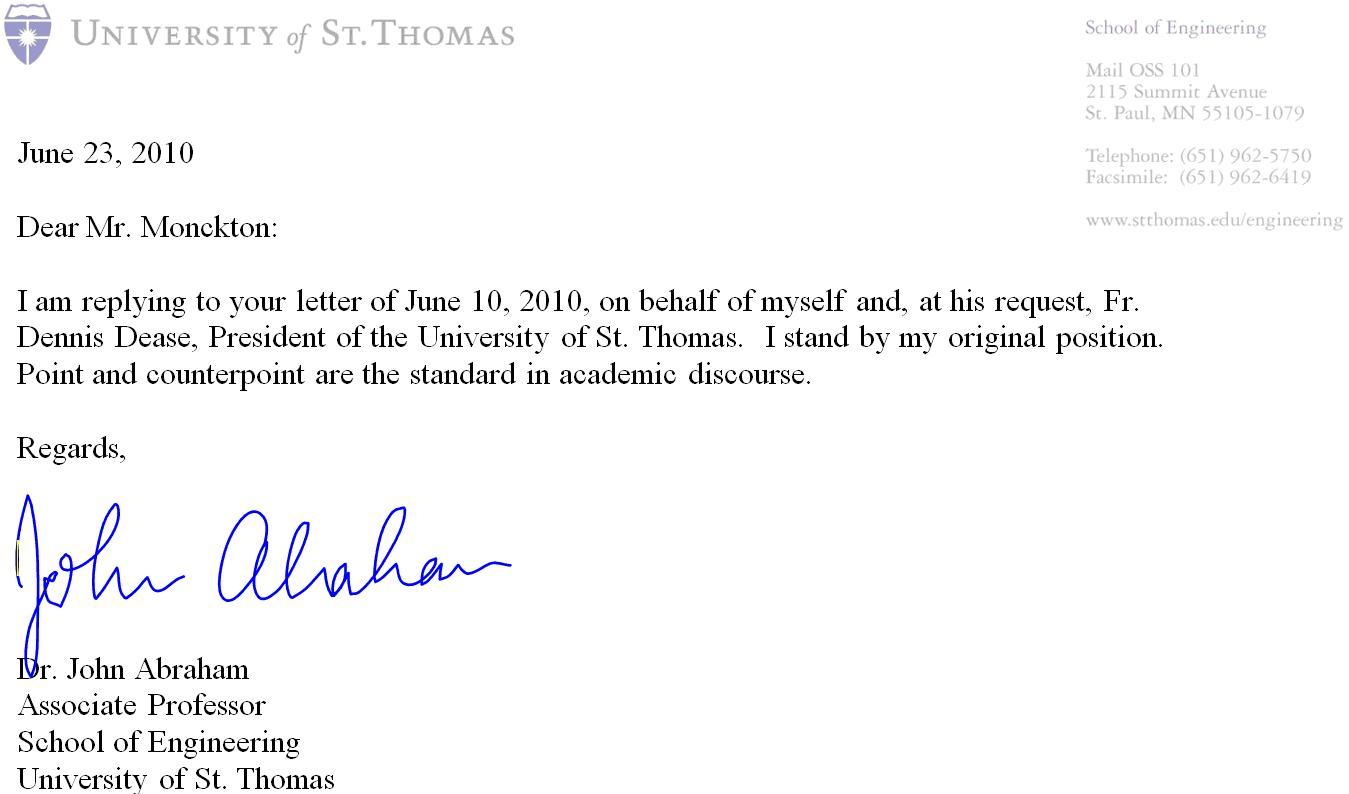
June 23, 2010
Dear Mr. Monckton

I am replying to your letter of June 10 2010, on behalf of myself and, at his request, Fr. Dennis Dease, President of the University of St. Thomas. I stand by my original position. Point and counterpoitn are the standard in academic discourse.

Regards,

Dr. John Abraham
Associate Professor
School of Engineering
University of St. Thomas
Eli added the italics. This demonstrates that Fr. Dease has fully backed Dr. Abraham


Text: June 25, 2010
Via Electronic Mail to monckton@mail.com
The Viscount Monckton of Brenchley
Carie, Rannoch, Scotland, PH17 2QJ

Re: University of St. Thomas

Dear Lord Monckton

Our firm represents the University of St. Thomas. I am writing concerning your recent communications with University President Father Dease, Professor John Abraham and other University personnel relating to Prof. Abraham's talk entitled "But Chris Monckton Said . . ."

It is the University's position that Professor Abraham has done nothing improper or illegal in expressing his ideas and opinions on this matter and that Professor Abraham has not engaged in any academic or professional misconduct. Accordingly, the University will not investigate Professor Abraham's conduct in this matter as you requested, nor will the University issue a retraction or apology for Professor Abraham's talk, comply with any of your other demands, or respond to any further communications from you on this matter.

Further, the University is appalled by your disparaging, outrageous and defamatory comments, regarding the University of St. Thomas, President Father Dease and Professor John Abraham, especially the comments you made during a television interview on June 24, 2010. On behalf of the University of St. Thomas, we demand that you immediately cease and desist making any further disparaging or defamatory comments about the University of St. Thomas, President Father Dease, Professor Abraham, the Archdioceses of Saint Paul and Minneapolis, or anyone else associated with the University. If your inappropriate conduct does not cease immediately, the University of St. Thomas will have no choice but to take appropriate legal action.

Very truly yours,

MOORE, COSTELLO & HAR, P.L.L.P
By Phyllis Karasov
Speaks for itself. Eli has previously written about the third letter.


Text: Text: June 28, 2010
Via Electronic Mail to monckton@mail.com
The Viscount Monckton of Brenchley
Carie, Rannoch, Scotland, PH17 2QJ

Re: University of St. Thomas

Dear Lord Monckton

We received your e-mail response to our June 25, 2020 letter. The University of St. Thomas respects your right to disagree wtih Professor Abraham, just as the University respects Professor Abraham's right to disagree with you. What we object to are your personal attacks against Father Dease and Professor Abraham, your inflammatory language, and your decision to disparage Professor Abraham, President Father Dease, and the University of St. Thomas.

Please be advised that neither we, nor the University of St. Thomas will communicate with you any further about your decision to sully the University of St. Thomas, Professor Abraham, and others rather than to focus on the scholarly differences between you and Professor Abraham.

Very truly yours,

MOORE, COSTELLO & HAR, P.L.L.P
By Phyllis Karasov


Thursday, July 15, 2010

Gold amongst the dross

or the Great Monckton Memory hole

From Christopher Monckton via JoAnne Nova we have the answer to Monckton's deranged demand letter on the University of St. Thomas (corrected, JAN from whom Eli copied the letter text left something out. Thanks to Igor for pointing this out. Omission in italic)

We received your email response to our June 25, 2010 letter. The University of St Thomas respects your right to disagree with Professor Abraham, just as the University respects Professor Abraham's right to disagree with you. What we object to are your personal attacks against Father Dease, and Professor Abraham, your inflammatory language, and your decision to disparage Professor Abraham Father Dease and The Univerity of St Thomas.

"Please be advised that neither we nor the University of St Thomas will communicate with you any further about your decision to sully the University of St. Thomas, Professor Abraham, and others rather than to focus on the scholarly differences between you and Professor Abraham."

Signed: Phyllis Karasov, Moore Costellow and Hart, P.L.L.P.

The lawyers have spoken for the University. Go add your support for the University and Prof. Abraham at Gareth's place


Added: Nick Barnes immediately below points to the "complete" correspondence, which includes this bit of purple prose from our Viscount
I should also be obliged if you were to specify which television interview you are referring to (I do not recall having conducted such an interview, so it may have been recorded some time ago), and to set forth a schedule specifying each "disparaging", "outrageous", or "defamatory" comment I am alleged to have made, with a brief indication of why, in each instance, the comment is considered "disparaging", "outrageous", or "defamatory", so that I may reach an informed opinion on whether to repeat or apologize for the comment.

It is also fair that I should draw your attention to a radio interview I gave to the Alex Jones show yesterday, before your present letter reached me. If there are any "disparaging", "outrageous", or "defamatory" remarks therein that you would prefer me not to repeat, perhaps you would be kind enough to say which and why, ut supra.
Since bunnies are obliging beasts, joe finds the dross amidst the blovation
From the Alex Jones show, 24 June 2010 part 5/6 (http://www.youtube.com/watch?v=OnQdKDeDjqI)

"...that, on its own, would be an offense for which he would be dismissed from a real university, but then he only belongs this half-assed Catholic Bible college" (1:10)

"...but apparently in this Bible college, lying is part of what they regard as their Christian mission..." (2:45)

"...I want you to email this creep of a President, Father Dennis J. Dease..."(08:30)
Christopher does not really understand the parallel nature of the internet and blogs. Eli eagerly awaits Moncktons apology to the University of St. Thomas and Father Dease.

BTW, John Abraham's letter to Monckton was a work of art
Dear Mr. Monckton:

I am replying to your letter of June 10, 2010, on behalf of myself and, at his request Fr. Dennis Dease, President of the University of St. Thomas. I stand by my original position. Point and counterpoint are the standard in academic discourse.

Regards,

Dr. John Abraham
Associate Professor
School of Engineering
University of St. Thomas
Thanks to Joe and Nick

The Great Monckton Limerick Contest

Here is your opportunity to select the winner of the Great Monckton Limerick Contest. Readers are invited to reread the entries. Of course you should also leave a note of support for John Abraham at Hot Topic, where Gareth is gathering signatures.

Monckton has now posted at WUWT asking for people to flood Abraham's university with calls for disciplinary action. As a consequence, I have posted this:

We the undersigned offer unreserved support for John Abraham and St. Thomas University in the matter of complaints made to them by Christopher Monckton. Professor Abraham provided an important public service by showing in detail Monckton?s misrepresentation of the science of climate, and we applaud him for that effort, and St. Thomas University for making his presentation available to the world.
A word from the wise bunny, leave a note of support for John, not an attack on Chris. Electioneering allowed here.

Vote early, don't vote often
anonypoe
AndyS
Ron Broberg
Horatio Algeranon
Gareth
Anonymous 8-38
barrymoose
jg
M
a_ray_in_Dilbert_space
jcrabb
MT
Rattus Norvegicus
pollcode.com free polls
Comments?

Wednesday, July 14, 2010

Advice to the lab bunnies

One of the reasons Eli has been rare is that he has been doing grant review panels. Lots of them. The money sucks but when your funder calls you damn well better answer. Eli would like to take this opportunity to offer some advice to those who write grant proposals, mostly for the US, but perhaps also of some value to outlanders.

No, he is not going to tell you how to get free money from the government. The government and the peer reviewers make damn sure you are going to work your butt off for very little money for yourself, but maybe a little satisfaction that you have hunter gathered for your students. The little ones, of course, will moan about how much you make them work.

Nor will he tell you what science is hot and what not, or how to use spell check (please do), rather this is about the "broader impacts" section that the granting agencies are increasingly asking for.

After years, the idea is finally getting through that writing "my splendid research will really impress my fellow scientists" cuts no mustard by itself. Really great science will get funded in spite of a bad broader impacts plan. If you are on or near the funding line, a good broader impacts plan will push you over. Anyone who doesn't have anything if it is called for in the proposal rules will get it tossed back express delivery. One of the things driving competitive reviews is there are too many proposals, funding rates are under 20, often 10% and program directors LOVE to toss proposals out for non-compliance. Their attitude is that this is a learning experience and something else they don't have to deal with.

OK. Having read a pile of stuff this year here is Eli's advice

Broader impacts includes educational and public outreach as well as transformational science.

If you are going to claim transformational science you damn well better back it up, showing exactly how your work will change the status quo, which starts with what the status quo is. Transformational effects that have economic benefits are much superior for this purpose. It's a hard challenge to meet. The peer reviewers are your bitter, hardened competitors who think that your stuff is crap and theirs is transformational.

So let's move onto the real point of this post, educational and public outreach. Eli has read zillions of proposals that look like a menu in a Chinese restaurant, one lecture at a high school, judge a science fair, mentor an undergraduate, etc. Roll eyes.

What the bunnies need to do is

1. Describe a single outreach program. No one asks for multiple research projects in a single investigator grant application.

2. Show why it is needed. Use statistics. Explain your motivation for doing it.

3. Explain, just as you did for your research what will be done and what the expected outcomes will be.

This includes such things as recruiting/publicity, funding, etc. and especially what happens after the grant ends. Collaboration with local outreach organizations really helps with some of this.

4. Describe a formative evaluation plan. Again, having someone who knows about evaluation is a big plus

5. It's really good if you can leverage resources (get promises of funding) and people around you (the science education people at your uni or in the local schools, or in organizations such as boys and girls clubs, organizations such as the Rotary, etc). If allowed, get a short letter from anyone who is going to collaborate.

6. Describe how the program will be disseminated, preferable so it can be used by others. If your program only affects a few people, describe why the outcomes will be important beyond the small number.

7. Discuss the amount of time needed for your outreach and show how you can do your outreach, teaching and research. Don't include so much outreach that there is no time for anything else. For example, new courses are tremendous time sinks.
When working with teachers, students, old ladies and young men or visa versa, make sure you understand what THEIR needs are and show how what you are proposing will satisfy them. One thing that really grates teeth is proposing new high school lessons that don't fit into the curriculum standards. HS teachers have no time for anything except teaching to standardized tests. They will NEVER include anything that doesn't fit the written curriculum no matter HOW cool you think it is. Especially in outreach, the people you are reaching out to are customers and they have to want to buy for your program to succeed.

There is another way of working this, finding an outreach program already underway and making a substantial contribution. For that you need a strong letter from the program director.

Good luck Mr. Phelps. Should you fail the Rabett will disavow any knowledge of his advice

Mashey tweets

John Mashey on behalf of himself and deepclimate moans

While the wegman report is providing much food, one actually does have to hunt it down and bring UT back ...

And then monckton just offers a 446-course banquet already prepared.
and continues
%$%$%$ The Viscount's offering is like Chinese menu, even conveniently numbered.

Wegman's is more like an elephant carcass.

A simple puzzler

OK bunnies, what's Monckton class about this graph from Cryosphere Today