Saturday, June 28, 2008

GIGO


Eli has learned over the years that all sorts of strange people write the same paper, very long, very hard to follow and very wrong. These papers and their defenders play the Gallileo card early and often. No one can follow the algebra (these things always hide under a blizzard of algebraic incantation), but you can look at the assumptions, and when you do this carefully you find some amazing stuff, not believable, not correct, but amazin. The bunnies have been through this with Gerlich and Tscheuschner, had a neat recent dissection of the Robinson, Robinson and Soon OISM paper, and yr. humble hare dabbles in classical quantum numerology including this classic of the genre. A recent paper by Ferenc Miskolczi falls neatly into this category and has been adopted enthusiastically by the usual suspects. If you have trouble with the paper, Miklos Zagoni's web site might make it easier for you, but the rubber really meets the road in a number of web sites including a 309 and counting thread at the climate audit bulletin board and a four part analysis at Niche Modeling. There is also something worth looking at on 2nd Sex and Arthur Smith took a brief run at it in the comments at Rabett Run.

Before looking at the science, a reply by Nick Stokes (who carried much of the argument at CA) is worth quoting

Re: What do people think of this new paper?

by pliny on Tue Jun 03, 2008 5:56 am
alexharv074 wrote:Having searched the web far & wide I am unable to find that anyone has actually contradicted M on this point.
Have you found anyone who thinks it is right, and can explain why?

I think Miskolczi's paper could have been written in two sentences:
"The greenhouse gas theory that has been used for the last century is TOTALLY WRONG! The proof is left as an exercise for the reader."
Seriously, if you are making a claim like this, you need a good argument, put with some clarity. You would usually write down a model with some unknowns, state some physical principles with their resulting equations, and derive relations which characterise the unknowns. M does this, but at least three of his basic equations appear to be totally wrong. They actually look like elementary errors. Or if they are right, it seems no-one can explain them.

So this is Black Knight stuff. OK the use of Kirchhoff may be wrong, not sure about virial or that pesky Eq 7, but can anyone prove this is wrong, or that? People just lose patience.

Especially as these questions also come with no referencing or explanation. Who exactly is using Eddington's equation wrongly, and how? And re Qn 2, what on earth is that graph? It just says that he computed two sets of points which seem to align. He didn't say anything about how they were computed. What comment could be made?

Nick Stokes

Well you ask, where is the beef (which shows how old Eli is)?

A number of beefs there are with this paper which make it unnecessary to read through the whole thing, although some brave souls have done so multiple times. This includes Arthur Smith, Nick Stokes and David Stockwell, the proprietor of Niche Modeling. You can catch up with them at Niche Modeling or at the CA thread, links above.

It boils down to the following:

A. Miskolczi does not understand Kirchoff's Law. As Stokes puts it
His invocation of K’s Law isn’t saying that up and down radiation is equal. The balance at the surface is expressed in his Eq 2. What he is equating is down radiation E_D and an absorbance A. Why I say that this isn’t Kirchhoff is that, in any statement of K that I have seen, emissivity is equal to absorptivity. These are coefficients, properties of objects. A body has much the same emissivity regardless of how much it IR is emitting. But no, M equates an actual emittance E_D with an actual absorption A, which I think is quite wrong. He then says “The physical interpretations of these two equations may fundamentally change the general concept of greenhouse theories.”
There is a rather longer version of this at CA

Re: What do people think of this new paper?

by pliny on Sun May 11, 2008 5:21 am
I think Miskolczi's paper goes wrong in its treatment of Kirchhoff's Law. But firstly, I'd like to note some of the cogent objections made earlier in this thread. Hans Erren queries the grey-body assumption, which lead to some discussion. stevo and apsmith queried the virial theorem statement; apsmith followed it up with the author, without apparently a convincing reply. That looks odd to me too.

But my main sticking point was the use of Kirchhoff's law. Steve Milesworthy raised it here. He hoped it wouldn't affect the paper's conclusions, but I think it does. There was some discussion on equilibrium discussions later in the thread. I'll summarise the problem.

Miskolczi says, in Sec 3:
According to the Kirchhoff law, two systems in thermal equilibrium exchange energy by absorption and emission in equal amounts, therefore, the thermal energy of either system can not be changed.
That isn't the definition I know. Thermal equilibrium, at least as often interpreted, is very restrictive, and suggests no nett flux at all. The more usual criterion is Local Thermodynamic Equilibrium (LTE), which is generally thought to be true in the atmosphere, except at rarefied levels. And then, in Pierrehumbert's book
Kirchoff’s Law states that the emissivity of a substance at any given frequency equals the absorptivity measured at the same frequency....
We will content ourselves here with the statement that all known liquid and solid planetary materials, as well as the gases making up atmospheres, conform very well to Kirchoff’s Law, except perhaps in the most tenuous outer reaches of atmospheres where the gas itself is not in thermodynamic equilibrium.
Or in these online lecture notes
Kirchhoff’s law states that absorptivity and emissivity are always equal....
Kirchhoff’s law may be considered valid for all processes of relevance to the atmosphere.
Note that absorptivity and emissivity are properties of objects - they do not imply any particular absorption or emission. The absorption will depend on the incident radiation, and the emission will depend on the temperature.

But Miskolczi's Eq (4) is absolute. It says that the upward LW radiation absorbed is equal to the downward LW radiation, as a result of Kirchhoff's Law. This means that the downward radiation is independent of air temperature, and hence also, I think, of GHG content beyond a limit. This is why he gets the limit on the greenhouse effect. This statement is different from his conservation of energy statement there.

But you can see this is wrong by applying the same logic to other levels of the atmosphere - there is nothing special about the surface. At TOA, there is upward emitted LW radiation, clearly measurable; it is Eu in M's model. But there is no absorption of downward LW to balance it - because there is no downward LW at all (or only a tiny amount from the Sun).
B. Miskolczi claims a virial relationship between the IR emission from the surface, Su and the IR emission from the top of the atmosphere Eu. At best this is roughly true for the Earth's atmosphere as an experimental fact, but it is not a mathematical relationship. In essence, as Arthur Smith points out, this is a constraint that Miskolczi arbitrarily imposes on the Earth system

Re: What do people think of this new paper?

by apsmith on Wed Mar 12, 2008 7:22 am

Steveo, I think you've hit the nail on the head there.

I actually sent the author an email the other day asking that very question - how does he go from KE = PE/2 to Eu = Su/2? His response so far was not very clear, and included the word "guess" which left me a little concerned.

By adding in this relationship, Eu = Su/2, he overconstrains the problem, and that means you can get out of it just about any result you could wish, at least if you did a full analysis.

Eu is a flux of energy from the atmosphere into space - but he claims it "represents" the total kinetic energy of the atmosphere. Su is the flux of energy from the ground (at least, if going through his rather odd list of assumptions we take the point Su = Sg in his diagram figure 1), but he claims it "represents" the total gravitational potential energy, because the surface temperature is related to the total gravitational potential through the surface pressure and density.

He does not explicitly state any linear relationship or other analysis that justifies the Eu = Su/2 claim. Eu depends on the absorptive properties of the atmosphere and the vertical temperature profile, which doesn't seem to be derived or discussed here at all.

It does happen that for Earth, Eu is roughly half of the surface radiative flux, so Miskolczi's relationship roughly holds for our planet. But it sounds like he "guessed" that it was some sort of universal law based on looking at the parameters for Earth, rather than actually deriving it from the physics of the situation. At least I don't see any physical basis for the claim in this paper, and it's certainly not obvious from the meanings given to the terms here.
and

Re: What do people think of this new paper?

by apsmith on Wed Mar 12, 2008 11:51 am
You can compute total internal kinetic energy from the molecular formula for a gas - the average of 1/2 mv^2 = 3/2 kT. That means total kinetic energy = 3/2 n R T (n = number of moles of gas), or total kinetic energy = 3/2 P V (for a small region at constant pressure and temperature - you would need to integrate over the range of temperatures in the real atmosphere to get the proper number).

But what bearing does this have on outgoing thermal radiation (E_U) from the atmosphere? If the atmosphere absorbs most infrared radiation then there's going to be some rough top-level layer of the atmosphere (the photosphere) from which most of the outgoing thermal energy is coming; if temperature in this region is T_A then E_U would be given by the Stefan-Boltzmann relation, i.e. proportional to T_A^4. If the atmospheric temperature was roughly constant, that would give you an E_U value varying as (total kinetic energy)^4, rather than linearly, but then it also depends on the total mass of the atmosphere (the 'n' value above). In any case, the author's claim that E_U literally "represents" the total kinetic energy seems very far from reality.

I've exchanged some email with the author now, and it seems pretty clear he does not have an actual derivation of this relationship from physical principles. Rather he seems to have done some simulations relevant for Earth's atmosphere, noticed that this relationship roughly held, and then claimed this analogy to the virial relationship that has no actual basis in physics. As far as I can tell, anyway....
C. Pat Cassen has some additional problems with the mathematical analysis

Friday, June 27, 2008

OISM meets Mike Powell. OISM loses

In the comments about the Robinson gang, Mike Powell gave good linkage :

One of my local denialists [Ed: Link Rot] was waving this Robinson et al. paper around and loudly proclaiming it to be ironclad proof that global warming is a hoax. I spent a couple weekends pulling up the primary literature that Robinson et al. refers to and then picking their paper apart paragraph by paragraph. I made it through about the first 4 pages before I just couldn't take it any more. If anyone's interested, my point-by-point "analysis" is here:

UPDATE: Mike's analysis has moved to an honored place at Rabett Run, The Tri-City Herald links have rotted.

These are the most complete set of comments about this denialist fig leaf that Eli has seen. To give you a taste, and perhaps some motivation let me quote a part of his analysis of Page 1

1. first page, 2nd paragraph. “When we reviewed this subject in 1998 (1, 2), existing satellite records were short and were centered on a period of changing intermediate temperature trends.” It’s not entirely clear what they mean by “changing intermediate temperature trends, but it’s worth noting that their previous paper devotes a considerable amount of attention to the old Spencer and Christy MSU data that did not show a warming trend (e.g., Figures 6 through 8 in that paper). Now that some errors in the Spencer/Christy analysis have been fixed, the satellite data *does* show warming. It appears as though the Robinson et al. (2007) appeal to “changing intermediate temperature trends" is an attempt to avoid direct mention of the fact that one of the principal arguments they made in 1998 has since proved to be false. . . . . .

4. first page, 5th paragraph and Figure 3. There are several problems with this graph. Why is only the Arctic temperature plotted along with total solar irradiance (TSI)? Shouldn’t the global temperature be used instead? And on what basis is the TSI scale adjusted to create the apparent match between Arctic temperatures and TSI? It appears as though the scales were adjusted “by eye” and there is not a physical basis for selection of the axis scales. . .

Also, again we have “hydrocarbon use” plotted rather than cumulative carbon emissions. Finally, note that TSI data after the year 2000 are not included. Perhaps this is because the TSI went down while Arctic temperatures continued to increase. Basically there’s been no secular change in TSI since 1980, but global temperatures have risen significantly.

Also, the source of the TSI data is apparently one of the authors (Soon) rather than one of the more widely accepted TSI reconstructions. See Figure 2.17 in the IPCC WG1, which provides the TSI reconstructions of Lean (2000) and Wang et al. (2005). These more accepted reconstructions show considerably less 20th century variation than does Soon’s reconstruction.

Young bunnies need this to protect themselves against Robinsons begging for signatures on the street corner. Of course, Mike has challenged us to read past page 4. . . . .

Wednesday, June 25, 2008

Rabett Power


Recently John Quiggin and Tim Lambert reprinted an editorial by Rudy Baum in Chemical and Engineering News, more fondly known as C&E News, the membership mag of the American Chemical Society, more fondly known as ACS. Rudy, as well as touching off the find the worst science journal in the world contest, took a much deserved run at the Oregon Institute of Science and Medicine, a one barn, no horse outfit

it says it was founded in 1980 by Robinson, his wife Laurelee, Martin D. Kamen, and, later, R. Bruce Merrifield. Kamen and Merrifield, although dead, are both listed as OISM faculty members. Robinson has real scientific credentials; he has a Ph.D. in chemistry from California Institute of Technology and he was an associate of Linus Pauling’s until the two had a falling out over vitamin C. In addition to its scientific work on proteins, OISM is also involved in developing home-schooling techniques and “emergency preparedness.”
Robinson is closely linked with the “Petition Project,” an effort begun in 1998 to collect the signatures of scientists who doubt the reality of human-induced climate change. Robinson’s JAPS paper, “Environmental Effects of Increased Carbon Dioxide” is a long, tendentious rehash of just about every already-rebutted argument made against human-induced climate change.
Anyhow, wudnt u no it, the wingnuts sprouted on the June 23 letters to the editor page led by Arthur and Noah Robinson writing from the perhaps aptly named Cave Junction Ore. In full harumphing regalia they denounced being denounced

Evidentiary Science

In “Defending Science,” Editor Rudy Baum delivers an ad hominem critique of us and our colleagues, the institution at which we work, and the journal in which we published the review article “Environmental Effects of Increased Atomspheric Carbon Dioxide” (C&EN, June 9, page 5).
Baum neglects to mention several points. Authors Arthur Robinson and Noah Robinson, both educated at California Institute of Technolgy, were the subjects of two complimentary articles in C&EN (April 16, 2007, and Feb. 17, 2003). Both articles include photographs of us conducting research work at the Oregon Institute of Science & Medicine, which Baum now refers to as a “curious little entity.”
Second, although he denigrates our article, he does not mention even one item of the data, text, references, conclusions, or other substantive matters in the article to which he objects.
Third, he conceals the central issue. It is highly unusual for a research paper to be editorially maligned. His editorial appears in C&EN just three weeks after the announcement of the results of the Petition Project at the National Press Club in Washington, D.C. For details see www.petitionproject.org. Our review article, used in the project, was published nine months earlier.
More than 31,000 Americans with formal degrees in science, including more than 9,000 Ph.D.s—many of whom are members of ACS and readers of C&EN—have signed a petition that reads as follows: “We urge the United States government to reject the global warming agreement that was written in Kyoto, Japan, in December, 1997, and any other similar proposals. The proposed limits on greenhouse gases would harm the environment, hinder the advance of science and technology, and damage the health and welfare of mankind.
“There is no convincing scientific evidence that human release of carbon dioxide, methane, or other greenhouse gases is causing or will, in the foreseeable future, cause catastrophic heating of the Earth’s atmosphere and disruption of the Earth’s climate. Moreover, there is substantial scientific evidence that increases in atmospheric carbon dioxide produce many beneficial effects upon the natural plant and animal environments of the Earth.”
If the editor of C&EN objects to our article, he should discuss the contents of the article. If he objects to our petition, he should take that up with the many thousands of his own readers who have signed it.
Arthur B. Robinson
Noah E. Robinson
Cave Junction, Ore.

Why thank you Art, the paper is now open for discussion. As a start, Art and Noah can go to the Real Climate Wiki to find a few of their errors and, of course, there is the discussion of the Oregon Institute of Science and Malarky. They discuss the slight of hand in Fig. 1 and Fig. 2. Eli will look at Fig. 3. There are lots of apples and oranges here as well as stuff well past its sell by date. The bottom of the graph shows hydrocarbon use, not the increase in greenhouse gases, or even better in greenhouse gas forcings. Solar activity (?) is much more strongly smoothed than the Arctic Air temperature. Why dear bunnies, perhaps, because as Tamino has shown, temperature does not follow the 11 year solar cycle which is pretty strong evidence that solar forcing is not as strong an influence as greenhouse gas forcing. Further, estimates of the change in solar irradiance during the past few hundred years have decreased significantly as can be seen in the graph below from Skeptical Science but not in the latest from Robinson lavs. Skeptical Science has a long list of studies demonstrating that it ain;t the sun that is raising global temperatures

Eli also observe that the global temperature increases strongly in the last 25 years but that is not so much the case in the OISM manuscript. Of course, you say, they are looking at ARCTIC temperature, not global temperature. Fair enough, where can we find a record of ARCTIC temperature, why in the Arctic Climate Impact Assessment. Seems to be a lot higher in 2000 than in 1940, which is not the case for Robinson and Soons .

Finally Eli and the bunnies extend their thanks to Rudy Baum, for printing a very special cover this week.

Rabetts rule.

Monday, June 23, 2008

Comparative advantage

A principle driver for off-shoring production has been that the cost of transportation was pushed to zero by cheap energy prices and increased efficiency. This meant that cheaper labor costs in undeveloped or developed countries could be fully realized. That era appears to be coming to an end. Paul Krugman points to a paper by Venables and Limao about transportation costs and does a back of the envelop to estimate that current oil prices will cut world trade by 17%.

In a second post, Krugman discusses reports from CIBC, and the National Bureau of Economic Research. The later is particularly interesting. Manufacturing involves imported components gets hit by a double whammy, the added cost of importing the components in addition to the cost of exporting them.

The same mechanism will cause changes within larger countries such as the US. We may be rapidly approaching the point where sending fruits and vegetables from California to the rest of the country will no longer pay. This together with the real estate bus might reruralize the exburbs.

Big changes are coming and those who don't catch on are going to lose big time.

Sunday, June 22, 2008

The Honest Broker works the Boiler Room

Ethon dropped by with a big grin on his beak. It's been an unhappy time with not much fresh liver available in Boulder, the old place is dry and dusty without Dano and the old bunny to stir things up, and even newcomers like Jon soon recognize that the Honest Broker Boiler Room is selling penny stocks. But just this weekend Pielke Jr. provided a wonderful sampler of cherry pickled liver dumplings from the old place. A big Roger special of proving that this is the best of all possible worlds followed by a very serious admonition that climate change is real, even though this is the very best of all possible world and nothing is happening anyhow, stirred up three comments.

Bunny University is going to feature Roger's tour de force in Eli's new textbook, "RTFR or get snookered". Crowing about the recently issued CCSP Extremes Report, Roger thumbs his way to the back pages:

1. Over the long-term U.S. hurricane landfalls have been declining.

Yes, you read that correctly. From the appendix (p. 132, emphases added):

The final example is a time series of U.S. landfalling hurricanes for 1851-2006 . . . A linear trend was fitted to the full series and also for the following subseries: 1861-2006, 1871-2006, and so on up to 1921-2006. As in preceding examples, the model fitted was ARMA (p,q) with linear trend, with p and q identified by AIC.

For 1871-2006, the optimal model was AR(4), for which the slope was -.00229, standard error .00089, significant at p=.01. For 1881-2006, the optimal model was AR(4), for which the slope was -.00212, standard error .00100, significant at p=.03. For all other cases, the estimated trend was negative, but not statistically significant.

Of course, he started reading from the back. If he makes it to page 5, he might have found
Atlantic tropical storm and hurricane destructive potential as measured by the Power Dissipation Index (which combines storm intensity, duration, and frequency) has increased (see Table ES.1). This increase is substantial since about 1970, and is likely substantial since the 1950s and 60s, in association with warming Atlantic sea surface temperatures (Figure ES.6) (Chapter 2, section 2.2.3.1).

There have been fluctuations in the number of tropical storms and hurricanes from decade to decade and data uncertainty is larger in the early part of the record compared to the satellite era beginning in 1965. Even taking these factors into account, it is likely that the annual numbers of tropical storms, hurricanes and major hurricanes in the North Atlantic have increased over the past 100 years, a time in which Atlantic sea surface temperatures also increased. The evidence is not compelling for significant trends beginning in the late 1800s.

Uncertainty in the data increases as one proceeds back in time. There is no observational evidence for an increase in North American mainland land-falling hurricanes since the late 1800s (Chapter 2, section 2.2.3.1). There is evidence for an increase in extreme wave height characteristics over the past couple of decades, associated with more frequent and more intense hurricanes (Chapter 2 section 2.2.3.3.2).

Hurricane intensity shows some increasing tendency in the western north Pacific since 1980. It has decreased since 1980 in the eastern Pacific, affecting the Mexican west coast and shipping lanes. However, coastal station observations show that rainfall from hurricanes has nearly doubled since 1950, in part due to slower moving storms (Chapter 2, section 2.2.3.1).

Attribution of Changes

It is very likely that the human induced increase in greenhouse gases has contributed to the increase in sea surface temperatures in the hurricane formation regions. Over the past 50 years there has been a strong statistical connection between tropical Atlantic sea surface temperatures and Atlantic hurricane activity as measured by the Power Dissipation Index (which combines storm intensity, duration, and frequency). This evidence suggests a human contribution to recent hurricane activity. However, a confident assessment of human influence on hurricanes will require further studies using models and observations, with emphasis on distinguishing natural from human induced changes in hurricane activity through their influence on factors such as historical sea surface temperatures, wind shear, and atmospheric vertical stability (Chapter 3, section 3.2.4.3).
And, oh yes, you will find the same information in the three cited chapters.

Roger of the Breakdown Institute continues his merry way

2. Nationwide there have been no long-term increases in drought.

Yes, you read that correctly. From p. 5:

Averaged over the continental U.S. and southern Canada the most severe droughts occurred in the 1930s and there is no indication of an overall trend in the observational record . . .
Hmm, so he DID read page 5, but somehow skipped over the part about hurricanes. If he was a broker, you gotta wonder which market he traded in, but agin, our hero suffers from attention deficit disorder an manages to leave out what follows the . . .
However, it is more meaningful to consider drought at a regional scale, because as one area of the continent is dry, often another is wet. In Mexico and the U.S. Southwest, the 1950s were the driest period, though droughts in the past 10 years now rival the 1950s drought. There are also recent regional tendencies toward more severe droughts in parts of Canada and Alaska (Chapter 2, section 2.2.2.1).

Attribution of Changes

No formal attribution studies for greenhouse warming and changes in drought severity in North America have been attempted. Other attribution studies have been completed that link the location and severity of droughts to the geographic pattern of sea surface temperature variations, which appears to have been a factor in the severe droughts of the 1930s and 1950s (Chapter 3, section 3.2.3).

Projected Changes

A contributing factor to droughts becoming more frequent and severe is higher air temperatures increasing evaporation when water is available. It is likely that droughts will become more severe in the southwestern U.S. and parts of Mexico in part because precipitation in the winter rainy season is projected to decrease (see Table ES.1). In other places where the increase in precipitation cannot keep pace with increased evaporation, droughts are also likely to become more severe (Chapter 3, section 3.3.7).
There is more, but we leave the rest of the evisceration to the peanut gallery. Might rip another piece out later

Tuesday, June 17, 2008

Ask for it under the counter in a plain brown wrapper


Eli has unearthed (and it was buried pretty deep in the stacks) the Journal of Scientific Exploration, an all arounders source for denialists and denial. As they themselves say (well they said it, but now have thought better of it, so down the memory hole -7/2010)

"While one organization may cover parapsychology, another consciousness, a third exotic energy sources, and a fourth UFO inquires, the SSE cover the gamut..." and more [a tip o the ear to Johan Mashey for digging that one out]
The bunny hereby opens the contest to find the strangest article published in the Journal of Scientific Exploration. To do so, you need access, some of which is on line and some of which has been posted by the proud authors. At the end of his comment John Mashey inquired if Eli had a subscription [NO, NO, NO]. Being an academic Eli never subscribes to what he can read for free, but it does raise the question of where you can go to put your hot little paws on a copy so you can enter. For those out in the SF bay area there are some likely suspects such as
  • Stanford University which has it shelved in the Engineering Library under research not pathology.
  • UC Berkeley, and UC Davis but the rest of the UC system appears not to subscribe.
  • San Diego State has v 1 and 2, but no more and has put it into the compactor and the rest of the CalState system is too poor or too smart to subscribe
Does your library subscribe??

UPDATE: The JSE website has been redone. Some of the bunnies favorites

Unexplained Weight Gain Transients at the Moment of Death - In the Words of William the Sane, this guy weighed sheep while he was suffocating them with a plastic bag. He concluded...there's no way to tell what he concluded.

"Retrotransposons as Engines of Human Bodily Transformation" also was a favorite

Radiation Hormesis: Demonstrated, Deconstructed, Denied, Dismissed, and Some Implications for Public Policy - an entry by our old pal Joel Kauffman

Monday, June 16, 2008

The underbelly of scientifical publishing


N3xus6 thought the bottom had been reached when Princess Denial, editor of Energy and Environment rejected Klaus Schulte's endocrine belch. That was so 2007. Just a few days ago Rudy Baum's C&E News jeremiad against that curious little entity, the Journal of American Physicians and Surgeons turned up in Quigginsville and on Deltoid. You can get a good feel for that operation from a recently appearing book review by one Joel Kauffman

Science Sold Out: Does HIV Really Cause AIDS? by Rebecca Culshaw, 96 pp, paperback,

It must have been hard for a professor of mathematics to write a technical book with only one graph (prevalence of HIV positives in the U.S. 1985-2005 steady at 1 million, p 2) and only one “equation”: human immunodeficiency virus (HIV) = acquired immune deficiency syndrome (AIDS) = death (p 1). Culshaw’s goal is to show the total falsity of that equation, and in my opinion, she succeeds.
Joel Kauffman you ask, not the Joel Kauffman, emeriti from Philadelphia, who recently published on climate change in the Journal of Scientific Exploration? What is he selling and what is that you ask? Why it is a mighty curious little entity published by an extremely curious other little entity, the Society for Scientific Exploration. And what science do they explore ask the little bunnies? Well you can get a taste from the focus of their national conference 'Emerging Paradigms at the Frontiers of Consciousness & UFO Research" but they have their doubts about HIV causing AIDs, plate tectonics and anything else you can rent-a-nut for.

The flavor and value of Kauffman's essay is easy to extract
Either Warmers or Skeptics may accept that primordial ionizing radiation from within warms the Earth.
which Eli will match with the discovery of how microwaves from satellites are what is really warming the earth (ear tip to John Mashey), but Kauffman is not one to think that his opinion is popular
Because of the existence of a research cartel and media control in this field (Bauer, 2004), the readers’ forbearance in my use of websites and non-refereed sources is requested.
and his footnotes are a veritable treasure chest of laughs. For one thing we have links to a quarterly magazine, 21st Century Science and Technology, covering scientific topics from the perspective of Lyndon LaRouche. That's where Nils-Axel Moerner and Ziggy Jaworoski hang out, Margie Mazel Hecht tells us where the global warming hoax was born (good luck Maggie), Lawrence Hecht tells us about how nuclei are really sets of nested Platonic solids, and much more. Woot!

Twice more

Having read the many comments about Rabbet Lab's simple explanation of man made climate warming, Eli makes a few deletions and additions to reach the final product.

  1. The total energy emitted by the earth has to equal the total energy absorbed from the sun. All this energy comes and goes as light.
  2. The earth radiates in the infrared, the sun radiates at much shorter wavelengths, principally in the visible.
  3. It gets colder the higher you go in the troposphere and the density of molecules is lower.
  4. From 3 the rate of radiation from IR active (greenhouse gas, GHG) molecules (CO2, H2O, CH4) is lower the higher you go (hotter things radiate more, see Stefan-Boltzmann law, more molecules radiate more).
  5. In the atmosphere below 100 km the ability of GHG molecules to absorb radiation equals their ability to emit radiation (Kirchhoff's law)
  6. Greenhouse gases are IR absorbers/emitters. They effectively block radiation escaping to space at wavelengths they absorb EXCEPT at high enough levels where the gas density is low and the radiation can escape directly to space without being absorbed (about 7 km which is still in the troposphere).
  7. Because radiation to space is blocked at IR wavelengths where GHGs (and clouds) absorb, the surface has to warm so that radiation can increase in unblocked areas of the spectrum and escape to space.
  8. This means that there will also be increased radiation in regions of the spectrum where greenhouse gases absorb which, in turn, will warm the atmosphere but cannot escape to space. Radiation absorbed in the atmosphere and scattered back to the surface warms the surface yet further.
  9. As the atmosphere warms, the areas of the spectrum where the greenhouse gas molecules absorb widens as more energetic levels of the GHG are populated (The link points to on line software, which you can model this yourself).
There are two complementary mechanisms

Walking Mechanism
. Increasing the amount of GHGs widens the spectral regions where they absorb and narrows the windows where radiation can escape to space. To maintain balance with incoming solar, the atmosphere and surface warm further

and Chewing Gum Mechanism. As the GHG mixing ratio increases, the effective level at which the Earth can radiate to space at the wavelengths emitted by the GHGs climbs, but because of the cooling with altitude and the lower density of molecule, to maintain the same radiation rate and balance the solar input, the new higher level at which the earth radiates has to warm, and to do this the entire troposphere and the surface have to warm.
  1. Humans have increased the concentrations of carbon dioxide, methane, nitrous oxides and other GHGs in the atmosphere. Increasing the concentration of CO2 by a factor of two will increase global temperature by a bit more than 1 C (~1.8 F). This is a forcing.
  2. This increase in global temperature warm the oceans and thus increases atmospheric water vapor (also a GHG) enough that the total rise in global temperature will be ~3 C (best estimate range is btw 2 and 5 C for 2x CO2). This is a feedback.
Since the increase of CO2, methane, nitrous oxide, and other GHGs are known to be caused by humans, so must an increase in surface temperature driven by these mechanisms.

Does the greenhouse effect operate by the same mechanism as greenhouses? No (except if you think of one blocking off energy loss by closing regions of the spectrum for radiative loss, and the other blocking off energy loss by stopping convection)

Drinking games

Given the recent weak attempts to caffeinate the paranoid style in American politics Eli would like to take this opportunity to point out that he is no latte sipping intellectual, but rather a latte slurping intellectual. Having stood behind several rather rough looking long hares in the neighborhood not Starbucks, he suspects the usefulness of the first description don't go very far these days.

Eli, of course, enjoys the occasional beer cremes.


Friday, June 13, 2008

Another list

  • Joseph Aldy, Resources for the Future
  • James Edmonds, Pacific Northwest National Laboratory
  • Richard Howarth, Dartmouth College
  • Bruce McCarl, Texas A&M University
  • Robert Mendelsohn, Yale University
  • William Nordhaus, Yale University S
  • ergey Paltsev, Massachusetts Institute of Technology
  • William Pizer, Resources for the Future
  • David Popp, Syracuse University
  • John Reilly, Massachusetts Institute of Technology
  • Roger Sedjo, Resources for the Future
  • Kathleen Segerson, University of Connecticut
  • Brent Sohngen, Ohio State University
  • Robert Stavins, Harvard University
  • Richard Tol, Economic and Social Research Institute
  • Martin Weitzman, Harvard University
  • Peter Wilcoxen, Syracuse University
  • Gary Yohe, Wesleyan University
So what do they have in common??


They are the economists consulted by the US Government Accountability Office on what should be done about climate change. You can read the report, or you can read the summary
All of the panelists agreed that the Congress should consider a market-based mechanism to establish a price on greenhouse gas emissions and supported implementation of the policy by 2015. Opinions varied on whether the Congress should implement a cap-and-trade system or a tax to control greenhouse gas emissions, with eight panelists preferring a cap-and-trade program with a safety valve (sometimes referred to as a hybrid system), seven preferring a tax, and three preferring a cap-and-trade program. All of the panelists agreed that the policy should target all sectors of the economy, and the majority believed that it should include all greenhouse gases. For example, one panelist stated that by establishing a price on emissions from all sources in the United States with no exceptions, the policy would equilibrate the marginal cost of reducing emissions across all sources, making it economically efficient.

The panelists varied in their views on the stringency of the market-based regulatory mechanism that they supported to place a price on greenhouse gas emissions.25 For example, in proposing an initial price on emissions, seven panelists said it should range from less than $1 to $10, six said from $11 to $20, and four said it should be greater than $20 (2007 dollars per metric ton of carbon dioxide equivalent).26 In addition, while most panelists said the price should increase over time, they varied in their views on the preferred rate of increase. For example, some panelists provided estimates ranging from 2 percent to 5 percent per year adjusted for inflation, while another panelist said more generally that it should be reevaluated periodically (for example, every 5 years) and rise as marginal damages of climate change rise. Some panelists noted the importance of a long-term commitment to establish a price on emissions and the flexibility to adjust the price and rate of increase as new information becomes available. For example, one panelist stated that certainty in setting emissions reductions goals was necessary for firms that would have to make substantial investments in new emissions reduction technologies.

Wednesday, June 11, 2008

Once more

Since the world no longer needs a good 10 cent cigar, and the White Owls Dad and Grandpa Rabett thought were good were anything but, Eli is driven to again try and provide a relatively simple explanation of the greenhouse effect.

For those of you who crave death by mathematical physics the bunnies suggest Ray Pierrehumbert's on line text book, or in a somewhat (and I warn you, only somewhat) simpler form in an arXiv article by Arthur Smith.

Eli will alter the text based on suggestions however we are going to KEEP IT SIMPLE. All entries become the property of Rabett Labs.

  1. The total energy emitted by the earth has to equal the total energy absorbed from the sun. The only mechanism for either of these processes is radiation to and from space
  2. The earth radiates in the infrared, the sun radiates at much shorter wavelengths, principally in the visible.
  3. It gets colder the higher you go in the troposphere and the density of molecules is lower.
  4. From 3 the rate of radiation from IR active (greenhouse gas, GHG) molecules (CO2, H2O, CH4) is lower the higher you go (hotter things radiate more, see Stefan-Boltzmann law, more molecules radiate more).
  5. In the atmosphere below 100 km there is always a local effective temperature, thus the absorbtivity of the GHGs equals its emissivity (Kirchhoff's law)
  6. Greenhouse gases are IR absorbers/emitters. They effectively block radiation escaping to space at wavelengths they absorb EXCEPT at high enough levels where the gas density is low and the radiation can escape directly to space without being absorbed by other GHG molecules(this is about 7 km which is still in the troposphere).
  7. Because radiation to space is blocked at IR wavelengths where GHGs (and clouds) absorb, the surface has to warm so that radiation can increase in unblocked areas of the spectrum and escape to space.
  8. This means that there will also be increased radiation in regions of the spectrum where greenhouse gases absorb which, in turn, will warm the atmosphere but cannot escape to space. Radiation absorbed in the atmosphere and scattered back to the surface, warming the surface yet further.
  9. As the atmosphere warms, the areas of the spectrum where the greenhouse gas molecules absorb widens as more energetic levels of the GHG are populated (The link points to on line software, which you can model this yourself)
There are two complementary mechanisms

Walking Mechanism
. Increasing the amount of GHGs widens the spectral regions where they absorb and narrows the windows where radiation can escape to space. To maintain balance with incoming solar, the atmosphere and surface warm further

and Chewing Gum Mechanism. As the GHG mixing ratio increases, the effective level at which the Earth can radiate to space at the wavelengths emitted by the GHGs climbs, but because of the cooling with altitude and the lower density of molecule, to maintain the same radiation rate and balance the solar input, the new higher level at which the earth radiates has to warm, and to do this the entire troposphere and the surface have to warm.

Since the increase of CO2, methane, nitrous oxide, and other GHGs are known to be caused by humans, so must an increase in surface temperature driven by these mechanisms.

Does the greenhouse effect operate by the same mechanism as greenhouses? No (except if you think of one blocking off energy loss by closing regions of the spectrum for radiative loss, and the other blocking off energy loss by stopping convection)

Tuesday, June 10, 2008

How to climate troll


We have always wondered how the climate trolls do it. Matt Nisbett points to the Denial Industrial complex which is busy funding the best and dumbest of trolldom. Tim Lambert identified the Lake Denial Echo Chamber where blather is amplified. Sure enough, came one BernardBlythe swimming up the Ethernet to mate with the comment section. Eli, with thanks to Crooked Timber has discovered the School of Denial Final Exam. (somewhat modified from the original by Bill Pollard and Soran Reader). All the best trolls have to pass this test before they are transmongrified into electrons and whizzed onto the INTERTUBES.

If you are ready to take the test, read below.

  1. Patch together some things you have read on blogs, in no particular order

  2. It is well known that all complex problems have simple, but wrong answers. Provide examples but explain in detail how YOUR wrong answers are right.

  3. Create an impression of original thought by impassioned scribbling (your answer may be ungrammatical. Extra points if the post is all CAPS).

  4. Does the answer to this question depend on your personal political or theological beliefs? Explain how this makes everyone else an atheist communist eco-Nazi.

  5. How much irrelevant scientific background can you give before addressing this question? Extra points for including references to papers that say exactly the opposite of what you claim

  6. Describe the consensus view of climate change and your personal view are simply two equal sides of the argument, then say what you personally feel. When it is pointed out that there is no reason to listen to you say that the atheist communists eco-Nazis hate freedom.

  7. Rise above the fumbling efforts of others and speculate freely on why climate is changing (it's pirates!).

  8. Either (a) Answer this question by announcing that it really means something different (and much easier to answer, see question 1) or (b) Give the same answer you gave in your 50 previous comments in the same thread. This is very easy using copy and post.

  9. Protest your convictions in the teeth of obvious and overwhelming objections.

  10. Insult the blog owner and then whine that you got banned.

Tuesday, June 03, 2008

Just wondering

Stoat discusses Exxon's corporate policy, Deltoid its funding of climate change denial, and Eli, Eli is fat and satisfied and curious. Look what the bunnies found in Exxon's Corporate giving reports:

The Exxon Foundation Corporate Giving Report for 2007 lists support of $55,000 directly from the Exxon Corporation to the Smithsonian Astrophysical Observatory,

The 2006 Exxon Foundation Worldwide Giving Report lists project support of $105,000 and general support of $50,000 and the

The 2005 report lists $105,000 of support.

Looks like they might be cutting out the middleman.

Thursday, May 22, 2008

HELP

Eli is being held prisoner by Ms. Rabett. Have briefly escaped to send this message. Will return June 2

Friday, May 16, 2008

We hardly noticed

A somewhat recent, but hardly noticed paper (open link) has appeared in Energy and Environment 18 (5) 2007 emitted by William Nierneberg’s accomplice in killing off early, and less expensive action on climate change, Gary Yohe, Eli’s old friend Richard Tol who thought Nicholas Stern should be stood up against the wall and striped of his economic stripes,

Really, climate policy would have been in a better place without Nick Stern.
and Dean Murphy, who for now will remain glissless. The conclusions are extraordinary given the source
The Stern Review and the Fourth Assessment Report of the IPCC together seem to have silenced the public debate on the reality of the risks of climate change. We do not know which contributed more, but the Stern Review clearly put the economics of climate change in the public attention.
Not that anyone noticed over here, or over here, or over there or even in never never take action land and certainly not anywhere near the wizard of denial and his acolytes.
On the one hand, this is a good thing. Economists have a technocratic streak, and public scrutiny of their policy advice is absolutely necessary (Funtowicz and Ravetz, 1994; Funtowicz et al., 1998). On the other hand, successful emission reduction will require a global, century-long effort.
On the one hand is required in every paper written by an economist. FDR was rumored to have a standing reward of a thousand dollars for a one handed economist. But then dear bunnies, come the kids who killed their parents to plea for mercy on the grounds they are orphans
The Stern Review enflamed rather than enlightened the discussion from which the effort will emerge. Where consensus is needed, controversy was flamed. This was true for the immediate aftermath of the publication of the Stern Review, and it may still be true.
Eli is inclined to be not very nice on this point, as those who stirred the flames now find that they were wrong, as we shall see, not for the right reasons. Still they did get there, and publication in E&E brings this point home. The bottom line is the place Eli has been since he came up with Eli Rabett’s Simple Plan to Save the World.
Let us hope that this is not the case for the future. Let us hope that Leonardt’s (2007) final observation from his day at Yale carries the day now that the dust is settling: “In other words, it’s time for a tax on carbon emissions”.Here is the beginning of my post.
Yohe, Tol and Murphy (YTM) argue that of the two possible choices, cap and trade and taxing emissions, taxing emissions is the best. Eli agrees, with the caveat that the tax has to deal with the free rider problem, something not considered in this paper. With the nice nice out of the way readers can now proceed to the snark. The purpose of this paper appears to be to provide cover to the authors for their previous nasty nasty about Stern. The bottom line is that Stern was right, but the report was not written as they would have liked, and that all misunderstandings were caused by Nick Stern not providing them with a personal explanation and writing a report that was not crystal clear to every idiot on the street. For the last, Eli will take their word. As YTM put it
The numerical results reported in the Review are controversial and value-laden, but that is the nature of the economic science. In some instances, the controversy has been created by people who want to undermine confidence in the Review’s fundamental conclusion - the economics of climate policy tells us unambiguously that it is time to act.
A very important point, which needs to be driven home

YTM go on to say
In other instances, the controversy can be attributed to economists being economists – arguing over every point to make sure that this fundamental conclusion is built on solid analytical and empirical ground. In both cases, unusually harsh words have been said about the Stern Review. We have participated in this discussion in large measure because we are convinced that the Review provides sufficient evidence to support its fundamental conclusion with very high confidence. We are, though, concerned that this confidence may not have been as influential as it could have been because the Review may be right for reasons for the wrong reasons.
It is amusing to troll through the net searching for the kind words that YTM said about the Stern report when it was issued, especially in the light of this paper being written only four months afterwards.

YTM provide a list of conclusions from Stern and the IPCC AR4 report which should drive policy responses
a. Climate is changing faster than was anticipated only 5 years ago in the Third Assessment Report of the IPCC (2001); indeed, the signs of human-induced climate change are now being observed.

b. Significant climate impacts have been calibrated in terms of multiple metrics, and the thresholds of associated climate risk have been identified in terms of changes in global mean temperature; some of these metrics are economic, but many of them are not.

c. Many of the temperature thresholds for critical impacts are, regardless of the metric, now thought to be lower than anticipated only 5 years ago; it follows that we are approaching them more quickly than we thought, and so we will reach them sooner than we thought.
The sharpening of the AR4 on these points with respect to the TAR and the Stern report answer Stoat’s question about why the AR4 makes Stern even more pessimistic about climate change then he was in Fall 2006.

The next point is one the Pielke Jr. does not get, although it has been explained to him multiple times by multiple people, some even nicely, at least the first few times.
d. Achieving any concentration threshold cannot guarantee that we will be able to keep increases in global mean temperature below any specific target; in fact, achieving a concentration target can only reduce the likelihood of keeping temperature increases below any target at any point in time in the future.

e. Achieving any concentration threshold may, therefore, only delay inevitable increases in temperature unless persistent policy intervention over the entire century and perhaps beyond is undertaken.
They refer to the chart of damages in the Stern Report (and by inference in the AR4) loosely relating greenhouse gas concentrations, which
. . . in terms of warming, are the basis for believing that the debate over the science of whether or not there is climate risk is over. To be more precise, while none of these thresholds is known with certainty, it is now impossible to argue that all of them are completely implausible. . . . While one may quibble about the precise numbers, their order of magnitude is not disputed.
Of course, we have heard the roar of quibble from the denialist side.

Our orphan ecomists, then make their argument for absolution without acknowledging their role aiding and abetting, even in stirring up.
The Stern Review’s estimates of economic damages and the cost of mitigation have been controversial within the economics research community in part because they are difficult to understand
YTM, Nordhaus and Co, are paid the big bucks supposedly because they are supposed to understand such things and explain them to us. They then, as usual attempt to place the blame elsewhere,
It is important to note in passing, however, that much of the controversy might have been avoided if the Review had been subject to a proper peer review before its release. This point was made by William Nordhaus at what was, in effect, a day long, public, and ex post peer review hosted by Yale University on February 15, 2007. The Stern author team admitted as much during that event, but they expressed concern that pre-publication review would have meant that bits of the Review would have been inappropriately leaked to the press.
OTOH, perhaps YTM, N and others could have held their tongues until they understood what the Stern Report said. Eli is a dreamer. But enough of this, let us summarize the policy that YTM recommend because of climate risk, policy makers should focus on
“buying insurance” against economic consequences of climate change and the economic consequences of rapidly ramping-up climate policy in the future. As soon they recognize that some sort of policy will be required . . .simple economics says that taking the least cost approach means starting now.

This conclusion is true in large measure because atmospheric concentrations of greenhouse gases depend on cumulative emissions over time. As a result, achieving any targeted concentration limit (and thus a corresponding range of possible temperature increases and associated climate risks) is fundamentally an exhaustible resource problem.
Such issues have known policy solutions where one starts by specifying
an initial price of carbon (or perhaps setting targeted permit price for a cap and trade system). This price should be designed to get the attention of the business community and to show political leadership in the face of a serious problem. It need not, however, be set so high that it would cause undue economic harm in the short-run. Allowing the carbon price to increase at the rate of interest year after year (following Hotelling) and acknowledging that adjustments for new knowledge about performance and risk will have to be accommodated over time will give the policy traction.
Evidently, YTM have read J. Willard Rabett’s dicta about climate change, that there are infinite procrastination penalties, and that the world has to start addressing the man made climate change issue now, things that adaptation does not address
Because the expected costs of adjusting to more pessimistic climate news sometime in the future if we delay taking action are higher than the expected costs of doing too much too soon (even with discounting at the market rate of interest).

. . . Since no policy created in 2007 will “solve the climate problem”, it is perhaps even desirable to step out from under that burden to confront a more manageable near-term problem while still making progress towards an ultimate response to an evolving understanding of climate risk. The answer to “What to do in the near-term?” is to design something that will (1) discourage long-term investments in energy, transportation, and construction that would lock in high carbon intensities for decades to come and (2) encourage development of alternative energy sources, carbon sequestration technologies and efficiency.
An example is provided where emissions can be cut by encouraging a change over to natural gas
Because natural gas is a considerably more expensive fuel than coal, it takes a substantial CO2 cost to overcome this fuel cost disadvantage – about $30/ton, on current fuel price expectations in the U.S. On the other hand, consider pending investments to add new generating capacity in the United States over the next few decades. Much of this capacity is currently planned as conventional coal-fired technology. What would it take, in terms of CO2 price, to make it economic to install new gas-fired capacity instead, thereby cutting by half the carbon emissions from this new capacity? On current gas price expectations, a CO2 price of only $5 per ton would be sufficient to make new gas-fired generators as economical as new coal-fired plants, based on the present value of fixed and variable costs. This number is much lower for new plants than the $30/ton seen above for existing plants because the lower cost of building a new gas plant compensates for some of its higher fuel cost.
Providing a floor price of carbon to safeguard and encourage investments in lower emission technologies is a key and often lost point. Carbon taxes and cap and trade regimes are not punitive but mechanisms to drive investment toward lower emissions and eventually a carbon neutral economy. They make explicit the costs to the world of high carbon emissions.

Eli is greatly encouraged that the world´s best economists have finally caught up to a stuffed bunny. He is sure they will agree but only after accusing him of being obtuse

Monday, May 12, 2008

Roger Revelle sees the future

In 1983 Scripps dedicated a new building, Ritter Hall, and invited folks to contribute to a twenty year time capsule. The sensible, and Roger Revelle was a very sensible man, view such exercises as opportunities. Revelle wrote

Time has passed so quickly that October 13, 1983 seems almost like yesterday. Yet higher education has been revolutionized during these 20 years. From being one of the most labor-intensive of human activities it has become a capital intensive industry.

The revolution in higher education didn't just happen, it came from computers. It began with IBM's development of a computer that could read handwriting - any kind of handwriting, no matter how strange - and could translate half-formed, ungrammatical sentences and misspelled words into good English. Some innovative faculty members immediately thought of using one of these machines to grade blue books. It turned out that the machine could do the job more rapidly and much more cheaply than graduate teaching assistants, many of whom were promptly terminated.

The next step came from the talking and listening, gully interactive computer developed by CDC for its PLATO programs early in 1992. This apparatus could give lectures and answer verbal questions from students; moreover, it could improvise professor type jokes during the lectures. It could also write equations and draw diagrams to illustrate what it was saying. Every now and ten, it would shoot a piece of chalk at a sleeping student. One enterprising chancellor - I believe he was at U.C. Irving - decided to appoint half a dozen of these machines to fill six faculty FTEs/ They were so successful and so inexpensive compared with faculty salaries (even though the initial cost was high) that soon every campus in the UC system had followed Irvine's lead.

Of course there was a little trouble with the Academic Senate. The Committees on Academic Personnel refused to recommend several machines for promotion to tenure, but they were quickly overriden in the name of economy by the vice chancellors - except in UC Santa Cruz. During the past 10 years, the new machines have replaced all assistant professors. As tenured professors and associate professors retire, they too are being replaced by machines. The financial savings are enormous.

In the last few years, an alarming new tendency has become evident. The students are also being replaced by machines. At first there was some question about whether machines could meet the admission requirements of the University of California, since none of them were high school graduates. But a few were admitted on an experimental basis, and all but one achieved a 4.0 grade point average. The one that didn't, turned out to be a defective Apple. "We mustn't let one bad Apple spoil the whole barrel," said the vice chancellor for Marine Affairs, as he threw the defective computer from the roof of Ritter Hall.
Defenestratiing computers is something we all yearn for too frequently.

There were other interesting and earnest contributions, including one from Walter Munk and William Nierenberg who wite that:
Climate predictions shall have made great progress . . .(insert advertisement for Scripps) short term climate predictions shall become as much a part of society's operations as weather prediction is today. . . .

Rational approaches to protection of the environment will continue to deveop using the increasing scientific knowledge deriving from our efforts. In particular, we will ahve a sharper understanding of the carbon dioxide problem and more precise recommendations as to actions needed to combat perceived adverse effects

Flatland

To be honest, Eli can accept people becoming a bit short with him, after all, he can be a mighty snarky bunny. OTOH Roger and his act like a two year old act and then do the whining for control bit has managed to light James Annan's fuse.


Yet, to answer but another question, if we look at ye old 1988 Hansen graph, you know, the one that got the 1998 El Nino right, we see between 1973 and 1984 a flat eleven year period in Scenario B

So what more do the denialists want, good predictions of El Nino, flat decades and more out of a twenty year old model that you can run on a PC.

Saturday, May 10, 2008

Dear Jon

Jon has been driving Roger Jr. nuts by pointing out that the latter ain't got a clue wrt Keenlyside, et al. Roger has now thrown down the gauntlet

What observations of the climate system to 2020 would be inconsistent (lets say at the 95% level of certainty) with the climate model projections of the IPCC AR4? It is a simple question. use global average surface temps from UKMET as the variable of interest if you'd like, since that is what we've been discussing, or use a different one.

I'll be happy to post up your answer as a main entry of the blog.

Would someone please ask what he is willing to pay per observation before we waste time.

Thursday, May 08, 2008

This has been another simple answer to a simple question

Air capture is the Nigerian scam letter of climate policy and about the last thing to invest anything but the buck you buy the odd lottery ticket with. Anyone who understands about entropy knows that you want to extract CO2 from places where it is a lot more concentrated. Just about nothing else would cost so much and do so little, so the bunnies have asked Eli why Roger and the Breakers are doubling down

CO2 capture at the source (fossil fuel power plants, cement kilns) imposes a cost on the fossil fuel industry. Air capture is another Treasury Raid (as well as silly, work out the energy and materials cost). It also holds out hope that we don't have to do anything now, but that in 50-100 years air capture will save the world.

This has been another simple answer to a simple question

SORT OF AN UPDATE: It's even worse. If you don the air capture true believer togs, then air capture makes even less sense because you could do better with less by picking off all the CO2 coming out of fossil fuel power plants and other fixed installations which, by itself would go a huge way, if not all the way to solving the problem.

Wednesday, May 07, 2008

It's all so hummy. . .

And if you ever had to clean up after a sick bunny you will know that it takes a lot to make Tonstant Wabbit fwow up. Roger Jr is being all too twee again. Michael Tobis linked to the latest, and to give Benny Peiser his due, even Benny could not stomach the act.

It's hard to know where to start, so Eli will start at the beginning. Roger leads off with the usual, which Michael also notes, that we gotta adapt, but he slips in the sly one

And by adaptation I don’t simply mean adaptation to the marginal impacts of human-caused climate change. . . I mean adaptation to climate, and as such, a concept much more closely related to the original notion of sustainable development.
which basically means he doesn't think that man made climate change is gonna be very much or very bad, but we gotta adapt. To what is not quite clear
Unrestrained emissions of carbon dioxide into the atmosphere will no doubt have effects on the global earth system, including the oceans, atmosphere, and land surface. There is a chance that these effects could be relatively benign, but there is also a chance that the effects could be quite severe. I personally lean toward the latter view, but I recognize that there is ample scientific knowledge available for people to selectively construct any position they’d like along this spectrum. I have little expectation that climate scientists, despite their notable work alerting the world to the risks associated with unmitigated emissions, have much prospect for accurately predicting the evolution of the global climate system (and especially its regional manifestations) on the time scale on which decisions related to mitigation and adaptation need to be made. In fact, I think there is a very good chance that some enthusiastic climate modelers will overstretch their claims and hurt their own cause. Even so, I have concluded that it is only prudent to establish some cost to emitting carbon (a global carbon tax is the theoretical ideal).
This paragraph is a huge ball of internal contradictions, but never mind. Clearly Roger doesn't agree with the IPCC reports, all three of them, which forecast that man is significantly affecting climate (WGI), that these changes are going to have very bad effects (WGII) and what is necessary to deal with this situation (WGIII).

Benny pointed out that the cost of adaptation is not zero but at least 150 billion/year and that Roger is handwaving. But Roger is doing more than handwaving he is showcasing a basic denialist position (we don't really know enough to be certain of anything and certainly not enough to take action) while putting a fig leaf in place to defend himself later. The only reason he thinks taking action is necessary is because he personally thinks the effect of man made climate change could be severe, but in the preceding paragraph he said that the effects of man made climate change would be marginal. What is Roger adapting to?

The dear lad has certainly changed his tune from just a year ago

Eli: 3. Do you believe that any level of GHG CO2 equivalent mixing ratios would be so dangerous/costly as to be avoided through serious mitigation. If so where (My answer is 550-600 ppm, although to avoid that action will have to be taken almost immediately. In this I differ significantly with Tol and Nordhaus on when we have to start although not the end point.)

Roger:450, though likely not in the cards. 550-600 also unlikely. As you know I don’t think that this is the best way to frame the problem or think about action. It is a little like saying, would you prefer a poverty rate of 10% or 8%? Well, lower is better, the question is how do you get there? Not by arguing about ideal poverty rates I’d say. The stabilization rate we get will be the result of many individual policies justified on their own merits, not a top down target, which is exactly as policies are in fact developing around the US and elsewhere.
The relax and enjoy it version of climate science **.
Eli 4. What level of GHG mixing ratios can be dealt with through adaptation? (My answer is 450-500 at most but there will have to be mitigation to prevent the mixing ratio from rising above this. )
4) Poorly posed — adaptation will occur whatever the level of CO2 is - 950? Yes. 1500? Yes. Much adaptation is needed at 380 ppm. Adaptation and mitigation are not trade-offs but complements. Adaptation is needed at any levels of GHG concentrations. See our recent Nature piece.
UPDATE: In the comments, Roger Pielke Jr. writes:
To answer your last question - at _no level_ is only adaptation sufficient. Clear enough?

Now go stalk a carrot for a while.
Which was as clear a statement on this issue as could be wished.

Eli took a lot of abuse on your behalf, dear readers, to nail the liver mousse to the wall. Recently, Jon did the same. There's a lot of bluster in Boulder. When will this sink in?

Sunday, May 04, 2008

The Manchurian Senior Fellow?


Ethon has been wondering about the recent push for more research before taking action on climate change. Of course, this is being lead by his favorite bag of munchies, Roger Pielke Jr. who insists, insists Eli tells you, that right now there is nothing we can do (well until paragraph 23) and blames the reporter for listening to him, gets the science all wrong on a paper in Nature to conclude that it's gonna get cold man, blames learning his science from newspapers, and generally has been trying to discredit anyone who thinks that climate change may be a major problem. Other players in the let's lie back enjoy it while paying for a lot of research that may or may not do anything school are our new friends from the Breakthrough Institute, Ted Nordhaus and Michael Schellenberger who are also playing the press like a squeeze box.

As devoted readers of this blog and Naiomi Oreskes may know, this was exactly the tactic used by William Nierenberg in the 1980s to delay action on climate change. Nierenberg, Fred Seitz and Robert Jastrow founded the Marshall Institute at about that time, and all three were hip deep in driving climate change denialism. Nierenberg recruited a bunch of economist accomplices, William Nordhaus (Ted's uncle), Gary Yohe and Thomas Schelling. They minimized the threat, assumed the most favorable case and used the miracle of compound interest to set US policy as research but no action.

John Mashey, has found the missing link between the past and present, Martin Hoffert, one of the emeriti from NYU and a great advocate of space based power, a senior fellow of the Breakthrough Institute and a Marshall Institute "expert". This is quite in keeping with the Marshall Institute's childish infatuation with space based missile defense

Now Eli fully expects a great harumphing to emerge from the Breakthrough Institute/ Roger Pielke Jr./ Marshall Institute nexus, pointing to 23rd paragraphs where they say they really didn't mean it.

They do.

Friday, May 02, 2008

Moles whacked

About a month ago Eli reported on attempts to force construction of coal powered electrical generating plants in Kansas. The KS Department of Health and the Environment had refused to issue a permit and Sunflower Electric was trying to get the legislature to over-ride. The leg performed to spec, but the governor, Kathleen Sebelius vetoed. Yesterday, the House failed to beat back the veto and 80 - 45 vote (needed were 84). One of the Republican members who voted to uphold the veto Pat Colloton, said that here constituents won her over

“I’m amazed at how well-educated many Kansans are on issues about the environment and energy,” she said.

Thursday, May 01, 2008

Ethon revs up the transport module

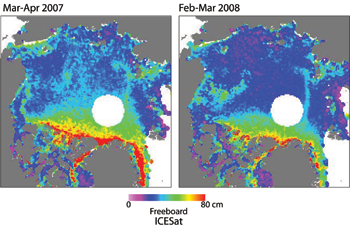
As you may recall, Eli has a bet with Stoat on 2008 setting a new record for minimum Arctic sea ice. A small birdie who munches adaptive liver out in Boulder has passed the word that the odds are shifting in the Rabett's favor.

New University of Colorado at Boulder calculations indicate the record low minimum extent of sea ice across the Arctic last September has a three-in-five chance of being shattered again in 2008 because of continued warming temperatures and a preponderance of younger, thinner ice.

The forecast by researchers at CU-Boulder's Colorado Center for Astrodynamics Research is based on satellite data and temperature records and indicates there is a 59 percent chance the annual minimum sea ice record will be broken this fall for the third time in five years. Arctic sea ice declined by roughly 10 percent in the past decade, culminating in a record 2007 minimum ice cover of 1.59 million square miles. That broke the 2005 record by 460,000 miles -- an area the size of Texas and California combined.

"The current Arctic ice cover is thinner and younger than at any previous time in our recorded history, and this sets the stage for rapid melt and a new record low," said Research Associate Sheldon Drobot, who leads CCAR's Arctic Regional Ice Forecasting System group in CU-Boulder's aerospace engineering sciences department. Overall, 63 percent of the Arctic ice cover is younger than average, and only 2 percent is older than average, according to Drobot.

The National Snow and Ice Data Center has an interesting map of the height of ice and snow above the sea surface from satellite measurements. This is roughly proportional to ice thickness.