Friday, August 29, 2014

What Part of Hot Air Rises Do You Not Understand


Dr Roy is having a mid life crisis.  He writes:

"But what if (I’m NOT necessarily advocating this) most of the CO2 humans produce, which is near the land surface, is absorbed by vegetation, and the observed global increase is partly or mostly due to outgassing of the oceans?"

Most of the CO2 humans produce is created by combustion of fossil fuels.

What part of hot air rises doesn't Dr. Roy understand?

There are more sophisticated answers to this from a whole bunch of atmospheric transport studies

Thursday, August 28, 2014

Water district election update from a guileless heavyweight

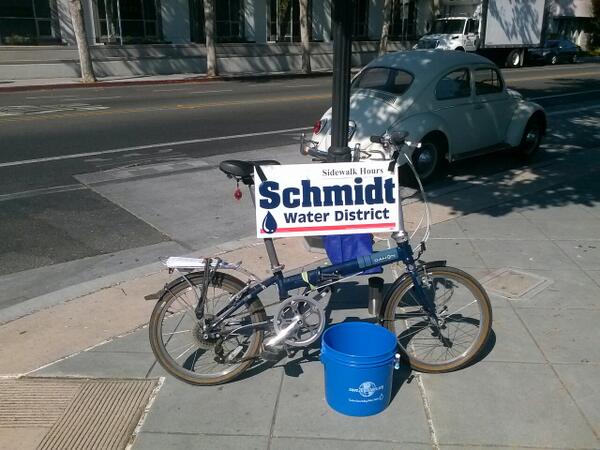
The title above refers to a San Jose newspaper article. I've mentioned a while back that I'm running for re-election, and it turns out it's going to be interesting.


People seem to have differing reactions to the column, so read it for yourself and I won't try to bias your view.

What I have been thinking for a while though in this runup to the election is to actually acknowledge the mistakes I've made. I've got one general category, and then one specific issue. The general category is dividing my attention on too many things. Here's an incomplete list of the memos I've written:  too many subjects. Obviously we do a lot more work than can be measured by memos, but those memos should usually be priority items. If I had chosen fewer subjects and put more time into them, we could have progressed further. (I'll still defend our progress overall, though.)

The other, specific issue is pretty technical but involves the best approach to resolving legal and environmental issues under both state and federal law for the protection of endangered steelhead salmon. We'd been attempting to get simultaneous state and federal permits but had been held up on the federal level. Some local environmental groups wanted to split the process to speed up actions to help steelhead under state law; our staff resisted this approach. A few months ago, our staff changed their minds. Maybe that could have happened two years ago instead - the split approach was the right one. Now we have to make up for that lost time.

Anyway, I think you can acknowledge mistakes while still doing a good job, and that's what I hope to do in this election. 

And to be a good politician (or less guileless one), I'll also add that help is greatly appreciated.

Thursday, August 21, 2014

All this has happened before

So Microsoft has decided to ditch the lobbying group ALEC because of ALEC's opposition to renewable energy. As the link says, the lobbying group is facing increasing problems with its corporate members. This is obviously good news and it parallels something that happened years earlier, where a conservative corporate coalition (the Global Climate Coalition) mobilized against climate change was gradually picked apart. In the earlier case, the demise of the conservative coalition received a helping hand from a moderate alternative established by the Pew Foundation. I am not aware of any behind-the-scenes nudging of Microsoft, but it wouldn't surprise me.

Despite this, I stand behind my original admiration for ALEC and think it should be imitated on the progressive side of politics. Maybe we can skip the unsavory stuff though, especially the secrecy that is getting it into trouble.

Wednesday, August 20, 2014

Roger Pielke Jr.'s Annus Horribilis

As Ethon points out this has been a very difficult year for Roger Jr. who, poor lad, has been exposed to the love that others have for him.  Roger has not taken this well, and his tried and true tactics of lashing out and expecting bunnies to back away have been tried and truly just did not work this time.

Of course the 538 comedy was difficult enough.  Before that there was his challenging John Holdren and having his teeth handed to him (indirectly of course).

The pushback is the result of going to the well too often.  The first rule of life, and academic life is that enemies accumulate.  Roger has any number and some of them now have bigger megaphones than he does.

Brad Johnson put together a fine collection of Roger's best for Grist in honor of Nate Silver shooting himself in the head by giving Roger a forum (a mistake soon rectified).

Pielke's response to criticism at the time was typical, demanding apologies from those who criticized him.

Trenberth said he considered Pielke's email "a threat to me.” “He was very accusatory and threatened me if I did not respond,” Trenberth told HuffPost. 
Trenberth forwarded the text of the email to HuffPost. Pielke wrote that Trenberth had "made some pretty coarse and perhaps even libelous comments" in the ThinkProgress article. Pielke requested that Trenberth correct his public claims and noted that "an apology would be nice also."  
Kevin is, of course, a long standing critic of Pielke Jr., no more clearly put than his review of Roger's The Climate Fix but Roger has never stood by idly when the opportunity beckoned and not loathe to give it a helping hand.

It is indeed a difficult thing to be exposed to the lack of respect others have for you. Given the past, bunnies could only expect the typical victim bully response
Unlike simple passive-aggression, victim bullies use accusations as weapons, and ramp up the accusations over time. Unlike a normal person, who would slink away in shame as the initial accusations are discredited, a victim bully lacks either guilt or shame, honestly believing that s/he has been so egregiously wronged in some cosmic way that anything s/he does or says is justified in the larger scheme of things. So when the initial accusations are dismissed, the victim bully's first move is a sort of double-or-nothing, raising the absurdity and the stakes even more
The absurdity stakes could not be any higher than the denouement of a panel on which both Roger and Kevin Trenberth had at each other last week.
Roger is playing no limit absurdity

Saturday, August 16, 2014

Delicate Flowers

Eli, contrary to rumor, has been following the comings and goings here and abouts.  Even twittering back and forth with Ethon.  As some bunnies may have noticed, this being summer, it is time for delicate flowering, and indeed there have been outbreaks at the usual places, for example, Judith Curry wondering about the road to scientific hell, and then missing all the turn signs.  ATTP tried to play nice (Eli pointed out that she had not a clue about ethics, it got sin binned).

In any case, which always goes around in the best circles, Eli was wandered over to an interview of Robert Bindschadler by Dahr Jamal.  Bindschadler a ice mass specialist now emeritus at NASA is one of the ones in the corner screaming bloody murder.  He is very pessimistic about ice on the planet, looking at major losses to the ice sheets in the 100-200 year time frame.

To reinforce your sense of well being, Eli would point you to the final report of the Dark Snow Project,

In the interview he describes how at the time of the first IPCC report, 1991, significant losses from Antarctica and Greenland were not even considered because it was assumed that the time frame for such would be well outside the next century horizon of the report.  As SAR, TAR, AR4 and now AR5 followed, and the weakening of the ice sheets became clear, the issue crept into the IPCC reports, but often in strange ways
Then we get up to the fourth IPCC report in 2007, and we were starting to get some models that incorporated our best understanding of the ice sheets that were showing that there might be some dramatic impact in terms of contribution to sea level. They were acknowledged, with verbiage like, ice sheet dynamics can change rapidly and contribute large amounts of water to cause excess sea level rise, but the dynamics are not well enough understood for predictive capability. The sea level numbers were pretty low, and the words around said they didn't really know how high they might go. So the story at that time was that we didn't really know what the numbers were. 
I asked the head of Working Group I on that report which had ultimate responsibility for everything that was in the Working Group I report, I said, "All the words say don't trust the numbers; why are there numbers there at all?" She told me that governments insisted that there be numbers, that they gave them the table and said you put the numbers in this table. Thus, she felt compelled to do that because the report was not going to be accepted by the government until there were numbers in the table.
Bindschadler was and is alarmed by this and, as he says, he started to engage
The shortening of the time scale that glaciers can now contribute to sea level rise and climate change drew me into the debate. And the science is solid. There's no question about it. Even in the early days it was solid. So I came down hard on the side of yes, it is happening, and I can speak to that when it comes to sea level going up as a result of shrinking ice sheets. That is going to happen.
 That gave me my entrance onto the stage where these nasty debates are going on. I wasn't that far away from the general expectation within the scientific community that said that as long as we spoke from the facts, and stayed secure with our caveats that have to be there, we will be listened to and it will have a positive effect on necessary policies that need to start being put in place. It was that naïve expectation that we're the experts, and scientists are usually pretty well regarded as credible, and that's never changed.

But there was such a strong blowback from climate change skeptics and deniers, using their bad science, and we felt there was a failing in the reporting of that, and even though the vast majority of the scientists, and back in those days it was 90 to 10 percent, it would still be reported as an equal debate.
But the dagger, was of course from the delicate flowers
The other thing that led me into a retreat is you would go out there and try to limit your emphasis on caveats and speak more crisply or without the caveats and with more black and white and you would be shot in the back by your colleagues. So I would be quoted in the paper making a rather bold statement and a colleague would call me out and say, well you didn't mention the uncertainty factor, and sounds like you know more than you know you do. But you have to consider the audience. If all you do is lace it with uncertainty, it gives them reason to do nothing. 
But there was not uniform agreement within the scientific community that that was the way to go. So I retreated.

Sunday, August 10, 2014

Sorely Missed Already - het

Coby Beck reports that Harold Elmer Taylor has died at the age of 68.  het compiled a graceful and humorous weekly summary of climate news and blog posts at A Few Things Ill Considered.   It was, however, not short of concern for what we are doing to the Earth.

"Harvey E. Taylor, aka het, died Monday, July 14, 2014 at his home in Portage la Prairie, a small town in Manitoba, Canada.  All I know of it is from one brief online obituary and one more detailed one at the website of a funeral home. It says he died peacefully and in his home."
He was also working on a novel called "The Bottleneck Years" parts of which were published on the blog over time.

Short memory candles   can be left at the funeral home site.  Longer one's at A Few Things.

We need a wake to ease the loss.

Wednesday, August 06, 2014

Chait gets it

The focus on per-capita emissions, the obligation to look at total emissions that have brought us to this point instead of ignoring the disparate emission levels between nations in the last decades, and the completely ignored commitment (okay, something of a commitment) by India and China not to reach American levels of per capita emissions.

Best paragraph:

The United States has emitted far more carbon into the atmosphere than India or China — indeed, more than India and China combined. The United States continues to emit several times more carbon per person than either China or India. Since China and India have vastly more people and are industrializing, they are likely to increase their per-capita emissions over time. I have seen no morally cogent explanation as to why the entire burden of sparing the world from runaway global warming should fall on the countries that have contributed the least to its existence. Developing countries have already made the significant concession that they will not be allowed to follow the cheap dirty-energy developmental path used by the West.
Read the whole thing.


UPDATE:  from the comments, Raypierre has a well-developed paper on the whole issue. I'll quibble with one point:
Perhaps there should be a statute of limitations for carbon emission. This cannot be justified on the basis of ignorance of consequences of carbon emissions, since that has been known for well over a century,
I can understand a start date of responsibility for past emissions in 1896, but I think the stronger argument is that the scientific notice given to the public and policymakers of a substantial risk from GHG emissions was insufficient prior to the 1960s or 1970s. The latest start date could even be the Rio Declaration, when you transfer from a risk of a problem to a near-certainty of a problem. I think the better argument is that a realistic and reasonably understood possibility of risk, communicated to the broader community, should be the start date of responsibility.

This part nails down the overall issue:
Some forms of unequal circumstances at birth (being born black, or female, or poor) are clearly irrelevant to the question of access to something like education or adequate health care, and need unconditional redress. The question of whether a person should suffer a reduced share of the Carbon Commons simply because she was born African or Indian falls naturally into the same category.

Tuesday, August 05, 2014

The Morally Confused

Judith Curry has wandered into ethics, without much of an understanding about such things.  She enjoys going on about how she is the protector of research integrity, without really understanding scientific ethics, perhaps first investigated by Max Weber, although Eli is sure that Willard may know of earlier sources.  There are many interesting things about this, first, that scientific ethics as distinct from ethics could not have been a subject much earlier, because science as a stand along thing really only blossomed at about the same time as global instrumental temperature measurements started in the late 1900s.

Second, that separating ethical behavior as a scientist from ethical behavior in general is not something that your average bunny in the street holds in high regard and is one reason that many people distrust science and scientists, as in Godless Scientists, etc. which is really a belief that science and scientists would gladly sell everybunny down the river for a Nature pub.  

Be that as it may, Weber pointed out that the distinction must be between facts and value judgements.  Since as has been mentioned here a few times, we have no data from the future, value judgements about the future must condition our views of how what we are doing now will affect the future.  Stephan Gardiner explains how this can easily lead to moral corruption

In conclusion, the presence of the problem of moral corruption reveals another sense in which climate change may be a perfect moral storm. This is that its complexity may turn out to be perfectly convenient for us, the current generation, and indeed for each successor generation as it comes to occupy our position. For one thing, it provides each generation with the cover under which it can seem to be taking the issue seriously – by negotiating weak and largely substanceless global accords, for example, and then heralding them as great achievements – when really it is simply exploiting its temporal position. For another, all of this can occur without the exploitative generation actually having to acknowledge that this is what it is doing. By avoiding overtly selfish behaviour, earlier generations can take advantage of the future without the unpleasantness of admitting it – either to others, or, perhaps more importantly, to itself
In discussing the House of Parliament Committee on Energy and Climate Change report Judith Curry shows how only valuing the things of today leads to such corruption
If people are concerned about the adverse impacts of extreme weather events, reducing CO2 emissions are not going to have any impact on policy relevant time scales, even if you accept the IPCC analyses.  Resources expended on energy policy are in direct conflict with reducing vulnerability to extreme events.
Oh yeah, that and as Gardiner call out, the full Lomborg, that you can't spend resources on both.
The first is the threat of a false dichotomy. Arguments from opportunity cost crucially rely on the idea that if a given project is chosen, then that choice forecloses some other option. But this is not the case in Lomborg's version. Helping the poor and mitigating climate change are not obviously mutually exclusive. . .

Second it is not clear even that the two projects are independent of each other, in the sense that they are fully separable opportunities rather than necessarily linked and perhaps mutually supporting policies. . . .

Third, it is not clear that the opportunity that Lomborg wants to emphasize is really available.
The good Lord protect the future from the defender of research integrity.

Tip of the ears to Matt at the Weasel's for pointing to this

Color Blind

The National Review, through its lawyers has filed a new pleading in Mann vs. Steyn as it has popularly been labelled.  Now Eli, not being a lawyer is not going to go through the lawyerly stuff, e.g.

Dr. Mann Cannot Demonstrate Actual Malice By Clear and Convincing Evidence Because National Review Sincerely Believes In The Truth Of The Statements
or
Read in context, Steyn’s commentary was protected rhetorical hyperbole, not a literal accusation of fraud or data falsification

Lowry’s phrase “intellectually bogus and wrong” is not actionable
which appear to be somewhat in contradiction, but one thing in the brief, emphasized by Willard Tony struck Eli as world class
 Third, critics have argued that the hockey stick is misleading because it splices together two different types of data without highlighting the change: For roughly the first nine centuries after the year 1000 A.D., the graph shows temperature levels that have been inferred solely from tree-ring samples and other “proxy” data. But from about 1900 onward, the graph relies on readings from modern instruments such as thermometers. In the words of one review conducted by a panel of independent scientists, many consider it “regrettable” that temperature reconstructions “by the IPCC and others” neglected to emphasize “the discrepancy between instrumental and tree-based proxy reconstructions of temperature during the late 20th century.” 
 Eli, being a RTFR type of bunny went and read Watts Up With That.

Eli has a copy of a figure from Tom Fuller guesting as the local expert on WUWT showing the MBH99 reconstruction as featured in the TAR together with the Lamb BON (back of napkin) sketch that John Mashey has had such fun with


for the colorblind in the IPCC TAR featured figure on the right, the black is the smoothed proxy reconstruction, the red the instrumental data.  Don't believe everything you read over there.

Wednesday, July 30, 2014

The Kzinti Lesson

Explication:  It has been pointed out to Eli that the Kzinti lesson is a bit obscure and maybe even not the right description of Richard's tactics.  In one of the books about Known Space, a human is forced to challenge some kzin, which he does with a fairly elegant short speech (imagine an academic doing a polite, but very firm refutation of someone else's paper).

The kzin tells the human that his challenge was needlessly verbose: a kzin would just "scream and leap".  Of course, kzin have learned that sometimes they need to apologize, sometimes.
Richard Tol is an interesting character, interesting, not admirable.  As he himself is proud of mentioning he ranks high in the h-number sweepstakes amongst economists as the most cited for this or that like 9th in the 2007 Top-40 of Dutch Economists (a productivity ranking); 18th in 2006; 2nd in 2005; 18th in 2004, 25th in 2001; not ranked in 2002 and 2003, go read his CV.  OTOH, until last year, he never had a permanent position.  Lots of jobs, visiting professor here, adjunct professor there and his interactions with others have always been. . . . . difficult.

Richard's way of dealing with anyone who questions Richard is full throated Kzinti roar and attack. For the most part this succeeds because few want the joy of dealing with an axe murderer, and Richard does an excellent impression.  This discourages criticism.

However, over a long enough time, the act wears thin, and the Kzinti run up against people who ain't gonna take it.  In Richard's case, Frank Ackerman, who with Charles Muntz published a paper about a divide by zero flaw in the FUND model.  Ackerman relates how this inspired Tol
to launch a relentless, multi-year campaign to have the article retracted, and to discredit me – including hostile letters about me to my former and current employers.

On the one hand, I am delighted to report that this campaign was essentially a total failure. The article was not retracted, and achieved much higher visibility due to Tol’s critiques. I very much appreciate the support of numerous economists, and of my former and current employers, who have all made public statements opposing the vendetta against me and my article.

On the other hand, the ensuing debate – focused on a specific flaw in FUND 3.5, which has been fixed in later versions – has distracted attention from the underlying issues which my coauthor and I sought to raise in our article. Compared to many other researchers, Tol’s work in general argues for an overly optimistic view of climate change, and a correspondingly less urgent approach to climate policy.
Eli made the same point in the middle of the set to about Tol's dissing the IPCC as did many others.  Ackerman is back with an analysis of Tol's contribution to the IPCC WG II report and an associated review article.
Tol’s 2013 review article, despite its appearance of objectivity, is founded on faulty selection of data and analyses, and contains interpretive flaws that make its facile conclusions unsupportable. First, it highlights 16 studies, some of them very old, from a handful of authors, as if they represented all we know about climate damages.

Second, it identifies a larger number of studies of the social cost of carbon, more than half from the same handful of authors, and then focuses almost entirely on the subset of results with a high discount rate. Where it reports on my own work, the survey clearly misrepresents the original published source.

Third, it purports to prove that low-carbon stabilization targets are expensive by ignoring models and analyses that reach these targets, but making ad hoc adjustments to other analyses that fail to describe a path to a stable climate.

The field of economic analysis of climate change is a work in progress, with many interesting, sometimes contradictory, developments and approaches appearing in recent years. Most of the field, and most of what economists are writing about climate change, cannot be seen through the narrow, distorting lens of Tol’s review article.
This does not even get into the gremlins fiasco that consumed Retraction Watch and others with Eli taking a bite or two about how Richard managed to mangle a whole bunch of signs.  As Andrew Gelman (the others) put it, even if you correct the signs, the model makes no sense.

Frank Ackerman points out that selective citing drives Richard Tol's conclusions.
Even a stable, gremlin-free version of this curve is problematical, however. It treats a narrow and dated collection of studies as the best available estimates of the economic severity of climate change. .  .

Despite the appearance of 16 different studies, Tol’s data represent the views of a small circle of economists, some of them counted repeatedly as their estimates evolved over the years.  As Tol notes later in his article, “the researchers who published impact estimates are from a small and close-knit community who may be subject to group-thinking, peer pressure and self-censoring.”
Somebunny in the editorial offices and the WG II working group should have smelled a problem, but as Eli said, Richard is very aggressive.  Ackerman, could have recycled his summary of Bjorn Lomborg's Cool It to describe Richard's body of work
He offers a definitive-sounding explanation of the climate problem for a nontechnical audience, identifies and summarizes recent research, and tells his readers who to trust and who to doubt. This claim of authority fails both because the book is riddled with small inaccuracies, and because it displays a pervasive bias in its coverage and evaluations of climate issues.
Eli might speculate that the 97% wars on top of the IPCC WG II fiasco and the gremlin attack may have caused Richard to lose control of the dialog.  One may hope.

Direct Deposit

Brian, being obsessed with water supply, he is from California, in writing about water reuse, missed this little goodie which Eli found at the AGU in the Good Hotel (a nest of relatively low cost hotels near the Convention Center and in the coffee zone. ).  While this is rather simple, a bit of plumbing accomplishes the same thing with your sink of choice.

Tuesday, July 29, 2014

Noahopinion

Noah Smith is having fun with automatic priors, pointing out that the reasonable person's prior on personal immortality is that you got it because you ain't dead yet.

Consider Proposition H: "God is watching out for me, and has a special purpose for me and me alone. Therefore, God will not let me die. No matter how dangerous a threat seems, it cannot possibly kill me, because God is looking out for me - and only me - at all times."

Suppose that you believe that there is a nonzero probability that H is true. And suppose you are a Bayesian - you update your beliefs according to Bayes' Rule. As you survive longer and longer - as more and more threats fail to kill you - your belief about the probability that H is true must increase and increase. It's just mechanical application of Bayes' Rule:
Frequentists may disagree, bodycounts tell a bunny something, Noah points out that while there are other reasonable priors, how to determine which one should be used appears to be a religious matter.  OTOH, there are people, particularly teenage boys who use Proposition H daily. 

Eli and Socrates debated similar issues a while ago and Andrew Gelman about eight years ago pondered same
The fundamental objections to Bayesian methods are twofold: on one hand, Bayesian methods are presented as an automatic inference engine, and this raises suspicion in anyone with applied experience, who realizes that di erent methods work well in different settings (see, for example, Little, 2006). Bayesians promote the idea that a multiplicity of parameters can be handled via hierarchical, typically exchangeable, models, but it seems implausible that this could really work automatically. In contrast, much of the work in modern non-Bayesian statistics is focused on developing methods that give reasonable answers using minimal assumptions.

The second objection to Bayes comes from the opposite direction and addresses the subjective strand of Bayesian inference: the idea that prior and posterior distributions represent subjective states of knowledge. Here the concern from outsiders is,  first, that as scientists we should be concerned with objective knowledge rather than subjective belief, and second, that it's not clear how to assess subjective knowledge in any case.

Beyond these objections is a general impression of the shoddiness of some Bayesian analyses, combined with a feeling that Bayesian methods are being oversold as an allpurpose statistical solution to genuinely hard problems. Compared to classical inference, which focuses on how to extract the information available in data, Bayesian methods seem to quickly move to elaborate computation. It does not seem like a good thing for a generation of statistics to be ignorant of experimental design and analysis of variance, instead becoming experts on the convergence of the Gibbs sampler.
Lars Syll riffs off Smith with a little less patience noting that as a religion Bayesianism is dangerous.  The right to carry automatic priors can produce nonsense.  James Annan showed this with Myles Allen's way to wide uniform prior, and the recent discussion about Nic Lewis' attempt to mangle C14 dating priors should caution the Bayesians.

Long live frequentism, at least when there is enough data. 

Monday, July 28, 2014

Curious Rabett

The British House of Commons Energy and Climate Change Committee has issued its report on the AR5 WG I.  While the report strongly supports the IPCC (see below), there is opposition within the Commons and the Murdochsphere.  An important issue is how does one know the opposition is blowing smoke.  There are tells. 

In commenting on climate change, Eli has always been of the opinion that the thin bench is the weakness of denialism.  In this, it was interesting to note that the opponents of the IPCC on the House of Commons Energy and Climate Change Committee invited Richard Lindzen and Nick Lewis accompanied by one Donna Laframboise to give oral testimony.  Bunnies can go back and forth about Lindzen and Lewis.  Lindzen has been wrong about a lot of things.  Lewis has a hammer.  Laframboise, well, it is difficult to say what she is, at least politely, and she was a challenge to the Committee.  A bit of the oral testimony shows that they knew they were being insulted  and oh yes, Richard Lindzen was maybe not held too seriously either.

Q75 John Robertson: I remember a movie that I think was called The Core, and the scientist who was a bit of a pain in the backside made a statement that “science is a best guess”. Nobody knows exactly what it is, but it is a best guess. We have to go on the best guess. You need to help us.

Professor Lindzen: Yes, but the question is, how do you decide on policy? In other words, it is kind of a point of amusement. Somebody says, “There is a problem”, and the politician says, “We have to do something”.

John Robertson: There lies your problem. Your problem is the science. Our problem is the policy. I do not get involved in the science and perhaps probably you should not get involved in the politics.

Donna Laframboise: If I might make a comment. I am a journalist with no scientific background whatsoever and I had left journalism for seven years. I got laid off at the National Post with 130 other people. I decided to do something else with my life. Then I started doing some independent research on climate change and decided I should write a book because I realised that there was a wide diversity of scientific opinion about climate change, but that diversity was not being reflected in the news reports that I was reading. I thought I was writing a book about 10 reasons to be calm, cool and collected about climate change because there are diverse points of view. Instead, I ended up writing an expose of the IPCC, quite unexpectedly, because the more I did some basic fact-checking about what we were told about how the IPCC works as an organisation, the more concerned I got.

I compare it to a criminal trial. If we find out that there was bias among the jurors, then we have to throw out the verdict and start again. What I see is there are so many questions and biases and potential problems with the IPCC process that I do not think it is trustworthy. I do not think any reasonable person can look at the IPCC in depth and say, “We can trust this decision”. It is unfortunate. I wish we could because it would be much clearer what we should do.

John Robertson: With the best will in the world, you are one person and a lot of other people would disagree with you and you have had your chance to sell your book.
One must thank the members of the committee in denial, Graham Stringer and Peter Lilley, for inviting Ms. Laframboise.  It would be hard to think of a clearer marker that denial is not to be taken seriously.  The fact that she was invited shows that there is no there there.

The Committee report issued just now is quite strong:
80. The conclusions of this inquiry are very clear: the WGI contribution to AR5 is the best available summary of the prevailing scientific opinion on climate change currently available to policy-makers. Its conclusions are derived with a high confidence from areas of well understood science. Uncertainty remains in a small number of important areas but these are diminishing. It is important to consider all lines of evidence together when assessing climate change rather than focusing on particular aspects of the report. The overall thrust and conclusions of the report are widely supported in the scientific community and summaries are presented in a way that is persuasive to the lay reader.
81. The size and scale of the report reflects the huge effort by the international climate science community, who volunteer their time and expertise. We can now be more confident than ever that human activity is the dominant cause of the warming witnessed in the latter half of the 20th Century. The most significant human impact is through the release of carbon dioxide, which is predicted to continue to cause warming in the coming decades and centuries.
On the issue of climate sensitivity the report states that
The WGI contribution to AR5 has considered the full range of both Equilibrium Climate Sensitivity and Transient Climate Response and given the best assessment possible within the constraints of the evidence available at the time. It does not appear that a consistent pattern for higher or lower sensitivities than that stated in the WGI contribution to AR5 has emerged since its publication. (Paragraph 48)
and on the global temperature anomaly
Periods of hiatus are consistent with earlier IPCC assessments that non-linear warming of the climate is to be expected and that forced climate changes always take place against a background of natural variability. The current period of hiatus does not undermine the core conclusions of the WGI contribution to AR5 when put in the context of the overall, long-term global energy budget. Despite the hiatus, the first decade of the 2000s was the warmest in the instrumental record and overall warming is expected to continue in the coming decades. (Paragraph 53)
and on models
The models used in the IPCC’s Assessment Reports have a successful history of simulating past climate and their future projection of substantial warming over the next century in all but the most aggressive mitigation scenarios is well founded and overwhelmingly clear. (Paragraph 64) 


Sunday, July 27, 2014

Climate change, desal and astronaut water

As Eli points out, California has a water crisis, and much of the rest of the country needs to be much more water efficient. Water efficiency is the obvious place to start but then the next-step question comes up.


While plenty of people don't live near the ocean, lots do. Oceanside areas with large populations are going to have wastewater treatment plants (in developed countries, anyway).  These places therefore have two potential sources of new water supply:  ocean desalination or potable reuse of recycled wastewater.

Potable reuse of wastewater is nothing new. Almost any city drawing water from a river which has another city upstream is already doing it; the question is can we do it without lying to ourselves. In the case of astronauts and the International Space Station, they can do it outright, but the rest of us have to catch up.

Or not. Ocean desal actually uses the same technologies that potable reuse requires, either distillation or more commonly through reverse osmosis. The difference is that ocean water has a lot more stuff in it (mainly salt) than wastewater which already has to go through some purification before it reaches your reverse-osmosis system. That means a lot more energy and cost is involved in ocean desalination than potable reuse, so we've got a climate change issue.

The other climate change issue is that the lack of water currently stops a lot of unwise sprawl development, but ocean desal could change that, or maybe even mandate it - a very expensive desal system could be built on the expectation that there will be a lot more development to pay for it. I suppose there's some sprawl risk from potable reuse as well, but because it functions best in an existing populated area, starting at the wastewater treatment plan and then spreading from there, the risk is lower.

Many other factors involved of course, but these are the main climate issues. All but one of the factors weigh in favor of potable reuse. The one factor favoring ocean desal is psychology and political acceptance. People hesitate to drink this water, and that hesitation killed an earlier potable reuse project in San Diego (p. 17).

I view desal and portable reuse as being in a race. Money is limited so communities are going to prioritize. As much as I can I've supported potable reuse and opposed desal.

First step for potable reuse is Indirect Potable Reuse, achieving psychological acceptance by making the treated water sit somewhere for a while before reuse, either in a reservoir or underground. It's good but maximum flexibility and less cost require Direct Potable Reuse, shunting the water to your drinking water plants.

At my water district we've set up a reverse osmosis system. Currently it's just to improve the quality of non-potable recycled water which will help with certain types of uses, but the goal is potable, if we can get public acceptance.


Note:  stumbled across this - Los Angeles actually constructed an indirect potable reuse plant in the 1930s, but shut it down when they acquired Colorado River water. Back to the future, like with electric cars.

Also, desalination sometimes refers to desal of brackish water, usually groundwater. This water is much less salty than ocean water so a lot of the energy concerns are reduced with brackish desal. But brackish water and even potable reuse require a fair amount of energy, just nowhere near as much as ocean desal.


Tweeting science over the last few thousand years

Twitter conversations by scientists, beginning with one of Pythagoras' tweets. Be sure to read the ones from Jonas Salk.

Wednesday, July 23, 2014

Meeting Michelle yesterday

(Not very substantive post on meeting Michelle Obama, click here to read if you're idly curious....)

Tuesday, July 22, 2014

The Future Today

Over at ATTP, Rachel, playing while Wotts is away, asks about community driven solutions to climate change.  Pekka misses the point in one comment (there are others in the thread which is worth reading, by Pekka and others)

Governments have had some role in those technologies as well, but what has made exactly these fields to grow at an exceptional rate, has not been the government. It’s worthwhile to ponder, what leads to the huge success of some developments, but not of the others. One factor is certainly that technology development has revolutionized data and signal processing, while most other technologies have not shown potential for anything comparable.
Eli was not as nice as he could be, pointing out that government is a vital player in anything that has to do with anything
Government had nothing to do with the coming of the railroads, road traffic or air travel. OK Pekka?
You could add electrical distribution networks and pipelines to that.  In this regard Eli would like to point to a map of the future today


More than there are gas stations inside the Périphérique.

Saturday, July 19, 2014

Stigma for fossil fuel companies, the reverse for the churches that dump them

World Council of Churches, Unitarian Universalists, United Church of Christ, and many smaller/regional church denominations and affiliated organizations have established climate divestment policies. Others are percolating - the Methodists are studying their investment policy, the Presbyterians are first going to try to persuade the companies to give up their core business model (good luck with that!)* and then we'll see them and others consider this issue.


People involved in climate divestment and had also been involved in South Africa divestment a generation ago say that climate divestment is moving faster. An Oxford study backs that up (p. 11).

The same study acknowledges limited direct financial impacts of divestment except for coal industry, but then focuses on the stigma issue:

As with individuals, a stigma can produce negative consequences for an organisation. For example, firms heavily criticised in the media suffer from a bad image that scares away suppliers, subcontractors, potential employees, and customers. Governments and politicians prefer to engage with ‘clean’ firms to prevent adverse spill-overs that could taint their reputation or jeopardise their re-election. Shareholders can demand changes in management or the composition of the board of directors of stigmatised companies. Stigmatised firms may be barred from competing for public tenders, acquiring licences or property rights for business expansion, or be weakened in negotiations with suppliers. Negative consequences of stigma also include cancellation of multibillion-dollar contracts or mergers/ acquisitions. Stigma attached to merely one small area of a large company may threaten sales across the board.
(p. 14, citations removed)

The stigmatization from divestment will have financial consequences. These companies will have to pay more for employees and for other businesses to work with them. Companies with a toe-hold in the fossil fuel sector will find it better for them to get out.

Most important is that stigmatized industries will find it tougher to manipulate the political sector. That's one reason why they disguise their funding, but the disguise is imperfect, and the difficulty gets worse with the stigma.

Two other points. The study acknowledges political restrictions resulting from the climate divestment effort could destroy the perceived value of reserves that end up staying in the ground. When the carbon bubble pops is hard to predict, but any downward pressure increases the possibility of it happening soon.

Second, when companies divested from South Africa they weren't required to physically blow up the businesses they left behind - they sold them. The argument that it had no financial impact was around then, but we see what happened in the end.


*I think there is a business case that fossil fuel companies should 1. stop wasting money exploring for new reserves, 2. sell the reserves they're not going to be allowed to develop before the carbon bubble bursts, 3. play out the remaining and cheapest reserves and 4. either distribute the profits and wind down their companies, or invest in another business model. Not bloody likely to happen, though.

I'm ignoring the complications of when natural gas can substitute for coal. 

Saturday, July 12, 2014

Down the Drain

Eli has long been an advocate of the five fold way
  • Adaptation to deal with the damage already done
  • Amelioration, eliminating harmful effects of our actions
  • Conservation with needed and desired but not wasteful usage
  • Substitution of green systems for destructive ones
  • Mitigation reversing our thoughtless abuse
and not just for dealing with climate change.  Neat and tidy are two virtues Mom Rabett was strong on, and Ms. Rabett, well at times she is just plain cheap, Eli being thrifty.  Thus waste offends.

There has been considerable noise in the climate set about leaks from natural gas pipes and wells.  An  article in the NYTimes by David Bornstein points out that water systems are sieves. 
The Environmental Protection Agency estimates (pdf) that public water systems lose, on average, one-sixth of their water — mainly from leaks in pipes. The E.P.A. asserts that 75 percent of that water is recoverable. (In truth, the volume of leakage in the nation’s 55,000 drinking-water systems is unknown, because few conduct water audits.
with loads of consequences
It’s been widely reported that California is experiencing its worst drought in history. But take a look at the United States Drought Monitor: much of the country is abnormally dry or in drought. Internationally, the problem is even more serious. The World Bank reports that, over the next decade and a half, water availability may fall 40 percent short of global need (pdf).

Meanwhile, utilities in the developing world are hemorrhaging water. The World Bank estimates that water systems have real losses (leakages) of 8.6 trillion gallons per year, about half in developing countries (pdf, 11MB, p.6). That’s enough to serve 150 million Americans (and we use a lot of water!)
Bornstein describes how the Bahamas are dealing with the problem in collaboration with a consulting firm Miya and the obvious progress they are making

Sealing up systems can not only save money, but because water systems are often limited by water supply, it can insure delivery.  Doing so requires commitment, technology and funding, but pays multiple dividends.
One study (pdf) conducted for the California Public Utilities Commission examined audits done by 17 water utilities and found that losses were 1.6 to 6.6 times higher than optimum levels.  Assuming that 40 percent of the losses could be recovered economically, the study’s lead author, Reinhard Sturm, estimated potential savings at 113 billion gallons per year — equivalent to the annual production of six Carlsbad projects.

It’s vital to consider the impact on energy use and the environment. Water is often lost between the main pipe and the customer, which means it has already been extracted, treated and transported a very long way. That’s expensive. All that energy is lost — and more has to be used — and that, of course, increases carbon emissions. California’s water system is already the state’s largest single energy user. At the same time, desalination plants are energy intensive. Electricity accounts for roughly half the cost of their water.
Oh yeah 


Friday, July 11, 2014

Suderman meets Tojo

Japanese citizens reading their newspapers during World War II noticed that the reports of unending series of Japanese victories in the Pacific had a pattern - each time that the Japanese smashed Allied forces, it was closer to the home islands than the previous time the Allies had been smashed.

Peter Suderman's critique of Obamacare over time follows a similar eerie pattern.

After losing Saipan, Imperial Japan did start to come clean about what was happening, somewhat. We'll see when that happens with the Republican leadership.