Monday, February 27, 2006

What they really think of you........


Eli has been looking at the nexus between the tobacco, ozone, acid rain, climate change denialists. The tobacco case discovery documents are on line and have a treasure trove of stuff for anyone interested in the astroturf industry. A foolish Steve Hemphill is playing nyah nyah you can't prove it on Roger Pielke Jr.'s Promethius, so our crack team of prize winning long eared detectives have been trolling the archives.

The best one so far is this letter 

TO= Bill Murray
FROM Alexander Holtzman
DATE: August 31, 1989
SUBJECT: Fred Seitz
I spoke to Bill Hobbs about arranging an appointment for you with Dr. Fred Seitz, former head of Rockefeller University and the principal scientific advisor to the R. J. Reynolds medical research program. Bill told me that Dr. Seitz is quite elderly and not sufficiently rational to offer advice. Bill said that he would strongly recommend your speaking to Dr. Alfred G. Knudson Jr. of the CTR Scientific Advisory Board.
Of course, this was the same month they released Singersmagnum opus on second hand smoke
You don't want to know what the people who have bought you really think.

Saturday, February 25, 2006

Smoking out the fellow travelers.......


Curiously as one reads about climate change, ozone depletion, tobacco use, and just about any environmental issue, you find the same cast of "scientists" and "think tanks" on the denialist side of the argument. Probably because, like protomatter, no reputable scientist would want to be associated with that group. One of the key players is the Heartland Institute, who on the climate side run a web site called Climate Search.

Eli was letting his fingers do the searching when he came across this letter (a very long one that starts about 1/2 way down on the page) from scottb, which pointed to this announcement on Climate Search.


Kyoto's Fatal Flaws Revealed - Nov 12, 2002
International Climate Experts Speak Out Against Climate Change Myths
You are invited to attend a News Conference where, for the first time in Canada, a group of the world's leaders in climate science and energy engineering will be assembled to reveal the science and technology flaws of the Kyoto Accord.
With the following list of climate scientists to speak at the briefing
1 - Dr. Tim Patterson - Carleton University professor of earth sciences (Paleoclimatology specialization).
2 - Dr. Fred Singer, President of The Science & Environmental Policy Project and Distinguished Research Professor at George Mason University and Professor Emeritus of environmental science at the University of Virginia.
3 - Dr. Tim Ball - professor of Climatology, University of Winnipeg and the first climatology Ph.D. in Canada.
4 - Dr. Madhav L. Khandekar, Environmental consultant. 25 years Research Scientist from Environment Canada.
5 - Dr. Pat Michaels - Dr. Michaels is a research professor of environmental sciences at the University of Virginia, visiting scientist with the Marshall Institute and Senior Fellow in Environmental Studies at the Cato Institute, both in Washington D.C.
6 - Professor Fred Michel of Carleton University Department of Earth Sciences
No surprises there, but then we have the secondary list of those who would not be at the news conference but were available for telephone and email interviews

Dr. Roger Pocklington
Dr. Sallie Baliunas
Dr. Willie Soon
Dr. John Christy
Dr. Chris Essex
Dr. Roger Peilke
Dr. William M. Gray
Dr. Fred Seitz
Dr. George Taylor
Dr. Sherwood Idso
Dr. David Wojick, P.E.
Art Robinson of OISM
Dr. Herb I. H. Saravanamuttoo
Dr. Robert Balling
Dr. Ross McKitrick
Dr. Philip Stott

Hmmm in a couple of cases.

Friday, February 24, 2006

Why does the stratosphere cool while the troposphere warms daddy?


One of the strongest and most consistent predictions of Global Climate Models is that if greenhouse gas concentrations increase, then the troposphere will warm. Another is that the stratosphere will cool. Both cooling and warming have been observed in the right places, but before we start, let us say that most of the currently observed stratospheric cooling is due to ozone depletion.

To my knowledge no one has stated a simple first order explanation for greenhouse gas (ghg) stratospheric cooling. William at Stoat tried to do this, but his explanation is not simple. If you don't believe me go read. Talking over a carrot martini a simple explanation appeared between my ears.

The stratosphere is dry, dry, dry. Most stratospheric water vapor comes from oxidation of methane and it ain't much. The only stratospheric ghgs (e.g. ones that can absorb infrared [IR] radiation) are ozone and CO2. Most of the radiation that makes it into space is emitted from a tropospheric layer at about 6 km, often called the top of the atmosphere (TOA). Forcing is calculated in terms of its effects on the TOA. If you want to know more look at this NAS report or this article by Roger Pielke Sr.)

Thermal equilibrium requires that the TOTAL emission from the TOA (warning simplification) has to equal the solar energy flux into the atmosphere. Simply put, stratospheric cooling is driven by higher water vapor concentration at the TOA driven by tropospheric ghg warming. TOA IR emissions from water vapor are not absorbed in the bone dry stratosphere, IR emission from CO2 is very efficiently absorbed, and more so if the CO2 concentration increases. Ghg warming lead to higher water vapor concentrations. The proportion of the constant TOA IR emission from water vapor increases. Since none of this emission (warning simplification) can be absorbed in the stratosphere, the stratosphere cools. QED.

Thursday, February 16, 2006

And now for something completely inspiring....


The image of Earth taken from the moon has become an icon, often referred to as the blue marble. NASA has a new site with truly breathtaking true color images taken from space, that can be accessed at the Earth Observatory web site.

You really have to explore the site to enjoy its richness.


Sunday, February 12, 2006

Newspeak, doublethink and Taken by Storm

Anyone reading "Taken by Storm" by Chris Essex and Ross McKitrick, needs a dictionary. In the best tradition of that Newspeak proverb, Ignorance is Bliss, you need your secret boys' decoder rings to read the book. Essex and McKitrick do provide an incomplete quack speak glossary, but how is one to tell what they are talking about without Dr. Rabett's amazing English - EssexMcKitrictionary?

For those of you who forgot about the purpose of Newspeak in 1984, from the Wikipedia

A comparison to Newspeak may arguably be seen in political rhetoric, where two opposing sides string together phrases so empty of meaning that they may be compared to the taunts young children toss back and forth. The arguments of either side ultimately reduce to "I'm good; he's bad."
Turnabout is fair play

Doctrine of Certainty - the idea that anyone besides Essex (and maybe McKitrick) can know anything. Obviously false. Often called "The Doctrine" includes items that are "manifestly false or the claim to know it is false". The first tenet is that "The earth is warming". Well yeah, guys, it is.

The Convection of Certainty - a gathering storm whereby people who study something and are experts come to a consensus. Obviously they are not as smart as Chris Essex (and maybe Ross McKitrick)

Official Science - The Convection of Certainty as conveyed to the public and policy makers by those ignorant experts who claim to know more than Chris Essex (and maybe Ross McKitrick) about climate.

PUN - the Panel of the United Nations, aka the UN Intergovernmental Panel on Climate Change, known among humans as the IPCC. Here, Chris Essex (and maybe Ross McKitrick) move into deep Black Helicopter territory.

The Big Panel - the UN Intergovernmental Panel on Climate Change Working Group I, composed of the worlds experts on climate science who falsely claim to know more than Chris Essex (and maybe Ross McKitrick) about climate science. Their job is to prevent politicians from learning about climate science from the real experts like Chris Essex (and maybe Ross McKitrick)

SPAMs - Known among most as the Summary for Policymakers in the IPCC reports. Written by evil people who know nothing about climate such as Sir John Houghton, not by true experts such as Chris Essex (and maybe Ross McKitrick)

ELGs - Environmental Lobby Groups aka NGOs organizations mislead by Official Science, the Big Panel and the SPAMS that actually think they have the right to petition their governments rather than take direction from Chris Essex (and maybe Ross McKitrick).
Let us pause here to practice our vocabulary. Can you use all these word in a sentence? Why yes, as in:
The Doctrine of Certainty forged in the Convection of Certainty by Official Science and promulgated by the PUN through the Big Panel in the SPAM was taken up by the ELGs.
Which actually is a bit better than Chris and Ross did!
.. came not only from ELGs but also from Official Science in the Big Panel:)
But both meet the requirements of Newspeak.

That concludes Chapters 1 and 2 folks.

Saturday, February 11, 2006

Everything is not what it seems.....

The efficient way that Jim Hansen offed his PAO* carbuncle, George Deutsch, is acquiring considerable notice across blogland. On the surface this is a simple story of a wet behind the ears political appointee trying to impose his political and religious views on a noble scientist. If anything, Deutsch’s recent comments have made his agenda clear, and endeared him to the radical Republican party, while justifying Hansen’s actions to everyone else. Do not be surprised if Deutsch starts running for something in deepest Redland.

What has been missed is the timing and skill with which Hansen did the job. The motives are, I think, clear: The attempt by the current administration to impose its politics on NASA earth science has ticked Hansen off and he has waited for his chance to make a statement. Deutsch was the immediate and easy target, but collateral damage was the purpose.

NASA is not a particularly political agency, but it would be a mistake to think that internal politics play no role and that administrations have no say in the agency. Historically administrations do this by picking the Administrators and by selecting the Agency mission. Since NASA is chronically underfunded and has more missions than dollars, putting a focus in one area of necessity means taking resources away from another. To parse the recent dust up we need to look at the last two administrators, Sean O'Keefe and Michael Griffin.

O'Keefe was a creature of OMB and a long time participant in Republican policy groups. His contributions to NASA were full cost accounting and the Space Exploration Initiative. The effect of both was to restrain the ability of NASA to do many of its missions, in particular the ones that the administration did not want it to do. Even looking at the budget does not tell the whole story, because many of the less favored programs were hard hit with taxes linked to supposed administrative costs under the full cost accounting scheme. Oh yes, the third thing was a reorganization that mashed Space Science and Earth Sciences together into a Science Directorate and de-emphasized it with respect to the new Exploration Systems Mission Directorate.

Michael Griffin is a creature of the space industry, both civilian and military. He has worked with NASA and for NASA all of his professional life. Griffin's first move was to clean house at the top of the agency. Some may argue that it would have been better to keep one or the other of the top 20 appointed by O'Keefe and encouraged to leave asap by Griffin, but there was remarkably little push back.

The final piece of the puzzle is the nature of the snakepit.

From nasawatch (a good place to learn about what is going on at NASA) we read about the environment that James Hanson works in

The following excerpts are taken from GSFC's mandatory career management online training required for all GSFC civil servants.

Slide 28: Knowledge of the Work Environment - NASA's Unwritten Rules

  • Unwritten rules are norms for behaving and performing successfully at GSFC that are not printed in any Standard Operating Procedures Manual or Employee Handbook. When an employee understands and adheres to GSFC's Unwritten Rules we call them politically savvy. Nothing can derail a career more quickly than a lack of political savvy.

No one has ever called James Hansen anything but politically savvy in the NASA sense although (as far as I know) he has never participated in partisan politics. NASA politics OTOH......

Now the lab that Hansen directs, GISS in New York City is an odd duck in an organization chart. Formally it is merely one of four labs in the Earth Sciences Division of the Science and Exploration Directorate at Goddard Space Flight Center, Greenbelt Maryland, and Goddard is one of ten NASA labs sited around the US. The director of Goddard, Ed Weiler, reports to Griffin in the new organization chart, but used to report to the Associate Administrator for Science, Mary Cleave. Weiler is a serious astrophysicist, Cleave was an astronaut, and a professional earth scientist. In organization speak, there are at least four people between Hansen and Griffin. ALL OF THOSE PEOPLE INCLUDING GRIFFIN HAVE STRONG EARTH OR SPACE SCIENCE CREDENTIALS.

What is more, GISS has always been more independent than the organization chart implies, with many of its own programs and a relationship with Columbia that gives it much of the intellectual freedom that JPL enjoys through Cal Tech. GISS is both a NASA lab and a part of the Earth Institute at Columbia.

This was not a random lashing out but a carefully considered first step. Need I connect more dots:)

OTOH, if anyone has a strategy for meeting the challenge of anthropic climate change that could be reconciled with the apparent goals of the Bush administration, it is Hansen. More on that later

Update: I forgot to leave links to what Hansen says about climate change and how to meet its challenges. Here is the text of his talk at the AGU session in honor of CD Keeling, and here is an article in Proceedings of the National Academy of Sciences which first set forth his ideas.

Monday, February 06, 2006

A Swift Boat on the Climate Sea

James Hansen, Head of NASA/GISS, has been in the news lately. He has been on just about every blog you can name also after Andrew Revkin in the NY Times wrote about how some Jr. Bush ranger in the Public Affairs Office at NASA/HQ has been trying to control what Hansen says.

Our friends, the Pielkes are also interested. Jr. is all for letting him speak, after all

3. Jim Hansen’s statements about “policy” are really just political exhortations, and not really about policy in any significant degree. The climate issue is in gridlock and it is inconceivable that (yet another) prominent scientist witnessing to his political values is going to change these dynamics, even if it offers some short term discomfort for the Bush Administration.

4. Jim Hansen’s statements had their 15 minutes of attention and were largely old news – the Bush Administration has turned a non-story into renewed focus on their approach to climate.

Hansen is old hat and not RP Jr., so what does he have to say, while Sr. just wants to give Hansen the third degree.

Still, you don't get to be director of a NASA lab without having some sharp elbows and infighting skill, as a certain Jr. Bush ranger is discovering, and Hansen is a subtle and smart character to boot. His letter in the Jan. 27th issue of Science is a different take on climate change policy and science which deserves careful thought:
The quote credited to me in the random samples item "Ice ages as history" (23 Dec. 2005, p. 1900) ("Anthropogenic climate change will basically produce another planet .…Earth won't have another ice age until humans go extinct.") was constructed from two statements that I made at the 6 December 2005 meeting of the American Geophysical Union: "business-as-usual scenarios will produce basically another planet" and "another ice age cannot occur unless humans become extinct."

The printed construction provides no hint of my conclusion that large climate change can be avoided via a scenario that includes action to improve energy efficiency and reduce non-CO2 climate forcings. These actions require strong policy leadership and international cooperation, but they have multiple practical benefits for the environment, human health, and economic development.

I suggest (my talk is available at www.columbia.edu/~jeh1) that special interests have been a roadblock to this end, wielding undue influence over policy-makers. The public has the power to override special interests, but scientists need to communicate the full climate story to the public in a credible, understandable fashion.

I f you have not yet read the talk, go do so.

Wednesday, February 01, 2006

The AGU must hate Roger Pielke Jr.


Roger Pielke Jr. recently pointed to the cancellation of "Triana", the satellite designed to sit out in L2 (one of the Lagrangian points) and observe the whole earth orb. He did it in passing while trying to sideswipe Bob Parks' op-ed in the NY Times. To quote Roger

Park chooses to go after cheap political points rather than engage the real substance of policy issues involving the convoluted and controversial history of Triana.

Park bemoans the termination of Triana and asks ominously, "Why did NASA kill a climate change project?". He suggests a sinister conspiracy within the Bush Administration to "avoid the truth about global warming" and to transfer their "hated" of Al Gore onto the project he first proposed in 1998.
....... (much interesting stuff which you can read on Pielke Jr.'s blog)

While perspectives on Triana are no doubt shaped by its unique origins, the reality is that has never occupied a high priority role in reseach priorities set forth by the climate science community, its costs ballooned and took resources from other earth and space science programs that had gone through community peer review, and it required a space shuttle flight of which there are exceedingly few left.
So what's the point of rehashing this? Well, your innocent ol' cottentail was sitting in the hare loo reading EOS (the house journal of the American Geophysical Union), when he came across an interesting article by Palle, Goode, Montanes-Rodriguez and Koonin: Can Earth's Albedo and Surface Temperatures Increase Together? It is clear that global temperature is increasing, but the trend in the albedo is uncertain. There are contradictory measurements, to quote:
To derive ideal estimates of the Earth's reflectance, it would be necessary to observe reflected radiances at all angles from all points on the Earth, which is technically impossible. Therefore, all measurements from which albedo can be inferred require assumptions and/or modeling. during recent decades, there have been some efforts to measure the Earth's albedo from space; but a long-term data series of the Earth's albedo is difficult to obtain due to the complicated intercalibrations of the different satellite data and the long gaps in the series.
They go on to discuss whether the Earth's albedo has increased in the past decade (maybe) and how this could be reconciled with global warming (possible). Interesting article important problem, and it is very clear that we have a tenuous grasp on the measurement of the albedo, at least to the accuracy needed.

So then, I turn to page two, only to see the headline NASA Terminates Two Earth Observation Missions. One of them, of course is DSCOVR (nee Triana, name changed for various reasons)

And what does the article say about DSCOVR?
The satellite would provide a continuous synoptic view of the Earth and facilitate climate science by measuring energy reflected (albedo) over an entire hemisphere. No other satellites can currintly obtain these measurements, which are needed to determine the effect of albedo on climate, according to DSCOVR principal investigator Francisco Valero of UCSD Scripps.
The AGU must hate Roger Pielke Jr.

Sunday, January 29, 2006

Lost!


This is something of a new direction. For a long time I have been a fan of Peter Woit's blog Not even wrong, which comments on theoretical physics and string theory in particular. Recently, he posted some comments on an article in Die Zeit, (a VERY erudite German news magazine publication with a distinguished history) about the current state of theoretical physics.

Since no English translation is available, some people posted machine translations. They were good proof of the old joke that if you take the English idiom "Out of sight, out of mind" into French and back, what you get is "blind idiot".

Anyhow, I have made a better translation (and I do welcome corrections and suggestions to improve it and if Zeit asks me to remove it I will) and am posting it here. The article was by Max Rauner, a science journalist, whose other work can be googled.

A translation from DIE ZEIT 26.01.2006 Nr.5 Aus! By
Lost!
Physics is stuck in a crisis: The dream of a Grand Unified Theory has collapsed, the new theories can scarcely be tested. Is cosmology still a science?
Free love, LSD, anti-war demos. As he says, Leonard Susskind took part in all that "and still more". Afterwards he became a physics professor at the elite American university Stanford, but he remains a rebel at heart. Now Susskind has written a book, which has created an uproar among his colleagues. If he is right, the end of physics is at hand, or physics is at a new beginning.
Originally Susskind was driven to find the Grand Unified Theory. For a long time he held the illusion of being close. In the eighties, together with the world’s most brilliant physicists and mathematicians, he developed string theory, the best candidates for a Theory of All. Six years ago, the physicist’s hopes met their first setback, when it was shown that this theory has almost infinitely many solutions. Now Susskind has gotten serious. He postulates in his book, The Cosmic Landscape that the theoretical solutions are not a tumorous mathematical product but to correspond, in each case, to an existing universe
In other words: There are innumerable other universes beside our known one - and each of these universes has its own natural laws. Thus, the search the search for a Grand Unified Theory would be absurd. Worse: Whether the other universes actually exist or not as a practical matter can never be proved. And that leads to the question of whether such a physics can be in any way be considered to be a natural science.
It is no wonder that this ignited a violent controversy among physicists. The controversy encompasses the relationship of theory and reality, of coincidence and necessity, physics and metaphysics. It concerns exploding, shrinking, and colliding universes - and the question whether the physicists still have all their cups in the cabinet (are insane, but I like the idiom-er)
After a cosmological transgression comes a deep depression
Debates about cosmological principles have always shaken human’s understanding of ourselves. Five hundred years ago, Nikolaus Kopernikus destroyed the geocentric worldview and set the sun into the center of the universe. Later, Sigmund Freud described this expulsion from the navel of the world as mankind’s "cosmological transgression". Soon it became clear that the sun is only one star in the backyard of the Milky Way and the Milky Way only one of many billions other galaxies in the universe. That physicists now have doubts now about the position of our universe is only a logical progression.
According to Susskind we live "in an infinitely small bag in an enormous Megaverse". Our world would therefore be only a nice anthropic niche, nearby which there are innumerable other universes. Some of them are empty and boring, others exist for a few milliseconds, a handful have brought forth stars, planets and even life. The concept of multi or megverses has been around for a while. What is new is that, meanwhile, not only a few philosophically inspired cranks believe in it, but to a certain extent the guiding elite of theoretical physics. For Leonard Susskind, and others who agree with him, it is certain: “If philosophers and physicists look back in one hundred years, they will describe today as that time, in which the concept of a single universe was replaced in favor of the concept of a Multiverse.”
But if Kopernikus’ theory was a transgression, the Multiverse is a deep depression. This puts mankind on a completely insignificant, accidental island in the cosmic ocean. The only comfort that remains for us is that nevertheless there are organisms on this island, who are intelligent enough to argue about it.
Scientifically seen, the major problem for this conception is whether it can be proved: How are we to know whether the Multiverse theory is actually correct? Even if there really were many other universes, we could never observe them. Is this science? Or does physics thereby become an esoteric system, in which much is only postulated, but nothing proven or can be refuted? The philosopher Karl Popper maintained that scientific theories should be so constituted that they can be disproved in principle, and are therefore falsifiable. If one gives up this guiding principle, a basic tenant of natural science is staggered.
Therefore, criticism of Susskind’s thesis has been severe. "I consider the assumptions to be dangerous", say Paul Steinhardt of Princeton University. "Science would come to a depressing end." The string theoretician Brian Greene feared, the idea could prevent scientist from seeking for deeper explanations. And the cosmologist Lee Smolin of the Perimeter of Institute in Waterloo, Canada, grumbles: "Lenny Susskind has gone astray, and he will see that he has done so. "It is good when one presents ideas, however if one has a theory, that neither explains anything nor predicts anything, then one is not doing science."
But the Multiverse theory has advocates who are just as prominent. "Our whole universe is a fruitful oasis within the surrounding Multiverse", says the astrophysicist Sir Martin Rees, president of the venerable British Royal Society. Andrei Linde of Stanford University, who sometimes charms his colleagues with magic tricks, has already simulated the Multiverse on a computer and placed pictures of it on his Website ("Kandinsky Universe"). Even the Nobel Prize winner Steven Weinberg, a solid, highly estimated theoretician, is open to the idea. "I am not convinced yet of the Multiverse, but I take the possibility seriously."
The controversy was overdue. With all its successes physics today has no answer to the fundamental question: Why is the world so constituted as we have found it? Or, in the words of Einstein: "Could God have created the world differently?" In the meantime we know that laws of nature and natural constants are so finely adjusted that the smallest deviations would have had fatal consequences, in any case for the existence of humans. But physics has never even gotten close to an explanation of this astonishing fact.
Until today two great theories stand next to each other like marriage partners who sleep in separate beds: Einstein’s theory of relativity and quantum theory. With the one can understand space, time and cosmological structures, with the other, the behavior of atoms and elementary particles. Both are extremely efficient in their range, but they cannot be reconciled. In the Big Bang they also fail, because the conditions are too extreme. Moreover, the theories cannot explain why the velocity of light is approximately 300000 kilometers per second and a hydrogen atom weighs 1.67 x 10⁻²⁷ kilograms. Physicists must insert dozens of such natural constants by hand into their equations.
"As a young physicists I hoped to find beauty and elegance in the laws of nature", remembers Leonard Susskind. Just as his father, a plumber, somehow aesthetically ran pipes at right-angles or parallel, so he then imagined physics. "Instead I found a depressing disorder." That was end of the sixties. In the seventies the situation improved, in the eighties the physicists became euphoric. A new theory gave hope. It described elementary particles no longer as point-like particles, but as vibrating strings or threads. These strings are, to be sure, too small ever to be directly observed (approximately 10-33 centimeters), but with this trick, mathematical infinities in the equations could be avoided. Even the gravitation force from relativity theory found its place in this abstract model. So far however, string theory is so complicated that many characteristics of the Multiverse remain in the dark. For example it postulates eleven dimensions, of which some are microscopically "rolled up", so that we observe only three special dimensions.
Michio Kaku compares string theory in his new book In the Parallel Universe with a small, beautiful pebble, which the physicists find in a trek through the desert: "As we swept the sand aside, we see that it really was the point of an enormous pyramid, which lay buried under tons of sand. After decades we discover mysterious hieroglyphics, hidden chambers and tunnels. One day we will penetrate the lowest level and finally push open the gate."
What Kaku so optimistically describes is the dream of the Grand Unified Theory. But that has now collapsed - says Susskind, who meantime has picked up a white beard and a bald spot: "Beauty became the beast." According to Susskind’s computations, string theory at present has 10500 solutions, which is for all practical purposes, infinite. Until Susskind’s book The Cosmic Landscape is published in German, some additional orders of magnitude could be added to the number of universes. Instead of talking about a pyramid, the Stanford professor now sketches the picture of an endless, imaginary landscape as a model of our cosmos. In this landscape there are mountains, valleys and highlands. And in each valley is another universe. Some look like ours, most exist only briefly before, again, in the same valley another new universe is born. Only unfortunately, one cannot move from one valley into another one. Whether other universes actually exist can never be determined.
Such unobservable theories produce cold sweat on the forehead of the physicist Lee Smolin. If physics gives the principle up of observability, then Smolin warns, it comes close to being a religious theory, such as, for instance, the creationist teachings of Intelligent Design. "The danger stands directly outside our door", says Smolin. For the Catholic Church the Multiverse theory is not particularly compatible with religion. In his much commented on attack on Evolution in the past year the Viennese Cardinal Christoph Schönborn also explicitly scourged the Multiverse hypothesis. For him, it contradicts the overwhelming evidence for nature’s purpose and design.
If there are enough universes, some of them must be habitable.
Such attacks leave hard bitten physicists such as Steven Weinberg cold. "It is nice that cosmology gets a bit of the attention which Evolution is enjoying these days" Weinberg said, sarcastically commenting on Schönborn’s statements. The speculative nature of the Mutiverse theories have a special attraction for atheistically oriented scientists such as Weinberg. They have been beating their heads against the wall in vain till now on the question of why the cosmos has been created with stars, planets and occasionally, also intelligent life. The almost unbelievable fine tuning of natural constants in favor of a habitable universe dissolves in the Mutiverse theory to everyone’s satisfaction. According to it, the existence of a philanthropic universe is a pure consequence of statistics: Among 10500 universes there simply must be one like ours, just as someone gets six lucky numbers in Lotto (Powerball) if enough people play. Martin Rees compares the Multiverse with a large clothing store. "If the selection of clothes is large enough, it is not surprising that we find something that fits" - namely, our own universe.
Could God have created the world differently? Yes, answer the Multi-World theoreticians and pile on: He used all the available space. It is only regrettable, that this concept leads to an inflationary arbitrariness in the description of reality.
How can physics progress? Whoever will not admit to being satisfied that either our universe is pure coincidence or the loving God has arranged all as we find it, has the choice between three possibilities.
The principle hope: String theory is not near finished, perhaps the physicists overlooked something. "It is much too early, to give up", says Princeton professor Paul Steinhardt, who has put forward his own theory of an eternally returning, cyclic universe. Who knows, perhaps still everything will come to good at the end, and one day an extended string theory will describe exactly one universe, i.e. ours.
The escape forward. Assume that the Multiverse actually exists. Then, to be sure the other universes exist outside of our own, and even the best telescope could never see it. But, perhaps one day other predictions can be derived from the theory, which one could empirically test at least in our universe. At the European research lab CERN in Geneva in 2007 the Large Hadron Collider (LHC) is to go into operation. Perhaps this gigantic particle accelerator could find a hint of the hidden spatial dimensions, which the theory predicts.
Finally the possibility of a mistake remains. For example, Peter Woit believes "String theory is simply wrong". Woit, a mathematician at Columbia University in New York, runs the anti-string blog Not Even Wrong and sets forth the challenge that: "A correct theory should have a limited number of solutions." As alternative candidates for such a theory some researchers are discussing loop quantum gravity, which is being developed among other places at the Albert-Einstein-Institute in Potsdam. According to it, space-time is developed from tiny pellets. It gets along without the many dimensions and universes of string theory. The problem is clear: So far this theory also delivers no empirically examinable predictions.
German physicists are playing almost no role in the increasingly heated debate over the Multiverse. Perhaps they are missing the socialization of the Bronx, where Leonard Susskind and Steven Weinberg attended the same High School. But in this country (Germany) philosophical analysis is treasured. Reiner Hedrich of the University of Gießen got a grant from the German Research Council, to analyze the arguments of the physics debate. Anyone who visits the philosopher hears classical music in the background. "The theory of the Multiverse is reasonable in its logic", says Hedrich, "however not reasonably enough to be science." The research program reminds him of the Greek philosophers before Socrates: it is "Metaphysical thinking about nature”
After 2500 years physics again seems to have arrived at its beginnings
Lee Smolin, joint discoverer of loop quantum gravity, warns his colleagues not to fall into the trap set by the Multiverse theory: "The progress of science in the last 400 years is based on a basic few ethical rules, and falsification is one of them." In principle, one must absolutely maintain Popper’s requirement of refutability. Leonard Susskind maintains a fundamentally different opinion: "Proper scientific practice follows no abstract set of rules, which are prescribed for us by a few philosophers”, he maintained in a hostile exchange with Lee Smolin on the Website edge.org. “Smolin is acting like a referee over good and bad science”. "Natural science is the horse, which pulls the cart of philosophy. Let us not put the cart before the horse."
In any case, Smolin has his own theory of universes. Universes could come into being in black holes as baby universes and afterwards, be destroyed in a kind of Darwinian selection process. Smolin assures that the theory is refutable by the observation of neutron stars. But other researchers doubt that.
Newton said, Hypothesis non fingo, I fabricate no hypotheses **. His modern colleagues hold back a bit less. It almost seems as if the dreaming up of new universes has become a pastime. A kind of finger exercise, until the LHC finally goes into operation. However, it would be too simple, to so regard the bizarre worlds of the cosmologists and string theoreticians. "As long as no one has a better idea, one has to continue trying", says the Giessener philosopher Reiner Hedrich, “even if the assumptions appear paradoxical: "Keep trying, knowing that it does not describe reality."
Until the cosmologists regain firm ground under their feet, one will have to make do with another measure for the reliability of a theory: Royal Society president Martin Rees would bet his dog on the Multiverse thesis, Andrei Linde of Stanford University would bet even his life. And in November, in a publication with the title “Life in the Multiverse” Steven Weinberg announced that he already has enough confidence in the theory “to bet both Andrei Linde’s life and Martin Rees' dog on it".

** translation for fingo as fabricate suggested by
Who said...see comments.

Thursday, January 19, 2006

Research at a Non-Research Habituated University


Having spent the last week with Ms. Fastlane (an overfussy bitch if there ever was one), Eli's thought turned once more to the differences between the University of California and the NRHU where he toils. This was brought home by his discussion today with our refugee from big Pharma who has not quite figured out where he is.

So, for the benefit of those who might want to figure out where they will be (and NRHUs are the fate of most graduates from the really big ones) here are a few rules about research in a research hostile environment:

Research is an addiction like alcoholism, worse there are no social researchers that it pays to hang out with.

Faculty:

a. Find at least one other faculty member to work with. If possible collaborate with people at multiple institutions. You cannot do it yourself.

b. Pick your problems carefully. If you work on a problem that someone at MIT is working on, you will lose. They have an army, you don't even have your own time.

c. Theoretical work is better than experimental work. You don't have a lab at home.

d. Unsponsored research is expensive onanism.

e. Understand your administrative system. Find the key people and be their friend. Take the time to explain to them what your research is about. They will be interested and they will develop an interest in seeing you succeed.

f. Find local businesses that can sell you what you need. They are your stockroom and shop. It pays to talk to the guys at the counter, they may know better than you what you need.

g. You will have to be imaginative. For example, we once saved over $1000 by realizing that a cooler a laser company wanted to sell us was a radiator from a motorcycle. The motorcycle store was more than happy to do the repair which was slightly non-standard, because they could tell the story to others.

h. Support your students. Faculty who take any grant to support their students are prostitutes. Faculty who expect their students to support them are pimps.

i. Some grants are not worth having, especially if you cannot possibly do the work, they require expertise you do not have or chew all your time up in administrivia.

j. The only time you have any leverage is at the beginning.

k. ALWAYS tell the truth. Social lies will kill you. Exaggerating will not help you. If you don't want to answer a question don't say anything.

Monday, January 02, 2006

Losers…..


Essex and McKitrick can’t even win a game of Global Climate Sceptic Bingo. To be fair, I only played with the “briefing” for Taken By Storm. Ms. Rabett has gifted me with a copy of the real thing….. a bunny needs a hobby. Who knows, maybe we will have a winner some day
But before we start, let me quote them on something new which will be of interest to those who engaged in the recent butterfly effect wars: It’s the housefly effect guys: (I've tried to include one link to each of the blog forts that were firing on each other, but the real knife work is in the comments and I am not exactly a disinterested party) Quoting from E&M Page 12 Last Paragraph: “Or to put it another way, if you were looking to explain “global warming” in the 1990s, would you think to study the activity of a housefly in the 1950s? Of course not. In classical physical theory small things typically cause small changes. In a chaotic system small things can cause big changes, and their effects can operate over long quiet intervals in which nothing appears to happen. The chaos revolution has meant the end of simple notions of predictability and change in deterministic systems.”

And since houseflies have large effects, large effects are meaningless: Page 13 First Paragraph “We cannot even be sure that “effects” have causes, when we are talking about chaotic systems…. It is just the nature of the system. You might go looking for a cause, and find some very plausible candidates. But nothing caused the jump.”
For why this is a more sophisticated version of weather is climate, take a look at the various links above. The short version is that the housefly might effect whether it rains on Joe Btfsplk or Daisy Mae, but it will rain somewhere in Dogpatch.
To quote Rasmus on Real Climate..."the most important information needed for such a weather forecast is the atmospheric initial conditions, a description of what the atmosphere and the SST look like when the weather model starts computing the weather evolution. If we want to make predictions over longer periods, such as the subsequent months, then the effects of boundary conditions become more important than the atmospheric initial conditions (due to internal chaos and the lack of predictability from the initial state)."
Anyhow, the proposal is in, the holidays are over and the devil is finding work for idle paws. If you want to read some more page down a bit (Blogger is doing something I don't understand with the html and leaving a big space between the text and the BINGO board). Thanks to Tim Lambert for allowing the use of his playground.


In the 70s scientists were predicting an ice age #There is no
such thing as global average temperature [2].
#
Scientists only say that global warming exists so they can get grants #The IPCC
summary for policy makers does not reflect the body of the report [6]. #
Belief in global warming is a religionFred Singer
cited #
Ice cores show that warming precedes increases in CO2 #Science
doesn’t work by consensus [5]. #
17,000 scientists signed a petition saying global warming isn’t happening #>Satellites show no warming #>Michael Crichton cited #Climate
modeling isn’t scientific [3]. #
Urban Heat Islands contaminate the surface record #We can’t
predict the weather a week in advance. How can we do it
100 years in advance? [1]. #
Water vapour
is 98% of the greenhouse effect [4]. #
The “Hockey Stick” is broken. #

[1] Page 2 Paragraph 1 “No one expects computer models of the weather to be that certain. Yet people have come to believe that computer models of climate should be so certain that a discrepancy between prediction and reality for a small region of the planet is a worldwide news event”

[2] Page 2 Paragraph 2 "The familiar concepts upon which the climate change discussion have been built: ideas like “global temperature,” the “greenhouse effect” and “radiative forcing” have little or no physical basis.”

[3] Page 2 Paragraph 2 “We are confronted not just with uncertainty, but with nescience: that old Latin word meaning “not to know.” As to the future behaviour of climate, we are not merely uncertain, we are nescient.”

Page 2 Paragraph 3, 4 “Not only are there new results and open secrets that have not been assimilated into the popular and scientific discourse but they make the notion of certainty on climate a laughable claim. But let’s first begin with a basic observation, not about the strangeness of climate but about the strangeness of the climate change discussion.”

[4] Not quite far enough. Page 6 Paragraph 1 , “Moreover, in the popular discussion of the “greenhouse effect” so-called, the most important “greenhouse” gas gets forgotten: namely water vapour. People focus incessantly on CO2 yet good old H2O, the one truly important infrared-absorbing gas, is almost always forgotten! But water is not only the most important greenhouse gas, it is, unlike all the rest, deeply embroiled in the whole fluid dynamics problem. So leaving it off the list helps leave the turbulence problem out of the discussion, which strips away all the fundamental uncertainty.

[5] Even better denial that a consensus exists Page 21 Paragraph 2 “The politics are too hot, the battles are too painful, and the dead hand of Official Science lurks in the background, ready to turn honest uncertainty into fictitious consensus, thereby stigmatizing holders of legitimate points of view as outsiders and skeptics, regardless of the merits of their position.”

Page 20 Paragraph 7 “That the climate is full of surprises is not the message of the IPCC Summaries. It is there in the Reports themselves if you know where to look. But the Summaries are the work of Official Science, and the aim there was to orchestrate a consensus. In reality there is no certainty to be had on this issue. Not yet, and perhaps not for a long time to come. And it is hard to have consensus amidst fundamental uncertainty and nescience.”

[6] Page 23 Paragraph 2 “Or maybe the IPCC has been assuming all this time that people don’t actually read and understand the reports, instead they just look through the executive summary for an authoritative decree, rendered ex cathedra by the climate pontificate. Certainly some politicians talk this way. If that’s the case then a heads-tails model will only seem like a platform for heresy. The alternative is, admittedly, rather comforting. A solemn pronouncement of infallible doctrine arrives from the Papal see on finest parchment, sealed with red wax. But if you are up on your ecclesiological jargon, you will know that such a document is called a “bull”, so be careful about carrying the analogy over to the Summary for Policy Makers.

Monday, December 12, 2005

It struck Eli that FUD is so 1990s


what we need is a new mantra for all the hip denialists. After consulting with the Rovians we have come up with FUX, fear uncertainty and xenophobia. It fits.

Sunday, December 04, 2005

Eli is writing a grant proposal....


with folk from a really big research university. The question is what do you do when the rabett hole goes down to Australia. Life is indeed different on both ends. Eli does all the budgeting, processing and begging at the research administration office himself with a boost from an occasional passing Co-PI. The guys on the other side have resource specialists, grant administrators, paperwork runners and more. They need it. Their F&A (AKA indirect cost) rules are so complex that you need a CPA to get it right.

Don't bring in the dollars there and you get a stall in the restroom for a lab and a space next to the washbasin for your office. At Eli's NRHU (non-research habituated university) getting a grant means more work rather than less. Eli, besides being a rabett, is a good gerbil. As Ms. Rabett points out Eli is a silly rabett.

Something taxing and off topic...


Well this blog does not have a topic, occasionally themes, but is a place for the bunny muse.

Occasionally Eli ventures into the realm of economics. Recently there was a debate on the Wall Street Journal site between Max Sawicky (in the red trunks) and Tyler Cowan (in the brown) on tax policy. A lot of Steve Forbes friends came out to cheer, mostly for the Flat Tax, getting rid of tax on business (e.g. on them), etc. Eli is not much amused by this attempt to shrink government income until it can be drowned in a bathtub. Katrina shows that the tub can be your city or town and there is a fair amount of collateral damage. I posted this in the comments section, but since the topic arises as the living dead from time to time, I thought I would put it here in order to have something to refer to on occasion.

"To stop taxing business is an invitation for those who operate small businesses to evade and cheat on their taxes even more than they currently do. And they do. It is well known that the greatest intensity of tax cheating occurs among small business proprietors. Even without outright cheating the opportunities of shifting expenses which have a personal benefit to business expenses (e.g. auto purchase or rental) are endless and used. Eliminating business taxation would be just another invitation to the ball.

Whenever this is pointed out the wounded bleating is louder than a 1970s rock concert, but folks, it is true.

Eliminate all deductions? But those go on Schedule A, how about eliminating some of those expenses on the other schedules. In other words deductions that decrease the taxes of wage earners bad, expenses that decrease the taxes of businesses and business owners good. Not.

When I see this suggestion from someone who only files on a 1040 with Schedules A and B I might take it seriously, but then again, maybe not.

The definition of income and business expenses is what bloats the tax code. We could have a simple tax code if folk like Steve Forbes would agree to give up definitions of income which benefit him. If corporations have the rights of individuals, why are they not taxed as individuals. Pick and choose is so much fun."
For those of you who doubt Eli, ask anyone you know who operates a business, or is pretty high up in one, who owns or pays for the auto they drive. All of the one's that I know drive business owned autos.

Sunday, November 20, 2005

T(emperature) Rex bites Essex and McKitrick in the butt.....


(Quite long, but quite amusing:)

As part of our on-going obsession with Essex and McKitrick's Taken by Storm we return to their briefing. Not that we have made no progress friends, we now know that by temperature, they do not mean something read by your average garden thermometer holding concrete figure, but something much more amusing and a lot less useful. Having confused us, their mother-in-laws and definitely McKitrick, they then choose to cast aspersions on global temperature measurements, calling it the king of temperatures, "T-Rex". As we will see old friend T is not adverse to taking a bite out of their butts. This is fair because E&M have sown a lot of confusion in their jeremiad

First, two definitions: An extensive parameter depends on the size of the system, an intensive one does not. Volume and energy are extensive, temperature and pressure are intensive. We can boil Essex and McKitrick down to two statements. By the end of this post, mom will be able to tell you why both are wrong. The first is:

...the physical equations involving temperature assign no meaning to a sum of temperatures on their own, only in conjugate pairs with extensive variables. So here is a question: if the mean is the “total T”, divided by the number of observations n, and “total T” (i.e. the sum of some temperature numbers) does not have a physical significance, what does the mean mean?
and the second is
If the physical context does not imply one type of average then mathematics steps in with an infinity of ad hoc possibilities. It includes an infinite variety of weights, exponents, algebraic formulas, functions and other mathematical cookware, all chosen to reduce a list of numbers to a single value. When any one of these cookware rules is used, it is normally presumed wishfully that the number produced is “representative.” But in reality an averaging rule can be found to rationalize any value in the list from the largest to the smallest as the “representative. Only in the case of a particular physical context can we select one from this range that has a specific physical meaning. Everything else is just statistics. Everything else is ad hoc. But no such physical rules are prescribed for intensive variables on their own. In the absence of physical guidance, any rule for averaging temperature is as good as any other.
But there is a physical context that implies the arithmetic average is the proper one for temperatures in a homogeneous medium like the atmosphere, and there are several types of averages which are idiotic for averaging temperatures if you use the wrong scales as Essex and McKitrick do. Tim Lambert has pretty well taken apart Figure 2 and 3 in the Taken by Storm briefing, showing the fine touch of Essex and McKitrick with averages.

Unfortunately, either Essex or McKitrick or both do not understand zero and negative numbers. You know where my money is. Let us look at the various types of averages.

For a set of n measurements (a1, a2, a3, a4.....) the arithmetic mean is the sum divided by n. For an arithmetic average, it does not matter where the zero of the scale is, e.g. whether you use Celcius or Kelvin (no ethical scientist uses Fahrenheit or Rankine. Engineers OTOH.......).

The geometric mean is the nth root of the product of all the measurements. IF one of the measurements is zero, then the geometric mean is zero no matter what the other values are. If n is even should you pick the even or odd root? If there is an odd number of negative measurements the root is imaginary, and so on. Clearly there is a real danger in using the geometric mean if you are using a temperature scale where the possibility of zero or negative measurements exists.

To calculate the harmo
nic mean you find the average of the inverses (1/ai) and then take the average of that. Clearly, if one of the ai is zero, the harmonic mean blows up, and you would be a lot better off.

The root-mean-square average is the square root of the average of the squared measurements (ai^2). Let us see how that does on a couple of simple cases: The RMS average of (+2,+2) is +2, so is the RMS average of (+2,-2) is +2....Hmmm.

But let us not bother with such trivialities. Let us look at the first example that Essex and McKitrick propose.
Consider a system consisting of a cup of coffee, at 33 degrees C, and a cup of ice water at 2C. What is the “one” temperature that describes both these liquids, at this moment, as they stand? Clearly there isn’t one temperature, there are two. The physics does not say in any way that there is a single temperature for the whole. But if you are interested in climate you might say that there is one temperature anyway, if your thinking has been clouded by the T-Rex obsession. To such a person combining the temperatures of the ice water and coffee into one number would be no different than combining the temperatures of the poles and equator into one number. Of course you can do it. You have an infinity of choices, but the physics doesn’t say which one to use. Fine then: pick an averaging rule. Better yet, pick four out of the infinity of choices. Then ask whether this system is “warming” or “cooling” as the liquids relax to room temperature. As is conventional, cooling will mean our average is declining, while warming will mean the average is rising.
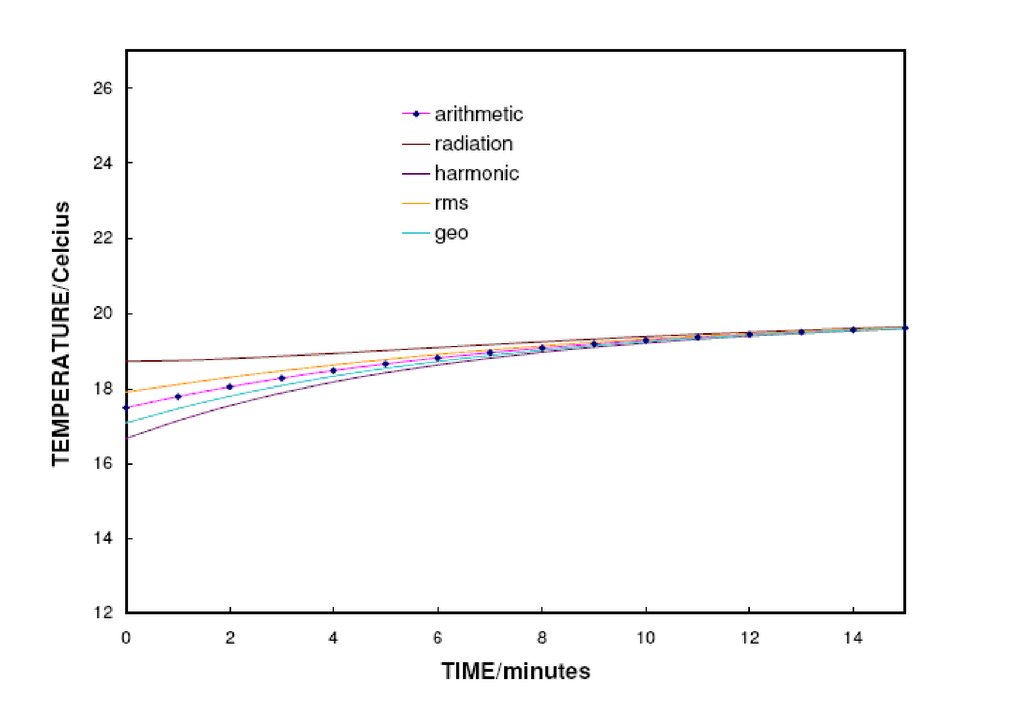
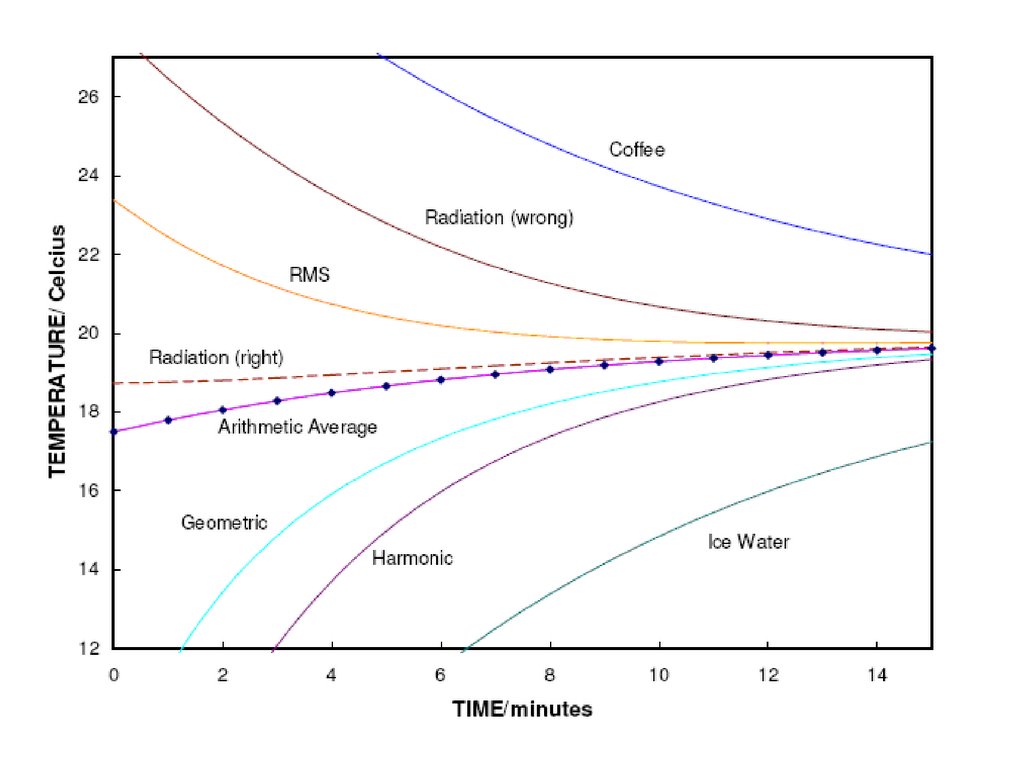
They then calculate the various averages for the coffee and the ice water warming separately up to a room temperature of 20 C. They claim to plot the predictions of the arithmetic average, the harmonic, the RMS and what they call radiation (proportional to T^4 following the Stefan-Boltzmann law). The only one they get right is the arithmetic average (see below). The figure to the left shows what they calculated. I have added the lines showing the temperatures of the coffee and the ice water

Essex and McKitrick then riff about how the radiation curve is higher than the RMS, and the arithmetic average, and the harmonic is lower (yr. hmble. hare added the geometric average for the heck of it)

So, let us ask is there anything that sets the arithmetic average apart? Why yes, happy that you asked. How about if you had first equilibrated the ice water and the coffee, and then let them warm up to room temperature. You would get the blue dots which overlay the arithmetic average. That seems to me a fine physical reason for preferring the arithmetic average.
But wait, what hath McKitrick wrought? He calculated the "Radiation" curve using Celcius. Any General Chemistry student knows you have to use absolute temperatures when dealing with thermo, maybe even Essex knows that when he is not hunting T Rex, but McKitrick? Hmmm. When you use Kelvin, you get the dashed brown line, which is pretty close to the arithmetic average. Tell you what, let us use Kelvin for all of the averages.

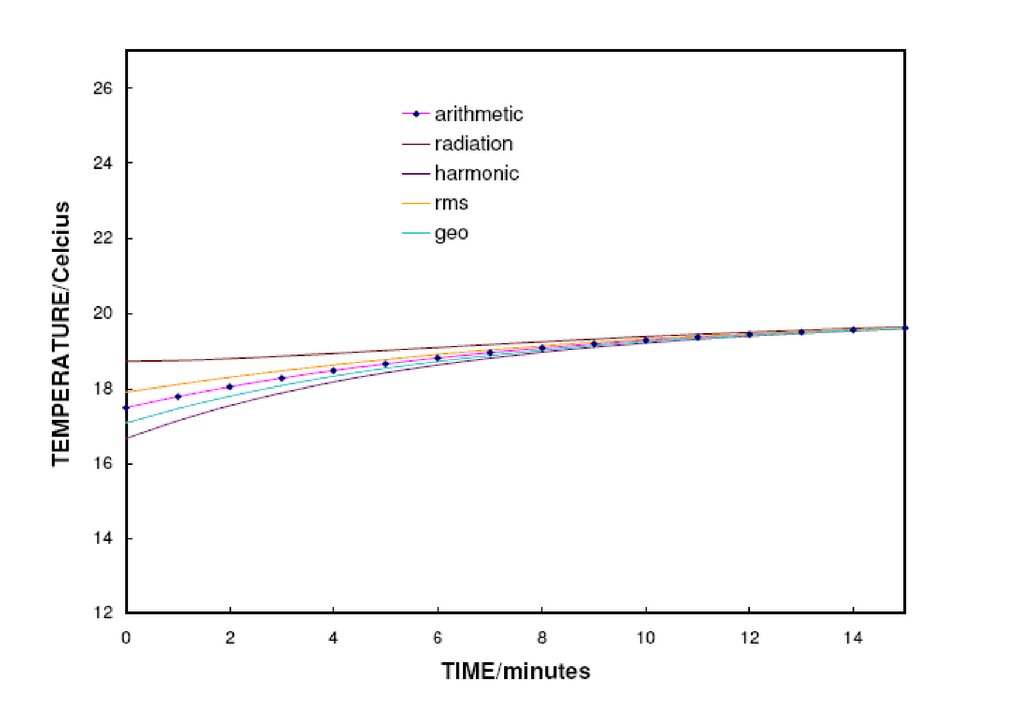
That looks a bit different does it. If you excuse the bad graphics (still learning, advice sought), and blow the image up a bit you will see that the ONLY average that did not change is the arithmetic average.

Seems to me another pretty good reason for using the arithmetic average to characterize temperature. What is more, a lot of the blather about how different the averages are, well, has gone poof.

But wait, we have more! E&M spent a long time pointing out that to "properly" average an intensive quantity, you have to multiply it by an extensive property and you then average the extensive product. Energy appears to fit that bill, remember that for something homogeneous, E = Cv T, where Cv is the specific heat per mole, or m^3, or whatever, and T is in Kelvin. Another good reason to use Kelvin and not that effete Celcius. Now there can be problems if Cv is a function of temperature, but for the atmosphere, it is not the case, or more accurately put, not significantly so.

Thursday, November 17, 2005

Announcing a new contest... How much does that textbook cost


Dean Baker thinks that textbooks are longing to be free and what we need is the ability to copy texts off the net. Other than the fact that Eli has done this and finds it a bad investment of time and money (them cartridges cost), he also knows that the textbook publishers make their books available at less than half the price outside of the US (does this perhaps remind you of drugs...., perhaps grandma should pick up your books on her trip to Canada).

Anyhow, a bit of googling showed that a popular chemistry text, "General Chemistry" by Ebbing and Gammon, costs $145 in the US and L34.95 in the UK (about $60) in the UK.

We invite everyone to find the most outrageous difference between textbook prices from the US and Europe or Japan. Prices are to be quoted from Amazon. Use www.tinyurl.com to compress any urls. Prizes to be determined later (probably a textbook).

Friday, November 11, 2005

Why are college textbooks expensive and high school textbooks cheap?


Dean Baker of the Center for Economic and Policy Research has a paper Are Copyrights A Textbook Scam? Alternatives to Financing Textbook Production in the 21st Century. He argues that

The reason that textbooks are costly is that the government grants textbook publishers copyright monopolies. Copyright monopolies allow the publishers to prevent anyone from competing with them in the market. They are the only ones that can sell a copyrighted textbook in whole or in part. This prevents individuals from freely reproducing a textbook or making it available over the Internet.
He is wrong. You could have all the copyright protection you wanted, but if the textbooks were sold into a competitive market, rather than being specified by professors and bought by students, prices would fall, inexpensive paperback versions would appear and the little cute tricks like new editions every other year would be held in check. For details see our earlier post, Who ordered that?

If you think that I am wrong, ask yourself why high school texts, which are both specified and bought by Boards of Education are really cheap.

The good news is that people are starting to wake up. Baker nails it when he says:
Textbook costs have consistently outpaced the overall rate of inflation, presenting a large and rapidly growing burden to millions of college students. According to the Government Accountability Office (GAO), textbook prices have been rising about 6 percent annually, or twice as fast as the overall rate of inflation, since the 1987/1988 academic year. The GAO estimates that the average first-year student at a four-year public university spent $898 on textbooks and supplies in the 2003/2004 academic year.1 This means that a student working at a minimum wage job would have to put in nearly 170 hours of work each year, just to pay for her textbooks.

Monday, November 07, 2005

As the Earth turns


Wm. at Stoat is explaining GCMs. With all the too and fro about butterflies and momentum, we somehow have missed the point about how momentum is transferred from the Earth to the atmosphere as it rotates. Inquiring minds wish to know how do GCMs handle that?

Update: Wm.'s answer is here

Sunday, November 06, 2005

What is temperature.....


Reading the several versions of Essex and McKitrick anyone familiar with thermodynamics (heat engines, blackbodies, chemical reactions, etc.) will start to scratch their heads. One peculiar statement after another appears dealing with temperature and other basic stuff. It turns out that Essex is using a rather special definition of temperature for a non-equilibrium radiation field. If you want to read about it look up "How hot is radiation", C. Essex, D.C. Kennedy and R.S. Berry, Am. J. Phys. 71 (2003) 969 . It really is a nice paper for a field known for impenetrability and crypticisms of all sorts.

As is standard in equilibrium thermodynamics, temperature is defined as (dU/dS)p (that should be the partial derivative of the system internal energy with respect to entropy at constant pressure, but hey, Blogger has a lousy equation editor). The energy and entropy of the ensemble are then obtained from the Hermetian density operator and the Hamiltonian of the radiation field.

In the equilibrium limit, the radiation emitted by a black body has the same temperature as the body, and the non-equilibrium temperature collapses to that from a black body. However, as Essex, Kennedy and Berry point out, while their definition is "relatively" simple for a radiation field, it is not so simple to define a non-equilibrium temperature for (radiation field + matter). They say:

"The Gibbs-Duhem relation for radiation, SdT-Vdp = 0 implies that the two intensive thermodynamic parameters, pressure, P (conjugate to volume) and temperature T (conjugate to energy), reduce to one independent intensive parameter, which is usually identified as T. This feature of radiation thermodynamics, like the photon's zero mass and lack of rest frame, makes radiation thermodynamics much simpler than that of matter, which has conserved particle numbers and nonzero chemical potentials. It also makes generalizing intensive thermodynamic parameters out of equilibrium much easier. Thus radiation is a natural context in which to introduce non-equilibrium temperature."

So, pretty clearly Essex is talking about non-equilibrium thermodynamics, and probably playing telephone with McKitrick. BUT, then they are clearly treating the atmosphere as a non-equilibrium system, and that reminds me of the jokes about for all practical purposes:

http://www.naturalmath.com/jokes/joke12.html

A mathematician and a physicist agree to a psychological experiment. The (hungry) mathematician is put in a chair in a large empty room and his favorite meal, perfectly prepared, is placed at the other end of the room. The psychologist explains, "You are to remain in your chair. Every minute, I will move your chair to a position halfway between its current location and the meal." The mathematician looks at the psychologist in disgust. "What? I'm not going to go through this. You know I'll never reach the food!" And he gets up and storms out. The psychologist ushers the physicist in. He explains the situation, and the physicist's eyes light up and he starts drooling. The psychologist is a bit confused. "Don't you realize that you'll never reach the food?" The physicist smiles and replies: "Of course! But I'll get close enough for all practical purposes!
You may prefer these versions:
http://www.ilstu.edu/~gcramsey/Gallery.html
http://www.badpets.net/Humor/Tech/EngineerJokes.html Third one down


Thursday, November 03, 2005

The perils of multiculturalism…..


This has been a VERY hard week for the slightly…overweight in multiculti land. First Halloween, then Diwali and now Eid al-Fitr.