Friday, February 19, 2016

Water Vapor, Water Vapor Everywhere and It All Absorbs in Air


Elementary quantum mechanics quickly shows that harmonic oscillators (shown by the dotted line in the figure to the right) can only absorb or emit light associated with a transition between neighboring quantum levels such as between v = 0 and 1.  To the extent that molecular vibrational motion is harmonic, this is an absolute rule. Oh yes, there also has to be a change in the dipole moment between the two levels of the transition which explains why homonuclear diatomics (N2 , O2, H2) don't absorb in the infrared. However, molecular vibrational motion (loosely defined as the relative motion of the atoms in a molecule relative to each other) is not quite harmonic (shown by the solid line), and the vibrational selection rule is not absolute in transitions between distant vibrational levels.

Multiquantum changing transitions are weak, but they can be observed, both in the laboratory and the atmosphere.  Karl-Heinz Gericke at Uni-Braunschweig has an on line molecular spectroscopy textbook that goes into detail. Of course, for polyatomic molecules there is more than a single vibrational level and there are transitions that involve not only mutiquantum changes in a single vibrational stack, but also combinations of these changes.

Water vapor, as a triatomic non-linear molecule has three vibrational modes and tens of thousands of observed lines.  Starting about 2000 a major effort was made to explore the quantum states and spectra of water vapor, extending from the near IR into the visible which involved many people and a remarkable mutually supportive set of experimental measurements and theoretical calculations.

As emphasized already in Parts I and II, a distinguishing feature of the present series of IUPAC-sponsored spectroscopic studies is the joint utilization of all available experimental and the best theoretical line (transition) and energy-level data, with a long-term aim of creating complete linelists for all water isotopologues. While determination of a complete linelist is outside the scope of present-day experiments, it can be determined by means of sophisticated first-principles quantum chemical computations. Studies on the spectroscopic networks of water isotopologues  also revealed that a large number of energy levels participate in some transitions strong enough to be observable. Thus, although only a small portion of all the allowed transitions will ever be observed experimentally, it seems likely that the majority of energy levels will eventually be connected to observed transitions. For the time being, as experimental line positions have a higher accuracy than those yielded by even the most advanced computations, complete line lists will necessarily contain a mixture of accurate experimental data and less accurate computational data. MARVEL-type efforts (a) replace as many computed lines as possible with their experimental counterparts, (b) validate and ideally reduce the uncertainty with which a transition has been determined, and (c) facilitate the assignment of experimental spectra. Unlike line positions, the overwhelming majority of one-photon, temperature-dependent absorption and emission intensities can be computed with an accuracy matching or even exceeding most of the measurements. Thus, the availability of first-principles intensities, based on computed and perhaps empirically adjusted potential energy surfaces (PES) and dipole moment surfaces (DMS)  greatly helps in the assignment and labeling of experimental absorption or emission spectra.
What does this have to do with the climate?  The transmission of sunlight through the atmosphere in the near infrared (between say 0.7 and 1.5 microns), is limited by the absorption of water vapor and we now know with precision where each of the lines is, how strong each is at any temperature and what transitions they correspond to.  The figure below shows the absorption through the entire atmosphere.  For comparison on a strong CO2 bending mode line a photon might travel a few meters before being absorbed, On one of these near IR lines, the average distance traveled before absorption might be a kilometer or more, so these lines are comparatively weak, but not vanishing.

A key predictions of climate models and common sense is that increased surface temperature will drive a positive feedback by increasing the water vapor content of the atmosphere, resulting in more rain, or if the bunnies prefer, precipitation.  This strengthening of the hydrological cycle on the front end depends on faster evaporation driven by warming of the surface, and on the back end by the lapse rate which cools the atmosphere at altitude and results in condensation.  Anything which warms the atmosphere where precipitation forms weakens the hydrological cycle but until relatively recently good line by line calculations were limited by the data.  Of course complex climate models which extend beyond radiative transfer cannot include all of this detail and rather parameterize  enables the calculations to take slightly less time than the age of the universe.  Each model in the CIMP5 ensemble is different on this account.

In an article in Nature (with an introduction by Steven Sherwood) deAngelis, Qu, Zelinka and Hall consider the effect of the NIR absorption by water vapor in the atmosphere on precip.
Using an ensemble of climate models, here we show that such models tend to underestimate the sensitivity of solar absorption to variations in atmospheric water vapour, leading to an underestimation in the shortwave absorption increase and an overestimation in the precipitation increase.  This sensitivity also varies considerably among models due to differences in radiative transfer parameterization, explaining a substantial portion of model spread in the precipitation response.
CIMP5 models find an increase of 1-3% in the cycle per degree kelvin surface warming, while this may appear small, it is a factor of three and a difference in the ensemble average of ~35%.   The parameterization varies from reasonably in agreement with observation (HadGEM2-ES, ACCESS1.3, GFDL-CM3) to way out (GISS-E2-R/H).

Basically, the path from bad to good is temporal, with more modern, and complex parameterizations performing better, and older schemes such as those based on the International Satellite Cloud Climatology Project, flux data set showing the worst agreement.  Sherwood concludes that
It is remarkable for a paper not only to identify a useful link between observable behaviour in today's climate and a crucial aspect of global climate change, provigind a physical explanation, but also to trace that link back to a specific scheme within models.  Such links, sometimes called emergent constraints, are now a hot topic in efforts to narrow the known uncertainty (model spread) in predictions of global warming.  They should take centre stage in any efforts to 'weight' the predictions of some models over others.  But most emergent constraints reported so far either lack a clear physical explanation or fail to significantly narrow the uncertainty, either because the relationship is insufficiently strong or because there are not enough relevant observations to exploit it.  DeAngelis and colleagues provide an example of what such efforts should aspire to.
DeAngelis et al is a major step forward, but as Sherwood says,
Their result is impressive, but its value for our understanding of climate change is more theoretical than practical.  The main impacts from global warming will depend on regional changes in the amount and intermittency of precipitation, rathe than theon the global, time averaged amount.
As the modelers incorporate this work into their models, and they are doing so, it will be interesting to see how it plays out on a regional basis.

Tuesday, February 16, 2016

The Morality of Existence

Ray Pierrehumbert does a guest turn at Dot.Earth. Judging from the picture this is from his Chicago days.  Given that he is now at Oxford, perhaps a bit more in the Gloucester Fisherman line of apparel might be more appropriate.  Eli had pretty much given up on Dot Earth because Revkin is a balancer of the first water.  Interestingly the tide does appear to have changed and wmar and Adrian O are being challenged.

In talking about the ambition and results of LIGO  he notes that

This is just one of the most dramatic examples of what we are capable of, given the chance to be our best selves. In science, I’d rate the revolution in detecting and characterizing exoplanets way up there as well. There’s no limit to what we can accomplish as a species.
But, you knew there would be a but
But we have to make it through the next two hundred years first, and this will be a crucial time for humanity. This is where Destiny Studies and our paper on the Anthropocene come together. The question of why we should care about the way we set the climate of the Anthropocene is far better answered in terms of our vision for the destiny of our species than it is in terms of the broken calculus of economics and discounting.
and Ray points to an important responsibility that Earthlings have
For all we know, we may be the only sentience in the Galaxy, maybe even in the Universe. We may be the only ones able to bear witness to the beauty of our Universe, and it may be our destiny to explore the miracle of sentience down through billions of years of the future, whatever we may have turned into by that time. Even if we are not alone, it is virtually certain that every sentient species will bring its own unique and irreplaceable perspectives to creativity and the understanding of the Universe around us.
This is a powerful moral argument.


Sunday, February 14, 2016

LIGO and Normal Science

The detection of gravity waves by LIGO is the big science news this week.  Eli is old enough to remember the long series of explorations that failed.  When he was a student, Joseph Weber at the University of Maryland lead the charge, and though that he had caught the boojum, but alas, it was a chimera.

Now some, not Eli to be sure, would argue that by the rules of junior high school science as taught by Karl Popper, each of the failures, and there were many, completely falsified Einstein's general theory of relativity, and indeed there were many who did so the link being only the first that popped up on the search engine. 

LIGO was a triumph of normal science. Normal science is characterized by coherence, consilience and consensus agreement.  Over time Einstein's general theory has met all of these tests as a coherent theory which describes our observations of the universe and which is accepted by a strong consensus of experts.


Law of the case

Scalia's death might change everything for the Clean Power Plan. Before there appeared to be a 5-4 majority on the Supreme Court that was likely ready to overrule the appellate court if the appellate ruling favored the Plan. Now there's just four, and on a 4-4 split, the appellate ruling would stand.

Some initial points, and I expect we'll see more about this:


  • "Law of the case" was going to kill us prior to now, but now the reverse is true. If the Supreme Court splits 4-4 on the Clean Power Plan, then it doesn't matter if a Republican wins the presidency and appoints some throwback - that case is finished. This is different from constitutional issues like Citizens United, where a future Democratic president appoints a changed majority of the Court that could reconsider the legal issues based on a new case that arises, like a new state law regulating campaign cash.
  • The 4-4 split means no change in the current status of the Plan, however. The stay suspending the Plan stays in place until the Supreme Court decides what to do with the inevitable appeal by whoever loses at the appellate court. Here's the actual language: "If a writ of certiorari is sought and the Court denies the petition, this order shall terminate automatically. If the Court grants the petition for a writ of certiorari, this order shall terminate when the Court enters its judgment."
  • In the past, when cases would've ended in a tie and then a new appointee arrived, they rescheduled and reargued the case - this could happen for the Clean Power Plan, which could get heard by the Court before a Republican gets appointed, and a decision issued afterwards. The 4-4 split stands only if it's issued before a new appointee gets on the Court.
  • If I were the Republicans, I would slow-walk the case. In particular if I lost at the appellate court, I'd petition for en-banc review by all the judges in that appellate court before appealing to the Supreme Court. Stall as much as possible and hope to win the presidency. Not sure what the EPA could do in response - maybe if there were some piddling issue they lost on, they could appeal to the Supreme Court - not sure if that's a good strategy.


Thursday, February 11, 2016

More Apps For Bunnies

To keep up with the trade, Eli offers an app for the bunnies to play with

From Bernd Herd, in honor of Nicola Scafetta, a gadget to show you how changes in sun spot number over the last couple of centuries doesn't explain very much.if you believe that the sunspot number is a good proxy for Total Solar Insolation aka TSI (bunnies can change the start date and the app updates each month)


Now some, including Eli might hope for a somewhat more recent take from the Sun Goddess or maybe even Leif Svalgaard.  Before the getting too crazy about the app allow Eli to point out that one thing the Rabett has learned from Leif is that the sunspot number is at best an interesting proxy for solar irradiance, and at worst not such a good one.  What is clear is that the old TSI reconstructions based on the Opinions, of course differ, but what is clear is that the variation since we have satellite observations has been minimal, nothing at all if we simply look at changes at the solar cycle minima, and less than 1 W/m2 from valley to peak.

That being said, over the Mauna Loa CO2 record, there is good agreement between the various solar reconstructions TSI do not correlate with the increase in temperature

Walking and Gum Chewing

It is established science, policy and politics that coal is the black devil for climate change forcing in the wrong direction.  It is also clear that particulate, sulfate and mercury pollution from coal are about as healthy as a three pack a day habit and that there is humongous excess mortality, in the UK and US during the early to mid part of the last century and in China, India and the rest of the developing world now and into the future.  Beyond the obvious (see picture of Beijing to the left), fine particles, aka P2.5 , e.g.2.5 microns and smaller as well as ozone 

And then we have the Fab Five on the US Supreme Court

Wednesday, February 10, 2016

A Day Late


Maybe not
One of the largest earth and space science meetings in the world is moving to New Orleans in 2017, drawing more than 25,000 scientists to the city.
The meeting will move to Washington D.C. in 2018, then return to its usual home in San Francisco by 2019.

In a news release, the American Geophysical Union said planned renovations at San Francisco's Moscone Center prompted the group's decision to relocate the annual meeting for two years.

Tuesday, February 09, 2016

Nigel Persaud Dons His Eyeshade and Audits the Auditor


Some time ago Nigel Persaud took up the trade of auditor and inquired about this and that.  Somebunny known here and abouts took up the challenge, only to find that careful examination showed that most of the inquiries were, shall Eli say it, perhaps about nothing at all, but that there were a couple of lacuna, things missing.  They eventually were noted in the appropriate place.

On the scale of errors, there are blunders, there are errors, there is over clever data selection, and there is ignorance.  There might be more, Eli will await word from Willard, but blunders occupy a special and deep circle of academic hell.

One of the auditors, Ross McKitrick, has an impressive case of the blunders.  Tim Lambert made a hobby of finding them.  There was, of course the famous confusion of degrees with radians in Michaels and McKitrick 2004 (MM04) and much much more.

A bunch of the lab mice, Rasmus Benestad, Dana Nuccitelli, Stephan Lewandowsky, Katherine Hayhoe, Hans Olav Hygen, Rob van Dorland, and John Cook have taken MM04 under the microscope as an example of, well, pretty much all of category of errors discussed in their recent paper.  They further respond to the McKitrick beasts wails of hurt in a recent Real Climate post.

There is one crucial point that McKitrick seems to have missed, which is that nearby temperature trends are related because the trend varies smoothly over space.

An important point made in (Benestad et al., 2015) was that a large portion of the data in the analysis of McKitrick and Michaels (2004) came from within the same country and involved common information for the economic statistics (GDP, etc). In technical terms, we say that there were dependencies within the sample of data points.
Bob Grumbine had pretty well nailed this over a decade ago after looking at the original version of MM04
He was fooling around with correlating per capita income with the observed temperature changes. He concluded that the warming was a figment of climatologists imaginations, as there was a correlation between money and warming. ‘Obviously’ this had to be due to wealth creating the warming in the dataset, rather than any climate change—his conclusion.
Along the way he:
1) selected a subset of temperature records
1a) without using a random method
1b) without paying attention to spatial distribution
1c) without ensuring that the records were far enough apart to be independant—ok, I shouldn’t say ‘he’ did it, because he didn’t. He blindly took a selection that his student made and which was—to my eyes—distributed quite peculiarly.
2) Treated the records as being independant (I know William knows this, but for some other folks: Surface temperature records are correlated across fairly substantial distances—a few hundred km. This is what makes paleoreconstructions possible, and what makes it possible to initialize global numerical weather prediction models with so few observations.)
3) Ignored that we do expect, and have reason to expect that the warming will be higher in higher latitudes
4) Ignored that the wealthy countries are at higher latitudes
Hence my calling it fooling around rather than work or study. He was, he said, submitting that pile of tripe* to a journal. *pile of tripe being my term, not his.
and
His main conclusion was regarding climate change—namely that there isn’t any. His secondary conclusion was that climate people studying climate data were idiots. Neither of those is a statement of economics, so my knowledge of economics is irrelevant (though, in matter of fact, it is far greater than his knowledge of climate; this says little, as his displayed level doesn’t challenge a bright jr. high student.).
Now this discussion of McKitrick and Michaels stirred a memory in Eli's rememberer, a comment that Steve Mosher had made when a follow on paper to MM04 and MM07 was being featured by Judith Curry.
I downloaded his data. In his data package he has a spreadsheet named MMJGR07.csv.
This contains his input data of things like population, GDP etc.

In line 195 he has the following data

Latitude = -42.5
Longitude = -7.5
Population in 1979 =56.242
Population in 1989 = 57.358
Population in 1999 = 59.11
Land = 240940 In his code he performs the following calculation

SURFACE PROCESSES: % growth population, income, GDP & Coal use // land is in sq km, pop is in millions; scale popden to persons/km2 // gdp is in trillions; gdpden is in $millions/km2

generate p79 = 1000000*pop79/land
generate p99 = 1000000*pop99/land
So, at latitude -42,5, Longitude -7.5 he has a 1979 population of 56 million people and 240940 sq km and a population density in the middle of the ocean that is higher than 50% of the places on land. Weird.
A few others looked at the spread sheet and saw that well in the words of another McKitrick was spreading the population and GDP of France across a couple of small islands in the Pacific.

WebHubTelescope summed it up
Whether it is getting radians and degrees mixed up, or doing elementary sanity checks on the data, this stuff isn’t that hard to verify for quality. Could it be that some people just don’t have the feel for the data? Or that they rely too much on blindly shoving numbers into stats packages? McKitrick’s paper has that sheen of mathematical formalism that can obscure the fact that he lacks some the skill of a practical analyst. Beats me as to his real skill level, or that he is just sloppy. 
 As far as Eli can see this "event" was only discussed in one other place, Marcel Crok's blog by Jos Hagelaars. 

Today Eli went and downloaded the file.  Just a quick pass through shows that of the 25/469 stations south of -40.0 latitude, 4 are UK territories and are associated with the population and GDP of the UK and the south pacific data is dominated by french territories.  Oh yeah, the Faroes have the population of Denmark.

Said file is available on request with a donation to the Ancient Bunny Fund. 

Yuck. Supreme Court puts hold on Clean Power, not a good sign for the future legal argument

This afternoon the US Supreme Court on a 5-4 vote issued a stay of the application of the Clean Power Plan to emitters (one example of the stays is here). They contradicted a lower court decision not to issue a stay pending a final legal ruling, so now the requirements are blocked for a period of months or more. The lower court has to issue its ruling, and then the inevitable appeal will be made by the losing party, and the Supreme Court will almost-inevitably accept the appeal and go through its own process. It won't end before the next President takes office.

That's obviously bad news for efforts to fight climate change, delaying initial requirements for taking place. The real question though is what does it tell us about the likely final outcome at the Supreme Court. Stays are generally issued based on four criteria:

(1) the likelihood that the party seeking the stay will prevail on the merits of the appeal; (2) the likelihood that the moving party will be irreparably harmed absent a stay; (3) the prospect that others will be harmed if the court grants the stay; and (4) the public interest in granting the stay. 

It's that first criterion that can set back global efforts on climate change. Courts do a balancing of the criteria, so if the Supreme Court majority weighed the other three strongly against the EPA, then they may be only somewhat doubtful of the Plan's legality. On the other hand, EPA argued that the early stages of the Plan place few restrictions on emitters (the emitters disagreed, saying they have to plan for outcomes many years in advance).

This is a situation where the way you argue at one stage of a case may not necessarily help you later. The winning side hopes the Court ignored their own arguments when it came to potential harm and listened to their arguments on the merits, and the losing side hopes the reverse is true.

It's still very unfortunate. If the Clean Power Plan gets thrown out, then a Democratic Party president will seek some regulation that can partially replace the Plan. A Republican president will doubtless seek to do absolutely nothing, and then face lawsuits by environmental groups and by some states for failure to apply the Clean Air Act. Those lawsuits will take a number of years to move forward, a loss of time that we can't afford.


UPDATE:  some more bad news, from the NY Times:  "The 5-to-4 vote, with the court’s four liberal members dissenting, was unprecedented — the Supreme Court had never before granted a request to halt a regulation before review by a federal appeals court." That makes it even more likely that the majority is ready to shoot the law down - they'd otherwise be hesitant to take an unprecedented step.

One consolation is that the constitutional arguments against the law are so silly that even this conservative Court is unlikely to adopt them. It's the statutory interpretation arguments that are more dangerous, and they're most likely to limit the Plan's application, not kill it entirely.

Harvard law professor Larry Tribe, known as a liberal in some circles, makes the invalid constitutional arguments, and it's not the first time he's sought to take down environmental protections. I don't see how his legal philosophy could possibly be appropriate for a judicial appointment by a Democratic president.

Monday, February 08, 2016

Temperature Baths


The key to understanding the greenhouse effect is that it is a problem of energy flows, not of energy per se. a zeroth order thermodynamical model in which there are two large (in thermo speak infinite) heat baths, the sun @ 6000 K and space at 3 K. The earth, stuck between these monsters is too small to be a heat bath is better though of as a heat engine, but a very lazy one producing no work on the external surroundings and therefore having to reject an equal amount of heat to space as it absorbs from the sun.

If the heat engine slows down because some thermal radiation is blocked by greenhouse gases, other parts of the spectrum have to heat up to compensate.


Sunday, February 07, 2016

Saturday, February 06, 2016

So much for that - the Washington State's renvenue-neutral carbon tax proposal

Too bad:

The carbon-tax effort has also struggled to attract support from progressives and Democrats, who are concerned that the proposal isn’t really “revenue-neutral.” The latest news from the Evergreen State suggests that this effort may well be doomed: 
 [T]he Washington State Democratic Party [has gone] on record as opposed to CarbonWA’s I-732, joining the Washington State Labor Council and [the Washington Council of Machinists] in the no camp. I-732 is a complex tax swap proposal that would levy a carbon tax while also reducing sales and business & occupation taxes. 
CarbonWA and other I-732 proponents contend that their tax swap is “revenue neutral” (meaning it would not increase or decrease state revenue). Nonpartisan legislative staff and the Department of Revenue don’t agree. According to DOR’s calculations, I-732 would reduce revenue by nearly $1 billion over the next four years.... 
CarbonWA’s endorsements page doesn’t list a single organization affiliated with the Republican Party or active in the conservative movement. And, as even CarbonWA has admitted, polling suggests right-leaning voters in Washington are incredibly hostile to the idea of levying a carbon tax.

I'm no expert in Washington state politics, but the Democratic Party is against it as not being truly revenue neutral, major unions are against, and no Republican leadership is for it. You're not going around these folks and getting a majority of the grassroots.

I think this thing is on the ballot and can't be changed. So support it and maybe some fluke will get it through, and if not then back to the drawing board.

Tom Steyer and friends have an alternate proposal for WA that I've heard about, but I suspect they're not going to get something on the same ballot. Maybe it'll be their turn next.

Monday, February 01, 2016

We made it to 3000

3000 posts at Rabett Run, that is.


Somebody get Eli and Ethon a gold watch and a toaster.

Cruz has a plan for the nomination that the others don't - in 2020

While Trump may well take Iowa tomorrow, it's widely acknowledged that Ted Cruz has the strongest grass-roots level of organization among conservative evangelicals and other conservatives, in contrast to Marco Rubio's weak organization that relies on media rather than putting people in the field. I'm not absolutely convinced that Rubio's strategy is wrong for this election, but the election's not the only thing that's in play.


Rubio's strategy is based on everything working out just right, as it indeed has so far in his short political career, but he's not building anything that lasts beyond this election. Cruz is building an organization and cadre of loyalists. If Cruz wins the nomination, then that's great according to him. If he doesn't, and the Republican nominee doesn't win, then Cruz enters the 2020 race for the nomination with the best field organization of any candidate already in place.

And of course there's more - if another Republican wins the presidency, Cruz will be a stalking horse for the next four years, threatening to run against that Republican if he turns out to be too moderate. Cruz also will not be relying on building influence within Republican elites, so he's creating an alternative power structure that he can use to pressure the Republican leadership.

Kind of obvious, but I haven't seen it remarked elsewhere. Good thing his anti-charisma limits his reach, but we're going to have to be dealing with him until demographics fix Texan politics. 

With that happy thought, we'll see which disaster gets chosen by Iowa Republicans tomorrow.

Sunday, January 31, 2016

Undercover journalism and prosecutorial discrection

Given the recent initiation of criminal prosecution against the people who made the defamatory video about Planned Parenthood, I thought I'd quote what journalism says about undercover journalism:

CJR:

Undercover reporting can be a powerful tool, but it’s one to be used cautiously: against only the most important targets, and even then only when accompanied by solid traditional reporting.
And Society for Professional Journalists:
Avoid undercover or other surreptitious methods of gathering information unless traditional, open methods will not yield information vital to the public.
So they're saying do it rarely, only when necessary, and do it well.

The prosecution against the undercover activists isn't for doing it badly, it's for doing it at all. It would apply equally to many groundbreaking investigations by true undercover journalists. And the line between journalist and activist is a slippery one that maybe doesn't matter (e.g., the people exposing animal cruelty at factory farms).

As a practical matter I don't see a good way to modify the law to say "don't use fake identification unless you're working undercover." That's where prosecutorial discretion comes into play. The grand jury has no role in that discretion and district attorney seemed to ignore her responsibility.

This indictment will be used to keep corporate crimes hidden. Go after these people for doing a bad job via defamation suits instead, but don't ban undercover operations.

Thursday, January 28, 2016

Housekeeping

With rapidly approaching retirement and other life altering events, Rabett Run has come perhaps to a fork in the roast.  Eli has questions:

1.  Should RR put up a donation box? After all income is required for trips to AGU, gifts for Ms. Rabett so she allows Eli to go to AGU and housing at AGU.   The holes that the Rabett has been hutching up in San Francisco, are, to put it mildly, very 1950s motelish.  Not quite rent by the hour but not . . .

2.  Or should RR take advertising, which, since it requires that readers actually click on something is not a wealth generating activity either as Eli judges that his Rabett Run Readers are as cheap as he is.  Sou appears to make a buck or two from this, but really, how low can Eli and Brian and John sink?

3.  All in favor Eli's handing the keys over to Brian and slinking into the twittering sunset raise your paws. You will be ignored.

4.  Anybunny interested in a book of RR's best takes showing how Eli was there before there was?  Self publishing is a thing these days and one can pray for an Amazon review by George Taki

Reheating the Michaels rehash

An easy blog post when Pat Michaels keeps reposting the same old thing, every time a new global temperature is associated with El Niño, or simply when the year after a new record happens to be slightly colder than the previous year. It's a recipe for cooking him, dating back to my early blog years of 2006:

How to cook Tim Blair, Andrew Bolt, and Patrick Michaels

1. Place Blair, Bolt, and Michaels in a large, water-filled pot equipped with a step ladder they can use to escape at any time. Set initial water temperature at average levels.

BLAIR/BOLT/MICHAELS: We're quite comfortable, thank you!!

2. Increase temperature to an unambigous, new historic high.

BLAIR/BOLT/MICHAELS: No big deal! Not going to last!

MICHAELS: Want to bet it won't be this warm again?

3. Drop temperature back down, but still far above average.

BLAIR/BOLT/MICHAELS: See!! Vindication!! There is no potboiler warming! Not a problem!

4. Gradually increase temperature to near or above the historic high.

BLAIR/BOLT/MICHAELS: We deny it's above the historic high! Deny it!

MICHAELS: And, uh, the bet offer is withdrawn.

5. Keep temperature very high, but a tiny bit below Step 4.

BLAIR/BOLT/MICHAELS: The science behind potboiler warming is bogus, and we'll stay here for as long as it takes to prove it!

BLAIR: I'm not feeling hot - crank it up, people!

BOLT: Me neither!

6. Repeat Steps 2 through 5 until done. Don't worry, they won't use the step ladder to get out. Process will be sped by the fact that their brains were already cooked.

Please, please, please, may some denialist point out to me that we haven't yet repeated Step 2 - just be prepared to put your money where your mouth is about what will happen in the near future.

(Hat tip: Deltoid.)

UPDATE [from 2006]: From RealClimate:

Most bizarre new contrarian claim:
"Global warming stopped in 1998".
By the same logic, it also stopped in 1973, 1983, and 1990 (only it didn't)
So we have repeated steps 2 through 5, multiple times.


UPDATE 2016:  you'd think the Wall Street Journal would want to publish something original, but maybe they're hard up for content.

Tuesday, January 26, 2016

Summer Reading List

Eli has been going back through the Rabett Run archives fishing out some old drafts and finding this and that.  Here is one of the thats.

THE USE AND MISUSE OF MODELS FOR CLIMATE POLICY * by Robert S. Pindyck

In a recent article, I argued that integrated assessment models (IAMs) “have crucial flaws that make them close to useless as tools for policy analysis.”  In fact, I would argue that calling these models “close to useless” is generous: IAM-based analyses of climate policy create a perception of knowledge and precision that is illusory, and can fool policy-makers into thinking that the forecasts the models generate have some kind of scientific legitimacy. IAMs can be misleading – and are inappropriate – as guides for policy, and yet they have been used by the government to estimate the social cost of carbon (SCC) and evaluate tax and abatement policies.
Pindyck's is indeed an argument for ignorance.  He is quite pessimistic that anybunny, economist or climate scientist knows anything, from discount rate to climate sensitivity to damage functions.  Choice of discount rate, of course can yield any answer the mythical anybunny might wish, but according to Pindyke it is worse because even probability distributions for any of these are improbable.  Thus IAM's become computer driven fantasy

So what to do.  Well, really really bad outcomes are so really bad that it doesn't matter what discount rate you chose if you lose the economy.  Pindyck is an economist.

So Pindyck's idea is get a bunch of wise heads together and figure out what the most probable really really bad thing that might happen is and figure out how bad it really would be. 
I have argued that the problem is somewhat simplified by the fact that what matters for policy is the possibility of a catastrophic climate outcome. How probable is such an outcome (or set of outcomes), and how bad would they be? And by how much would emissions have to be reduced to avoid these outcomes? I have argued that the best we can do at this point is come up with plausible answers to these questions, perhaps relying at least in part on consensus numbers supplied by climate scientists and environmental economists. This kind of analysis would be simple, transparent, and easy-to-understand. It might not inspire the kind of awe and sense of scientific legitimacy conveyed by a large-scale IAM, but that is exactly the point. It would draw back the curtain and clarify our beliefs about climate change and its impact.
Discuss

Saturday, January 23, 2016

Redistribution of Enthalpy


So it snows, and Eli digs into the drafts pile to dig this one out.

Eli understands that the old guy is trying to trash him. Eli would be quite happy to talk it over with him, if the old guy wanted to have a discussion, but he appears to want to talk to others without others talking to him and the Rabett is not interested in that. OTOH, we have been hopping about the net and came across the figures from Mark Jacobson's books on Atmosphereic Modeling (link since disappeared) and came across this interesting figure. Looking at it we see that the difference in absorbed incoming solar energy is about a factor of two higher at the equator than at the poles (100% difference) but the emitted outgoing IR radiation above the atmosphere is only about 25% higher at the equator than at the poles.


As near as the team at Rabett Run can make out the large units on the ordinate are 100 W/m^2, which agrees with these measurements of average solar insolation.

What first caught Eli's eye was the implication that radiation and convection move enthalpy from the tropics to the poles. No surprise there. It's called weather. This, of course, is averaged over the year, different cloud conditions and more.

So the bottom line is that even though the temperature difference between the poles and the equator is ~ 50 K, the solar insolation at the surface is a factor of two higher at the equator and the same is true of the emission from the surface as predicted by the Stefan-Boltzmann relation, the amount of energy emitted by the earth in the polar region is only about 25% less than at the equator. Another hmm . . ..

Thursday, January 21, 2016

Hmm. . . That's Suspicious


Eli being a glutton for punishments and carrot was easily led astray by the likes of Barry Bickmore describing a usual Moncktonian perambulation (aka a trip around the mulberry bush). Seeking amusement Eli  was going thru the comments at Willard Tony when this appeared in the LCD from Roy Spencer

"The quoted statement is incorrect as it stands. PRTs are used to measure the temperature of the onboard (warm-point) calibration targets. The cosmic background (cold point) is assumed to be 2.7 K (or something close to that..it doesn’t really matter). PRTs are laboratory standard and highly stable, each one being carefully calibrated before launch. 
Those two calibration points are used to calibrate the Earth-viewing data.and the AMSR-E calibration is a special case of poor design…the warm target was made of a material with low thermal conductivity. The instrument was designed in Japan by engineers just coming up to speed on the technology, and it should never have been approved by NASA in the first place. But, the instrument was “free” to NASA, so there was less scrutiny. I say all this as the AMSR-E U.S. Science Team leader."
Dr. Roy was explaining to the assembled WattKnots how the (A)MSU system works by interpolating the signal between deep space (2.8K) and a hot target.  The hot target has a number of platinum resistance thermometers buried in it and a pseudo black body surface (black is the most difficult color).  The targets are technically complex.  They are not anywhere as laboratory standard nor highly stable as platinum resistance thermometers. Eli's comment which they let through
If the warm target is made of a material with low thermal conductivity the implication is that it could slowly age, e.g. it’s thermal conductivity could change and thus the temperature distribution across the warm target could slowly change. With eight prt’s this should be observable.  If there is a temperature distribution across the warm target, the detector could be looking at a varying emissivity. Just sayin.
Now as the regulars recognize the Bunny has been playing with the idea that there is some sort of long term drift in the microwave sounding units or the analysis of data from these units, so this was a new item in play.

It turns out that there are many opportunities for changes, including changes in emissivity of the target coatings.  One of the secret sauces in analysis of AMSU returns is figuring out on station the non-linear gain of the antenna from the two calibration points.  Scott Church made a long study of the AMSU system which describes the mess best described as TL:DR, but the bottom line has a name, Instrumental Body Effect.  There is certainly enough room for all sorts of mischief.

Tell Eli about the gold standard.

Wednesday, January 20, 2016

2015 GISS temp anomaly is .87C, massive record

Presentation here, with NOAA anomaly .90C. In a teleconference this morning they both said well over 90% certainty that 2015 is the warmest so far (NOAA says 99%), and both expect that 2016 is likely to be even warmer.

So at the top of everyone's mind should, of course, be the status of my bet with David Evans. I'm winning - obviously I'm benefiting from El Nino but there was also a (weaker) El Nino in the 2005-2009 baseline period for the bet.

To simplify the over-complicated bets, there are two that bet against different levels of warming and for each the possibility is to win, lose, or void the bet if the result is close to the middle value of a range. I win both bets if the 5-year GISS average is .81C or higher and lose both if its .71C or lower.

We're only one year in to the 2015-2019 bet, but now the last four years' average could be .80C and I'd still win both. To lose both the four-year average can't exceed .67C. My wild guess at this point is I'm slightly more likely to void rather than win the warmer bet, and will easily win the the less-warm bet. And then it's on to our 15-year and 20-year bets.

And then there's James Annan's bet. I'm jealous, although he says his betting counterparts have not been very communicative in recent years.

UPDATE:  David's perspective here (from Feb. 2015, but I expect he'll update it).

Read it and weep


From the NASA/NOAA news conference

And showing how NOAA "fixed the climate record" by making the trend smaller.


Tuesday, January 19, 2016

What to say. Bob Carter, 1942-2016.

Bob Carter, one of the very few qualified scientific experts who disagreed with the scientific consensus on climate change, died recently at age 74.


It's hard to figure out the appropriate thing to say in this situation. There's what to avoid, first of all. Christopher Hitchens occasionally wrote hate obituaries of people he disliked. The only thing to say in his defense is he probably wanted someone to write a hate obituary for him when he died, but I'm still not going to follow his example. Another example to avoid are denialists (some of them) who attacked terminally-ill Nasa scientist Piers Sellers for his dedication to climate change work.

An example to follow instead is Matt Yglesias' response to being attacked by economic historian Niall Ferguson. Ferguson has written a lot of economic nonsense in recent years heavily seasoned with vitriol, including an attack on Yglesias. Matt responded by highlighting the - apparently - very good work that Ferguson had done in earlier years on World War I and the value of alternative history.

I'm not knowledgeable enough to do the same with Bob Carter, but I have read from people who are that he did good work on marine stratigraphy and was supportive of young scholars.

I hope we address the challenge of climate change quickly, and that in the long run the good that Carter did in building up science will be the most important part of his work.

Mind Bending


Eli and Tamino have posted about the obvious long time deviation of the lower troposphere satellite temperature records often called TLT.  Eli and Steve Mosher, with friends and cynics have been doing a dosy do at ATTP and Rank Exploits.

It looks like either a) there is some aging effect in the AMSU receivers or b) the atmospheric/surface composition has shifted in the last 15 years or so (e.g. less ice/ more water vapor) in a way that biases the returns.

It started with Nick Stokes looking at the trends of various temperature anomaly records

clearly showing that UAH 6.0 trends vary strongly for RSS and UAH 6.0 and the various surface records and UAH 5.6

In the midst of the usual ill tempered fro and to about trends at Rank Exploints, it struck Eli that there were really two questions, the long term trends about which much had been said, and the actual measurements which take place over a day or less and about much less has been said, at least in blogs and Congressional hearing, or even on the radio. 

To get at this Eli compared the monthly variation in CRUTEM4 and RSS, showing that they were a pretty good overlay.  Tamino showed both that on the short term (months) there was a perfect match between the UAH and RATPAC balloon sonde records but that they deviated starting in about 2000

Both comparisons show that while the climate system has a fair bit of variability on a monthly or a yearly basis (Hi Judy), the instrumental noise, e.g. the noise inherent in the measurement process is much smaller by comparison.  

Eli's original POV was that the drift is most likely in the AMSU satellites or the processing of the AMSU data. Unanticipated aging of the receiver or the internal hot calibration target seems to Eli most likely, although there might be something involving orbital decay (less likely now because this caused a lot of trouble early on) or even changing land/sea/ice patterns which affect the AMSU response.


However, upon reflection it appears equally likely that there has been some change in the atmosphere (humidity was suggested) or surface emissivity (Mosher's idea) that has befuddled the atmospheric model used by RSS and UAH. That the same effect is seen in RSS and UAH 6.0 indicates that the atmospheric models are idempotent or close.

That the break between the RSS and UAH records and the balloon sonde/surface temperature anomaly records come at the same time as the change over from the MSU to the AMSU, A standing for advanced, makes it hard to choose.


It is well known that the (A)MSU sensors have trouble with ice and snow as well as measuring over high land, so Eli, in his naivety, thinks that point by point comparison with temperatures measured by the (A)MSUs at specific locations might be useful and Mosher has a project moving in this direction
also the weighting function relies on an assumption of a constant emissivity for earth. gimme a few days and I may be able to tell you if gridded delta’s between RSS and BE are correlated with changes in emissivity.
But, rather than go much further into this, Eli would like to point out how this discussion has been mind bending.

A principal attack on RSS and UAH has been that the measurements are five km or so up there and we live on the surface.  The short term global comparisons that Eli and Tamino have done shows that the precision of the (A)MSU measurements as estimates of immediate global temperature are pretty good.

The question now is whether the long term drift is engineering or science

Extending the comparisons between surface, balloon sonde and satellite measurements to specific regions and a daily basis will really nail the precision and maybe the source of drift.  Opportunity exists for using aircraft platforms (research and commercial) to even improve on this and, of course there is the Taiwanese/US COSMIC GPS occultation program.

Closing the loop on temperature anomaly measurements is within our reach.  At that point each of the methods will support confidence in the other and the strengths of each will allow a deeper understanding of the climate system.

ADDED:  In the comments Eric Swanson posted a table which Blogger could not handle really well, of trends.  Here it is prettified.


Sunday, January 17, 2016

Wise, Terrifically Eloquent, Modest, Momentous


Piers Sellers has written about his terminal cancer and how he is dealing with it.  Perhaps not the sort of thing often seen in the New York Times or commented on at Rabett Run.

Sellers, a former astronaut, Deputy Director of Science at Goddard Space Flight Center and Acting Head of the Earth Sciences Division, has lead a full life likely to be cut short.

Having read the article Eli takes away the same feeling that one of the writers to the Times, nick fras did.  An amazing piece, wise, terrifically eloquent, modest and momentus.

I have never read anything that captures so well the joys, privileges and responsibilities of being a scientist.


Saturday, January 16, 2016

And then there was one. So, one more to go.


Arch Coal files for bankruptcy, joining a half-dozen other major American coal companies going bankrupt over the last year. Arch is the second biggest coal producer, after Peabody.  And Peabody is now worth 0.4% of what it was valued five years ago. The main, direct business effect is to make it very unlikely that coal corporations will be able to finance much anything, either through bonds or stock issuance. The political impact seems more important - the chart above shows what people think of coal's future.

And in political news, Obama has suspended new coal leases on federal lands for a three year review period. If a Democrat replaces Obama then this suspension will be permanent. While the administration claims current leases can sustain production for 20 years, the suspension reduces the flexibility to shift production between different leaseholders. Production level also depends on price, so the suspension eliminates the chance to switch to newer and cheaper coal sources on federal land, especially after the cheapest coal gets mined from existing leases.

Obama also has a $10 million program to assist economically-declining coal areas of Appalachia, assuming the Republican Congress passes it. That assumption isn't guaranteed, even though Republicans dominate the area, because the program helps people and not the coal corporations that fund the Republican Party.

Hillary Clinton has a much bigger $30 billion proposal specifically targeting assistance to present and retired coal miners. This relates back to the bankruptcies - the companies are using them to void pension obligations and to transfer ownership from stockholders to lenders, and among the stockholders are miner pension funds. Again coal companies and Republican leadership reject the help, arguing instead for trickle-down benefits of increasing coal company revenues and expecting miners to get some of the money.

Last, world coal consumption may have peaked in 2013. China and India may both be ramping down their coal imports. I'm not sure I believe their claims that they'll end imports in two years, but it's more evidence that the international market is in decline, which can affect the love affair with coal and climate denialism in places like Australia and the US.

Some very good news.

Wednesday, January 13, 2016

Ups and Downs

So Eli was slumming over at Lucia's where Steve Mosher was doing his best tipsy Richard Tol imitation and the subject was the Cruz Pause 18 year no trend in the satellite record, when a thought occurred. (Ear tip to Tamino, also look at his follow on, Drift)

If the changes in temperature over short periods (like days or months or even annually) track each other, even just in direction in the satellite and surface records (so) then that is pretty convincing evidence that the problem is a long term drift in one or the other and that on the short term they are measuring the same thing.

So Eli hit Wood for Trees and compared the RSS land only record with CRUTEM4 between 2005 and 2015.  (RSS offset by 0.25 K)

.
If there was significant random (not actual) variation in either record, one would expect that there would be many months when the two curves moved in opposite directions.  There are a few, but it's a lot like finding the panda.  From this we conclude that MSU and CRUTEM4 are consistent on a monthly and even an annual basis.  It might be even more interesting to look at this on a daily basis and even match times and AMSU footprint areas

Thus if (see Nick Stokes) the long term trends diverge, and the short term anomalies agree, that is pretty good evidence of systematic drift.
.
The surface record analysis is simpler and a drift would require correlation between drifts at many stations using different instruments that are calibrated on site.
.
Eli concludes that the drift is most likely in the AMSU satellites or the processing of the AMSU data. Unanticipated aging of the receiver or the internal hot calibration target seems to Eli most likely, although there might be something involving orbital decay (less likely now because this caused a lot of trouble early on) or even changing land/sea/ice patterns which affect the AMSU response.

Since there are four or five satellites carrying the AMSU units and there is a newer ATMS system, analysis of where the discrepancy enters would not be simple.

Tuesday, January 12, 2016

Peter Ward Is Very Confused

An old volcanologist by the name of Peter Langdon Ward (ed note:  John McCormack points out in the comments a possible confusion with paleontologist Peter Douglas Ward an entirely different bunch of bones) is holding forth at various places on his theory of everything.  Now Eli's considered judgement is that, as Walter Hannah puts it "His Theory Is Garbage".  But as Ray Pierrehumbert said some garbage is more amusing than others, mostly because it exposes things that have to be explained to the naive, and occasionally because the mistake is subtle enough to deepen Eli's own thoughts about this and that.

Hannah (and Eli) spot the G&T, a common mistake amongst phenominologists 

Greenhouse warming theory also assumes that the heated air radiates energy back to Earth’s surface, and that this return flow of heat energy warms Earth. The problem with this is that the [lower atmosphere is] colder than Earth’s surface. Heat cannot physically flow from cold to hot. You do not stand next to a cold stove to get warm.”
OTOH, you could put on a coat which limits the rate at which your body radiates heat just as greenhouse gases limit the rate at which the Earth radiates to space.  Hmm, Eli did talk about that, but so does Hannah
Heat “flows” in a few different ways, but heat is radiated in all directions. In a way, he is correct that the net “flow” of heat is always from warm to cold, but the downward radiation from the atmosphere slows this net cooling of the planet considerably. This downward radiation is actually really important, it is a key reason why Earth is not a lifeless ball of ice. He is obviously confused about how global warming works, because no one is proposing that there is a net gain of heat from downward radiation. Instead, the idea is that the net loss of heat from the surface is slowed by CO2, which naturally results in a net warming.
 What greenhouse gases do is hinder the cooling of the surface.

Let's go a bit further today. Ward writes in a 2010 paper
Note that a body can only be warmed by radiation from a warmer body that contains higher frequencies and higher amplitudes. The dashed black line shows Wien’s displacement law, the frequency (ν) of peak spectral radiance as a function of a body’s temperature (T) where ν = 5.88 x 10¹⁰ T. Radiation consisting of a narrow band of frequencies close to this value or larger could warm a body to temperature T if absorbed in sufficient quantity. Radiation with peak spectral radiance less than ν can only warm a body to a lower temperature. This means that it is physically impossible for Earth to be warmed by its own radiation as assumed, for example, in energy budget calculations for greenhouse gases
So Eli is a simple bunny, and for the hell of it he substituted 300 K into that equation and got 1.76 x 10¹³ Hz, and then if you divide by the speed of light 3.0 x 1010 cm/sec, the frequency in wavenumbers is ~590 cm-1 real close to where CO2 absorbs and emits (670 cm-1).  The Bunny is not going to sign on to this, but by Ward's own reckoning CO2 emission could warm the surface to 340 K which is higher than 300 K.

Yet it is late, there are students to work with tomorrow, and Ms. Rabett is hot to pick up the special extra Christmas present tomorrow.  So to bed

Boston 1906 video and an alternative history

Intriguing video:  8 minutes of riding through traffic on the front of an electric streetcar in 1906 Boston:


More info here.

Besides being a scene from a different world, I'm amazed by the number of electric streetcars you see - we'd love to have that kind of public transit coverage in modern American cities.

I've been interested in an alternative history where the Golden Age of electric vehicles in the 1910's prevailed and how it could have affected climate change, but this video shows another possibility of urban life based on electric street cars. Obviously electricity wasn't very clean back then, but it still had a lot more possibility to clean up.

Anyway, cool video.

VW faces the music (and just the first part)


The feds started their first lawsuit against Volkswagen recently, along with many private class action suits filed previously. The Department of Justice press release is here, with a link to the complaint.

In related news, VW has refused to turn over internal emails to American investigators, citing German privacy laws. Americans were less than pleased.

Paragraphs 92 and 93 from the complaint should be chilling to VW -

92. The United States’ efforts to learn the truth about the emission exceedances and other irregularities related to the 2.0L Subject Vehicles, including whether VW had committed the violations of federal law alleged herein, were impeded and obstructed by material omissions and misleading information provided by VW entities including at least VWoA and Volkswagen AG. 
93. VW entities including at least Volkswagen AG knowingly concealed facts that would have revealed the existence of the dual-calibration strategy utilized in the 2.0L Subject Vehicles to regulators when they had a duty to share such information, and also engaged in affirmative misrepresentations and took affirmative actions designed to conceal these facts.

I've argued that the time between May 2014, when published results indicated VW had a problem and September 2015, when they admitted they installed defeat devices will get the company in even more trouble than it originally had, and these two paragraphs are the start.

This federal lawsuit is a civil action not a criminal complaint, but the feds haven't ruled out a criminal lawsuit, and in addition to criminal violations of the Clean Air Act, those claims sound like obstruction of justice charges. Here in this civil case, they can provide the justification for punitive damage multipliers of the civil damages (complaint doesn't specifically call for punitives, however).

The lawsuit calls for over $30,000 in damages for each violation (car), plus other damages. The total is over $40 billion, although that's more likely a starting point for a negotiated settlement.

Some claim the large amount is unfair and could make VW regret ever coming to America. I think if it were possible to identify and communicate with the relatives of the estimated 59 people killed so far by the illegal NOx emissions, they'd say the best situation would've been for VW to have never come.

As I mentioned earlier, no criminal cases yet, but take a look at the video posted above where two hackers show how they hacked into VW's electronics to understand how the defeat device software worked (and thanks Eli for the video tip). Many people may like the hacking-focused second half of the video, but as a lawyer I'm particularly interested in the first half, where the apparently-former-VW-engineer speaker describes the amount of documentation and top-down control that is involved in everything the company does (UPDATE:  per the comments, he's from BMW and not VW).

So it's interesting to see the company resisting requests to turn over internal emails, while at the same time claiming it was a small group of bad-apple engineers and designers below the board management level that was responsible. In other words, our company VIPs weren't involved and we're not going to turn over the documents that would test that statement.

Given the 16 months of obstruction, I assume VW's position is that it unluckily handed control of the response to the investigation in May 2014 to the same bad apples that created the problem, and those people fought a two-front war, lying both to the outside world and upper management, presumably while trying unsuccessfully to come up with a software hack that would erase both the defeat device software and evidence of its existence. In other words, VW is throwing these people under the VW bus hard, reversing and running over them again, and saying they are intentional criminals. There absolutely has to be a criminal investigation under VW's theory of what happened. Whether that theory, even if correct, keeps VW from corporate criminal liability is a separate question.

Finally, no mention anywhere so far about environmental consequences of VW's violations. We'll see about that.

Monday, January 11, 2016

Questions, Bunnies Got Questions

The US primary season is upon us and the question occurs what would the bunnies ask the clowns?  And indeed this time there are a number of clowns although the density function appears sadly to have moved completely to the right. YMMV

For a long time, an organization Science Debate has been trying to shame the gatekeepers into asking a question or three about science, tech, health and environmental issues in their candidate debates, In 2008 and 2012, they got written answers but ones straight from the elephant or donkey's mouth would be more interesting and less structured.

Key questions of the future are based on an understanding of these issues, and even the kids want to know.


Eli's POV is that he doesn't want candidates to debate science, tech, health and environmental issues, he wants them to outline the policies they would institute and how those policies fit in with the scientific consensus in each of those areas.  If they don't agree with the consensus, and they should be aware of it, why not?  Who would be their scientific advisers and why do they trust them?

Never mind, Eli inquires what would you ask. You can sign the Science Debate petition and show them your question.

Saturday, January 09, 2016

Eternal Grift

With the political season upon Iowa, the grift is as high as a Republican's eye, the Democratic version being more sedate, but there is no denying that mailboxes, virtual and metal are filled with appeals to save the nation, or maybe cut it to pieces.  Amongst the chaff Jeb! has had the best success with the classical model of separating the billionaires from their bucks.  The Carson campaign stands out, following the tradition method elucidated by Rick Perlstein in the Long Con  

The strategic alliance of snake-oil vendors and conservative true believers points up evidence of another successful long march, of tactics designed to corral fleeceable multitudes all in one place—and the formation of a cast of mind that makes it hard for either them or us to discern where the ideological con ended and the money con began.
Carson's campaign is a masterful combination.  Is the point is to promote a candidate for office or support a money raising operation which casts off riches to those doing the shilling?  Carson spends about 54% of every dollar raised to raise more dollars. Carson's business, after he gave up neurosurgery, at which he was quite good, became self-promotion, at which he is also quite good. and the Father, if not Mother of Self-Invention.

Self invention delusion is (watch the pea here) the lodestone of many classical grifts.  Who amongst the bunnies has not accepted received an invitation to have one's sterling biography listed in Who's Who in the Burrow? and is not LinkedIn the online versions of this?

By way of Lucia's blog, Eli just became aware of a rather, to Eli, more pernicious version.  JD from Ohio wrote:
My 9th grade son was invited to a conference sponsored by “National Academy of Future Scientists and Technologists” in late June. Among the speakers are Buzz Aldrin, Dean Kamen and 2 Nobel prize winners in physics. ….

I don’t expect that actual attendance at the conference, in itself, will be overly helpful to his academic career. (He scores roughly, in the top 5% in science with disciplined work but without a lot of stress) However, I think it might be a fun experience and that he might make friends/connections that would be worth the $1,500 cost. Online, a number of people call this a scam. Personally, if the speakers are as stated, I find it is hard to believe it is a scam. Whether it is worth doing is another question, and I am wondering what your opinion and that of others is.
According to the solicitations, only the best students have been selected for this honor.  The standards judged by many comments on line from students and parents who have been solicited are a bit elastic

To many it was clear that this was a variant on Who's Who, seeking to capture money from parents trying to give their kids a leg up.  Eli, being a more perhaps obsessive through type turned a few rocks over, and soon realized that this was not an isolated thing.  Back in 2009 Diana Schmo wrote about these schemes in the New York Times under the headline of Congratulations! You Are Nominated.  It's an Honor.  (It's a Sales Pitch).

The Richard Viguire of this money maker appears to be one Richard Rossi starting with a creature called Envision EMI. a private company (at least now) which, as Schmo writes it
While the council’s (Congressional Youth Leadership Council) stated goals are educational, Envision has gone after profit openly: a vision statement adopted after 9/11 called for it to increase profits tenfold within eight years. “This big hairy audacious goal has ignited us to think completely out of the box when assessing potential opportunities,” the statement said. “Halfway through this eight-year vision, we are on track to achieve our goal.”

 The company adopted that goal, Mr. Rossi says, as tourists fled Washington in 2001 and the company’s survival was in doubt. Newly energized, the company branched out into new markets and bought out the nonprofit council, which aimed to grow “incrementally, or not at all,” Mr. Rossi says.
Envision runs dozens of programs from K-gray having now completely absorbed the Council but the Foundation Center has the Form 990 tax return from the Council.  Lest anybunny think this is small beer, revenue was north of 56 million back in 2007 before they went private.  Where did it go?  Well 18 million of that went to Envision, the Viguiere model to a T 

Rossi appears to have moved on to more of the same.  As JD found out the current pop stand is the National Academy of Future Scientists and Technologists but wait, there is more the National Academy of Future Physicians and Medical Scientists and the National Academy of Youth Leadership

All of these share the same leadership, Richard Rossi and Pat McLagan.

Eli is not the first to have figured this out.  From Delphi Listener @ college confidential
Who is behind it? It is a FOR PROFIT Educational company founded by Richard Rossi who is well known for his burgeoning stable of for profit educational companies that make lots of money from high school students and their families.

He is behind: National Young Leaders Conference, NYLC see: http://www.collegeconfidential.com/dean/is-national-young-leaders-conference-a-scam/ ; National Academy of Future Physicians and Medical Scientists, Congressional Youth Leadership Council, and many others.

He's been at this marketing to aspiring college students for 26 years.

Since the organization has no track record, let's look at the founder's track record. See Envision, EMI LLC, in particular THE CLASS ACTION LAWSUIT AGAINST another one of his for profit companies that he ran until 2011 http://en.wikipedia.org/wiki/Envision_EMI
To sum these things up, in spite of the come on, they are mostly working from pretty non selective lists, parents pay the money and there is a program, you might get a nice certificate grandma can hang in her living room but, contrary to the promotional literature no college admissions office pays the least little mind. 


The pattern is obvious and dispiriting.  Eli awaits the expected delivery of astroturf.

Wednesday, January 06, 2016

Some jerks are on the left side of the spectrum. Who knew?

Today, a grab bag:

* Color me unimpressed with this review of Alice Dreger and her book, Galileo's Middle Finger, although I haven't read the book so I'm unsure if the problem is the book or the review. The review discusses two (2) cases of white male researchers being treated unfairly for saying something that contradicts academic orthodoxy in their field. (I had known previously about the Changnon/Yanomami issue and agree with the author; I didn't know anything about the Bailey/transgender issue other than what I just read.) Two cases do not make a counterpart to Mooney's Republican War on Science.

What's odd is I'm aware of the argument that much of sociology (and anthropology outside of paleo) is hopelessly politicized in academia along a left axis. I don't know enough to make a final conclusion but it seems like there's some good evidence for that. In particular, it seems ludicrous to argue that hunter-gatherer societies were essentially peaceful, and to argue the abundant evidence of violence by modern hunter-gatherers and from those in the historical period is due to "contamination" from developed civilizations. A book that wrestled with this would be interesting; one that points out a few jerks is less so. For more, see some of the nuanced comments at the LGM post on the issue.

Skeptical Science has a good rundown on what Alberta is doing to address climate. Alberta has one of the worst per-capita emissions in the world, making the US looking like Denmark by comparison. It's a good start, but only levels off rapidly-increasing emissions rather than lower them. It also shows the real-world political complexity of a carbon tax - the sausage-making of politics gives you something different from the economic ideal.

* A good-news article about financing solar energy in remote villages in India. We need more of this stuff, but 5 million solar home systems isn't nothing, even in India. Creating a credit history for people making a few dollars a day is also incredibly beneficial.

A bad-news article about incredible methane leak in California, constituting the biggest single source of greenhouse gases in the state (depending on how you weigh methane). I didn't believe it when I first heard a radio talk show caller mention it, thinking it must be exaggerated. It wasn't. I'm not sure how California cap-and-trade should affect this, but I'd want the leaker forced to buy permits as just one part of the punishment.

* Know the flow! Niagara Falls is maintained at 100k cubic feet per second in the daytime (2800 cubic meters per second), with excess diverted for hydropower:


For comparison purposes when water is running down your street.

Monday, January 04, 2016

Missing the Lede

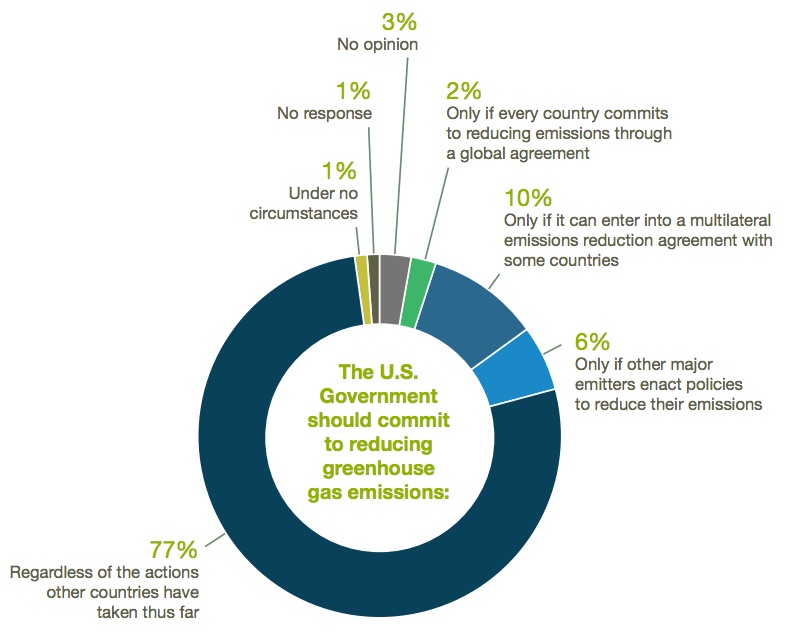
Skeptical Science reports on a new survey of 365 economists.  Interestingly, the name of the report from the NYU Institute of Policy Integrety is Expert Consensus on the Economics of Climate Change.  The Skeptics (tm jcook) reproduce a key figure from the report


but interestingly while tearing it apart miss the lede.  Let Eli give a hand.  In answering the question about Whether the US Government should commit to reducing greenhouse gas emissions only 1% answered Under No Circumstances.

That means of 365 economists who know about the issue of global warming and climate change less than 4 (maybe 6 with rounding) were firmly against further governmental limitations of greenhouse gas emissions either by taxes or regulation.

Oh yes, Eli would not be Eli if he did not show the Nick Stern memorial figure showing that the ecotools who attacked the Stern Report for choosing a low discount rate were the 1%.


Friday, January 01, 2016

Bunnies Can't Statistically Prove. . .


With the exceptionally concerning weather the world has been gifted for Christmas and New Years, the Statistical Trolls have been on the Net and the Tweets, proclaiming that "no one can prove that"

Eli has been alerted to the appropriate response, and calls upon the Bunnies for more
No bunny can prove that any race won by Lance Armstrong was caused by doping
No bunny can prove that any home run that Barry Bonds hit was caused by steroids
No bunny can prove that Ben Johnson ever won a race because of "medicines"
OTOH, wanna bet?