Tuesday, September 18, 2007

If an article in the forest is not cited does it make any noise?

Well, actually we know the answer to that given the loud speaker brought forth by such trash as Zhen-Shan and Xian and the rest of the Schulte 7. Eli, in keeping with his mantra of RTFR did the "global climate change" search today on Web of Science. The mice will be pleased to know there are now 577 papers published since 2003, up a few each couple of days. The guys went and looked first at the top ten, the articles with the most cites

1. Evaluating predictive models of species' distributions: criteria for selecting optimal models
Anderson, RP; Lew, D; Peterson, AT ECOLOGICAL MODELLING
162 (2003) 211
Number of Citations: 127 Citations/Year: 25.40

2. Changes in tropical cyclone number, duration, and intensity in a warming environment
Webster, PJ; Holland, GJ; Curry, JA; et al. SCIENCE
309 (2005) 1844
Number of Citations: 110 Citations/Year: 36.67

3. Soil carbon sequestration impacts on global climate change and food security
Lal, R
SCIENCE 304 (2004) 1623
Number of Citations: 90 Citations/Year: 22.50

4. The changing character of precipitation
Trenberth, KE; Dai, AG; Rasmussen, RM; et al.
BULLETIN OF THE AMERICAN METEOROLOGICAL SOCIETY 84 (2003) 1205
Number of Citations: 90 Citations/Year: 18.00

5. Global amphibian declines: sorting the hypotheses
Collins, JP; Storfer, A DIVERSITY AND DISTRIBUTIONS
9 (2003) 89
Number of Citations: 90 Citations/Year: 18.00

6. Flexibility and specificity in coral-algal symbiosis: Diversity, ecology, and biogeography of Symbiodinium Baker, AC ANNUAL REVIEW OF ECOLOGY EVOLUTION AND SYSTEMATICS 34 (2003) 661
Number of Citations: 87 Citations/Year: 21.75

7. Modern global climate change
Karl, TR; Trenberth, KE SCIENCE
302 (2003) 1719
Number of Citations: 75 Citations/Year: 15.00

8. Release of methane from a volcanic basin as a mechanism for initial Eocene global warming
Svensen, H; Planke, S; Malthe-Sorenssen, A; et al NATURE
429 (2004) 542
Number of Citations: 71 Citations/Year: 17.75

9. Thermal acclimation and the dynamic response of plant respiration to temperature
Atkin, OK; Tjoelker, MG TRENDS IN PLANT SCIENCE
8 (2003) 343
Number of Citations: 64 Citations/Year: 12.80

10. Rapid turnover of hyphae of mycorrhizal fungi determined by AMS microanalysis of C-14
Staddon, PL; Ramsey, CB; Ostle, N; et al SCIENCE
300 (2003) 1138
Number of Citations: 64 Citations/Year: 12.80

Interested mice can use Google Scholar to find many of these papers (and at a minimum their abstracts), however, Eli draws your attention to numbers 2, 4 and 7. Webster, Holland and Curry did stir up a storm.

But wait John S. asks, how did the Schulte 7 do, didn't they have a lot of citations. Sadly No.

UPDATE: The mice and bunnies were up all night in the lab. Eddie won the gold star, but then as he said:
Couldn't stop myself. Here's what I got.

1. Cao et al (2005). Cited by three other papers:
http://scholar.google.com/scholar?hl=en&lr=&cites=4678028341612595130
I’m not a climate scientist, so can’t say much about these papers. All three appear to have been translated from Chinese.

2. Gerhard (2004) yields 4 cites, 1 to a sceptic paper in Environmental Geology, the other three to AAPG bulletins.
http://scholar.google.com/scholar?hl=en&lr=&cites=6587388743221504476

3. Leiserowitz does not belong on this list. It doesn't deal with the "hard" science but with public perception of climate change. (Really, you'd have thought that its publication in a journal called Risk Analysis would have been a tip-off. Not only that, but the 7 papers that cite it also are social science oriented:
http://scholar.google.com/scholar?hl=en&lr=&cites=6794206332519444725
Moreover, a quick read of the abstract suggests that its implicit aim is to provide more information to those wanting to know how to get people on board the global warming "gravy train". How is this bucking the consensus? (Unless I'm missing something, this one is an embarrassment for Schulte/Monckton.)

4. Lai et al (2005) has zero cites.

5. Moser (2005) has only 1 cite.
http://scholar.google.com/scholar?sourceid=Mozilla-search&q=moser+%22Uncertainties+in+the+human+dimensions+of+global+change+deeply+affect+the+assessment+and+responses+to+climate+change+impacts%22
The gScholar link doesn’t seem to go to the right place, but judging from the abstract, it’s hard to say whether this is a counter-consensus paper. Moser is merely saying that “Uncertainties in the human dimensions of global change deeply affect the assessment and responses to climate change impacts.” Seems non-controversial.

6. I got no cites for Shaviv; can't see where you got the four citations.

7. Finally, the Zhen-Shan & Xian paper, which I think James Annan savaged recently. Cited 3 times by sceptic chop-shops:
http://scholar.google.com/scholar?hl=en&lr=&cites=3363744258458693716
by Bob Carter in a speech delivered at the Aus/MM New Leaders Conference; by the Independent Summary for Policymakers IPCC Fourth Assessment Report put out by the Fraser Institute and co-ordinated by Ross McKitrick; and in the “Index of Leading Environmental Indicators 2007” (12th ed.) put out by aconvenientfiction.com.

AND … that’s the total.
I got the four cites to a slightly earlier Shaviv paper one of which is the Shaviv paper you looked at. There were (as Eli recalls, and Eli is an OLD Rabett, two self cites, one refutation and one agreement. The agreement is interesting in that the authors know the CR lit, but not the climate lit. Details in the evening (left my thumb drive at home).

Monday, September 17, 2007

Hors Categorie

Eli has added a new feature to the blogroll. There are some things that are beyond expectation, and the blogs of two friends of furry bloggers fit into that. Hors Categorie, for those who don't know is a classification of climbs in the Tour de France, that are so difficult that even the pros get off their bikes and walk. The English translation, beyond category, was a description that Duke Ellington used to describe the music he loved best.

As Michael Berube pointed out there are lots of dishonest grifters out there making a living off science denial. Our job, (climate changes inserted to Berube's rant) therefore, is to contest their legitimacy, and to find a way of dealing with them that denies what they want: namely, (1) important concessions or (2) outrage. They feed on (2), of course, and uses it to power their Climate Audting Center and Massive Persecution Complex and most of the time, we give it to them by the truckload. Realists need to try (3), mockery and dismissal, and thereby demonstrate, that when someone tries to blame global warming increases on hockey sticks and hibatchis, that person needs to be ridiculed and given a double minor for unsportsmanlike bullshit.

Visit Nexus and Horatio for some of the good medicine.

Horatio at the coffeehouse. . .

Horatio Algeranon lost his muse
And started a blog to find it.

Just leave it alone
Eli has added it to the blogroll

Sunday, September 16, 2007

Roger and Jim

Ethon came back from the library with some interesting reading. Of course we had to clean the liverwurst sandwich crumbs out of the copies, but underneath the stains Eli found this interesting comparison of Roger Revelle's 1990 recommendations for dealing with global climate change with Jim Hansens 2007 recommendations.


Revelle (1990)

Hansen (2007)

1. Changing the mix of fossil fuels to use more methane and less oil and coal

1. Phase out the use of coal and unconventional fossil fuels except where the CO2 is captured and sequestered. Reserve oil and gas for transportation.

2. Energy conservation, i.e., increasing energy efficiency, the benefits obtained per unit of energy used

2. There must be a rising price (tax) on carbon emissions, as well as effective energy efficiency standards, and removal of barriers to efficiency.

3. Substitution of non-fossil energy sources for coal, oil and natural gas


5. Sequestration of carbon in trees and other long lived land plants

4. Steps must be taken to ‘draw down’ atmospheric CO2 via improved farming and forestry practices, including burning of biofuels in power plants with CO2 sequestration.

6. Increasing the earth’s albedo

6. See Crutzen, Paul

4. Sequestration of organic carbon in the deep sea by stimulating spring phytoplankton production in high latitude oceans

3. There should be focused efforts to reduce non-CO2 human-made climate forcings, especially methane, ozone and black carbon.


Revelle was more enthusiastic about geoengineering, but of course 1990 were relatively early and hopeful days. OTOH, Hansen is a great believer in sequestration.

Interested mice can find more on Hansen's POV on his Columbia web site

And so it goes . . .

One of the McMice, John V, over at Climate Audit has set up his own program for calculating surface temperatures. He used this to calculate surface temperature anomalies in the US for the stations that Watt and Co classified as best (CRN12) and worst (CRN5) and GISS (boo hiss). Eli was not surprised at the result,


the three sets are pretty much the same! Eli, commenting over at CA made two points.

First, since you don't know what the station looked like 10, 20, 30, 40 or more years ago, the fact that a station is well run today, tells you nothing about how they were run in the past. Thus, each of the stations probably was good, bad and indifferent at different points in the past, so you would expect that the current classification is not very good for assigning past classifications. The best you could probably do is compare recent trends at nearby stations that appear different today.

Second, John V did exactly what science folk do, took the algorithm, wrote some code to match the description and then looked at the result. The line by line examination of the original program only comes when significant differences are found.

Great credit to him.

UPDATE: Since folk are coming over here from Real Climate, allow a small blog ad - take a look at Ethon checks out the air conditioning. . . which looks at how the photo contest got started, who started it, and important work by Tom Peterson of NOAA on how anomalies on the regional and larger scales were not sensitive to microconditions at individual stations. We will be posting soon about an additional and important 2005 paper by Peterson. Eli has to RTFR again.

Saturday, September 15, 2007

The Northwest Passage is open for business

The ESA reports that satellite synthetic aperture radar shows the Northwest Passage is open for business (link for HiRes image)

"The most direct route of the Northwest Passage (highlighted in the top mosaic by an orange line) across northern Canada is shown fully navigable, while the Northeast Passage (blue line) along the Siberian coast remains only partially blocked. To date, the Northwest Passage has been predicted to remain closed even during reduced ice cover by multi-year ice pack – sea ice that survives one or more summers. However, according to Pedersen, this year’s extreme event has shown the passage may well open sooner than expected."

Hmm. Looks like Northeast Passage may not have been such a wild guess.

Thursday, September 13, 2007

There is nothing new in the eye of the hurricane

Eli notices that Humberto spun up from zilch to Cat 1 in record time, continuing a worrying trend. While sheltering from the rain, he found this tasty bit from 1987:

Nature 326, 483 - 485 (08 April 1987); doi:10.1038/326483a0
The dependence of hurricane intensity on climate

Kerry A. Emanuel
Center for Meteorology and Physical Oceanography,
Massachusetts Institute of Technology,
Cambridge, Massachusetts 02139, USA

Tropical cyclones rank with earthquakes as the major geophysical causes of loss of life and property1. It is therefore of practical as well as scientific interest to estimate the changes in tropical cyclone frequency and intensity that might result from short-term man-induced alterations of the climate2. In this spirit we use a simple Carnot cycle model to estimate the maximum intensity of tropical cyclones under the somewhat warmer conditions expected to result from increased atmospheric CO2 content. Estimates based on August mean conditions over the tropical oceans predicted by a general circulation model with twice the present CO2 content yield a 40–50% increase in the destructive potential of hurricanes.

Whom you would destroy you first defund (Part 23)

Today's NY Times brings word of a new report about the US Climate Change Science Program from the National Academy of Sciences among the conclusions are

Science quality observation systems have fueled advances in climate change science and applications, but many existing and planned observing systems have been canceled, delayed, or degraded, which threatens future progress.
Surprise
The separation of leadership and budget authority presents a serious obstacle to progress in the CCSP. . . . . However, the CCSP director and agency principals lack authority to allocate or prioritize funding across the agencies, and the interagency working group members often have little budgetary authority to implement the research directions that they define. Such authority usually resides a higher levels in the participating agencies. As a result, progress is most likely when CCSP and agency interests coincide.
Why to the words seldom and never occur?
Discovery science and understanding of the climate system are proceeding well, but use of that knowledge to support decision making and to manage risks and opportunities of climate change is proceeding slowly.
Bigger and better bureaucratic ostriches.

On adaptation without mitigation

Adaptation is not the only choice. You can die. Your family can die. Your situation can deteriorate to the point it is not worth living (see Somalia, Iraq, dystopia, etc.). Happens frequently to individuals during major changes.

Adaptation is not a magic wand that makes everything good again, and sometimes it is not possible, certainly not for individuals, and often enough not possible for populations. Advocates of adaptation frequently think that it is a strategy for others and they will not have to take part. Simply to say adapt and go not further is a response of the ethically challenged. Adapt how, at what cost, in money and lives and quality of life.

Avoiding situations where dire choices have to be made is advisable, but evidently not to those who would rather not confront necessary changes to their own behavior.

Eli is not a big fan of adaptation. 

 UPDATE: Eli would once again remind everyone about J. Willard Rabett's four laws J. Willard sent Eli a set of laws to guide climate change policy makers 

1. Adaptation responds to current losses. 
2. Mitigation responds to future losses 
3. Adaptation plus future costs is more expensive than mitigation, 
4. Adaptation without mitigation drives procrastination penalties to infinity. 

 J. Willard thinks adaptation has an important role to play, but by itself adaptation is worse than useless, it actually can make things worse by delaying mitigation. While John McCormick thinks no serious person would suggest adaptation without mitigation, there are a lot of clowns out there with megaphones and pockets full of cash. In the words of Roger Revelle (1990)


Research and observation over the next ten to twenty years should give us a much better idea of the likely magnitude of atmospheric and global warming during the twenty first century. In the meantime we should think of ways to mitigate, adapt to, and better understand future global change and its effects on our societies and our environment
It is now 17 year since Revelle spoke those works

Tuesday, September 11, 2007

Eli does a Schulte


It occurred to Eli that World of Science is not a very good tool for a Schulte as it returns a date sorted list of articles and besides which, where the Rabett is sitting, he does not have access. Google Scholar, on the other hand

How are articles ranked?
Google Scholar aims to sort articles the way researchers do, weighing the full text of each article, the author, the publication in which the article appears, and how often the piece has been cited in other scholarly literature. The most relevant results will always appear on the first page.

Plus which is free and eliminates the blogospheric trash found with Google. So, the lab bunnies did a search. Specifying only things published this year, they did the Oreskes, searching on "global climate change". The first few items were:
Effects of solar UV radiation on aquatic ecosystems and interactions with climate change - all 12 versions »
DP Hader, HD Kumar, RC Smith, RC Worrest - Photochem. Photobiol. Sci, 2007 - ciesin.columbia.edu
... Increasing temperatures associated with global climate change are generally expected to decrease DOM concentrations and thus increase the penetration of UV-B ...
Cited by 125 - Related Articles - Web Search
Economy-wide Estimates of the Implications of Climate Change: Sea Level Rise - all 7 versions »
F Bosello, R Roson, RSJ Tol - Environmental and Resource Economics, 2007 - Springer Page 1. Economy-wide Estimates of the Implications of Climate Change: Sea Level Rise FRANCESCO BOSELLO 1,2 , ROBERTO ROSON 1,2,3, * ...
Cited by 15 - Related Articles - Web Search
Implications of Global Climate Change for Tourism Flows and Seasonality
B Amelung, S Nicholls, D Viner - Journal of Travel Research, 2007 - jtr.sagepub.com
... at Google Indexer on February 16, 2007 http://jtr.sagepub.com Downloaded from Page 2. Implications of Global Climate Change for Tourism Flows and Seasonality ...
Cited by 4 - Related Articles - Web Search
Awakening the Scientist Inside: Global Climate Change and the Nature of Science in an Elementary … - all 2 versions »
JJ Matkins, RL Bell - Journal of Science Teacher Education, 2007 - Springer
... c Springer 2007 Awakening the Scientist Inside: Global Climate Change and the Nature of Science in an Elementary Science Methods Course ...
Cited by 3 - Related Articles - Web Search

You can do this yourself, but the interesting things are

1. A large majority of the references dealt with the economic and biological consequences of global climate change showing the wide scientific consensus agreeing with the IPCC AR4

2. In the first 200 or so listings there were none that argued against the conclusions of the IPCC AR4.

Everybunny is welcome to repeat this exercise. Remember to use the advanced search in Google Scholar, enter the string "global climate change" in the match exact phrase box and set the limits for the year that you want.

Please send your results to Princess Denial c/o Energy and Environment.

Thursday, September 06, 2007

And in this corner . . .

Eli would like to draw your attention to two new entries in the blogroll

Skeptical Science by John Cook at the University of Queensland who mission is to take the hottest skeptical arguments (he's ranked them folks) and grind them into the ground using the mighty pestle of the scientific literature. John mission statement says:

I've noticed two patterns in global warming skepticism. Firstly, many reasons for disbelieving in anthroporphic global warming (AGW) seems to be political rather than scientific. Eg - it's all a liberal plot to spread socialism and destroy capitalism (or sometimes just plain dislike for Al Gore). As one person put it, "the cheerleaders for doing something about global warming seem to be largely the cheerleaders for many causes of which I disapprove".

But beneath the politics is a more elemental instinct - an aversion to alarmism. We've been burnt before. The media predicted an ice age in the 70's which never eventuated. Y2K was going to destroy society - it was barely a hiccup. And I won't deny there are alarmists in the global warming camp. Urgent cries that the ice sheets are on the verge of sliding into the sea. Hysteric predictions that Manhattan will soon be underwater. Or emotional pleas to save those cute little polar bears. Sadly, alarmists seem to be the loudest voices in the global warming debate. But that doesn't change the science underneath.

So I avoid the distractions of political agendas, ad hominem arguments and hyperbole about "the new religion". Instead, I concentrate on the science. And I noticed when the discussion did get to science, the same flawed skeptic arguments kept popping up and got passed around the blogosphere, Chinese whispers style. This website is an attempt to examine all the scientific arguments that reject AGW.

Very much in the spirit of Coby Beck's How to talk to a global warming sceptic and very nicely done but sadly no comments. (John is smarter than Eli)

And Big City Liberal Strikes Back, climate blogging gold amongst the Canadian politics dross (Ok BG, Eli is a cynic at heart). You might enjoy his Great Balls of Dry Ice pumpkin chucker (who the hell can spell trebuchet)

Wednesday, September 05, 2007

The Northwest Passage is open

and it looks like the Northeast Passage near Siberia will soon open. Has that EVER happened?

A farewell gift

Ethon brings word from Boulder that Roger P Sr. is retired from blogging. Climate Science is no more, although, had Eli to bet we might see RPSr. occasionally rise on Prometheus or elsewhere. Still Eth and Eli were sitting about the table wondering what gift we could send for the good times memories, when we remembered that Roger really, really wanted a measure of ocean heat content. Well, as the saying goes, what does not exist, sometimes has a proxy, and (we await correction from those who know better, such as llewelly) it may be that the hurricane track records found at Unisys might be such a proxy.


The strengthening of the storms should be related to the ocean heat content. A poor resolution perhaps, but averaged over some period of time, perhaps useful. Just an idle thought. Go gently sweet Climate Science.

Tuesday, September 04, 2007

Somewhat boring but let's keep the guys over at Climate Audit amused.

Although the bunnies are always looking for better burrows, we disclaim responsibility for the large number of folk surfing surfacestations.org. However, we have the next real cool site from Anthony Watts' collection, and what is cooler than Berkeley?


Our cool station of the day.

An air conditioner or a shadow do not a trend make. We can find at least as many cooling flaws in the USHCN network than warming ones, yet the surface record trend agrees with trends in other series such as the corrected satellite MSU, the sea surface temperature and more. A major problem with all the jumping up and down is, as Eli has pointed out forevah, that it is not clear how the associated offsets will affect the multiyear trend. But there goes the baby with the bathwater

Oh yeah, take a look at what the Sparrow has wrought

Monday, September 03, 2007

Cool station of today . . .

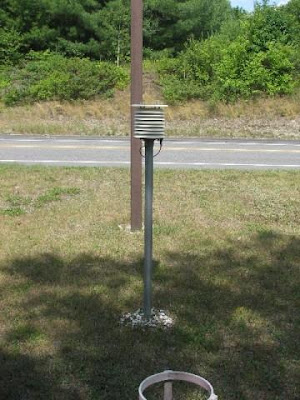
Alma MI, with the Stevenson Screen right next to a large bush and a tree to the south to provide shade


The report describes this as an urban back yard shaded in the morning and late afternoon. Wanna bet that is an Urban Cooling Effect.

As Eli said for every air conditioner there is a tree, for every piece of blacktop a bush.

Where we are

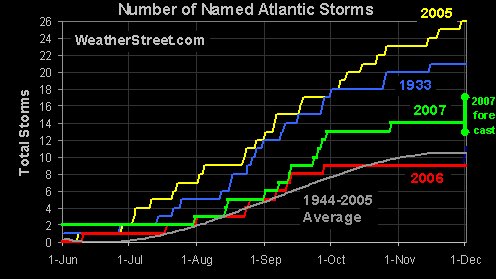
Some discussion about the number and intensity of Atlantic hurricanes has lead Eli to Weather Street, another properly obsessed site which has a very interesting graphic showing the number of hurricanes per season.


Currently 2007 is running a bit above average, but not significantly more than 2006, which was a low year, yet the most striking thing about 2006 was that there were no named storms after October 1. It is also interesting to note that the hurricane season appears to be starting earlier (June) than in the past.

UPDATE: One of the mice asked for the Atlantic hurricane tracks between 1015 and 1037, and o yeah, she also wanted the track of the 1900 Galveston hurricane. Now Eli is REALLY good folk, but unfortunately the 1015 data was recorded on an MFM disc which crashed about 1995, but 1900, a piece of cake

and for the obsessed amongst thee we have the complete record, hurricane and cyclone tracks for all the years since dot.

Sunday, September 02, 2007

Listen to the bunny

A few weeks ago Eli pointed out that the Gulf of Mexico was cocked and ready to amplify any hurricane that showed up. And there were doubters

Anonymous said...

So you are forecasting a busy season? Let's revisit this in November. 11:31 AM

EliRabett said...

I think I'm forecasting an intense season. If a storm gets going everything I see out there says it will intensify strongly.

Dean showed up and went to Category 5 before slamming into the Yucatan and now we have Felix

REPORTS FROM A NOAA HURRICANE HUNTER AIRCRAFT INDICATE THAT FELIX
CONTINUES TO RAPIDLY STRENGTHEN.

A TROPICAL STORM WATCH REMAINS IN EFFECT FOR JAMAICA AND FOR GRAND
CAYMAN. A TROPICAL STORM WATCH MEANS THAT TROPICAL STORM
CONDITIONS ARE POSSIBLE WITHIN THE WATCH AREA...GENERALLY WITHIN 36
HOURS.

INTERESTS ELSEWHERE IN THE CENTRAL AND WESTERN CARIBBEAN SEA SHOULD
CLOSELY MONITOR THE PROGRESS OF THIS SYSTEM.

FOR STORM INFORMATION SPECIFIC TO YOUR AREA...INCLUDING POSSIBLE
INLAND WATCHES AND WARNINGS...PLEASE MONITOR PRODUCTS ISSUED
BY YOUR LOCAL WEATHER OFFICE.

AT 800 PM EDT...0000Z...THE CENTER OF HURRICANE FELIX WAS LOCATED
NEAR LATITUDE 13.8 NORTH...LONGITUDE 72.9 WEST OR ABOUT 390 MILES...
625 KM...SOUTHEAST OF KINGSTON JAMAICA.

FELIX IS MOVING TOWARD THE WEST-NORTHWEST NEAR 18 MPH...30 KM/HR...
AND THIS GENERAL MOTION IS EXPECTED TO CONTINUE FOR THE NEXT 24
HOURS.

MAXIMUM SUSTAINED WINDS ARE NEAR 165 MPH...270 KM/HR...WITH HIGHER
GUSTS. FELIX IS A CATEGORY FIVE HURRICANE ON THE SAFFIR-SIMPSON
SCALE. SOME FLUCTUATIONS IN INTENSITY ARE TO BE EXPECTED OVER THE
NEXT 24 HOURS.

Friday, August 31, 2007

Birthing a mouse is hard


Eli posted the new American Association of Petroleum Geologists climate change policy with the remark that it was a mouse, but a mouse is better than a rat. Some disagreed, claiming that rats are cuter and smarter. As a keeper of whip smart anonymice, Eli disagrees, but de gustibus non est disputandem (Eli won't bother arguing with your bad taste). It is interesting to read the AAPG President's column which opened season on the previous policy.

During my tenure as president I have received correspondence from members on various topics -- but the two largest volume topics have been the proposed “graduated dues” structure and AAPG’s current position on global climate change.

Members have threatened to not renew their memberships if the graduated dues system is passed, or if AAPG does not alter its position on global climate change (although not the same members). And I have been told of members who already have resigned in previous years because of our current global climate change position. 

My response is: You have a much better chance of changing AAPG from within than from without. It sounds like the old saying, “Don’t throw the baby out with the bath water.”
and continued
This year’s Executive Committee has listened to members’ views on global climate change, and we have appointed an “all-star,” balanced committee to recommend a set of facts on global climate change (see box above). 
As stated in my January President’s Column, this committee’s work should result in a set of facts on climate change that will replace the current position paper and that can be distributed at member’s request in the form of a pocket-sized card. This change is occurring because we are listening to AAPG members, not because we are listening to members of other organizations. 

Appointing the ad hoc global climate change committee was one of my most important tasks this year as president. I relied upon the wisdom of the Executive Committee, but also DEG President Jane McColloch and DPA President Rich Green. Every member I asked to serve on the committee agreed because it is such an important issue to him or her, and they want AAPG to “get it right.” 
Why is AAPG’s position on climate change so important?
  • Members need facts to communicate with their own communities, newspapers and government officials as debate on climate change policies intensify both in the United States and globally. Global policy makers need our geologic input to make scientifically sound decisions.
  • The current policy statement is not supported by a significant number of our members and prospective members.
AAPG is indebted to this dedicated committee, and we are anxious to see their recommendation 
Being president of AAPG is challenging and consuming, but the attitude and help from volunteer members make it all worthwhile.
Comments on the proposed AAPG statement have been closed to non-members. Rabett Run posted some of the comments when they were open and Eli wonders if an AAPG member could do the same for later posts.

A somewhat discouraging marker of how the proposed document was watered can be found by comparing a part of the draft
Public concern over the potential impacts of climate change is growing because observations demonstrate that the planet has been warming since the middle to late 19th century and increasingly sophisticated climate models predict increased future warmth (IPCC 2007). These conclusions have been articulated mainly by climate scientists, through reports of the National Academy of Sciences, American Geophysical Union, American Association for the Advancement of Science, and the American Meteorological Society.
to the final document on the same point
Certain climate simulation models predict that the warming trend will continue, as reported through NAS, AGU, AAAS, and AMS. AAPG respects these scientific opinions but wants to add that the current climate warming projections could fall within well-documented natural variations in past climate and observed temperature data. These data do not necessarily support the maximum case scenarios forecast in some models. To be predictive, any model of future climate should also accurately model known climate and greenhouse gas variations recorded in the geologic history of the past 200,000 years.
One wonders where the AAPG found climate simulation models that do not predict the warming trend will continue, have they been consulting with Piers Corbyn and Co, and then, of course we can haggle about accurately. Ethon, Eli has been told, is looking for his liver oil pill container and hopes to peck up a storm.

Thursday, August 30, 2007

The AAPG brings forth a mouse (which is better than a rat)


The American Association of Petroleum Geologists has issued its new policy on climate change. James Annan and Julia Hargreaves will be very happy

Stand up and be counted (after you pay your dues..)


The AGU is revising its position statements on Teaching Evolution, Human Impacts on Climate and Natural Hazards. The statement on Teaching Evolution, originally agreed in 1981 and last revised in 2003 states

The American Geophysical Union affirms the central importance of scientific theories of Earth history and organic evolution in science education. An educated citizenry must understand these theories in order to comprehend the dynamic world in which we live and nature's complex balance that sustains us. . .
"Creation science" is based on faith and is not supported by scientific observations of the natural world. Creationism is not science and does not have a legitimate place in any science curriculum.
AGU opposes all efforts to require or promote teaching creationism or any other religious tenets as science. AGU supports the National Science Education Standards, which incorporate well-established scientific theories including the origin of the universe, the age of Earth, and the evolution of life.
Comments can be left after registration

The statement on Human Impacts on Climate issued in late 2003 starts
Human activities are increasingly altering the Earth's climate. These effects add to natural influences that have been present over Earth's history. Scientific evidence strongly indicates that natural influences cannot explain the rapid increase in global near-surface temperatures observed during the second half of the 20th century.
Comments can be left after registration

The policy on Natural Hazards was first issued in 1995 and reaffirmed in 2005
Natural hazards (earthquakes, floods, hurricanes, landslides, meteors, space weather, tornadoes, volcanoes, and other geophysical phenomena) are an integral component of our dynamic planet. These can have disastrous effects on vulnerable communities and ecosystems. By understanding how and where hazards occur, what causes them, and what circumstances increase their severity, we can develop effective strategies to reduce their impact. In practice, mitigating hazards requires addressing issues such as real-time monitoring and prediction, emergency preparedness, public education and awareness, post-disaster recovery, engineering, construction practices, land use, and building codes. Coordinated approaches involving scientists, engineers, policy makers, builders, lenders, insurers, news media, educators, relief organizations, and the public are therefore essential to reducing the adverse effects of natural hazards.
Comments can be left after registration

Here and back again. . .

An interesting discussion on open access continues both here and on Deltoid. One tdawwg has had, I think the better of the argument, and there are two points of his which Eli wishes to both agree and disagree with

So why is market regulation to recoup costs so abhorrent? And I would argue that however publicly funded research may be, there is a substantial individual contribution that renders the scholarly work individual, not public, property.

and

The idea that academics don't need to publish in peer-reviewed journals is not disingenuous. The system we have now hasn't existed forever: it was arrived at consensually, with many parties agreeing and disagreeing over how it should work, who does what, etc. I see no reason why the intellectual elite can't come up with an acceptable alternative if they find that the restrictions of paying for copyrighted content are too much for them, are morally odious, etc.
To really understand what is happening one needs to know a few things about scientific publishing. This post is somewhat of a backgrounder.

When Eli as a young and rather small underbunny sat at the feet of a great Hare. Big Foot occassionaly remarked in passing that post WWII it was obvious that scientific research in the US was going to be a huge and important thing driven by government funding. The great and good sat with the political types and all realized that this would result in an explosion of academic publication with increasing stress on libraries to keep up. They thought large thoughts about how to fund it quickly realizing that there were several possibilities:

  • Direct funding of academic presses and/or scientific organizations (AAAS, etc)
That would leave the commercial presses out in the cold, which was a big communist type no-no. Or what we have now:
  • Subvention of the academic presses through page charges paid by the authors from their grants
  • Subvention of the libraries through overhead (now called F&A or facilities and administrative) charges
  • Expensive journals from commercial publishers.

Almost every grant has a couple of thousand $ or more per year for page charges. What are page charges you ask, well they are an amount that the authors pay per article/per page to cover some of the costs of publications. Most scientific organizations have page charges for their publications, and there are arrangements where the needy (or whiny) can have them forgiven. The National Academy policy is both typical and indicative of how such organizations are trying to meet the challenge of open access

PNAS depends, in part, on the payment of page charges for its operation. Payment of the page charge of $70 per printed page will be assessed from all authors who have funds available for that purpose. Authors will be charged for extensive alterations on proofs. Payment of $250 per article will be assessed for Supporting Information. Authors of research articles may pay a surcharge of $1,100 to make their paper freely available through the PNAS open access option. If your institution has a 2007 Site License, the open access surcharge is $800. All articles are free online after 6 months. Articles are accepted or rejected for publication and published solely on the basis of merit.

Payment by authors of the following additional costs is expected: $325 for each color figure or table; $150 for each replacement or deletion of a color figure or table. A single figure is defined as original art that can be processed as a unit and printed on one page without intervening type. Requests for waiver of charges should be submitted to pnas@nas.edu
The AGU "basic publication fee" (PC for page charge) structure is more complicated. Google "pages charges" and you will come up with a bundle of these policies and a severe case of MIGO.

When you go through the exercise the learned society (AIP, ACS, AGU, RSC, etc.) have pretty reasonable policies and subscription fees and are pretty close to break even on their publishing through the combination. Demanding that they go open access without another funding mechanism will destroy them.

On the other hand commercial presses, such as Elsevier (aka Darth Publisher) simply stick it to the libraries. The libraries are up against it with increasing subscription rates. Eli's place has been triaging journal subscriptions for the last ten years and it is really tight now. This letter to the faculty from the University of Maryland Libraries gives you a fair picture of what is happening:

As detailed in the Provost's letter, in 2003 Elsevier maintained a negotiating stance with the Libraries that failed to meet the Libraries' criteria for control over collection decisions and for the ability to exercise prudent management of rapidly escalating subscription costs.

Elsevier wanted the Libraries to commit to an entire set of journals whereas the Libraries wanted to subscribe to individual titles and to retain the authority to cancel subscriptions as necessary. When the Libraries opted out of the package arrangement, Elsevier raised its 2004 prices an average of 27% per title.

The Libraries will scrutinize Elsevier subscriptions carefully and will exercise its right to make title-by-title subscription decisions. All publications from Elsevier warrant this careful attention since their prices increase at such a rapid rate, well over the rate of inflation. Furthermore, the Libraries spend roughly 1.5 million dollars for Elsevier subscriptions. This amount accounts for 43% of all journal expenditures, but only 8% of the total number of current journal subscriptions. The Libraries need to ensure that these titles are bringing real value to the campus.

Usage data tallied for 2004 and cost per use calculations will inform subscription renewal decisions this year.

  • The average use per Elsevier title in 2004 was 226.
  • The average cost per use in 2004 was $9.27.
Further, a letter to the MIT community

“…we are concerned about the pressures exerted on the scholarly publishing system by a small number of highly profitable commercial publishers concentrating in science and technology journals. These publishers lock libraries into high-priced packages for combined print/electronic output, and contractually constrain libraries’ ability to manage expenditures. Libraries must invest a continually larger percentage of their budgets in providing access to these publications.”

Professor Marcus Zahn, Chair of the Faculty Committee on the Library System, The MIT Faculty Newsletter, Dec.-Jan., 2003
Our favorite boat anchor is Tetrahedron Letters, $12.8K/yr for one journal, one that we have to have to maintain our ACS accreditation.

The bottom line is that for open access to work, research funding organizations will have to pay considerably more than they do now and authors will have to stay away from the commercial publishers who currently control key titles. Eli is not opposed to any of this, but he is not a raw enough Rabett to think that this will occur simply and without a fur fight.

Tuesday, August 28, 2007

Why librarians want to kill libertarians

There is a rumor that information wants to be free, and the open access movement is gathering steam. The mantra is that the results of publicly funded research should be free to all. Tim Lambert touched this off by pointing to a particularly stupid screed against open access. This produced the usual posturing from the anything I can grab is mine libertarian crowd.

Eli, a consumer of carrots and science papers, and rather cranky at the moment, has no strong opinion in the abstract. On the other hand he knows enough librarian avengers to understand that the base issue is who guarantees that the journals will be available forever.

Electronic databases of journal articles are fundamentally different from print. Print archives are found at multiple libraries, each of which has an institutional obligation to maintain them in the face of declining budgets and space (ever wonder why librarians love microfiche?). For a significant journal, such as JACS, Phys. Rev., etc., there will be many hundreds of complete archives up to the point where the libraries stop taking the printed editions. True you can search the earth for the Journal of the Montana Academy of Science, but inter-library loans can even get you that.

Electronic databases of journal articles reside in one place and are distributed on the Web.

What guarantees that the archive will exist 50 years from today? If Elsevier closes Science Direct down because it can't make the money it wants on it libraries that have switched over to electronic access only wake up with huge holes in their collections. In some cases where the material only exists as electrons everyone has lots of nothing. Librarians are all too aware of these issues which is why they are not greeting the open access movement with huzzahs. Before open access can actually happen, the archive issue has to be satisfied, which means that someone has to come up with the money to fund the archive in perpetuity.

This is not a problem that will be solved by volunteers nor is it one to be solved on the cheap

Sunday, August 26, 2007

Station of the day: Farmington ME


Courtesy of the Kristan Byrnes Science Foundation and Surfacestations.org

Another demonstration of the cooling bias in the USHCN temperature anomaly record.

Tuesday, August 21, 2007

Cool station of the day

As has been pointed out by others, Tony Watt's surface station site features the hot, which bothers many readers. Several really good posts have asked whether they really are so hot, and whether this makes a difference in the long run, a station that is hotter than the surrounding area being balanced by one(s) that are cooler. Eli and the bunnies are starting a new feature "Cool station of the day"

Now where would a Rabett find a cool US weather station? Perhaps where the most cooling has been seen in the US, the southeast, and yo there it is, the whole package, Bainbrige GA, a GISS rural station,


UPDATE: The rake in the face crowd demands to see the temperature data.


Like Eli told you real cool. For fun, think of how the as nearby trees grow over the years, the amount of shade increases linearly leading to increasing cooling.

Monday, August 20, 2007

No Exit

Jean Paul SarteSartre taught the bunnies that hell was the people you had to spend eternity with. He was wrong. Hell is Philadelphia International Airport with the USAIR grim reaper training class canceling flights to every destination. Terminal F being the lowest circle, we are now scheduled to board a bus somewhere in the wee hours that will circle the airport endlessly. Like poor Charlie, Eli may never return.

However, to keep you amused here is an interesting picture of a surface station, the one that Eli knew when he was a SarteSartre fan, walking the streets of the Village, being cool (well he tried) and all that.


Eli recalls walking into Central Park, near the Belvedere Castle to go see Joe Papp's Shakespeare in the Park productions and the huge change in temperature as one left Fifth Avenue, and how the weather station was located in a lovely, leafy grove. See you one air conditioner

UPDATE Those who must be obeyed pointed out that Eli had forfeited any claim to pseudo intellectual appearance by misspelling Sartre. Au contraire mon mice, this only nails the sucker to the wall. For pointing this out the anonymouse wins the hall of hell (Philadelphia International Airport) fun alarm. A 220 dB tooth extractor that used to hang over the baggage carousel that refused to spit up our stuff because it had been sitting out in the rain for four hours and didn't taste good. We've also relinked the picture so that all can see.

Friday, August 10, 2007

Help

Eli is being held prisioner by Ms. Rabett and forced to vacation. Back on Aug 21 unless briefly paroled to an Internet cafe

Saturday, August 04, 2007

Trashburning dynamics

Heat flow by convection can be visualized by Schlieren photography in which density differences can be clearly seen. Schlieren photography is closely related to what we commonly refer to as watching the heat rise off hot asphalt, but is much more sensitive (a paper by Gary Settles gives several examples). Horatio Algeranon (a very punny anonymouse) picked up on this, and found a picture showing that the heat flow from a charcoal grill is pretty much straight up. But even Ethon knew this, if he stands to the side when grilling his liver McClimateAudit burgers, things are relatively cool, but bend over and put his beak above the coals, and sure enough it gets fried.

Which brings up to one of Anthony Watts' favorite surface station views


so how does the heat flow


straight up, heating of the air on the sides in contact with the barrel is minimal as seen by the lack of structure.

We have heard a lot about AC units. We even have the famous Marysville picture

Eli walked by a large one yesterday, there was very little airflow a few feet to the side. Schlieren shows the same

Friday, August 03, 2007

You say tomato, I say tomahto


Brian Schmidt has an interesting post over at Back Seat Driving which Eli would encourage all to go read. Tokyo Tom, from the old Prometheus gang pointed Brian to a recent paper by Jim Hansen. Hansen's hair is on fire. He and his co-authors think that we are VERY close to a non-linear transition to out of control sea level rise as the Greenland and West Antarctic ice caps start to disintegrate. You can read about that on Brian's blog and in the paper. Brian points to a suggestion from Hansen, et al.

We conclude that a feasible strategy for planetary rescue almost surely requires a means of extracting GHGs from the air. Development of CO2 capture at power plants, with below-ground CO2 sequestration,may be a critical element. Injection of the CO2 well beneath the ocean floor assures its stability (House et al. 2006). If the power plant fuel is derived from biomass, such as cellulosic fibres5 grown without excessive fertilization that produces N2O or other offsetting GHG emissions, it will provide continuing drawdown of atmospheric CO2.
about which
Tokyo Tom and I disagree somewhat about the last paragraph. He thinks it lends support for open-air carbon capture, the approach favored by Roger Pielke Jr. and the only semi-mainstream idea more speculative than geoengineering. I think Hansen's referring to carbon sequestration from biomass power generation, which is a means of extracting GHGs from the air.
Eli would have commented about this at Back Seat Driving, but comments appear to be turned off, or the Rabett has taken his stupid pills. It appears to Eli that they are both right, which is why the suggestion is elegant. Plants extract CO2 from the atmosphere on balance and convert it to biomass. The are evolved to work with low concentrations of CO2. In that sense TT is right, the plants are efficient at open air capture. By burning the biomass in a power plant the CO2 is captured in the smokestack where it is concentrated. This proposal separates the capture (diffuse) from the sequesterization (concentrated), optimizing each step. In the diffuse capture step plants are much more efficient and lower cost than the various liver in the sky schemes that have been suggest. The gas in a smokestack given efficient combustion, is almost completely water vapor and CO2. The former can be condensed, leaving almost pure CO2 to be sequestered.

Thursday, August 02, 2007

Sgt Rabett patrols the comments

Our mission at Rabett Run is to give the anonymice the free run necessary for a great blog. Unfortunately we have begun to pick up commercial spam at an increasing rate and may have to put the captcha feature back on.

Eli is insanely jealous of Michael Tobis who found this panel first at Climate Cartoons

BTW, it takes a bunch of insanely factitious anonymice working the comments to really make a great blog.

Wednesday, August 01, 2007

Watts up Doc?


UPDATE from on the road: Eli has been off planet for a week. Ms Rabett has taken control, but she is fluffing in the shower and we are in a place with wireless. Anyhow, brief looking about shows that Steve McIntyre has found a mistake in some of the GISS adjustments (actually Eli does not even know if the mistake was with the GISS or the USHCN bunches, as Climate Audit appears to be off the air because of a DRDOS attack, or at least that is what they say).

However, junior management wishes to point out that as we pointed out below, the issue was not the physical layout of the stations, Tony Watts' and Roger Pielke Sr. thing. After going through the metadata about Detroit Lakes, Eli concluded there was a problem, but the problem had to be in the adjustments. Eli, being the lazy Rabett, and ear deep in work at the time left it at that without looking into the matter. McIntyre found one, which from the comment slipstream appears to have been fairly trivial (sort of like Spencer and Christy's minus sign), but, as Tony pointed out and is quoted below)

But hey, they can "fix" the problem with math and adjustments to the temperature record.
They did.
--------------------------------------------------------------
Tony Watt's surface station watchers have landed a whopper, Detroit Lakes, Mn, a rural station in western Minnesota (ID: 212142)


As he says
This picture, taken by www.surfacestations.org volunteer Don Kostuch is the Detroit Lakes, MN USHCN climate station of record. The Stevenson Screen is sinking into the swamp and the MMTS sensor is kept at a comfortable temperature thanks to the nearby A/C units.
According to Don Kostuch, the AC unit was moved from the roof of the building 5/99 and the chart from GISS (uncorrected USHCN data) shows ~ 4C jump about 1999


This has everyone (well isn't Climate Audit everyone) jumping up and down and has even made it over to Germany

Much speculation.
Knashing of Hansen
We codda done it better

Ah, but little bunnies, if we actually go and get the data from GISS or from CDIAC (sadly in F) we see that the jump

Year GISS CDIAC Mo.
Miss.
1990 3.92 39.71
1991 3.75 39.46 1
1992 999.9 38.81 7
1993 999.9 37.46 12
1994 999.9 38.94 6
1995 3.68 37.81
1996 1.59 34.94
1997 999.9 38.57 4
1998 6.4 43.52
1999 6.93 44.72
2000 7.58 42.73
2001 6.54 43.71
2002 5.7 40.71
2003 5.42 40.36
2004 5.52 40.21
2005 6.37 42.04

really comes in 1997/1998. The lab bunnies, who do RTFR also noted that there were a whole bunch of months missing in 1997 and earlier in the decade, (USHCN fills in even long stretches, GISS 999.99s them out) so they went to the historical record for Detroit Lakes and they saw that the station moved from one side of the lake to the other August 30, 2002. The satellite picture shows no building near the old site. Thus the jump happened two years before the station moved to its current location near the air conditioner.

UPDATE: Eli and the bunnies want to drive a stake into that air conditioner theory. Detroit Lakes is in rural western Minnesota. They do not run A/C during the winter. It is too cold for a heat pump. If there were any effect from the A/C it would raise the temperature during the summer. Let us look at the difference between the summer (J-J-A) and the winter (D-J-F). Listening to the ranting anonymice there should be a jump when the A/C was installed (1999)

Guess not.

Well what about that scuzzy Stevenson screen. August 11, 2006 the max/min thermometer was replaced by the MMTS sensor. Nothing under the screen, why pay any attention to it. One might speculate that when they put in the automatic MMTS they pushed it to the side and left it. The shelter has since gone through a Minnesota winter. Eli, a plush white Rabett, would look like that after one of those suckers.

So what DID happen in 97/98 according to the historical record?

Two things. On January 1, 1997 the station was moved to another management section and it looks like the time of observation changed from 17:00 to 7:00 and on July 16 1998 the observer changed.

Looks like a lot of the new anonymice were wrong when they thought a photograph alone was important. Of course, we are depending on the station historical record available to everyone through the majic of the INTERTUBES. Still, there does appear to be a problem here, IEHO associated with an imperfect homogeneity adjustment
Currently all data adjustments in the USHCN are based on the use of metadata. However station histories are often incomplete or changes that can cause a time series discontinuity, such as replacing a broken thermometer with one that is calibrated differently, are not routinely entered into station history files. Because of this we are developing another step in the processing that will apply a time series discontinuity adjustment scheme described in Peterson and Easterling (1994) and Easterling and Peterson (1995). This methodology does not use station histories and identifies discontinuities in a station's time series using a homogeneous reference series developed from surrounding stations.
Eli will let Tony Watts have the last word, because at least he got it right
But hey, they can "fix" the problem with math and adjustments to the temperature record.

For the younger bunnies

Its getting hot in here is a group climate blog for the younger set

It’s Getting Hot in Here is the strong voice of a growing movement, a collection of voices from student and youth leaders of the global movement to stop global warming. Originally created by youth leaders to allow youth to report from the International Climate Negotiations in Montreal, It’s Getting Hot in Here has since grown into a global online community, with over 90 writers from countries around the world.
worth pondering.