Wednesday, June 28, 2006

A List for James Inhofe....

Update 6/4/07

Welcome to our new friends from Planet Gore. You might be interested in some further comments on An Inconvenient Truth such as "The lag between temperature and CO2 (Gore's got it right)" and Glaciers (Al Gore got it right), and oh yes, sea level. For those wanting more details about the IPCC sea level rise statments, and why Gore's statement are not in disagreement with the latest IPCC report we have more from someone involved in drafting the IPCC report. More references on request.

Update 7/4

18. In the department of you take it from whence it comes we have Roy Spencer:

What would Spencer have said if he was contacted? It’s interesting to note that both he and the other skeptic E talked with had mixed reactions to An Inconvenient Truth. Asked if the film was scientifically accurate, Spencer said, “Partly yes and partly no. His explanation of global warming theory was very good. He correctly showed that the planet is warmer now than it has been in hundreds of years. But Gore said ‘thousands,’ and the National Academy of Sciences report says we know only that it is warmer than any time in the last 400 years. Gore repeatedly buys into the most catastrophic views and presents them as fact. And he incorrectly makes it appear as if extreme weather is increasing with global warming.”

But many scientists do believe that hurricane strength is affected by warmer water. Does Gore’s film go beyond that? “He shows all these things that happen naturally, ice calving off and falling into the ocean, for instance, droughts and floods—and implies that it is all related to global warming,” Spencer said. He also claimed that only two of the five scientists interviewed in Borenstein’s piece were actually climate scientists.

Update 7/2

17. Judith Curry
"You cannot blame any single storm or even a single season on global warming. ... Gore's statement in the movie is that we can expect more storms like Katrina in a greenhouse-warmed world. I would agree with this," said Judith Curry. She is chairwoman of Georgia Tech's School of Earth and Atmospheric Sciences, and is co-author, with Mr. Webster, Mr. Holland and H.R. Chang, of a paper titled "Changes in Tropical Cyclones," in the Sept. 16 issue of Science, a weekly publication of the American Association for the Advancement of Science."
UPDATE 6/30

16. I'll go out on a limb with Bob Watson, chief scientist of the World Bank and former head of the IPCC.

UPDATE 6/29:

15. Dr. Jeffrey Masters, meteorologist posted a review on his blog. Disagreed about the Katrina bit, but what the hell, he is a meteorologist

-------------------------------------
Senator James Inhofe is demanding that AP provide him the names of the 19 atmospheric scientists who told the press agency that the science in "An Inconvenient Truth" was accurate. I have gone through a number of articles and put together a list of the first 14 that I could find.

Here is a chance for climate scientists to step up to the plate. If you agree with Jim Hansen, Robert Corell, Eric Steig, and the others listed below, put your name, some indication of your expertise and any other words you may wish into the comments. I will move them up into the text, and we will have our own little list. The only rule is that you MUST be a climate scientist, or in a closely related field and have seen the movie or read the book.

1. James Hansen, NASA/GISS, - NY Review of Books
Indeed, Gore was prescient. For decades he has maintained that the Earth was teetering in the balance, even when doing so subjected him to ridicule from other politicians and cost him votes. By telling the story of climate change with striking clarity in both his book and movie, Al Gore may have done for global warming what Silent Spring did for pesticides. He will be attacked, but the public will have the information needed to distinguish our long-term well-being from short-term special interests.

2. Robert Corell, chairman of the worldwide Arctic Climate Impact Assessment - source AP

"I said, 'Al, I'm absolutely blown away. There's a lot of details you could get wrong.' ... I could find no error."

3. William Schlesinger, dean of the Nicholas School of Environment and Earth Sciences at Duke University. "Excellent. He got all the important material and got it right." - source AP

4. Karen Bice, an associate scientist at the Woods Hole Oceanographic Institution,
..saw Gore's film last week in New York City. As a scholar in paleoclimatology - the study of past climates - Bice said she was impressed with Gore's knowledge and said information presented in the documentary was factual. - Cape Cod On Line
5. "I saw it last night and was impressed with the climate science presented in the film," said David Archer, a climatologist at the University of Chicago. - Inter Press Service

6. Eric Steig University of Washington geochemist in Real Climate
How well does the film handle the science? Admirably, I thought. It is remarkably up to date, with reference to some of the very latest research. Discussion of recent changes in Antarctica and Greenland are expertly laid out. He also does a very good job in talking about the relationship between sea surface temperature and hurricane intensity. As one might expect, he uses the Katrina disaster to underscore the point that climate change may have serious impacts on society, but he doesn't highlight the connection any more than is appropriate (see our post on this, here).
7. Dr. Gavin Schmidt, NASA/GISS climate modeler in Salon
"Such an amount of relatively hard science could have been extremely dull, and I've been to a lot of presentations on similar stuff that were very dull," says Schmidt. "Where there was solid science, he presented it solidly without going into nuts and bolts, and where there were issues that are still a matter of some debate, he was careful not to go down definitively on one side or the other."
8. Lonnie Thompson, a professor at Ohio University, - in Salon
whose work on retreating glaciers from the Andes to Kilimanjaro and Tibet is featured in the film, was happy with the result. "It's so hard given the breadth of this topic to be factually correct, and make sure you don’t lose your audience," he says. "As scientists, we publish our papers in Science and Nature, but very few people read those. Here's another way to get this message out. To me, it's an excellent overview for an introductory class at a university. What are the issues and what are the possible consequences of not doing anything about those changes? To me, it has tremendous value. It will reach people that scientists will never reach."
9. John Wallace, of the University of Washington, in Salon
"I think that he's gone to great lengths to make the science comprehensible to the layman," he says. "Given the fact that this was a film intended to bring the message to the lay public, I think it was excellent."
10. David Battisti, a University of Washington scientist in the Seattle Pilot
There are some minor things I might nitpick, but they don't detract from the overall message," said .
11. At a screening organized by EPA scientists and engineers:

Bob Hall -- chief of EPA's air pollution technology branch, which does research on pollutants emitted by boilers and engines -- called the film an eye-opener.

"There is a little bit of politics in it," Hall said of the film. "Overall, it's more factual. I think he is doing a good public service if the public will watch it."....

12. continuing
Like her colleagues, Geri Dorosz, an environmental scientist, said the fact that the movie will bring the issue to a wider audience was inspiring.

"He is preaching to the choir here," Dorosz said. "Now, if he could preach to some of those that are singing out of tune."

13. Richard Gammon, another UW climate change expert, said the film could be "pretty shocking" for people who are in denial about global warming and see the movie as their first exposure to the evidence.

He doesn't criticize the science in the movie, but wished "it could have ended on a more positive note and talked a bit more about solutions." in the Seattle Pilot

14. And perhaps most touchingly in a tribut to Yoram Kaufman, the chief atmospheric scientist at NASA/Goddard, who was killed while riding his bike Laurie David said
In a fitting tribute, Yoram's NASA colleagues have arranged for a special memorial screening of "An Inconvenient Truth" to honor Yoram. The screening is open to the public....

NASA and other scientific agencies around the world observed a moment of silence during his memorial service on Sunday. The tribute even extended into space, where data collection on two satellite spacecraft ceased for the moment of remembrance.
Let's go

Tuesday, June 27, 2006

Flacking for death and destruction ....


One of the accidental themes of Rabett Run has been the smokescreen that a few scientists have put up to limit regulation of tobacco. Anyone paying attention knows that a rather small number of well paid scientists coordinated a campaign to provide cover for Big Tobacco. Strangely in large part they were the same people who now are out front on climate change denial.

The last refuge of the tobacco scoundrels was slipstream, or passive smoke. they spent considerable time denying that passive smoke was a problem, indeed, the the misleading sign up list strategy originatedwith the Heidelberg Appeal, which was designed as a three-fer to oppose regulation of tobacco smoking and disease causing substances legislation and acknowlegement that people were changing the Earth's climate. The Alexis de Tocqueville Institution took $20,000 for Fred Singer to produce a screed against passive smoke regulation

Today, the US surgeon general issued a report conclusively stating that passive smoking is extremely dangerous. The report, The Health Consequences of Involuntary Exposure to Tobacco Smoke: A Report of the Surgeon General can be read on line, along with the press release, remarks by the SG and the executive summary. The six major conclusions of the report are:

  • Many millions of Americans, both children and adults, are still exposed to secondhand smoke in their homes and workplaces despite substantial progress in tobacco control.
  • Secondhand smoke exposure causes disease and premature death in children and adults who do not smoke.
  • Children exposed to secondhand smoke are at an increased risk for sudden infant death syndrome (SIDS), acute respiratory infections, ear problems, and more severe asthma. Smoking by parents causes respiratory symptoms and slows lung growth in their children.
  • Exposure of adults to secondhand smoke has immediate adverse effects on the cardiovascular system and causes coronary heart disease and lung cancer.
  • The scientific evidence indicates that there is no risk-free level of exposure to secondhand smoke.
  • Eliminating smoking in indoor spaces fully protects nonsmokers from exposure to secondhand smoke. Separating smokers from nonsmokers, cleaning the air, and ventilating buildings cannot eliminate exposures of nonsmokers to secondhand smoke.
In the news conference held to announce the report, the Surgeon General, Richard Carmona, stated that :
"Smoking by parents causes respiratory symptoms and slows lung growth in their children," the report added. "The scientific evidence indicates that there is no risk-free level of exposure to secondhand smoke."
"Nonsmokers need protection through the restriction of smoking in public places and workplaces and by a voluntary adherence to policies at home, particularly to eliminate exposures of children,"
Of course, the tobacco companies provided their usual denials
Altria Group Inc.'s Philip Morris USA unit said people could choose whether to be around smokers.
Phil might consider the babies whose moms and dads smoke.

Eli would like to ask Seitz and Singer and their fellow travelers on a very well paid road what they intend to do to make up for the harm they have caused? Those who have contributed to the smog machine have to ask themselves the same thing. On the other hand, it would really do the heart good to see them chased down by a mob of tort seeking lawyers. Were the world just, Singer, Seitz and Co. would spend the rest of their days in jail. Eli would settle for watching them spend the rest of their days in court.

Saturday, June 24, 2006

Worry.....

A few weeks ago, in a posting on sea level rise, Eli pointed out that sea level rise lags warming by a considerable extent. This accounts for a 500 year delay between when you stop emitting CO2 and the final sea level.


(click to enlarge)

To repeat the top figure is the prediction for increasing CO2 by 1% a year for 70 years and then holding it constant, the bottom is for increasing CO2 by 1% a year for 140 years and then holding it constant. But, as was pointed out, there is a caveat to this prediction, that glaciers respond slowly to external forcings.

A recent feature article in The Earth Observer, v. 18(3), p. 8, 2006 casts strong doubt on that article of fate. The authors, Leigh Stearns and Gordon Hamilton report on measurements by others on two glaciers in southeast Greenland, Kangerdlugssuaq and Helheim. The flow has speeded up greatly, the calving front has rapidly retreated, and the ice surfaces are 100 m lower.

The 11-14 km/yr flow speed cannot be accounted for by internal pressure on the ice and the associated deformation.
The scientists speculate that warmer summer temperatures observed in this part of Greenland are melting increasing amounts of water that is subsequently stored in surface ponds. This melt water eventually reaches the glacier bed, lubricating the ice-rock interface, leading to acceleration. Kangerdlugssuaq and Helheim glaciers are not the only glaciers in Greenland known to be undergoing recent rapid changes. Jakobshavn Isbræ, a tidewater glacier at a comparable latitude (69º N) in west Greenland accelerated 30% between 2000 and 2003 [Joughin et al., 2004] and retreated more than 3 km over the same period [Thomas et al., 2003]. The picture emerging from these observations is one in which large changes in ice dynamics can occur on short timescales of a few years. If the mechanism triggering the changes of Kangerdlugssuaq, Helheim and Jakobshavn affects other Greenland outlet glaciers, which currently show stable ice dynamics [Stearns et al., 2005], the mass balance of the ice sheet will become increasingly negative, unless balanced by an equal increase in snow accumulation, and rates of sea-level rise will increase much faster than current models predict.
Oh well.

Update: If you have not already read Jim Hansen's article in the New York Review of Books do so. The base of his argument is the catastropic scenerio discussed in this posting.

Update II: The LA Times publishes a front page article on Greenland glaciers in a perfect storm of articles in the yellow press. And, for the calmer heads we have an earlier post from Real Climate. ThLA Times article was picked up by Political Animal, and other blogs (follow the trackback)

Update III: And to close the circle, Real Climate answers Eli's request for more within the hour. Good going guys:)

Wednesday, June 21, 2006

Nanny wants to know

if the forcing by CO2 has grown since 1950 and if the rate of growth of the forcing has increased. Fortunately for him, we can find the answer in a PNAS paper by Sato and Hansen

Click for clearer/larger image

These are not the forcings, but the rate of change of the forcings. The rate of growth for CO2 forcing has clearly increased, as has the forcing itself. On the otherhand, it appears that the CFC forcing is actually decreasing (thanks to the Montreal Protocols).

The actual changes in forcings and concentrations can be found in an earlier Rabett Run posting

PS. You can also find the forcing for CO2 in the PNAS article CO2 F = f(c) - f(co), where f(c) = 4.996 ln (c + 0.0005c2). co is the preindustrial value for the CO2 mixing ratio in ppm. From this and concentration data you can calculate changes in forcing and changes in the rates back to the year dot.

Tuesday, June 20, 2006

There he goes again v.93 p.1220....


Eli has not visited the place with no name, but this evening as he was sitting innocently in the garden when Ethon came by and whispered in his ear about what was going on at Pielke Jrs. blog. Roger, of course is up to his old tricks, quite in line with his blog's namesake (Wikipedia).

Prometheus was a son of Iapetus by Clymene(one of the Ocenaids). He was a brother of Atlas, Menoetius and Epimetheus. He surpassed all in cunning and
deceit.
Steve Bloom pointed to an article on Rick Piltz' Climate Science Watch
Lieberman calls on White House and NOAA to address climate science censorship allegations 6/14/06.
Of course, Steve would have done better to point at Climate Science Watch's long list of NOAA, shall we say, information management actions, each of which has an attached article and set of sources:

BBC Panorama: Has the Bush administration covered up the findings of global warming scientists? 6/07/06 - with remarks from NOAA's Thomas Knutson and Jerry Mahlman

NOAA censors speech by science experts on endangered salmon 6/04/06

Rep. David Wu requests GAO investigation of science manipulation and censorship 5/9/06 - including NOAA

House Science Committee Chair Calls for Reform of NOAA Public Affairs Policy 4/12/06

Washington Post reports "Climate Researchers Feeling Heat From White House" 4-9-06

Senators call for National Academy auditing of government reports on climate change 3-29-06 Directed toward actions of Dr. James Mahoney, Assistant Secretary of Commerce for Oceans and Atmosphere

Providence Journal: "NOAA hiding truth about hurricanes, scientists say" 3-29-06.

Former NOAA Lab Director: "Climate scientists within NOAA have been prevented from speaking freely" 3-10-06

Senate committee lets Adm. Lautenbacher off the hook on NOAA media restrictions 2-24-06 (Eli wrote on this one earlier)

Sen. Mikulski's letter requesting GAO report on openness in federal science communication 2-21-06 (specifically mentions NOAA)

Jim Hansen: NOAA "by fiat" put out "biased information" on hurricanes 2-16-06

The NOAA Media Policy: Political pre-approval for public communication by scientists 2-14-06
Rick Piltz's site is one stop shopping for those seeking to understand the game being played.
Rabett Run had some even more current comments by Warren Washington, which included a pointer back to a 1989 statement by Jerry Mahlman about how Bush administrations distort science.

As Steve Bloom said, nothing here, move on, just a day's work on Mount Caucasus, chewing on reality.
 
Update: Steve Bloom points out the post was from a guest, and that Steve wanted to use something recent. I will resist the urge to say still, and buy my pet Ethon a gig of error correcting memory.


Saturday, June 17, 2006

The doctor is out.....


On deadline for a proposal. Writers block. Mom's birthday. Nothing new until Wed.

Tuesday, June 13, 2006

NOAA (No Opposing this Administration's Attitudes)....


From the Rocky Mountain News we have the latest information about news management in the United States of America ......

Warren Washington, a senior scientist at the National Center for Atmospheric Research in Boulder, said that Bush appointees are suppressing information about climate change, restricting journalists' access to federal scientists and rewriting agency news releases to stress global warming uncertainties.
"The news media is not getting the full story, especially from government scientists," Washington told about 160 people attending the first day of "Climate Change and the Future of the American West," a three-day conference sponsored by the University of Colorado's Natural Resources Law Center.
.....Washington said in an interview that the climate cover-up is occurring at several federal agencies, including NASA, the National Oceanic and Atmospheric Administration, and the U.S. Forest Service. NOAA operates several Boulder laboratories that conduct climate and weather research.
Washington's comments echoed statements made by NASA climate researcher James Hansen in a Jan. 29 article in The New York Times. Hansen said the Bush administration tried to stop him from speaking out after he called for prompt reductions in emissions of greenhouse gases linked to global warming.
......Washington insisted that government officials are "trying to confuse the public" about climate change and the scientific consensus that global warming is a real problem.
This is an eerie echo of what happened in the first Bush administration. We have already heard from Jim Hansen back in 1989, how the Office of Management and Budget changed his written testimony to a Senate Subcommittee, here is Jerry Malman,
Sen. Gore: Dr. Mahlman, have you ever had an experience with OMB attempting to change your presentation of scientific conclusions to the Congress?

Dr. Mahlman: I have experienced a somewhat subdued version of a similar phenomenon.

Sen. Gore: You have?

Dr. Mahlman: Yes. This was for testimony prepared for analogous hearing for the House Appropriations Committee on the 21st of February, and that in my organization, NOAA, the issue came down to a struggle as to whether if an individual scientist is asked to offer testimony whether he or she speaks for him or herself.

And I got a lot of comments, not only from OMB, but from other people in the agency in the name of clearance of testimony that I found objectionable and also unscientific, and I pointed out to them that if I were to adhere to these recommendations that I would have an integrated testimony which would be severely embarrassing to me in the face of my scientific colleagues and that I wished to get a clarification as to whether there is clearance of testimony by people who are outside my suptervisory line or are they merely offering review of testimony which I always find valuable.

I did get reviews from OMB. I did receive conclusions from them and others that should have been changed in my testimony, according to their assertion that I found unacceptable, and I said that I find this unacceptable and I insist on having the right to offer my own testimony in my own words.

We in the scientific community demand the right to be wrong because if we do not have the right to be wrong, we have squelched the right to be creative.

And I made it very clear that I am speaking for myself, not for my agency, nor for Commerce, nor for OMB, and that seemed to be the end of it, and effectively for this testimony I did not receive similar feedback.

Sen. Gore: Were these scientists at OMB?

Dr. Mahlman: Not to my knowledge. They are all anonymous

Sen. Gore: Dr. Hansen, were there scientists in OMB who ordered the change in your testimony?

Dr. Hansen: I do not know them personally, so I really cannot say.

Sen Gore: These are nameless, faceless individuals with whom you are dealing, is that correct?

Dr. Hansen: Yes.

Sen. Gore: Sort of like members of the Science Politburo of the Bush Administration.
And, of course, if anyone wants data on whether this has continued at NOAA, we have the word of, why, Jerry Mahlman, via Rick Piltz web site
Contrary to Dr. Lautenbacher’s assertions, I state emphatically that climate scientists within NOAA have indeed recently been systematically prevented from speaking freely to anyone outside NOAA who is seeking information on the new scientific insights that have added to the prodigious amount of information gained recently on the scientific understanding of our inexorably warming planet. It is quite distressing that Dr. Lautenbacher has chosen in his “Message” to pretend that NOAA climate scientists have not been forbidden from speaking freely about their scientific contributions to global warming science, unless the call is accompanied by an Administraton “minder” of the conversation. From my recent personal experience, his contention is simply not true. A number of NOAA scientists have directly and openly disagreed with Lautenbacher’s statements that deny his direct connection with censorship of climate science
And, of course, anyone interested in more data about NOAA suppression of science can look at this page from the Piltz web site for several stories, or go directly to this BBC story and webcast

A US government whistleblower tells Panorama how scientific reports about global warming have been systematically changed and suppressed.
Some of America's leading climate scientists claim to Panorama that they have been censored and gagged by the administration.
.....Another scientist from the National Oceanic and Atmospheric Administration (NOAA) tells Panorama he had research which established global warming could increase the intensity of hurricanes. He was due to give an interview about his work but claims he was gagged.
......Panorama learns that some scientists are afraid that what they see as a cover up will leave it too late for the US to have any hope of controlling climate changes brought about by global warming.
or this one about fisheries in the West from the Washington Post
The Washington office of the National Oceanic and Atmospheric Administration -- the agency responsible for protecting endangered salmon -- has instructed its representatives and scientists in the West to route media questions about salmon back to headquarters. Only three people in the entire agency, all of them political appointees, are now authorized to speak of salmon, according to a NOAA employee who has been silenced on the fish.
The order was issued the day after an article appeared last month in The Washington Post quoting federal technocrats making positive statements about two recent decisions -- one by a federal judge, the other by federal scientists -- that challenged previous Bush administration policy about protecting salmon in the troubled Klamath River, which flows out of Oregon into California.
And if you really wanted more data to show that NOAA is up to improved versions of it's old Bushite tricks, well Rick Piltz has a lot more on these activities at NOAA. Some of you might direct Rick's posts to the attention of the Captain Renault of climate blogging, who I am sure will be shocked, shocked to find that NOAA management is engaged in distorting science. We all know that Donald Kennedy, Kevin Trenberth, the IPCC, the FCCC are is the only one who do that.

Sunday, June 11, 2006

Business was not usual (continued)


Jim Hansen, in his testimony to the Senate Committee on Energy and Natural Resources (btw he testified four times on essentially the same topic between November 1987 and 1989) said:

For the future, it is difficult to predict reliably how trace gases will continue to change. In face, it would be useful to know the climatic consequences of althernative scenerios. So we have considered three scenarios for future trace gas growth, shown on the next viewgraph.

Scenerio A assumes the CO2 emissions will grow 1.5 percent per year and that CFC emissions will grow 3 percent per year. Scenerio B assumes constant future emissions. If populations increase, Scenerio B requires emissions per capita to decrease.

Scenerio C has drastic cuts in emissions by the year 2000, with CFC emissions eliminated entirely and other trace gas emissions reduced to a level where they just balance their sinks.

These scenarios are designed specifically to cover a very broad range of cases. If I were forced to choose one of these as most plausible, I would say Scenario B. My guess is that the world is now probably following a course that will take it somewhere between A and B
Of course, as we have seen in the previous post, atmospheric methane (CH4) concentrations have leveled off starting in 1990 and the Montreal Protocols are actually reducing the mixing ratios of the CFCs.

In testimony to the House Energy and Power Subcommittee Hansen made the following recommendations for immediate action:
I think we could take some steps now to reduce the rate of growth of the greenhouse effect. Chlorofluorocarbons, which destroy ozone, as well as cause 20 percent of the greenhouse effect, could be phased out entirely over an appropriate period of time. The manufacturers agree that there are or will be substitutes for the chlorofluorocarbons.

Also, we should increase our energy efficiency, because CO2 causes 55-60 percent of the greenhouse effect. There's a lot of room for improved efficiency. It would have other benefits, independent of the greenhouse effect, especially on our balance of payments deficit. How to get at that problem is, of course, a major difficulty and that's something you can address better than I can. I know that there are major ways that we could improve our energy efficiency.

Finally, I think we should discourage deforestation and encourage reforesetation, because that would not only reduce atmospheric CO2, but also preserve the habitat for innumerable, valuable biological species. The impact of these kinds of steps on the short run is going to be relatively small, but it's very important, because it would change the direction in which the greenhouse effect is headed. Instead of the sharp, upward ramp that we're on now, it could put us on a more manageable course on the longer term, over the next several decades.
Before anyone gets crazy, the "CO2 causes 55-60 percent of the greenhouse effect", clearly refers to the forcing, not the total greenhouse effect.

Saturday, June 10, 2006

Business as usual in 1988


More silly indirection from Pat Michaels, about Hansen's Scenerio A. In essence, Michaels is claiming that Scenerio A was "business as usual" and since nothing was done about greenhouse gases, it should be the reference for checking the accuracy of the 1988 GISS model. You can find links to links at Deltoid, and, of course, we have been blog, blog, blogging along over here at Updike Upper Falls.

However, greenhouse gas forcing has been less than the 1988 business as usual would anticipate, principally because of a flattening of the mixing ratios for methane (CH4), and the chlorofluorocarbons. In the former case economics was the driving force, in the latter, policy as expressed in the Montreal Protocols. We can see this by looking at the NOAA ANNUAL GREENHOUSE GAS INDEX from which the following graphs showing the mixing ratios for CO2, CH4, N2O and the CFCs are taken. In the upper left hand corner of each graph I have put the approximate (2001) amount that each of the greenhouse gases contributes to the forcing.


Clearly, the 1988 business as usual trajectories for methane and the CFCs would have lead to a very different situation than the current one. We can see this in a graph taken from the same source which shows all of the greenhouse gas forcings (a strength of the forcing concept is that it allows a useful comparison of the effect of different greenhouse gases/solar insolation, etc.)


(click to enlarge)
Business as usual would imply that the fairly linear increase in forcing up to 1988 continue. That would imply an additional ~10% forcing today.

(to be continued)

Plus ça change, plus c’est la même chose

Senator Gore: I would like to start with you, Dr. Hansen

In your statement you respond to our request for information on our scientific understanding of global climate models and our effort to determine which effects are pretty well understood and which effects are subject to change as we learn more about the models.

You respond by saying among other things, that as the models improve and more evidence becomes available, it is not very likely that scientists will change their conclusion that increases in greenhouse gases will intensity drought in the middle and low latitude land areas like the Midwest of the United States.

I am puzzled that you also say on that same point on page 4 of your statement that you want to stress that you do not really believe that and that as the computer models evolve, that conclusion will very likely evolve and should not be regarded as reliable.

I think I know the answer to the question I am about to ask you, but why do you directly contradict yourself in the testimony you are giving about this scientific question?

Dr. Hansen: Let me first rephrase exactly what we said in that regard because when I discussed this with my scientific colleagues the slight rephrasing makes a difference.

What I said was we believe it is very unlikely that this overall conclusion drought intensification at most middle and low latitude land areas if greenhouse gases increase rapidly, will be modified by improved models. Now, that is what I believe and it is what I wrote.

The last paragraph in that section which seems to be in contradiction to that was not a paragraph which I wrote. It was added to my testimony in the process of review by OMB, and I did object to the addition of that paragraph because in essence it says that I believe that all the scientific conclusions that I just discussed are not reliable, and I certainly do not agree with that.

...........
Senator Gore: Now we are confronted with the most difficult environmental question humankind has ever faced and we are forced out of necessity to fashion policy on the basis of science that is incomplete and as we gain more information, we find more justification for toughening the actions.

I think we know enough already and a lot of other people believe that. But the Administration does not want to act. They want to sit still and do nothing, and as the evidence becomes clearer and clearer, they become more and more afraid of the scientists coming up here and telling us how much closer they are to certainty about what is going on. -
May 8, 1989, Subcommittee on Science, Technology and Space
There is lots more to come :). BTW, that's three links to follow in the title line.

Update: Coby Beck asks what OMB is in the comments. It is the Office of Management and Budget, through which the US president manages the US government.

Wednesday, June 07, 2006

You say emissions, I say concentrations .....


and together we say forcings. I see that even I have been caught up in confusing emissions and concentrations in the various scenerios described by Hansen et al. To clear this up, Hansen et al., made a forecast of what the mixing ratios would be for CO2 and methane. They did not predict emissions. They predicted emissions for the CFCs. Building on previous work of Weiss (J. Geophys. Res. 86 (1981) 7185, they predicted emission scenerios for N2O, although this is somewhat hidden in the description.

However, the real point of all this is that it is possible to produce simple, accurate predictions of future forcing over a 15 year period, and perhaps longer. On the other hand emission scenerios are easier to link to social and economic policy decisions.

Tuesday, June 06, 2006

Continuing our series.....

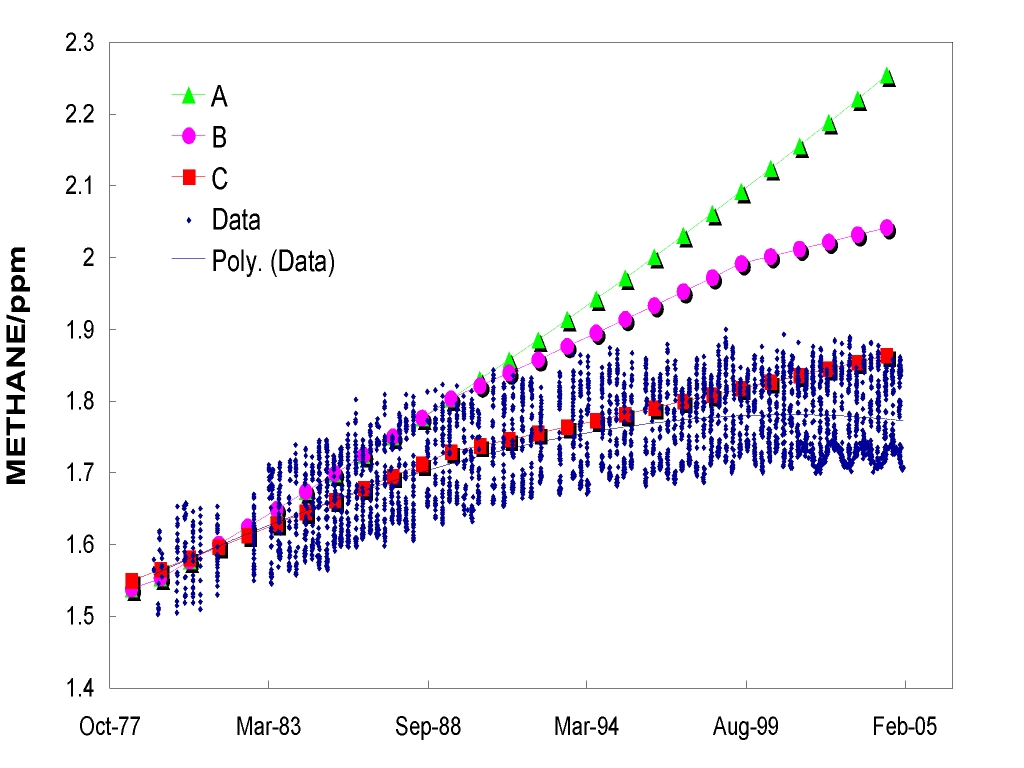
on the emission scenerios in Hansen, et al, 1988 (implicit to Hansen's congressional testimony) we now show a comparison between the predicted methane concentrations from Scenerios A, B and C.

(Click on image to enlarge and make clearer)

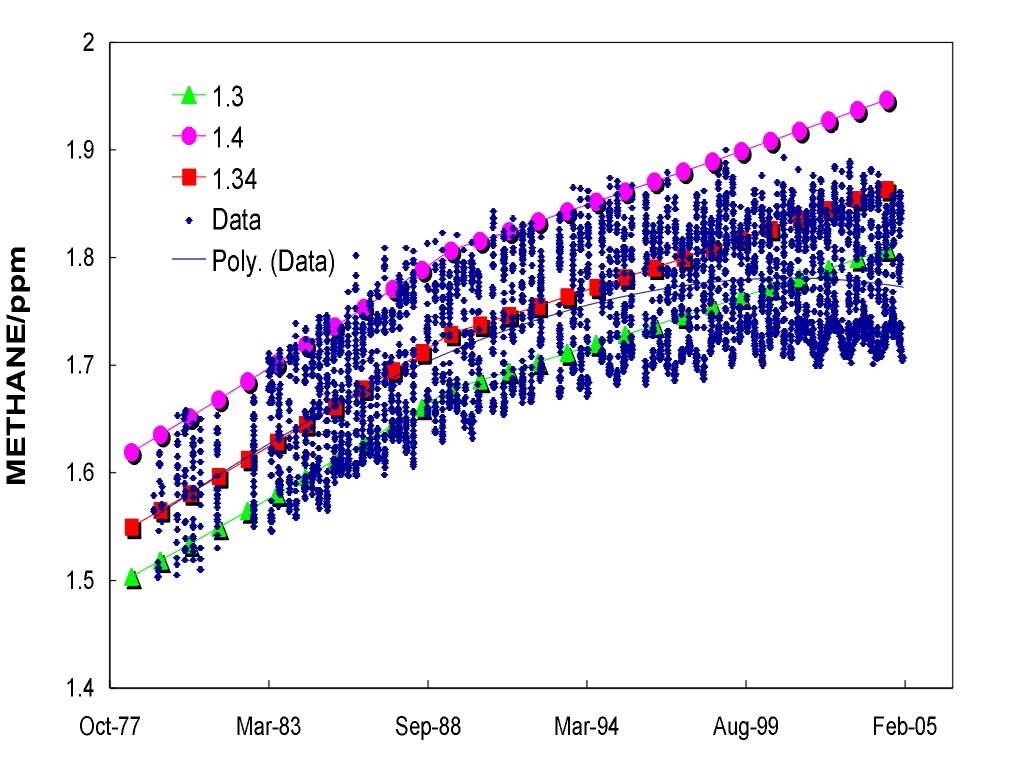
There is a bit of a cheat here. Hansen, et al. assumed that the mixing ratio was 1.4 ppb in 1958. The figure above assumes 1.34 to give the best fit to the data. The figure below shows the mixing ratios assuming 1.40, 1.34 and 1.30 ppb in 1958 with Scenerio C as described in Hansen et al.

(Click on image to enlarge and make clearer)

There are a number of issues here. First of all the methane mixing ratio series does not extend as far back as that for CO2. Eli is using Blake's (UC Irvine) data which extends back to 1979. Blake analyzes grab samples by gas chromatography with a flame ionization detector. This is an accurate and sensitive method. Samples are taken at fixed sites at different latitudes (Mauna Loa and Antarctic stations are used) and on ship transects. Keep in mind that since methane has an atmospheric lifetime of only a few years, that concentration will vary with latitude and altitude, since the sources are at the surface and emissions are concentrated in the northern hemisphere. Thus it is not trivial to say which of the three starting points is the best. For example, the lower one is more representative of the Antarctic measurements, the top one of mid northern latitudes, and so on.

The important points associated with these scenerios and the data are:

- Scenerio C from Hansen, et al. was a good model for the actual CH4 mixing ratios for about a decade.

- Scenerios A and B were overestimates for methane forcing

- Beyond 2005, even Scenerio C is beginning to exceed actual mixing ratios.

- Claims by Michaels that actual emissions followed Scenerio A are falsified for both CO2 and CH4. At best Michaels is culpable for not RTFR. At worst he is a stone liar and a perjurer.

- Those attempting to defend Michaels have either not RTFR, or cannot UTFR or are just passing gas.

- Comparison of trends in greenhouse gas emissions with these predictions show that alternative scenerios such as those proposed by Hansen are possible.

- Most importantly it shows that reasonable scenerios can be constructed over a ~20 year period (contrast that with economics for example).

- It shows that many details in emission scenerios are unimportant, or rather that false estimates in one direction are most likely going to be cancelled by false estimates in the other for a different forcing agent, and that on average the scenerios should be useful for larger periods.

Saturday, June 03, 2006

Update on scenerios....


It looks increasingly like Scenerio C from Hansen et al, is a much the best match (except for CO2 after 2000) to the actual greenhouse gas mixing ratios up till now. If you look at the prediction, there is not much difference between those for Scenerios B and C. The bottom line is that anyone who says Scenerio A is the best match is blowing smoke. Finding a consistent set of data for all of the non-CO2 greenhouse gases is proving to be a problem. Hopefully graphs tomorrow.

Friday, June 02, 2006

Scenerio A B and C

Having posted on Hansen et al., assumptions for CO2 forcing, it struck me that there was some value in posting the scenerios for the other gases. Might even get others to do some of the work.

CH4

A: Begins at 1.4 ppbV in 1958. Increases by 0.06%/yr until 1970, 1%/yr until 1980 and 1.5%/yr thereafter.

B. Begins at 1.4 ppbV in 1958. Increases by 0.06%/yr until 1970, 1%/yr until 1980, 1.5%/yr until 1990, 1%/yr until 2000 and 0.5%/yr thereafter

C. Begins at 1.4 ppbV in 1958. Increases by 0.06%/yr until 1970, 1%/yr until 1990, 0.5%/yr until 1990, 1%/yr until 2000 and is constant thereafter.

Amazingly, the data most closely matches scenerio C. Methane concentrations level off ~1990 so all scenerios overestimate methane concentrations. Scenerio A is wildly off. This is a serious problem for anyone trying to claim that Scenerio A is the McGuffin.
------------------------------------------------
CFCs (principally CFC-11 and 12) . Note: the scenerios look at emissions not concentrations. CFC lifetimes are assumed to be 75 and 150 years

A: Data ends in 1982. Emissions are assumed to increase at a rate of 3%/yr.

B. Data ends in 1982. Emissions increase at a 3%/yr until 1990, 2% until 2000, 1% until 2010 and are constant thereafter.

C. Data ends in 1982. Emissions increase at a 3%/yr until 1990 and then decrease linearly to zero.

The problem with interpreting this is that while C best approximated what happened with CFCs, the HFCs that were introduced in their stead have a significant greenhouse potential. This would have to be factored in. The Scenerios model increases in other CFC like molecules by multiplying the CFC forcing by two.
--------------------------------------
N2O

A: Increases 0.1% from 1958, 0.2% from 1980, 0.4% from 2000 and 0.9% in 2030

B. Defined differently (weird) Uses a formula that depends on anthropogenic emissions which are assumed to start at a 3.5%/yr growth rate in 1988, decline to 2.5%/yr in 1990, 1.5% in 2000 and 0.5% in 2010.

C. Flat lines after 1988.

I have to RTFRs to get beyond this to concentrations and forcings, but it is clear that Scenerio A is an overestimate for the actual forcings since 1988.

Thursday, June 01, 2006

As Mr Dooley says, trust everyone, but cut the cards....


On second thought, maybe we should exclude Pat Michaels from that. More of a shake hands and count your fingers type that boy. A few weeks ago, I posted on a push back that had developed against Hansen, and his 1988 testimony to congress. A version of the key graph from Hansen's presentation, with the data up to 2000 is shown below (UPDATE: Eli substituted a new figure with observations updated until 2005 from PNAS: Global temperature change Hansen, Sato, et al. 2006 [5/11/07])


As you may recall, our boy Pat in later testimony to the US Congress, had erased the lines showing scenerios B and C and then claimed that Hansen's prediction was too high. In defense of Michaels, folk were claiming that Hansen had never said that scenerio B was the most likely. Eli went and RTFR (J. Geo Res. 93 (1988) 9341), and sure enough Hansen et al. sure enough said that B was the most likely scenerio

Now comes Paul Krugman, who as part of a column on the mendicity of the global warming denialists (Swift Boating the Planet), flat out calls Michaels a fraud, and takes Hansen to task for being unwilling to do so.
Even now, Dr. Hansen seems reluctant to say the obvious. "Is this treading close to scientific fraud?" he recently asked about Dr. Michaels's smear. The answer is no: it isn't "treading close," it's fraud pure and simple.
This, of couse, sets the cat among the canaries. Michaels posting from the Climate Change Denial Center of the world replied that he was sorely wounded, and then sets us off on a wild goose chase, commiting a second fraud.
NASA scientist James Hansen had a model that did just this, published in 1988, and referred to in his June 23, 1988 Senate testimony as a “Business as Usual” (BAU) scenario.
BAU generally assumes no significant legislation and no major technological changes. It’s pretty safe to say that this was what happened in the succeeding ten years.
He had two other scenarios that were different, one that gradually reduced emissions, and one that stopped the growth of atmospheric carbon dioxide in 2000. But those weren’t germane to my discussion. Somehow, Krugman labelled my not referring to them as “fraud.”
The BAU scenario produced a whopping surface temperature rise of 0.45 degrees Celsius in the short period from 1988 through 1997, the last year for which there was annual data published by the United Nations’ Intergovernmental Panel on Climate Change at the time of my testimony. The observed rise was 0.11 degrees.
I cited the reasons for this. In fact, the rate of carbon dioxide increase in the atmosphere was quite constant–rather than itself increasing like compound interest–during the period.
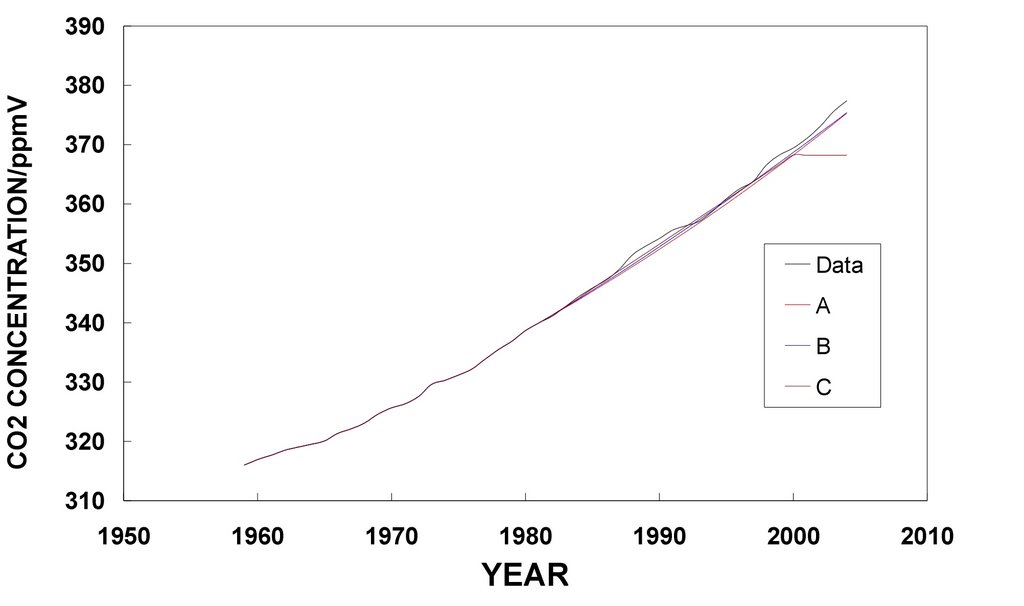
The reason this is a fraud, is that there is very little difference up to 2004 in CO2 mixing ratios for Senerios A and B (and C tracks right along until 2000 when it goes flat). The graph below shows the data (Mauna Loa), and the predictions of Hansen's Scenerios A, B and C for CO2 concentrations.


(Click to enlarge and produce a clearer image)
Moreover, the assumptions of Hansen, et al. for the growth of CO2 concentrations was very good (both Scenerios A and B are about 2 ppm lower than measured in 2004). OTOH, we are now only about 18 years from the publication of the Hansen paper.

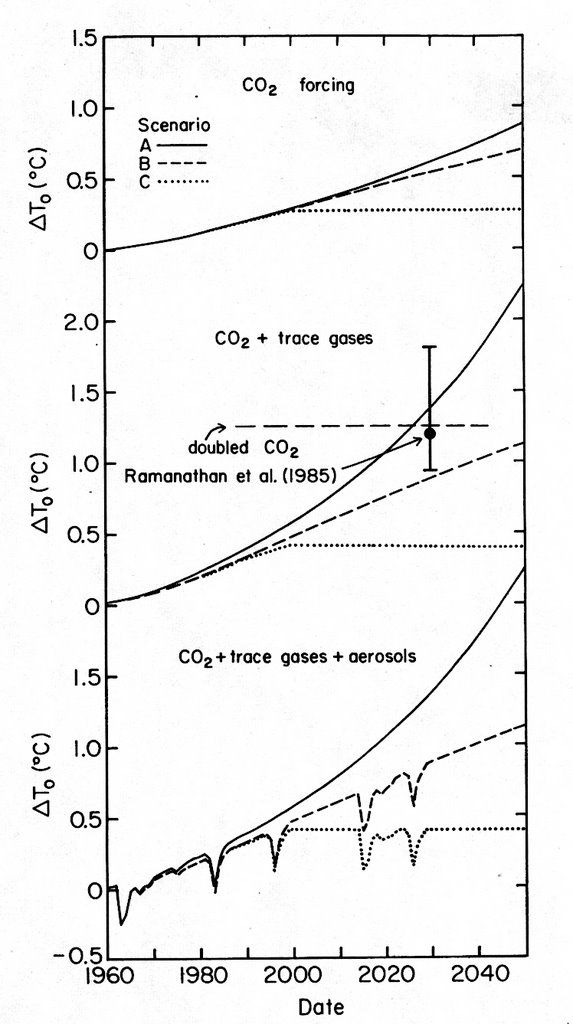
Until 2010, the difference in forcing between Hansens scenerios A and B all come from changes in concentration of chlorofluorocarbons, methane, and nitrous oxide and volcanic eruptions. You can see this in Fig. 2 from the paper. That figure shows (copy below) forcings from CO2 increases (top), CO2 + trace gases (middle) and CO2 + trace gases + aerosols from volcanos (bottom).

(Click to enlarge)

The dip in the bottom third near ~1982 represents the effect of the eruption of El Chichon, the later dips are guesses about when major eruptions will occur. Pinatubo came at in the 90s, a bit earlier than assumed, but the depth of the effect was about right.

So now the question is, how well did Scenerios A, B and C match the actual growth of concentrations of the other greenhouse gases and how well did the observed forcing match that assumed in each Scenerio. Unfortunately that means I have to find the observational data. Hints are allowed.

P.S. I see from Michaels post that RPJ has jumped the Hansen shark again.
On May 30, Roger Pielke, Jr., a highly esteemed researcher at University of Colorado’s Center for Science and Technology Policy Research, examined Hansen’s scenarios. Of the two “lower” ones, he concluded, “Neither is particularly accurate or realistic. Any conclusion that Hansen’s 1988 prediction got things right, necessarily must conclude that it got things right for the wrong reason.” (italics in original)
Well Roger, if you happen to peek in you can see that Hansen, Fung, Lacis, Rind, Lebedeff, Ruedy and Russell nailed the CO2 concentrations and the forcing from it.

Update: The emission scenerios for methane (CH4) are now posted.

Tuesday, May 30, 2006

Man bites dog......


stories are beloved in the press. We also know that the denialists believe that CO2 is life. Well, in some cases life can bite....

Rising levels of carbon dioxide—a so-called greenhouse gas that traps heat within Earth's atmosphere—can fuel booming poison ivy growth, a new study reports.

Even worse, the rash-inducing vines may become more potent.
At ~600 ppm CO2 poison ivy growth is about 150% faster than in today's ambient atmosphere and the active compound undergoes a chemical transformation and becomes more potent.

Which leaves the question of how much worse the ivy itches today because of those global climate change denialists. (snark off)


Monday, May 29, 2006

Parsing greenhouse gas driven sea level rise.....


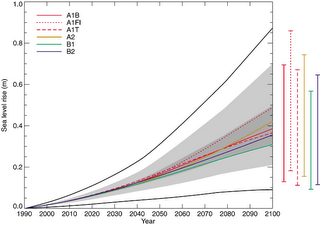
Is not trivial. We have seen the IPCC TAR predictions for sea level rise until 2100

where the dark band is the average of all of the GCM predictions over the 35 emission scenerios. This best estimate of 30 to 40 cm by 2100 is not very scary, although it is concerning. More concerning if you live in Florida than Colorado, but still it looks like it can be handled.

But wait, there is still more. If you look carefully (or read the text) you find that the rate of sea level rise increases in the second half of the 21st century by a factor of ~1.6 over that in the first. So, in the spirit of the second law of thermodynamics, it is going to get worse, before it gets better.

But there is STILL more, there is good evidence that there is a 50 - 100 year time lag for the global temperature due to the thermal inertia of the oceans, so, we are already committed to sea level rise, even if we stop emitting excess excess greenhouse gases today.

And since we are not going to stop emitting excess CO2 tomorrow, there is STILL MORE, if you look further out in time you get this prediction:

The top figure is the prediction for increasing CO2 by 1% a year for 70 years and then holding it constant, the bottom is for increasing CO2 by 1% a year for 140 years and then holding it constant. If the energy content of the atmosphere and ocean increases, it will take a long time to melt a lot of ice, and warm up the ocean, but melt and warm it will. That, is already a LOT of sea level rise. So it may not get better, but at least in a few hundred years it may not get worse.

BUT there MAY BE STILL MORE, we don't know a lot about the mechanics associated with ice sheets breaking apart. We assume that it will take millenia, but Hansen points out that it may only take centuries. That is a short enough time that if you hurry up and buy your Hummer now you may be able to screw your great grand kids. In Hansen's words:

A 20-meter sea level rise is not required to wreak havoc with civilization today. Three-quarters of a meter each from Greenland and Antarctica would do the job quite well.
Things may get a lot worse before they get better.

Sunday, May 28, 2006

What the devil are they doing in the Virgin Islands....


Tim Lambert is discussing the question of how much CO2 Al Gore generates. Besides being an opportunity for bad jokes this cries out for a bit of data. Eli went to the United Nations Statistics Division for some comparative international values. You can look up how the average person in your particular flyspeck does, but here are some comparative values:


Country annual/capita per day per day

metric ton kg lbs
Australia 18.3 50.1 110.3
Brazil 1.8 4.9 10.8
China 2.7 7.4 16.3
France 6.2 17.0 37.4
Germany 9.8 26.8 59.1
India 1.2 3.3 7.2
UK 9.2 25.2 55.5
US 20.9 57.3 126.0
Virgin Isl. 91.9 251.8 553.9


Eli, pointed out to Ms. Eli that he only generates 60% of his weight in hot air. Ms. Rabett replied that he should do better in both regards. Be that as it may, the interesting point about these figures is the difference between the UK and Germany on one hand and France on the other. Nuclear electrical generation appears to reduce CO2 emissions/capita by about a third.

Achenbach does a Colbert on Bill Gray. . . . .


Dear readers, take yourself over to the Washington Post where Joel Achenbach does a demolition of Bill Gray and bystanders.

IT SHOULD BE GLORIOUS TO BE BILL GRAY, professor emeritus. He is often called the World's Most Famous Hurricane Expert. He's the guy who, every year, predicts the number of hurricanes that will form during the coming tropical storm season. He works on a country road leading into the Front Range of the Rocky Mountains, in the atmospheric science department of Colorado State University. He's mentored dozens of scientists. By rights, Bill Gray should be in deep clover, enjoying retirement, pausing only to collect the occasional lifetime achievement award......
He's loud. His laugh is gale force. His personality threatens to spill into the hallway and onto the chaparral. He can be very charming.
But he's also angry. He's outraged.
He recently had a public shouting match with one of his former students. It went on for 45 minutes.
He was supposed to debate another scientist at a weather conference, but the organizer found him to be too obstreperous, and disinvited him.
Much of his government funding has dried up. He has had to put his own money, more than $100,000, into keeping his research going. He feels intellectually abandoned. If none of his colleagues comes to his funeral, he says, that'll be evidence that he had the courage to say what they were afraid to admit.
Which is this: Global warming is a hoax.....
In just three, five, maybe eight years, he says, the world will begin to cool again.
We sit in his office for 2 1/2 hours, until the sun drops behind the mountains, and when we're done he offers to keep talking until midnight. He is almost desperate to be heard. His time is short. He is 76 years old. He is howling in a maelstrom.
and much more. Perhaps you need too much background to get it, but you can hear the teeth grinding over at CEI and out to Colorado.

Monday, May 22, 2006

Touche....


Well a certain someone has threatened to cut Eli's ears off, and the NSA and all that is following everyone around, so, for the truly paranoid we recommend TOR an anonymouse net communication system from the Electronic Freedom Foundation. It does slow things up tho however some of the results are fun, for example, being rerouted to all the Googles in the world.

Did someone hear a seal bark?

Saturday, May 20, 2006

Banned in Boulder....


UPDATE 1/2/2007: Sometimes circumstance is fell. It turns out that one of Roger Pielke's children has a similar name to the one I used in this post which is now replaced by XXXX. This explains his negative reaction. For that I sincerely apologize. There was no intent or knowledge on my part about the child's name - Eli Rabett
------------------------------------------------------------------
Something that Eli said has really bothered Roger P, so it was Banned in Boulder. Should anyone be interested it was a response to this trio of statements from Andrew Dressler

Let's go back to what I said: "I would argue that there is a strong consensus that most of the warming over the last 50 years is likely due to human activities."
At the stated level of precision/uncertainty, there is no argument that a strong scientific consensus supports this statement ... do you disagree with either the statement or that a consensus exists, Roger?
Jim Clarke

All studies that attempt to determine the percentage of the recent warming that is man-made, use GCMs to make that determination. There are a significant number of well-qualified scientists who dispute that the GCMs have any skill (whether you like it or not). Therefore, there is still a significant debate as to how much of the recent warming is man-made.

and Roger Pielke, Jr.

You write, "There is no reasonable definition of "significant" that would allow one to truthfully say that "significant debate" is occurring over this statement."
Well the IPCC is debating this statement right now and is changing key parts of it from "most" to "dominant" and "likely" to "very likely" --- all that seems pretty significant.
To which I replied that the discussion reminded me of an old story. Andrew and XXXX were walking along a park path. XXXX jumped with shock when she saw a woman lying motionless in a pool of blood. Andrew went over and felt for a pulse, finding none, he said: XXXX this woman is certainly dead.
In another version Jim and XXXX were walking along the same park path. XXXX jumped with shock when she saw a woman lying motionless in a pool of blood. Jim grabbed her elbow and said: That is red wine she spilled, obviously a drunk, sleeping it off, let's go.
Finally Roger and XXXX were walking along the same park path. XXXX jumped with shock when she saw a woman lying motionless in a pool of blood. Roger said, not very interesting, we all know she is dead, but the real question is whose policy is to blame. If you read my paper (link provided) you will learn that it is all the fault of the criminologists.


Solving the climate change and budget problem in one go....


The US has a large budget deficit and low auto mileage. There are two ways the later problem could be solved. The first would be to mandate fleet mileage limits, but as we have seen this is a game that the auto companies play, the second would be EU level taxes on gas. Since the latter are regressive that must be accompanied by equivalent cuts on payroll taxes which are regressive. The net effect would be neutral or slightly progressive. If accompanied by lifting of the maximum earnings on which Social Security taxes are levied the effect would be to make the total tax system much more progressive, increase revenues and solve the Social Security funding issue into the far future.

Prof. Rabett's handy dandy all purpose maxisolution.

An Inconvient Truth and the Conventional Wisdom


The most sensible comment I have seen on "An Inconvenient Truth"

Mr. Gore clearly intends the exercise as an unconventional way to set off a public-policy debate. In New York, he'll be participating in a kind of town-hall meeting on global warming that coincides with the film's opening there. After that, "he's going to be out speaking on this issue and continue communicating on this issue," says Michael Feldman, an aide and adviser to the former vice president. Many of the proceeds from the movie are going to a new organization fighting climate change.
from the Wall Street Journal, and the conventional wisdom from the same source
That inevitably will raise the question of whether Mr. Gore intends the exercise to revive his political career. When the movie was previewed at the National Geographic Society's headquarters in Washington, an official there noted that the widespread reaction among Geographic employees who had seen the film earlier was: "Do you think he'll run again for president?" Mr. Gore responded with a dismissive wave of his hand.

Sunday, May 14, 2006

Quotes from Chairman Eli.....


I have a small suggestion for economists who want to see the effects of illegal immigration for themselves. Wherever you are find the local shape up, you know, the 7-11 where the landscaping and building contractors show up between 6 and 10 in the morning to pick up casual labor. Go down there and watch what happens. Then you can close your eyes and claim that these folks are not in your community, and yes, Virginia, they are depressing wages in that sector. Stick around and watch what the guys who don't get picked up do, it ain't pretty. The best way to handle the situation is to swallow deeply and set up a city/county run center with rules, but these are opposed by those who like having mown lawns and cheap kitchens. Like sausage, the populance has no stomach for seeing how it is made.

If you don't know where these places are in your city, then a) you have not been looking, b) just ask the guys who do your lawn or remodel your kitchen. If you can find a REAL old timer, ask him (and it will be a him in that case) how the ethnic identity of those doing casual labor has changed in the last 40-50 years.
Otherwise, don't bother talking to me about it. - Originally posted at Brad deLong's blog

And btw, if you are in a different country, the same rules apply.

Wednesday, May 10, 2006

Sea-level Rise Central


James Titus was one of the first, if not the first to think about the implications of climate change for sea level rise and how to meet that challenge. His private web site is an extraordinary resource with links to many primary references on the subject and his expert evaluation of the work.

The most amusing is a recording of "When the North Pole Melts" from 1988, created at the Climate Institute's "Preparing for Climate Change" conference that Ian Castles quoted from in starting Rabett down this little hole. Eli is working through the references before posting again on that issue, however you can gain a good idea of the situation by starting at Titus' Captain Sea Level's Links reading his comments and going through the links. If you don't have much time start at what Titus calls the EPA's mea culpa for having over-estimated future sea level rise during the 1980s and go on to a recent talk by Jim Hansen (the parenthetical comments are priceless). Since the origin of the set-to was in Australia, it is worth quoting a stanza from "When the North Pole Melts"

The Australian Labor Party wants to see the economy grow;
So their platform says that we will tow Santa from the Equator to the South Pole.
If the Russians will get him through the Bering Strait,
The currents can do rest.
But the Conservatives would rather that we make him wait,
And put him to the market test.
But What Will Santa Do?

Chorus

When the North Pole Starts to Melt?
What is gonna happen to his little elves?
Will they be too busy swimming to make the toys?
And what will Santa do?
If the North Pole melts too fast
Is this Christmas gonna be his last?
What will parents have to tell their girls and bays?
It sounds better than it reads. A classic in a capella science

Sunday, May 07, 2006

Always RTFR....

Always RTFR....

Ian Castles has responded.

You ask 'was the latter even printed?' Yes, the Director of the Office of Policy Analysis of the USEPA cited three multi-authored books that had appeared in 1983, 1985 and 1987. It is common for books to be printed.
The conference was sponsored by (among others) the Climate Institute, NOAA, the US Department of Energy, the US EPA, the National Science Foundation, NASA, the World Resources Institute and UNEP in cooperation with the Participating Agencies and Universities of the Canadian Climate Program. As might be expected, the Proceedings were printed.
In another presentation at the Conference, James Titus, Project Manager for Sea Level Rise at the EPA, presented a table showing that NASA's estimate of sea level rise was 70 cm by 2085 and that estimates by other authorieies of sea level rise to 2100 were: EPA, 56-345 cm; National Academy of Science, 50-200 cm.; and Hoffman et al, 57-368cm.
So the CONSENSUS view changed by a huge margin over a period of 13 years - it wasn't just one person's estimate
Eli's first thought was to point out that Castles was pointing to Morgenstern's impression of a consensus not a consensus. But then I remembered RTFR. Well, I don't have it, but I can probably get it tomorrow.

Still, Google is your friend, and you can find a lot of things if you know how to look. But before we do, let us remember that Castles claims the 1987 consensus (according to Morgenstern) was that by 2100 the global sea level will rise by 61-238 cm, while in 2000, the IPCC Third Assessment Report (TAR) consensus rise was 9-88 cm.

And gee, guess what I found. From the Intergovernmental Panel on Climate Change (IPCC). 1990. Potential impacts of climate change. Report of Working Group 2, Intergovernmental Panel on Climate Change, 1-1 to 2. Geneva: World Meteorological Organization (WMO)/United Nations Environment Programme (UNEP).
Global warming will cause a thermal expansion of the upper layers of the ocean and this expansion, together with the expected melting and movement into the ocean of some land-based glaciers, is expected to accelerate the current sea-level rise trend. A rise of 9-29 cm is expected over the next 40 years, or 28-98 cm by 2090 (Working Group I Report - Summary).
That's 1990 folks, from the First Assessment Report (FAR). Right in line with the "9-88" cm rise expected in the IPCC TAR ten years later and with the US National Academy report on Responding to Changes in Sea Level: Engineering Implications (1987) That's 1987 folks, the same time that Castles claims the consensus estimate is 61-238 cm. The second chapter of the report summarizes expert opinion on global temperature increases and the associated sea level rise. It concludes:
Apply these values to an estimated temperature change of 3.5 +/- 2 C due to a doubling of greenhouse gases over the next century, and the associate range in global mean sea level change is from 24 to 154 cm.
But there is more, let us go to the TAR, Figure 11.-2.

As the caption explains "The region in dark shading shows the range of the average of AOGCMs for all 35 SRES scenarios. The region in light shading shows the range of all AOGCMs for all 35 scenarios. The region delimited by the outermost lines shows the range of all AOGCMs and scenarios including uncertainty in land-ice changes, permafrost changes and sediment deposition" In other words, the dark shaded region (30-50 cm) is the most likely, the gray shaded region (20-70 cm) is somewhat least likely and the region between the two black lines (9-88 cm) encompasses the full range of possibilities. The core estimates are quite close to the FAR 28 - 98 cm. The high end estimate of 154 cm from the 1987 National Academy report has come down significantly, but then again the upper temperature limit from that report was 5.5 C as opposed to the 5.1 of the TAR.

You really do have to RTFR with these guys.

What should the IPCC do....


As many are aware, the US government has widely distributed the second order draft of the fourth IPCC climate change evaluation. This has opened the document up to sniping, both in an indirect (and CYA manner) and more directly (see the comment by Vincent Gray.

This raises the issue about what the IPCC should do.

The first is that the IPCC should refuse to respond to comments by anyone who has publicly broken their agreement to keep the draft confidential.

The second is that the IPCC should inform the US government that they have seriously damaged the process.

While it would be very difficult to implement, the IPCC should take over distribution of all future drafts in the US and not leave this to US government agencies.

RTFR (and the dictionary and the thesaurus, and don't forget Bartletts)


E has been out and a commenting in various places. Unfortunately he is not very impressed by the moral behavior of many posters. Being an old bunny, E is well aware that folk will utter absolute nonsense with perfectly straight faces, but he is shocked, I say shocked to have discovered that this behavior is common among the purveyors of Potemkin science (see the end of that post).

It is hard to know where to begin. Well we can start with two little libertarians at Deltoid. In defense of his pathological hatred of government Nanny Government Sucks used this quote:

"Government is not reason, it is not eloquence - it is force. Like fire, it is a dangerous servant and a fearsome master" - George Washington
and if you google that little beauty you get about 46,000 hits, which shows that those of the libertarian persuasion at least know how to use the copy and paste function of their computers. One problem. No one can find the original source. George never said it

In the same thread, Jack Strocchi chimes in with another golden oldie
"Thomas "government is best which governs least" Jefferson
This one, it appears was originally adopted (there appears to be an earlier source) by Henry Thoreau who attributed it to Jefferson, but TJ never said or wrote it.

We now move on to E's favorite pinata, RPJr. himself. RPJr is a smart cookie. Although I would bet significant money that he has access to the second draft of the IPCC report on climate change (AR4), he knows that he cannot quote directly from it without exposing himself to significant censure. Therefore he used a quote from a Yahoo Asia report to launch the first of many attacks on the document. Roger has the Steve Colbert's to write:
A second key difference is the substitution of the phase "dominant cause" for the word "most." IPCC terms are not chosen arbitrarily and my reading of this is that as far as GHGs, it represents a step back from the statement in 2001. I equate "most" with a majority (>50%) and "dominant" with a plurality. I am sure commentators will have a field day with that. Were I a betting person I'd wager that "dominant" won't last until the end.
As Eli pointed out there is only one problem with this. The definition of dominant.


dom·i·nant http://www.m-w.com/
Function: adjective
1 : commanding, controlling, or prevailing over all others
2 : overlooking and commanding from a superior position
3 : of, relating to, or exerting ecological or genetic dominance
4 : being the one of a pair of bodily structures that is the more effective or predominant in action
synonyms DOMINANT, PREDOMINANT, PARAMOUNT, PREPONDERANT mean superior to all others in influence or importance. DOMINANT applies to something that is uppermost because ruling or controlling .


And, just for fun, how about most


1 : greatest in quantity, extent, or degree
2 : the majority of
Let us be plain, Roger sucked in some pretty sharp characters with his little newspeak dictionary work. Andrew Dressler wrote

As far as "dominant" goes, I agree that this is not clear. I hope that they substitute this with a more transparent word when the final version comes out.
And after it was pointed out that dominant was totally clear and transparent to anyone with a dictionary and without an agenda he was not able to accept the idea that his friend Roger purposely mislead him
I think that what the writers intended for "dominant" was the meaning of "vast majority". But I agree w/ Roger that "dominant" is a poor word.
Eli had to hammer the point home
Andrew, what problem do you have accepting that if someone says dominant with respect to the influence of greenhouse gases they mean a commanding and controlling forcing prevailing over all others? They certainly do NOT MEAN MOST.
Unfortunately this caused Andrew to say
I have the document and the quote above is correct. I do not have a problem with "dominant" if that's what they mean. My point was that since this is a draft, I wonder if they really mean that. We'll see when the final version comes out.
Which, at least technically is a violation of the conditions he accepted for viewing the AR4 draft and I am sorry that he felt compelled to do that. Roger, of course, having set the trap, did not step into it. You do have to pass the definitions part of the SAT to be a professor at Colorado?

And finally in the analogy section of the test we have Ian Castles, who used this beaut:

I've seen a lot of consensuses evaporate in my time, but let's take an example from climate change science. In October 1987, Richard Morgenstern of the US EPA spoke on 'Implications of climate change for environmental policy making' at the conference 'Preparing for Climate Change' which was sponsored by the World Resource Institute, UNEP, the US National Science Foundation and 12 other US-based organisations.
He said that there was 'an emerging concensus that the global warming could result in a rise in sea level on the order of two to seven feet by 2100', and cited multi-authored books that had appeared in 1983, 1985 and 1987.
The 'two to seven feet' translates into 61-213 cm. Thirteen years later the IPCC concensus for the sea level rise between 1990 and 2100 was 9-88 cm - a decrease of 85% at the top of the range and nearly 60% at the bottom. Doesn't this mean that Paltridge may have a point when he says that 'Consensus on its own is not the sort of thing on which sensible people put their money?
The only problem being that he is comparing a 20 year old conference report by one person, expressing his seat of the pants impression of emerging science, representing at most one agency and one government, to a published report resulting from a structured consultative process involving international panels of experts.

And you know, people fell right into the hole that Ian Castles dug for them.

Wednesday, May 03, 2006

The cost of astroturf.....

If you are the Alexis de Toqueville Institution, it's for sale at $20K a pop and they will throw in an new front organization for free....

February 29, 1994
To: William P. Orzechowski
Tobacco Institute
Re: ETS Study
From: Cesar V. Conda

Per your memo, what follows is a proposed action plan by the Alexis de Tocqueville Institution on the ETS issue
ETS is environmental tobacco smoke aka second hand smoke
1. Produce a research paper to assess the research and scientific methods used in the original ETS studies -- and EPA's most recent cost-benefit "analysis" of the impact of ETS. Possible authors include - Fred Singer, Kent Jeffreys (formerly djrector of the Competitive Enterprise Institute's Environmental Studies Program). or another reputable economist (perhaps Bob Tollison).

2. Assemble an advisory board of economists and scientists who could endorse the findings in the report (perhaps call it the Commission on Environmental Science -- we envision that this would be used as framework to examine a variety of environmental science questions -- from endangered species to pesticides reform).

3. AdTI would release and distribute the report to press outlets nationwide and circulate widely on Capitol Hill.

The timetable for producing such a report will depend on the level of research that you believe is necessary. A baekgrounder length report by policy analysts like a Kent Jeffreys or Fred Singer would probably take 2-3 weeks; an original research paper by an academician could take several months.

My sense is that we could produce an efffective backgrounder report which reviews all of the known facts about the science used in the ETS ease. Moreover, the Commission on Environmental Science -- or whatever we choose to call it -- would give the issue added attention and prominence.

The cost of this project would be $20,000 which includes all costs (contracting, distribution, staff time, etc.)

As you know, we can move on this very quickly.
One stop shopping.