Saturday, October 20, 2012

Friday, October 19, 2012
Physics Follies Strike Again!
A year and a half ago, I mentioned on Rabett Run that the American Physical Society (APS) was thinking about establishing a Topical Group on the Physics of Climate. Well, it has happened !!!
I received an email from the APS today, announcing that the newly formed Topical Group on the Physics of Climate (GPC) is hosting a Focus Session entitled "The Physics of Climate" at the next APS General Meeting, in Baltimore on March 18-22, 2013.
An invited speaker has been selected: Geoff Vallis (Princeton Program in Atmospheric and Oceanic Sciences)
A Invited Symposium has the theme "Climate as a Complex Dynamical System,", and includes the following speakers:
- Bill Collins, Professor, Earth and Planetary Science, Univ. California, Berkeley
- Peter Huybers, Professor, Earth and Planetary Sciences, Harvard
- Sasha Madronich, Senior Scientist, Atmospheric Chemistry, NCAR
- Claire Parkinson, Aqua Project Scientist, Goddard Space Flight Center, NASA
- Nir Shaviv, Racah Institute of Physics, Hebrew Univ. of Jerusalem

In addition, contributed talks are solicited, on topics that include (but are not limited to)
1) Climate as a complex dynamical system;
2) Mechanisms, magnitudes, and timescales of processes that affect climate, including greenhouse gases, aerosols, solar variability, feedbacks involving clouds, water vapor, sea ice, hydrological and carbon cycles, and ocean-atmosphere interactions;
3) Physics of proxies used to infer past climate forcings and properties for which instrumental records are unavailable;
4) Computational and statistical analyses of climate models and measurement systems.
Specific areas underlying these topics include, but are not limited to, fluid dynamics, nonlinear and complex systems, gas, condensed and interfacial phase behavior, radiation/heat transfer, phase transitions, measurement science, computational physics, statistics, biophysics, chemical physics and geophysics.
Contributed talks should focus on climate physics, without reference to issues of policy, legislation, or society. The Focus Session may include one or more invited presentations.
The above information was extracted from an email from Jim Brasseur, Chair of the newly formed Topical Group on the Physics of Climate. The speakers are quite distinguished, and represent a spectrum of the several disciplines in climate science. Madronich is a chemist, while Shaviv is an astrophysicist who can assess the purported linkage between cosmic rays and climate. Most noteworthy is that the fringe handful who deny that the humanity is changing the climate are not included. Naturally they may see this as a conspiracy.
It is a long-standing tradition that any APS member can present a contributed paper at any meeting. So if the deniers feel excluded, they are free to submit a contributed talk. IF they dare to do so infront of an expert audience. I think the deniers won't show up.
Thursday, October 18, 2012
Rogue geoengineering and scrivener's error
A shadowy businessman from my state named Russ George has apparently dumped boatloads of iron into the Pacific off the Canadian coastline in an alleged carbon sequestration project. I first thought he had hooked up with the Haida, a Canadian First Nations indigenous group, in order to get some political backing, but the link shows it may have been more involved:
The dump took place from a fishing boat in an eddy 200 nautical miles west of the islands of Haida Gwaii, one of the world's most celebrated, diverse ecosystems, where George convinced the local council of an indigenous village to establish the Haida Salmon Restoration Corporation to channel more than $1m of its own funds into the project.
The president of the Haida nation, Guujaaw, said the village was told the dump would environmentally benefit the ocean, which is crucial to their livelihood and culture.
"The village people voted to support what they were told was a 'salmon enhancement project' and would not have agreed if they had been told of any potential negative effects or that it was in breach of an international convention," Guujaaw said.One imagines they could have done better things with a million dollars than financing Mr. Ross. He is of a certain infamy from his Planktos company's effort to do the same thing five years ago and sell carbon offsets certified AFAICT on the basis of their own say-so.
So now they seem to have legal trouble with international agreements that tried to regulate efforts such as those by George. However, wherever you can find a dubious legal interpretation that could harm the environment, it seems one can find a connection to the recent Rabett favorite, David "Heartstrings" Schnare:
• The London Convention / London Protocol: You may fertilize if the intent is to grow fish but not if the intent is to dispose of carbon in the ocean. Hence, focus on “restoration”.At the same link, Ken Caldeira writes:
It would be useful if any legal minds in the group would assess exactly the relevant language that Russ George has supposedly violated.
I recall that in negotiations under the London Convention / London Protocol, there was concern not to impact fish farms which of course supply copious nutrients to surrounding waters.
If my recollection was correct, somebody proposed an exception for mariculture. I piped up and said that all ocean fertilization could be considered mariculture and that the CO2 storage could be regarded as a co-benefit, achieved knowingly but not intentionally (just as when we drive a car we knowingly heat the planet although that is not our intent).
My recollection was that in response to this comment, the word 'conventional' was added to the language, so that it now reads:
"Ocean fertilization does not include conventional aquaculture, or mariculture, .. ". Resolution LC-LP.1(2008) - IMO
Incidentally, it seems that they have a misplaced comma, as I believe the word 'conventional' was meant to apply to both 'aquaculture'' and 'mariculture', but with the placement of the comma, I read this as 'conventional aquaculture' or 'mariculture'. I am not enough of a lawyer to know whether the intended meaning or the literal meaning is the one likely to prevail under some sort of adjudication process.The misplaced comma is what lawyers call scrivener's error, a great way to mess up legal documents and run up legal bills. To broadly over-generalize, under US domestic law courts will correct scrivener's error when it leads to absurd results. It strikes me as absurd to limit the regulatory exception to conventional aquaculture while expanding it to all mariculture. The legal issue here isn't domestic law though, but international law as interpreted by domestic authorities, probably Canada in this case. Hardly my field, but Article 79 of the UN Treaty on the Law of Treaties says if signatories agree there was a clerical error, you just go and fix it. I think that's where we would stand now on the clerical error, but there are other reasons for thinking George is in legal trouble (comments of Jim Thomas) regardless of the misplaced comma.
Wednesday, October 17, 2012
One climate adaptation in process for local water demand
So I'm going to get at least one of the climate change goals I've had for my Water District - recalibrate anticipated future water demand based on anticipated future temperatures.
I know that anticipating our future local water supply (about 35% is local, 55% from the Sierras, and 10% is from conservation) is really difficult. Most likely it will be worse - longer droughts and larger percent of precip coming in large storms where the water mostly flushes to the ocean instead of percolating to groundwater or caught in reservoirs. Also less snow - and we do get snow in the Bay Area hills, even if it doesn't last. But none of this translates into numbers that we can plug into our 25-year projections.
Demand, or at least aspects of it, can be modeled in a climate-changed world. Thanks to weather, we've got past unseasonably-warm years that will be just typically-warm years of the future, and the increased demands from crops and landscapes due to warmth should be easy to see.
While this analysis didn't go into a water supply master plan that we approved last week, it will go into the next iteration. I brought up the issue below, and got support from our board chair and (after discussion of other issues by staff) from the conservative Republican director on our board:
If the video above goes away, click here, click on the October 9 2012 video, and go to Minute 43.
Wish it was this easy all the time. Adaptation to climate change still seems like the easiest way to bring about acceptance of climate reality, despite North Carolina's legislature.
(Updated to replace "next week" with "last week".)
Tuesday, October 16, 2012
Here Comes the Hammer

Inference is an important tool. Reading between the lines necessary. Setting traps for the self-important, great sport. Eli suspects that the hammer is about to fall and sent Ms. Rabett out for more popcorn.
Tweet.
Monday, October 15, 2012
Pat Michaels Erases the Arctic
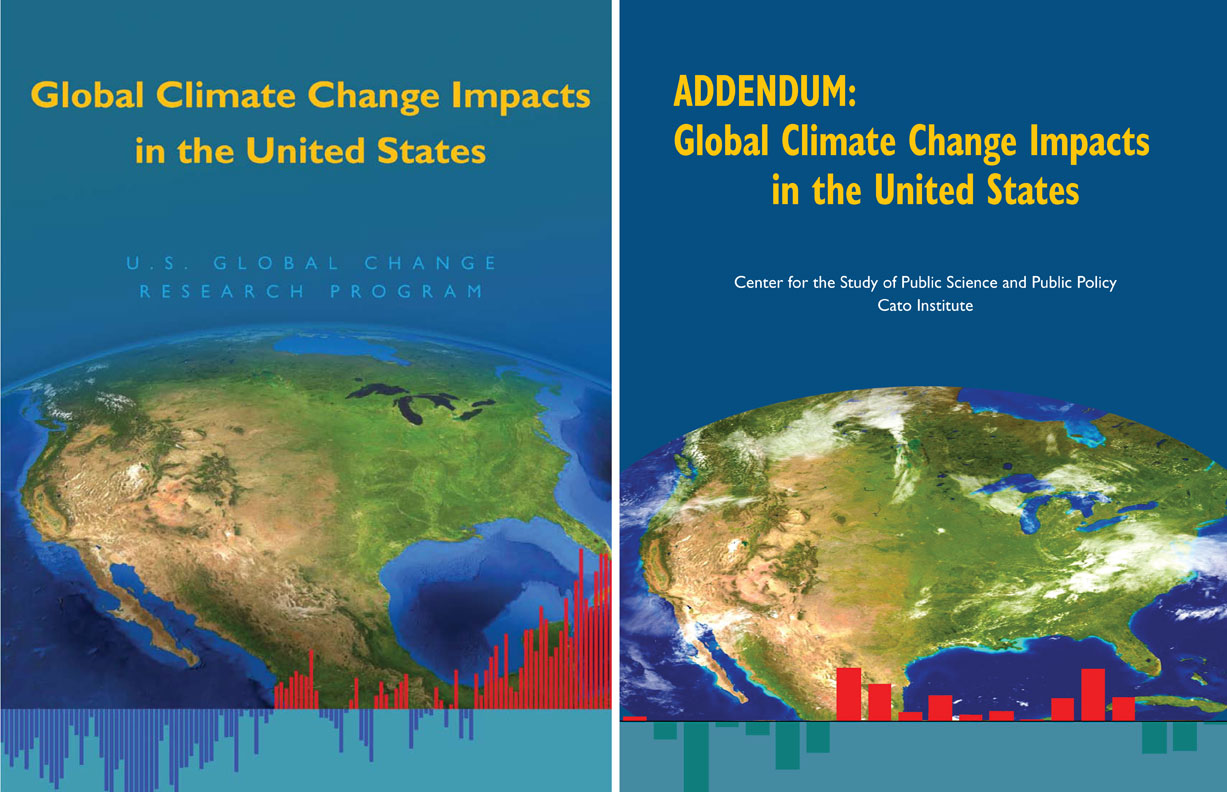
OISM Act II is about to appear, a not very amusing parody of the 2009 US Global Change Research Program Impacts in the United States report, brought to you by none other that Pat Michaels and friends** for the Cato Institute, a bunch so twisted that they are stealing themselves from their owners. Not yet released, but bunnies can read the preprint. Even on the cover Pat wields the eraser.
Typical Michaels flim flam abounds, even from the disclaimer
This Addendum to “Global Climate Change Impacts in the United States” is a fourth-order draft, one iteration from the final draft that will be released later this year. It is likely that there will be few, if any, changes of significant substance between this draft and the final copy. Minor typographical, format, and sequencing errors in the text and endnotes will be corrected in the final edit.Looking carefully at the covers one can see how CATO disappears the Arctic, but why you ask, why now.. Peter Sinclair may have the answer from a source
As such, any subsequent revisions to this draft are likely to be minor in nature.
There is a reason why Cato is putting it out now. It is not so the average person will read it. It will be handed to Republican candidates who can tout the latest science in attacking the Administration’s efforts to address climate change; and it will be used by the Republicans in the lame duck session as justification for eviscerating funding for climate change.Exactly what the OISM deception did to Kyoto. Be prepared to push at the churnalists on this one.
** Robert Balling, Mary Hutzler, Robert Davis, Indur Goklany, Chip Knappenberger and Craig Idso
UPDATE: Cato art contest: As Russell says it's hard, but not impossible to improve on Cato's art work, and indeed, he and stoat have risen to the challenge. Vote early, vote often
Sunday, October 14, 2012
Another Reason to Close Schools of Communication
John Fleck at Inkstain, points to a piece by Lauren Morello at E&E about how farmers view the issue of climate change in the US, and to no one's surprise, they deny it is happening
The farmers are more worried that the government will put them out of business than the weather, but, of course, climate change is doing the job through its cats paw weatherA February survey of 4,778 farmers across the nation's Corn Belt found that while roughly two-thirds believe the climate is changing, just 8 percent believe human activities are the primary cause.
Perhaps unsurprisingly, polls also show few growers are willing to accept measures designed to combat climate change.
Deep-seated worries about regulation
"Talking about mitigation is likely a non-starter with 60 percent of farmers," said J. Gordon Arbuckle Jr., an Iowa State sociology professor who conducted the Corn Belt poll. "That is one thing I've been talking about with my extension colleagues. And that's a key finding out of this study."
It's a conclusion that sounds right to Wilson.
"Most of the farmers will admit that climate change is happening," he said of the growers he advises in western Kentucky, on the Corn Belt's eastern fringe. "What they don't want to hear is that it's global warming induced by man's activities. In their mind, if we say, 'Yes, we think climate change is real. Yes, we think global warming is happening,' then someone is going to say, 'You are a big cause of it. You use fertilizers and chemicals and big tractors, and we're going to regulate you.'"As is usual with such stuff written by graduates of Schools of Communication, the answer is to frame the issue correctly. Allow Eli a hearty snort as he watches the carnage of this Planck problem. Planck, of course was the one who pointed out that new theories are not accepted by old scientists, but become established as they die off.
And that means that simply throwing more information at farmers isn't the answer for scientists and others who want to start a productive conversation about climate change and agriculture, experts said.Much of this puts Eli in mind of a new book, Better Off Without Em: A Northern Manifesto for Southern Secession, by Chuck Thompson, which bluntly puts it that the US (or at least the part without Kansas to Florida, would be a lot better off without the South. The opening says it all
Paul Vincelli, a professor of plant pathology at the University of Kentucky's agricultural extension, learned that lesson the hard way. As part of the school's working group on climate change and agriculture, he prepared a dense handout packed with scientific facts and figures that "provoked a little blowback" from farmers, he said.
These days, he's trying a different line when he speaks about climate change with county extension agents and farmers: "I tell them this is not something you've caused -- we've all caused it."
Like many agriculture experts working on climate change issues, Vincelli believes farmers are much more receptive to aid intended to help them adapt to environmental shifts, whether it's developing new drought-tolerant strains of corn or wheat or adopting more efficient irrigation practices.
"Mitigation is not yet really something our society wants to talk about, and that's reflected in our farmers," he said.
Hang out in my living room on any national election night and at some point in the evening, usually around 7 p.m. Pacific time, you're almost certain to hear me scream something like: "Why in the hell does the United States—and by extension the entire free world, capitalist dominion, and all of Christendom—allow its government to be held hostage by a coalition of bought-and-paid-for political swamp scum from the most uneducated, morbidly obese, racist, indigent, xenophobic, socially stunted, and generally ass-backwards part of the country?"Oh yeah, they don't know much science either. This is not to say that there are not brethren in the other states, but that they are not controlling elsewhere and mostly they get ignored or laughed at, after all Chris Monckton is a Brit. Thompson provides lots of data to buttress his polemic, but the truth is it ain't gonna happen and even if it did it ain't gonna be happy.
Unfortunately this means that things will have to get a lot worse further down the road and much harder to solve because early action is the most effective, but remember the churnalists know that it is the framing, not the reality that counts, and it's the fault of the scientists not the churnalists.
As Eli mentioned not so long ago it's not that scientists are or are not lousy communicators (say that and the Rabett will lock you in a room with Richard Alley for example), but that journalists are lousy communicators. It's their fucking (emphasis added) job and they are screwing it up to a fare-thee-well. It ain't just climate either.
That drew some blood from the Kloor side of the family.
Saturday, October 13, 2012
Wattsbusters
 Saturday night is date night Ms. Bunny calls, so Eli is turning the keys over to an evil bunny with nasty big pointy teeth, aka the Rabett of Caerbannog. He (well Eli was not going to get close enough to really tell, those nasty pointy teeth you know, and the lack of the Holy Hand Grenade of Antioch) spent his spare time learning Python to put the Wattsbuster package together. It displays global-average temperature estimates from
stations interactively selected by a user (on a global
map). The package (it is not yet totally user friendly) strips away the mystery behind the NASA/NOAA/CRU
global-temperature computations for non-technical folks. Being
able to *show* the non believers rather than just *telling* them seems to be
helpful... Instructions on downloading and installation can be found at the end of this post and a FAQ follows (btw this is Caerbannog's post)
Saturday night is date night Ms. Bunny calls, so Eli is turning the keys over to an evil bunny with nasty big pointy teeth, aka the Rabett of Caerbannog. He (well Eli was not going to get close enough to really tell, those nasty pointy teeth you know, and the lack of the Holy Hand Grenade of Antioch) spent his spare time learning Python to put the Wattsbuster package together. It displays global-average temperature estimates from
stations interactively selected by a user (on a global
map). The package (it is not yet totally user friendly) strips away the mystery behind the NASA/NOAA/CRU
global-temperature computations for non-technical folks. Being
able to *show* the non believers rather than just *telling* them seems to be
helpful... Instructions on downloading and installation can be found at the end of this post and a FAQ follows (btw this is Caerbannog's post)
Unlike many other aspects of climate-science (hockey-stick with
principal components, regressions, etc.), the global-temperature anomaly,
involving nothing more than simple averaging, is something that bunnies can
explain to non-technical friends/relatives in a way
that they actually *get it* (at least to some extent).
This seems to be the Watts-skeptic crowd's biggest vulnerability --
they've gone out on a limb by being consistently wrong about stuff that I
can explain to high-school/junior-college-educated folks...
FAQ:
###### 1. How we can know what the earth's temperature is ########
 Basically, you average together a whole bunch of measurements over the Earth's surface.
But it should be made clear that the NASA/NOAA/CRU are more interested in quantifying
how average surface temperatures have *changed* than in just calculating the
"Earth's temperature".
Look at the Y-axis of one of the NASA global-temperature plots. What you will see
is a Y-axis range of on the order of -1 deg C to +1 deg C.
Obviously, the Earth's temperature does not lie between -1 and +1 degrees. What
the NASA plots show is how the average of the temperature measurements taken by GHCN
stations has *changed* over time.
Basically, you average together a whole bunch of measurements over the Earth's surface.
But it should be made clear that the NASA/NOAA/CRU are more interested in quantifying
how average surface temperatures have *changed* than in just calculating the
"Earth's temperature".
Look at the Y-axis of one of the NASA global-temperature plots. What you will see
is a Y-axis range of on the order of -1 deg C to +1 deg C.
Obviously, the Earth's temperature does not lie between -1 and +1 degrees. What
the NASA plots show is how the average of the temperature measurements taken by GHCN
stations has *changed* over time.
It should be emphasized that we aren't interested so much in calculating the Earth's absolute
temperature as we are in estimating how it has *changed* over time.
Here is a basic summary as to how to compute average temperature changes from GHCN data.
1) For each station and month, calculate the average temperature over the 1951-1980 period.
i.e. for each station, average all the Jan temps over the 1951-1980 period to produce
the January baseline average temp for that station. Do the same for the
Feb, Mar, ... etc. temps.
For any given month, stations with insufficient data to compute 1951-1980 baselines
are thrown out (that will still leave you with many thousands of stations for
every month of the year). What constitutes "sufficient data" is a judgement call --
I require at least 15 out of 30 years in the baseline period. NASA requires 20 (IIRC).
Results are very insensitive to this (10, 15, 20, etc. years all produce very similar results).
You will end up with a 2-d array of baseline average temperatures,
indexed by GHCN station number and month.
2) For every temperature station, subtract that station's Jan baseline average from
the Jan temperatures for all years (1880-present). Do the same for Feb, Mar,
Apr, etc.
These are the station monthly temperature *anomalies*. "Anomaly"
is just a $10 word for the difference between a station's monthly
temperature for any given year and that station's baseline average
temperature for that month.
3) The crudest, most-dumbed-down procedure to compute global-average
temperature anomalies is simply to average together the monthly
anomalies for all stations for each year. This is a very crude
technique that will still give you not-too-bad "ballpark" global
average estimates.
4) The problem with (3) is that stations are not evenly distributed
around the globe. (If stations were uniformly spaced all over the
Earth, the method described in 3 would be ideal).
With method (3), regions with dense station coverage (like the continental
USA) would be over-weighted in the global average, while less densely-sampled
regions (like the Amazon region, Antarctica, etc.) would be under-weighted.
To get around this problem, we divide up the Earth's surface into grid-cells.
Then we compute the average temperature anomalies by applying (3)
just to stations in each grid cell to produce a single average
anomaly value per month/year for each grid-cell. Temperature values for all
stations in each grid-cell get merged into a single average value for that grid-cell.
Then we just average all the grid-cell values together for each year to
produce the global average temperature anomalies.
Note:
The surface areas of fixed lat/long grid-cells change
with latitude, so you will need to scale your results by the grid-cell
areas to avoid over-weighting high-latitude temperature stations.
An alternate approach is to adjust the grid-cell longitude dimensions
as you go N/S from the Equator to ensure that the grid-cell areas are
approximately equal. The grid-cell areas won't be identical (because your
grid-cell longitude sizes are limited to integer fractions of 360 degrees),
but they'll be close enough to identical to give very good results.
(i.e. good enough for "blog-science" work).
5) The gridding/averaging procedure in its most rudimentary, stripped-down
form is quite simple But it still produces surprisingly good global-average results.
The one pitfall of the above method is that if you use the NOAA/CRU standard
5deg x 5deg grid-cell size, you will end up with many more "empty" grid-cells
in the Southern Hemisphere than in the Northern Hemisphere. This will cause
the NH (where there has been more warming) to be over-weighted relative to
the SH (where there has been less).
So if you don't compute interpolated values
for the empty grid-cells, your warming estimates will be too high (i.e. higher
than the NASA results).
But you divide up the Earth into 20 deg x 20 deg (or so) grid-cells, you
will get results amazingly close to the official NASA results without having
to bother computing interpolated values for "empty" grid-cells (because
you made the grid-cells big enough that none of them will be empty). It's a
crude short-cut, but it's a lot less work than doing all the interpolations,
and it still gives you pretty darned-good global-average results.
######## 2 What sort of games Watts has been playing ###############
The big problem with the Watts approach is that he and his followers
have not bothered to perform any global-average temperature calculations
to test the claims they've been making (i.e. claims about UHI, homogenization,
"dropped stations", etc.)
IOW, they have failed to perform any serious data analysis
work to back up their claims.
Had they done so, they would have found what I have found, namely:
1) Raw and adjusted/homogenized station data produce very similar global average results.
2) Rural and urban station data produce nearly identical global-average results.
3) The "dropped stations" issue pushed by Watts is a complete non-issue. Compare results computed with all stations vs. just the stations still actively reporting data (separating them out is a very easy programming exercise), and you will get nearly identical results for all stations vs. just the stations that haven't been "dropped".
4) The GHCN temperature network is incredibly oversampled -- i.e. you can reproduce the warming trends computed by NASA/NOAA with raw data taken from just a **few dozen** stations scattered around the world. I was able to replicate the NASA long-term warming trend results very closely by crunching *raw* temperature data from as few as *32* rural stations scattered around the world.
####### 3 How real skeptics can beat him by reducing the data themselves ######
The best approach is to roll up their sleeves and compute their own global average temperature estimates for a bunch of different combinations of globally-scattered stations. Skeptics with sufficient programming experience should not have much trouble coding up their own gridding/averaging routines from scratch, in their favorite language. They can even use python -- it's amazingly fast for a "scripting" language. Skeptics without programming experience will just have to trust and run code written by others.
####### 4 Where to get that data ##########
NASA and NOAA have had long-standing policies of making all of the raw and adjusted temperature data they use freely available to the public.
The GHCN monthly data can be downloaded from here: ftp://ftp.ncdc.noaa.gov/pub/data/ghcn/v3/
The GHCN daily data can be downloaded from here: ftp://ftp.ncdc.noaa.gov/pub/data/ghcn/daily/
Note: Unless you are a masochist who wants to write a lot mind-numbing low-level data handling code, just use the monthly data.
-----------------------------------------------------
The whole ball of wax (including GHCN V3 data) can be downloaded from tinyurl.com/WattsBusterProject
Need to give a shout-out to the authors of the socket code and the QGIS software package -- most of the "heavy lifting" was done by those guys. (QGIS and python are *really* cool, BTW -- this project was my first serious intro to python). Also, here's a quick summary (minus a lot of cluttering details) of the installation/operation procedure
1) Make sure that gcc/g++, gnuplot, X11 and QGIS are installed.
(Easiest on a Linux Box)
2) Unpack the WattsBuster zip files
3) Launch QGIS.
On the top menu bar, go to Plugins->Fetch Python Plugins
Find and install the Closest Feature Finder plugin.
4) Shut down QGIS
5) Copy the closest_feature_finder.py file supplied in the WattsBuster package
to the appropriate QGIS plugin folder (typically ~/.qgis/python/plugins/ClosestFeatureFinder/)
6) In the WATTSBUSTER-1.0.d directory, build the anomaly.exe executable as follows:
make clean; make
7) Launch the executable per the supplied script:
./runit.sh
8) Launch QQIS
Load the supplied QGIS project file (GHCNV3.qgs)
Start up the Closest Feature Finder plugin and connect to the anomaly.exe
process.
9) Select a GHCN station layer and start ctrl-clicking on random stations.
This is not a polished end product; think of it as a "proof of concept" prototype..
Friday, October 12, 2012
Nothingburgers

Those who deny that humans are responsible for today’s changing climate are admitting is that their cause has no scientific basis, because, if it were, they would not be last ditch defending the inclusion of fourth raters in the Wikipedia. There is nothing these clowns (and Eli uses the word with purpose) have beyond their ostrich act.
The Weasel brought one case to attention, a Marcel Leroux, a very minor French academic, who whose article was deleted in the Wikipedia and my, did that get the Willard Tony crowd excited,
but of course, everything gets them excited. The convoluted theory of why Leroux and similar deserve a Wikipedia page devolves to that they are contrarians, equivalent to praising those whose opinion differs that the Earth is a spherical object. Although bound up in Wikiadministrivia (Stoat is an expert practicioner ) the discussion of whether to relist captures the full flavor.
Now Eli observed with amusement the push starting four or five years ago to get actually denialist papers published here and there. Some of those attempts, have, of course not ended well. Others have simply vanished into the ether. Rumors abound about a coming reprise of the Oregon ISM, NIPCC type to appear under the auspices of the Cato Institute as a response to Climate Change Impacts in the United States . We shall all enjoy another attempt to put lipstick on a pig, dressing it up as something other than a press release from a think tank
Part of this push was to come up with enough losers to establish a beach head in the Wikipedia, which has become a de facto first stop in looking things up. No one is going to object if someone like Lindzen or Roy Spencer (a weaker case) has an entry but there really is some weak wood out there waiting to be cut out. The bench on the denialist side is full of splinters.
Wednesday, October 10, 2012
Schnare on screen, Captain.

I'm annoyed that Eli beat me to the punch, but I did get the above spy-cam video showing David Schnare's latest work. More GIFs of Schnare here.
You think that is a Scharescapade, Brian? This is the real Schnarey thing - Eli
Tuesday, October 09, 2012
Enschnared
 Kate Shepard at Mom Jones tries to advance the David Schnare broke all sorts of ethics rules when he represented ATI against UVa story, but alas, not much new since we all enjoyed Eli's last bout of Schnarenfreude. Greg Laden is a bit more straightforward with Kate's story, but blogger ethics panels are not as strict as editors.
Schnare worked not only for ATI, but for a period of time, he also workedfor the US Environmental Protection Agency (EPA). In order for this to have been ethical and legal, Schnare would have had to seek and obtain permission from the EPA to carry on outside activities related to EPA work. Schnare claimed to have sought permission but the University of Virginia has argued that Schnare did not inform the EPA of this outside work until about nine months after first engaging in it. Schnare claims that the letter requesting permission was prepared on or near November 16th, 2010, but there is no record at the EPA that any such letter existed. The letter, which exists now, seems to have been prepared much later in time.
All of this raised significant concerns over the trustworthiness of of those representing ATI.And yes, the Pope is also German. News at 11. However, Eli is an indirect bunny with a mischievous bent, or, as some would say, a bent bunny with an indirect way of looking at things and there is something ATInteresting on the horizon. Spurred on by Steve Milloy, ATI has filed suit against the EPA for testing the effect of small aerosols (PM 2.5, refers to the size) on human subjects.
Based on epidemiological studies EPA knows that PM 2.5 (particulate matter of ~ 2.5 microns in size) causes a significant amount of death and illness in the general population but the biological mechanism is not clear. Therefore, the agency has set up at least one study to investigate in human subjects. This, as they say, is a big deal because the emissions come primarily from diesel engines and restricting them would require better and more expensive filters. Milloy, of course, is a shill for industry, and cutting off the human subject studies would make EPA rule making harder and subject to more of a challenge in court (It's an EPA rule bunnies, you think it will not end up in court?).
Since Schnare worked for the EPA on enforcing clean air standards, this also looks ethically interesting if anyone jumps on it. Much more direct than the UVA case, because our David is suing the agency he worked for on things related to his work.
Take it from Eli, in the original filing David Schnare does the full shark jump with a double Godwin
I was named after David Steiner, a man who died of starvation in Buchenwald concentration camp on May 3, 1945. Tattooed on his body was the number 59059. He was witness to horrors that, today, we have a hard time even contemplating, something that I thought would never exist on this planet again – the abhorrent practice of giving human subjects poisons in order to determine what subsequently happens to them. I have always been deeply affected by the circumstances of my great-uncle’s death. It is a heavy burden to carry the name of such a victim. . . .
This case involves the intentional exposure of human subjects to “fine particulate” matter, also known as PM2.5. EPA obtained their PM2.5 from a diesel truck. It is difficult to overstate the atrocity of this research. EPA parked a truck’s exhaust pipe directly beneath an intake pipe on the side of a building. The exhaust was sucked into the pipe, mixed with some additional air and then piped directly into the lungs of the human subjects. EPA actually has pictures of this gas chamber, a clear plastic pipe stuck into the mouth of a subject, his lips sealing it to his face, diesel fumes inhaled straight into his lungs.Eli, of course, is a bit cynical, so he went and found the IRB description of how the exposure was to be done, and, of course, it is very different. If nothing else, puffing on the tailpipe gets you a whole lot of other pollution ranging from SOx to NOx to CO2, and so forth. Not good for your health, but don't ride your bike behind the bus. What actually happened was
CAP Exposures-Concentrated particles will be generated by drawing ambient air from above the roof of the Human Studies Facility and passing the air through a 2 stage aerosol concentrator which produces up to a 20-fold increase in particle number and mass. Particles larger than about 2.5 microns will be excluded by a size-selective inlet from entering the concentrator at the rooftop intake. During the particle concentrating process, ambient air pollution gases will be diluted by a factor of four. Air temperature and humidity will be monitored and maintained to ensure proper operation of the concentrator. An air conditioner in the chamber can be utilized to both heat or cool chamber air for subject comfort. The flow of air into the chamber will be 65 liters per minute, with approximately 15 liters per minute diverted for analytical instrumentation and filter devices attached upstream from the chamber. The remaining approximately 50 L/min will be provided to the subject through a face mask. Since the air will be pulled into the chamber by a suction blower connected downstream of the chamber, the chamber will be slightly below atmospheric pressure.
The concentration of particles delivered to the chamber will vary depending on the levels of naturally occurring particles in the Chapel Hill air. Although 24 hr averages seldom exceed 15-20 ug/m3, peak values in the summer can be as high as 50-60 ug/m3 with lower values during the rest of the year. A face mask is used to reduce the daily and seasonal variability of PM concentration. Our past experience provides a basis to expect the particle mass delivered to the mask will be up to 600 ug/m3. The particle burden, on a mass basis presented to the volunteer will not exceed an exposure an individual receives over a 24 hour period while visiting a typical urban center in America on a smoggy day. The particle mass of the outdoor air entering and exiting the aerosol concentrator will be monitored continuously. Filter samples will be obtained from the devices located upstream from the chamber and analyzed for both mass and chemical composition of particles. If it is confirmed that particulate mass levels exceed 600 ug/m3 for greater than 6 minutes, exposure will be terminated.Now Eli could really fisk the whole filing, a questionable piece of special pleading, but that would be unfair. In the IRB and the other filings by the government there is much about informed consent, monitoring of the paid volunteers, and what you would expect for such a study, but doubt it not, the denialsphere is all over this. Still, there was a problem
the party seeking such an injunction must make a “clear showing” that temporary equitable relief is necessary. Mazurek, 520 U.S. at 972. The movant therefore carries a heavy burden not only of demonstrating that “he is likely to prevail on the merits” but also that “he will suffer irreparable injury” without injunctive relief.As, the government points out in its reply filed Oct 4,
Perhaps in recognition of this fatal flaw in Plaintiff’s motion for emergency relief, Dr.Eli has never seen such a river of tears south of Climate Audit
Schnare filed a Supplemental Declaration (ECF No. 6) asserting that his knowledge of the studies authorized by EPA has caused him emotional distress.
10. Having learned of the unethical and immoral activities conducted at the Human Studies Facility, I can no longer visit the UNC-CH campus because it causes me emotional distress simply contemplating the activities going on so close to my former home and school. I suffer from more than merely the psychological consequence of EPA’s activities. Their activities deny me the opportunity to enjoy alumni activities on campus. The horror of illegal EPA human experimentation denies me the ability to reminisce while walking the campus, to revisit the chapel where I was married, to see the neighborhood where I raised my son. Because of this I feel marginalized and excluded from normal alumni activities. Because of ongoing EPA’s activities on the UNC-CH campus, I feel that going to the campus is like visiting a working death camp. The aesthetics of this once beautiful campus, the Old Well, the tree-line walks, these have been destroyed. They now look to me like no more than a Potemkin village behind which is hidden a gas chamber. EPA has destroyed the aesthetic of this campus for me and until UNC and EPA begin to comply with the laws of human experimentation, I cannot in good conscience or with spiritual and emotional freedom visit my former home.
11. During my employment with the U.S. Environmental Protection Agency (EPA) I worked in the Ariel Rios building at 1200 Pennsylvania Avenue, N.W., in Washington D.C. This building is an architecturally beautiful building. My wife and I have taken many pictures of the building, its graceful front and its spiral staircases. EPA’s Office of Compliance has used one of my photographs as a logo for various informal and internal publications.
12. In the past I have taken people on tours within the building to see the stunning collection of WPA artworks, murals, which decorate the walls of each floor. I have routinely included showing the building to family and friends who visit from out of town.
13. My work requires me to travel to Washington D.C. routinely and specifically in the Pennsylvania Avenue and 12th street area which is most closely served by the Federal Triangle metro stop. In that area I meet with attorneys and scientists whose offices are nearby. In addition, I have a standing invitation to participate in EPA’s seminars offered by the Office of Policy’s economic staff, and have routinely participated in those sessions – sessions held in and near the Ariel Rios building.
14. Since I learned of the immoral and illegal human experimentation conducted by EPA, the building has completely lost it beauty. It has, for me, become a symbol of the power of government to trample the rights of its citizens by its failure to comply with laws it wrote for itself. When I travel to the District of Columbia, I can no longer use the Federal Triangle metro stop which sits directly below the Ariel Rios building because to do so causes me spiritual and emotional upset. I am too uncomfortable to attend the environmental economics seminars and have lost forever the opportunity to participate in those seminars or hear the interaction of those present, and continue to lose that opportunity for each succeeding seminar. EPA’s immoral and illegal human experimentation has caused me to change my conduct in adverse ways by forcing me to limit my use of opportunities that previously had been open to me.A classic. As Nick wonders in the comments "Will they let Schnare out of rehab,or just videolink,for this case? " It will be interesting to watch the rulings from the bench on this.
Sunday, October 07, 2012
Friday, October 05, 2012
AGUAS DE MARÇO
Borrowed from James Fallows, who got it from some Japanese guy, who. . . .
It is that good and a fantastic way to start the weekend. Share it with your honey bunny. That is all.
Brian's call to Santa Clara County environmentalists to vote for the Safe Clean Water Measure
After the jump below is a shortened version of a letter I'm sending far and wide to the local environmental community in support of a funding measure for the Santa Clara Valley Water District that I represent. The funding goes to watershed restoration, water supply, and flood control, with this appeal directed to environmentalists. Mail-in ballots will go out next week.
Letter to Santa Clara County Environmentalists about the Safe Clean Water Measure
Brian Schmidt
October 4, 2012
(More after the jump....)
Wednesday, October 03, 2012
Eli Writes
 Eli, both cautious and direct (well, damnit this is Eli's blog so what did you expect), is in the habit of asking others what they mean rather than constructing elaborate finger weaves, so when White Beard (he has another missive) pointed out that something was fowl (yes Weasel, Eli knows) with parts of the DOI Inspector Clouseau report, Eli took electrons in hand and wrote to Dr. Rosa Meehan who was quoted in the IG Report in her then role as Division Chief, FWS’ Marine Mammals Management (MMM) program in Anchorage, AK
Dear Dr. Meehan,Today Ethon flew in with the air Email from Dr. Meehan
I have been reading the DOI IG report on Charles Monnett, and came across the following statement on page 37
---------------------------
Meehan explained the distinction between threatened and endangered listings by stating that threatened “means you’ve got a population that’s in trouble” and endangered means that the “species is one that is in danger of extinction.” Meehan said that the polar bear was designated as a threatened, rather than endangered, species because at the time of MMM’s evaluation, the polar bear population was estimated to be around 200,000, and they were not likely to become extinct.
Meehan further explained that there are instances when species have been listed immediately as endangered. Meehan said that informal interviews conducted with scientists and subject experts on modeling revealed that the evidence pointed mainly to the change in the ecosystem and its correlation to the polar bears losing prey, losing weight, and other issues.
-----------------------On the face of it, it appears that the 200,000 estimate is too high by at least an order of magnitude, and I was wondering if you agreed that 20,000 is a better estimate or have a better estimate of the population. Further, USGS has stated that climate change and the associated decline in summer ice in the Arctic is the most important threat to the polar bears, has the position of FWS shifted on this, or did your statement about changes in the ecosystem refer to the accelerating loss of summer ice in the Arctic?While I would appreciate a response that I could quote or paraphrase, any request for confidentiality will be honored
Hi -
The 200,000 is definitely a typo/misquote - I usually go with the range of 20 - 25,000.
The explanation I provided is the longer version of simply saying the sea ice is going away. I haven't heard of anyone in FWS or the administration saying anything else.Very, and Eli thanks Dr. Meehan because this establishes authoritatively that the best estimate of polar bear population in the Arctic is between 20 and 25K, AND that the major threat to the population is the sea ice decline, the basic implication of Monnett and Gleasons' paper as set forth in a footnote.
Hope this is helpful.
Now some, not Eli to be sure, might think the IG evasive in dancing about how the loss of habitat for a species that spends most of its foraging time on sea ice refers to the loss of sea ice. Very artful the dodgers are, for example, they report on their interview with Douglas Krofta, the Fish and Wildlife Services Chief of the Endangered Species Listing Program,
Krofta “strongly” believed that if Monnett’s manuscript information had not been used for support, FWS would have still gone forward with the listing. Krofta believed that the manuscript helped to create an image about how the loss of sea ice causes bears to have to swim greater distances and the possible relationship between sea ice loss and more bears drowning.
He reiterated, however, that they had “very strong” data that suggested that the polar bear’s habitat itself was being lost and the effects on the polar bear were going to be severe. Because of these data, Krofta speculated FWS would have gone forward with its recommendation even without Monnett’s manuscript information.Eli contemplates writing to the DOI IG about the shoddy work her shop is putting out.
Subscribe to:
Posts (Atom)

 Posts
Posts


