Monday, February 08, 2010

Clear on the Concept

Considerable skepticism has been expressed in the press and elsewhere about the limitations associated with release of data from the University of East Anglia Climate Research Unit. Indeed the usual suspects have been rather loud on this (contributions of links appreciated)

As part of the spreading FOIgate investigation at Rabett Run (the comments are hopping), in which Steven McIntyre has been proved to have organized and administered through Climate Audit a vexatious FOI attack** on the CRU one of the bunnies, bluegrue points to a letter from Tom Peterson, which not only shows McIntyre's inherent sliminess when he writes:

And oh yes, Jones’ correspondent, Tom Peterson of NOAA, wrote back:

Hi, Phil,
Yes, Friday-Saturday I noticed that ClimateFraudit had renewed their interest in you. I was thinking about sending an email of sympathy, but I was busy preparing for a quick trip to Hawaii ...

Not Tahiti, as some speculated.

and manages to leave out that this was a two day trip including travel from the east coast of the US to Hawaii, which leaves precious little time, as bluegrue points out
A bare minimum of digging would have shown to you, that Tom Peterson was a panelist for the session “Global Climate Change Impacts in the United States” (page 14) on Tuesday, July 28 2009, at the Hawai’i Conservation Conference 2009.
McIntyre tries to play the innocent while spewing additional slime
I’ve done enough business travel to know that these sorts of things are necessarily not a holiday and, as you say, it wasn’t in Peterson’s case here. But Hawaii is still a nice destination. And parlaying the endpoints of this sort of business travel can be a sort of hidden perq – one not exercised by Peterson in this case, but perhaps others did. I didn’t notice any emails mentioning meetings of climate scientists in Flin Flon or Saskatoon in January.
but what concerns us are the other parts of Peterson's letter which flatly contradict the nonsense spewed at Climate Audit over the past three months
Hi, Phil,

Yes, Friday-Saturday I noticed that ClimateFraudit had renewed their interest in you. I was thinking about sending an email of sympathy, but I was busy preparing for a quick trip to Hawaii - I left Monday morning and flew out Tuesday evening and am now in the Houston airport on my way home.

Data that we can't release is a tricky thing here at NCDC. Periodically, Tom Karl will twist my arm to release data that would violate agreements and therefore hurt us in the long run, so I would prefer that you don't specifically cite me or NCDC in this.
Interesting that the Director of the Center, Tom Karl, contrary to the McIntyre party line, has actually been pushing for data release even when that has the potential to hurt research programs.
But I can give you a good alternative. You can point to the Peterson-Manton article on regional climate change workshops. All those workshops resulted in data being provided to the author of the peer-reviewed paper with a strict promise that none of the data would be released. So far as far as I know, we have all lived up to that agreement - myself with the Caribbean data (so that is one example of data I have that are not released by NCDC), Lucie and Malcolm for South America, Enric for Central America, Xuebin for Middle Eastern data, Albert for south/central Asian data, John Ceasar for SE Asia, Enric again for central Africa, etc. The point being that such agreements are common and are the only way that we have access to quantitative insights into climate change in many parts of the world. Many countries don't mind the release of derived products such as your gridded field or Xuebin's ETCCDI indices, but very much object to the release of actual data (which they might sell to potential users). Does that help?
Emphasis added. Let Eli repeat such agreements are common and are the only way that we have access to quantitative insights into climate change in many parts of the world.

Given their track record, who is so naive as to believe that McIntyre and his horde would honor a subsequent no disclosure agreement? Given the need to protect the original data from release in order to ensure its continued availability the requirement that such data only be released to academic researchers who can be trusted is obvious.

Comments?

**McIntyre obviously is as deep into denial on this as he was when his bot expedition to the GISSTemp server made it impossible for others to access the web site and the administrator threw him off. The correct answer is GMAFBA

Another Try

UPDATE: Eli has started working on the graphics and text as per suggestions. When he is done he will move the original text with comments to Eli Rabett's Memory Hole and repost the modification. 2/10

Periodically Eli tries to explain the greenhouse effect to someone who doesn't want to believe in it, and like explaining atomic or nuclear structure, it really cannot be done without the person with hands over ears knowing a fair amount of stuff. The really short version is in caps at the bottom. The numbers used are based on measurements or averages of measurements. Let's list a few of the preliminaries and put quotes around concepts that anyone interested in learning more can google

  1. Eli is going to use the "Kelvin temperature scale" which is the appropriate one for all thermodynamical stuff.

  2. In the atmosphere it gets colder the higher you go up to about 12 km. This is called the "adiabatic lapse rate" and is a result of gravity compressing the atmosphere. **

  3. A solid body emits thermal radiation in the infrared (IR), this is called "black body radiation" and the amount emitted as a function of frequency (or wavelength) is described by the "Planck radiation formula". The total amount emitted per unit area is proportional to the fourth power of the temperature (ecT^4) according to the "Stefan Boltzmann law". e is a constant called the emissivity, c usually written as the Greek sigma, is the "Stefan Boltzmann constant". e is close to unity for all solids or liquids.

  4. The total amount of energy in the sunlight absorbed by the earth per unit time, has to be emitted to space for the Earth to remain at a constant temperature. The emission is all in the thermal IR. There is very little, to no overlap between the "solar spectrum" and the thermal IR emitted by the Earth. If less energy is emitted, the Earth warms, both the surface and the atmosphere until the temperature is high enough (see "Stefan Boltzmann Law") to restore the balance. If more energy is emitted, the Earth cools, both the surface and the atmosphere, again, until the temperature is low enough to restore the balance.

With the preliminaries out of the way we can look at what the emission from the Earth through the atmosphere looks like at 20 km.

Look at the figure. The x-axis is in frequency units, wavenumbers, used by spectroscopists. It is the inverse of the wavelength in cm. The y-axis is the intensity of emission in W/m^2 per unit wavenumber. The red curve is the emission, the others are "Planck function" curves for various temperatures. If you look to the right, you see that there are parts of the curve that roughly follow the Planck curve for ~290 K which is the temperature of the ground. This is radiation that is going through the atmosphere essentially undisturbed. The chaff is absorption by water. The dip at about 1000 wavenumbers is from absorption by ozone, the big dip at 675 wavenumbers is absorption by CO2. There are continuum absorptions at the high and low frequency ends, mostly due to (H2O)2 (two water vapor molecules stuck together) and other complicated things consideration of which we leave for the next class.

At 375 "ppm", the current value, emission in the center of the CO2 band is characteristic of the 220 K Planck curve, meaning that the emission to space comes from an altitude at which the temperature is ~ 210 K. Because the temperature is very low, the amount of energy radiated to space is low, about 30% of the amount of thermal radiation leaving the ground at those frequencies (210^4/290^4 = .28). If we double the amount of CO2 in the atmosphere to 750 ppm the CO2 band widens blocking MORE thermal radiation

To restore the balance the Earth system has to warm.

Let's talk about that. A lot of this discussion, as you have noticed has to do with rates at which energy is transferred. Thermodynamics requires is that no NET energy be transferred from a hotter to a colder body.

The rate at which sunlight is absorbed by the ground is ~170 W/m2. If there were no absorption of the thermal IR in the atmosphere the average temperature of the Earth would be AT MOST ~255 K*

*(Eli is making a simplification here having to do with cloud reflectivity and absorption in the atmosphere, but the bottom line is the same)

What happens when the "greenhouse gases" absorb the thermal IR? The molecules almost immediately and completely transfer that energy by collision to the nitrogen and oxygen in the atmosphere, slightly warming it, BUT, collisions also vibrationally excite the greenhouse gases, including CO2. The net result is that there is an equilibrium amount of vibrationally excited greenhouse gases in the atmosphere, and this equilibrium amount depends on the local temperature.


The vibrationally excited greenhouse gas molecules emit IR in all directions, including back to the surface. With the greenhouse effect the rate at which thermal energy leaves the surface is ~390 W/m2. The rate at which the thermal energy returned to the surface is, ~325 W/m2 (go look at the Trenberth diagrams referenced below). Therefore the NET amount of energy leaving the surface due to radiation is ~65 W/m2. Of course this neglects convection, evaporation of water and a few other things. Add everything up and you get that on NET the rate at which the surface radiates is 170 W/m2 but here is the joker

BECAUSE OF THE GREENHOUSE GASES THE SURFACE HAS TO BE WARM ENOUGH TO RADIATE 390 W/m2, AND THAT MEANS THAT IT IS AT ~290 K RATHER THAN LESS THAN 255 K

If you want a more detailed exposition http://www.atmo.arizona.edu/students/courselinks/spring04/atmo451b/pdf/RadiationBudget.pdf

Comments?

** the atmosphere cools because of the adiabatic lapse rate up to the tropopause at ~ 12-15 km. Above that it warms because of absorption of UV light from the sun by ozone, but the greenhouse effect is pretty much confined to below the tropopause. Eli has a post which touches on this

Sunday, February 07, 2010

Amoeba Gets Underfoot

Phil Jones has given an interview to the Sunday Times. In one of the comments, amoeba reports that one Alan Wilkinson wrote

This was the exact text:

I hereby make a EIR/FOI request in respect to any confidentiality agreements restricting transmission of CRUTEM data to non-academics involving the following countries:
CAROLINE ISLANDS
SOLOMON ISLANDS
WALLIS ISLANDS
COOK ISLANDS
NIUE ISLAND

1. the date of any applicable confidentiality agreements;
2. the parties to such confidentiality agreement, including the full name of any organization;
3. a copy of the section of the confidentiality agreement that "prevents further transmission to non-academics".
4. a copy of the entire confidentiality agreement,
I am requesting this information for the purposes of academic research.
Amoeba points out in the comments at Rabett Run that
The point of his argument seems somewhat blunted by three observations:

An apparently identical template was posted on ClimateFraudit.
http://www.climateaudit.org/?p=6623

The fact that this FOI was submitted at the same time with the ClimateFraudit initiated FOI storm. What a coincidence?

If he were genuinely an academic, why would he issue the CRU with an FOI request about confidentiality agreements restricting transmission of CRUTEM data to non-academics involving the listed countries?

I'm sure there are other things that do not add-up about Alan Wilkinson's claim.
and goes on to give good google
It is most revealing to google

'Alan Wilkinson' site:climateaudit.org

It reveals that Alan Wilkinson was not an honest broker, but a porolific poster at ClimateFraudit and part of the FOI campaign.

Read this
'Steve McIntyre
Posted Jul 24, 2009 at 10:59 AM | Permalink | Reply
I suggest that interested readers can participate by choosing 5 countries and sending the following FOI request to david.palmer at uea.ac.uk:

Dear Mr Palmer,

I hereby make a EIR/FOI request in respect to any confidentiality agreements)restricting transmission of CRUTEM data to non-academics involing the following countries: [insert 5 or so countries that are different from ones already requested]

1. the date of any applicable confidentiality agreements;
2. the parties to such confidentiality agreement, including the full name of any organization;
3. a copy of the section of the confidentiality agreement that “prevents further transmission to non-academics”.
4. a copy of the entire confidentiality agreement,

I am requesting this information for the purposes of academic research.

Thank you for your attention.

Yours truly,
yourname

If you do so, please post up a copy of your letter so that we can keep track of requested countries.'

From:
http://climateaudit.org/2009/07/24/cru-refuses-data-once-again/
A coordinated campaign, unintentionally revealed by one of the dishonest participants.
Eli wonders if one of the Brit readers might bring this to the attention of the Information Commissioner’s Office asking if they would care to revisit their drive by on Phil Jones. An enterprising reporter might like to ask questions. An enterprising lawyer might wish to explore the area of harassment and the misuse of the FOI process.

And enterprising readers should visit Deep Climate who is exploring what the M&M boys were up to. Deep Climate does miss the "Auditing the Auditors" threads on sci.environment, where Steve played Nigel Persaud.

Comments?

The Real Climate McCarthy

A while ago, a pole of the Pielkesphere tried to defend peerless leader by attacking Joe Romm as the Climate McCarthy. Marky Mouse recently called our attention to the real Climate McCarthy and Eli thought you might enjoy this example of Climate McCarthyism

“February 03, 2010

Allison C. LernerInspector General
National Science Foundation
Office of Inspector General
4201 Wilson Boulevard
Arlington, VA 22230

Dear Ms. Lerner:

This is a follow-up to my letter of December 2, 2009 and concerns today’s announcement by Penn State University that it has concluded its initial inquiry into possible research misconduct by one of the University’s researchers, Dr. Michael Mann. Penn State’s internal inquiry found further investigation is warranted to determine if Dr. Mann “engaged in, directly or indirectly, any actions that seriously deviated from accepted practices within the academic community for proposing, conducting or reporting research or other scholarly activities.”

While I firmly agree that Penn State’s investigation is warranted and must commence without delay, there are federal laws and policies implicated in this matter, including your “Research Misconduct” regulations, Title 45 CFR Part 689, that go beyond the scope of Penn State’s inquiry. Therefore, in order to have a full and complete accounting of this matter, I request that you now begin a formal investigation of the allegations against Dr. Mann.

Among other laws and regulations, I ask that you investigate compliance with, or violations of, OMB administrative procedures, 2 CFR Part 215 (OMB Circular A-110), in particular 2 CFR §215.36; Freedom of Information Act 5 U.S.C. §552 (NSF Regulation, 45 CFR Part 612); NSF guidelines implementing OMB information quality guidelines (515 Guidelines); Federal False Claims Act, 18 U.S.C. §287, and 31 U.S.C. §§3729-33; and Federal False Statements Act, 18 U.S.C §1001. Finally, given that Dr. Mann was at the University of Virginia from 1999 until 2005, I also request that you inquire whether his activities at the University of Virginia are implicated in this matter and within your jurisdiction.

Sincerely,

James M. Inhofe
Ranking Member
Senate Committee on Environment and Public Works”

If you still don't get it, take a look at what Hank Roberts wrote to our friends

Waitaminute.

Are _any_ of Nordhaus, Shellenberger, Kloor, or Yulsman actually old enough to remember the McCarthy era from personal experience?

I find it hard to believe any of you could recall life in those times, and think some guy on a blog is remotely comparable.

You’re looking at the television or the words — not the reality of the power McCarthy had.

You can’t be old enough to remember the reality, and think these are comparable situations.

I was five years old, a college faculty brat, sitting in front of a tiny little 12″ black and white television, having heard since I started to understand how hard it was for teachers simply to try to teach. My parents and their peers had fought a war, and come back, and started to live — and were afraid, though they didn’t want to show it. McCarthy was powerful and had done great damage.

I remember this — when it was first broadcast — and I remember the beginning of hope that it gave after people realized it had happened.

http://www.youtube.com/watch?v=lAur_I077NA

“Card carrying Communist” witch hunts? People losing their jobs on suspicion and anonymous accusation? The blacklists? The utter fear among academics of teaching something that would get them denounced?

You’re way off base.

Romm’s maybe a Jerry Rubin or an Abbie Hoffman — he’s theatrical, he’s dramatic, I can’t read him very long, any more than I can read a lot of public bloggers who are so heartfelt they have trouble keeping their heads screwed on straight — though he’s far better than most. Sometimes he’s a flamer, sometimes he’s a clown, often he’s an attention-getter, and, always, he’s got to be more careful of his facts and cite his claims better– like any public speaker on anything important.

And we’re in the midst of a great extinction, and he knows it.

And you guys don’t, apparently, or you’d care more and show more knowledge and you’d be scared to death and trying to spend your lives on this problem, and you might even get a little erratic yourself instead of arch and polished.

But, man, I remember Joe McCarthy
Joe Romm is no Joe McCarthy.
Not even close, not even comparable.

You look at that video, and look at the videos of some of the really slick, sophisticated, anti-environmental spokespeople. You’ll see a similarity, for sure.

Joe Romm’s not one of those. He’s maybe _trying_ to be that smooth and orgnaized, but he’s just never got the self control to be the kind of sleaze that McCarthy was, and he’s never had anything remotely like the power McCarthy had.

Get real, kids. You’re not repeating history here.

This was the original figure. Hank Roberts suggested the substitute, but we need to keep this in place to explain some of the comments.
Comments?

Friday, February 05, 2010

Betroffenheitstroll

Jörg Zimmerman has an excellent article about concern trolls on his blog. It is not exactly kind to the three amigos, Pielke Jr., Tol and von Storch, but the post makes some excellent points about theses self styled "honest brokers". Since it is in German, Eli asked Jörg for permission to translate and post. As they say, these issues have, as they say, come due, so here it is. You can play with Richard Tol over at Climate Progress

----------------------------------------------------

Concern trolls

In internet jargon, there is the English term "concern troll". A troll is someone who disrupts discussions by provoking others. Through excessive, improper, aggressive or irrational behavior, the troll attempts to drive the discussion off the rails and cast doubt on accepted ideas. The "concern troll," which I occasionally translate as Betroffenheitstroll, is a special variant. He acts as if he accepts the group consensus but places it indirectly in doubt by pretending to find problems in what he claims to be his own position, creating reasons why one should worry that the consensus is false. In truth, the concern troll does not agree with the consensus, but he tries to hide that.

The concern troll is also found in the climate debate among people who show up saying that they themselves believe in global warming and also believe that human emissions of greenhouse gases are to blame, but do not understand certain things. And then, by and by, the classic objections of the denialist scene emerge one after another. It is difficult to ascertain the motives of others on the Internet because they have to be inferred indirectly. Thus, it can be difficult circumstances to separate a real skeptic who wants to deal with a few issues from the "concern troll". A true skeptic will be satisfied with answers, a "concern troll" never. It can be irritating for the casual reader when an experienced person recognizes and attacks a "concern troll" after one or two comments, because in the opinion of the naive reader the "concern troll" had justified doubts that one should have dealt with politely. The polite answer, of course, ultimately wastes time that could be spent more productively and that thievery is a concern troll goal.

There are several varieties of internet "concern trolls" as in any public debate. It can be scientists who ostensibly want to promote scientific inquiry by questioning existing results. If, however, all they do is ask questions without ever producing any results, leaving only unfinished projects, one is probably watching a "concern troll" at work, one whose only concerned is insuring that no conclusion is ever reached. McIntyre and his blog Climate Audit are fine examples of this, where as self-appointed "Auditor", he only seeks to discover errors in climate research. Naturally, in almost all cases he only finds fault in the IPCC and research that points to global warming being due to increasing greenhouse gas concentrations. And, of course, all the faults he finds are ultimately rebuttable or details which have no effect on the results. His discovery, together with McKitrick, of errors in the temperature reconstructions of Mann et al 1998, for example did not change the so-called hockey stick shape of the global temperature curve for the last 1000 or 2000 years, as has been confirmed by all subsequent research. Further, an error in the United States temperature records reconstructed by NOAA and GISS, were totally irrelevant to the global temperature curve and did not alter the relative order of years for U.S. mean annual temperature. While McIntrye and his blog have produced a big zero of meaningful results his annoying and persistent requests for information have cost those he pursues considerable time. No wonder that some of the targeted, such as the Climate Research Unit, regarded the requests for information as a sabotage attempt and talked about how they could defend themselves against McIntyre and others of his ilk who are using requests for information as ammunition for further attacks.

As word about such discussions burst onto the public scene in the stolen CRU emails, they provided other concern trolls the opportunity to complain about the politicization of scientists, as if this was produced not by the attacks on the science, but by the scientists who were under attack. Among those who volunteered, what a surprise, appeared the "honest broker" von Storch. In the U.S. there are others who claim the mantle of "honest brokers" for themselves itself, and use it to troll. There is Roger Pielke Jr., an environmental political scientist and economist who generally has adopted the view that while there is global warming, we do not know exactly how damaging it will be. Since dealing with global warming would cost money, one should weigh the costs of damage from global warming and dealing with it against each other. Of course, if Pielke Jr. deals with the issue, the costs of warming are low and the cost of fighting it high. The cheapest option in the opinion of Pielke Jr., is to wait until new technologies are developed which will make the cost of dealing with greenhouse gas emissions cheaper. Until then, it is better to do nothing. This mind set has lead to economic losses of at least 100 billion Euro in the period between 1979 (JASON report) and 2007 (4. IPCC AR4). It would have been at least that much cheaper to have begun limiting greenhouse gas emissions around 1980. Pielke Jr. is a special form of denialist according to environmental activists such as Joe Romm of Climate Progress, who calls him a delayer, one who does not deny climate change but collects arguments for delaying any action. This too is a tactic to maximize profits in the energy industry and to prevent tax increases.

Roger Pielke Jr., should not be confused with his father, Roger Pielke, Sr. Pielke Sr. is a meteorologist who is active in a number of climate research areas. And he too is an "honest broker" who claims to want to mediate between denialists, whom he calls skeptics and the scientists or the group of them that he politely describes as "alarmists". This mediation is not neutral. He asks, in a very concerned trollish way, whether we can trust the surface temperature measurements, or if they are distorted by the urban heat island effect. He is the eminence grise behind the SurfaceStations.org project, whose official front man is the weather newscaster Watts, who also runs the denialist blog Watts Up With That. They work hard to show that besides the actual urban heat island effect associated with growing cities, above all "micro-site" issues lead to small scale errors in the measurements. This includes, for example, air conditioners at the weather stations. According to the people at SurfaceStations.org it is obvious that such errors at the weather stations can only produce increased warming trends and they really push this view very strongly. Even if the measurements were contaminated in the U.S., that would be virtually meaningless for the global temperature trend. The temperature increase over the oceans dominates, where urban heat island effects certainly play no role. It is also seen in trends measured from satellites, which are also not affected by the urban heat island effect. That station quality had no effect on the temperature trends was also seen in an early study from that compared the temperature trends of good and bad stations, categorized according to Watts, and found no significant differences. A further re-analysis by Menne et al. 2009 showed that there were negligible differences in temperature trends for stations classified best and worst by Watts, or shall we say ostensibly so characterized by Watts, with Pielke Sr. hunkering in the background..

Concern trolls pretend to belong to a group, pay attention to what is being discussed, critically and carefully to consider the conclusions of the group, and then try to create doubt or to push their own agenda, including polishing their reputation as a critical observers and gaining a reputation as an independent commentator. As a side benefit this is also useful for selling books (if you will really want to find other motives).

Examples of concern trolls include two of the aforementioned individuals and a third, von Storch, Roger Pielke Jr. and the third amigo, Richard Tol, who have written an article in Spiegel Online "Save the IPCC", which at least for Pielke Jr. is hardly anything he would like to save, but rather hinder as much as possible. At root, this comes down to that in the more than 2000 pages of the three reports by the IPCC Working Groups, details in two paragraphs are in error or misinterpretations. Errors are inevitable in such a report, von Storch quickly adds, only then to argue as if they are avoidable. In the face of this contradiction one asks if this is the real reason they are demanding the IPCC chairman's resignation?

The concern trolls see several problems. First it is the fault of the IPCC that someone has stolen and made the Climate Research Unit Emails public. A ludicrous line of reasoning. If anything, an indiscreet glance at these emails shows first, that contrary to endless assertions by the denialists, no data was distorted by the CRU. Second, based on these Emails there is not a single scientific statement that has to be altered. Indeed, were it otherwise that would have happened already. Third, it is clear from the Emails that the CRU scientists were indeed put on edge by the McIntyre inspired concern trolls, and therefore wished to delete certain Emails. The circus after the publication of the stolen Emails showed that the CRU-scientists were right. Nevertheless, they are legally obliged to provide relevant information even when that demand is part of an apparent sabotage action by McIntyre.

Still, an investigation into the incident in the United Kingdom found misconduct by the CRU scientists who could not be charged because too much time had passed, and therefore this was inconsequential. Von Storch believes that this is especially important in proving a scandal but in my opinion, his theatrical display of dismay and demands for consequences is disproportionate. Anyway, no matter what you want to complain about CRU, what does the IPCC have to do with it? That is one question that burned out von Storch's logic switching units, but also those of many journalists. Fourthly, in the stolen e-mails, several scientists talked about how they could keep certain papers out of the IPCC reports. What is not featured by the critics, however, is that this concerned papers that individual scientists wrote to influence policy, introduced faulty or erroneous information into journals, something that peer review can often, but not always, prevent. In concrete terms, this included studies in which global warming was attributed to heat island effects on the basis of questionable correlations (McKitrick and Michaels 2004), a clear example of how denialists use pseudo-science to influence policy. Although as these scientists find, the strongest warming is found in areas which are the centers of socio-economic development, one must simultaneously recognize that these centers are on land in the northern hemisphere which according to theory, is the place where global warming will be most pronounced. This typical spurious correlation slipped through the dirty work of refereeing in a professional journal. Something like this should be sorted out in a review article as was discussed in the emails. Von Storch, who wants to be known as the "honest broker" thinks it awful that bad papers were not be treated seriously in the IPCC report, leaving one to question what is it that he really wants?

The next criticism of the three who allegedly are trying to save the IPCC by cleansing it concerns alleged conflicts of interest. They state that the IPCC chairman, Pachauri, has personally benefited from the fact that it was stated in the IPCC Working Group II report on social, environmental and economic consequences of climate change, that the Himalayan glaciers could disappear by 2035, if climate change continues its dramatic progress. This claim arises because an institute that Pauchauri is involved in, TERI (Energy and Resources Institute), has received a research contract based on the erroneous paragraph in the IPCC report. It is true that Pachauri is chairman of the Institute and this Institute has received a major research contract to study the consequences of a melting of the Himalayan glaciers. Roger Pielke Jr's guess is that TERI would not have been considered for the research mission, if the said paragraph was not in the IPCC report. In fact we definitely know that the glaciers in the Himalayas, and worldwide the majority of glaciers (with some exceptions), are sharply declining and this has long term consequences for the local water balance. Even if the Himalayan glaciers decline only partially by 2035, by 2100 serious impacts on water supplies in parts of Asia are possible, and a study of these effects is a relevant issue for India. Pielke Jr. 's insinuation is based on a very shaky assumption: namely, that Pachauri had an opportunity to instruct the scientists writing Chapter 10 of the IPCC Working Group II report to exaggerate the risks involved in the Himalayan glaciers melting [ and then used this to snare a grant from the Indian government - ER added]. Pielke, Jr. makes no effort to make this libel plausible. He leaves it to the imagination of the audience for whom the background is not quite clear. In this context it is probably meaningless when Pachauri points out that he personally does not receive any payment from TERI and therefore according to the rules of the IPCC there is no conflict of interest.

Indeed scandal after scandal, shakes the credibility of the thousands of climate scientists, the IPCC and the thousands of pages of its reports - if you want to believe the "honest brokers". Apparently there was no mechanism in place to deal with errors in the IPCC report, as if the rounds of corrections, and the referees assessments for the IPCC report did not take place. Perhaps one could ask in the future that the scientists who worked on the WG I report of the IPCC look at WG II more closely, which would have prevented the errors about the Himalayan glaciers. Exactly this reform is on the IPCC's radar, even without the three star "honest brokers".

Meanwhile, something is happening, which is typical for the media: the law of the series. If a bug in the IPCC reports shows up, then the reader will be fascinated by a series of mistakes. Therefore, bad journalists (the rule) are always happy to report the Himalayan glaciers error as the second breakdown in climate science, (IPCC is just too boring to write, better throw it all in one bag) after covering the stolen emails from the Climate Research Unit, although the two events have nothing to do with each other. Strange when stealing from someone is described as a scandal of those stolen from and curiously, journalists cannot distinguish CRU, IPCC and climate research from each other- such a lack of selectivity might be forgiven for Betty Blueyes and Johann Six-Pack, but not in the media. And so, after Emailgate and Himalayagate (in the sense of Watergate, that is somewhat like comparing a tax increase to the 3rd Reich) now we have Hurricangate and Amazonasgate. What's behind that? I will analyze it in another post.

Comments below

Thursday, February 04, 2010

Passing Gas

About a week ago, an argument broke out between Richard Steckis and Gavin Schmidt about atmospheric oxidation of methane (Start with #comment 12 and search for Steckis). Steckis seems to think that "CO2 is NOT an oxidative byproduct of the atmospheric oxidation of methane" and he has his doubts about water vapor. Gavin loses the thread and wanders off into very detailed and not very to the point stuff. Suffice it to say, much confusion on both sides so Eli thought it would be a good thing to hold a brief review before the test


In looking at complex reaction mechanisms such as the one for methane, diagrams like the one above are great crutches, Eli mostly redrew this one from Ravishankara's 1988 review of methane oxidation which appeared in the Annual Reviews of Physical Chemistry. It's a bit dated but still useful, and anyone interested in a more up to date evaluation of the individual reactions should look at the IUPAC atmospheric chemistry evaluation (open source).

UPDATE: In the comments, Andrew Dessler dates himself by pointing to one of his first papers that summarizes the methane oxidation mechanism in discussing the hydrogen budget (read H2O, H2 and CH4) of the lower stratosphere. It is good and short, but may presume more of the reader than Eli did. As Ravi points out in 1988, the mechanism was pretty well understood by 1971, but the finer details of the kinetics and understanding of the distributions of the various reactants are still being worked on. Today, the emphasis in atmospheric oxidation schemes has shifted to biogenic compounds emitted by those killer trees. Those have complicated spaghetti reaction schemes with large blocks containing the words, "here occurs a miracle".
-----------------------------------------------
Bunnies can find methane in blue in the upper right hand corner. The first step is reaction with the hydroxyl radical, HO (in the troposphere) and O(1D) or Cl in the stratosphere (box with dashed lines). O(1D) or singlet oxygen is a low lying excited and reactive electronic state of oxygen which is produced in the photo dissociation of ozone below ~ 306 nm.

The HO, O(1D) or Cl, or Br from photodissociation of halons, reacts with methane, CH4, to produce methyl radicals, CH3. The reaction with HO produces water vapor

CH4 + HO ---> CH3 + H2O

thus, at least one water vapor molecule is immediately produced when methane oxidizes.

Free radicals are molecules with an unpaired electron that react rapidly, cause lonely electrons really want to find a date, and methyl radicals do that, combining quickly with oxygen molecules, O2, to form methyl peroxy radical, CH3O2.

The first step is "rate limiting". It is the slowest step, requiring, on average years. The rate of this reaction = k(T) [CH4][OH]. The square brackets are phys chem speak for the concentration of. The "k(T)" is a rate constant, and is a function of temperature. At 300 K the rate is about 10-14 cm3 s-1. At 1000K, it is two orders of magnitude higher, which is why methane burns faster in a flame than it oxidizes in the atmosphere. The reaction scheme is about the same, and every other step is much faster, the first reaction is still the slowest step, and as we said, it determines the overall speed of the reaction.

The fate of the CH3O2 depends on where in the atmosphere it forms. If it forms in a region where there is lots of NOx (the sum of NO and NO2) then the reactions shown by the red lines become a major part of the scheme. In that case CH3O2 reacts with NO2 to form an adduct CH3O2NO2 . The adduct "stores" CH3O2, but the bond between the CH3O2 and the NO2 moities (a convenient way of designating the molecular units) is weak, and collisions can break it, thus the tight loop.

Lets print the diagram again, so the bunnies don't have to thumb back and forth

In a clean (you ain't running your damn cars, electricity is all generated by wind mills, nuclear power plants and solar units and nature ain't doing its part either) NOx free atmosphere, which is not very many places the CH3O2 can only react with HO2 to form CH3OOH, which Steckis insisted only rained out. Au contraire, that is only one fate. It can react with OH to form formaldehyde, or return to CH3O2 in very roughly equal yields, or it can photodissociate to produce methoxy, CH3O. The reaction with HO yields a molecule of water again

CH3OOH + HO ---> CH3O2 + H2O

Let's return to CH3O2, the peroxide. In a clean atmosphere it can react with itself to form the methoxy, but this is really slow, compared to the channel involving reaction with HO2 which has a much higher concentration.

Reaction rates are proportional to the concentrations of the reactants and a constant, called the rate constant, so if the rate constants are roughly the same, and HO2 is present, as it is in the atmosphere, in a ten times or more higher concentration, the reaction involving HO2 will go ten times faster. The reason that HO is found at lower concentrations is that it is much more reactive that HO2. Among other things it reacts with any hydrocarbon, acting as Mother Nature's atmospheric vacuum cleaner. Eli guesses that it would be good to have a post on the HO2-HO cycle (called the HOx cycle)

Where NO is available, the CH3O2 reacts with it to form methoxy (CH3O). The methoxy reacts with oxygen molecules

CH3O + O2 --> CH2O + HO2

which regenerates HO2. Follow the arrows, and you see if NO is present, the HO2 reacts with the NO to yield HO which reacts with CH4 and around we go again.

CH2O is formaldehyde. Just about every hydrocarbon passed through CH2O at the end of its oxidation mechanism either in the atmosphere or in combustion. There are two photodissociation channels, one to H + HCO, the other to H2 +CO. The details of the second one have created a cottage industry for theoretical and experimental chemical dynamicists for reasons Rabett Run may discuss in the future (Hmm, this may lead to a lot of posts). The reaction with HO is fast. The balance between the three channels depends on wavelengths of light available, but suffice it to say that all three play a role. CO produced in the second channel oxidizes to CO2. The HCO reacts with oxygen molecules to form HO2 and CO, which then oxidizes to CO2. CO2 is the major carbon containing product of methane oxidation in the atmosphere. Not to rub it in, but Richard Steckis was looking at only part of the mechanism.

Have at it.

Wednesday, February 03, 2010

Michael Mann Exonerated

Penn State has issued a phase one ruling on the inquiry into Michael Mann's conduct. They found there was no substance to the first three allegations, and said that while they could find no evidence to substantiate the fourth, they would convene a phase two inquiry on it, for which a committee of faculty has been appointed.

It is important to get the word on this out before the denialists grab the report and start distorting it.


Allegation 1: Did you engage in, or participate in, directly or indirectly, any actions with the intent to suppress or falsify data?

Decision: NO. Michael Mann did not
engage in, or participate in, directly or indirectly, any actions with the intent to suppress or falsify data
------------------------------

Allegation 2: Did you engage in, or participate in, directly or indirectly, any actions with the intent to delete, conceal or otherwise destroy emails, information and/or data, related to AR4, as suggested by Phil Jones?

Decision: NO. Michael Mann did not engage in, or participate in, directly or indirectly, with the intent to delete, conceal or otherwise destroy emails, information and/or data, related to AR4, as suggested by Phil Jones
---------------------------

Allegation 3: Did you engage in, or participate in, directly or indirectly, any misuse of privileged or confidential information available to you in your capacity as an academic scholar?

Decision: NO. Michael Mann did not engage in, or participate in, directly or indirectly, any misuse of privileged or confidential information available to you in your capacity as an academic scholar
---------------------------

Eli humbly suggests that the mice list examples of people who accused Mann of these, so we may inquire for an apology. Links will be filled in.

Allegation 4. Did you engage in, or participate in, directly or indirectly, any actions that seriously deviated from accepted practices within the academic community for proposing, conducting, or reporting research or other scholarly activities?

The committee of inquiry could, in their words, find no evidence of a violation on the fourth one, they believed that further inquiry was warranted given the public outcry.

Francesca Grifa of the Union of Concerned Scientists points out that

"The remaining question relates to whether Dr. Mann's conduct eroded public trust in the integrity of climate change science and climate scientists. Because different branches of science have different cultures, the committee—comprised solely of administrators—didn't feel it had the standing to pass judgment.

"Unfortunately, climate contrarians are already misrepresenting this finding to foster doubt regarding the strong scientific consensus on climate change. These baseless attacks on the character of scientists and the credibility of their institutions are intended to divert public attention from the challenge of addressing the real-world consequences of climate change.


Eli wants to get this out there because Morano and Co are already in full cry about the phase two inquiry. Remind everyone that on three of the four charges McIntyre, Morano, Myron Ebell and Co were shown to be pond scum.

Mann has issued a response to the report

"I am very pleased that, after a thorough review, the independent Penn State committee found no evidence to support any of the allegations against me.

Three of the four allegations have been dismissed completely. Even though no evidence to substantiate the fourth allegation was found, the University administrators thought it best to convene a separate committee of distinguished scientists to resolve any remaining questions about academic procedures.

This is very much the vindication I expected since I am confident I have done nothing wrong.

I fully support the additional inquiry which may be the best way to remove any lingering doubts. I intend to cooperate fully in this matter – as I have since the beginning of the process."

More details below the fold
Beginning on and about November 22, 2009, The Pennsylvania State University began to receive numerous communications (emails, phone calls and letters) accusing Dr. Michael E. Mann of having engaged in acts that included manipulating data, destroying records and colluding to hamper the progress of scientific discourse around the issue of anthropogenic global warming from approximately 1998. These accusations were based on perceptions of the content of the widely reported theft of emails from a server at the Climatic Research Unit of the University of East Anglia in Great Britain.
Given the sheer volume of the communications to Penn State, the similarity of their content and their sources, which included University alumni, federal and state politicians, and others, many of whom had had no relationship with Penn State, it was concluded that the matter required examination by the cognizant University official
All these communications were, as you might have expected given the source, incoherent. The University attempted a synthesis of the charges flying about
At the time of initiation of the inquiry, and in the ensuing days during the inquiry, no formal allegations accusing Dr. Mann of research misconduct were submitted to any University official. As a result, the emails and other communications were reviewed by Dr. Pell and from these she synthesized the following four formal allegations. To be clear, these were not allegations that Dr. Pell put forth, or leveled against Dr. Mann, but rather were her best effort to reduce to allegation form the many different accusations that were received from parties outside of the University. The four synthesized allegations were as follows together with the phase one ruling:
Allegation 1: Did you engage in, or participate in, directly or indirectly, any actions with the intent to suppress or falsify data?

Finding 1. After careful consideration of all the evidence and relevant materials, the inquiry committee finding is that there exists no credible evidence that Dr. Mann had or has ever engaged in, or participated in, directly or indirectly, any actions with an intent to suppress or to falsify data. While a perception has been created in the weeks after the CRU emails were made public that Dr. Mann has engaged in the suppression or falsification of data, there is no credible evidence that he ever did so, and certainly not while at Penn State. In fact to the contrary, in instances that have been focused upon by some as indicating falsification of data, for example in the use of a “trick” to manipulate the data, this is explained as a discussion among Dr. Jones and others including Dr. Mann about how best to put together a graph for a World Meteorological Organization (WMO) report. They were not falsifying data; they were trying to construct an understandable graph for those who were not experts in the field. The so-called “trick”1 was nothing more than a statistical method used to bring two or more different kinds of data sets together in a legitimate fashion by a technique that has been reviewed by a broad array of peers in the field.

Footnote: The word trick as used in this email has stirred some suspicion. However, trick is often used in context to describe a mathematical insight that solves the problem. For example, see in a classic text on quantum mechanics by David Parks: "The foregoing explanation of the velocity paradox involves no new assumptions; the basic trick, the representation of a modulated wave as the superposition of two (or more) unmodulated ones, has already been used to explain interference phenomena..." pg. 21, Introduction to Quantum Theory, David Parks, Third Edition, Dover 1992.

Decision 1. As there is no substance to this allegation, there is no basis for further examination of this allegation in the context of an investigation in the second phase of RA-10.
Allegation 2: Did you engage in, or participate in, directly or indirectly, any actions with the intent to delete, conceal or otherwise destroy emails, information and/or data, related to AR4, as suggested by Phil Jones?

Finding 2. After careful consideration of all the evidence and relevant materials, the inquiry committee finding is that there exists no credible evidence that Dr. Mann had ever engaged in, or participated in, directly or indirectly, any actions with intent to delete, conceal or otherwise destroy emails, information and/or data related to AR4, as suggested by Dr. Phil Jones. Dr. Mann has stated that he did not delete emails in response to Dr. Jones’ request. Further, Dr. Mann produced upon request a full archive of his emails in and around the time of the preparation of AR4. The archive contained e-mails related to AR4.

Decision 2. As there is no substance to this allegation, there is no basis for further examination of this allegation in the context of an investigation in the second phase of RA-10.

Allegation 3: Did you engage in, or participate in, directly or indirectly, any misuse of privileged or confidential information available to you in your capacity as an academic scholar?

Finding 3. After careful consideration of all the evidence and relevant materials, the inquiry committee finding is that there exists no credible evidence that Dr. Mann had ever engaged in, or participated in, directly or indirectly, any misuse of privileged or confidential information available to him in his capacity as an academic scholar. In media reports and blogs about Dr. Mann and other paleoclimatologists, those who are named in the CRU email files are purported to have been engaged in conspiratorial discussions indicative of a misuse of privileged or confidential information. Although it is not clear where the exact accusation lies in this with respect to Dr. Mann, it is inferred that the emails prove the case. Those who have formed this view feel that, in their capacity as reviewers, Dr. Mann and his colleagues had early access to manuscripts from other authors with whom they disagreed, and that they could somehow act on those to reject them for publication. Actually, when one does due diligence on this matter, and asks about what papers were involved, one finds that enormous confusion has been caused by interpretations of the emails and their content. In some cases, the discussion and related debate centered on papers that were about to emerge which members of the purported conspiracy had written, but which were simply under embargo. In other cases, the discussion and related debate centered on papers that have emerged in otherwise notable scientific journals, which they deemed to have been published with a lower standard of scholarly and scientific scrutiny. The committee found no research misconduct in this. Science often involves different groups who have very different points of view, arguing for the intellectual dominance of their viewpoint, so that that viewpoint becomes the canonical one. We point to Kuhn2 as an authority on how science is done, before it is accepted as “settled.”

Decision 3. As there is no substance to this allegation, there is no basis for further examination of this allegation in the context of an investigation in the second phase of RA-10.

Allegation 4. Did you engage in, or participate in, directly or indirectly, any actions that seriously deviated from accepted practices within the academic community for proposing, conducting, or reporting research or other scholarly activities?

Finding 4. After careful consideration of all the evidence and relevant materials, the inquiry committee could not make a definitive finding whether there exists any evidence to substantiate that Dr. Mann did engage in, or participate in, directly or indirectly, any actions that deviated from accepted practices within the academic community for proposing, conducting, or reporting research or other scholarly activities. It is the case that there has been a public outcry from some quarters that Dr. Mann and his colleagues did deviate from what some observers claim to be standard academic practice. All disciplines and scientific fields work within broad bounds of “accepted scientific” practice that apply to all researchers. However, within different disciplines of science there are additional elements of accepted practice that may be specific to those disciplines and therefore are different from those of other disciplines and fields. For example, accepted practices in a field of pure mathematics, such as number theory, may differ markedly from those in a field such as socio-biology. This is axiomatic. That said, the committee could not make a definitive finding on this allegation for reasons that follow. . . .
followed by a summary of relevant Penn State research policies
Decision 4. Given that information emerged in the form of the emails purloined from CRU in November 2009, which have raised questions in the public’s mind about Dr. Mann’s conduct of his research activity, given that this may be undermining confidence in his findings as a scientist, and given that it may be undermining public trust in science in general and climate science specifically, the inquiry committee believes an investigatory committee of faculty peers from diverse fields should be constituted under RA-10 to further consider this allegation.

In sum, the overriding sentiment of this committee, which is composed of University administrators, is that allegation #4 revolves around the question of accepted faculty conduct surrounding scientific discourse and thus merits a review by a committee of faculty scientists. Only with such a review will the academic community and other interested parties likely feel that Penn State has discharged it responsibility on this matter.


Tuesday, February 02, 2010

Eli Concern Trolls

UPDATE: Hints added

Well, ok, perhaps more in the mold of actual questions for which he has not the answer.

The Bunnies have been following with interest the harumphing over at the new place [Roger Pielke Jr.s new blog just about any post] about where the decimal point is in determining whether there is a detectable trend yet in storm damage and flooding [caused by climate change]. Eli's take on this is that the signal has not yet emerged from the noise, but there are good reasons to think that it will. Indeed this is exactly the conclusion of the WGII report, that evidence of current impacts are sketchy, but that there is great confidence that there will be very significant future impacts without mitigation and costly adaptation programs. Debating about whether there are current impacts is a diversion.

However, several thoughts occurred. First, that the cost of damage corrected for economic development not be the correct thing to look at or as AR4 WGII puts it

In all of these cases, the valuation of vulnerabilities depends considerably on the development context. For instance, vulnerabilities in more developed areas are often focused on physical assets and infrastructures and their economic value and replacement costs, along with linkages to global markets, while vulnerabilities in less developed areas are often focused on human populations and institutions, which need different metrics for valuation. On the other hand, vulnerabilities to physical and economic costs can have a greater proportional impact in developing areas.
Second that as far as Eli has read, the cost estimates do not include the increasing costs of flood/damage control which have been substantial and are growing.

Enlightenment?

Another world

Eli is newly subscribed to a Ann Lander's blog for PIs, which answered such beauts as

Because of some of our recent scientific papers, we have achieved a bit of prominence as "up and comers" in our field. At the institute lunch table, I have freely shared ideas and thoughts with a colleague whose lab is down the hall. But they were just collegial, rambling discussions, nothing more. Now, he has published a paper in a major journal and listed me as a co-author. This is without my permission and without there having been any real input or review from me. I do not want my widespread colleagues to feel I have endorsed this chap's research -- let alone contributed to it. He claims he was just being gracious by including our name, but we feel he might be "trying to ride on our coattails". At this point, how can I set the record straight, and also prevent him from doing this again?

Reader Question: A month ago I was flying to a convention of my research specialty in San Francisco, and in one of my checked bags was my notebook computer and three discs of raw data (non-encrypted) on about 800 patients we have enrolled in a clinical trial. But the airline lost the bag in transit. Of course, I filed a "lost bag" claim with them, but no trace of it yet. Little hope now. I have heard there is some new law called HITECH that applies to lost data. What should I do at this point? Should I already have done anything?

Reader Question: One of my lab technicians has begun talking to himself and has become very argumentative. Several of my staff have confided they are worried he is developing a mental disorder--and thus we could be heading for some episode of "workplace violence". As PI and his supervisor, may I legally interview him about these personality changes? Should I? If I refer the matter to our institute's Human Resources department, could the technician accuse me of "defamation of character"? Do I have any duty to do something or anything?

My lab has 200 rats involved in a long-term study. The technicians have become very attached to one in particular, and have turned “him” into something of a pet. He has been given a name, and his cage is kept right in our lab, not in the animal room. He frequently gets stroked and petted, plus he is even put into a tiny “leash” and taken for walks around the lab. Is their friendliness to a lab animal to be praised, or should I insist it be discontinued and staff maintain their emotional distance? Are any animal welfare regulations being violated?
Drug Monkey would be jealous. Today's question is
Reader Question: What is the maximum or ideal teaching load a P.I. can accept and still effectively lead a research effort?
and the response comes from a different planet than the one the Rabett currently inhabits
The teaching load is dependent on several factors. First, you need to consider the percent effort needed for your grant(s). If high, then the less time you have available to teach.

The percent effort you owe your grant varies due to the type of institution. If you have responsibilities to teach undergraduates as well as graduate students, such as a science department in a School or College of Arts and Sciences, it is usually no more than 25%. Therefore you should be able to participate in teaching during both academic semesters. But, the effort required for teaching will depend on the type of classes you teach (i.e. large lecture-type service classes require a higher level of effort than smaller specialized upper-level classes or seminars).

If you are at a medical school or research institute, the percent effort on grants typically ranges from 50% to even 100%. (It is not recommended that your effort be 100% because then there is no leeway for activities not related to a currently funded grant, such as teaching or working on a new grant!)

In any case, you have to be very careful about teaching commitments. If your effort on grants is above 60%, most likely you have multiple grants to support this level of effort with the concomitant increase in time required to obtain and manage your research program. You should only give a select set of lectures in large service-type classes (such as for medical students or graduate students) and participate in seminars. You can often design a seminar so that it covers the current literature relevant to a research program supported by grants. Thus you can assist with the teaching mission of the department and enhance your research program concurrently.

As a new PI, you should have a frank discussion with your chair about selecting classes that will allow you to contribute to the teaching mission of the department while maintaining the time needed to develop and manage a funded research program

Comments by Gregory F. Ball, Ph.D., Dean of Research and Graduate Education, Johns Hopkins University
In the Ghandian sense, that would be a good thing

Sunday, January 31, 2010

A Post Without Name

Received from Rabett Run's special Onion correspondent. Read at your own risk


NEW YORK—In a statement posted this morning on several Warmist websites ( here, here, here, and here) comprising the Global Warming Network, IPCC, claimed responsibility for last Thursday's devastating personal attack on Northern California resident Anthony Watts.

The highly coordinated strike, targeted the unsuspecting TV weatherman as he exited a meeting where he had received further marching orders from Roger Pielke Sr. and made light of Watt's failure to execute a useful experimental design for the Surface Station Project, related to his complete lack of training and meaningful qualifications, and inability to meet single women, occurred at 9:32 AM. At 9:35 AM, a second wave of vicious insults was reportedly launched at Watts, obliterating what little remained of his self-esteem.

"The foot soldiers of IPCC have struck at this pathetic slob of a man with righteous force, and they have brought him down," read the statement from the James Hansen Kombat Brigade hiding in the wastelands of northern Manhattan. All praise to Claude N. Williams, Jr., and Michael A. Palecki from the NOAA/National Climatic Data CenterNational Climate Data Center, who carried out the personal attack. "There is nothing left of him now. Anthony Watts has been destroyed."

"Praise be to Rajandra K. Pachauri," the statement continued. "Rajandra K. Pachauri is great."
Not the IPCC (NIPCC) officials and funders from the Heatland Institute and the Competitive Enterprise institute told reporters that it could take months to determine the full extent of the damage from what they are calling the worst ever ad hominem strike on a climate denialist blog, even as mop up crews from pielkeclimatesci and Watts Up With That worked the Internet around the clock to salvage whatever bits of Watt's' self-respect they could from the wreckage.

"Never before has our nation witnessed such brutal mockery," NIPCC Director S. Fred Singer said. "It appears that the IPCC had been monitoring Mr. Watts long enough to become fully conversant in his insecurities, and was prepared to employ any means necessary, even pointing out his huge, Neanderthal-like statistical ignorance, to achieve its terrible goal. Indeed, there wasn't a single emotional sore spot—from his lack of scientific training to the fact that most scientists don't seem to like him—that they did not exploit. "

"It's unthinkable," Singer added. "They even reminded Tony about the time nobody showed up to his NIPCC talk for whom we had not paid the admission fee. Indeed, even there, some of the street people were extremely disrespectful even though we fed them well."

When asked by reporters why the NIPCC had failed to prevent the hurtful attack, Singer said it was impossible for the NIPCC to secure every potential target in a denialosphere so densely populated with losers. Substantial resources had already been expended defending the hopeless Ian Plimer and the emergency squads were out dealing with Rosegate when the attack on Watts began. Other resources were engaged in an attack on the great enemy Pachauri coordinated by Roger Pielke Jr. who had made his Roladex available to the NIPCC in a major campaign.

"At this time, we simply don't have the resources necessary for such an undertaking," Singer said. "As much as we would like to, we cannot guarantee the safety of every TV weather presenter who sleeps on a futon and still has not graduated from high school junior college although almost 50 years old."
Critics, however, pointed to the fact that the IPCC allied blogistas had attempted a similar personal attack on Watts in 2009, one that might have succeeded had it not been for an uncharacteristic intelligence-gathering error on the warmists part when we were able to temporarily trick force You Tube into taking down a video critical of Watts.

"We know that the IPCC will keep returning to a target until they get their desired result," CEI director Myron Ebell said. "Seven months ago, for whatever reason, they failed to take into account that Mr. Watts had been feeling pretty good about having learned how to operate a digital camera that morning and was optimistic about a job interview he'd just been on. That attack was unsuccessful, but we should have learned from it."

"I mean, just look at the guy," Ebell added. "It's hard to imagine a more vulnerable target."
While acknowledging that there is no foolproof way of protecting oneself against the cruelly incisive barbs of the IPCC and the warmist bloggers, NIPCC released today a list of basic self-maintenance measures that Americans, particularly the most defenseless sad sacks, should employ to minimize their risk. Chief among these is learning how to read the scientific literature and do basic statistics. According to Singer, small, relatively easy improvements in literacy and numeracy can deprive the IPCC of obvious defects upon which to capitalize. Special teams have been detached to help Chiefio understand what an anomaly is.

"All denialists must be vigilant about checking their FORTRAN code and elimate GOTOs," Singer said. "Also, they should not directly call Gavin Schmidt names, but leave that to the comments and the FOIA demands."

"A personal attack can come at any time and when you least expect it, whether you're lounging around all weekend at the NIPCC conference or sitting in the waiting room of a brain-loss clinic," he added.

Ebell stressed that there was no immediate threat of a personal strike against any particular individual. However, he admitted that his department was closely monitoring a number of "soft targets," including Epsom resident Richard Courtney, chronically outraged Canadian blogger Steven McIntyre, the walkabout Jennifer Marohasy, and Scrotum, a 28-year-old ruined castle resident who divides his time between fighting UN jackboots on-line in the World of Climatecraft and staring glassy-eyed at old family yearbooks late at night.

"I've personally monitored a few of these targets myself," Singer said. "Believe me, an attack from the IPCC is the last thing these losers need."

Received from our special correspondent at the Onion. Read at your own risk

Comments?

Saturday, January 30, 2010

Tom's trick and experimental design

By now all the bunnies are all familiar with"Mike's trick". How Michael Mann realized that if you want to show global temperature anomaly changes and your proxies end in 1980, you show the trend into the late 1990s by using the more reliable instrumental records.

But Tom Karl has a pretty good trick too. Realizing that it was impossible to jump back into the wayback machine and improve the COOP stations in the US Historical Climate Network he set up the US Climate Reference Network,

Its primary goal is to provide future long-term homogeneous observations of temperature and precipitation that can be coupled to long-term historical observations for the detection and attribution of present and future climate change. Data from the USCRN will be used in operational climate monitoring activities and for placing current climate anomalies into an historical perspective. The USCRN will also provide the United States with a reference network that meets the requirements of the Global Climate Observing System (GCOS). If fully implemented, the network will consist of about 110 stations nationwide. Implementation of the USCRN is contingent on the availability of funding.
As Eli put it In other words, here is a sensible way of checking the accuracy of older climate networks in the past and calibrating them in the future. Pictures of stations in the network can be found on the web site. The stations are designed to be optimal, with respect to location, instrumentation and operation. The USCRN design is paired, that is the USCRN stations are near USHCN stations and the results of the network compared. Indeed, the Menne paper (Excellent discussions here, here, here, and here, Class 5 discussions here. Snit fit here) does exactly that showing that not only are the temperature anomalies from the best and worst USHCN stations identical, but that they also overlay those of the USCRN. Coupled with the excellent agreement over a now thirty year period between the various MSU and surface station temperature anomalies (NOAA, GISSTemp, HadCRUT) sensible people understand that properly constructed global temperature anomalies such as GISSTemp, HADCRUT, RSS, and UAH are yielding an accurate and precise picture of global climate change. That Karl's Trick (TM- ER) is working is the real take home from the Menne paper.

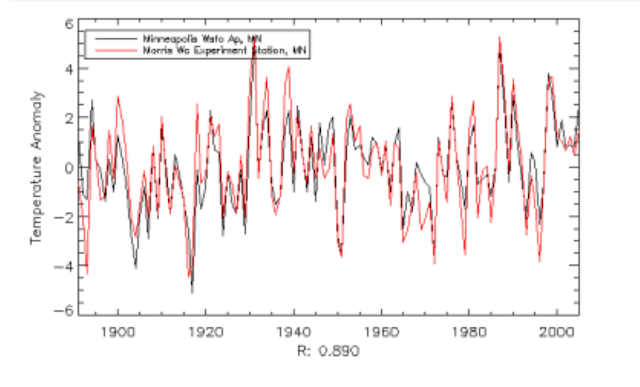
In 2008 Friend Atmoz had pretty well shown that Pielke Sr. and Watts were on a snipe hunt with their surface station picture show. Atmoz first looked in detail at two of the best US HCN stations in Minnesota, finding that the correlation between stations ~220 km apart was greater than 0.9 using the raw data from the USHCN archive. One of these was in a rural location, in a field, and the other at an airport (the Watts boys are moaning about airports not being real good stations, but Atmoz has preemptively shown that this is just shinola). Furthermore Atmoz showed that the correlation between what Watt's called an awful station, Detroit Lakes, and the good stations was also very high (> 0.8)

Atmoz's conclusions were
  • This area of the USHCN is over-sampled [ER- holds for all of the US except maybe Alaska]
  • CRN ratings as applied by surfacestations.org do not contribute a great deal to yearly average temperatures
  • The urban heat island (UHI) may not have a large effect in this region [ER-Note this refers to the anomalies]
  • Local heat sources, such as airplanes and air-conditioners, have only a small influence upon the temperature record [ER - at least as far as the anomalies]
However, dear bunnies, it was Atmoz's second post a couple of months later that exposed Tom Karl's trick, here he plots the monthly anomalies of the University of Arizona COOP station with and that of a US CRN station at the Senora Desert Museum which is ideally situated. Our friend Tony Watts, of course, had been dissing the UofA station.
This and the graph from Menne at the top shows that Karl's trick is working. Although we only have seven to eight years of the CRN, that is enough to show that neighboring US HCN and CRN stations measure the same high frequency variations in temperature anomalies and it is unlikely that long term trends will differ. It is also a clear validation of GISSTemp's assumption that measurements at locations considerable distance from each other are strongly correlated and that one can make use of that correlation to estimate temperature anomalies at locations which are not directly measured.


But there is more, faithful readers, that is but the half of it. The strength of Karl's Trick (TM ER) is that the CRN was carefully designed. Among other things, NOAA figured out that they only needed ~100 stations to adequately determine climate trends for the US. They were also careful to site CRN stations near USHCN stations, they over instrumented them and more

Contrast this with the helter skelter Surface Stations nonsense. Today Watts moans that
Texas state Climatologist John Nielsen-Gammon suggested way back at 33% of the network surveyed that we had a statistically large enough sample to produce an analysis. I begged to differ then, at 43%, and yes even at 70% when I wrote my booklet “Is the US Surface Temperature Record Reliable?, which contained no temperature analysis, only a census of stations by rating. 

The problem is known as the “low hanging fruit problem”. You see this project was done on an ad hoc basis, with no specific roadmap on which stations to acquire. This was necessitated by the social networking (blogging) Dr. Pielke and I employed early in the project to get volunteers. What we ended up getting was a lumpy and poorly spatially distributed dataset because early volunteers would get the stations closest to them, often near or within cities. 
The urban stations were well represented in the early dataset, but the rural ones, where we believed the best siting existed, were poorly represented. So naturally, any sort of study early on even with a “significant sample size” would be biased towards urban stations. We also had a distribution problem within CONUS, with much of the great plains and upper midwest not being well represented. 
This is why I’ve been continuing to collect what some might consider an unusually large sample size, now at 87%.
Even at 33% there were more than enough stations. So how do we interpret Watts' lament. Well, if it were Watts alone maybe he should attend an experimental design seminar, but since Roger Pielke Sr. is pulling the strings, this can only be seen as an attempt to put off the evil day they are now confronting. Is this evidence of bad faith, why yes.

Surveys can be corrected for population density if you know what the population density is, and area averages are easy to do. Over-representation of urban/suburban stations can thus be corrected for if one really wants to know the answer.

Oh yeah, can't resist pointing out that in 2007 Eli noted that
UPDATE: Following the crumbs left by the mice (Dano and Chuck) in the comments below, Eli observes that this is exactly what Roger's survey is designed to do with its bias, nay more than bias, prejudice for photographing sites close to people, e.g. in developed areas. Folk are going to take pictures of sites near them, so they are going to get a sample heavily tilted towards sites near them. It will be fun to correlate the locations of sites photographed with voting patterns. Of course we have the American speaking bias on top of that.
Comments?

Monday, January 25, 2010

It's a slow week

So Eli opens the comments for

Links your Mom would have warned you to avoid like the plague
Science fiction only please

Saturday, January 23, 2010

The Honest Joker

In a recent thread, somewhere or other, Eli forgets, Roger Pielke Jr. asked Eli to comment on his policy studies. Now true, Ethon would like a bite, but we are ever so earnest here at Rabett Run and the policy person formerly known as #14 deserves an answer, although the Rabett respectfully declines the opportunity of doing it at Roger's new place. Dad Rabett taught Eli the need to control the message. From the Ragged Edge of Reality we have a pretty good description of where RPJ is coming from: There is no need for scientists to get involved in policy cause he will handle it all.

Eli has remarked on the immaturity of Roger's policy framework before, but to be fair, he went and read the "Honest Broker". It is a piece of incredibly immature twaddle, if this is policy studies then policy studies got big problems. To repeat myself (which Eli does very well), Roger's naive injection (let's be nice) of the "honest broker" into climate science policy studies has pushed discussion into a fruitless direction. As with many such things, reality shows how hollow this is. IEHO looking at what brokers do in the real world better illuminates the issue.

Brokers do not expand the scope of choices available to clients, they narrow them. Brokers make markets. Brokers make a living by matching buyers to sellers and taking a commission (You thought they do it for free? What carrot wagon you fall off of bunny?). Ethical brokers will go out on the market seeking product suited to clients and will seek clients suited to products available to them. Ethical brokers have mutual obligations to sellers and buyers, to qualify the buyers and vet the sellers, not to sell every piece of nuclear waste to every rube with a cell phone.

Good brokers know what is available for purchase and what their buyer's needs are. They select the best matches (with allowance for the front and back end fees they are going to collect). The broker you want often tells the client NO, don't do that. Where the client insists on committing financial suicide the ethical broker is obligated to tell the buyer to take the business elsewhere. Contrast this with Roger's model of how the "honest broker" gives advice on how to find food

. . you might instead provide your visitor with information on all restaurants in the city, basic information on each (cost, menu, etc.) and let the visitor face the challenge of reducing the scope of choice (i.e., making a decision). Such "honest brokering" could also be strong (e.g., a comprehensive guide to all restaurants in the city) or weak (e.g., a guide to all those within a 5 minutes walk). The defining characteristic of the honest broker is an effort to expand (or at least clarify) the scope of choice for decision making.
Notice that the "honest broker" is not allowed to say that the food sucks, or that the place was closed for health violations, lest she become the dreaded "Issue Advocate" Pielke's "honest broker"slams the Yellow Pages down on the counter and leaves.

His argument is that all choices are political/personal by nature and the proper broker's role is to show all products and not advise the client based on technical knowledge and experience. At best this is postmodernism, that power determines reality. Even in the best comments section (Hi Marky!) you can always find someone who denies quantum mechanics, that tobacco smoke causes cancer, or HIV causes AIDS, or that increasing greenhouse gases will lead to increased global warming. Pielke is telling the powerful to do what they want, there is no reality beyond what they create.

Peilke's honest broker is simply a Thabo Mbeki enabler, allowing the former South African President to glom onto far out denialist science fiction on HIV as equal to the best research and expert advice available. Many people died and are dying because of that attitude. Fundamentally Pielke cannot accept that there are experts in anything who might provide educated advice. There is no better illustration of Pielke's nihilism than his description in the "Honest Broker" of the 2003 Soon, Baliunas and Robinson paper that appeared in Climate Research
It is characteristic of the science and politics of the early twenty-first century to see scientists actively engaged in political debates and particularly as related to the environment. For example, when a 2003 paper in the journal Climate Research argued that twentieth century climate variations were unexceptional in millennial perspective advocacy groups opposed to the Kyoto Protocol predictably hailed the research as “sound science”, while advocacy groups in support of the Protocol called the paper “junk science” (Regalado 2003). In this case, more troubling than the “cherry picking” of scientific results by Issue Advocates (scare capitals –ER) is that many scientists’ evaluations of the scientific merit of the Climate Research paper correlated perfectly with their public expressions of support for or opposition to the Kyoto Protocol on climate change
There is no attempt to come to grips with whether the paper was a contribution to knowledge or a provocation (Hint), and no discussion of how the most expert editors resigned when that piece of trash was forced into the journal. Roger's assumption is that the science follows the policy, not the policy view the science.

Roger is not shy about evaluating claims by the likes of James Hansen, Kevin Trenberth or the Munich Re folk, and always finding fault with them, but he is curiously shy about doing the same for Pat Michaels, S. Fred Singer and that ilk which is a marker of what he is really about. There is no better illustration of Pielke's track record of dishonesty than his attempt to tear Evan Mills down. Mills, of course, thinks that there is evidence that cyclone damage is increasing, something that Roger Pielke Jr. disagrees with.

Since his orientation is towards serving power (a well known and excellent career track for political scientists), the only thing that counts is power and appearance. In a comment at Cruel Mistress, Roger unmasks himself. Ben Hale discusses the morality of cruise ships stopping at a guarded enclave in Hati immediately after the earthquake. Roger, as usual, thinks its all about him and the only thing wrong would be getting caught in public.
There are a lot of other choices that we all make that are equally insensitive, but the don’t look bad because no one sees them. So perhaps pointing to Royal Caribbean and saying tsk tsk makes us feel a bit better about those other things.
He is quite the expert in erasing context. For example, in discussing tobacco he said
In the battle over smoking efforts to deny a link between smoking and health risks seems to have been completely a lost effort.
This is consistent with Pielke's effort to frame other issues
...science has a huge role in getting a subject onto the "agenda" of decision making, but after that, its role is very much diminished and subsumed to other factors, such as cultural, social, and political. If this is correct, it would require some deeper understanding about the role of advocacy related to scientific issues and the efficacy of using science as a tool of advocacy.
and he continues
This begs the question -- why has anti-smoking advocacy been so successful over time? The throwaway answer that increasing scientific certainly is the key does not seem to jibe with this data.
The problem with this whole line of reasoning is that it is built upon a falsehood. The tobacco industry used advertising, public relations campaigns, Potemkin science, litigation, and any other method it could find to maintain revenues. Deaths were collateral damage. This is no secret to anyone who reads the newspapers let alone science journals. The mortality data and the data on tobacco use and its relationship to advertising both pro and con is readily available to anyone who makes the smallest effort to search. The Potemkin science allowed all of the other efforts to go forward, providing a screen against the imperative necessity of eliminating tobacco that were being uncovered by medical research. The tobacco companies were the successful ones, with all the facts against them, they delayed action for decades, but in the postmodern Pielke World, there are no facts. (Except that there has been no measureable increase in tropical cyclone intensity, that Roger reluctantly accepts as a fact)

Eli awaits Roger complaining that his specific policy proposals have not been discussed. True enough. Tomorrow comes.