Tuesday, June 28, 2016

Call it a Cameron


David Cameron has done it.  The United Kingdom is breaking apart, the EU is getting ready to toss the Brits and the economic damage already exceeds two trillion, which whatever the Weasel may think is real money.  And oh yes, the torch Cameron lit is being used to burn out those the leavers denigrated.

There was no reason for last week's referendum except Cameron's desire to cement his position in the Conservative Party. The incompetent way that he set the terms of the vote and prepared for it would, were there justice, lead to derision being showered upon him should he dare show his face in public.

Eli proposes that "a cameron" from here on out be used to describe disasters caused by unlimited self regard and incompetence.   Hopefully Donald Trump does not get his turn to pull a cameron

Amongst the link list, James Annan puts it best.  Go there and read his post, but Eli strongly disagrees with 

I can't help but conclude that the best outcome would be for the new Govt to reject the referendum result (and fight an election on that basis). There is no good exit plan or outcome that I can see. Of course it would inevitably destroy a few political careers and we'd have a bit of rioting, but that's better than the alternatives.
This is simply not on offer.  The rest of the EU will not go forward with the UK as a member given the history of special pleading and how the EU became an excuse for everything that was wrong in Britain and the current political situation.  Eli really cannot see the Poles or really any of the others being generous about any terms, let alone continued membership.

So what is on offer? At best membership in the EFTA with Switzerland, Norway, Iceland and Lichtenstein.  The EFTA (European Free Trade Association) gets access to the EU single market under the condition of following all EU rules including those covering free movement of people between all the EU and EFTA members.  The get to follow the rules, but not make them.  The EFTA members favor England and Wales joining because it would allow them to have a bit more input into negotiations with the EU, but to a country the EU is not happy with the Brits so there are no guarantees on that.  Norway is not really on board but offering them the Shetlands would be an interesting bribe.

Of course, that leaves Scotland and Northern Ireland.  If the EU figures out how to cover the transfer payments from the UK to both, then, they are probably gone.  Northern Ireland could rationally have a status as a special administrative area in Ireland that the Unionists might be happy with.  A unified united Ireland is not likely, but as James and others point out, closing the border between Ireland and Northern Ireland would wipe out all the gains following the Good Friday Agreements.
The Irish question hasn't been addressed at all, as far as I can tell. It seems near-inevitable that Brexit will rip up the Good Friday Agreement, since that is underpinned by free movement over the border and the primacy of the European Convention on Human Rights. Sinn Feinn are already agitating for reunification, and I can't blame them at all. Even a prominent Unionist politician is openly encouraging Northern Irish to apply for Eire passports (another outcome of the GF agreement) and the Belfast PO quickly ran out of forms. The Good Friday Agreement, which successfully drew a line under 100 years of terrorism and violence in Northern Ireland and the mainland UK, was the one remarkable achievement of an otherwise unremarkable Major administration and it's a great shame to discard it so casually and with so little forethought. I'd think the best outcome we could hope for there would be a relatively straightforward and peaceful reunification process for Ireland as a whole, but there will be a whole lot of unhappy people whatever happens, and the peace there was fairly fragile in the first place.
Eli recommends reading Shoco's series of tweets to get a better idea of the coming disaster if the border is closed.  There are 42 tweets, despair in all.

Scotland is simply gone from the UK.

So, is there any hope for England and Wales.  Not with the current crew. 

England and Wales need a government of national unity that will face up to the cameroning and start to dig out.  There is obviously no one in the House of Commons up to the job. Perhaps there is one in the House of Lords. 

One name suggests itself to Eli, but admittedly Eli is an not a Brit, Gordon Brown. As former Prime Minister and Chancellor of the Exchequer he has the tools, and perhaps a dour Scot for a dour time is needed, but certainly the fractured political system can not continue if anything is to be left of the United Kingdom.


Monday, June 27, 2016

News From Ethon


Eli made an interesting point on Twitter (this assumes that a) Eli can make an interesting point and b) that an interesting point can be made on Twitter, but no matter) about energy mix. 

The nature of the thing is that the world's electrical energy needs can be met by renewables, e.g. solar, wind and hydro, but the intermittent nature of the first two require overbuilding both the installation and the distribution network and as the complexity of the distribution network increases, so does that cost and the time needed to deploy.  It can also lead to sudden surges in birthdays when the network fails.

Nuclear baseload on Eli's other hand can balance the amount of overbuilding necessary but it was pointed out that the balance requires controlling costs and reducing construction time.


Saturday, June 25, 2016

Federation of Planets hits a setback

Cameron should've found out what was said in the speech.

I used to be a fervent supporter of limited, democratic international government, and I remain a much more jaded supporter of same. We'll get there in a century or so barring the Singularity, but we just hit a snag with Brexit.

William's got a good post on it, as does most anyone with a brain outside of Britain and nearly half the people inside it. I'll add to his points that the situation reminds me a little of the runup to the Iraq War, where the entire rest of the world said "WTF?" to us Americans (partly excepting the Brits) and that made virtually no difference to our politics. 

I also agree with him that immediate economic repercussions will likely be somewhat limited. Regardless, we'll need a few more days to see what the short-term impact will really be. Medium-term it depends on what the Leave campaigners and the EU seem to be aiming at - if it's a Norway-style, you obey all the rules but have no control and that somehow feels good outcome, then the economic impact could stay limited. If they want to take actual economic control of their borders, then they're in for serious problems.

Mostly in agreement with William about the stupidity of EU leaders threatening to punish Britain. I think they're not taking the long-term view - if the election had been held ten years from now, the Remain side would've won - and maybe it will, if you don't go out of your way to alienate them. (My idle speculation, btw, is that Cameron is stalling to October in case the economy or something else gives him a chance for a redo election.) Where I'd disagree somewhat is that EU's primary job during the split is to look out for their side. They shouldn't go out of their way to punish Britain, but protecting Britain's interest is the task of the British negotiators. 

Interesting article here on Greenland's exit from the EU thirty years ago - it took them 3 years of contentious negotiations to get this island of 60k people out, and now some people there want back in. Have fun, everybody.

Finally, various people like Kevin Drum have said stop blaming the economy, that there's an obvious xenophobic and racist component in significant parts of the support for both Brexit and Trump. That just sends us to the next question though - why are they happening now. In America at least, I doubt our racism is stronger now, certainly not stronger than 20 years ago. So there is more to it - maybe just an accident of political conditions, or maybe something more is happening.

Tuesday, June 21, 2016

Margin Call, or Jo Nova, Wanna Be Hedge Fund Manager

Jo Ann Nova, David Evans and a guy by the name of Chris Dawson, CEO of the Lord Monckton Foundation are asking for donations to establish a something or other, in which said something or other will do something in some undisclosed way to slay the sky dragons.

Chris Dawson is cagey about what the something or other will be except it will be a hedge fund, whatever that is, and everybunny knows that hedge funds are the key to riches and have special tools and by the way climate change is a crock and the hedge fund of Jo Ann's dreams will . .

. . . short-selling overvalued renewables stocks, and doing other things that profit from cooler weather or collapsing subsidies — but which fund could you invest in to manage that? It’s a niche crying out to be filled. David and I liked this idea so much when we were approached by Chris Dawson two years ago, we got involved in developing Cool Futures (and obviously stand to benefit if this comes together, see the Disclosure at the end). Cool Futures could change the game in so many ways.

. . . . With a self funded, highly profitable due diligence process and cost benefit analysis on the science, economics and finance of climate change, we will literally hedge our bets on climate change and on changing climate change policy.
The Weasel has expressed a few words of derision,
Bored with force X from outer space? Was Force F just too fuckwitted, and part 22 just too dull? Then why not play “hedge funds”? Hedge funds do lots of complex maths and make lots of money (only not so much recently); they also have the advantage of being opaque. So play today, with Jo Nova and her band of performing marsupials. Yes, I know, its a picture of a monkey with an arrow up it’s bum, and a monkey is not a marsupial. But no known mediaeval manuscripts feature marsupials.
Context, context: I forget the context in my obsession with primate posteriors. coolfuturesfundsmanagement is, like, a hedge fund. Run by Jo Nova! And some others. Or perhaps better, a wannabe hedge fund with a severe shortage of moolah. And its going to hedge against cooling, maan. Tagline: “Are we preparing for catastrophic warming when we should be preparing for cooling?”
It's hard figuring out exactly what this "fund" is going to do except raise money to figure out what they are going to do and indeed Chris Dawson is pretty cagey about this because it would be dangerous to actually say that they are raising money for a hedge fund because investment in hedge funds are limited to a qualified (e.g. very rich) people who know what they are doing and can afford to lose their money.  Minimum US qualifications are a net worth of a million, and income of over $200K in the past two years, and oh yes, prospects of making that or more into the future.

But no, there is no such hedge fund, but the ask is for money to "set up" such a hedge fund which will then go seek investors. And, of course, since it will be housed on one of the Caribbean islands well known for housing tax evasion schemes, Eli assumes that the incorporation papers will be drawn up by Mossack Fonseca. Of course, hedge funds being inherently risky this becomes a lot like asking rich people to contribute mega dollars to Donald Trump so he can rip them off.

But wait, why the Cayman's or similar to house this "hedge fund"  Well, guess what, there are no limits on who is a qualified investor in a Cayman "hedge fund", unlike the US where you have to have a minimum of a million net worth and an income of $200K.  Given this and a good guess at how much the net worth and income of the inhabitants over at Nova's offered this kinky opportunity.  Now some, not Eli to be sure.

ATTP points out that, well, the facts assumed are taken from a rather tall cherry tree, but the grifters have already scored over 42K$ US.   This gave rise to a hilarious (well Eli is easily amused, how else do you think he has made it to a ripe old age) series of tweets, starting with

upon which Paul, just Paul borrowed the Pielke humphing apparatus and replied

and it goes neener neener for a while as twitter is won't, but, the answer is simple, these clowns are not hedge fund managers, they are hedge fund manager wanna bees. 

A bunny wanting to flush their hard earned dollars down the toilet would do better giving directly.


Sunday, June 19, 2016

Someone else notices gas stations are disappearing

This time it's Daniel Gross at Slate, noting a 25% decline in stations over a decade. He acknowledges the importance of extraneous forces like pricier real estate and fleet vehicles switching to natural gas, as well as future impacts from driverless vehicles. Gross also highlights electrical vehicles and plug-ins as a force, though. He doesn't quite get to the virtuous cycle argument - that as market share for electric increases, the market for gas stations suffers, gas stations disappear, gas vehicles become less convenient, and market share for electric increases even more. But he's heading in that direction.

Among the other tidbits Gross finds is Norway contemplating a ban on gas engine vehicle sales starting in 2025 (with Netherlands and even India saying something similar, but I find Norway more believable).  EVs are 20% of current sales in Norway - when penetration reaches those levels, then these proposals don't seem outlandish. It's one way to accelerate the virtuous cycle of EVs replace ICEs.

Monday, June 13, 2016

Astrobiology Is a Crok


Now some, not Eli to be sure, want to know why Eli thinks astrobiology is a crok.  Ever helpful, allow the Bunny to explain.  There are many reasons but it starts with Enrico Fermi.

Lots of things do.  Fermi was the type of thinker Eli has always aspires to and hopefully on occasion is.  As Philip Morrison wrote, a Fermi question allows

... the estimation of rough but quantitative answers to unexpected questions about many aspects of the natural world. The method was the common and frequently amusing practice of Enrico Fermi, perhaps the most widely creative physicist of our times. Fermi delighted to think up and at once to discuss and to answer questions which drew upon deep understanding of the world, upon everyday experience, and upon the ability to make rough approximations, inspired guesses, and statistical estimates from very little data." [Philip Morrison [1]]
The story goes that one day Fermi was munching at lunch with colleagues when the question of extraterrestrial civilizations came up.  They went through the exercise of thinking about how much time and resources it would take to spread through the galaxy and
Fermi realized that any civilization with a modest amount of rocket technology and an immodest amount of imperial incentive could rapidly colonize the entire Galaxy. Within ten million years, every star system could be brought under the wing of empire. Ten million years may sound long, but in fact it's quite short compared with the age of the Galaxy, which is roughly ten thousand million years. Colonization of the Milky Way should be a quick exercise.

 So what Fermi immediately realized was that the aliens have had more than enough time to pepper the Galaxy with their presence. But looking around, he didn't see any clear indication that they're out and about. This prompted Fermi to ask what was (to him) an obvious question: "where is everybody?"
Now this is not quite astrobiology which in its weak form merely asks if there is any biology out there, but at this point it would be well to look at Brian's most recent post, where he discusses the morality of research on better ways of extracting fossil fuels.  There is, sad to say, a strain of people who want to escape to space, terraform Mars, visit the stars, so that we can escape responsibility for dealing with the problems we are creating for ourselves on Earth.  Even sadder and more common is the fixation of many more on an afterlife, the belief in which is coupled to escaping not only the responsibilities for this Earth but also the trials and tribulations of the same.  Decoupling of this sort is not a good thing.  Before flaming, allow Eli to point out that this is not an attack on the religious or the space mad, but rather on those who use either to ignore responsibility.

The last part is from personal experience.  The NASA Astrobiology Program was started as a consequence of a claimed finding of polycyclic aromatic hydrocarbons (PAH in the business) in a meteorite that was expelled from Mars, landed in the Antarctic and was discovered.

This was amazing.  To Eli what was amazing was the study that showed the rock came from Mars.  He was rather more skeptical of the analytical chemistry and the possibility that the rocks had been contaminated over many thousands of years on Earth, but that is not the story.  What the story really is, is how the news was received at NASA.

NASA is chronically underfunded and survives only because of public support driven in large part by the public's interest in space.  To the NASA administration the Public Affairs Office is the key part of the agency.  Evidence of "life" (OK of PAHs, but they didn't sell it that way) was immediately seen as a great way to sell both space science and the manned space program, two of the main parts of the Agency.

At the time Eli was running a summer program at Goddard working with the University Affairs Office there.  The Director of the Office, Gerry Soffen was an amazing guy (you can read about him here and here).  He also was one of the most important people in the agency who was a biologist, having been the Project Scientist for the Viking landers on Mars which search for life there and did not find it.  True believers still believe Gerry lied.

In any case Gerry was tasked by Headquarters with putting together a much larger program than the small one that existed called exobiology.  The idea was to not anchor the program in a single location but rather creating a distributed institute which had obvious political advantages and off they went.

The meteorite discovery was an important impetus for Mars exploration missions, even though doubt has been cast on how pristine the rock was and how the issue was handled since then.  When Gerry asked Eli what he thought, the Rabett replied that although that he was amazed by the rock solid evidence that the meteorite came from Mars, he was less impressed by the chemistry knowing something about the technique used and the focus of research in the lab where the chemical characterization was done.  In short they were not geochemists.

The doubts about the meteorite results arose very quickly, within two years, but by that point NASA had already decided to emphasize astrobiology.  And many things became astrobiology which are really astrochemistry and astronomy.

All of which is why Eli believes astrobiology is a crok.

Sunday, June 12, 2016

Researching cheaper fossil fuel extraction is unethical

That's not to say that researching fossil fuel extraction in general is bad. New technologies to make it safer, less environmentally damaging, and better understood in terms of environmental impact is fine. Research to make fossil fuel use cheaper also may not be a problem if the research improves the energy efficiency, in effect reducing the carbon emissions from fossil fuel use. The problem is research that provides no help with emissions but instead harms the low-carbon market in the future.

We need to transition away from fossil fuels, especially coal but not just coal. I don't know if emissions 15 years from now will be lower than today but it would be better if they were, and they must trend downward. Research that makes fossil fuel extraction cheaper has no immediate economic benefit, it just changes price levels down the road as it succeeds and spreads. Fracking is a good example of something that was decades in the making and is still spreading internationally.

While some research may be applied quickly, the more likely and widespread application of some bright new idea that arises today is 10-20 years in the future. Low-carbon power sources will be much more widespread then, so the alleged need for fossil fuels will be less, and the urgency to stop using fossil fuels will be even greater.

As usual, natural gas is the trickiest component, but just as new natural gas plants don't make sense, new research to make natural gas cheaper doesn't make sense. Any bridge argument for natural gas has little bridge left to cross in 10-20 years in the future, and becomes a liability instead. And as with new gas plants, investment in research requires a payback period. Researching cheaper fossil fuel now is an attempt to promote fossil fuel use over renewables 20 to 40 years from now.

I think ending this type of research at the university and governmental level should complement the current divestment movement. My alma mater, Stanford, did the right thing by divesting from coal but refused full divestment. I know that Stanford has some complicated investments that would take some time to unwind, and I believe they're in natural gas. The complication by itself isn't a barrier to divestment - I think no one would object if Stanford took a little more than the typical five years to complete divestment. What may be a barrier, though, is the research aspects.

Getting to a speculative level, I suspect that Stanford's complicated investments have a significant research component, and that the real financial value Stanford sees is in its research paying off - i.e., making fossil fuel extraction cheaper. That's problematic, and I don't think they have thought it through or even have been confronted with it.

As the link shows, Stanford is establishing a climate task force to examine operations, research and teaching (investment is somehow not mentioned, must just be an oversight). This could be an opportunity to examine whether Stanford should research or should invest in research that makes fossil fuels cheaper in the future, right at the time that we need to end using them.

Friday, June 10, 2016

The Frame War: How Skeptics Lost the Climate Debate


Many in the community Eli slums in twit and blog about Exxon, about climate risk and recent attempts to force fossil fuel companies to confront the risk to their business of climate change.  At the Exxon stockholders meeting just last month a motion to that effect failed with 37% of the voting shares being in favor.  That is an outstanding shot across the bows of Exxon management, 37% means that many significant economic players have come over to the side of yeah, climate change is not only a risk to people, but also our money, but there is more.

Now some, not Eli to be sure, who might not be paying attention, indeed Eli was not, but the Bunny was at a recent seminar on the economic issues of climate change with some of the high and mighty holding forth, and they kept coming back, one might, only might say smugly, to three letters of the alphabet, FSB and the Bloomberg Committee.

Eli sat up bolt upright because he thought that there were four letters FASB, the US Financial Accounting Standards Board, basically the guys who killed defined benefit retirement by making the costs appear out to infinity on any employer who offered one.  They also trashed the Bunnies retirement health insurance plan for the same reason.  Were they taking an interest in meeting the accounting challenges of climate change?  Big news if so (and this will require looking into)

But no, this is the Financial Stability Board, a construct of the G20, more exactly the Finance and Treasury ministers of same the G20 being the 20 most economically important countries in this Galaxy (Eli thinks that astrobiology is a crock).  The FSB was formed after the recent 2008 economic meltdown

The FSB promotes global financial stability by coordinating the development of regulatory, supervisory and other financial sector policies and conducts outreach to non-member countries. It achieves cooperation and consistency through a three-stage process, including monitoring implementation of agreed policies.
and as a creature of governments and especially the finance ministries of governments it is not to be sneezed at.  The FSB IS concerned with how the threat of climate change to economic stability
Policymakers have an interest in ensuring that the financial system is resilient to all forms of risk. In April 2015 the G20 asked the FSB to consider risks related to climate change and in November the FSB proposed the creation of an industry-led Task Force to develop recommendations on climate-related financial disclosures. Appropriate disclosures are a prerequisite for financial firms not only to manage and price climate risks accordingly but also, if they wish, to take lending, investment or insurance underwriting decisions based on their view of transition scenarios.
Just what the activist shareholders are trying to drag the fossil fuel companies to, and they are resisting.  The task force was put together in December 2015, and Michael Bloomberg is the chair.

That should cause some bunnies to sit up in their seats.

A first report on the lay of the land has already been published (more later) and
During the second phase, the Task Force’s work will focus on delivering specific recommendations for voluntary disclosure principles and leading practices, if appropriate, with a view to issuing a report for public consultation by end-2016. As part of its work the Task Force will conduct public outreach to engage a wide and varied range of stakeholders as it develops its recommendations.
The intent of the FSB can be read in the next paragraph
The work of the TCFD builds on the successful work of the Enhanced Disclosure Task Force (EDTF), which was created to provide recommendations on developing more effective bank risk disclosures
and that is what the TCFD is about
The Task Force on Climate-related Financial Disclosures (TCFD) will develop voluntary, consistent climate-related financial risk disclosures for use by companies in providing information to investors, lenders, insurers, and other stakeholders. The Task Force will consider the physical, liability and transition risks associated with climate change and what constitutes effective financial disclosures across industries. The work and recommendations of the Task Force will help firms understand what financial markets want from disclosure in order to measure and respond to climate change risks, and encourage firms to align their disclosures with investors’ needs.
Stress tests for Exxon bunnies and voluntary is likely to become not optional real quick as governments implement the rules.

Sunday, June 05, 2016

McArdle messaging mess

Lost in her errors and insults flung at the scientific community, and at her political opponents who accept climate reality, was the only part of Megan McArdle's argument that should matter:

....there are folks like me who aren’t sure enough to make a prediction, but are very sure we wouldn’t like to find out, too late, that the answer is “oops, catastrophic.”
Okay, so she's very sure that we shouldn't follow a policy pathway that makes catastrophe possible. What does she want to do with that framework? I see she semi-approvingly cites to a lukewarmist, kind of a bad sign. Said lukewarmist said basically stop doing everything we're doing now to fight climate change and impose a carbon tax instead, but doesn't say what we should do given that the Republican Party rabidly prevents all attempts at imposing a carbon tax. McArdle, somewhat to her credit, says he doesn't want to do enough, but again fails to tell us what enough is to her.

My two takeaways:

1. She's mad at the rest of us that her tribe is wrong, so even as she semi-admits they're wrong, she throws as many insults at climate realists and adds as many mistakes as she can, starting with the idea that the flaws in modeling human behavior demonstrate similar flaws in modeling the physics of climate. The important message, that we need to act, gets lost in her discussion of alleged communication failures by people outside her tribe.

2. McArdle has (possibly) made an interesting leap over a divide where many lukewarmists/denialists haven't. A common denialist position short of complete denial is to accept scientific reality up to the point at which that reality would require them to shift their policy positions, and then for mysterious reasons, they suddenly find that the science no longer works. McArdle seems to allow we need to do something. How she deals with the binary choice issue between Republicans and Democrats was left unsaid here, but could be worth pursuing.

Finally, I'd add that I'd write this very differently if I expected McArdle to read this and wanted to influence her. I'm writing to us realists here, and I'm mostly just mouthing off without expecting to change much. Maybe climate realists should try more, or at least check in periodically with people like her, despite the annoyance involved. But for her part, if she were really trying to influence "alarmists", then she's doing it wrong.

Saturday, June 04, 2016

A Weekend Puzzler


The Denialati are busy showing everybunny figures created by John Christy


Excellent examples for the Eli Rabett Weekend Puzzler contest.  To explain why these figures are both correct (well Eli would like to know where those 982 stations are, but he can make a good guess) requires only that the bunnies have been reading and remembering one of Eli Rabett's seminal contributions to combatting bullshit and have a native distrust of a bottom dealer like John Christy. 

Sit back and have a drink of your choice with a partner of your choice.  All entries should include a small check for the Bunny Friend Alliance Ethics Committee and at least one of these


My spirited defense of Bush and Trump

I'm going back to one of my arguments, that in no way was Bush Junior the worst president in US history - he's the third worst. History and historians are pretty clear that James Buchanan was the worst ever, and even a President Trump is going to have to stretch to be worse (although it's not impossible). Reading more about Buchanan, I had no idea that he was involved in making the Dred Scott decision much worse, and that his mismanagement helped trigger the start of the Civil War at Fort Sumter.

I think history's pretty clear about Franklin Pierce being second-worst, even if historians themselves are a little vague (come on, Harding was just a buffoon, he doesn't rate, and Andrew Johnson's mistakes after the war are no comparison to the mistakes that allowed it). Accommodating the South and expanding slavery were Pierce's and Buchanan's response to the impending disaster, and they made it happen as much as actively evil people like Calhoun and Davis.

Bush can't handle this competition.

Moving on to Trump, it's outrageous to call him fascist - he's authoritarian, someone who respects and might want to emulate dictators and their violent repression, but without the ideological and intellectual development to espouse a theory of total domination of the individual by the state or ethnic identity. His personality is similar to Mussolini, but the only thing he cares about is Trump, not the crushing of the individual under ethnicity.

The only way I see to calling Trump fascist is to equate the word with authoritarian, which is stupid. English already has a word for someone with dictatorial tendencies, and if fascist becomes a duplicate for it then we don't have a word for the even-worse thing that fascism described. It reminds me of the tendency to redefine terrorism from violence directed at civilian for political reasons to politically-directed violence that the speaker disagrees with.

Since I haven't been feeling the Bern, I will give Bernie some applause for calling out the morons who have used violence to keep citizens from being able to hear Trump. What I find strange is the number of people on the left who think violently interfering with people's free speech and assembly rights is wrong, but non-violently interfering with those rights by blocking access and shutting down speeches is somehow good. My term for people who do that stuff is authoritarian, even though some might consider themselves anarchists.

Friday, June 03, 2016

It's Friday

Tuesday, May 31, 2016

Special Snowflake Seeks Rent


Eli observes that special snowflake syndrome is spreading faster than Zika and interacting with the carriers, well, it shrinks a bunny's brains because it is hard to believe that such needy people have survived to adulthood with all of their teeth.  

The Urban Dictionary provides a diagnostic

A malady affecting a significant portion of the world's population wherein the afflicted will demand special treatment, conduct themselves with a ludicrous, unfounded sense of entitlement and generally make the lives of everyone around them that much more miserable.
and recommends running away on first encounter.

A defining characteristic of such carriers is that they insist you do their work, 24/7.  No better example than a tweet exchange btw  Roger Pielke Sr. and Gavin Schmidt a few days ago

Well Eli could display the entire exchange after that, but suffice it to say that Roger goes rent seeking soon after
Continuing his challenge to Gavin for a challenge round of Pielkes All the Way Down

UPDATE:  Somebunny reminds Eli of Nathan Myhrvold and the black solar cells where he proved to Steve Levitt that solar cells could never help with global warming because they were black.  Brad deLong deals with this and RayP invites Levitt and Myhvold to his office for a beat down.  Good times

It appears that rent seeking is a defining symptom of Special Snowflake Syndrome. To continue with Ex 2, a few days ago Nathan Myhrvold is the former chief technology officer at Microsoft posted a manuscript to arXiv which claims that the NASA/JPL group who have been designing a mission to detect near Earth asteroids has got it all wrong and come pretty close to them wanting to go out and hire Mike Mann's lawyer. Phil Plait at Bad Astronomy does an excellent job of summarizing the science as well as linking to other blogs and discussions on the set to.

The science argument can be settled in a second.  The NASA/JPL group calibrates its model of asteroid size against accurate occultation measurements of a fair number of objects in the asteroid belt.  They then use the calibrated model to measure the diameters of a large number of asteroids that were observed by previous space telescopes.  Myhrvold claims to use "basic physics" but his results are off by more than a order of magnitude. Bunnies can read Platt and Eli also recommends this discussion in the Asteroid and Comet mailing list.

However, science be damned for this post, for this post, what is most interesting is the exchange between the NASA/JPL group and Myhrvold as described by Plait
Myhrvold says the team was not cooperative about their work and gave him “cryptic” answers to his questions.

Mainzer told me a very different story. She said she worked with Myhrvold multiple times, trying to show him where some of his ideas were either incorrect or not applicable to the work they were doing, but he remained defiant. She pointed out specific errors, but despite that the errors remain in his work.

The errors she mentioned are various, including his confusing diameter with radius in his calculations and using a model that incorrectly determines diameters. For his part he says their model doesn’t include some basic physics, and that some of their numbers are suspicious.
Indeed, even though his model fails a basic bullshit test Myhrvold like an good special snowflake, digs in and demands that the JPL group bow to his genius.  No bunny should have expected anything else.  It's part of the package. This pattern of behavior is especially available in Twitter.  Eli, against his better judgement has gotten brain squeezed a couple of time there.  He shoudda known better.  Just tell em to go away.

Monday, May 30, 2016

So What Does Publishing a Scientific Paper Cost?


More accurately what is the cost of Open Access to authors.  Eli has come across an interesting effort in Particle Physics called SCOAP3,

SCOAP3 is a one-of-its-kind partnership of over three thousand libraries, key funding agencies and research centers in 44 countries and 3 intergovernmental organisations. Working with leading publishers, SCOAP3 has converted key journals in the field of High-Energy Physics to Open Access at no cost for authors. SCOAP3 centrally pays publishers for costs involved in providing Open Access, publishers in turn reduce subscription fees to all their customers, who can re-direct these funds to contribute to SCOAP3. Each country contributes in a way commensurate to its scientific output in the field. In addition, existing Open Access journals are also centrally supported, removing any existing financial barrier for authors. 
where the average cost per paper is given as 1,100 Euro over 10K papers.  The distribution of costs among the participating countries IEHO would be a model for other fields, but, of course, all depends on continued funding.  Even just HEP/Particle Physics subvention of open access requires $10M€ per year


arXiv is using a different model which represents the only the costs of operating and maintaining the arXiv,
What are arXiv's operating costs? 

arXiv's operating costs for 2013-2017 are projected to average of $826,000 per year, including indirect expenses. The operating budget projections for 2012-2017 include the four key sources of revenues mentioned above: Cornell's annual funding of $75,000 per year, plus indirect expenses,; the $50,000 per year gift from the Simons Foundation; annual fee income from the member institutions; and the $300,000 per year challenge grant from the Simons Foundation, based on the revenues generated through membership payments.
To and extent SCOAP3 and arXiv overlap because arXiv originated in the HEP/Particle Physics community which is still a heavy user.
arXiv would potentially be a beneficiary of redirected funding administered by the Sponsoring Consortium for Open Access Publishing in Particle Physics (SCOAP3) consortium. It's not clear, however, when this initiative will meet its annual funding goal of €10,000,000 ($14,120,000). It should also be noted that the SCOAP3 initiative is restricted to HEP and particle physics content only, which represents between 18% and 40% of submissions to arXiv (depending how broadly the subject area is construed). If SCOAP3 is successful it could potentially subvent a similar fraction of arXiv's operating costs. We will continue to monitor the development of SCOAP3 and its impact on our long-term plans.
It is well to remember that arXiv almost died in 1999 when the US DOE and LANL lost interest.  How long Cornell will remain willing to house the arXiv is a concerning issue.

Sunday, May 29, 2016

OA EU the OB and who pays


Eli, as he has mentioned before, is a very old bunny.  Back when he was not a very old bunny he took a class from another very old bunny who shall remain nameless, but was very well connected to the scientific/government nomenklatura even further back and who liked to reminisce.

The old Bunny (OB below) one day started for no particular reason to discuss scientific publishing.  He said that after the war (for bunnies of OBs age that would be WWII) there were discussions about how to support scientific research and publishing.  As far as publishing went, the OB said there were two choices, send money directly to the scientific societies such as ACS/APS, etc. or provide money within grants (which were increasing by leaps and bounds) to subsidize publication.

The latter was chosen for the political reason that it would be hard to NOT subsidize commercial publishers if the former were taken, and if commercial publishers were subsidized there would be a mighty hue and cry across the land.

Twitter is abuzz with the EU announcing that from then on (2020) all publications will have to be Open Access (OA). The UK is already there so Brexet will make no difference one way or another.  Victor V is really excited about this. 

Which brings Eli to a couple of points.  In the last few years granting agencies have been writing open access rules into their guidelines.  For example the NSF Public Access Plan reads
NSF will require that either the version of record or the final accepted peer-reviewed manuscript in peer-reviewed scholarly journals and papers in juried conference proceedings or transactions described in the scope above (Section 2.0) and resulting from new awards resulting from proposals submitted, or due, on or after the January 2016 effective date must:  
• Be deposited in a public access compliant repository designated by NSF;
• Be available for download, reading, and analysis free of charge no later than 12 months after initial publication;
• Possess a minimum set of machine-readable metadata elements in a metadata record to be made available free of charge upon initial publication (Section 7.3.1);
• Be managed to ensure long-term preservation (Section 7.7); and
• Be reported in annual and final reports during the period of the award with a unique persistent identifier that provides links to the full text of the publication as well as other metadata elements. 
The NIH Public Access Plan differs in one significant way imposed by the law
The Director of the National Institutes of Health shall require that all investigators funded by the NIH submit or have submitted for them to the National Library of Medicine’s PubMed Central an electronic version of their final, peer-reviewed manuscripts upon acceptance for publication, to be made publicly available no later than 12 months after the official date of publication: Provided, That the NIH shall implement the Public Access Policy in a manner consistent with copyright law
Which means that NIH assumes the burden of maintaining the PubMed Central database in perpetuity.

The UK Research Councils have a similar policy, but have explicitly grabbed the bunny by the ears
It is planned that the funding provided by Research Councils to support open access will be increased over the next five years until all published peer‐reviewed papers which derive from Research Council funding are open access (whether published via the ‘gold’ or ‘green’ routes).  This increase in funding during transition reflects an estimate of the time that will be needed for researchers, institutions and publishers to make the transition to a fully Open Access model.  It will also allow publication funding already provided through direct and indirect costs on current grants to be fully utilized.
and they provide a table of block granted payments to the various UK universities.  Just for local interest, Edinburgh gets 1.1 M£, Bristol 0.78 M£, Sussex 0.22.  The total is about 22.6 M£ per year.

Now librarians are caught between the devil (Springer) and the deep blue sea (faculty).  The devil has squeezed the libraries declining budgets dry, while ACS, APS, etc. are not so avaricious their journal packages still cost a bit in an era of declining resources, but librarians are librarians and the point of a library is not to have today's journal available today, but in 100 years or more.  There is always the 100 year old article/book that is still relevant today so they have to ask what guarantee there is that a repository will not have expired, that the 8" floppy, or cd that the information is on will still be readable, etc.  A librarian sees great virtue in paper, even papers not published on acid free paper.

In particular were Eli a librarian, he would be greatly troubled by the suggestion that colleges and universities establish and maintain the repositories for their own faculty's writings.  Who knows what will happen to that college?  Who knows if a publisher who has a repository will go out of business, or even worse, sell out to some dudebro like Martin Shkreli.

So OA has to confront not only right now, but way out when and that is not so easy.

So, what is the answer?

Eli suggests Global Access, a set of linked repositories maintained by all of the funding agencies and learned societies of the world with a uniform Article Processing Fee structure.  If a publisher wants more, let the authors take it out of their own pockets, or rebated overhead, or grandma's cookie jar. Whatever

Authors shall be responsible not only for depositing electronic versions of their articles, but also for ensuring that print versions are available either through commercial or learned society publications/journals or through a library accessible through the World Cat.

If the later is chosen the depositing library shall be responsible for obtaining a unique DOI for the document with appropriate metadata so that it can be searched and identified. 

Of course, it could all be left to Sci Hub.  Maybe not.

Donations to Trump Campaign could go to Trump instead, especially now

I've had a long vendetta about candidates at any political level loaning money to their campaigns and the ethical morass it creates. As with most tough issues, there's a kernel of justification - a campaign needs money early and throughout the campaign, but the money often arrives too late to spend efficiently, sometimes even after the election. My own campaign in 2014 received a $1000 refund for mailing expenses after the election that we ended up donating to charities. If candidates are clear about what they're doing - that they're fronting the money they expect to raise during the campaign, and that they'll convert any unpaid post-election debt to a contribution rather than fundraise from wealthy interest, that's probably okay.

And then there's Trump.

The man who talks so proudly about his wealth and says he's not beholden to special interests because he's "self-funding" his campaign has almost exclusively loaned the money, $43 million as of the end of April, while donating only $317,000.* My opponent for a seat on a local water district board spent $500,000 of his own money in the campaign.

There's a huge difference between fronting the necessary funding for a campaign and self-funding it. Trump and his representatives say he intends to convert the loans into contributions. Then why not make them as donations to begin with? His promise not to pocket campaign contributions could be taken about as seriously as his promise in February 2015 to release his tax returns.

We're at a particularly interesting period because the law views this campaign as two elections:  one to choose the party nominees and the other to select the president. A part of campaign finance reform that has so far survived the Republican nominations to the Supreme Court says that in presidential elections, candidate loans automatically convert into contributions 20 days after the election, which would be the nominating conventions this summer and again after the November election.

As this NBC article points out, Trump is expressly fundraising for the primary campaign where there are very few expenses remaining now that he's won, but millions owed to him personally. Nineteen days after the Republican convention he can use these people's money to pay himself back. Obviously that wouldn't go over well, but a man who jokes that he can shoot people in public while remaining popular might think this issue from the summer would blow over by November.

The other interesting time will be the runup to the November election. Let's assume Trump loans more millions to his campaign but by mid-October realizes he has little chance of winning. If Trump is more interested in his own fortune than in losing slightly less badly, then his campaign will deliberately not spend everything, fundraise like hell through the election and maybe even a day or two afterwards for the die-hards, and then pay off Trump as much as possible. All this is 100% legal.

With an immediate stroke of the pen, Trump could prove all this wrong today by converting his existing loans to contributions, and only making contributions in the future. His failure to do that tells smart Republicans everything they need to know - the only ones who should be donating to the campaign now are the ones who are paying for access.


*The link above says $36 million, while the FEC website is updated to $43m but annoyingly doesn't provide a live link to that result. You can look up the latest here.

Friday, May 27, 2016

Forgot about that thing I use every day

That thing being hot water.

On the issue of electrifying and renewablizing uses that now come from fossil fuels, I've always focused on transportation. Until someone at my Community Choice Energy group mentioned it last week, I completely forgot home heating and water heating. Yes, we'll have to get those off of natural gas. The specific idea is that removing natural gas heating should be subsidized by electrical utilities, seeing as we don't have a carbon tax to make it happen naturally.

This won't be easy or cheap, although it is easier and cheaper for high density construction (and safer).

One significant advantage over electrifying transport is that residences stay around for a long time. Electric vehicles over their decade-or-so lifetime will benefit somewhat from a grid that's getting increasingly cleaner. Electrifying home heating is a 30-year-plus investment, and the grid even in places like West Virginia should be a lot cleaner in time, so the carbon savings will add up.

Wednesday, May 25, 2016

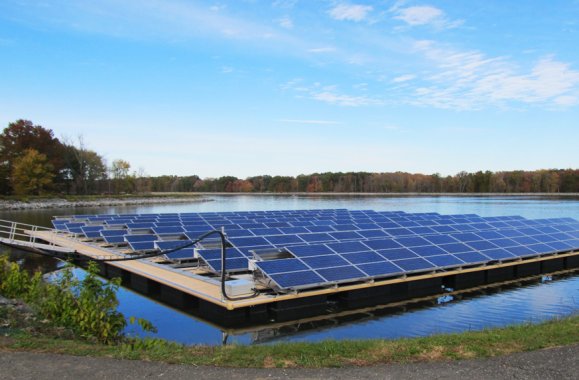
Floatovoltaics!


About time they hit the New York Times:

...floating solar arrays are becoming more popular, with installations already operating in Australia and the United States, and more planned or under construction.

The growing interest is driven in part by huge growth in the solar market in recent years as the cost of the technology has dropped quickly.

Floating solar arrays — they are often referred to as “floatovoltaics,” a term trademarked by one company — also have advantages over solar plants on land, their proponents say. Renting or buying land is more expensive, and there are fewer regulations for structures built on reservoirs, water treatment ponds and other bodies of water not used for recreation....The floating arrays have other assets. They help keep water from evaporating, making the technology attractive in drought-plagued areas, and restrict algae blooms. And they are more efficient than land-based panels, because water cools the panels.
The company attempting to trademark floatovoltaics can jump into one of those lakes, btw.

I tried to push this idea at my old water district five years ago and got nowhere, unfortunately. Now it's an idea whose time has come - in certain places, anyway. Maintenance is trickier, so any place with cheap land and lots of water will have no use for them. OTOH, the hot, water-short areas with expensive land, or problems from algae blooms, or problems from toxics like mercury that become much worse in warm, low-oxygen water are good candidates. All of which describe my water district. Now the local competitor for most-environmental water district has gone ahead with floatovoltaics, so maybe it'll spread.

I still think Lake Nasser behind Aswan Dam is a natural for floatovoltaics, although admittedly it's far from places with power demand. Dryer parts of India could also be great places, and they're experimenting with small systems already.

Tuesday, May 24, 2016

Consensus Messaging

Eli is a bunny of few words (exactly how many Rabetts do you know that have any), but he is quite mystified by the consensus messaging wars.

It's simple.  Most people when confronted by a controversy don't know enough about the situation to pick a side.  The safe choice is to wait and do nothing.

If a group wants to do nothing it is to their advantage to pretend there is a controversy even if there is not a controversy.

Somehow this escapes the Dan Kahans of the world.

Sunday, May 22, 2016

Misophonia

Today's random blog post features my empathy for the woman describing her misophonia - an abormally strong aversion to certain sounds such as eating noises - in this New York Magazine interview. I have a mild version of what she's talking about, although I've read of others in even worse situations who can't go to restaurants or parties.

The woman interviewed seems to have acute hearing and a wide range of noises that drive her to distraction. For me it's mainly lip-smacking and chewing with the mouth open. Of course those things bother lots of people, but maybe twice a month they bother me to the point where I have to do something, put on earbuds or move to a different seat in a coffee shop/bus/theater.

There's definitely a psychological component to it - the saving grace for me is that loud chewing noises don't bother me if I'm also eating, and those two overlap the vast majority of the time. Like the woman interviewed, children eating noisily doesn't bother me. I've also spent a lot of time in Asia where the norm in some places is to slurp noodles, which doesn't bother me, mostly. My hearing is average, not acute. All that makes me think it has to be partially psychological.

Reading her interview gave me an interesting gender perspective - I've been self-critical about not getting over it, but being male means I've never wondered if I'm just a bitch.

And then there's the issue of who deserves criticism - the public lip-smackers and open-mouth eaters, or me for reacting so much to it. My guess is that I'm close enough to normal range that I can manage my response to close-to-normal levels, but people who have a more severe problem really can't help it. Maybe I'll do some special pleading for them, and I'll be the lucky beneficiary on the side.