Tuesday, December 01, 2015

UAH TLT Series Not Trustworthy

The news has been full of Lamar Smith, Chair and Poohba of the House Science Committee fulminating about NOAA and his attempts to gangplank Tom Karl.  In a recent op-ed in the Washington Times (fishrap whose time and sugar daddy has come and gone) Smith writes

NOAA often fails to consider all available data in its determinations and climate change reports to the public. A recent study by NOAA, published in the journal Science, made “adjustments” to historical temperature records and NOAA trumpeted the findings as refuting the nearly two-decade pause in global warming. The study’s authors claimed these adjustments were supposedly based on new data and new methodology. But the study failed to include satellite data.

Atmospheric satellite data, considered by many to be the most objective, has clearly showed no warming for the past two decades. This fact is well documented, but has been embarrassing for an administration determined to push through costly environmental regulations.
Now this is very popular on the SKS list of denial as the El Nino driven SURGE is pushing global temperatures through the roof.  Certain folk, including Congressman Smith, invoke the UAH MSU global temperature record as their gold standard.  Yet anybunny looking into the matter knows of the serial screwups and the teeth pulling needed to get any information about the majic Spencer and Christy use to transform microwave intensity to temperatures and how it is hard to figure out what and where is actually being measured.

All is not clear in Alabama.

A friend of the Rabett Run knows quite a bit about MSU units and how Roy Spencer and John Christy have danced with the data.

He wrote a letter to Lamar Smith.

Eli thought reproducing the letter would be a public service.  It is a bit long for a tweet, and, indeed some additional comments have been added at the end.

--------------------------------------------------
Rep. Lamar Smith,
Chairman House Committee on Science, Space, and Technology
2321 Rayburn House Office Building
Washington, DC 20515

RE: your Op-Ed  26 November in The Washington Times

Chairman Smith:

I read your op-ed with considerable interest.  I’m a retired engineer whose work experience included several years in satellite design.  As I read your article, my impression was that you do not understand the so-called “satellite temperature” data developed by Roy Spencer and John Christy of UAH.  Allow me to provide some information.

The MSU series of instruments and the later AMSU measure microwave intensity from orbit, that is, from the top of the atmosphere.  Theoretical work has been developed to support the claim that these measurements for each channel of the instrument correspond to a “bulk” temperature profile thru the atmosphere.  When Spencer and Christy presented their first effort in 1990 (1), they worked with data from channel 2, which they still produce, (now labeled TMT for Temperature, Middle Troposphere).

However, in 1992 (2), they presented results which showed that the channel 2 data is distorted by emissions from the stratosphere, which has exhibited a well known cooling trend.  For this reason, they proposed a modification of the channel 2 data, (now labeled TLT for Temperature, Lower Troposphere) which they claimed removed the distortion from the stratosphere in the MSU data.
The TLT computation begins with the 11 scan positions which the MSU produces for each swath across the ground track below.  There are 11 positions, labeled 1 thru 11, with #6 being straight down (nadir).  There are also 2 more positions at the ends of each swath, one viewing deep space and the other viewing a heated target which is monitored for temperature with two accurate resistance thermometers.  The TLT algorithm actually includes only 4 of the 11 positions, throwing out 5, 6, and 7 and using 1, 2, 10 and 11 as a correction for the data from 3, 4, 8 and 9. Thus, the resulting TLT data can not be said to “ provide “complete global coverage”.  Also, the data can only be provided between 82.5N and 82.5S, due to the inclination of the orbit.  Spencer and Christy calculate a gridded data product including higher latitudes, which they calculate by interpolation, artificially extending beyond the range of available data.

The TLT algorithm is based on theoretical calculations, using a model of the microwave emission and adsorption at each pressure altitude added together from the surface to satellite altitude. Spencer and Christy have never publicly revealed the method they used to create their algorithm, which is rather curious, as the assumptions used may be critical.   Some of the microwave energy in channel 2 comes from the Earth’s surface and the TLT computation adds more surface effects, thus the TLT is not a pure measure of temperature.  As the MSU instruments are retired, newer AMSU instruments are replacing them and Spencer and Christy have created a different algorithm in order to include the AMSU data into the TLT.  They claim that they are simulating the TLT from the MSU, again without specifying the method used to do so.  They have continued this lack of transparency with the latest TLT (version 6), which Spencer briefly described on his blog, but which has not been published after peer review.

The important point to remember from all of this is that the TMT is not useful for measuring climate change and the TLT is highly theoretical.   In spite of being aware of these limits, Spencer and Christy have presented the TMT in testimony to Congress, showing a comparison between the TMT and the results of computer simulations, both globally and over  the tropics.  What they don’t mention is that to produce their graphic,  they have simulated the orbital altitude TMT measurements from the GCM results (3), using CMIP5 data from the KNMI Climate Explorer website (4).  The model results from KNMI are monthly averages and include only temperatures at 3 pressure levels, the surface, 500mb and 200mb pressure height, as I understand it.  The method to translate those monthly values into simulated TMT results remains an unpublished mystery.

Spencer and Christy’s claim (which you  repeated ) that the satellite data does not exhibit as much warming as that from the surface is not surprising.  The 13 satellites’ orbits take the instruments across each latitude at the same time of day with each orbit, the equator crossing times being nearly constant.  The surface temperature record is usually an average of the temperature at a location, computed as an average of the daily low and high temperatures.  This average will not be the same as the temperature measured at a fixed times of the day, say 10AM and 10PM, which the satellite might see over mid-latitudes. And, at the highest latitudes, each pass provides measurements half way between the equatorial crossing times, 3AM at one pole and 3PM at the opposite pole.  At polar latitudes, the orbits overlap, giving multiple measurements during the day, which are summed into a grid box, while in mid latitudes, there are missed areas between the ground swaths, which exacerbates the lack of coverage in the TLT.

Twelve years ago, my curiosity led me to perform an analysis of the UAH TLT data, the results of which I published in a peer reviewed journal in 2003 (5).  I found an apparent discrepancy at high latitudes of the Southern Hemisphere, which I suggested might be due to the effects of sea-ice. After my report, the group at Remote Sensing Systems (RSS) decided to exclude any coverage to the south of latitude 70S from their version of the TLT, their reasoning being that the high elevations over the Antarctic was distorting the measurements.  RSS also excludes data from other regions with high elevations, such as the Andes and the Himalayas.  I later performed an analysis using the TMT product, finding that these data did not exhibit the anomalous characteristic which I noticed in the TLT.  These results have not been published, but can be made available on request.  It would be of interest to see the result of a similar analysis using the latest version 6 of the TLT, though I am not likely to perform such an effort.

In conclusion, I think these facts provide very good reasons to discount the “satellite temperature” data when assessing the climate change resulting from mankind’s activities adding CO2 to the atmosphere.

Best Regards,
Richard Eric Swanson, AAAS, AGU


References:
1.  Spencer, R. W.,  J. R. Christy, Precise monitoring of global temperature trends from satellites, Science 247, 1558 (1990).

2.  Spencer, R.W.,  J. R. Christy, Precision and radiosonde  validation of satellite gridpoint temperature anomalies, Part II: A Tropospheric retrieval and trends during 1979-90., J. Climate 5, 858 (1992b).

3.  http://www.drroyspencer.com/2013/06/epic-fail-73-climate-models-vs-observations-for-tropical-t ropospheric-temperature/

4.  http://climexp.knmi.nl/selectfield_cmip5.cgi?id=someone@somewhere

5.  Swanson, R. E., Evidence of possible sea-ice influence on Microwave Sounding Unit tropospheric temperature trends in polar regions, Geophysical Research Let., doi:10.1029/2003GL017938, (2003)

--------------------------------------------------------
Eli asked for and received permission to publish this letter and also got some additional comments in the return Email.  The Rabett had asked about some documentation S&C had provided, housed at NOAA
-----------------------------------------------
As usual, I thought of some additions, such as a mention of the fact that the early satellites exhibited a drift in equator crossing time as well as orbital decay, both of which result in the need for corrections to the time series. And, as you know, there were several other problems found over the years as well, which further complicate the MSU/AMSU products.

I had previously seen some version of the MLT document in your link. That document deals only with the processing of the data, which is quite convoluted. However, there's no discussion of the derivation of the actual algorithm used to convert the data from individual MSU and AMSU scans into a single value for the TLT. Of course, S&C still fail to mention the impact of surface emissions, hydrometers and rain fall on their time series. I looked around and was reminded of 3 papers by Prabhakara, et al in Climatic Change from 1995 and 1996 on these issues. There were other reports as well, which raise questions regarding the validity of the TLT. I think it's rather damning that Christy used the TMT in his committee presentation on 13 May this year. He appears to be completely ignoring the contamination due to stratospheric cooling.

Monday, November 30, 2015

The Magic Moment

 “In every big transaction,” said Leech, “there is a magic moment during which a man has surrendered a treasure, and during which the man who is due to receive it has not yet done so. An alert lawyer will make that moment his own, possessing the treasure for a magic microsecond, taking a little of it, passing it on. If the man who is to receive the treasure is unused to wealth, has an inferiority complex and shapeless feelings of guilt, as most people do, the lawyer can often take as much as half the bundle, and still receive the recipient’s blubbering thanks.” - Kurt Vonnegut in God Bless You Mr. Rosewater
There is a type whose mission in life is to place themselves in the middle of any transaction and rip off a piece for themselves.  The farther that they can keep the two sides apart, the larger their share.  Some time, a decade ago almost to the day, Eli pointed out that this was the Honest Broker game.  Indeed, this is the sine qua non of climate policy sharks and the journalist pilot fish flossing about them.

Scientists, well most, are unused to wealth and power, suffer from imposter's syndrome and have shapeless feelings of responsibility especially if their studies lead to dour and distressing places.  Facts are value neutral, obvious implications not.  True the receivers don't suffer from any of these, but if they can be kept separated from the source, why opportunities are boundless.

And the middlemen, well in the couple of decades that Eli has been in the blogging business, there are quite a few, but always new ones.  They tend to come from political science and economics, have a weak grasp of the science, or at least are not very concerned with it if ignoring advances their persona, but hunger for access.  New ones pop up now and again.

Oliver Geden is the most recent entry.  Eli has spent some tweets and posts on him, and ATTP, well there is not much left to say after the latest deconstruction.  Geden has opened up a vein to Nature but it is a weak one, based on the idea that it's all a hall of policy mirrors, scientific knowledge is besides the point.
so one should not trouble a bunny's pretty little ears because 2 C is a bridge too far
Paul Price at ATTP had a good summary of who deserves the credit
Yes, let’s admit that limiting to 2ºC is already very difficult but that does not mean that the pragmatic policy is to give up on 2ºC. It should mean that the alarm is ringing very loudly to say that the ‘honest brokering’ of policy advisors like Geden has entirely failed to move policy in the direction of actually achieving the emission cuts necessary. This latest article is just another attempt to evade the culpability of ‘advisors’ like himself for this ongoing policy failure. Shooting the messenger, he wants to blame climate scientists for pointing out inconvenient truths: so much for his integrity as a policy advisor. It’s hard to see Geden’s article as anything more than another prolonged effort to keep reality from intruding on his own political preferences for climate inaction.
Still, besides the obvious intent to kidnap, there is an important point here that everybunny is missing.  The 2 C target came from the good Nordhaus, not the BTI one, early on when there were a few decades, not right now or else conditions, but willy nilly it has been adopted as a boundary, a place beyond which there be tygers, but staying inside provides at least a modicum of safety and more time to get back to 350 ppm or less.

It would be impossible and foolhardy to renegotiate this goal now.   

There simply is not time, it would open too many possibilities for delay and mischief.  2 C is simple and straightforward and easy for a policy maker to understand.  Meeting the goal will be hard, maybe even impossible, but it is a goal and the closer the world can get to the goal the better.  The further away the more catastrophic.

Sunday, November 29, 2015

Pay the Tax


Tired of hearing about how the only way of dealing with climate change is to turn off the lights.  Last night, Eli heard a rapping on the window, rapping on the window, only to find Ethon who entered the dreary room where LED candles fed by the local wind turbine burnt, Eli being very carbon conscious.  Eli he said, one of the bunnies has asked me to deliver a message before the Paris COP21 opens.  He dropped a missive on the table and flew off.  Eli bent down to read. . .

Teleconferencing? But that uses electricity...!

Perhaps scientists should stop using computers, calculators, paper,any tools of the modern era.  Or anything manufactured using fossil fuel, - or wood harvested from forests,  --- or living and working in buildings and houses, -- how much energy does it take to put an earth observing satellite up? and for God's sake stop eating meat.. (well, there might be something to that..)

Bunnies, tired of"...if you're against climate change/oil drilling/pollution/urban sprawl/wars for oil... why do you have a car?"

We have a car because we've built a bassakwards transportation system that keeps most people from participating in society, having a job, even getting food -  if they don't have one.

 It's part of what we've been screaming about since the seventies, dammit.

We aren't in trouble because scientists are doing research and going to meetings, we are in trouble because we have been burning coal  and cutting down forests  for 250 years.

We're in trouble because we've allowed those made wealthy by fossil extraction to dominate our political process.

 If, by not going to a meeting, a scientist or a policy maker could stop the plane from taking off, then this line of argument would make sense. By all means, telecommute. A huge share of what we do now happens on line.  Skype works great - better all the time. But irreplaceable things happen when people meet face to  face.

So let's push for less unnecessary travel, and new types of aircraft fuel - but that is decades away.

The replacements for coal and gas fired electricity are here now, and only being held up by a dishonest political system and media, and the bullshitters who bring up these kinds of "there is no climate change because Al Gore flies in planes" distractions.
But Eli has a plan.

Saturday, November 28, 2015

You can't ignore consensus, and that includes fluoride

Kind of hesitant to jump back into the fluoride food fight, but Living On Earth went there first with an attack on fluoridation. (Obligatory disclaimer:  I love LOE and listen to their podcasts religiously, but per the Blogger Commandments, I'm now highlighting them for the purposes of ankle-biting.)

The fluoride segment has a number of problems but let's start with the main one - the failure to wrestle with scientific consensus positions that water fluoridation is effective and safe  (update:  should describe the consensus as "effective, and safe enough to be highly recommended"). To be harsh about it, you could easily find a similar post on a climate denialist website - begin with a token mention of the mainstream position and then highlight something published recently that you present as an important contradiction. So what LOE failed to do was to explore the consensus and how it formed. They failed to wrestle with their opposition to the consensus - they might say they don't have a position, they're just reporting out on recent science that calls the consensus into question, but that's cherrypicking by excluding the science that reinforces the consensus. Finally they fail to wrestle with how non-experts should handle scientific consensus.

My perspective is that the non-expert's first job is to understand the consensus, including what is the consensus on the level of confidence in their various conclusions. That doesn't mean things always stay the same, but that change is an internal process - non-expert cherrypicking of outlier studies that happen all the time isn't a good way to predict a change.

What LOE focuses on is effectiveness of fluoridation and effect on IQ. For effectiveness it references a meta-analysis and says

The Cochrane Collaboration, a global network of doctors and researchers who analyze science to improve public health, suggests the evidence is not so clear. The group found earlier this year that only three studies since 1975 have established credible links between fluoridated water and cavity prevention. Again, Dr. Peckham.  
PECKHAM: Their main conclusions were that there was no evidence to suggest that it reduced inequalities in dental health, that there was no evidence to support that it had a positive effect on adult teeth, and that there was no evidence to suggest that if you stopped water fluoridation, levels of decay would increase.
LOE doesn't provide a direct link to the Cochrane, just to a Newsweek article about it. Did LOE actually read it? When you dig out the article you find there were more than three studies. Cochrane decided to exclude other studies because they compared fluoridated and non-fluoridated communities, not before/after studies of places that began fluoridation. This will become ironic about about four paragraphs from now. Cochrane says this:
Our review found that water fluoridation is effective at reducing levels of tooth decay among children. The introduction of water fluoridation resulted in children having 35% fewer decayed, missing and filled baby teeth and 26% fewer decayed, missing and filled permanent teeth. We also found that fluoridation led to a 15% increase in children with no decay in their baby teeth and a 14% increase in children with no decay in their permanent teeth. These results are based predominantly on old studies and may not be applicable today.

Within the ‘before and after’ studies we were looking for, we did not find any on the benefits of fluoridated water for adults. We found insufficient information about the effects of stopping water fluoridation. We found insufficient information to determine whether fluoridation reduces differences in tooth decay levels between children from poorer and more affluent backgrounds.
A little different from what was reported out on LOE. In particular, those of us familiar with Roger Pielke Jr.'s "work" on damages from storm events know the distinction between detection and attribution. Lots of noise doesn't mean there is no signal. And it's flatly wrong for LOE to report out insufficient evidence as "no evidence". Finally, a reality check - we know lots of children receive inadequate dental care at home and don't get to the dentist enough. These kids aren't that different from those prior to 1975 when fluoride toothpaste and dental office fluoridation became common.

So, IQ next from LOE:
GRANDJEAN: We looked at more than 20 studies from China where they had compared children exposed to high fluoride content in the water and low. And on the average, the difference in performance among those kids was seven IQ points. That’s a sizable difference. And obviously some of the kids have been exposed to substantial fluoride concentrations in water, some of them were just a little bit above what’s common in this country and, therefore, I find that evidence very worrisome, and we need to follow up and determine if there is any risk in regard to fluoride exposure under US conditions.
The China studies examined fluoride effects by, maybe you guessed it, comparing communities exposed to fluoride with communities not exposed, the same type of study Cochrane excluded as inadequate. Some of the exposure was many times the recommended US level. Some of it was also from exposure to coal pollution, and I'll gently suggest those children were dealing with more problems than just fluoride in that case.

Mainly the issue with LOE is cherrypicking. The 2010 Health Canada report, a national level consensus document, found that the Chinese studies it examined were unreliable (see section 9.1.7). The 2014 Dunedin longitudinal study found no neurological effect from fluoride (actually a slight benefit but not statistically significant).

Maybe LOE doesn't know about this research, but that points out the problem of non-experts jumping at the latest scientific blip and ignoring the consensus. There are other flaws in the LOE report and other things I don't really know about, because I'm not an expert, but I think there's a pattern.

Fluoridation and climate change aren't equivalent debates - I'd compare fluoridation more to GMOs where both sides exaggerate and oversimplify, a contrast to climate change where realistic bad scenarios are usually underplayed. My non-expert reading of the scientific consensus is there are some aspects of fluoridation that are still potentially problematic. The way to resolve those issues is through pushing for scientific progress.

Friday, November 27, 2015

Emergency kits for the holiday gift season

My annualish post below on home and car emergency kits, something that makes an excellent gift. Even if you and yours are all set, there's always maintaining and updating your kits. Most of this post is a retread; the one upgrade is an inexpensive, solar-powered lantern. 

I've found that emergency kits make highly-appreciated gifts for friends and relatives, one of those things that are on everyone's to-do list but often don't get done. If the entire kit's too expensive, you can just give a car kit, or get a part (I suggest water and water purification) and upgrade over time.

If people have had kits for a few years then it's also time to consider replacing out the food. If you or someone you know uses camping food, you might switch out the old with the new a year or two before expiration, so you can use the food before it expires. Freeze-dried food will probably last longer than the expiration date, so you might replace the older stuff but hold on to it in case the emergency lasts longer than expected.

My emphases were making them easy for me to put together, easy for people with no camping experience to use, and ones that would last as many years as possible without needing replacement or maintenance. In return I was willing to pay more, be more bulky than the minimum possible, and have limited control over food selection.


72-Hour Home kits:
The above is the absolute minimum. Meals can be eaten in their pouches, so no dishes are needed. Flameless heating kits eliminate the need for cooking stoves (water has to be purified, though). Emergency meals also can be eaten with cold (purified) water although they taste bad. The food and flameless kits should be good for at least 3 or 4 years, and probably more than twice that long.

In earthquake country, your kit should be stored outside your home in case you can't get inside. So in your yard, your car, or somewhere else. The only maintenance this requires is to simply look every six months to see if the water's leaked through the seams of the plastic jugs - it happens fairly often.

Additional useful items:
  • MPOWERD Inflatable Solar Lantern, 1 per person. Maybe a cheap flashlight/headlamp too.
  • Spare batteries in clear plastic bag so you can see if they've become corroded over time
  • Plastic tarp and cord as a rain shelter
  • Swiss Army knife
  • Emergency shelter, 1 per adult
  • Cheap or expensive first aid kit (I went with cheap kits from the local drugstore)
  • Cheap rain gear, spare shoes and clothes
  • Toilet paper (in plastic bag to prevent dampness) and trowel
  • Hand-crank radio/flashlight combination (can also charge cell phones)
Don't let the extras delay you from putting together the minimum.

I also made better-than-nothing emergency kits for everyone's car, in case you're stuck on the road:

Car kits:
  • Liter water bottle per person (enough to keep you hydrated for a few hours until you can find a water source)
  • Water purification tablets (can disinfect murky water from ditches, and you might need to) 
  • Emergency shelter
  • Small amount of long-lasting food (I found tins of honey-roasted peanuts that were good for four years)
  • Cheap rain poncho
  • Emergency contact list
  • Shoes you can walk many miles in, if that's not what you normally wear
  • MPOWERD Inflatable Solar Lantern, and maybe a cheap, tiny flashlight
  • wool blanket (additional warmth, or traction under a spinning wheel in the mud or snow). Cheap space blanket is an alternative, but it won't give you traction.
You can do much better than this car kit, but it's something in case destroyed roads/bridges keep you from getting home for 12-24 hours.

Additional tricks for both kits: put the contact lists in their own ziplock plastic bags to reduce the chance that they'll mold/get wet over the years.

Hopefully this is all unnecessary.

Lots of great comments when I did this post in 2013 here, and a resource link at Making Light.

Thursday, November 26, 2015

Prebutting the lame denier excuses for 2015

With October being a record hot month during a record hot year that will easily beat the previous record hot year, 2014, we can anticipate some lame excuses from the denialists. I thought I'd address them now.

They come down to three categories:  El Nino, margin of error and satellite cherrypicking.


El Nino:

We already heard some of it right after the 2014 record, from the predictable Bob Tisdale at Watts Up.* The argument was that if you go into the annual dataset covering the entire planet, and for that one year you remove the large area that's the warmest (in this case the North Pacific), then the rest of the planet isn't as warm as it was in previous years. I have zero doubt that he'll consider writing something like that again in a few months.

Tisdale's trick is to remove the 20% of the planet's area that happened to be extra warm in 2014 and compare it to the rest of the planet with that same 20% area removed in previous years, but the problem is that same 20% wasn't the warmest part of the planet in those previous years. A better comparison would be to remove the 20% that was warmest from every year and compare. Tisdale didn't do that for obvious reasons.

He could've done something even more obviously ridiculous though, removing the North Pacific for 2014 and then comparing the planet minus the North Pacific in 2014 to the whole planet in previous years. I have zero doubt that for 2015, if that's what someone needs to do to claim the year is cooler than previous years, then that'll happen


Margin of error:

 We have Tisdale again, at the same post. The final temperature in any dataset has a middle figure that's commonly cited and then a margin of error on either side. 2014 was more likely to be the warmest year than any previous year, but it is possible some other year was the warmest.

The 2015 record is going to be significantly higher than previous years, and it will be very probable to be the warmest year. However, the coldest temperature within the margin of error will overlap, if only slightly, with the warmest temperature margin of error for previous years. We can anticipate squawking over this possibility, too.

What deniers will ignore is that the probability of the warmest year being 2015, 2014, or 2010 will be extremely high, nearly certain. If the warmest year was nearly certainly one of the more recent years, very likely to be one of the last two years, then their claims about a climate hoax just ring pretty hollow.


Satellite cherrypicking:

We saw Ted Cruz switch to satellite cherrypicking after 2014, from previously referring to no warmth in general to then narrowly referring to satellite measurements. And he's actually picking only one satellite dataset, RSS, as the basis for saying this. We will doubtless see the same thing happen after 2015 records come out.

The denialists will be narrowly cherrypicking one dataset out of many, and then narrowly cherrypick a short time period out of that dataset to deny there's a warming trend. Since 1980, the RSS dataset shows warming around .2F/decade (updated, corrected from .2C in the original post). It takes time for climate change to be measurable, and as the link shows, satellite data is difficult to use anyway.

An amusing part of this cherrypicking comes from our friend Chris Monckton and others at Watts Up, ignoring the vast majority of temperature measurements and saying no warming trend for X number of months using RSS data, and then carefully moving the start date forward as the temperature increases. They go from saying October 1, 2014 marks exactly 18 years without warming (with cherrypicked RSS) to saying November 1, 2015 marks 18 years 9 months without warming. Monckton had to drop 4 cold months at the earlier part of the dataset to keep up the impression that it wasn't warming. At some point this won't work anymore, and then they'll probably manipulate the dataset to find a longish period with a warming rate they'll describe as "minimal".


*I could swear I blogged about Tisdale's post earlier this year, but can't find it anywhere. Maybe I saw someone else's post.

Wednesday, November 25, 2015

Progress on Malaria


There is excellent news on dealing with malaria in Africa.  A report in Nature from a number of public health statisticians has got a handle on how the fight is progressing.  This is no mean feat as public health records in many of the most affected African countries, are, well, sketchy.

The team, lead by Samir Bhatt (at least in the author list) found a way around this.  Rather than looking at mortality, they looked at the incidence of plasmodium falciparum infection in children between the ages of 2 and 10 across the continent using a set of reliable surveys.  These were then used to infer (think of how global temperature anomalies are inferred from individual stations).

We estimated that there were 187 (132–259) million clinical cases of P. falciparum malaria in Africa in 2015. Case incidence declined by 40% from 321 (253–427) per 1,000 persons per annum in 2000 to 192 (135–265) per 1,000 persons p.a. in 2015, with all but one of the 43 mainland endemic countries meeting the Millenium Development Goal target of reversing incidence trends by 2015, 19 (17–25) achieving a >50% decline, and 7 (6–7) declining by >75%
The figure below shows the percentage of the population infected across the continent in 2000 (red) and in 2015 (blue).


The major reduction in high percentages of infection is especially heartening, because the two reservoirs of plasmodium falciparum infection are mosquitos and people.  The protozoan parasite ping-pongs between the two.  Typically (think Walter Reed and Yellow Fever) diseases like malaria are fought by decreasing the mosquito reservoir, but if fewer people in an area are infected, the human reservoir is shrunk and the probability of the disease spreading following mosquito bites from an infected individual is decreased.

Since 2000, under the UN Millenium Development Goals, three methods of malaria suppression have been deployed, pyrethroid treated bed nets (ITN), artemisinin combination therapy (ACT), and indoor residual spraying with DDT (IRS).  Bhatt, et al find that the bed nets have had the greatest effect to date.


Bhatt, et al point out that the relative effectiveness of each of the three methods is related to when they were deployed and the effort put into their deployment
Changes in prevalence largely followed patterns of increasing ITN coverage, and ITNs were by far the most important intervention across Africa, accounting for an estimated 68 (62–72)% of the declines in PfPR seen by 2015 (Fig. 2a). We estimated ACT and IRS contributed 19 (15–24)% and 13 (11–16)% respectively, although these interventions had larger proportional contributions where their coverage was high (Extended Data Fig. 4). It is important to emphasize that these proportional contributions do not necessarily reflect the comparative effectiveness of different intervention strategies but, rather, are driven primarily by how early and at what scale the different interventions were deployed.
There is concern about each of these tools losing effectiveness.  ACT resistance has emerged in Southeast Asia for example and there is a major effort to limit it and the mosquitos are evolving in ways to decrease the effectiveness of ITNs and IRS.

New tools are being developed, for example vaccines, and using bioengineering aka Genetic Modification to create mosquitos that cannot support plasmodium falciparum.  A major need is development of an inexpensive and accurate diagnosis kit that can be deployed into all areas.  Lack of rapid diagnosis leads to underemployment (people don't get treated and are mosquito targets) or overemployment of ACTs (leads to development of resistance in the plasmodium).

Humans can take pride in meeting the UN Development Goal for malaria
Target 6.C: Have halted by 2015 and begun to reverse the incidence of malaria and other major diseases 

  • Between 2000 and 2015, the substantial expansion of malaria interventions led to a 58 per cent decline in malaria mortality rates globally. 
  • Since 2000, over 6.2 million deaths from malaria were averted, primarily in children under five years of age in Sub-Saharan Africa. 
  • Due to increased funding, more children are sleeping under insecticide-treated bed nets in sub-Saharan Africa.
The next time somebunny starts frothing about Agenda 21, the UN and Maurice Strong ask them what they have against successfully fighting malaria.

Things Break

A letter from the good Dutch Richard in the Economist explains things break, and cannot be put back together.  Adaptation from a disaster is not guaranteed (emphasis added)
SIR – “In the balance” (April 5th) presented a false dichotomy between being dispassionate and being alarmist about the impacts of climate change. There is nothing alarmist about the risk of extreme weather events leading to breakdowns in critical services and food systems. Such breakdowns have already accompanied, for example, the 2011 floods in Thailand and the 2010 drought in Russia. And there is nothing dispassionate about economic damage estimates that, in the words of the Intergovernmental Panel on Climate Change, are “incomplete” and face “recognised limitations”. 
Rather than suggesting that the risks assessed by the IPCC are scare stories and that the overall economic costs of climate change would be manageable, The Economist could explore the assumptions used by economic models and their developers to arrive at such estimates.

One assumption is that the occurrence of impacts will automatically lead to adaptation to those impacts. The IPCC chapter, “Adaptation opportunities, constraints and limits”, shows that such optimism is not justified. Not every farmer facing crop losses has the ability to choose a different crop variety, and not all urban dwellers can move to an area where they are not exposed to floods or landslides.

The world is facing impacts of climate change precisely because it is difficult to take effective action to reduce greenhouse-gas emissions. To assume that adaptation to these impacts will take place with little extra effort, at low or no cost and with immediate pay-off, is quite silly, and not a reflection of reality.

RICHARD KLEIN
IPCC author
Stockholm Environment Institute
As J. Willard Rabett incessantly points out, adaptation pushes procrastination penalties to infinity

Tuesday, November 24, 2015

Nuff Said

OK,

Blogger Profile has his own personal thread.  BP and anybunny else who wants to expose themselves can post here.  If BP or his next version comments elsewhere, they will be deleted

Any gloating will also be terminated.

-The Management

Sunday, November 22, 2015

What to do when Eli retires


ATTP and Eli have been exploring the carbon cycle, with a few simple, but illustrative models. ATTP's attention was drawn to a recent submission to Earth System Dynamics A simple model of the anthropogenically forced CO2 cycle by Weber, Lüdeke and Weiss, which is not even wrong, worse, it is misleading.  Hans Joachim Lüdeke, the S. Fred Singer of the German denialist set seems to be making a retirement project of such things.  If you doubt your friendly bunny and Eli knows none of the readers of Rabett Run would stoop so low, there is this comment from Neven about an earlier attempt at misdirection by Herr Lüdeke-Singer

I do not dismiss them because they belong to a certain political group. I dismiss them because I have seen them lie and distort repeatedly, and never be right about anything, and never retract allegations, and never admit or correct mistakes.
and this analysis of the attempt (published in E&E and Int J. Mod Phys B, who would have guessed, not Eli to be sure), by Richard Tol during one of his rational periods. Tol points out that
Lüdeke concludes that there is no trend in the global temperature record of the past century or so, after he removed the trend by So far so good. Unfortunately, fluctuation analysis does not work on trending variables. Therefore, LLE use DETRENDED fluctuation analysis. That is, they first fit a polynomial of order two to the data, remove this trend, and study the deviations from the trend.
Having removed the trend from their data, LLE cannot answer the question: What caused the warming? They eliminated from their analysis the very thing in which they are interested.
This trick, of course is one of Tamino's top ten on this list of statistical flim flam but there is a lot more.

The abstract of the Weber paper claims that
From basic physical assumptions we derive a simple linear model of the global CO2 cycle without free parameters. It yields excellent agreement with the observations reported by the carbon dioxide information analysis center (CDIAC) as time series of atmospheric CO2 growth, of sinks in the ocean and of absorption by the biosphere. The agreement extends from the year 1850 until present (2013). Based on anthropogenic CO2 ; emission scenarios until 2150, future atmospheric CO2 concentrations are calculated. As the model shows, and depending on the emission scenario, the airborne fraction of CO2 begins to decrease in the year ∼ 2050 and becomes negative at the latest in ∼ 2130. At the same time the concentration of the atmospheric CO2 will reach a maximum between ∼ 500 and ∼ 900 ppm. As a consequence, increasing anthropogenic CO2 emissions will make the ocean and the biosphere the main reservoirs of anthropogenic CO2 in the long run. Latest in about 150 years, anthropogenic CO2 emission will no longer increase the CO2 content of atmosphere.
Now some, not Eli to be sure, might fight their war through the mathturbation, including a freshman level reprise of Euler's method for solving a simple differential equation. Eli is a visual bunny and he always looks at the figures first. His attention was drawn to Figure 5b, which purported to show the response of the atmosphere to a pulse of CO2

Weber et al attempt to model the interchange between the biosphere (b), the atmosphere (a) and the ocean (s). The grey line shows what everybunny else finds, the blue what the EIKE crew claims. To first approximation the three upper reservoirs their model treats each hold about the same amount of carbon. Fossil fuel combustion pushes carbon into the atmosphere, and that carbon is moved from the atmosphere into the biosphere and the surface ocean.

The Weber model fails because it does not consider reverse interchanges from the biosphere and the surface ocean into the atmosphere. According to Weber, et al the adjustment time is 100 years and the grey shaded regions are the responses of 15 models considered by Joos et al., 2013. One immediately notices that their atmospheric CO2 concentration declines rapidly to zero. This is possible for sequential reactions, a --> b + s but not for opposing reactions (a = b and a = s) where there are both forward and backwards reactions. A simple, straightforward kinetic model for the flow of carbon between the three reservoirs would be


Where kxy is the rate constant for moving carbon from reservoir x to y and Nx is the amount of carbon in reservoir x. n is the CO2 injected into the atmosphere at time t. If No is the total amount of CO2 in the system, at equilibrium where a steady state approximation can be applied (in other words set each of the derivatives to zero because the concentrations are not changing, the system is in equilibrium)


By inspection Weber et al’s result can only be obtained if the rate constants for transfer between the biosphere, kba, and surface ocean, ksa, to the atmosphere are zero. Nope

And then there is physics and chemistry. Even if one denies the analysis of the carbon cycle as shown above, if, as Weber, et al, claim, all of the excess carbon injected into the atmosphere is totally sequestered into biological materials after a hundred years or so, for it to stay there as required by their analysis would mean that decomposition of biological materials would not be increased by the increased amount of material.  Similarly for excess CO2 sequestered in the surface oceans. If the partial pressure of CO2 in the surface ocean is increased physics requires that the out gassing of the surface ocean would be increased.

Finally, if Weber et al, are going to try and claim that they were talking about a rapid descent of the atmospheric carbon dioxide into the deep oceans, well, there is a lot of information about that interchange, and one of the reviewers, Fortunat Joos, buries that one
Can transport processes within the ocean be approximated with a single time scale? There is the GLODAP data base on CDIAC which includes CFCs and radiocarbon data sampled over the pastdecades (Key et al., 2004). These data show that mixing time scales for the upper thermocline are decadal and mixing time scales for the deep ocean are multi-centennial. The lowest radiocarbon ratios of dissolved inorganic carbon are found in the deep Pacific with values that are about 240 permil or so lower than the atmosphere or about 200 permil lower compared to the surface ocean. This corresponds to a water age of roughly 1800 years.

Wednesday, November 18, 2015

Shallow is good

Last summer I took the World Bank MOOC course on climate change in Spanish (it will be offered again next year in both English and Spanish). My final presentation was on using shallow aquifers to mitigate and adapt for climate change.


Many communities located near coastal areas or on large floodplains have multiple layers of aquifers separated by clay layers. The shallowest aquifer is usually not used because of contamination risks, but it has a lot of advantages in terms of receiving recharge and requiring less energy to use, as long as you don't drink it. Australia figured this out, and a lot of other places should do the same.

Last week I finally translated and updated the presentation, including a PowerPoint on an urban shallow well/recharge system in Redwood City near Silicon Valley. For anyone interested, the English version is here, and the Spanish version here.

The only thing


The agenda of fear and hate driving conservative candidates for president today is the last thing we should do. So what to do, instead. There's Duncan Black on one side saying, do less blowing up. Kind of vague, but not meaningless. Josh Marshall on the other hand says do more blowing up of ISIS (also stop blowing up Assad, but the main thing is blow up ISIS).

I'm somewhere in between but think I'd lean more towards the pretentious one's argument. Many people have reminded Republicans that it was their invasion of Iraq that put us in this fine mess. Less remarked is that ISIS talked a big game in the caliphate's first year, but pretty much concentrated on local genocide, rape, and enslavement - we were blowing them up first before they got to Paris. Maybe people don't make this argument because of the whole genocide thing - the pretentious Duncan sure glosses over that.

I'm no expert but I read history, and in World War II neither side liked getting bombed, making efforts to retaliate more for domestic consumption than out of real strategy. From the Doolittle Raid to the V-2, the motivation basically was to strike back.

Duncan's right that blowing up ISIS creates problems, although not blowing them up in some situations allows them to create genocide. So I'd say do more blowing up when needed to stop genocide despite the risk of retaliation, but getting rid of ISIS where it has some popular support isn't our job. Especially in Iraq, the campaign in Anbar province might be going too well - the Iraqi Shiite government is succeeding in taking over Sunni areas without real Sunni participation. That sounds like a recipe for future problems, and not where the rest of the world needs to tread.

Syria is a bit different, Sunnis are fighting both ISIS and Assad. I once favored a safe zone in the northwest, assuming Turkey's government would be less-than-evil about who got through. I don't know if that could still happen - maybe. Containing ISIS while locals figure out how to handle them seems like a better approach, and it would mean less bombing than we're doing now. Maybe that would work, like Duncan says. Working with Assad would be a huge mistake and again not where the rest of the world needs to tread.

Paris was a tragedy. There are many other tragedies. Let's make things better instead of worse.

Tuesday, November 17, 2015

Resistors Are Cheaper Than Batteries


Sometimes there are odd thoughts that surge through Eli's brain.  Recently he was reading about a concentrated solar power plant the first phase of which had opened in Morocco.  Noor 1 will generate 160 Megwatt.  When completed, the four phase project will generate almost 500 megawatts, of course, when the sun shines, which it pretty much does all day in Ourazazate.

What is particularly interesting about this plant is that the design can source power for three hours after the sun sets, because the working fluid (an oil mixture) can be used to store thermal energy in a reservoir, and the temperature in the reservoir is high enough to drive steam turbines for up to three hours after sunset.  Moreover, substituting salts which change their phase as they cool can provide even more energy, or the same energy for a longer time.  

The characteristic of solar and wind is that when you have sun and wind you have more power than you need.  When you don't you have nothing.  The general idea is at least for small installations like houses, to bridge with batteries.

A long time ago, on sci.environment Eli, the Weasel, MT and others engaged with John McCarthy of LISP.  McCarthy was a cornucopian, and if you carefully went through his thoughts, they all came down to the price of energy being zero.


The price of solar and wind IS zero once you install the plant.  Eli has an outrageous idea.
Couple super-efficient insulation, the heat storage of phase change salts, resistors to convert waste electricity generated by wind and solar to heat and then use photothermal generators to convert the heat back to electricity when needed.  Of course, you could always use the heat directly to warm the house or cook the carrots.  The best (e.g. lab) thermoelectric materials can have efficiencies of 10-20% and nanopatterning can improve the transfer efficiency.  Just an idea.

Monday, November 16, 2015

The Surge, The Surge


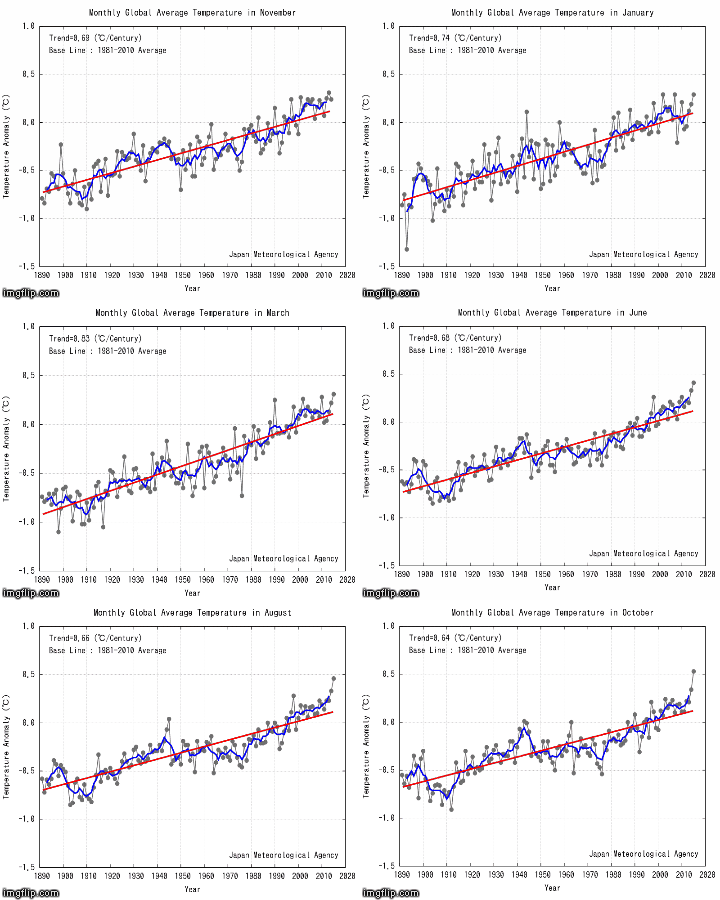
It is getting warm out there and the El Nino is showing no signs of slowing down.  The Japan Meteorological Agency has a tool which shows the average monthly temperature in each month from 1890 to today.  Eli has turned this into an animated gif using imgflp.  Starting in November of 2014 until October 2015


The surge, the surge.

Sunday, November 15, 2015

Lowering the Boom on Exxon

Eli was perusing the tweets and came across a back and forth that involved ATTP and a churnalist know it all by the name of Peter Hitchens.  Well no matter, you can read about that at ATTP, but amongst the drivel was a useful pointer by Willard, no not that useless scumbag Willard Tony, but Willard


which lead back to a post by Hans Custers in Our Changing Climate back in Febrary 2014.  Quite worth reading, but, the killer is down a bit in the comments we have Eli's friend Victor Venema first quoting from the post
If there are any ‘climate change skeptics’ who want to contribute to real science, they might see this as a challenge. Maybe they can come up with a research proposal, based on one of the options for falsification. Like proper scientists would do.
and then lowering the boom 
If someone at an oil company only had the slightest doubt such a challenge might be possible, he had already funded this research. If every visitor to WUWT would pay one cent, they could hire a good scientist. That they rather fund PR firms and write daily erroneous posts shows that even they know the AGW is solid.

Friday, November 13, 2015

This Night is a Time of Pain and Mourning


Ce soir c'est le moment de la douleur, des pleurs, du deuil, mais Paris est là, debout. Je sais que les Parisiens, qui vont souffrir avec ceux qui sont tombés ce soir, sauront aussi se relever pour être d'abord aux côtés des victimes, et pour montrer que cette liberté, cette liberté qu'il y a dans notre ville, cette joie de vivre qu'il y a dans notre ville, ils ne l'atteindront pas - Ann Hidalgo, Mayor of Paris

This night is a time of pain and mourning ... but Paris is still here and standing. ... The freedom, the joyful life that fills this city, [the attackers] have not touched that.

Tuesday, November 10, 2015

Posted without comment


Politics

1. League of Conservation Voters endorses Clinton, their earliest endorsement in 30 years. A no-brainer compared to the Republicans, but much less so compared to her party rivals. My impression of LCV is that it's a quite political organization - and speaking as a former politician, I'm not saying that as an insult. I just hope whatever political value they saw in the early endorsement, in terms of her prioritizing the environment if elected, will be worth it. This also probably has a lot to do with John Podesta as her campaign chair. Enviros are putting a lot of faith in Podesta - maybe rightly so, but he's not the one who could be president.


2. Obama killing Keystone. What I haven't seen mentioned is the union issue, that a number of unions supported the pipeline. Cooperation and conflict between environmental and union priorities is a long-running aspect of the Democratic Party scene. Rejecting Keystone despite union support is a marker for how that all plays out within current party politics.

A related issue that surprises me locally is how little union representation there is within the renewable power industry - that feels like a missed opportunity locally, and maybe more broadly.


3. Kentucky as a test of the worst-case scenario in 2017. If Republicans score their trifecta, keeping the Senate while winning the presidency, what happens to Obamacare could be partly predicted by what's happening now in Kentucky and whether the Republicans can take medical care away from people. If they can't get the political will to pull it off in Kentucky, they may find it hard to do at the federal level.

As for what happens to Obama's Clean Power Plan under this scenario, you've got me. The lawsuits will fly. I fear the worst if Republicans get the Senate and kill the filibuster.


4. Burma. I spent a lot of time there long ago, and now it looks like Suu Kyi's party will overcome the "free and unfair" election obstacles to form a government to the extent allowed by the military. Despite Suu Kyi's lionization by the outside world, the ethnic minority representatives that I knew didn't trust her. My optimistic hope is that she'll do something to help against the brutal mistreatment of ethnic and especially Muslim minorities. She faced strong internal constraints against directly confronting Burmese racism before the election, but it's reached frighteningly dangerous levels. She had better spend some of that political capital she just earned in the right way.

Monday, November 09, 2015

World Ends


at least as far as Eli is concerned.  The wort in Brussels is not cooling because of the warm evenings and the lambics and geuzes are not fermenting.  Already two vital months have been chopped off the brewing schedule and it will only get worse as temperatures increase.

Who will fund Eli's pilgrimage to Belgium before the worst happens?  Contribute to a worthy cause.

Responsible, ethical DuPont. At least compared to Exxon.

Stung by claims that their product could alter the Earth's atmosphere and be a disaster for humanity, the dominant company in the industry launched its own research project in the 1970s and 1980s, only to find out that the claims were correct.


This sounds like the Exxon story we've been hearing in recent weeks, but it works equally well for DuPont. It's an eerie and overlooked coincidence that these two industry leaders were simultaneously following parallel courses for ten years in the 70s and 80s.

The difference of course is that by 1988, DuPont came clean at the highest corporate level about what its own science confirmed. From the link above, DuPont's CEO went in the course of three weeks in March 1988 from saying there was no need for CFC emission reductions to saying they would be out of that business by the end of the century.

I should emphasize I'm only grading DuPont relative to Exxon's behavior - the ozone problem was obvious enough years earlier, and the possibility of a problem, one that could've been worse than greenhouse gas emissions, was known even earlier. Still, DuPont didn't contradict its own scientists while Exxon did.  Exxon funded denialists and its CEO said as late as 1996 that "Currently, the scientific evidence is inconclusive as to whether human activities are having a significant effect on the global climate."

If, when, tobacco-style litigation ensues against Exxon and possibly other fossil fuel companies, the strong contrast between what Exxon said and what DuPont said to their investors and the public could be a powerful legal argument.

Leaving the legal issues aside, there's also the contrast between not just the statements but also what actions the two companies took. I don't claim it would have been feasible for Exxon to plan to get out of the oil business by the year 2000 (for one thing, CFCs were only a minor part of DuPont's business). However, Exxon could have taken the lead on starting to plan alternatives, and that's another key difference between the two companies in the 1980s.

Several years prior to 1988 and the official change in tune, DuPont started developing CFC alternatives and subsequently made a good business out of the alternatives while winding down CFCs. By the early 1980s if not earlier, Exxon had a comparative advantage over other oil companies in directly understanding the climate challenge. The renewable energy business was non-existent at that time other than large hydro - Exxon could've been in at the beginning to become a major player or the major player in what today is a big business with huge growth potential.

Other oil companies like Chevron and BP have put a toe, or more than a toe, in the renewable business. Exxon could've followed the DuPont model and have been way ahead of those companies. Instead as far as I can tell Exxon does nothing.

Exxon blew the opportunity that DuPont seized, and it didn't say what DuPont said.