You're getting to be a rabbit with me!

In a review of William Nordhaus' new book, Climate Casino: Risk, Uncertainty and Economics for a Warming World, Paul Krugman reveals that he was Nordhaus' undergraduate research assistant at Yale for the first Integrated Assessment Model.
Forty years ago a brilliant young Yale economist named William Nordhaus published a landmark paper, “The Allocation of Energy Resources,” that opened new frontiers in economic analysis.1 Nordhaus argued that to think clearly about the economics of exhaustible resources like oil and coal, it was necessary to look far into the future, to assess their value as they become more scarce—and that this look into the future necessarily involved considering not just available resources and expected future economic growth, but likely future technologies as well. Moreover, he developed a method for incorporating all of this information—resource estimates, long-run economic forecasts, and engineers’ best guesses about the costs of future technologies—into a quantitative model of energy prices over the long term.Of course, these models have both their uses and abuses like any model. One of the problems, of course, is that damages are a non linear function of the warming and that is hard to capture if the economic world, the one we function in has never experienced such conditions. For example, since progress, encapsulated as an increase in world GDP, is assumed to grow, one finds that economic damage in IAM models tends, shall one say, to be charitable, to be limited for even global warmings of 10 C. There is a lot of misplaced confidence by practisioners of IAMism. Krugman explains
The resource and engineering data for Nordhaus’s paper were for the most part compiled by his research assistant, a twenty-year-old undergraduate, who spent long hours immured in Yale’s Geology Library, poring over Bureau of Mines circulars and the like. It was an invaluable apprenticeship. My reasons for bringing up this bit of intellectual history, however, go beyond personal disclosure—although readers of this review should know that Bill Nordhaus was my first professional mentor. For if one looks back at “The Allocation of Energy Resources,” one learns two crucial lessons. First, predictions are hard, especially about the distant future. Second, sometimes such predictions must be made nonetheless.
However it’s done, how ambitious should an emissions reduction program be? There’s an international consensus that we should aim to limit the temperature rise to 2°C; sure enough, Nordhaus goes into full debunking mode here: “The scientific rationale for the 2°C target is not really very scientific.” Instead, he argues for cost-benefit analysis—but this leads him to an only slightly higher target: his best estimate of the optimal climate policy if done right would limit the temperature rise to 2.3°C.While the NYRB does not have a comments section, Krugman has written a lead in on his blog where bunnies can comment
The qualifier “if done right” is important. Stabilizing temperature rise in the 2–3 degree range already requires very large reductions in CO2 emissions, albeit reductions that Nordhaus (and just about all serious energy economists) believe can be achieved at only moderate cost, given sufficient lead time.
Experts like Avril Alexander, Caribbean coordinator of Global Water Partnership:
“When you look at the projected impact of climate change, a lot of the impact is going to be felt through water.”
Experts like Lystra Fletcher-Paul, Caribbean land/water officer for the UN FAO:
“ Inaction is not an option. The water resources will not be available.”
Yet another anthropogenic global warming alarm, and just in time for IPCC AR5, whose newly released WG1 chapters 7 and 11 say there is high confidence that dry regions will get drier, wet regions will get wetter, and storms will get stormier. “But there is only low confidence in the magnitude.” These Caribbean experts are much more certain—Caribbean water resources will not be available.And then he tosses himself in at the deep end
Saltwater intrusion doesn’t apply much to Caribbean island groundwater. The islands are mountainous. Pico Duarte in the DR is 3098m. Pic la Selle in Haiti is 2680m. Jamaica’s Blue Mountain is 2256m. Cuba’s Pico Turquina is 1974m. Antigua’s ‘Boggy Peak’ is 402m. St. Croix’ ‘Mount Eagle’ is 355m. Barbados is only hilly, with a maximum elevation of ‘just’ 343m.
Rising sea levels will not contaminate Caribbean fresh water supplies.Rud has maybe never visited the Caribbean. While mountains on many Caribbean islands rise up from the sea, most of the population and infrastructure lives on the coast. That is especially true of the tourist infrastructure. Runoff, especially on the volcanic islands can be really fast. Aquifers and water supplies are often (when they exist, in Bermuda for example many collect rainwater run off) local to the coastal cities and settlements, and thus vulnerable to sea water intrusion. The nature of the climate with wet and dry seasons exacerbates the situation. Oh yeah, storm surge pushing sea water inland is not wonderful for agricultural lands and water supplies.
Van Meerbeeck said water supplies will continue to decrease if individuals as well as agriculture and tourism, the region's key industries, do not monitor use.
"Climate is maybe not the biggest factor, but it's a drop in an already full bucket of water," he said. "It will have quite dramatic consequences if we keep using water the way we do right now."
Jamaica, Trinidad and Barbados have ordered rationing this year, with Barbados reducing pressure and occasionally cutting off supply to some areas. The island also began to recycle water, with officials collecting treated wastewater to operate airport toilets.
Overuse of wells elsewhere has caused saltwater seepage and a deterioration of potable water underground, leading to the construction of hundreds of desalination plants in the Caribbean.
Interesting editorial in the Mercury News over the "resource reshuffling" issue and California's effort to control climate change. And attention, carbon tax fans, you're not safe from this issue either.
It's a variation on the leakage problem, that reducing carbon emissions in one jurisdiction might result in more emissions elsewhere. The argument in this case is that coal and gas plants outside of California that previously supplied the California and other state markets would just reshuffle who gets supplied with what, with California achieving "reduced" emissions only because other states are being credited with the "increased" emissions.
I'm not sure what to think of the argument. To be fair, it reminds me a lot of my Burma boycott days from the 1990s, when a retail buyer of clothing from a manufacturer would promise not to take any of their Burma imports. We said that's unacceptable, the manufacture will just reshuffle the Burma stuff to another retailer who doesn't even pretend to care about ethics.
But there's always another hand. The resource reshuffling mentioned here shrinks the market for the worst fuels - gas can sell anywhere, while coal can't. And doesn't that reshuffling happen all the time anyway - if I buy an electric car and a bunch of solar panels, wouldn't just a tiny decrease in gas price result in more purchases that (almost) make up for my removal of my vehicle from the market? What's the real solution - is California supposed to go to other states, buy and shut down their coal plants, and then buy and shut down any new coal plants proposed to take the old plants' place? As for the editorial, it suggests continued responsibility for the reshuffled emissions - but for how long? Forever?
I think I could agree with some transitional responsibility for reshuffled emissions for one or a few years, but after a while I'd say the emissions belong to whoever's creating them, not whoever used to create them in the past.
I got my five minutes at the press conference, starting about 10 minutes into the video below:
(Link here for Oct. 17 video - no idea why the freeze frame is on my blathering mug instead the mayor's....)
The main takeaway from the conference - two thirds of fossil fuel reserves represented on world capital stock exchanges have to stay in the ground to stay within the 2C temp rise goal. The valuation of the rest is a carbon bubble.
My note - I suppose it could be that the carbon returns to the ground instead of the fossil fuel stays, although CCS hasn't done well.
Seattle Mayor Mike McGinn: we're the first generation to experience climate change, and the last to be able to stop it.
My note - a bit of an overstatement and understatement - we can't stop it, and even a business as usual scenario for X years in the future would be disastrous but not a reason to do nothing starting X years in the future.
A contract-and-grow strategy works for fossil fuel companies - e.g., an oil company that stops throwing away profits on finding new fossil reserves and increases dividends instead will be worth more and serve its owners better than a typical oil company that spends money finding reserves it will never burn.
Lots of discussion on fiduciary duty, something used as an excuse to not divest. Bob Massie calls it a Harry Potter spell - "Fiduciarydutyparalyis!" Given the risks from companies that say they don't care about the future, the fiduciary duty could actually support divestment - what does that say about the quality of the management?
One speaker presented two portfolios, one with fossil fuel companies and one without. The one without had a larger carbon footprint. Climate divestment can get tricky.
My note - I expect that most of the time, this would not be the usual outcome. Perfect v good issue.
Talking to financial people, it sounds like the recognition of financial exposure that you see in the insurance sector is starting to happen in the financial sector.
A number of professionals showed backcast simulations of divested portfolios v. typical portfolios. Overall it seemed to not diverge all that much.
One person asked a question I had - would recognizing the carbon bubble create a race by companies to get the fuel burnt first, before we hit the ceiling? Response said no, projects are currently being cancelled. YMMV.
Investor engagement/shareholder activism - speakers acknowledged this can be a viable alternative in some circumstances, but argued that if a problem with a business is its core business strategy, then shareholder activism won't work. One speaker made a slightly contrary argument - they're going to engage directly with fossil fuel companies to get them to drop the $100b most expensive new fossil fuel projects in planning stages, setting the stage for shareholder lawsuits if they don't drop them and then the projects crash and burn metaphorically.
Someone raised the slippery slope issue that climate divestment is only one issue and that it opens the door to still other ways to reduce the investment universe. I can understand the reasoning - I think a reasonable response might be that you can consider multiple causes, up to whatever line you choose to draw on restricting your investment universe. Then cage match the causes against each other. The speaker said you also have to look at the investor's mission and the cost of a screen - e.g., divesting from Russia-investing companies would be much more difficult than divesting from top 200 fossil fuels.
On a personal note, I ran into a guy who I used to work with on Burma human-rights issues 18 years ago, and saw him today for the first time since then. Small world.
What, bunnies ask, do zombies wanting to eat your brains have to do with the Stadium Wave?
Well consider, the Weasel's take on Wyatt and Curry's Role for Eurasian Arctic shelf sea ice in a secularly varying hemispheric climate signal during the 20th century. Eli's friend actually reads the paper and notices several things. First, the waves, that W&C claim to be displaced from one another in several different climate indicators (see the figure below for a quick look, read the link to Stoat for more details) are the result of massive filtering of the AMO, PDO, etc. To get an idea of how much smoothing, compare the two figures below). Second, all of the signals were normalized in the figure displayed by W&C, even though most of them had little power in the frequency pass band. Stoat goes on to show that
---------------------------------------------------

I think that’s about it, really. All the stuff about exploding
sardines is just fluff and can be ignored. The “mechanisms” is an
extended exercise in self-delusion.
-----------------------------------------------------
Again, what does this have to do with zombies. Well, there is a long, as these things go, history of amateurs and pros, trying to use the PDO alone or with the AMO or the AMO alone as a climate forcing to brew statistical moonshine.
One can see exactly how much W&C are loosing by comparing the five year smoothed PDO shown in red with the figure above, let alone the yearly data.

Correlated indicies, considered along with M-SSA results potentially add further insight into dynamics associated with the signal's propagation. Prior to computing correlations between pairs of linearly detrended normalized raw time series, values were smoothed with a 13-year running mean filter to sort out shorter-term fluctuations in order to highlight longer term behavior of indicies. We also experimented with a variety of filter sizes from five years to 20; results were virtually unhanged valuesThat, as they say is a big no-no. Obviously even a five year smoothing eliminates much of the variability, which if left would decrease the correlations. Detrending is also problematical. In a quoting the devil (well the citizen-devil) mode, Eli will send you to Climate Audit and a post by Willis Eschenbach, Data Smoothing and Spurious Correlation, and here is one from Willard Tony hisself.
Sexual harassment from Bora Zivkovic, who's done so much good for science blogging and then used it to harass women. What a shame. Comments worth reading too, one woman after another talking about dealing with the same damn thing.
More context here.

David Archer's Climate 101 starts Oct 21 on Coursera as Global Warming: The Science of Climate Change
David discusses the new bells and whistles on Real Climate
The Supremes have decided to accept an industry/US Chamber appeal of a lower court decision saying the EPA was "unambiguously correct" when it used regulating greenhouse gases for motor vehicles as a trigger to begin regulating emissions by power plants. They refused to consider broader questions, including reconsideration of their 2007 decision that effectively mandated the beginning of EPA regulation. The EPA also interpreted legal requirements of the Clean Air Act to allow them to focus only on major polluters - the forces of darkness tried to make a poison pill of the law by forcing them to regulate everybody, and AFAICT that's been shut down.
This issue involves arcana of the CAA, much of it beyond my area. I can just say that it takes only four of the nine supremes to accept an appeal but it takes five to win. The original 2007 vote was 5-4. Granting cert to consider the appeal doesn't necessarily indicate a change in the vote count, but it does indicate that at least four think they've got a chance to ruin the global environment.
While it's legal arcana, the environmental implications are huge. That the US Chamber is again choosing the fossil fuel industry interests over the green business interests shows its dysfunction in failing to represent American businesses.
Al Gore has taken a lot of abuse for prematurely being against climate change over the years. One of the sillier ones was for a bit of artwork that appeared on the cover of his latest book “Our Choice: A Plan to Solve the Climate Crisis” with Gore's comment

When you unfold the cover, the image you see if the earth as we know it today with its deep blue oceans, rich soil, and green forests. This side of the cover reveals an artist’s rendering of an earth where unchecked global warming has wreaked havoc. We are at a crossroads. We must choose which earth will be home to future generations.He would, perhaps have done better to run the image past Kerry Emanuel first, but of course, the jackals pounced.


Specifically, if a letter asserts that there's no sign humans have caused climate change, then they don't publish it, instead hoping that some other letter may contain factual information.
This strikes me as reasonable enough; the usual comparison to creationism applies. I would limit it somewhat - if a LTE quoted one of the very few peer-reviewed, skeptical abstracts, then that's not complete nonsense. Whether an outlier opinion deserves such a prominent placement is the next question and probably depends on the letter and context.
My anecdotal sense is that the false equivalence of ten and even five years ago in the mainstream media over climate science has changed, and the LA Times is one example.

Packing list for newlyweds:
Clothes
Map
Watch
Credit card
Driver's license
OOhhhhhh.. I just knew I was forgetting something!!
Dear Bunnies,
A few days ago, Eli and others pointed to a new paper on natural variability by Camilo Mora and others at the University of Hawaii.
Mark Morano has called out the flying wingnuts to harrass Prof. Mora, which, as you know can be quite unpleasant, but even if not, those of us who appreciate good work (and Mora has a long and excellent track record on biodiversity issues) do not mind giving a pat on the back, so if you feel that a pat is of value, let him know, if you have a question about his new paper, ask, and if you think you have something to add, that would be nice, better tho if brief. And finally, if you have been the subject of a flying monkey attack, talk about how you dealt with it.
The Email is cmora@hawaii.edu
Eli
Eli has noted some spiffy (tells you how old the Bunny is) artwork motivated by the IPCC report, and thought he would provide a Poster Session. Late submissions will be considered by the committee.
Eli will start with Gavin's take on the AR5's POV of climate forcing and the changes therein. Welcome back Gavin, we need you. As to the rest of the Real Climate crew (ok, not Stefan), get off your butts, the public outreach of Real Climate is worth ten papers in GRL. For those others out there in AGU/AMS/EGU land without your own blogs or even with, consider strongly contributing to Real Climate (if you have some snark on your chest, Eli is always welcoming)
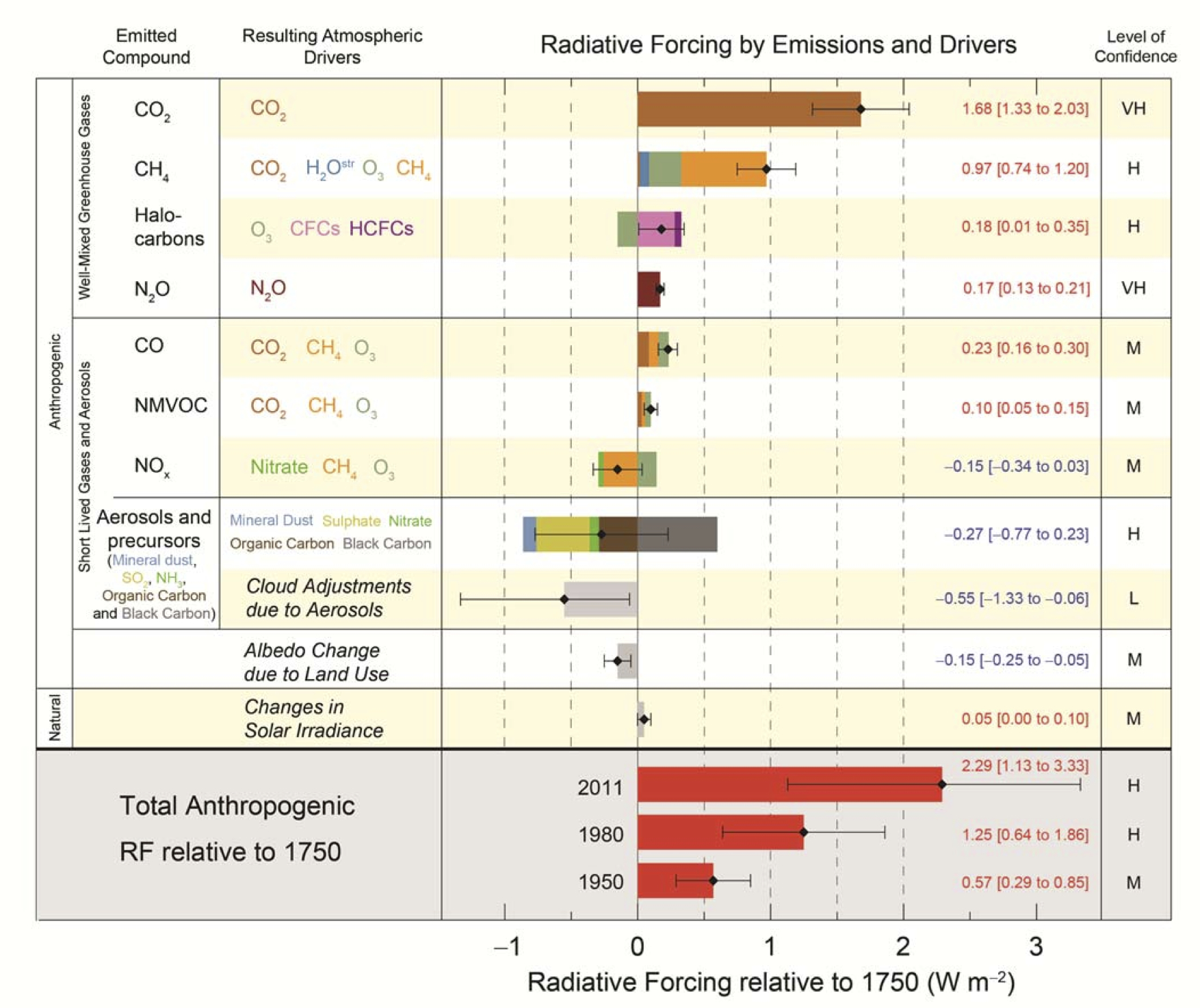
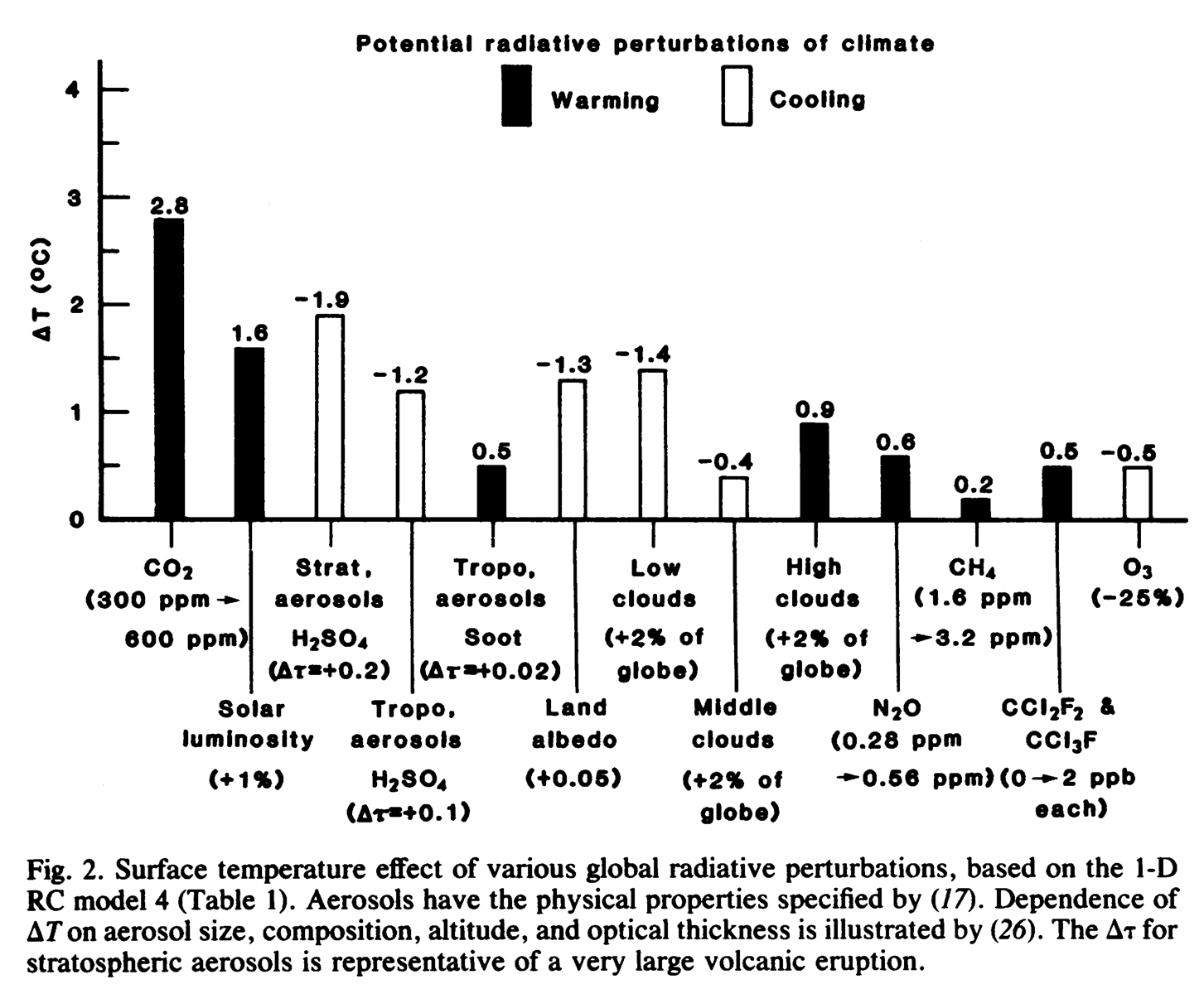
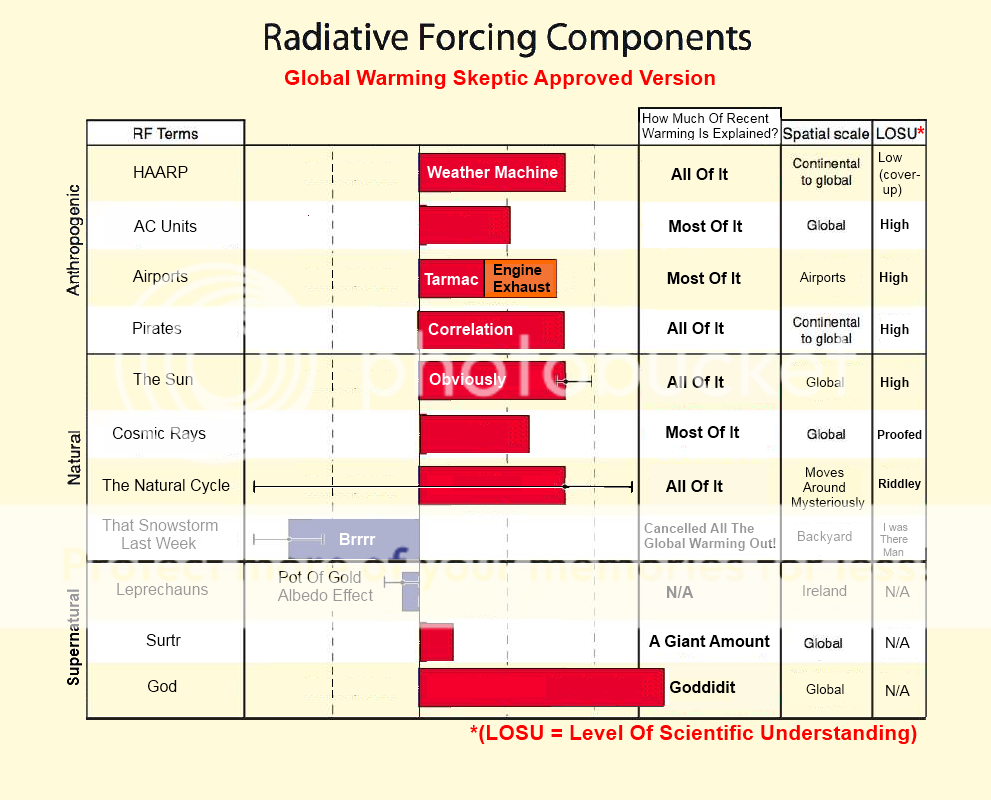


A little personal tale from the government shutdown - I came back yesterday from vacation at Baxter State Park visiting three moose, two beaver, one insolent racoon, and a million colored leaves, with the plan of leaving next week for our water district's fall trip to Washington DC. We go to lobby the Feds on funding for our various flood control projects and San Francisco Bay restoration program. So much for that trip - our staff tell us that government officials we'd been planning to meet are basically disappearing - they're not even legally allowed to answer calls we make to them on their government-issue phones. The story's that it will get even worse after Friday - the Office of Management and Budget has allowed a few agencies to teeter forward on rollover funding, but that's done with after this week. So we'll be going in November on the hope that things will work out then.
Here's my thought experiment: why shouldn't the Democrats demand that the Republican House pass climate change legislation or a fiscal stimulus as a condition of funding the government and raising the debt limit? If the tactic of taking the national and global economy hostage is legitimate, why shouldn't Democrats use it?
This isn't even a case where Republicans can argue the ends justify the means, a utilitarian argument they usually avoid. The ends they seek are the opposite of the ends that Democrats would seek so there's no utility-maximizing outcome, just a government shutdown and potential default. The only way to win the game is not to play - except of course for trying to win elections, a legitimate way to change the law.
One good thing about the strange fact of the Army Corps of Engineers running America's domestic flood control program is they're more likely to operate during a government shutdown, so we were able to do a little negotiation at yesterday's district board meeting. Not sure if it'll be interesting, but I'm attaching below a clip where I tried unsuccessfully to pin down one of their experts on an environmental issue. For decades we've allowed trees and bushy vegetation to grow on our levees along streams, incorporating them into our riparian system and providing important benefits to endangered fish. Recently the Corps has been changing that.
I think he's truly trying to be helpful, but I'm not sure if I failed to ask the right question or if it's just that it's not possible to be more specific.
UPDATE: C also Fergus
An everygreen in denial land has been that natural variability covers all climate change. All of those econometrician types, and some of Eli's favorite crazy aunts are fond of this, but they are lumpers. There is no single natural variability.
The tropics, of course, are the region with the most species, the most biodiversity, a hell of a lot of people, and an almost unchanging climate. Why do the bunnies think that the tropics have the most species, the most biodiversity and so many people? It is a lot easier dealing with a constant climate than one that varies all over the place. For one thing you don't have to change your fur with the seasons. The flip side is that nature in the tropics is not so well structured to deal with even small changes. While variability is low, human climate forcing driving the system beyond its usual local limit is dangerous.
Of course, high latitudes are vulnerable exactly because climate variability there is so high. In that case one worries about damage that is hard to reverse from large excursions (things don't always break the way you want). If there is a really warm summer, and the permafrost goes really non perm, it's hard to dig the Alaska oil industry out of the muck.
A paper to be published tomorrow in Nature The projected timing of climate departure from recent variability by Camilo Mora and friends at the University of Hawaii that makes an important contribution by recognizing this issue. Well, it does come from Hawaii, one of the places with the most constant climate on earth. They examined historic climate using 140 years of data for the past, and Earth System Models for the future (You want data from the future? Sorry, that is not currently available). They define exceeding natural variability at any position as exceeding the limits of the 140 year data record for various periods of time. For reference RCP45 is an emissions scenario that brings the CO2 mixing ratio in 2100 to 538 ppmV

Here we present a new index of the year when the projected mean climate of a given location moves to a state continuously outside the bounds of historical variability under alternative greenhouse gas emissions scenarios. Using 1860 to 2005 as the historical period, this index has a global mean of 2069 (+18 years s.d.) for near-surface air temperature under an emissions stabilization scenario and2047 (+14 years s.d.)under a ‘business-as-usual’ scenario. Unprecedented climates will occur earliest in the tropics and among low-income countries, highlighting the vulnerability of global biodiversity and the limited governmental capacity to respond to the impacts of climate change. Our findings shed light on the urgency of mitigating greenhouse gas emissions if climates potentially harmful to biodiversity and society are to be prevented.The years when variability will be exceeded forever on an annual basis are shown in a) below, and on a monthly basis in b) below. Eli directs your attention to the summers in the Indian subcontinent and Southeast Asia.

the projected timing of the ocean’s climate departure was pushed forward to this decade when pH was considered alongside sea surface temperature. Global mean ocean pH moved outside its historical variability by 2008 (+3 years s.d.), regardless of the emissions scenario analysed.Eli wonders if Richard Tol would agree that this paper explicitly endorses the IPCC consensus?
There is more than some confusion about the IPCC process. Ethon has tried explaining this on several occasions, but, perhaps at this time another try would help. First there are those who accuse the IPCC of being political, second those who object to the idea that the IPCC achieves a consensus. Ethon would simply point out that that is the plan, not the problem.
Now some, not Eli to be sure, might wonder why politicians and political scientists are mystified that the IPCC Summary for Policy Makers has political and policy implications. The answer is simple, every single sentence is unanimously approved by over 170 nations, each of which has a delegation consisting of politicians, policy makers and scientists.
So, as Sherlock Holmes might say, the absence of dissenters is a sure sign of a consensus.
But how was that consensus achieved? After all there are loose canons out there, some of them have oil, some coal and some nuts. Some statements have been modified to placate all of these, but the basis remains. Well, that is design. Consider, for example the Consensus Oriented Decision Making Model

 Posts
All Comments


Eli, Eli was enjoying life, when he happened to wander into Judith Curry's house of mirrors to find another digression by one of her pet polymorphs (she really should collect lagomorphs, a much better and nicer bunch), Rud Istvan. Rud is pushing new carbon based materials for energy storage capacitors in real life. At least Russell blows microbubbles. But as a hobby, Istvan has been here and there in comments and the occasional guest post in the usual places. He really values his opinion.