Wednesday, July 14, 2010

Eli Rabett's Chris Monckton Limerick Contest

UPDATE: Voting is now open

Seeing as a Limerick contest has broken out in the comments about Moncktons Gallop, Eli thought Rabett Run might offer a prize, a ticket (Eli will provide a grant) to one of his lectures in the next year, airfare, housing, etc. NOT included, but Eli will provide a decent bottle of Scotch so you can survive, Eli's choice of course, but Eli has standards. Ms Rabett, OTOH has the check book and the charge card. It will be better than OK but that's all we promise. Multiple entries allowed

To get you started here are the current entries

anonypoe started it all

Once there was a Viscount of Brenchly
Who disputed his critics most contentiously
With a lawsuit in hand
And an imperious demand
No one doubted the defense of His Excellency

Noe one doubted that is save for Poe
Who's Law is unknown by most joes
Now seeing the crank
Raised to high rank
Its impossible to tell the man from the show

A Viscount worried about his reputation
Fired up by an internet disputation
With a bunch of new slides
Screwed up his hurt pride
And revealed a self-mocking refutation.
Andy S
John Abraham once debunked an
Egregious talk by Chris Monckton
So the Lord tried to do
His own Peer review
Which he characteristically flunked on.
Ron Broberg-
Once a Lord of the House came to say
As "b is not a" so "b is not 'not a'"
So as you can see
All things that are 'b'
Are orthogonal to our reality today.
Horatio
There once was a man who used graphs
Equations and more advanced maths --
He dazzled the Tonys
With all his baloneys
And sent them down dead-ended paths.

There once was a man who used graphs
Equations and more advanced maths --
He dazzled the Tonys
With all his baloneys
And sent them down dead-ended paths.

There once was a journalist named Chris
Who thought there was something amiss
With the physics of Newton
Said he 'You're darned tootin'
"I will get to the bottom of this."

There once was a man with Nobel
Pinned to his suit-coat lapel
"When you address me, bow low"
"I'm world famous, you know"
Gareth provides a Clerihew (sorry, Eli has standards) and a limerick
There was a daft Viscount from Brenchley,
Whose shark jumping owed much to Benchley,
His downfall, they say,
Was caused by the way
His politics posed as reality
And . . .

Tuesday, July 13, 2010

Scrotum sends Gareth to guest

From the comments an answer to Christopher Monckton's

#126 Since I gave advice on a wide range of scientific and technical matters to the British Prime Minister for four years, and ran a successful technical consultancy in the field of public administration for two decades, and have twice very profitably exploited a previously-unsuspected wrinkle in the laws of probabilistic combinatorics, and I have published what is on any view a heavily mathematical paper on the determination of climate sensitivity in a reviewed journal, on what rational basis did you consider it appropriate publicly to disseminate – without any qualification or verification – Dr. Keigwin’s unscientific guess that I had “no background in science”? Is this an instance of the care you take, as “a scientist”, to verify your facts?
Well there are more detailed answers Gareth puts it clearly, calling this puffed up bit of hot air convection.
The rational basis, therefore, for the assumption that Christopher Monckton, Viscount Brenchley, has no scientific background is that the evidence shows he hasn’t got one. The very best that can be said for him is that he has a facility for maths, a wonderful line in pompous prose and a bee in his bonnet.
and goes on to provide the details. Bunnies are invited to argue about the facility for maths but the point is that why should John Abraham have all the fun?

Tim Lambert has a go, including Pinkergate.

Eli loves the "gave advice", probably true, and even more certainly true that if he gave, she didn't hear it. The boy dissembles with style.

Richard Littlemore takes a bite, noting that

My favourite set of criticisms, though, revolve around Abraham's general statements that Monckton had urged his audience to believe: "The world is not warming;" "The ice is not melting:" "The ocean isn't heating;" and "Sea levels aren't rising at all."

Monckton says each of these characterizations of his position amount to "a lie" and to prove it, he points to some of the graphs that he used to illustrate the issues in question. These graphs appear on slides labelled "The 'it's getting worse' lie;" " ...so sea level has not risen for four years;" and "Arctic summer sea ice area is just fine; it's recovering from a 30-year low in 2007."

having on video claimed that these graphs show the earth is not warming, or in writing, in his words, "that global warming ceased in 1998" (slide 57), he now claims that they show the Earth is warming. Either he was dissembling then or he was dissembling now, but Chris is angry that Abraham took him at his word. Eli would never be so foolish.

Oh, and for giggles, take a look at the comparison between MBH's hockey stick and M&M's red noise on slide 45.

Scrotum confused the labels! Of course, you only get hockey sticks from red noise, if you abuse the algorithm and even then if you blow up the labels on the axis you would see that the real temperature proxy data variation is at least an order of magnitude higher than the random red noise. His lordship has been showing this hither and yon.

Monday, July 12, 2010

What goes up, often melts down

Trapped. Eli should be working and no sooner does he come finish his last post then Scrotum shoves his Lord's shifty next question in his face

456: Given that you showed great interest in a paper suggesting that ice-melt from Greenland was great enough to cause sea level to rise by what turned out to be less than 1 millimeter, why were you silent when confronted with the above visual evidence, from the US Department of Defense, showing that half a century ago its DEW-line early-warning radar stations were standing proud of the ice, while now the allegedly melting ice is accumulating rapidly around them?

Hmm class let's take a guess at this one.

Maybe, just maybe, they built the radar station on the ice. You know, that's hard to believe, but bunnies, it's GREENLAND, land of milk and cookies. Gee, if it got a bit warmer during the summer, and the top layer got a bit slushy, the unattended station might just kinda fall down into the ice And hmm,it was blacker than the ice/snow around it. And probably absorbs more sunlight during the summer, and gets warmer, And there does not appear to be much ice on top of the station.

And, hey, look at that, it is a lot deeper in 2006 than in 1998. GLOBAL WARMING ALERT!!!

This is where Eli came in

Viscount Monckton is busy jumping the shark, having been bitten by John Abraham, so Eli thought he would go over and have a look. Since Chris is a backwards lad, Eli started at the end, and after passing over a few odd bleats he came to

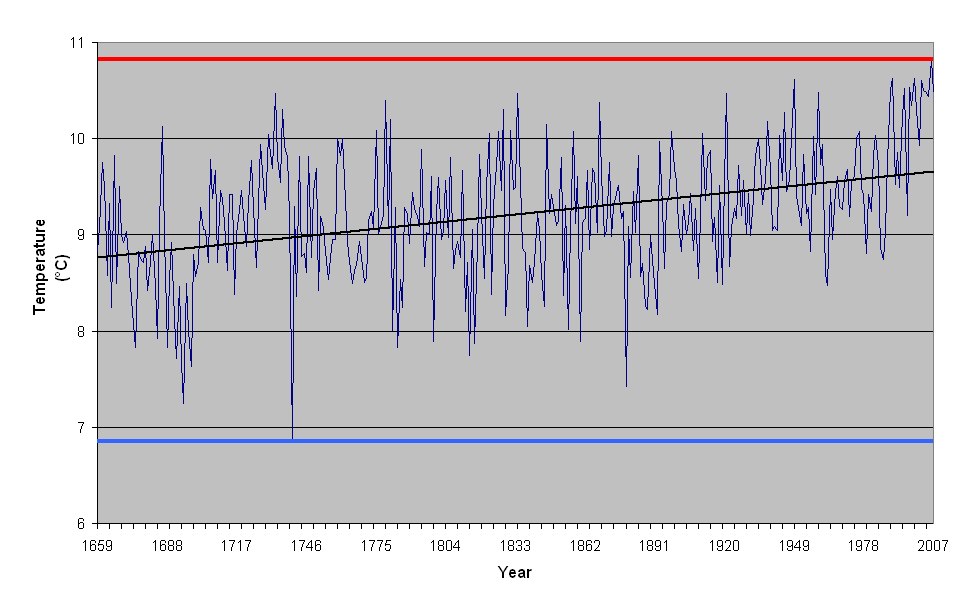
455: Since you are apparently so concerned about even small changes in temperature, and about minute variations in the peaks and troughs of the global temperature curve from one graph to another, are you not truly astonished to find that in the Central England Temperature Record, compiled since 1659 and, because of its latitude and other regional characteristics, a reasonable proxy for global temperature anomalies, shows that in the 40 years 1695-1735, before the Industrial Revolution even began, Central England temperature rose by 4 F°, a rate eight or nine times greater than the warming of the 20th century?
This brought back all sorts of fond memories.

Leaving aside the issue of whether the CET is representative of global temperatures there is the amusing fact that in the 1707 to 1722 period it went tramping to Utrecht and got fouled. Whatta you expect when you play the Dutch. But there is more. . .

The Central England historical record, was originally published by Manley.

The data base is maintained by the Hadley center and the series runs from 1659 to the present.

Our friend Nigel Persaud got his knickers into a twist because Mann, Bradley and Hughes only used the record from 1730 on. Much of this comes from that audit of the auditor. The CET is set forth in

Manley, G., 1953: The mean temperature of Central England, 1698 to 1952. Quart J Roy Meteorol Soc, 79, 242-261.

Manley, G. 1974: Central England Temperatures: monthly means 1659 to 1973. Quart J Roy Meteorolol Soc, 100, 389-405.

Parker, D. E., T. P. Legg, and C. K. Folland, 1992: A new daily Central England Temperature Series, 1772-1991. Int J Climatol, 12, 317-342.

Bunnies can find links and a nice graph at the Wikipedia where interested lagomorphs might note that the CET temperatures "FELL" between 1659 and 1695, by about the same amount they "rose" between 1695, and 1735. 1998 and all that.

At the time Eli went and got the last two papers, and read them. The reason that MBH98 does not use the data before 1730 is clearly explained in the first paragraph of the 1992 Parker, Legg and Folland paper:
"Manley1953) published a time series of monthly mean temperatures representative of central England for 1698-1952, followed (Manley 1974) by an extended and revised series for 1659-1973. Up to 1814 his data are based mainly on overlapping sequences of observations from a variety of carefully chosen and documented locations. Up to 1722, available instrumental records fail to overlap and Manley needs to use non-instrumental series for Utrecht compiled by Labrijn (1945), in order to mate the monthly central England temperature (CET) series complete. Between 1723 and the 1760s there are no gaps in the composite instrumental record, but the observations generally were taken in unheated rooms rather than with a truly outdoor exposure...."
Which means that the Manley reconstruction is only continuous from 1722 on, but the information upon which it relies from 1723-28 has further difficulties, essentially absolute values were not reliable, and the series was constructed by taking the difference between measurements made by those thermometers and ones thought to be more reliable after 1727, and then repeatedly differenced to get values before 1727.

In the light of this, it is perfectly reasonable to truncate the CET series at 1730 although Parker chose to start in 1772 when reliable thermometer records are available from Hoy in London, not trusting the data before 1770.

On balance this illustrates the principal of RTFR (Read the effing references) and the danger of someone unfamiliar with an area trying to do an "audit". The CET before 1730 is certainly not reliable, even Scrotum knows that, but whether he has passed the word onto Mycroft Monckton is uncertain.

So, since things have been dull at Rabett Run, Eli invites all to answer any of his Lordshifts questions, which will be dully featured.

Tally-ho!

Thursday, July 08, 2010

Wednesday, July 07, 2010

Missing comments

It appears that some comments are not getting through. JA has seen the same problem Appears to be bloggeritis. UPDATE: MT has the bug too.

UPDATE: July 8 This appears to have been resolved by Blogger. Thanks to Hank and Timothy for their efforts, which Eli suspects spurred the big B a bit.

Tuesday, July 06, 2010

Bart can retire - Part I

Bart Verheggen, owner and operator of My View on Climate Change, aka Our Changing Climate, reports on a study carried out by the Planbureau voor de Leefoomgeving (PBL),aka the Netherlands Environmental Assessment Agency, on the reliability of Working Groups II's report in the AR4. More exactly, the PBL's political masters asked for a specific evaluation of the chapters evaluating probable regional changes. Eli will encourage you to hie over there to read the results, but the general outcome was that the report was reliable, even though they found one additional clunker. What caught Eli's attention was that the PBL took comments from the public. Of the 40 or so that came across the transome, ONLY 3 were relevant, but the PBL provided answers to them all and Rabett Run is pleased to add them to his retirement home.

COMMENT: It has come to my attention that the PBL has opened a website for reporting errors in the IPCC report. It is apparent to me, however, that this website limits the chapters on which the comments must be about and allows for no other comments or questions. This unfortunately impeded the open and honest debate about the IPCC report that many seek. Therefore I take this opportunity to write to you in the hope that my comments will be taken into account by you and your colleagues.

I will keep my questions and comments brief, acceptingthe risk that they may not in all respects be expressed perfectly scientifically or technically. For this I apologize. If my questions are not clear, I am happy to explain them further.

My questions / observations are as follows:

1. The effect of the flood of human-produced CO2 on the (alleged) (enhanced) greenhouse effect.

The IPCC assumes a significant effect of CO2 on climate.
Although CO2 is a greenhouse gas, the influence of water vapor in the atmosphere is much greater, given the much larger amount of water vapor in the atmosphere than CO2. The influence of CO2 on a (possible) temperature increase is only about 3% of the total impact. I would like to understand why the IPCC ascribes a major influence to anthropogenic CO2.

2. The IPCC reports the report was "peer-reviewed". P

I am curious to hear from you, how the comments of "peers" were handled .
It could be (I blame no one!) that only the positive reactions were considered and the negative ones were ignored. In that case it would still be peer-reviewd "despite the negative comments not being considered.

Note: In my time I did TNO tests of devices.
Some were unequivocally rejected. But some of those who submitted devices made a point in their advertising that their products were "TNO-tested"!! Linguistically that was correct, of course, but it twisted the meaning. Can you confirm that this state of affairs does not apply to the concept of "peer-reviewed "in assessing the IPCC reports?

3. "Global warming".

The models in the IPCC reports are assume a continuous global warming.
How does this model, account for the already more than 10 years of continuous cooling of the earth? The temperature has not increased anymore in the last 10 years. Nature does not seem to track any of the models! How reliable are the models then?

Those are my questions. I look forward to your response.


ANSWER: Thanks for your comment submitted within the framework of our research on errors in the report of IPCC Working Group II.

Your comment focuses on issues outside the limits of our investigation. However, I want to briefly respond to your letter.

Water vapor is the main greenhouse gas, because water is present in abundance on Earth, and thus relatively high levels in the atmosphere. Approximately two thirds of the greenhouse effect is attributable to water vapor. The important role of water vapor has been completely dealt with by the IPCC. Take a look at this webpage on Climate Portal, which Bart Strengers of PBL in a discussion with Hans Labohm including addresses the role of water vapor: http://www.klimaatportaal.nl/pro1/general/start.asp?i=0&j=0&k=0&p=0&Itemid=367 (in Dutch, use Google Translate to get an idea)

As to the effect on the CO2 concentration of the 3% anthropogenic emissions of CO2, I refer you to to this Web Portal on Climate: http://www.klimaatportaal.nl/pro1/general/start.asp?i=0&j=0&k%20=%200&p%20=0&Itemid=565

You also ask about the review process of the IPCC. You can see what happened to the comments on the IPCC website. See http://hcl.harvard.edu/collections/ipcc/index.html where comments on each chapter and each stage of the process is documented showing all the comments. Click on a section and see in the rightmost column, the responses of the IPCC authors.

Finally, a response to your comment about global warming over the past 10 years. Climate models show not only an increase in temperature. Climate models take into account natural variations in temperature over a period of 10-15 years, including temporary cooling, even when CO2 concentrations are continually rising. See for example the scientist-versus-skeptic blog on the website of the NIS: http://weblogs.nos.nl/klimaat/2009/12/17/wedden-dat-het-opwarmt/

The causes of limited warming in the last 10 years is under discussion in science. See:
- Solomon et al., Science 5 March 2010, Vol. - Solomon et al, Science 5 March 2010, Vol. 327. 327. no. 5970, pp. No. 5970, pp. 1219 - 1223: http://www.sciencemag.org/cgi/content/short/327/5970/1219 1219 - 1223: http://www.sciencemag.org/cgi/content/short/327/5970/1219
- News in Climate Science and Exploring Boundaries (december 2009). - News in Climate Science and Exploring Boundaries (December 2009). On our website see: http://www.pbl.nl/en/publications/2009/News-in-climate-science-and-exploring-boundaries.html .

When our investigation is completed, we will inform you of the results.

Sunday, July 04, 2010

Not in it for the gold

No one is


Tip of the ears to Ben Hale who turned Eli on to the RSA animations.

This pretty well sums up why bunnies take up the scientifical life and why the denialists are unlikely to contribute

Some have asked about

Eli and the bunnies opinion of characters such as Tom Fuller


Comment

Saturday, July 03, 2010

The World Cup repeats itself, first as tragedy, then as farce

There is much comment on the tragedy of how Ghana was denied a victory by Luis Suarez's blatant handball on the goal line, followed by a missed penalty.


As Ben Hale puts it "Ghana got screwed". Of course, today we were entertained by the farce of Paraguay


and Spain


both missing penalties within a few minutes of each other. The shooters and the ref should be shot.

Football is being ruined by cynical play, diving, professional fouls and more, of which there are no better examples than Maradona's "Hand of God" goal,


and just this year Thierry Henry doing the same to knock Ireland out and put France into the World Cup. That worked out well enough that one might believe in divine justice.


Eli starts with the observation that additional referees, instant replays and more would ruin the flow of the beautiful game. The cynicism that has crept in comes from a moral calculus that undervalues the costs of cheating and sharp practice. The real issue is not how to make the game "fairer", but rather how to tip the balance so that players don't take advantage.

His answer is impose long bans, even lifetime bans, on players who do what Maradonna, Thierry Henry and Luis Suarez did, and insist that they not be paid during their bans. Such bans would be imposed post game and the tribunals could use replay video, referee's reports and more. If Luis Suarez had to balance losing the game against losing his career, he might not have punched the ball off the line.

Comments

Thursday, July 01, 2010

Watt now? McIntyre will have a cow

The Penn State Faculty Committee of Inquiry on Michael Mann's conduct of research has issued its final investigative report about whether

"Dr. Michael Mann engage in, or participate in, directly or indirectly, any actions that seriously deviated from accepted practices within the academic community for proposing, conducting, or reporting research or other scholarly activities?"
Bottom line first
The Investigatory Committee, after careful review of all available evidence, determined that there is no substance to the allegation against Dr. Michael E. Mann, Professor, Department of Meteorology, The Pennsylvania State University.

More specifically, the Investigatory Committee determined that Dr. Michael E. Mann did not engage in, nor did he participate in, directly or indirectly, any actions that seriously deviated from accepted practices within the academic community for proposing, conducting, or reporting research, or other scholarly activities.

The decision of the Investigatory Committee was unanimous.
They first considered whether Mann had deviated from accepted practices in his proposals (oh yes Ken C you are gonna have a problem with that one). They concluded that Mann's record in light of stringent reviews meant that
This level of success in proposing research, and obtaining funding to conduct it, clearly places Dr. Mann among the most respected scientists in his field. Such success would not have been possible had he not met or exceeded the highest standards of his profession for proposing research.
They next considered whether Mann deviated from accepted practices in the conduct of research
The Investigatory Committee established that Dr. Mann, in all of his published studies, precisely identified the source(s) of his raw data and, whenever possible, made the data and or links to the data available to other researchers.
thus
Dr. Mann's actual practices with regard to making source codes and intermediate data readily available reflect, in all respects, evolving practices within his field
The Committee of Inquiry noted that Mann was held in high regard as shown by the many awards he has received, and finally they considered whether he had deviated from accepted practices in his reporting of research results.

The report includes a straightforward answer to Nigel Persaud
The next question for Dr. Mann was posed as follows: "What is your reply to the email statements of Dr. McIntyre (a) that he had been referred to an incorrect version of your data at your FTP site (b) that this incorrect version was posted prior to his request and was not formulated expressly for him and (c) that to date, no source code or other evidence has been provided to fully demonstrate that the that to date, no source code or other evidence has been provided to fully demonstrate that the incorrect version, now deleted, did not infect some of Mann's and Rutherford's other work?"

Dr. Mann responded by stating that neither he, nor many of his colleagues, put much reliability in the various accusations that Dr. McIntyre has made, and that, moreover, there is "no merit whatsoever to Mr. McIntyre's claims here." Specifically, Dr. Mann repeated that all data, as well as the source codes requested by Dr. McIntyre, were in fact made available to him. All data were listed on Dr. Mann's FTP site in 2000, and the source codes were made available to Dr. McIntyre about a year after his request was made, in spite of the fact that the National Science Foundation had ruled that scientists were not required to do so. The issue of an "incorrect version" of the data came about because Dr. McIntyre had requested the data (which were already available on the FTP site) in spreadsheet format, and Dr. Rutherford, early on, had unintentionally sent an incorrectly formatted spreadsheet.
Does any of that sound familiar? Eli finds some interesting points in there that Steve should discuss.

The Committee slapped Mann on the wrists for sharing without permission unpublished stuff with third parties as careless and inappropriate.

Richard Lindzen, who was also interviewed, as many have guessed, is not exactly a friend of Michael
When told that the first three allegations against Dr. Mann were dismissed at the inquiry stage of the RA-lO process, Dr. Lindzen's response was: "It's thoroughly amazing. I mean these are issues that he explicitly stated in the emails. I'm wondering what's going on?"
but Lindzen also told the Committee
The next question inquired whether, in Dr. Lindzen's view, climatologists normally make their codes (used in the analysis of data) available for other people to download. Dr. Lindzen responded by stating that "it depends."
RTFL. Comments?

Wednesday, June 30, 2010

Eli Re- Retires

Carrot Eater (must the kids always show up the old bunny) points to a pamphlet released by Swiss Re providing answers to your average climate sceptic written by Urs Neu. of course, Rabett Run has a few exceptional climate sceptics, and the bunch confidently predicts that they will blame it all on Tamino. Eli sent Ethon over to pick up a bundle, and he came back with this interesting item in his craw about extreme events. More, as they say, later.

Monday, June 28, 2010

Deadline

The July 1 deadline for submitting comments to the Inter Academy Council on the IPCC is approaching. Eli will submit the one on a new category "Reviewers" and encouraging open review. Nick Barnes' petition has been well supported. Are there other suggestions out there that merit consideration?

Wednesday, June 23, 2010

Yet another modest suggestion

Eli is accepting signatures for his first modest suggestion to improve IPCC processes by allowing public comment on the second stage review. Those wishing to sign can put a comment under the appropriate post or send Email to EliRabett2003 at yahoo.

Another day, of course and another suggestion. Frankly the Bunny is stumped on how to write a suggestion for fully funding the lead authors and review editors, but is willing to listen to others, since the idea appears somewhat popular. This one deals with injecting a regulatory science component into the Summaries for Policy Makers.

Comment to the InterAcademy Council Review of the Intergovernmental Panel on Climate Change.

1. Summary

The IPCC was founded to provide Policy Makers with summaries of climate research. While the Working Groups' focus on current research and future research needs is appropriate, there is a gulf between their reports and the need of policy makers and regulatory agencies to settle on and justify actions. We suggest that representatives of regulatory agencies be involved in drafting all Summaries for Policymakers and the Synthesis Report

2. The Problem

IPCC reports contribute to global public policy debates and processes, which may have major effects on the daily lives of every person in the world. Every government and large enterprise has already been affected. As the century continues, the effects of policies based on IPCC work will increase in their scope and impact: they will create whole new industrial sectors, thousands of businesses, and many ways of life.

For this reason, the IPCC reports and the processes which create them have been under increasing scrutiny as the reports provide the scientific basis for regulatory action, but the reports themselves are summaries of research and suggestions for future research directions. The need for action has become clearer with time, but the recommendations for action must be within the context of regulatory actions and laws.

3. Proposed solution

The InterAcademy Council should consider how regulatory agencies could be better integrated into the drafting of the Summaries for Policy Makers and the Synthesis Report. These documents would then be better aligned with the needs of Policy Makers and governments.

This suggestion formalizes much that has naturally occurred.

4. Recommendations

This is a series of concrete recommendations for amendments to the document “Principles Governing IPCC Work, Appendix A – Procedures for the preparation, review, acceptance, adoption, approval and publication of IPCC Reports”, with the effect of implementing the solutions described above. Changes are shown in bold

4.3 Approval and Acceptance of Summaries for Policymakers and Adoption of Overview Chapters of Methodology Reports Related to national Greenhouse Gas Inventories

Summary sections of Reports approved by the Working Groups and accepted by the Panel will principally be the Summaries for Policymakers, prepared by the respective Working Groups of their full scientific, technical and socio-economic assessments, and Summaries for Policymakers of Special Reports prepared by the Working Groups. The Summaries for Policy Makers should be subject to simultaneous review by both experts and governments and to a final line by line approval by a Session of the Working Group.

Governments should ensure that appropriate regulatory agencies are involved in the simultaneous review, and selected representatives should be present as observers during the final line-by-line approval to advise the Working Group

Responsibility for preparing first drafts and revised drafts of Summaries for Policymakers, lies with the respective Working Group Co-Chairs. The Summaries for Policymakers should be prepared concurrently with the preparation of the main Reports. . .


4.4.1 The Synthesis Report

The Synthesis Report will synthesise and integrate materials contained within the Assessment Reports and Special Reports and should be written in a non-technical style suitable for policymakers and address a broad range of policy-relevant but policy-neutral questions approved by the Panel. The Synthesis Report is composed of two sections as follows: (a) a Summary for Policymakers and (b) a longer report. The IPCC Chair will lead a writing team whose composition is agreed by the Bureau, noting the need to aim for a range of views, expertise and geographical representation. The team will include diverse representatives of appropriate regulatory agencies nominated by governments. An approval and adoption procedure will allow Sessions of the Panel to approve the SPM line by line and to ensure that the SPM and the longer report of the Synthesis Report are consistent, and the Synthesis Report is consistent with the underlying Assessment Reports and Special Reports from which the information has been synthesised and integrated. This approach will take 5-7 working days of a Session of the Panel.
5. Conclusion

We believe that involvement of regulatory agencies in the drafting of the AR5 Summaries for Policy Makers and Synthesis Report will help governments use the AR5 to guide policies related to climate change.

Comments?

Tuesday, June 22, 2010

Eli is a friendly bunny

A recent post at Rabett Run, describing the hard working lagomorph at work, morning noon and night, elicited a rather pithy comment from Arthur Smith

and pretty soon, Eli's name is cursed! (well it already seems to be a byword for Watts and friends).
Indeed, some rather rude characters are doing drive bys on Eli and Tamino and yes, the crowd at Watt's farm has gone thermonuclear, Roger is whining again (ok, Roger is always whining, but this is about his dad, it's personal) and more. Frankly, Eli is way too low on the food chain to be attacked by the science bleg of the year or whatever. Romm maybe, that would be punching up, but the attack on Joe coordinated by the Pielkesphere has been frenetic and not very effective.

So the question is what gives.

What gives is they stuck a stick into the climate science community with the theft of the CRU Emails. No one north of Judith Curry thinks the denialists are deserving of any consideration, and the entire science community, having for years thought that the denialists were a harmless and occasionally charming bunch of emeriti, have woken up and are not taking it anymore. The response is well on its way to demonstrating the fringe nature of climate change denial and that is having its effect. The denialists response is to play victim bully

To top it off one of the minor characters, one Greg Goodknight, who managed to get through undergrad physics courses at one time in his life has convinced Wordpress to take down a post at Open Mind, where his feelings were hurt by people not accepting his nonsense. If you want a piece of Greg, he is lording it up at Rebane Ruminations, giving Anna Haynes a hard time. This is also going on at lucia's place.

From the Google Cache, Eli has a copy of the offending thread at Open Mind minus Goodknight's comments, but he carefully repeats one of them at Rebane.

Death, doom and disaster coming soon to a planet in your neighborhood

Just when the denialists have convinced themselves that there is no problem here, keep moving, comes Steven Sherwood and Matthew Huber in the Proceedings of the National Academy of Sciences, to point out that yes Virginia (GMU) and Roger, death, doom and disaster are saddling up and while they might not arrive before a couple of hundred years, the time horizon for climate change issues extends beyond 2100 and what is out there is seriously worrying.

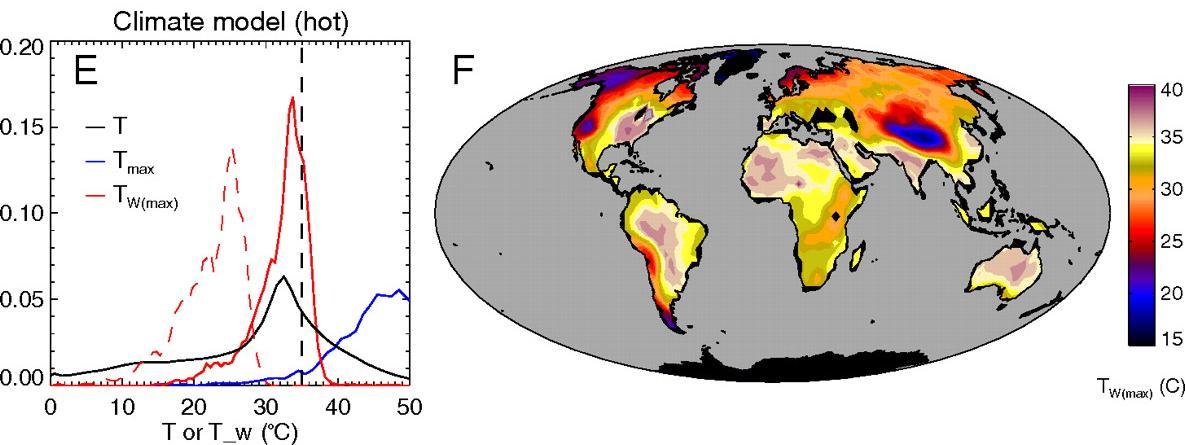
Despite the uncertainty in future climate-change impacts, it is often assumed that humans would be able to adapt to any possible warming. Here we argue that heat stress imposes a robust upper limit to such adaptation. Peak heat stress, quantified by the wet-bulb temperature TW, is surprisingly similar across diverse climates today. TW never exceeds 31 °C. Any exceedence of 35 °C for extended periods should induce hyperthermia in humans and other mammals, as dissipation of metabolic heat becomes impossible. While this never happens now, it would begin to occur with global-mean warming of about 7 °C, calling the habitability of some regions into question. With 11–12 °C warming, such regions would spread to encompass the majority of the human population as currently distributed. Eventual warmings of 12 °C are possible from fossil fuel burning.
Humans, and many animals upon which the world depends, must maintain core temperatures of ~ 37  °C by shedding energy via conductive, radiative and evaporative cooling. When the ambient wet bulb temperature exceeds 35  °C, core temperatures sore soar and people die fairly rapidly, in a few hours. The figure below gives you an idea of how problematic human existence would be on such a brave new world.

The consensus estimate for climate sensitivity is ~2-4.5  °C for doubling of CO2. With a bit of bad luck warmings of 8 °C are possible (Tw trails the global temperature by a bit) at 4x CO2, which is certainly within reach in a bit more than 100 years.

UPDATE: Anonymouse in the comments below points out that
It's the creeping statistical hints between the lines of this paper that really bother me. Long before or even if we never see broad areas permanently enter a existentially threatening torrid regime, what about excursions? For instance, Pakistan this year has seen record temperatures approaching 54 degrees C in places where many people live, fortunately with lower humidity and only for handful of days but what about when/if such aberrations extend to a handful of weeks and are accompanied by inexorably increasing humidity? The resulting disaster would cause migrations. The worst-case scenario in Sherwood and Huber would not have to happen before we effectively lose major swathes of territory for year-round habitability.
And if you follow the press, there have been lots of deaths in Pakistan and Northern India from these heat waves.

Sherwood and Huber are pushing the envelope here, but remind Eli again about the proper discount rate for starting to deal with climate change.

We conclude that a global-mean warming of roughly 7 °C would create small zones where metabolic heat dissipation would for the first time become impossible, calling into question their suitability for human habitation. A warming of 11–12 °C would expand these zones to encompass most of today’s human population. This likely overestimates what could practically be tolerated: Our limit applies to a person out of the sun, in gale-force winds, doused with water, wearing no clothing, and not working. A global-mean warming of only 3–4 °C would in some locations halve the margin of safety (difference between TW max and 35 °C) that now leaves room for additional burdens or limitations to cooling. Considering the impacts of heat stress that occur already, this would certainly be unpleasant and costly if not debilitating. More detailed heat stress studies incorporating physiological response characteristics and adaptations would be necessary to investigate this.

If warmings of 10 °C were really to occur in next three centuries, the area of land likely rendered uninhabitable by heat stress would dwarf that affected by rising sea level. Heat stress thus deserves more attention as a climate-change impact.

The onset of TW max > 35 °C represents a well-defined reference point where devastating impacts on society seem assured even with adaptation efforts. This reference point constrasts with assumptions now used in integrated assessment models. Warmings of 10 °C and above already occur in these models for some realizations of the future (33). The damages caused by 10 °C of warming are typically reckoned at 10–30% of world GDP (33, 34), roughly equivalent to a recession to economic conditions of roughly two decades earlier in time. While undesirable, this is hardly on par with a likely near-halving of habitable land, indicating that current assessments are underestimating the seriousness of climate change.

Another modest suggestion

Eli has a small suggestion for changing the IPCC Procedures for the Preparation, Review, Acceptance, Adoption, Approval and Publication of IPCC Reports. Based on the principle that there is no point in reinventing a good wheel, this follows the form that Nick Barnes has created in his comment on improving the AR5 bibliography

Comment to the InterAcademy Council Review of the Intergovernmental Panel on Climate Change.

1. Summary

The IPCC procedures should be amended to differentiate between levels of reviewers and deal with an anticipated higher number of comments. The proposed amendments would clarify the roles of reviewers at different levels of the process and expedite the review.

2. The Problem

IPCC reports contribute to global public policy debates and processes, which may have major effects on the daily lives of every person in the world. Every government and large enterprise has already been affected. As the century continues, the effects of policies based on IPCC work will increase in their scope and impact: they will create whole new industrial sectors, thousands of businesses, and many ways of life.

For this reason, the IPCC reports and the processes which create them have been under increasing scrutiny. Members of the public have gained access to draft reports and submitted a large number of comments in ways that were not anticipated when the procedures were originally written. This development is to be applauded.

Yet, this has created problems. The large number of comments on the AR4 created a significantly increased amount of work for the Review Editors and Lead Authors. Some who contributed comments used the IPCC designation of "Expert Reviewer" as a affirmation of expertise, to the point that the term has become a bit of a joke. The IPCC itself contributed to this problem in its press releases dealing with the number of scientists who contributed to the report.

3. Proposed solution

The InterAcademy Council should consider how the inclusion of comments from the broad public should be better implemented. We wish to make three suggestions

1. A new category should be created for members of the public who provide comments in the second stage of the review. Expert Reviewer should be reserved for those described in section 4.2.4.1 First Review (by Experts) of the Procedures. Others whose first contribution comes in the second stage could be called Reviewers.

2. The IPCC should maintain separate lists of Expert Reviewers and Reviewers. Both should be allowed, if they wish, to provide a single link to materials establishing their standing such as a web page, a publication, etc.

3. If the number of comments exceeds the capacity of the Convening Lead Authors and Lead Authors to deal with they should be allowed, with the approval of the IPCC Secretariat, to group comments together for responding.

4. Recommendations

This is a series of concrete recommendations for amendments to the document “Principles Governing IPCC Work, Appendix A – Procedures for the preparation, review, acceptance, adoption, approval and publication of IPCC Reports”, with the effect of implementing the solutions described above. Changes are shown in bold

4.2 Reports Accepted by Working Groups and Reports prepared by the Task Force on National Greenhouse Gas Inventories. . . .

To ensure proper preparation and review, the following steps should be undertaken:

1. Compilation of lists of Coordinating Lead Authors, Lead Authors, Contributing Authors, Expert Reviewers, Reviewers, Review Editors and Government Focal Points.

4.2.4.1 First Review (by Experts)

First draft Reports should be circulated by Working Group/Task Force Bureau Co-Chairs for review by experts selected by the Working Group/Task Force Bureaux and, in addition, those on the lists provided by governments and participating organisations, noting the need to aim for a range of views, expertise, and geographical representation. The review circulation should include:

• Experts who have significant expertise and/or publications in particular areas covered by the Report.
• Experts nominated by governments as Coordinating Lead Authors, Lead Authors, contributing authors or expert reviewers as included in lists maintained by the IPCC Secretariat.
• Expert reviewers nominated by appropriate organisations.

The designation Expert Reviewer should be reserved to those in these categories.

The first draft Reports should be sent to Government Focal Points, for information, along with a list of those to whom the Report has been sent for review in that country.

The Working Group/Task Force Bureau Co-Chairs should make available to reviewers on request during the review process specific material referenced in the document being reviewed, which is not available in the international published literature. (Nick might want to add something here)
and
4.2.4.2 Second Review (by Governments, Experts and the Public)

A revised draft should be distributed by the appropriate Working Group/Task Force Bureau Co-chairs or through the IPCC Secretariat to governments through the designated Government Focal Points, and to all the coordinating lead authors, lead authors and contributing authors and expert reviewers.

Governments, at their discretion, are invited to open the second review to the public. Governments should only forward comments which discuss the accuracy and completeness of the scientific/technical/socio economic content and the overall scientific/technical/socio-economic balance of the drafts. Members of the public who comment shall be designated as IPCC Reviewers.

Governments should send one integrated set of comments for each Report to the appropriate Working Group/Task Force Bureau Co-chairs through their Government Focal Points.

Non-government reviewers should send their further comments to the appropriate Working Group/Task Force Bureau Co-Chairs with a copy to their appropriate Government Focal Point.

Addition to Annex I

4b. REVIEWERS

Function:
To comment on the accuracy and completeness of the scientific/technical/socio economic content and the overall scientific/technical/socio-economic balance of the drafts.

Comment:
Reviewers are members of the public who comment on the text in the second stage of the review process according to their own knowledge and experience. They may be nominated by Governments, national and international organisations, Working Group/Task Force Bureaux, Lead Authors and Contributing Authors.

Annex 2

3. Responsibilities of the Working Group/Task Force Bureau Co-Chairs

The Working Group/Task Force Bureau Co-Chairs coordinating the Report will (a) collect and index the sources received from authors, as well as the accompanying information received about each source and (b) send copies of unpublished sources to expert reviewers who request them during the review process. Reviewers shall have access to these materials by electronic means if possible.

4. Responsibilities of the IPCC Secretariat

The IPCC Secretariat will (a) store the complete sets of indexed, non-published sources for each IPCC Report not prepared by a working group/the Task Force on National Greenhouse Gas Inventories (b) send copies of non-published sources to expert reviewers who request them. Reviewers shall have access to these materials by electronic means if possible.
5. Conclusion

We believe that explicitly opening the second stage review to the public through their governments would be an important improvement on the transparency of the current process. Governments would benefit from the involvement of their citizens.

Open for comments/suggestions changes. Eli will ask for signatures in a short while

Wednesday, June 16, 2010

Nick Barnes has a say

From the comments

The procedures I would like to see improved are "Principles Governing IPCC Work", and in particular Appendix A - "Procedures for the preparation, review, acceptance, adoption, approval and publication of IPCC Reports"[PDF].

UPDATE: Nick's submission is now available for signature by others at the link

In section 4.2.3: "Preparation of Draft Report". Currently that says "Contributions should be supported as far as possible with references from the peer-reviewed and internationally available literature, and with copies of any unpublished material cited. Clear indications of how to access the latter should be included in the contributions. For material available in electronic format only, a hard copy should be archived and the location where such material may be accessed should be cited."

A sentence like this should be added: "Contributions should include, wherever possible, access instructions for any original data, and computer source code used for analysis or processing, and an indication of the public availability and licensing of such data and code."

The other change I would like to see would be the establishment of a public-access coordinated AR bibliography, including a repository of any open materials, with links to anything linkable, DOIs for anything with DOIs, and so on. There is already the IPCC Data Distribution Centre, but it's much too narrow.

Note that this is something which could be done outside the IPCC (watch this space) but it would be better done under IPCC aegis and with IPCC clout.

We appear to have a disagreement here

James Annan writes

Paying IPCC authors? Last I heard there wasn't actually a shortage of applicants. Pay what is necessary to fill the posts, that's what I say! If the most capable people are actually turning it down out of hardship, then that's another matter...but I have not heard of such a case.

and Richard Tol writes:
Researchers indeed have a small amount of discretionary time available for "service". I've worked at 8 universities in 6 countries. I've worked at 4 IPCC reports. The time needed to fulfill your duties to the IPCC cannot be done in the time available for services.

There are all sorts of implicit subsidies going from universities and national labs to the IPCC. That is sort-of fine as long as the subsidies do not come with political ties. But there are also IPCC people from national labs who are not at arms' length of the government; there are governments who hire consultants to work for the IPCC; and there are IPCC people in the employ of industry and environmental NGOs. The latter groups tend to have more time and energy for the IPCC and disproportionally influence its findings.

If you do not believe me, just research the authors of AR4.

And there are people who would have been in the IPCC were it not for the fact that their boss said "if you can raise the money".
Eli's position is that if the IPCC fully funds the authors there is a) a gain in transparency and b) this would enable people in soft money positions who have to cover their salaries (ie they are on piecework like RT) and there are a lot of them, to participate.

Since even with IPCC funding non faculty folk will still have to account for their time to their organization, this will not be a silver bullet.


Tuesday, June 15, 2010

Progress is Eli's most important product

Happy to say that Eli is hard at work and Rabett Run is making progress in reforming the IPCC. There is good agreement that the IPCC should offer travel and a stipend to cover expenses and time lost to all Lead Authors and Convening Lead Authors (and almost certainly to the official referees). Countries wishing to participate would contribute in proportion to their UN dues (the poorer countries, obviously would not have to pay anything)

Everyone agrees that there needs to be mechanisms for updating the reports, perhaps something along the lines of a meeting every two years of the Lead Authors for each chapter asking them to provide brief summaries of how new research has substantially changed their understanding of the issues, no change being the default position.

Correcting errors is perhaps the simplest one. There are two points, the first is that the original IPCC process was set up when chopped trees were the way in which the report was published. Today, errors could simply be marked in the on line text, with the well known UPDATE. There would have to be a process where such updates were acknowledged by the CLAs.

James Annan and Nick Barnes are writing about open code issues, but it is not clear to Eli how this would be put into the IPCC process.

Eli, indirectly raised another issue, the tension between Frontier Science, Regulatory Science and Textbook Science. The IPCC needs to better differentiate between the three. Started to delineate where the frontier was, much of WG1 is already Textbook Science. Essentially all of the lead authors in each of the working groups are involved in Frontier Science, but what the policy makers are asking for is Regulatory Science, science that justifies policy. Currently the Regulatory level is imposed in the great plenum meeting with political representatives of all countries involved and the CLAs. Messy, messy, messy.

As the bunnies have seen, government agencies, such as the EPA know how to do regulatory science and they need to be involved in the process intermediate between the Frontier Scientists and the governmental representatives.

For the rest of you, how to improve the open review without pissing Judith Curry off?

Sunday, June 13, 2010

Summertime

Summertime, and in Rabett Labs, a new bunch of undergraduate bunnies are researching away. In an attempt to impose structure on bedlam and please the funding agencies, Eli and his friends are running a weekly seminar in scientific ethics which met for the first time last week. Eli had asked Ben Hale to recommend a book, and he did, Scientific Integrity, by Francis Macrina, more of a casebook than an academic text and, except for its biomedical focus, a very good thing indeed.

Ben also told Eli that if all the students agreed, something was wrong, but to start the discussion the Rabett put a question, how does your research compare to what you thought your research would be, and there was agreement:

It's a lot more chaotic.
and that captures a great deal of the disjunction in discussions of science, not only climate science, between practicing scientists and others. Macrina follows Henry Bauer in dissecting the myth of the scientific method, differentiating between "textbook science", old tried and true stuff, the kind of things we do in undergraduate teaching labs, and "frontier science" stuff that people are still working on.

What we learn about in junior high school is an idealization of textbook science. The "noble scientist" whosoever she is, thinks deeply about all that is known, identifies something unknown, formulates a hypothesis, tests the hypothesis, interprets the data and publishes.

Would that it were ever so, indeed, the textbook science today that was frontier science back then, was not done in that way, but we contribute to the myth by the way in which we describe our work in publications. As Peter Medawar put it, the scientific paper is a fraud (Eli is channeling Macrina with some caveats in all this), it misrepresents
the thought processes that led to the work reported. He points out that the results section is written to present facts without and mention of significance or interpretation. These are saved for the discussion section. Medawar snickers that this is where scientists "adopt the ludicrous pretense of asking yourself if the information you have collected actually means anything" and "if any general truths are going to emerge from the contemplation of the evidence you brandished in the section called results"
whereas, in the real lab, the results are tested and interpreted as they come in against the scientist's expectations, which are formed by previous study and yes, previous understanding. Macrina quotes Goodstein
...every scientific paper is written as if that particular investigation were a triumphant procession from one truth to another. All scientists who perform research, however, know that every scientific experiment is chaotic, like war. You never know what is going on; you cannot usually understand what the data mean. But in the end you figure out what it was all about and then, with hindsight, you write it up describing it as one clear and certain step after the other. This is a kind of hypocrisy, but it is deeply embedded in the way we do science.
This is not unknown to scientists and is frequently remarked on, for example, quoting Francois Jacob
Scientific writing "substitute(s) an orderly train of concepts and experiments for a jumble of disordered efforts. . .In short writing a paper is to substitute order for the disorder and agitation that animate life in the laboratory
and without which life in the laboratory would be exceedingly boring. Macrina concludes that scientific papers do not describe what actually happened, but omit the details of how conclusions were reached, don't include the
wrong turns, dead ends, and "broken test tubes" that may have been crucial to the overall body of work. Scientific papers rarely describe or put into perspective the pure luck and mistakes that were also part of the work. .
Looking back at many of the attacks on science from our dear friends, they are wails that climate, and tobacco, and ozone scientists are not doing textbook science, and, of course, since most people only have learned textbook science, this can look like a pretty convincing argument. It is also why demands for regulatory science can be deadly to real science and why "auditing" is a distraction and a fraud.

On the other side, scientists, point to the triumphant march through their published papers, although over the course of time methods change, some conclusions are modified and the glorious adventure, the stories of how we reached our understanding, are swept under the rug. There are a thousand interesting stories out there in the Naked Laboratory, and they need to be told. Explaining the stops and starts would put a human dimension on science that is far more interesting and convincing to the public than what we have now. It is where blogs and open review can and will play important roles.

Stoat and Gareth have something to say on the matter, but of course, not as well.

Traveling man

Eli has been asking for suggestions about how the IPCC process could be improved. Arthur Smith wants to figure out how to

Find a way to get updates or "supplements" out in between major reports that address important scientific developments in the interim

Find better ways to communicate the report results to the general public.
which means that suggestions are being entertained but solutions not yet offered.

Bill S. has a timely suggestion
I don't know how the IPCC process works in regards to the workload and people's regular day jobs, but it seems to me that major contributors like Lead Authors should be given a paid sabbatical of some kind while they're on the IPCC job. It would certainly reduce their stress level, if nothing else, and could possibly lead to the report coming together faster (if that's desirable).
There is an ancient tradition in science that 120 hour work weeks are expected, but even the quacks are finding that tired residents are residents that make serious mistakes. Science used to be an avocation of the well to do, but that, as track and field, has changed.

The IPCC was started with a serious purpose, but not in an environment where immediate action was contemplated. Today IPCC work needs to be fully funded and this should go further than the convening lead authors who get a stipend. All of the authors should receive travel and per diem when they are working on IPCC business as well as a stipend to cover the fraction of a work-year they devote to IPCC matters.

This is especially important for those who do not have base funding for their salary, but are fully or even partially supported by grants and contracts.

Now, of course, we can discuss the matter as a tragedy or a farce. By way of Stoat, Ethon points out Richard Tol whining that the Irish government will not pay his travel because they do not agree with his views. Richard is astonished that a government plays politics. Eli suggested that Richard ask S. Fred Singer for a travel grant (half seriously)

OTOH, the IPCC should really emphasize (they probably do) using the internet for meetings, and scheduling face to face meetings around large international conferences such as the AGU or EGU.

Thursday, June 10, 2010

And so Eli writes, by morning, night, and afternoon

Time to submit comments to the IPCC review. This is a review of IPCC Processes and Procedures, it is NOT at review of the reports themselves. The terms of reference are

The IAC Review Committee will take into account the following IPCC official documents: “Principles Governing IPCC Work”, including their Appendices: Appendix A “Procedures for the preparation, review, acceptance, adoption, approval and publication of the IPCC reports” and its Annexes (hereinafter referred to as “IPCC Procedures”), Appendix B “Financial Procedures for the IPCC”, and Appendix C “Rules of Procedures for the Election of the IPCC Bureau and Any Task Force Bureau”. The Review Committee is requested to perform the following tasks:

2.1. Review the IPCC procedures for preparing assessment reports including, but not restricted to:

    1. Data quality assurance and data quality control;
    2. Guidelines for the types of literature appropriate for inclusion in IPCC assessments, with special attention to the use of non peer-reviewed literature;
    3. Procedures for expert and governmental review of IPCC materials;
    4. Handling of the full range of scientific views; and
    5. Procedures for correcting errors identified after approval, adoption and acceptance of a report.

2.2. Analyze the overall IPCC process, including the management and administrative functions within IPCC, and the role of UNEP and WMO, the United Nations system and other relevant stakeholders, with a view to strengthen and improve the efficiency of the assessment work and effectively ensure the consistent application of the IPCC Procedures.

2.3. Analyze appropriate communication strategies and the interaction of IPCC with the media to ensure that the public is kept apprised of its work.

While everyone is free to submit, perhaps this is time for another Bunny Labs submission?

Wednesday, June 09, 2010

Do unto others

Michael Tobis has discovered a dastardly fraud. Someone sent a forged letter, purporting to be from the NSF, to a student at R A Hall Elementary School in Beeville TX "awarding" her a prize for an essay "disproving gobal climate change". Not only was the school and the local paper sucked in but this went viral engorging Marc Morano and many others.

While this is being hashed out as usual, Eli thought that there must be some way of assuaging the hurt to the student and the community, so he has donated two books to the school

Janice VanCleave's A+ Science Fair Projects - Janice Van Cleave
Mario Molina - Cynthia Guidici

(listed only to avoid duplication) with a short note

Dear Ms. Villareal, students and teachers,

Please accept this small gift as a token of my hopes for your school. This is a small reward for everyone's hard work on your science fair. As a practicing scientist, I hope that you will take part in the splendid adventure that science is and I wish that you will not be discouraged by recent events.
The bunny is sure that if they get too many books they will share them with other local schools. It might be good to stay away from the usual hot buttons.

Thursday, June 03, 2010

Flying the flag


In Science, Philip Kitcher reviews several recent books on climate change

Merchants of Doubt: How a Handful of Scientists Obscured the Truth on Issues from Tobacco Smoke to Global Warming. By Naomi Oreskes and Erik M. Conway.

Why We Disagree About Climate Change: Understanding Controversy, Inaction and Opportunity By Mike Hulme.

Storms of My Grandchildren: The Truth About the Coming Climate Catastrophe and Our Last Chance to Save Humanity By James Hansen.

Science as a Contact Sport: Inside the Battle to Save Earth's Climate. By Stephen H. Schneider.

The Lomborg Deception: Setting the Record Straight About Global Warming. By Howard Friel.

The Climate Solutions Consensus By David E. Blockstein and Leo Wiegman.


Climate Change Science and Policy. By Stephen H. Schneider, Armin Rosencranz, Michael D. Mastrandrea, and Kristin Kuntz-Duriseti,

The Politics of Climate Change. By Anthony Giddens. Polity,
Among other things, Kitcher talks about the difference between the US and the rest of the world on these issues
It is all too easy to be beguiled by an opposite thought: that democracy demands that there be extensive public discussion, even on technical matters, discussion in which all participants operate as equals. Those in the grip of this idea will view Hansen and Schneider as hysterical and arrogant people who aim to short-circuit the proper airing of alternative views. (Although sympathetic critics might also ponder the fact that these two eminent scientists have been rebutting the same "alternatives" for decades). Perhaps continued discussion could be tolerated, were there no urgency about the issue under debate. If they saw no compulsion to act soon—and if they were convinced that the fight were fair—Hansen and Schneider might share Milton's confidence that truth would ultimately emerge as victor. Yet the stories they tell in their gripping narratives reveal all too many points at which messages have been distorted and suppressed because of the short-term interests of economic and political agents. They also demonstrate many ways in which the arena of public discussion has been set up to block the widespread acceptance of conclusions based on an increasing body of evidence.
As to how this happened, Oreskes and Conway provide a roadmap
"There are many reasons why the United States has failed to act on global warming, but at least one is the confusion raised by Bill Nierenberg, Fred Seitz, and Fred Singer."
with Kitcher filling in some of the dots
This apparently harsh claim is thoroughly justified through a powerful dissection of the ways in which prominent climate scientists, such as Roger Revelle and Ben Santer, were exploited or viciously attacked in the press.

None of this would have been possible without a web of connections among aging scientists, conservative politicians, and executives of companies (particularly those involved in fossil fuels) with a short-term economic interest in denying the impact of the emission of carbon into the atmosphere. But it also could not have produced the broad public skepticism about climate change without help from the media. As Oreskes and Conway point out, "balanced coverage" has become the norm in the dissemination of scientific information. Pitting adversaries against one another for a few minutes has proven an appealing strategy for television>news programs to pursue in attracting and retaining viewers.
Kitchner has touched off a debate among several of the authors with others invited to take part.

Those looking for an explanation of the bunny flag are invited to wander over to Open Mind

Wednesday, June 02, 2010

Eli can retire Part XIV - Death, no taxes

Continuing Eli's lazy stroll through the US EPA responses to comments. They are serious folks.

Comment (5-11):
A commenter (8320) submits information and references on the potential health effects of global climate change. The commenter discusses the following topics: extreme heat events, wildfires, vector-borne diseases, water-borne diseases, air quality and human heath, aeroallergens and allergies, environmental justice, and the vulnerability of children to effects from air quality. The commenter stresses that “climate change will alter the global environment and present major challenges to the health and welfare of children.”

Response (5-11):
EPA has reviewed the submitted comments and associated references, and finds that they include several very recent and relevant studies (e.g., St. Louis and Hess, 2008; Patz et al., 2008; Jerret et al., 2009) that confirm the scientific support for health related impacts summarized in the TSD.

In one example, Luber and McGeehin (2008) call extreme heat events “the most prominent cause” of weather-related human mortality in the United States, noting that they are responsible for more deaths annually than hurricanes, lightning, tornadoes, floods, and earthquakes combined. We note that the recently released U.S. Global Change Research Program (USGCRP) report (Karl et al., 2009) also concludes that mortality from heat is the number one weather-related cause of death and cites an analysis of nine U.S. cities showing that deaths rise with increases in temperature and humidity with no confounding or effect modification due to air pollution (Zanobetti and Schwartz, 2008).

Another recent study (Jerret et al., 2009) provided by the commenter indicates that high levels of ground-level ozone can increase the risk of asthma-related hospital visits and premature mortality and that the effect of long-term exposure to ozone on air pollution–related mortality was not known. The study indicates that ozone exposure is associated with the risk of death from respiratory causes, and that long-term, low-level exposure can be lethal. Researchers studied the outcomes of almost 500,000 adults in 96 metropolitan regions who enrolled in the American Cancer Society Cancer Prevention Study in 1982 and 1983 and were tracked for an average of 18 years. In addition, the study by Jerrett et al. (2009) looked at associations between ozone concentrations and the risk of death, in a single-pollutant model and in a two-pollutant model with fine particulate matter (PM2.5). In two-pollutant models, researchers demonstrated a significant increase in the risk of death from respiratory causes in association with an increase in ozone concentration. The study found that every increase in 10 parts per billion (ppb) in average ozone concentrations was associated with a roughly 4% increase in mortality from respiratory causes. This translated in Los Angeles to a 43% increase in the risk of dying from respiratory causes. Eastern cities like New York and Washington had an average increased risk of about 25% to 27%. EPA concludes this study fills important knowledge gaps in health impact literature from increases in ozone exposure (at low levels).

Another study provided by the commenter provides evidence of vector-borne disease shift attributed to climate. For example, in Europe, geographic shifts in the tick’s distribution have been attributed to climate change. An expansion of the tick’s range into higher elevations in the Czech Republic corresponded to rising temperatures. A shift toward higher latitudes in Sweden corresponded to a reduction in the number of very cold winter days (Gage et al., 2008).

Based on review of the cited literature from the commenter, we conclude that the information provided is generally consistent with, and in several cases even stronger than the assessment literature summarized in the TSD.

Tuesday, June 01, 2010

Wisdom of the bunny

As long as we are talking about peer review, let us also discuss dispassionate skepticism, the other virtue (if scientists can be said to have any as a group) of scientists. It is the decoupling of dispassionate from skepticism that makes public discussions about climate science and environmental issues in general so uninformative. One might say that skepticism alone is a nasty, but insufficient condition for policy.