Thursday, July 30, 2009

As predicted (Update below)

Eli has always been pretty good at figuring out where the fruitcake will be deposited, so a couple of weeks ago when he pointed to an editorial by Rudy Baum in C&E News (the American Chemical Society house organ)

The science of anthropogenic climate change is becoming increasingly well established. The scientific consensus on the reality of climate change has become increasingly difficult to challenge, despite the efforts of diehard climate-change deniers (for brevity’s sake, CCDs).
We were fully confident that
Rudy Baum, editor in chief of C&E News (ACS's membership magazine) had a stemwinder of an editorial in the June 22 issue which will, without a doubt, encounter much snorting in the near future to be featured in Rabett Run.
UPDATE: Thanks to Big City, we have Baum's reply to Joe the Chemist reads in part

ACS, in fact, has an official position on climate change, which is easy to find under the "Policy" section of www.acs.org. The position statement opens with the following: "Careful and comprehensive scientific assessments have clearly demonstrated that the Earth's climate system is changing rapidly in response to growing atmospheric burdens of greenhouse gases and absorbing aerosol particles (IPCC, 2007). There is very little room for doubt that observed climate trends are due to human activities. The threats are serious and action is urgently needed to mitigate the risks of climate change."

I am also struck by the contempt of many of the letter writers for the thousands of scientists who work for government agencies such as EPA, NASA, NOAA, and DOE. Their harshest vitriol is aimed at the UN's Intergovernmental Panel on Climate Change (IPCC). Many of the letters dismiss out of hand any report from IPCC or any U.S. government agency that supports the idea of human-induced global warming, calling such reports irredeemably "politicized." I am startled that they so blithely impugn the integrity of so many of their colleagues.

Baum also includes an interchange with a mysterious interlocutor, later shown to be one Steven J. Welcenbach. First we had Joe the Plumber, later shown to be Samuel Joseph Wurzelbacher who was no plumber, now we got Joe the Chemist, who has a BA and runs some sort of disposal company. Joe's Emails are right out of denialdepot
--------------------------------------------------
And sure enough, the harumphing(c) has begun with a whole bunch of letters, but if you actually read them, over half support Baum.

The criticisms ranges from simple, I don't know therefore everyone don't know (a
How many readers of C&EN even know why carbon dioxide is the "culprit"? How many kilocalories of infrared energy can a ton of carbon dioxide absorb? What is the amount of carbon dioxide absorbed in fresh or salt water, and how is that equilibrium impacted by temperature or other environmental factors? What are some of the other variables that can cause an increase or decrease in temperature?

To the evergreen OISM petition
Man-made global warming is a theory that is supported by a "consensus" of investigators in the field of studying the relationship of carbon dioxide in the atmosphere and its effect on Earth's global temperature. Consensus is not proof, and a petition has been signed by more than 30,000 persons with scientific academic degrees (9,000 of them having Ph.D.s) who are skeptical of global warming caused by carbon dioxide emissions.
and of course

Your editorial in the June 22 issue of C&EN was a disgrace. It was filled with misinformation, half-truths, and ad hominem attacks on those who dare disagree with you. Shameful!


Are you planning to write an editorial about the Environmental Protection Agency's recent suppression of a global warming report that goes against the gospel according to NASA Goddard Institute for Space Studies Director James Hansen? Or do you only editorialize on matters in keeping with your biased views on global warming?


It's actually quite staid (that's what editors are for silly with a balancing amount of support for Baum
The more people try to trivialize global warming, the more we and our descendants will suffer the results, some of which have already been quantified (for example, glacier melting and polar ice disappearing). Weather disruptions and shore erosion, for example, will begin to occur. The people who deny global warming are in the same class as those who rejected the negative effects of DDT, those who denied the negative effects of CFCs on the atmosphere, and so on.

and

Your comments about the climate-change deniers are right on target. In fact, your closing paragraph, "Sow doubt; make up statistics," etc., was one of the best summaries I've seen of the deceitful practices that the deniers are allowed to get away with.


We humans seem to learn from experience, and thus our modern systems of justice are not well geared for dealing effectively with climate-change deniers. This is a shame, because every month's delay in taking meaningful action likely will lead to more climate-related death and destruction in the future. There should be a law.


Including this from Eric Heller

I understand that letters published in C&EN do not necessarily reflect your views. I also appreciate the benefits of publishing a diversity of opinion. However, I am sure you exercise editorial discretion in choosing which letters are to be published and that you would not want to appear to be giving credibility to unscientific thinking and irresponsible conclusions.

But that is exactly what you did when you published the letter on global warming by Albert Z. Conner (C&EN, April 20, page 6). A quick Internet search reveals statements by Conner in a letter to the editor of a Delaware newspaper, complaining about higher taxes on cigarettes: The government "continue[s] to promulgate the outright lie of the dangers of secondhand smoke and the fictitious statistic that 400,000 people die each year in the U.S. from smoking." To deny the link between smoking and lung cancer and other diseases in this day and age and in face of all the evidence is absolutely inexcusable and irresponsible.

Believing that global warming is not at least partially caused by humans and believing that cigarette smoke does not cause cancer are becoming roughly equivalent in credibility. I doubt that C&EN would want to publish, in 2009, a letter that claimed that cigarette smoke does not cause cancer.

It would make the publication look frivolous and irresponsible, even if the editors disagreed with the writer's conclusions. But in 2009, denying the connection between carbon dioxide and global warming is just as frivolous and irresponsible, indeed even more so, because of the consequences of ignoring the problem.

This indeed is an excellent example of RTFR. Look at our friends over at denial central and you would think that the entire ACS membership is screaming for Baum's head. Send the guy a letter of support.

Chemical & Engineering News Letters To The EditorOur e-mail address is edit.cen@acs.org.Our fax number is (202) 872-8727.

Or you can send your letter to:

C&EN Editor-in-Chief
1155--16th St., N.W.
Washington, DC 20036

Letters should generally be 400 words or fewer and should include the writer's full name, address, and home telephone; letters may be edited for purposes of clarity and space.


Tuesday, July 28, 2009

Krammies


Eli has been mining Gerhard Krimms contribution to arXiv and has come up with yet another Krammi. We had a recent discussion of the surface temperature of the moon here at Rabett Run,

The Moon is a good example to contrast with the Earth. It rotates much more slowly, and therefore has a temperature distribution that approaches what is used by Gerlich and Tscheuschner to derive their "Tphys". Each point on the Moon's surface is tolerably close to radiative balance with the solar input at that point.

The Moon has an albedo of about 0.12. It therefore absorbs more of the incoming solar energy than Earth. Using the solar constant of 1369 W/m2, the absorbed radiation for the surface facing the Sun is about 1205 W/m2. Hence Teff for the Moon is (1205/4/σ)0.25 = 270K, or -3C. This is the temperature that would radiate back the solar energy, if evenly distributed over the moon. But directly facing the Sun, the temperature will be more like (1205/σ)0.25 = 382K, or 109 C. Albedo is not uniform. In any particularly dark patches, the temperature could even get up to (1369/σ)^0.25 = 394K, or 121C. On the night side, however, temperatures will fall toward absolute zero. Bear in mind that as temperatures fall, so too does the rate of emission of energy. Hence it takes a long time to fall all the way to zero. Say rather that temperatures should fall far enough for the emission of energy to be small.

Now consider data on the Moon from http://www.solarviews.com/eng/moon.htm

Average day temperature is 107 C. Maximum day temperature is 123 C. These are close to theoretical expectation, to within a couple of percent.

The mean night temperature is -153C. This about 120K, and radiates a bit less than 12 W/m2. That's less than 1/100 of the solar constant, so the temperature has indeed fallen close to zero, using radiated energy as the basis for comparison.

There's no average temperature given, but the mid point of mean day and mean night temperatures is in the ballpark. This is -23C. And, just as should be expected, it is somewhere between Tphys (-120C) and Teff (-3C). But it is closer to Teff, because it is the cool side of the moon that is most different, in absolute temperature, from the unphysical extreme that is the basis of Gerlich and Tscheuschner's Tphys

On Earth, fortunately, we have an atmosphere that has to be heated from the surface. By basic thermodynamics, the Earth's average surface temperature is therefore substantially warmer than our airless moon. where surface radiation escapes directly to space.
but Gerhard shows a contradictory example

Figure 5: Moon's disk temperature at 2.77cm wavelength versus moon phase angle φ during two complete cycles from twice new moon via full moon to new moon again (adopted from Monstein.)
with a comment below of
Our Moon nearly satisfies the requirement of a planet without an atmosphere. It is well known that the Moon has no uniform temperature. There is not only a variation of the temperature from the lunar day to the lunar night, but also from the Moon equator to its poles.

Using Eqs. (1.4) would provide T 270 K e ≈ when the albedo, 0.12 M α = , and the emissivity, 1 M ε = (black body), are considered. However, as illustrated in Figure 5, the mean disk temperature of the Moon observed at 2.77cm wavelength by Monstein (2001) is much lower than this equilibrium temperature
There is nothing necessarily wrong with the Krammigraph (Eli has not checked, but it compares reasonably to similar ones that he has seen. What's up? Work out your answer and send it with to box tops (we are not particular about the boxes) to Rabett Run Krimmi Kontest @ yahno.con. Extra prizes for those who figure out how to send the boxtops.

ANSWER: Look carefully at the wavelength that the brightness temperature was measured at little bunnies. Hmm, 2.77 cm. That's pretty long wave. It turns out that long wavelength radiation (and 2.77 cm is pretty long wave compared to IR even which is micrometers) penetrates through about 4 to 8 times the wavelength. Thus if you use 2.77 cm, what you are measuring is the temperature of the moon 10 - 20 cm below the surface and that is a lot cooler and has a lot less variation with the diurnal cycle. What about if we measured at the surface. Well Apollo 15 left a temperature measuring instrument and this is what it found


Fig. 2. Lunar surface temperature time series from the landing site of the Apollo 15 mission. The series are part of the historical data archive PSPG-00093 of the US National Space Science Data Center. The color-coding of the temperature series used in this diagram is also used in Figs. 3 and 4.
The answer is that the Krammi did not show surface temperature, but below surface temperature.

Sunday, July 26, 2009

Posturing


Eli has been asked to respond to recent posturing by various Indian officials and non-officials about their government climate change policy.

AS THE visiting US Secretary of State Hillary Clinton listened, Environment and Forests Minister Jairam Ramesh on Sunday made an apparent gesture of his anger over the ‘pressure’ exerted by the rich nations at the recent Major Economies Forum in Italy to force India into agreeing to a 2 degree C cap — one that has received much flak back here and also led to speculations over a difference of opinion between the foreign and environment ministries over the contentious issue of climate change. It means despite being one of the countries with the lowest per capita emissions, India would still need to work towards emission reductions to ensure the global temperatures do not increase beyond 2 degrees above 1990 levels even though the developed countries, the biggest emitters, have refused to agree to 40 per cent reductions by 2020, to match the cuts.

“Even with 8-9 per cent GDP growth every year for the next decade or two, our per capita emissions will be well below that of developed country averages. There is simply no case for the pressure that we, who have among the lowest emissions per capita, face to actually reduce emissions. As if this pressure was not enough, we also face the threat of carbon tariffs on our exports to countries such as yours,” Ramesh said in an obvious reference to Clinton while making his opening remarks at the ITC Green Building event at Gurgaon.
Eli had previously dealt with the per capita emissions argument but in a recent lecture at Bunny State, he pointed out some home truths:

To our Indian friends it is my sad duty to point out that among the great civilizations India will be hit first and hardest by climate change, if not within my lifetime which grows short, certainly within the next three decades. As the IPCC WPII group pointed out
Himalayan glaciers cover about three million hectares or 17% of the mountain area as compared to 2.2% in the Swiss Alps. They form the largest body of ice outside the polar caps and are the source of water for the innumerable rivers that flow across the Indo-Gangetic plains. Himalayan glacial snowfields store about 12,000 km3 of freshwater. About 15,000 Himalayan glaciers form a unique reservoir which supports perennial rivers such as the Indus, Ganga and Brahmaputra which, in turn, are the lifeline of millions of people in South Asian countries (Pakistan, Nepal, Bhutan, India and Bangladesh). The Gangetic basin alone is home to 500 million people, about 10% of the total human population in the region.

Glaciers in the Himalaya are receding faster than in any other part of the world (see Table 10.9) and, if the present rate continues, the likelihood of them disappearing by the year 2035 and perhaps sooner is very high if the Earth keeps warming at the current rate. Its total area will likely shrink from the present 500,000 to 100,000 km2 by the year 2035 (WWF, 2005). The receding and thinning of Himalayan glaciers can be attributed primarily to the global warming due to increase in anthropogenic emission of greenhouse gases. The relatively high population density near these glaciers and consequent deforestation and land-use changes have also adversely affected these glaciers. The 30.2 km long Gangotri glacier has been receding alarmingly in recent years (Figure 10.6). Between 1842 and 1935, the glacier was receding at an average of 7.3 m every year; the average rate of recession between 1985 and 2001 is about 23 m per year (Hasnain, 2002). The current trends of glacial melts suggest that the Ganga, Indus, Brahmaputra and other rivers that criss-cross the northern Indian plain could likely become seasonal rivers in the near future as a consequence of climate change and could likely affect the economies in the region.
When that happens, not only will Indians beyond counting suffer, starve and die in disasters worse than the worst famines of the past centuries, but the basis of their religion, beliefs and civilization will become a seasonal chimera. Food and water sent as aid from the outside will at best sustain a small remnant. Can the Indian government survive such a disaster? Likely not. Nor will Indian society be able to withstand. It will wither and die on the sere ground of the Ganga valley and those who temporized today will be cursed forever.

India has three choices. It can do nothing to meet the threat, concentrating on business as usual and increasing emissions. It can posture about energy equity as a negotiating position, ensuring that not enough will be done as the inevitable half a loaf results in most of the disaster, or it can lead by example. India, in short, by searching out ways to decrease forcings, not only of CO2, but of black carbon, and of land use changes can, by demonstrating a great heart and leading by example in the spirit of Ghandi, can bring others along.

Already we see many in the developing world who would do nothing because China and India will not do everything. If India leads, can China not follow, and if India and China lead, the world must and will change.

India is between a very hard rock and a harder hard place. It cannot do nothing. It must do a lot

Let us now reason together about what actions India must take to continue developing and avoid calamity in twenty years. There are some obvious things that can be done. Solar and wind power, for example are well suited to a country where there is no existing electrical distribution network to huge numbers of villages where many live. Improved cooking stoves coupled with digestion of animal wastes currently used for cooking to yield cleaner burning fuel and fertilizers are places where research can make an almost immediate contribution. But we must take care not to rob the livelihoods of those who currently gather and supply the fuel nor neglect the value of improving the health of those who use the fuel. India has recognized the importance of land use changes in holding back global warming, and here too, the developed world can and must help. This will not be simple, but it is necessary.

Monday, July 20, 2009

On possibility and necessity

Eli has come to understand that both frequentist (Tamino) and Bayesian (James Annan) statistical descriptions have serious problems when applied to climate from scientific and policy standpoints. The mixture of the two is quadratically difficult as anybunny entangled in discussions of future changes can tell. Local responses to global trends which are worse.

There is, however, another way of looking at things, loosely described as Possibility Theory. Possibility Theory grew from studies of fuzzy sets and is useful for analyzing situations where knowlege is incomplete and was first described by Lofti Zadeh. Wikipedia, of course, has a description.

Rather than assigning a distribution of probabilities, Possibility Theory differentiates between the possibility and the necessity of an outcome. Some are beginning to use possibility theory to describe climate related issues, for example stream flow, climate scenarios. Also take a look here

Saturday, July 11, 2009

A gift for William Connolley and John Mashey

Ada, Countess of Lovelace discovers the difference engine
Via Brad de Long. In between saving the world, Eli thinks of his friends. Follow this link for more

Thursday, July 09, 2009

Eli Rabett's Simple Plan to Save the World (Part II)


About a year and a half ago, Eli provided a simple plan to save the world, something that appears to be of interest to your average Nobel Prize winner.

Nations wishing to make major progress on decreasing greenhouse gas emissions should introduce emission taxes on all products. These taxes should be levied on imports as well as domestic goods at the point of sale, and should displace other taxes, such as VAT, sales taxes, and payroll (e.g. social security, health care) in such a way that tax revenues are constant, and distributed equitably.
Recently, it has come to Eli's attention that the developing countries, specifically India, and to an extent China, are behaving badly, something that the denial-o-sphere is celebrating, if not directly, quite passive-aggressively. Even there, India's POV seems to orient towards the audience, much of this is pre-negotiation tactics. There are two principle threads to the argument, the first being that the US and the rest of the developed world own the problem. According to the principal Indian negotiator, Shyam Sara
We see no link between what the United States, as the world's largest emitter of greenhouse gases, does and India assuming legal commitments for emission reductions. The volume of US emissions today constitutes over 20 percent of the global total and 20 tons annually per person. Despite our much larger population, India produces only 4 percent of those emissions -- 1.1 tons per person. Therefore, while we would welcome a positive and forthcoming attitude on the part of a new administration to significantly reduce US emissions -- as President-elect Obama has promised -- this has no bearing on India. It will not lead India to accept rules that go beyond the current UN climate treaty, which does not stipulate legally binding reductions for developing nations.
Eli's simple plan bypasses this. While India and China may reject emissions added levies, there is not much they could do about it in their export lead economies. The second being that everyone owns a per capita emissions cap
Even though there is no legal obligation on India in this respect, the Prime Minister of India made a commitment that India's per capita emissions will at no time exceed the average of the per capita emissions of developed, industrialized countries. We have thus accepted a limit on our emissions and at the same time provided an incentive to our partners in developed countries to be more ambitious.


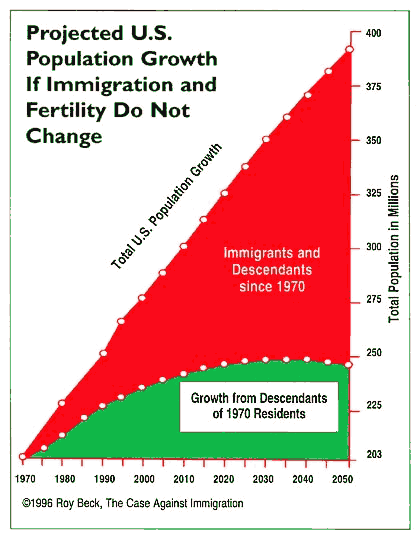
To wave a red flag, per capita arguments need to confront population growth. Claiming a larger emissions cap on the basis of increasing population should not exactly win any more points than similar persiflage. It is instructive to look at population growth. Europe and Japan (not shown) have essentially flat population since the 1970s, the US population has grown, but a large part of that is immigration. India, well, Eli is a compassionate, fast breeding mammal but still. OTOH, the Rabett recognizes denial when it is on display thus
Eli Rabett's Simple Plan to Save the World (Part II):
India and China and many other developing countries should reduce their emissions of black carbon by 90% or more in the next decade. This will not only significantly reduce warming of the climate, it will make a major contribution to the health of their people. Simple and economical methods of doing this are available.
Anyone doubting the dimension of the problem should read James Fallows reports from Beijing (he recently left) in the Atlantic

---------------------------------------------------------------------
More on the Emissions Added Levy (Blogger is behaving badly, but the full text is still in the Google cache)
These should be introduced as an Emissions Added Levy (avoiding the bad jokes). EAL would be imposed on sale for emissions added in the preceding step and inherent to the consumption of the product, as would be the case for heating oil and gasoline. Manufacturers would pay the EAL on electricity they bought, and incorporate this and the levy on emissions they created into the price of the product they sell.
Imports from countries that do not have an EAL would have the full EAL imposed at the time of import. The base rate would be generic EALs based on worst previous practices in the countries that do have EALs, which would be reduced on presenting proof that the actual emissions were lower.
Saving the world is hard work, Eli needs a beer. Comments

Tuesday, July 07, 2009

The best of the worst

UPDATE: A new classic, commented on everywhere

McLean, J. D., C. R. de Freitas, and R. M. Carter (2009), Influence of the Southern Oscillation on tropospheric temperature, J. Geophys. Res., 114, D14104, doi:10.1029/2008JD011637.

With comments at Open Mind, Real Climate, James Empty Blog, In It For the Gold, Deltoid, More Grumbine Science and just about the entire Rabett Run Blogroll. An instant classic of denial and self regard.

John Mashey asks
Maybe the Rabett has this list stuffed in his burrow:

is there a nice list somewhere of truly awful climate papers published in otherwise-plausible-looking journals? (I.e., not E&E, or JSE, or things like that.)

The main use of this is to know where peer review seems to be failing.
But friend Cohenite already delivered and Eli blogged on it. Still, there is a fair amount of E&E in there, so here are Eli's top four.

Thomas Palm adds (see comments)

5. "Thermal pollution causes global warming" Bo Nordell, Global and Planetary Change 38 (2003) 305–312.

and another under review
----------------------------------------------------------
4. G. V. Chilingar, L. F. Khilyuk, O. G. Sorokhtin. Cooling of Atmosphere Due to CO2 Emission, Energy Sources, Part A: Recovery, Utilization, and Environmental Effects, 30(1), 1 - 9 (2008). Actually anything by this trio. Brings incoherence to new heights.

3. Christopher Essex, Ross McKitrick, Bjorne Andresen; Does a Global Temperature Exist? Journal of Non-EquilibriumThermodynamics, 32(1) 1-27.

2. Ferenc Misckolczi; Greenhouse effect in semi-transparent planetary Atmospheres. Quarterly Journal of the Hungarian Meteorological 111(1), January–March 2007, 1–40.
Cohenite's favorite and a hot contender

1. Gerhard Gerlich and Ralf Tscheushner, Falsification Of The Atmospheric CO2 Greenhouse Effects Within The Frame Of PhysicsInternational Journal of Modern Physics B, 23(3), 275-364 (2009). Get close and feel the spittle

Comments? Additions?.

Winter at Summit Camp

The Earth Observer, a NASA newsletter on the Earth Observation Program has been running Lora Koenigs diary describing winter at Summit Camp on the top of Greenland. Definitely worth reading.

Hello! My name is Lora Koenig and I am a remote sensing glaciologist and a new hire in the Cryospheric Sciences Branch at the NASA Goddard Space Flight Center. My research uses satellites to monitor the ice sheets and I am always interested in how well measurements from space compare to those taken on the ground.

My interest in ground truth data and learning more about ice sheets has lead me to spend this winter at Summit, Greenland (Latitude 72.5 N Longitude 38.5 W). Over the course of this weekly blog I will tell you about my life and science, in the middle of the Greenland Ice Sheet, in the middle of the winter. I will start with a quick introduction and explain how I ended up in the dark on an ice sheet.
Comments?

Say it ain't so Rudy

Rudy Baum, editor in chief of C&E News (ACS's membership magazine) had a stemwinder of an editorial in the June 22 issue which will, without a doubt, encounter much snorting in the near future to be featured in Rabett Run. He starts by summarizing the situation

The science of anthropogenic climate change is becoming increasingly well established. The scientific consensus on the reality of climate change has become increasingly difficult to challenge, despite the efforts of diehard climate-change deniers (for brevity’s sake, CCDs).
and then points to recent major reports which strengthen the case for human driven climate change, the US Global Change Research Program report, a joint statement from the Presidents of the G8+5 national academies on climate change
Climate change and sustainable energy supply are crucial challenges for the future of humanity. It is essential that world leaders agree on the emission reductions needed to combat negative consequences of anthropogenic climate change at the UNFCCC negotiations in Copenhagen in December 2009. At the same time, agreement is needed on actions to ensure basic energy services are available to all of the world’s people.
Baum's close nailed it
We see here the same tactics used by other purveyors of nonsense rejected by the mainstream scientific community. Creationists, for example, only want to expose students to “both sides of the debate over origins,” ignoring the fact that there is no debate over evolution. And, of course, it’s always useful to attack the “mainstream media.”

Heartland and its ally AmericanEnergySecurity.com are also flogging an 800-plus-page report, “Climate Change Reconsidered,” from the Nongovernmental International Panel on Climate Change (NIPCC)—kind of an anti-IPCC, get it?—which, of course, proves conclusively that global warming probably isn’t happening; if it is happening, it’s not due to human activity; and, besides, a “warmer world will be a safer and healthier world for humans and wildlife alike.”

Sow doubt, make up statistics, call for an “open debate,” claim that you are being “silenced and ignored by the media and politicians,” claim that your opponents are just a “few bureaucrats and environmental activists,” not real scientists—those are the tactics that will be brought to bear in the coming months by the CCDs in their attempt to derail meaningful efforts to respond to global climate change.

Comments?

Monday, July 06, 2009

Reality Check


Werner Aeschbach-Hertig brings interesting news about Rabett Run's friend S. Fred Singer and the Chilingar.

Comment over there

Sunday, July 05, 2009

As the world wobbles

The issue of increased damage from extreme weather driven disasters as a result of climate change is attracts the same polemic that the gallery previously observed about climate change and global warming.

  1. Starting Position: It ain't happening
  2. Fallback Position: It has noting to do with the enhanced greenhouse effect
  3. Fallfurtherback Position: There is no scientific proof, we need more research
  4. Fallmuchfurtherback Position: If the local left (relatively) party didn't insist on building on the coast or in flood planes there would not be a problem.
  5. Fallwayfurtherback Position: What have the Bangladeshi's ever done for us?
In many ways this resembles the progression we have seen throughout the history of climate change, and the answers given by the IPCC (and previous reports).
FAR: The unequivocal detection of the enhanced greenhouse effect is not likely for a decade or more.

SAR: The balance of evidence suggests a discernible human influence on global climate (considerable progress since the 1990 report in distinguishing between natural and anthropogenic influences on climate, because of: including aerosols; coupled models; pattern-based studies)

TAR: There is new and stronger evidence that most of the warming observed over the past 50 years is attributable to human activities

AR4: Most of the observed increase in globally averaged temperatures since the mid-20th century is very likely (> 90% certainty) due to the observed increase in anthropogenic (human) greenhouse gas concentrations.
The state of the art can be found in a new paper by Schmidt, Klemper and Hoeppe that was previously commented on at Rabett Run. Particularly interesting is the correlation between sea surface temperature and tropical cyclone damage.

The bars in the figure to the right shows adjusted losses for tropical cyclones that made landfall in the US. The adjustments take account of socio-economic changes. The black line is a ten year smoothed average. The red line is the smoothed North Atlantic sea surface temperature. The good correlation of the losses with the sea surface temperature provide a cleft stick to hoist DenialCON 2 position holders on, leaving them the oxymoric position of asserting that sea surface temperature is independent of global warming. Eli is confident that they will be up to it tho.

As Chris pointed out, the conclusion brings us pretty close to having to invoke DenialCon 4.
annual adjusted losses since the beginning of the last cold phase (1971) show a positive trend, with an average annual rise of 4% that cannot be explained by socio-economic components. This increase can at least be interpreted as a climate variability impact. There is no evidence yet of any trend in tropical cyclone losses that can be attributed directly to anthropogenic climate change. But we advance the premise that if losses are affected by natural climate fluctuations, they are also likely to be affected by additional global warming due to anthropogenic climate change. This premise is supported by indications that the intensity of tropical cyclones is affected by anthropogenic climate change."
An objection to this has been raised on the basis that the trends do not extend back to the 1950s. File that one in the wishful thinking category given the physical correlation between global warming, sea surface temperature, and tropical cyclone intensity.

See Harold, not once was the name of the The Talented mentioned or even linked to.

Comments?

Wednesday, July 01, 2009

Science lurches forward again

About two years ago Stan Sanders group at JPL tossed a bombshell into our understanding of stratospheric ozone depletion, with a new, and much lower measurement of the chlorine peroxide (ClOOCl) absorption cross-section. This was a bombshell because it meant that there would be a lot less free chlorine in the stratosphere available for ozone depletion. Drew Shindell blogged on it at Real Climate, there was a bit of triumphalism on the denial beat.

The basic idea is that Cl catalyzes conversion of ozone, O3 to molecular oxygen, O2

(1) Cl + O3 --> ClO + O2
(2) ClO + O3 --> Cl + 2O2

ClO can dimerize

(3) ClO + ClO --> ClOOCl

which removes it from the catalytic cycle (1) and (2), but it can also be photolyzed

(4) ClOOCl + hv --> ClO + ClO

so the rate of photolysis, which is proportional to the absorption cross-section, determines how much ClO is available for the cycle. Because O3 absorbs most of the light at shorter wavelengths than 305 nm, for all practical purposes, only the absorption cross-section of ClOOCl above ~305 nm is important.

The rub, of course, is that to measure the absorption cross-section of a molecule, the lab bunnies need to know how much of the molecule is in the light path. This is not easy. As a matter of fact it is very tough, especially for ClOOCl because you cannot prepare a pure sample, there will always be Cl2, O2, and maybe other stuff hanging around. Before Pope, Hansen, Bayes, Friedl and Sander, others had tried to figure out the amount of ClOOCl in the light path by mass balance, starting from the initial reactant concentrations and using absorption spectroscopy in various regions of the spectrum to assign concentrations of the stable species where known. Sanders group did a spectral subtraction of the know Cl2 spectrum from the observed spectrum in the UV, which they assumed was a combination of ClOOCl and Cl2 (O2 does not absorb much until 200 nm).

The Academica Sinica group (H. Y. Chen, C. Y. Lien, W. Y. Lin, Y. T. Lee and J. J. Lin) chose a different path. They created a molecular beam containing the equilibrium mixture of ClOOCl and Cl2 and used a laser to photodisocciate (shoot out) each. Because they knew the absorption coefficient of Cl2 at the laser wavelengths, they could get the ratio of the ClOOCl to Cl2 cross-sections at each wavelength. The results are shown in the figure and agree well with earlier measurements. As they point out all three methods have their difficulties. They think that Pope, et al, overcorrected for Cl2, but that really is speculation.

This is the way that science auditing works. Comments?

Tuesday, June 30, 2009

Wither Twitter?

After distributed computing efforts such as SETI at home, and Climate Project came GLOBE, a world wide effort to involve students in gathering ground truth for environmental and climate studies and Weather Bug, a distributed set of weather stations available to classes, media, and on your Blackberry. Motivated by early efforts to gather climate and weather data over new media Eli asks, wither Twitter and is not very optimistic. From the Urban Dictionary

freep: To slew or cheat an online poll by repeatedly voting (clearing cookies, using proxies) or to make a blog appear to be commented by numerous posters by the same means. (From the practices of the Free Republic or "freepers")
The results of the CNN question of the day were running 70:30 in favor until an hour ago when it got freeped.
Alas, without enforced automatic quality control or restricting the contributors to trusted sources, something like this is doomed which is too bad, because involving the public in climate and weather sciences would be a valuable thing. Not only would coverage increase, but feedback could be used to provide a valuable introduction to science, mathematical and statistical concepts and ways of posing questions and answering them.

Comments and suggestions?

Kiss Hubble Goodbye

Into Eli's mailbox floated this

NASA is placing RFI NNH09ZDA010L ("Feasibility of using Constellation Architecture for Servicing Existing and Future Observatory-Class Scientific Spacecraft") on hold. The August 10 due date for information in the form of a white paper is cancelled; no new due date is announced at this time. The "Workshop I" described in NNH09ZDA010L will not occur in June; a new date has not been established at this time. Updates will be made available at http://ServicingStudy.gsfc.nasa.gov/ regarding revised study plans and opportunities for community involvement. Any new workshop or white paper opportunities will be announced through a new RFI.
The bunnies will gather at 17:00 in the usual place for the wake. Comments?

Monday, June 29, 2009

The Catastrophist

Elizabeth Kolbert has an article about the cap and trade legislation and Jim Hansen. It's behind a paywall, but the New Yorker is one of those things you should subscribe to ($50/yr) so don't expect sympathy. Particularly interesting is Kolbert's description of how Hansen moved from space science (modeling Venus) to Earth science. After the discovery that CFC were killing off the ozone layer Hansen

"realized that we had a planet that was changing before our eyes, and that's more interesting," Hansen told me. The topic attracted him for much the same reason that Venus's coulds had: there were new research questions to be answered. He decided to try to adapt a computer program that had been designed to forecast the weather to see if it could be used to look further into the future. What would happen to the earth if, for example, greenhouse gas levels were to double.

"He never worked on any topic thinking it might be any use for the world," Anniek told me. "He just wanted to figure out the scientific meaning of it."

When Hansen began his modeling work, there were good theoretical reasons for blieving that increasing CO2 levels would cause the world to warm, but little empirical evidence. Average global temperatures had risen in the nineteen thirties and forties; then they had declined in some regions, in the nineteen fifties and sixties. A few years into his project, Hansen concluded that a new pattern was about to emerge. In 1981, he became the director of GISS. In a paper published that year in Science, he forecast that the following decade would be unusually warm. (That turned out to be the case). In the same paper, he predicted that the nineteen nineties would be warmer still. (That also turned out to be true.) Finally he forecast that by the end of the twentieth century a global warming signal would emerge from the "noise" of natural climate variability. (This too proved to be correct.)

Later, Hansen became even more specific. In 1990, he bet a roomful of scientists that that year, or one of the following two, would be the warmest on record. (Within nine months, he had won the bet. ) In 1991, he predicted that, owing to the eruption of Mt. Pinatubo, in the Philippines, average global temperatures would drop, and then, a few years later, recommence their upward climb, which was precisely what happened.

From early on, the significance of Hansen's insights was recognized by the scientific community. "The work that he did in the seventies, eighties and nineties was absolutely groundbreaking," Spencer Weart, a physicist turned historian who has studies the efforts to understand climate change told me. He added, "It does help to be right."

"I have a whole folder in my drawer labelled 'Canonical Papers,' Michael Oppenheimer, a climate scientist at Princeton, said. "About half of them are Jim's"
Comments?

Saturday, June 27, 2009

Ms Rabett on GM

Eli was wondering why GM (and Chrysler) killed off particular dealerships. Ms. Rabett pointed out that for the last fifty years, the US automakers have been concentrating on the high end of the market, esp. large cars with fins and machine gun mounts. They allowed, or at least turned a blind eye when their dealers opened up foreign car dealerships because they saw that as the entry level for customers who would later move up to the domestic brands. Of course , Toyota, BMW et al., had other ideas, filling out their own lines. Today, the US manufacturers are going to have to downsize their offerings. She speculates (and Eli is damned if he is going to check this out) that at least in part, they divested dealerships which also sold imports which would be in competition with the US brands. You go argue with her.

Comments?

Thursday, June 25, 2009

Ethon RTFR ( a bit edited:)


Ethon flew in the window with a great flap of concern. Big Bird was distraught, someone had moved his liver and it looked like Prometheus was no more. Don't worry Ethon, Eli said, they moved the liver, but you can still have some. The Rabett will bet you that one of the bunnies right now is out there scouting for you and we can have more fun playing follow the dead links on Uncle Stoats blogroll.

Sure enough, the new rock was quickly located tho whether it will be as comfortable as the last is not clear, it is close in Bloggerland, with a fine exposure to the elements, a nearby pool, and Eli still can't go there. (That means you too Dano). The Eagle Scout bunny who reported back, asks Eli to speculate about the need for a move, did Roger's balloon mortgage go south, has Al Gore bought them out, did the new head of the Center say no more or did they have to cut the technical support? The possibilities for speculation are endless, but in that, as much else we will lean back and listen

With the move of his food source to a more exposed position, Ethon put on his GPS and wandered out for a little liver snack. The young fellow lay out in a delightful repast. He started with a tasty snippet and Ethon was delighted as well as hungry,

Silvio Schmidt and colleagues have a new paper in press that replicates our hurricane loss normalization work in Pielke et al. 2008 (PDF).
continuing
After a detailed look at the data they conclude quite properly:
There is no evidence yet of any trend in tropical cyclone losses that can be attributed directly to anthropogenic climate change.
They do speculate about a link based on the conclusion of IPCC 2007:
Ethon, being used to this sort of thing, clicked through to the paper, and what did he see. Well first there were three authors, Silvio Schmidt, Claudia Kemfort and Peter Hoeppe. Hoeppe, you may recall is at Munich Re and is the fellow who came up with the idea of comparing earthquake losses with losses due to weather over the long run to try and tease out climate effects. Someone that Roger would like to send down the memory hole. The birdie saw an abstract which is quite different from what was promised.
No trend is found for the period 1950–2005 as a whole. In the period 1971–2005, since the beginning of a trend towards increased intense cyclone activity, losses excluding socio-economic effects show an annual increase of 4% per annum. This increase must therefore be at least due to the impact of natural climate variability but, more likely than not, also due to anthropogenic forcings.
This is interesting, because as everybunny knows, warming really took off in the 70s. The climate record shows that the warming trend flattened out between 1940 and 1970.

But wait, there is more. This one comes from the demolition job our boy tries on Evan Mills
One answer might lie in the fact that Evan Mills was a co-author of the report (p. 159). Do you think that had anything to do with it? His list of consulting clients is positively Phil Cooney-esque. Here are a few businesses and organizations that he lists under Consulting & Advising in his resume:
* Armstrong/Energyn (US)
* Barakat, Howard & Chamberlin, Inc. (US)
* Better Energy Systems (UK)
* Ceres (US)
* CMC Energy Services (US)
* Integrated Process Technologies (US)
* Investment Research, Inc. (US)
* Teton Energy Partners (US)
The amusing thing is that we get a link to Mills' cv, from which Eli will quote somewhat more completely then that carefully selected list. The joy of Roger Jr. is the contempt he holds his readers in, leaving the link knowing that the clientele won't follow.

Major Clients

  • California Air Resources Board (CARB)
  • California Energy Commission (CEC)
  • California Institute for Energy & Environment (CIEE)
  • National Science Foundation (NSF)
  • U.S. Agency for International Development (AID)
  • U.S. Department of Energy (DOE)
  • U.S. Department of Housing and Urban Development (HUD)
  • U.S. Environmental Protection Agency (EPA)
  • U.S. Federal Aviation Administration (FAA)
  • U.S. Global Climate Change Research Program (GCRP)
Consulting & Advising
  • Armstrong/Energyn (US)
  • Barakat, Howard & Chamberlin, Inc. (US)
  • Better Energy Systems (UK)
  • CalPERS - California Public Employees' Retirement System
  • Capital-E (US)
  • Ceres (US)
  • Connecticut Interlocal Risk Management Agency (US)
  • CMC Energy Services (US)
  • Disney Imagineering (US)
  • Electricity Corporation of New Zealand (New Zealand)
  • Energy Auditor and Retrofitter Magazine (now Home Energy) (US)
  • German Marshall Fund (US)
  • Harvard Medical School - Center for Health and the Global Environment (US)
  • Hewlett-Packard (US)
  • Idyllwild School of Music and the Arts (US)
  • Institute for Environmental Technologies (Netherlands)
  • Integrated Process Technologies (US)
  • International Association for Energy-Efficient Lighting (Sweden)
  • International Project for Sustainable Energy Paths (US)
  • Investment Research, Inc. (US)
  • Organization for Economic Co-Operation and Development--Environment Directorate (Group on Urban Affairs) (France)
  • Peralta Community College District (US)
  • Regents of the Central European University (Hungary)
  • Rockefeller Familly Fund (US)
  • Swedish Parliament Working Group on Energy Efficiency and Renewable Sources (Sweden)
  • Teton Energy Partners (US)
  • United States Trade and Development Agency (US)
  • United Nations
  • World Bank / International Finance Corporation (US)
It's gonna be a fun summer. But remember always RTFR.

Wednesday, June 24, 2009

Grants 101 (aka shaking the cup for science)

Eli's life, such as it is, if you could call it one, has been dominated over the past month and a bit with grants, reviewing, writing, submitting. While not in the class of the most successful, over the years the bunny has kept Ms. Rabett from complaining much about his lying about doing nothing* and he is foolish enough to think that he has some useful advice. The targets for this series are both those starting out to shake their cups for science and the general public, who might benefit from understanding. Besides which, as has been written elsewhere, pretty much everything has been said in the climate blogging game and it is more fun agitating the denialists on their own sites. This is going to be US centric and Rabett Run welcomes input from the rest of the globe, but that's the part Eli knows best.

Let us start at the beginning by describing the players. People who write grants can be divided into faculty, research faculty, folk at independent research institutions (SRI International, Desert Research Institution), folk at for profits and contractors and civil servants at government laboratories. You at the back, did I leave you out?

Faculty come in a few varieties, including the obvious ones, full, assoc. and asst., research oriented schools, and non-research oriented, bio-medical and others. Except for deans and chairs, they have 9 month appointments, which means that the family budget depends on hustling a quarter of their salary from summer school, summer research fellowships, consulting, grants or contracts. That is the strong motivation for becoming a Chair or Dean

At this point Eli needs to introduce the institutional base salary (IBS). This is the yearly (9 month) salary that the institution guarantees to pay a faculty member. Part of it can come from grants or contracts. Biomedical schools and a few of the higher rated research institutions demand that faculty externally fund a substantial portion of their academic year salary. Mount Sinai, for example, wants a 35/65 split. You can guess where the 35% comes from, or you could follow the link.

IBS is adjusted each year and most often has fixed and variable components. It's sausage, except for your own salary, you really don't want to inquire about how it is made, but to generalize the variable component is connected to the external support that you brought in in the previous year.

The need to bring in 3 or more months salary is a strong motivator, but what about research faculty? They need to bring in 12 months salary, and if they don't they are either out the door, or in part time status (which usually negatively affects their fringe benefits). Serious places have a bridge funding bank where the number of weeks that you can be paid without external support is related to the amount of time that you have had previous support, but it rarely goes beyond a year. Lots of places have a swinging door. This is the buzz saw that our friend Pat Michaels ran into when the State Climatology gig was up.

At independent research institutions, and for profits, EVERYONE is in the same position as research faculty and their entire salary comes from grants and contracts. The same is true of contractors at government labs. The general run of things is that you come in as a post-doc, serve as a co-Investigator as you move up to junior status, and start writing your own grants. Most of the technical staff at government labs are contractors, essentially everyone at all the DOE labs and JPL, which are run on contract. Civil servants have protection but are assignable to projects.

Tomorrow the playing field.

* We know, comments?

Monday, June 22, 2009

Good question


When last seen Eli was providing an example of how Science lurches forward, a nice example, where a flawed experiment loosened a tidal wave of publicity, only to end in a quiet fizzle. Some of the bunnies asked good questions and the Rabett will here endeavor to provide some answers. The question was whether excited state NO2* could react with water to form OH radicals as first proposed about a year ago in Science, by Sinha's group. This was questioned (we are being nice) by Dwayne Heard and colleagues recently and there was a reply. Eli did not think much of the reply although he did not go into it at the time.

Chuck asked

Is zero zero, or is zero their detection limit, after background subtraction?
for4zim thought that Li, et als answer was fine and Ankh had a few
Isn't the problem here that their conclusions come from logical reasoning rather than from collecting relevant data?

They got a different result, using a different method and different materials. Well, okay.

So wouldn't they also run the experiment without using the concentrating lens, just to reduce that difference?

They used different source chemicals. I don't know if that's something their setup allows them to experiment with or not.
Carr, Heard and Blitz first calculated the amount of OH radical that would be formed if Li, Matthews and Sinha were correct. They then generated OH, by photolysis of acetone at 280 nm followed by its reaction with O2 to form OH

(CH3)2CO + hv (280) --> CH3CO +CH3

CH3CO + O2 --> OH + other products

They detected the OH from this process as shown by the red dots in the figure to the right, which establishes that they can detect the radical at the levels implied by Li, Matthews and Sinha. The acetone was used to calibrate the signal. The thin black line shows the expected OH signal if Li, Matthews and Sinha were correct.

Now let's look at the response from the Shinha group. There are some interesting ideas there that will help understand what happened, even beyond the Heard group's objection. We can summarize the response as follows
1. Focusing was necessary to produce enough excited NO2* the absorption coefficient of NO2 is small.

2. A different calibration photodissociation was used for OH

3. Carr, et al do not suggest a mechanism for production of the OH that Li, et al observe (Eli is going to start naming the groups by their leaders, Heard and Sinha respectively for convenience) and they also did not push the intensity high enough to observe multiphoton production of OH

4. The non-zero intercepts in the power law measurements are characteristic of what is found in the Sinha lab for other situations including their OH calibration by photodissociation of HNO3 and CH3OOH.

5. Other than the offset, the linear power dependence shows that the process was first order in the laser intensity. Therefore little to no doubly excited NO2 was produced

6. Introduction of H2 into the system did not result in production of OH from O(1D) + H2O, a well known reaction. This shows that no O(1D) [the first electronically excited state which will not collisionally or radiatively quench to the ground state by collision in almost all cases] was produced by multiphoton processes

7. Any ground state O(3P) would have to be improbably hot translationally to react with water vapor producing OH

8. Higher lying quartet states of NO2 are unlikely to react.

9. The action spectrum (you tune the laser, monitor the OH) matches the absorption spectrum of NO2 showing that the excitation was not multiphoton

10. Transfer of energy from NO2* to H2O followed by reaction of other NO2* with the vibrationally excited H2O would depend on the square of the NO2 concentration.
Of these, 6 is by far the strongest. However, let us turn to the others starting with 1, 5 and 9 which are related. The absorption cross-section of NO2 around 570 nm is ~ 10-19 cm-2 which is not huge, but not vanishingly small like the O2 absorption @ 760 nm ~4 x 10-24 cm-2. Sinha focused their laser, which depending on this or that made the diameter of the focal volume something smaller than 50 microns to be conservative. Thus the cross-section would be ~10-4 cm2.

They used 12-15 mJ @ 55o nm to excite the NO2, which can be converted into a number of photons using E = hv yielding ~3 x 10¹⁶ photons/pulse, the number divided by the cross-sectional area of the focus, F, is
F = 3 x 10¹⁶ photons/10-4 cm2 = 3 x 10²⁰ photons/cm2 .
If the transition is not saturated the fraction of NO2 molecules excited is the product of F and the absorption cross section. If it is saturated we have to include stimulated and spontaneous emission and carefully account for transitions to other electronic states. Let us see what we get for Sinha's conditions assuming no saturation.
P = 3 x 10²⁰ photons/cm2 x 10-19 cm-2 = 30
Hmm, obviously saturation is going to be an issue for the focused condition, and the relative number of NO2* to NO2 ground state molecules may become a serious concern. On the other hand, for unfocused conditions (assuming a beam area of 1 cm2 which is maybe an upper limit for the lasers used, 0.1 cm2 might be slightly better - personal communication E Rabett) the fraction of NO2* will be about 0.003 and saturation will not be an issue.

Points 5 and 9 are tightly coupled. For molecules and multiphoton excitation (MPE), one distinguishes between a simultaneous and step-wise aka sequential multiphoton excitation. In simultaneous MPE the molecule is never in an intermediate state and simultaneously absorbs or emits two or more photons. If such a transition is not saturated (and you can saturate it by focussing hard or using a room sized laser or using a femtosecond system) the result depends on the intensity of the laser to the power of the number of photons absorbed.

In sequential MPE, the molecule absorbs a photon and is excited to another electronic state in which it remains for some time longer than a few fs, and then absorbs another photon, is excited to a yet higher excited electronic state, and then, maybe another, etc. This is what happens when multiphoton excitation is used for ionization (MPI). Sequential MPE and MPI are expecially effective for molecules because the number of states available increases rapidly (almost exponentially) with energy, so there are always more states available the higher you go.

Because of this, the action spectrum that will be observed is always the action spectrum associated with the "hardest" step, usually the first, and Sinha's point 9 is simply contrary to experience. Such stepwise transitions have been seen by Romanini in cavity ringdown spectra of NO2 at much lower intensities
In addition, in coincidence with absorption by these near infrared transitions, an appreciable fluorescence signal was detected in the visible range. According to our interpretation, this fluorescence is from NO2 levels excited by two photons in a stepwise incoherent process, with a strongly allowed second step. Since the fluorescence spectrum has the same lineshapes as the CRDS absorption spectrum, it seems that the first transition step is the one limiting the overall two-step process.
Indeed, you can get very high up, even with much less energy then Sinha used, as shown by the fact that in 1983 emission was seen from the Schumann-Runge bands of O2 following focussed excitation of NO2 (open article), and there are lots of studies of multiphoton ionization following focussed laser excitation of NO2 (Ed Grant was hot on that in the 1980s).

In short, Sinha's conditions favored significant multiphoton excitation, it occured as sure as Eli likes carrots. While it is not clear what highly energetic fragments molecules were produced, it is clear that a large variety were available including electronically excited fragment molecules, ions, atoms, radicals (NO is an honorary free radical having one unpaired electron) and more.

That takes out the rest of the points with the exceptions of 2, 4 which is simply bad technique and 6 showing that there was little to no O(1D). Point 2 is not really important, both groups have previously demonstrated that their methods work for calibrating the amount of OH and other radicals. Both groups and their father, mother and grandparent groups have excellent reputations for such stuff.

Thanks for getting the bunny even more interested in this.

It will get prettied up tonight maybe even with a couple of more pictures.

Tuesday, June 16, 2009

Science lurches backwards


About a year ago, a friend came into Eli's office, hair standing on end, waving a copy of Science. Eli's friend is an atmospheric modeler, but he models air pollution, not global stuff, and the article claimed (it's open source) that excited NO2, which can be written as NO2* can react with water vapor to create OH, something like this

(1) NO2 + hv (> 420 nm) --> NO2*
(2) NO2* + H2O --> OH + HONO (aka ho no as opposed to oh no)
(3) NO2* + H2O --> NO2 + H2O

The last step is de-excitation and it dominates, so Sinha (the boss bunny in the lab that did the experiment) said that they had to really press on the first step to excite a lot of NO2* to see even a bit of OH. In the competition between reactions 2 and 3, 3 is a lot faster. To get a high concentration of NO2* they focused the excitation laser. This is a VERY tricky thing, because you can easily do amusing multiphoton things like

NO2 + 2hv --> NO + O
O + H2O --> 2 OH

Sinha et al. measured the amount of OH they produced and found that it scaled linearly with the number of photons they pumped in. Normally, for a single photon process, the response scales linearly with the photon flux, for a two photon process it scales as the square, etc. However, in a focussed geometry, the power law is 1.5. Anyone who wants an explanation of that needs to hire Eli. If you look at the figure on the right, you see that the response appears linear, but as the dog that did not bark in the night, the intercept is not at the origin. If the reponse really was linear it has to pass through the origin.

Eli spent a lot of his youth doing multiphoton stuff and his reaction to this test was that he was not impressed, and certainly not convinced.

Hopefully gentle bunnies you will continence a short digression here about why air pollution guys hair caught on fire when they saw this. Indeed there was a huge amount of press coverage because it provided another source of OH radicals which could attack hydrocarbons in the atmosphere leading to smog and additional ozone. The paper was splashed all over the world. There was a perspective in Science (Li is the lead author)

Li et al. add another level of complexity to the story. In laboratory experiments, they show that excited-state NO2 (denoted NO2*) may also break the O-H bond in water, yielding OH and HONO. NO2* is produced in the atmosphere when NO2 absorbs sunlight between 400 and 650 nm. Li et al. find that for typical urban conditions, 1 in 10,000 of the NO2* molecules produced reacts with H2O to produce OH and HONO. Despite this low efficiency, the rate of OH production from NO2* in urban atmospheres can be comparable to the classical OH source (ozone photolysis). The amount of OH produced from NO2* scales linearly with the amount of NO2 in the atmosphere. The net result is that the calculated ozone production rate is higher. In addition, the maximum ozone production rate occurs at higher NOx concentrations.
We have performed model simulations of air quality in the Los Angeles basin for a typical summer smog episode (4, 5) both with and without the NO2* source of OH. With the NO2* source, ozone concentrations are calculated to be much higher throughout the city, with increases of up to 55 parts per billion; percentage increases in ozone concentrations are as high as 30 to 40% (see the second figure). The most affected area is downwind of the city, near Riverside, where NOx is most abundant. Aerosol levels are also affected, especially near Riverside, where small particle concentrations (diameter <2.5 src="http://www.sciencemag.org/icons/symbolgifs/hand/mu.gif" alt="mu" border="0">m) increase by 20 mug/m3.
To give credit, the perspective did hedge its bets
The experimental approach used by Li et al. differs slightly from that used by Crowley and Carl, but it seems unlikely that this alone explains the different findings. We find no obvious problem with either study. Given the potential importance of this chemistry and the high sensitivity of atmospheric models to the reaction of NO2* with H2O, further investigation is clearly needed.
Crowley and Carl being an earlier study that found bupkis. So Eli was sitting in the smallest room a couple of weeks ago reading Science (wo sonst?) when he saw buried at the end of the letters a short one from someone he knew (lab bunnies live in an incestuous world).
Li et al. (Reports, 21 March 2008, p. 1657) suggested that the reaction between electronically excited nitrogen dioxide and water vapor is an important atmospheric source of the hydroxyl radical. However, under conditions that better approximate the solar flux, we find no evidence for OH production from this reaction.**
These folk did not focus the excitation laser and they did not see any OH.

Nor did they get any publicity

Eli's friend said he was glad he had not added this to his models.

(**There is still a potential gottcha. NO2 has two different low lying electronically excited states, 2B2 and 2B1. Don't worry if you don't understand the notation. The point is that the 2B1 state is much longer lived than the 2B2. The two spectra overlap so it is possible that Sinha and Heard excited different states....time for a proposal....:)

Wednesday, June 10, 2009

Ya gotta get a horse.

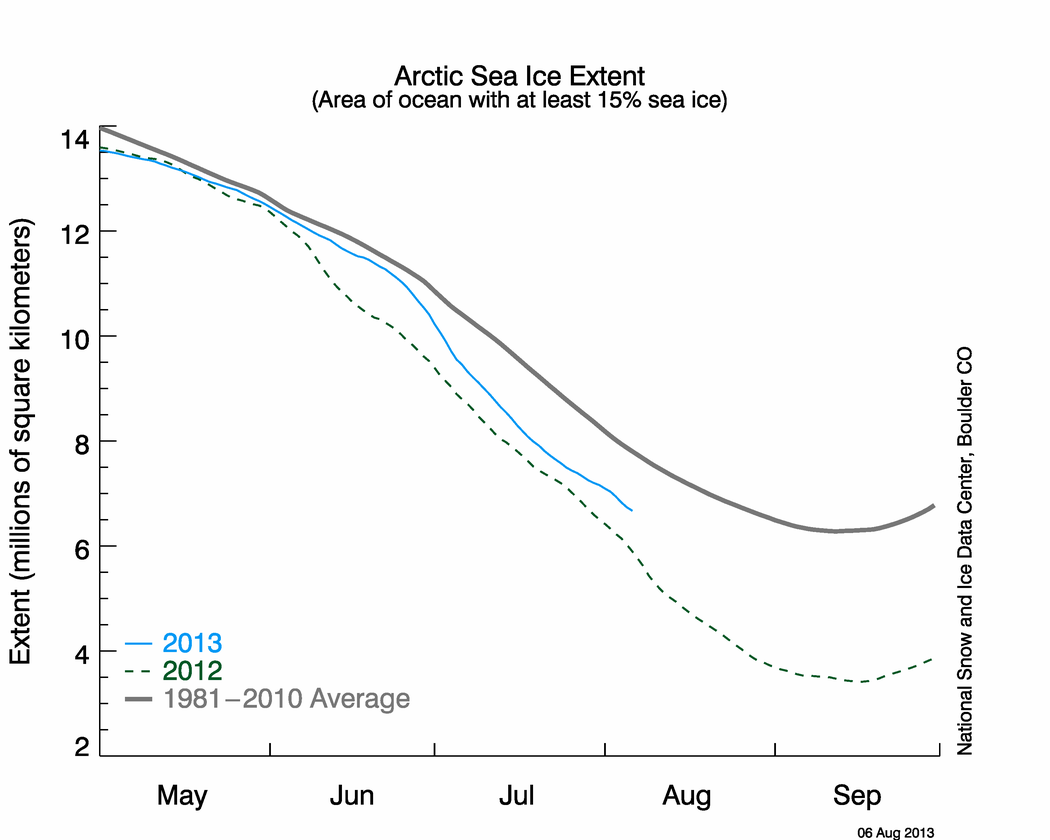
It's melt season up north and the ice jockeys are mounting their ponies. Michael plays the chalk with nsidc's classic, Stoat throws the IJIS spaghetti against the wall, and Tony Watts, why he wants to sell you the Norwegian entry with his Aussie girlfriend upside down in the saddle.

Eli, Eli prefers to look at dirty pictures from the Reeperbahn

June 12, 2009

June 12, 2008


June 12, 2007

As Drudge would say: Developing

Comments

Monday, June 01, 2009

Down the Rabett hole


Sorry for disappearing but Eli is

a) engaged in a bunch of real world things that are quite exciting.
b) just has nothing more original to say.
c) celebrating Ms. Rabett's birthday.

Give me a week.

Monday, May 25, 2009

The Death of Calculus

One of the standard moans is that no one takes physics anymore, and when they do, “calculation has been replaced by writing”.

Far be it from the bunny to be serious, but have you folk realized that algebra and calculus are in pretty much the same position that arithmetic was in 1970 when HP's calculator killed it. Why sweat integrating functions when Mathematica/MathLab/Maple can do it for you? To the same extent, you have to know the rules in order to spot problems (ill stated inputs, etc), but you don’t necessarily have to master the minutia.

The time is here when students take their computers into the test to run the symbolic math applications for their test, and in that case calculation will have been replaced by writing and the students will have to explain why and what they did. Not a bad thing IEHO.

Comments

Saturday, May 23, 2009

Last Call

UPDATE: Thank you for approving "COMMENT ON "FALSIFICATION OF THE ATMOSPHERIC CO2 GREENHOUSE EFFECTS WITHIN THE FRAME OF PHYSICS"".

Submitted.

The files have been uploaded to the International Journal of Modern Physics B, and are available at Rabett Run Labs. Eli is looking for suggestions to send to the Editor for referees. Particularly valuable given the editorial board would be referees from Germany, Singapore, China and south and southeast Asia.

Eli would appreciate if you, dear Readers took a quick look at the files for errors. There was a considerable amount of reformatting needed to get the figures to stick in place and the bunny is sick of looking at the thing.

Friday, May 08, 2009

Efficient, elegant and economical - pick one

Ideally one searches for all three in any solution, on the other hand, as NASA engineers said about Dan Goldin's mantra: "better, faster, cheaper", pick two. Steven Chu, the new US Secretary of Energy likes efficient, although when pushed to the wall he would not object to adding elegant to the mix. Eli would like to point out that the Walmart solution, cheaper, by itself ain't bad.

Consider where the costs and problems associated with reducing carbon emissions comes from, from having to transform a dispersed, costless source of energy such as wind or solar or geothermal, into a form which can be centrally distributed to cover all needs. For that we need efficient and elegant. On the other hand there are applications where cheap by itself would do the job, such as an inefficient small windmill or a solar array you could hang out the window which would generate enough electricity to recharge all your Ipod, Iphone, Inks (a very old device made by Apple for taking memos), etc. and run the standby power for your TV. Eli remembers some awkward windmills that used to pump well water on farms. Same sort of thing. The ultimate example is drying clothes on a clothesline.

Things such as this will not solve the problem by themselves, but they will make the problem soluble.

YMMV, but then again, you would be wrong.

Sunday, May 03, 2009

Krammed


To our misfortune Gerhard Kramm, defender of Gerlich and Tscheuschner descended upon innocent Rabett Run. Gerhard is an amusing combination of Emily Litella, and Roseanne Roseannadanna, characters played by Gilda Radner on Saturday Night Live. Like Emily he has the talent of creative deafness, twisting clear statements in obtuse directions. As Joel said:

If I may make a meta-comment here, it seems to me that Dr. Kramm is using a rhetorical technique rather similar to that of G&T themselves. What it seems to amount to is this: One takes something and then finds an interpretation of it (sometimes quite convoluted) and then says that because one has come up with an interpretation of it where it does not make sense, therefore it is nonsense
Like Roseanne, Gerhard, well Gerhard kinda tries to be aggressive but comes off as silly. Dealing with him is like being savaged by Geoffrey Howe.

Yet Dr. Kramm has a couple of interesting gigs going. Someone to be named later (maybe) has been posting haigographys of Gerhard in Wikipedia. Based on the posting habits of our mysterious one, one might think that there is a very personal relationship with the subject, a Wiki nono. This ticks Ethon off. The big bird is at least as distinguished and influential as the Kramm while the Stoats of the world have relegated Eli's friend to a footnote. Free Ethon. Perhaps we need a new Wiki entry:
Ethon, a mythical bird, fond of liver who has had an effect on the climate change debate by ridiculing Prometheus rather than savaging him. Ethon is a frequent flyer between Colorado and the Rabett Run, were he comments. The bird purchases carbon offset credits to cover his emission.
But wait, as several have become aware, there is yet another strand to Gerhard Kramm's ligaments. He has been peppering arXiv with specials, including the latest one which continues the silliness that he attempted to perpetrate here.
1. arXiv:0904.2767 [pdf]
Title: Comments on the "Proof of the atmospheric greenhouse effect" by Arthur B. Smith

2. arXiv:0901.1863 [pdf]
Title: Planck's blackbody radiation law: Presentation in different domains and determination of the related dimensional constants

3. arXiv:0801.2197 [pdf, other]
Title: Heuristic Derivation of Blackbody Radiation Laws using Principles of Dimensional Analysis

4. arXiv:0801.1870 [pdf, other]
Title: Comment to "Recent Climate Observations Compared to Projections" by Rahmstorf et al
Authors: Gerhard Kramm
Comments: 5 pages, 4 figures. Submitted for publication to Science

5. arXiv:0711.1551 [pdf, other]
Title: On the recognition of fundamental physical principles in recent atmospheric-environmental studies
Comments: 21 pages, 4 figures, presented on the workshop of the University of Alaska Fairbanks "2007 Dynamics of Complex Systems: Common Threads" held in Fairbanks, Alaska, July 25-27, 2007
This is an amusing bunch of stuff. Let us take a brief look at #1. As Arthur Smith said, that is a 22 page comment on a 6 page note, so no, brief, maybe not be the right word, but the bunny can be efficient. First Kramm tries on the nonsense he raised at Rabett Run about Arthur Smith's definition of an effective emissivity. Kramm only wins in an echo chamber, at Rabett Run it got torn to shreds.

Well, that ain't the first time nonsense ever got put up at arXiv, it ain't even only the fifth time, but it is amusing to see the next move, a misrepresentation so old that even Eli doesn't remember the first time he saw it. The trick here, of course, is that the two y-axes don't really have any relationship to each other. By plotting the temperature anomaly say from -0.4 to +0.4 you can get a pretty good match, by squeezing it more a worse one. What you can do that makes sense ( Eli understands this is not what Gerhard is trying to do) is plot the temperature anomaly against various forcings from models. In this way a change in greenhouse gas concentration is plotted as the temperature change predicted by the model. What happens when you do that? Well, this happens

<---- a="" br="" good="" match.="" pretty="">This little bottom of the deck shuffle has appeared many times, but maybe it is a first for arXiv. We then meet a couple of old friends from G&T, the non-rotating Earth model: the back side is cold as hell and the front as warm. Of course Kramm neglects to point out that this pretty well is what happens on the moon and cannot happen on a rotating earth.

And so to bed.

BTW, #4 on Rahmstorf, et al , is another version of the same figurative swindle Kramm attempts in #1, except there he also neglects the effects of other forcings which were important in the 50s and 60s. As the figure to the left shows, the greenhouse gas forcing only became dominant ~1960. This sort of nonsense only works when no one is looking.