Saturday, May 20, 2006

Banned in Boulder....


UPDATE 1/2/2007: Sometimes circumstance is fell. It turns out that one of Roger Pielke's children has a similar name to the one I used in this post which is now replaced by XXXX. This explains his negative reaction. For that I sincerely apologize. There was no intent or knowledge on my part about the child's name - Eli Rabett
------------------------------------------------------------------
Something that Eli said has really bothered Roger P, so it was Banned in Boulder. Should anyone be interested it was a response to this trio of statements from Andrew Dressler

Let's go back to what I said: "I would argue that there is a strong consensus that most of the warming over the last 50 years is likely due to human activities."
At the stated level of precision/uncertainty, there is no argument that a strong scientific consensus supports this statement ... do you disagree with either the statement or that a consensus exists, Roger?
Jim Clarke

All studies that attempt to determine the percentage of the recent warming that is man-made, use GCMs to make that determination. There are a significant number of well-qualified scientists who dispute that the GCMs have any skill (whether you like it or not). Therefore, there is still a significant debate as to how much of the recent warming is man-made.

and Roger Pielke, Jr.

You write, "There is no reasonable definition of "significant" that would allow one to truthfully say that "significant debate" is occurring over this statement."
Well the IPCC is debating this statement right now and is changing key parts of it from "most" to "dominant" and "likely" to "very likely" --- all that seems pretty significant.
To which I replied that the discussion reminded me of an old story. Andrew and XXXX were walking along a park path. XXXX jumped with shock when she saw a woman lying motionless in a pool of blood. Andrew went over and felt for a pulse, finding none, he said: XXXX this woman is certainly dead.
In another version Jim and XXXX were walking along the same park path. XXXX jumped with shock when she saw a woman lying motionless in a pool of blood. Jim grabbed her elbow and said: That is red wine she spilled, obviously a drunk, sleeping it off, let's go.
Finally Roger and XXXX were walking along the same park path. XXXX jumped with shock when she saw a woman lying motionless in a pool of blood. Roger said, not very interesting, we all know she is dead, but the real question is whose policy is to blame. If you read my paper (link provided) you will learn that it is all the fault of the criminologists.


Solving the climate change and budget problem in one go....


The US has a large budget deficit and low auto mileage. There are two ways the later problem could be solved. The first would be to mandate fleet mileage limits, but as we have seen this is a game that the auto companies play, the second would be EU level taxes on gas. Since the latter are regressive that must be accompanied by equivalent cuts on payroll taxes which are regressive. The net effect would be neutral or slightly progressive. If accompanied by lifting of the maximum earnings on which Social Security taxes are levied the effect would be to make the total tax system much more progressive, increase revenues and solve the Social Security funding issue into the far future.

Prof. Rabett's handy dandy all purpose maxisolution.

An Inconvient Truth and the Conventional Wisdom


The most sensible comment I have seen on "An Inconvenient Truth"

Mr. Gore clearly intends the exercise as an unconventional way to set off a public-policy debate. In New York, he'll be participating in a kind of town-hall meeting on global warming that coincides with the film's opening there. After that, "he's going to be out speaking on this issue and continue communicating on this issue," says Michael Feldman, an aide and adviser to the former vice president. Many of the proceeds from the movie are going to a new organization fighting climate change.
from the Wall Street Journal, and the conventional wisdom from the same source
That inevitably will raise the question of whether Mr. Gore intends the exercise to revive his political career. When the movie was previewed at the National Geographic Society's headquarters in Washington, an official there noted that the widespread reaction among Geographic employees who had seen the film earlier was: "Do you think he'll run again for president?" Mr. Gore responded with a dismissive wave of his hand.

Sunday, May 14, 2006

Quotes from Chairman Eli.....


I have a small suggestion for economists who want to see the effects of illegal immigration for themselves. Wherever you are find the local shape up, you know, the 7-11 where the landscaping and building contractors show up between 6 and 10 in the morning to pick up casual labor. Go down there and watch what happens. Then you can close your eyes and claim that these folks are not in your community, and yes, Virginia, they are depressing wages in that sector. Stick around and watch what the guys who don't get picked up do, it ain't pretty. The best way to handle the situation is to swallow deeply and set up a city/county run center with rules, but these are opposed by those who like having mown lawns and cheap kitchens. Like sausage, the populance has no stomach for seeing how it is made.

If you don't know where these places are in your city, then a) you have not been looking, b) just ask the guys who do your lawn or remodel your kitchen. If you can find a REAL old timer, ask him (and it will be a him in that case) how the ethnic identity of those doing casual labor has changed in the last 40-50 years.
Otherwise, don't bother talking to me about it. - Originally posted at Brad deLong's blog

And btw, if you are in a different country, the same rules apply.

Wednesday, May 10, 2006

Sea-level Rise Central


James Titus was one of the first, if not the first to think about the implications of climate change for sea level rise and how to meet that challenge. His private web site is an extraordinary resource with links to many primary references on the subject and his expert evaluation of the work.

The most amusing is a recording of "When the North Pole Melts" from 1988, created at the Climate Institute's "Preparing for Climate Change" conference that Ian Castles quoted from in starting Rabett down this little hole. Eli is working through the references before posting again on that issue, however you can gain a good idea of the situation by starting at Titus' Captain Sea Level's Links reading his comments and going through the links. If you don't have much time start at what Titus calls the EPA's mea culpa for having over-estimated future sea level rise during the 1980s and go on to a recent talk by Jim Hansen (the parenthetical comments are priceless). Since the origin of the set-to was in Australia, it is worth quoting a stanza from "When the North Pole Melts"

The Australian Labor Party wants to see the economy grow;
So their platform says that we will tow Santa from the Equator to the South Pole.
If the Russians will get him through the Bering Strait,
The currents can do rest.
But the Conservatives would rather that we make him wait,
And put him to the market test.
But What Will Santa Do?

Chorus

When the North Pole Starts to Melt?
What is gonna happen to his little elves?
Will they be too busy swimming to make the toys?
And what will Santa do?
If the North Pole melts too fast
Is this Christmas gonna be his last?
What will parents have to tell their girls and bays?
It sounds better than it reads. A classic in a capella science

Sunday, May 07, 2006

Always RTFR....

Always RTFR....

Ian Castles has responded.

You ask 'was the latter even printed?' Yes, the Director of the Office of Policy Analysis of the USEPA cited three multi-authored books that had appeared in 1983, 1985 and 1987. It is common for books to be printed.
The conference was sponsored by (among others) the Climate Institute, NOAA, the US Department of Energy, the US EPA, the National Science Foundation, NASA, the World Resources Institute and UNEP in cooperation with the Participating Agencies and Universities of the Canadian Climate Program. As might be expected, the Proceedings were printed.
In another presentation at the Conference, James Titus, Project Manager for Sea Level Rise at the EPA, presented a table showing that NASA's estimate of sea level rise was 70 cm by 2085 and that estimates by other authorieies of sea level rise to 2100 were: EPA, 56-345 cm; National Academy of Science, 50-200 cm.; and Hoffman et al, 57-368cm.
So the CONSENSUS view changed by a huge margin over a period of 13 years - it wasn't just one person's estimate
Eli's first thought was to point out that Castles was pointing to Morgenstern's impression of a consensus not a consensus. But then I remembered RTFR. Well, I don't have it, but I can probably get it tomorrow.

Still, Google is your friend, and you can find a lot of things if you know how to look. But before we do, let us remember that Castles claims the 1987 consensus (according to Morgenstern) was that by 2100 the global sea level will rise by 61-238 cm, while in 2000, the IPCC Third Assessment Report (TAR) consensus rise was 9-88 cm.

And gee, guess what I found. From the Intergovernmental Panel on Climate Change (IPCC). 1990. Potential impacts of climate change. Report of Working Group 2, Intergovernmental Panel on Climate Change, 1-1 to 2. Geneva: World Meteorological Organization (WMO)/United Nations Environment Programme (UNEP).
Global warming will cause a thermal expansion of the upper layers of the ocean and this expansion, together with the expected melting and movement into the ocean of some land-based glaciers, is expected to accelerate the current sea-level rise trend. A rise of 9-29 cm is expected over the next 40 years, or 28-98 cm by 2090 (Working Group I Report - Summary).
That's 1990 folks, from the First Assessment Report (FAR). Right in line with the "9-88" cm rise expected in the IPCC TAR ten years later and with the US National Academy report on Responding to Changes in Sea Level: Engineering Implications (1987) That's 1987 folks, the same time that Castles claims the consensus estimate is 61-238 cm. The second chapter of the report summarizes expert opinion on global temperature increases and the associated sea level rise. It concludes:
Apply these values to an estimated temperature change of 3.5 +/- 2 C due to a doubling of greenhouse gases over the next century, and the associate range in global mean sea level change is from 24 to 154 cm.
But there is more, let us go to the TAR, Figure 11.-2.

As the caption explains "The region in dark shading shows the range of the average of AOGCMs for all 35 SRES scenarios. The region in light shading shows the range of all AOGCMs for all 35 scenarios. The region delimited by the outermost lines shows the range of all AOGCMs and scenarios including uncertainty in land-ice changes, permafrost changes and sediment deposition" In other words, the dark shaded region (30-50 cm) is the most likely, the gray shaded region (20-70 cm) is somewhat least likely and the region between the two black lines (9-88 cm) encompasses the full range of possibilities. The core estimates are quite close to the FAR 28 - 98 cm. The high end estimate of 154 cm from the 1987 National Academy report has come down significantly, but then again the upper temperature limit from that report was 5.5 C as opposed to the 5.1 of the TAR.

You really do have to RTFR with these guys.

What should the IPCC do....


As many are aware, the US government has widely distributed the second order draft of the fourth IPCC climate change evaluation. This has opened the document up to sniping, both in an indirect (and CYA manner) and more directly (see the comment by Vincent Gray.

This raises the issue about what the IPCC should do.

The first is that the IPCC should refuse to respond to comments by anyone who has publicly broken their agreement to keep the draft confidential.

The second is that the IPCC should inform the US government that they have seriously damaged the process.

While it would be very difficult to implement, the IPCC should take over distribution of all future drafts in the US and not leave this to US government agencies.

RTFR (and the dictionary and the thesaurus, and don't forget Bartletts)


E has been out and a commenting in various places. Unfortunately he is not very impressed by the moral behavior of many posters. Being an old bunny, E is well aware that folk will utter absolute nonsense with perfectly straight faces, but he is shocked, I say shocked to have discovered that this behavior is common among the purveyors of Potemkin science (see the end of that post).

It is hard to know where to begin. Well we can start with two little libertarians at Deltoid. In defense of his pathological hatred of government Nanny Government Sucks used this quote:

"Government is not reason, it is not eloquence - it is force. Like fire, it is a dangerous servant and a fearsome master" - George Washington
and if you google that little beauty you get about 46,000 hits, which shows that those of the libertarian persuasion at least know how to use the copy and paste function of their computers. One problem. No one can find the original source. George never said it

In the same thread, Jack Strocchi chimes in with another golden oldie
"Thomas "government is best which governs least" Jefferson
This one, it appears was originally adopted (there appears to be an earlier source) by Henry Thoreau who attributed it to Jefferson, but TJ never said or wrote it.

We now move on to E's favorite pinata, RPJr. himself. RPJr is a smart cookie. Although I would bet significant money that he has access to the second draft of the IPCC report on climate change (AR4), he knows that he cannot quote directly from it without exposing himself to significant censure. Therefore he used a quote from a Yahoo Asia report to launch the first of many attacks on the document. Roger has the Steve Colbert's to write:
A second key difference is the substitution of the phase "dominant cause" for the word "most." IPCC terms are not chosen arbitrarily and my reading of this is that as far as GHGs, it represents a step back from the statement in 2001. I equate "most" with a majority (>50%) and "dominant" with a plurality. I am sure commentators will have a field day with that. Were I a betting person I'd wager that "dominant" won't last until the end.
As Eli pointed out there is only one problem with this. The definition of dominant.


dom·i·nant http://www.m-w.com/
Function: adjective
1 : commanding, controlling, or prevailing over all others
2 : overlooking and commanding from a superior position
3 : of, relating to, or exerting ecological or genetic dominance
4 : being the one of a pair of bodily structures that is the more effective or predominant in action
synonyms DOMINANT, PREDOMINANT, PARAMOUNT, PREPONDERANT mean superior to all others in influence or importance. DOMINANT applies to something that is uppermost because ruling or controlling .


And, just for fun, how about most


1 : greatest in quantity, extent, or degree
2 : the majority of
Let us be plain, Roger sucked in some pretty sharp characters with his little newspeak dictionary work. Andrew Dressler wrote

As far as "dominant" goes, I agree that this is not clear. I hope that they substitute this with a more transparent word when the final version comes out.
And after it was pointed out that dominant was totally clear and transparent to anyone with a dictionary and without an agenda he was not able to accept the idea that his friend Roger purposely mislead him
I think that what the writers intended for "dominant" was the meaning of "vast majority". But I agree w/ Roger that "dominant" is a poor word.
Eli had to hammer the point home
Andrew, what problem do you have accepting that if someone says dominant with respect to the influence of greenhouse gases they mean a commanding and controlling forcing prevailing over all others? They certainly do NOT MEAN MOST.
Unfortunately this caused Andrew to say
I have the document and the quote above is correct. I do not have a problem with "dominant" if that's what they mean. My point was that since this is a draft, I wonder if they really mean that. We'll see when the final version comes out.
Which, at least technically is a violation of the conditions he accepted for viewing the AR4 draft and I am sorry that he felt compelled to do that. Roger, of course, having set the trap, did not step into it. You do have to pass the definitions part of the SAT to be a professor at Colorado?

And finally in the analogy section of the test we have Ian Castles, who used this beaut:

I've seen a lot of consensuses evaporate in my time, but let's take an example from climate change science. In October 1987, Richard Morgenstern of the US EPA spoke on 'Implications of climate change for environmental policy making' at the conference 'Preparing for Climate Change' which was sponsored by the World Resource Institute, UNEP, the US National Science Foundation and 12 other US-based organisations.
He said that there was 'an emerging concensus that the global warming could result in a rise in sea level on the order of two to seven feet by 2100', and cited multi-authored books that had appeared in 1983, 1985 and 1987.
The 'two to seven feet' translates into 61-213 cm. Thirteen years later the IPCC concensus for the sea level rise between 1990 and 2100 was 9-88 cm - a decrease of 85% at the top of the range and nearly 60% at the bottom. Doesn't this mean that Paltridge may have a point when he says that 'Consensus on its own is not the sort of thing on which sensible people put their money?
The only problem being that he is comparing a 20 year old conference report by one person, expressing his seat of the pants impression of emerging science, representing at most one agency and one government, to a published report resulting from a structured consultative process involving international panels of experts.

And you know, people fell right into the hole that Ian Castles dug for them.

Wednesday, May 03, 2006

The cost of astroturf.....

If you are the Alexis de Toqueville Institution, it's for sale at $20K a pop and they will throw in an new front organization for free....

February 29, 1994
To: William P. Orzechowski
Tobacco Institute
Re: ETS Study
From: Cesar V. Conda

Per your memo, what follows is a proposed action plan by the Alexis de Tocqueville Institution on the ETS issue
ETS is environmental tobacco smoke aka second hand smoke
1. Produce a research paper to assess the research and scientific methods used in the original ETS studies -- and EPA's most recent cost-benefit "analysis" of the impact of ETS. Possible authors include - Fred Singer, Kent Jeffreys (formerly djrector of the Competitive Enterprise Institute's Environmental Studies Program). or another reputable economist (perhaps Bob Tollison).

2. Assemble an advisory board of economists and scientists who could endorse the findings in the report (perhaps call it the Commission on Environmental Science -- we envision that this would be used as framework to examine a variety of environmental science questions -- from endangered species to pesticides reform).

3. AdTI would release and distribute the report to press outlets nationwide and circulate widely on Capitol Hill.

The timetable for producing such a report will depend on the level of research that you believe is necessary. A baekgrounder length report by policy analysts like a Kent Jeffreys or Fred Singer would probably take 2-3 weeks; an original research paper by an academician could take several months.

My sense is that we could produce an efffective backgrounder report which reviews all of the known facts about the science used in the ETS ease. Moreover, the Commission on Environmental Science -- or whatever we choose to call it -- would give the issue added attention and prominence.

The cost of this project would be $20,000 which includes all costs (contracting, distribution, staff time, etc.)

As you know, we can move on this very quickly.
One stop shopping.


Saturday, April 29, 2006

Effective tobacco advertising....


A rather curious idea is being put forward by Roger Pielke Jr., that

In the battle over smoking efforts to deny a link between smoking and health risks seems to have been completely a lost effort.
This is consistent with Pielke's effort to frame other issues
...science has a huge role in getting a subject onto the "agenda" of decision making, but after that, its role is very much diminished and subsumed to other factors, such as cultural, social, and political. If this is correct, it would require some deeper understanding about the role of advocacy related to scientific issues and the efficacy of using science as a tool of advocacy.
and he continues
This begs the question -- why has anti-smoking advocacy been so successful over time? The throwaway answer that increasing scientific certainly is the key does not seem to jibe with this data.
The problem with this whole line of reasoning is that it is built upon a falsehood. The tobacco industry has used advertising, public relations campaigns, Potemkin science, litigation, and any other method it could find to maintain revenues. Deaths were collateral damage. This is no secret to anyone who reads the newspapers let alone science journals. The mortality data and the data on tobacco use and its relationship to advertising both pro and con is readily available to anyone who makes the smallest effort to search. The Potemkin science ** allowed all of the other efforts to go forward, providing a screen against the imperative necessity of eliminating tobacco that were being uncovered by medical research.

The Surgeon General has been reporting on tobacco use for over thirty years. You can find the reports here, and other information here. In the preface to the 2000 report, the Director of the Center for Disease Control, Jeffrey Koplan writes:
But if the evidence is clear that tobacco use is harmful and if the tools are available to reduce its use, why has the reduction in prevalence been less than would be expected? The answer is very complex. As described in Chapter 1 of this report, numerous forces influence a person’s decision to smoke, or if that person is a smoker, the forces that drive continued use. The most important force for smoking is the totality of industry activity, including advertising, promotion, organizational activity, support for ancillary issues, and political action, which maintains marketability and profitability of the product. Efforts to reduce tobacco use face a more than $5 billion annual budget that the tobacco industry dedicates to advertising and promotion aimed at sustaining or increasing tobacco use. Nonetheless, there is cause for optimism based on considerable public support for efforts to prevent children from becoming addicted to tobacco. If the recent pattern of increases in youth tobacco use can be reversed, we can make progress toward tobacco-free generations in the future.
What exactly have been the effects of advertising. In the introduction to the report, we read
Regulatory Efforts (Chapter 5)
Advertising and Promotion

Attempts to regulate advertising and promotion of tobacco products were initiated in the United States almost immediately after the appearance of the 1964 report to the Surgeon General on the health consequences of smoking. Underlying these attempts is the hypothesis that advertising and promotion recruit new smokers and retain current ones, thereby perpetuating a great risk to public health. The tobacco industry asserts that the purpose of marketing is to maintain brand loyalty. Considerable evidence has accumulated showing that advertising and promotion are perhaps the main motivators for adopting and maintaining tobacco use. Attempts to regulate tobacco marketing continue to take place in a markedly adversarial and litigious atmosphere. The initial regulatory action, promulgated in 1965, provided for a general health warning on cigarette packages but effectively preempted any further federal, state, or local requirements for health messages. In 1969, a successful court action invoked the Fairness Doctrine (not previously applied to advertising) to require broadcast media to air anti-tobacco advertising to counter the paid tobacco advertising then running on television and radio. Indirect evidence suggests that such counter-advertising had considerable impact on the public’s perception of smoking. Not surprisingly, the tobacco industry supported new legislation (adopted in 1971) prohibiting the advertising of tobacco products on broadcast media, because such legislation also removed the no-cost broadcasting of anti-tobacco advertising. A decade later, a Federal Trade Commission (FTC) staff report asserted that the dominant themes of remaining (non-broadcast) cigarette advertising associated smoking with “youthful vigor, good health, good looks and personal, social and professional acceptance and success” (Myers et al. 1981, p. 2-13). A nonpublic version of the report detailed some of the alleged marketing strategy employed by the industry; the industry denied the allegation that the source material for the report represented industry policy. Nonetheless, some of these concerns led to the enactment of the Comprehensive Smoking Education Act of 1984 (Public Law 98-474), which required a set of four rotating warnings on cigarette packages. The law did not, however, adopt other FTC recommendations that product packages should bear information about associated risks of addiction and miscarriage, as well as information on toxic components of cigarettes. In fact, many FTC-recommended requirements for packaging information that have been enacted in other industrialized nations have not been enacted in the United States.

The role of advertising is perhaps best epitomized by R.J. Reynolds Tobacco Company’s Camel brand campaign (initiated in 1988) using the cartoon character “Joe Camel.” Considerable research has demonstrated the appeal of this character to young people and the influence that the advertising campaign has had on minors’ understanding of tobacco use and on their decision to smoke. In 1997, the FTC brought a complaint asserting that by inducing minors to smoke, R.J. Reynolds’ advertising practices violated the Federal Trade Commission Act Public Law 96-252). The tobacco company subsequently agreed to cease using the Joe Camel campaign. Although the FTC’s act grants no private right of enforcement, a private lawsuit in California resulted in a settlement whereby the tobacco company agreed to cease its Joe Camel campaign; notably, the Supreme Court of California rejected R.J. Reynolds’ argument that the Comprehensive Smoking Education Act of 1984 preempted the suit’s attempt to further regulate tobacco advertising.
Among other tactics, the tobacco companies targeted marketing at women. The summaryof the Surgeon General's 2000 report on Smoking and Women includes:
In the 1990s, the decline in smoking rates among adult women stalled and, at the same time, rates were rising steeply among teenage girls, blunting earlier progress. Smoking rates among women with less than a high school education are three times higher than for college graduates. Nearly all women who smoke started as teenagers - and 30 percent of high school senior girls are still current smokers....

...Tobacco industry marketing is a factor influencing susceptibility to and initiation of smoking among girls, in the United States and overseas. Myriad examples of tobacco ads and promotions targeted to women indicate that such marketing is dominated by themes of social desirability and independence. These themes are conveyed through ads featuring slim, attractive, athletic models, images very much at odds with the serious health consequences experienced by so many women who smoke.

....Women have been extensively targeted in tobacco marketing, and tobacco companies have produced brands specifically for women, both in the United States and overseas. Myriad examples of tobacco ads and promotions targeted to women indicated that such marketing is dominated by themes of both social desirability and independence, which are conveyed through ads featuring slim, attractive, athletic models. Between 1995 and 1998, expenditures for domestic cigarette advertising and promotion increased from $4.90 billion to $6.73 billion. Tobacco industry marketing, including product design, advertising, and promotional activities, is a factor influencing susceptibility to and initiation of smoking.
** Something that appears elaborate and impressive but in actual fact lacks substance: “the Potemkin village of this country's borrowed prosperity” (Lewis H. Lapham). After Grigori Aleksandrovich Potemkin, who had elaborate fake villages constructed for Catherine the Great's tours of the Ukraine and the Crimea (from the American Heritage Dictionary)

Tobacco mortality ........


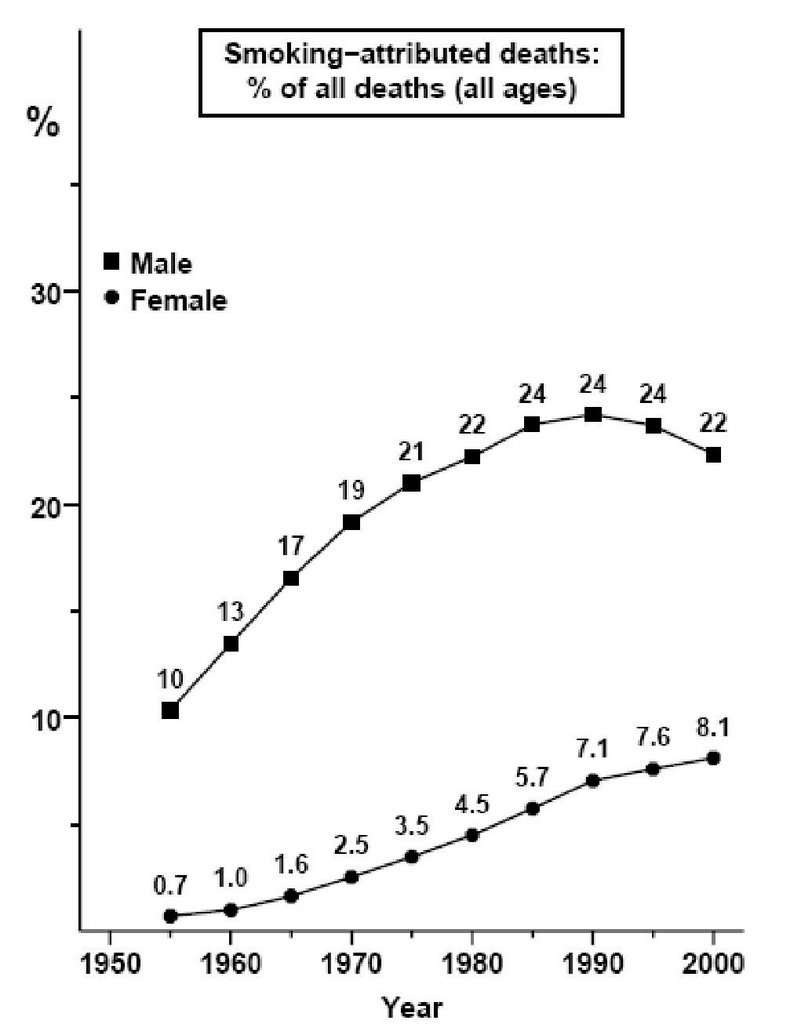
One of the purposes of this blog is to provide a place where I can store answers to questions that continually arise. Uncle E is becoming involved in the tobacco wars. Two issues have come up recently, the first having to do with mortality rates. The long and short of it is that mortality from smoking is large, accounting for ~20% of male and 10% of female deaths in developed countries. The situation in developing countries is not as well defined because the data is not of the same standard.

A motherload of data can be found at the Oxford Clinical Trial Service Unit site. Richard Peto and his colleagues have been keeping track of tobacco related mortality in developed countries. The seriousness of the situation can be seen in the graphic to the left. For those of you who are chauvinistic, the data from individual countries is available.

Below you will find a couple of abstracts that back up and expand on the information in the graphic. The take home message is that in 2000, 22% of all male deaths and 8.1% of female deaths in developed countries were tobacco related.

Those interested in looking further into this issue are referred to the Oxford CTSU site and to PubMed where you can search on "mortality from tobacco"

From PubMed:

Br Med Bull. 1996 Jan;52(1):12-21.
Mortality from smoking worldwide.

Peto R, Lopez AD, Boreham J, Thun M, Heath C Jr, Doll R.
ICRF/MRC/BHF Clinical Trial Service Unit, Radcliffe Infirmary, Oxford, UK.

Estimates are made of the numbers and proportions of deaths attributable to smoking in 44 developed countries in 1990. In developed countries as a whole, tobacco was responsible for 24% of all male deaths and 7% of all female deaths, rising to over 40% in men in some former socialist economies and 17% in women in the USA. The average loss of life for all cigarette smokers was about 8 years and for those whose deaths were attributable to tobacco about 16 years. Trends in mortality attributable to tobacco differed between countries. In some the mortality in middle age (35-69 years) had decreased by half in men since 1965; in others it was continuing to increase. In women, the proportion was mostly increasing, almost universally in old age. Mortality not attributable to smoking decreased since 1955 in all OECD (Organization for European Collaboration and Development) countries, by up to 60% in men and more in women. No precise estimate can be made of the number of deaths attributable to smoking in undeveloped countries, but the prevalence of smoking suggests that it will be large. In the world as a whole, some 3 million deaths a year are estimated to be attributable to smoking, rising to 10 million a year in 30-40 years' time.
Lancet. 1992 May 23;339(8804):1268-78.
Mortality from tobacco in developed countries: indirect estimation from national vital statistics.
Peto R., Lopez AD, Boreham J, Thun M, Heath C Jr.
Imperial Cancer Research Fund Cancer Studies Unit, University of Oxford, Radcliffe Infirmary, UK.

Prolonged cigarette smoking causes even more deaths from other diseases than from lung cancer. In developed countries, the absolute age-sex-specific lung cancer rates can be used to indicate the approximate proportions due to tobacco of deaths not only from lung cancer itself but also, indirectly, from vascular disease and from various other categories of disease. Even in the absence of direct information on smoking histories, therefore, national mortality from tobacco can be estimated approximately just from the disease mortality statistics that are available from all major developed countries for about 1985 (and for 1975 and so, by extrapolation, for 1995). The relation between the absolute excess of lung cancer and the proportional excess of other diseases can only be approximate, and so as not to overestimate the effects of tobacco it has been taken to be only half that suggested by a recent large prospective study of smoking and death among one million Americans. Application of such methods indicates that, in developed countries alone, annual deaths from smoking number about 0.9 million in 1965, 1.3 million in 1975, 1.7 million in 1985, and 2.1 million in 1995 (and hence about 21 million in the decade 1990-99: 5-6 million European Community, 5-6 million USA, 5 million former USSR, 3 million Eastern and other Europe, and 2 million elsewhere, [ie, Australia, Canada, Japan, and New Zealand]). More than half these deaths will be at 35-69 years of age: during the 1990s tobacco will in developed countries cause about 30% of all deaths at 35-69 (making it the largest single cause of premature death) plus about 14% of all at older ages. Those killed at older ages are on average already almost 80 years old, however, and might have died soon anyway, but those killed by tobacco at 35-69 lose an average of about 23 years of life. At present just under 20% of all deaths in developed countries are attributed to tobacco, but this percentage is still rising, suggesting that on current smoking patterns just over 20% of those now living in developed countries will eventually be killed by tobacco (ie, about a quarter of a billion, out of a current total population of just under one and a quarter billion).

Sunday, April 16, 2006

Fred Seitz is not as pure as the driven snow....


Since people keep referring to Fred Seitz as the scientist he was rather than the propagandist he has been for the past twenty or more years, it is worthwhile to bring together several comments on this matter that E has made so that he can simply point to a URL in response.

In another universe, Dr. E was challenged to show that Fred Seitz was not as pure as the driven snow. Seitz, of course, was an eminent condensed matter physicist, President of the National Academy of Sciences and President of Rockefeller University. In the later role he developed, shall we say, a close relationship with the tobacco industry, that somehow, later morphed into a close relationship with the fossil fuel industry. Both were remunerative, both personally and for organizations Seitz was associated with.

There are good sources you can use to show the octopus like reach that Seitz has had on both issues, for example, the disinfopedia, the tobacco document archive, and the Exxon Secrets site and, for those who like their meat red, an ecosyn blog.

Seitz has a very long association with the tobacco companies and their attempts to deny the harm that tobacco does and, of course, this gem which brings the singing Freds, Seitz and Singer, together. Singer is tied back to back with Seitz in a whole bunch of tricky business including the OISM petition (17000 duped dentists deny global warming) and the Heidelberg appeal which was a neat straddle between climate, tobacco and asbestos denialism. I am working on some comments about those after dinner entertainments.

By going through the tobacco documents archive, I was able to piece together a rather damning sequence of documents which shows exactly what Seitz has been about.

Seitz signs on:

May 1979
Pg 1
There are abundant reasons for R-J-R to place a priority on research, particularly on smoking and health research. One is that our sense of integrity dictates that we respond directly to a fundamental attack on our business. Another is that if we can refute the criticisms against cigarettes, we may remove government's excuse for imposing heavy taxes on the product. …… A third reason is that there are a large number of crucial questions that need scientific answers in the area of smoking and health.

Pg 7
In evaluating and monitoring the special projects that we fund -- particularly the sole-sponsorship programs -- R.J. Reynolds Industries has secured the services of a permanent consultant -- Dr. Frederick Seitz, former president of Rockefeller

Seitz’ role

June 1980
Procedures for Managing and Progress Monitoring of R.J. Reynolds .Industries Support of Biomedical Research .Management -
The following procedures govern the commitment of funds to biomedical research and the role of various individuals and authorities in considering requests and granting approvals:

Requests for funding support will be referred to Dr. Frederick Seitz

Dr. Seitz and other members of his advisory panel will review fund requests and prepare recommendations based on these criteria: Project viability, Researcher' s qualifications,

Adequacy of facilities, Consistency with overall program objective

Prior to presentation to the Contributions Committee-for disposition, Dr. Seitz will informally discuss recommendations with Mr. H.C. Romer, general counsel. His comments will be appended to the written evaluations and recommendations presented to the Contributions Committee

How much did Seitz get:
July 1986

Dear Dr. Seitz: We should like to renew the letter agreement dated July 12, 1978 between you and RJR Nabisco, Inc. (formerly R.J. Reynolds Industries, Inc.) for six months commencing July I, 1986 at an annual fee of $65,000 which shall be paid in equal monthly installments on the last day of each month. In all other respects the agreement will remain in full force and effect.

And just a pointer to the most amusing document in the entire tobacco archive.

Saturday, April 15, 2006

Tim Curtin insists on topping himself.....

Not only does he start by blowing two orders of magnitude in his favor....

Industrial production of CO2 at 100 million tonnes in 2005 growing at 10% pa (your figure) will overtake fossil fuel emissions of 25 billion tonnes of CO2 growing at net 0.005% pa (the actual rate of growth of CO2 at Mt Louai in Hawaii) by 2067.fossil fuel emissions of 25 billion tonnes of CO2 growing at net 0.005% pa (the actual rate of growth of CO2 at Mt Louai in Hawaii) by 2067
Only to catch himself half an hour later
Re Eli again, a correction, I mistyped the CO2 growth rate at the Hawaii station, it is 0.5% p.a. ( which is what I used in my extrapolation). Apologies.
But he can't figure out how to spell Mauna Loa (nice picture here).

He can't figure out that when the hare of the day (Happy Easter to all) said:
Yes, if you have one buck to your name and your money grows by 10%, while Bill Gates' money grows by 5%, your money is growing faster than his. And at the end of the day you got $1.10, and he got several hundreds of million $ in extra interest.
The 10% rate of increase did not refer to the growth of CO2 production for industrial gases. That looks to be ~3% or so (at least in the US).

As Chris O'Neill pointed out on Deltoid II even the correction is a bit shifty
BTW, the atmospheric CO2 is growing at 2% of the atmosphere's anthropogenic CO2 per year. If you want to model atmospheric CO2 with an exponential growth curve, try to remember that it didn't start at zero as an exponential growth curve does.
But wait, there is more, on an absolute basis, the rate of increase is closer to 0.7% than 0.5% (2.6 ppm/381 ppm current) and if you look at it as a percentage of preindustrial (280 ppm), then it is close to 1%.

Ian Gould is starting to make the point that most of the CO2 used for industrial purposes, ends up, guess where, in the atmosphere......

However there is another important question to ASK Tim Curtin: Where did that 100 million ton figure from, and in what sense it is using production. A lot of CO2 is produced in various industrial processes (brewing beer being my favorite) but very little of it is captured for industrial purposes.

Stephen Berg ASKS an important question:
Why are we squabbling over such a minor detail when there is a lot of work to be done to save our planet from ecological catastrophe?
To which the obvious answer is that when folk like Tim Curtin start throwing sand in the air, you need to show their propaganda up for what it is so that folk like Stephen Berg will see them for what they are, and what they are is not making any kind of contribution to an honest discussion.

Off to deliver......

Friday, April 14, 2006

More spag thrown on the wall....


We have a new winner for the most meaningless statement of the week on climate change. This, courtesy of Tim Curtin on Deltoid.

Neither is aware that the demand for industrial CO2 is growing faster than the production by AGW.
First of all, AGW (anthropic global warming) is a RESULT of increased human emissions of CO2, although there is some positive feedback as temperatures rise, increasing the rate of vegetative decay, and shifting of the CO2/H2CO3/HCO3-/CO3 2- equilibria in the oceans.

Second, comparing rates, when the magnitude of the two processes differs by several powers of 10 is more than a shade dishonest. Yes, if you have one buck to your name and your money grows by 10%, while Bill Gates' money grows by 5%, your money is growing faster than his. And at the end of the day you got $1.10, and he got several hundreds of million $ in extra interest.

Thursday, April 13, 2006

RTFR (I)


UPDATE: For those coming in from various places we have posted an update on 1988 and all that for those who want to look behind the thick black RSS line, and there is a whole series of Rabett Run posts, perhaps the most relevant of which is No More Mr. Nice Bunny where Jim Hansen shows the rubes the trick (esp. if you are reading Climate Audit). Well Lookee That and Business as Usual in 1988 are also worth a look. You can find more of these by searching this blog on "1988"

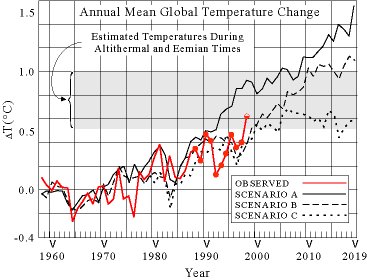
A rather strange push back has developed centering around Jim Hansen's Congressional testimony in 1988. In that testimony he presented a graph with three scenarios which he labeled A, B, C, and predictions of global temperature based on each of these scenarios


In 1998, Patrick Michaels in testimony before congress, also presented this graph, but erased scenarios B and C. He claimed that,

That model predicted that global temperature between 1988 and 1997 would rise by 0.45°C (Figure 1). Figure 2 compares this to the observed temperature changes from three independent sources. Ground-based temperatures from the IPCC show a rise of 0.11°C, or more than four times less than Hansen predicted. Lower atmosphere temperatures measured by ascending thermistors on weather balloons show a decline of 0.36°C and satellites measuring the same layer (our only truly global measure) showed a decline of 0.24°C.
The statements about satellite and weather balloon measurements have now been shown to "inoperative" (e.g. wrong, they are now are calculated to be consistent with surface measurements )**. Hansen was a mite peeved at Pat's erasing. He has put his take on this and other acts of denial on the GISS site.

However, a bunch of very strange spaghetti is being thrown against the wall with respect to Hansen's 1988 testimony and the paper upon which the testimony was based (J. Geophys. Res. 93 (8) 9341-9364 (1988). Some of them are very simple to deal with, others are more complex. Finally, I do want to check in the Library of Congress to see if the written and oral testimony is available.

Eli was able to find the abstract for this paper at GISS, and posted it into the maelstrom at R Pielke's place (towards the bottom) where he has become an unfavorite for pointing out that the Emperor is wearing some interesting togs. One of the weird claims was that Hansen had never said that Scenario B was the most probable in his testimony or in the abstract. This was a VERY serious issue for Paul, just Paul. To which we say RTFR (p9345 2nd paragraph)
These scenarios are designed to yield sensitivity experiments for a broad range of future greenhouse forcings. Scenario A, since it is exponential, must eventually be on the high side of reality in view of finite resource constraints and environmental concerns, even though the growth of emissions in scenario A (~1.5%/yr) is less than the rate typical of the past century (~4%/yr). Scenario C is a more drastic curtailment of emissions than has generally been imagined; it represents elimination of cholorfluorocarbon emissions by 2000 and reduction of CO2 and other trace gas emissions to a level such that the annual growth rates are zero (i.e. the sources just balance the sinks) by the year 2000. Scenario B is perhaps the most plausible of the three cases.
2. But wait, there is even more amusement in the comments, one of the Ethonettes, Jim Clarke (in reference to the very warm El Nino year 1998, where the global temperature was so high that we are just reaching it again ) said:
I would also like to point out that you will not find a 7 year period of 'flat' temperatures in any of Hansen's forecasts with increasing CO2. Even with ENSO cycles, his graphs show a net warming over any seven year period.
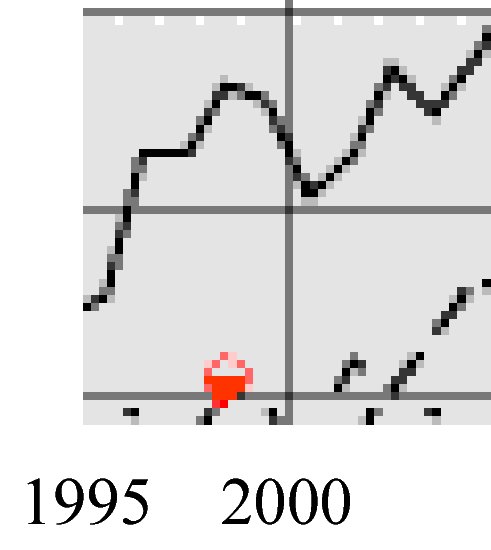
Actually you can, the period between 1974 and 1982 in Scenarios B and C. But there is a VERY interesting little wrinkle in Scenario A. I've taken the liberty of isolating Scenario A between about 1995 and 2005

[insert tongue in cheek] As you can see, the GISS model found the 1998 Super El Nino, ten years before it occurred, and as you can see, in this exponential forcing model it took five years for the temperature to exceed the global temperature in the Super El Nino year. Another triumph for GCMs!


**an important point to remember is that the satellite does not measure temperature directly, but microwave emission from the atmosphere and this must be converted to temperature by a rather involved calculation).

Tuesday, April 11, 2006

Good news....Bad news....

Both from EOS. The good news is the new NASA media policy
(You need a subscription, but AGU dues are low)

NASA scientists will be able to speak freely about their work to the media and the public, under a newly revised policy announced 30 March by NASA Administrator Michael Griffin......

The policy is intended to establish a ‘culture of openness,’ in which scientists may communicate the results and conclusions of their scientific research to the public without hindrance. However, NASA scientists will be required to distinguish personal views from those of the agency. The revised policy also outlines the responsibilities of the public affairs staff, who will be prohibited from altering or editing scientific information.
The proof, of course being in the eating.

Bad news....
The U.S. Environmental Protection Agency (EPA) is not investing enough money in the science needed for the agency to make sound environmental policy decisions, according to several witnesses who testified before a U.S. House of Representatives subcommittee on 16 March....

EPA has proposed cutting funding in a number of areas, including research about mercury, ecology and ecosystems, global change, and sustainability. Meanwhile, the agency would spend more money on homeland security issues......

Jeffrey Ruch, executive director of Public Employees for Environmental Responsibility (PEER, a non-profit organization seeking to uphold environmental laws), said that unlike the situations with NASA and NOAA, the most frequent complaint about EPA is that the agency keeps research locked in draft reports so that it can never be used in decision-making. For example, a report on dioxins has been in draft form for 12 years. EPA’s Gray said that reports such as the
one on dioxins were kept in draft form for so long because of the agency’s “rigorous peer review process” and that “it takes time to get science right.”

Ruch also noted that, in contrast with recent ‘open science’ policies announced by NOAA and NASA, EPA has reiterated its policy of requiring scientists to get prior approval for all communications with the media. Ruch said, “Until EPA offers its scientists some meaningful protection for discussing emerging issues or reporting findings without prior political vetting, the agency’s entire science program will be tainted in the eyes of both the scientific community and the general public.”

Thursday, April 06, 2006

Nothing here, keep moving......

The last three posts on Real Climate have dealt with how newspapers, by publishing fallacious (e.g. lying) op-eds, have distorted the climate debate. They have really come down hard on the Washington Post. This comes on top of the whoo hah about the Bush administrations "massaging" (scary quotes) of the climate debate by controlling access of the press to scientists at NASA, NOAA and other agencies.


Roger Pielke Jr. has claimed that tempest that Jim Hansen stirred up is over, history, shove it down the memory hole (about half way down in the comments):

Eli, you're sharing dated materials. Both NASA and NOAA obviously have had some problems. I am sure they will continue to do have issues on the PR front, but Jim Hansen has gone back to work satisfied with NASA's response, and since Lautenbacher's statement, no one in NOAA I have spoken to has complained. Those earlier news articles will be online forever, but reality will move on.

Evidently he has not spoken to a large number of people at NOAA including

Pieter Tans said

"that although he often "ignores the rules" the administration has instituted, when it comes to his colleagues, "some people feel intimidated -- I see that.

Christopher Milly, a hydrologist at the U.S. Geological Survey, said he had problems twice while drafting news releases on scientific papers describing how climate change would affect the nation's water supply.

(Conrad) Steffen studies the Greenland ice sheet, and when his work was cited last spring in a major international report on climate change in the Arctic, he and another NOAA lab director from Alaska received a call from Mahoney in which he told them not to give reporters their opinions on global warming.

Ronald Stouffer, a climate research scientist at NOAA's Geophysical Fluid Dynamics Laboratory in Princeton, estimated his media requests have dropped in half because it took so long to get clearance to talk from NOAA headquarters. Thomas Delworth, one of Stouffer's colleagues, said the policy means Americans have only "a partial sense" of what government scientists have learned about climate change.

"American taxpayers are paying the bill, and they have a right to know what we're doing," he said.

Once more a large gulf opens.

Friday, March 31, 2006

Trust everyone, but cut the cards.....Peter Finley Dunne, speaking as Mr. Dooley

The dust up about how science is being, well, shall we say selected at NASA, NOAA and EPA might be dying down, OTOH, it might not. Roger Pielke Jr. thinks it is dying down and has posted:

Eli, you're sharing dated materials. Both NASA and NOAA obviously have had some problems. I am sure they will continue to do have issues on the PR front, but Jim Hansen has gone back to work satisfied with NASA's response, and since Lautenbacher's statement, no one in NOAA I have spoken to has complained. Those earlier news articles will be online forever, but reality will move on.
When I expressed my doubts, he came back with...

Date: Mon, 13 Mar 2006 18:11:54 -0500
From: James Hansen
To: jhansen@giss.nasa.gov
Cc: jhansen@giss.nasa.gov
Subject: "Political Inclinations" and "Back to Science"

To be removed from Hansen's e-mail distribution list, respond to sender with "Remove" as the subject.

"Political Inclinations"
Following statement was placed on my web site in response to journalist requests and (moderate number of) e-mails/letters from the public (not colleagues).

http://www.columbia.edu/~jeh1/polinclin.pdf


"Back to Science"

Dear Colleague,
Last December, following a talk on global warming that I gave at the AGU meeting, NASA Public Affairs attempted to place rigid constraints on my ability to communicate with the media and the public. When I objected publicly to their proposed constraints, and ignored them, I received several offers of pro bono counsel. I accepted advice from the Government Accountability Project (GAP), headed by Louis Clark. I especially appreciate the practical, insightful guidance of GAP Legal Director Tom Devine with regard to my legal rights of free speech and how to protect myself in exercising them. I urge anybody with similar concerns to contact GAP.

The situation in NASA regarding free speech (albeit not science funding) is promising. There is no doubt that Administrator Griffin recognized the problem, fully supports openness and free speech, and intends to have supportive rules and procedures. If implementation by Public Affairs differs from that spirit, you will hear about it.

NOAA’s Admiral Lautenbacher also expressed support for openness. I am unaware of whether actions are being taken to insure free speech in NOAA. It will be interesting to query NOAA colleagues to see if there is still selective use of government ‘minders’ to monitor interactions with the media on topics such as global warming. The situation in EPA, where double-speak (“sound science”, “clear skies”, …) has achieved a level that would make George Orwell envious, is much bleaker, based on the impression that I receive from limited discussion with colleagues there. The battle to achieve open communication between government scientists and their employer, the public, is far from won.

Nevertheless, I agree with the opinion of colleagues that the focus should be on discussing solutions to global warming. Unless some new event demands it, I am not going to participate further in “whistle-blower”
activities. In particular, I decline the generous offer of GAP and Rick Piltz to share in a whistle-blower award and ceremony in April. I think that it would be most useful and effective for the spotlight to shine brightly on Rick Piltz and EPA, where the rubber meets the road.

My personal aim is to get back to science research full time, especially on quantifying options for dealing with global warming. Sincere apologies for overdue book reviews, workshop reports, and science manuscripts. As of now, I am working on these.

Best regards, Jim Hansen

Which, I assume was sent to Roger as part of a mailing list distribution. Fair enough. Eli, however, is a long time fan of Mr. Dooley, whose establishment was not far from GISS, so, mechanical bunny that he is he goes and reads http://www.columbia.edu/~jeh1/polinclin.pdf to find what (Hint: certainly not something that Roger implies)?

(If you are short of time, read the first and last two paragraphs, the conclusion is:
The constraints placed on scientists, preventing them from informing the public about their concerns, is much worse in places such as the National Institutes Health and the Environmental Protection Agency than it is in NASA. My quotation on 20 April 2006 Freedom Forum calendar, "In my more than three decades in government, I have never seen anything approaching the degree to which information flow from scientists to the public has been controlled as it is now”, is accurate. )
This statement (available at http://www.columbia.edu/~jeh1/polinclin.pdf) responds to journalist requests and to several criticisms from the public (not scientific colleagues). I infer from the criticisms that the writers accept as true charges made by a former NASA Public Affairs employee. Specifically, the Washington Post quoted George C. Deutsch as “I quickly learned one thing: Dr. Hansen and his supporters have a very partisan agenda and ties reaching to the top of the Democratic Party. Anyone perceived to be a Republican, a Bush supporter or a Christian is singled out and labeled a threat to their views. I encourage anyone interested in this story to consider the other side, to consider Dr. Hansen’s true motivations and to consider the dangerous implications of only hearing out one side of the global warming debate.”

These claims are nonsense. Political inclinations should have no impact on science analyses, but in any case the above description of my inclinations is inaccurate. I can be accurately described as moderately conservative. I am registered to vote (in Pennsylvania) as an Independent. In the 1980s I met politicians of both parties in the course of testifying to the United States Senate and House of Representatives. My favorite politician then, as I indicated to friends, was Senator John Heinz, a Pennsylvania Republican, who I hoped would one day run for President. I may have been biased by the fact that he called me at home to tell me that he had intervened with John Sununu (head of President George H. Bush’s staff) on my behalf (I have a 17 May 1989 letter from Heinz describing those interactions) after I complained about alterations of my Senate testimony by the Bush Administration.

However, my rationalization for supporting Senator Heinz was his balanced support for the environment in the context of strong economic development. At his request I participated in his “Town Hall” meeting in Philadelphia on the topic of global warming and economic development.

In my “Iowa talk” (available at above http://www.columbia.edu/~jeh1/ website) I indicated that my favorite for President in 2004 would have been John McCain, but he was not on the ballot. I appreciated the priority he gave to both decreasing the power of “special interests” in politics (campaign finance reform) and global warming, in addition to the fact that he calls a spade a spade and is an American hero. I indicated that I would vote for John Kerry because he recognized the global warming problem and he said that he would work with industry leaders to address it, but I also noted that I had reservations about Kerry (citing his appeal to Nevada voters to have no nuclear waste disposal there).

As for “ties reaching to the top of the Democratic Party”, early in the first Clinton/Gore term I was invited to and attended in the White House a “breakfast with the Vice President” (along with Joyce Penner and Bob Charlson), which was my only meeting with Gore during his eight years in the White House. In the middle of the Clinton/Gore administration, after publication of an Op-Ed in the New York Times (by Greg Easterbrook, I believe) that Vice President Gore objected to, it was suggested to me (via an intermediary) that I write an Op-Ed article to dispute the published Op-Ed article. I declined to do that. My next interaction with Vice President Gore was in January 2006 in a meeting at his request to discuss current understanding of global warming. In this meeting he apologized (I presumed it was in regard to the request for an Op-Ed article), said that he would like me to be on a board overseeing a campaign to alert Americans to the dangers of global warming, and asked if I would critically review his slide/PowerPoint global warming presentation. I did not agree to be on the board, but I subsequently (February 6) reviewed and offered scientific comments on his presentation.

I have great respect for Vice President Gore and his dedication to communicating the importance of global warming. He has a better understanding of the science of global warming than any politician that I have met, and I urge citizens to pay attention to his presentation, which I understand will come out in the form of a movie. Even if you don’t agree with Vice President Gore’s politics, you should pay attention to his climate message. He knows what he is talking about.

To the best of my recollection, I have twice contributed financially to election campaigns (probably $1000 in each case). The first was to the 1992 Clinton/Gore presidential campaign. The second was also to the Democratic ticket in one of the last two elections, either to Gore/Lieberman or Kerry/Edwards, I don’t remember which. I could probably find out by digging through cancelled checks,
but I don’t think that it matters.

In summary, I do not have close political ties to a political party. I believe that Republicans and Democrats alike must abhor the partisanship that now infects the operation of technical government agencies. The constraints placed on scientists, preventing them from informing the public about their concerns, is much worse in places such as the National Institutes Health and the Environmental Protection Agency than it is in NASA. My quotation on 20 April 2006 Freedom Forum calendar, “In my more than three decades in government, I have never seen anything approaching the degree to which information flow from scientists to the public has been controlled as it is now”, is accurate. For the good of the people, it makes no sense that political appointees are put into the agencies to control the flow of information to the public. It is hard enough to communicate science to the public as it is, without adding a requirement to get through a political filter. We would all be better off if a law were passed limiting Public Affairs appointments to nonpartisan professionals. As for religion, I was baptized and raised as a Reorganized Latter Day Saint. Our long-time Sunday school teacher, Sarah Goeser, would be disappointed by the fact that I married a (Dutch) Catholic. By pure coincidence, both of our children married into strong Catholic families (Galileo, forgive them!).

I will not respond further to personal attacks.

James E. Hansen
February, 2006
This is a VERY strong statement of dissatisfaction.

Thursday, March 30, 2006

The final word on models....


Science snark is a fine art. Seldom has there been a better example than this from Thomas Knutson

Michaels et al. (2005, hereafter MKL) recall the question of Ellsaesser: “Should we trust models or observations?” In reply we note that if we had observations of the future, we obviously would trust them more than models, but unfortunately observations of the future are not available at this time.

Compare and contrast.....

What George Bush says today about energy policy

It is in our interests that we use technologies that will not only clean the air, but make us less dependent on oil. That's what I said in my State of the Union the other day. I said, look -- and I know it came as quite a shock to -- for people to hear a Texan stand up and say, we've got a national problem, we're addicted to oil. But I meant what I said.

Being addicted to oil is a problem for our economy. In a global economy, when burgeoning economies like India and China use more fossil fuels, it affects the price of gasoline here in America. In a world in which sometimes people have got the oil we need, or don't like us -- it's kind of a undiplomatic way of putting it -- it means we've got a national security issue.

And what Jimmy Carter said 26 years ago

Tonight I want to have an unpleasant talk with you about a problem unprecedented in our history. With the exception of preventing war, this is the greatest challenge our country will face during our lifetimes. The energy crisis has not yet overwhelmed us, but it will if we do not act quickly.

It is a problem we will not solve in the next few years, and it is likely to get progressively worse through the rest of this century.

We must not be selfish or timid if we hope to have a decent world for our children and grandchildren.

We simply must balance our demand for energy with our rapidly shrinking resources. By acting now, we can control our future instead of letting the future control us.

Two days from now, I will present my energy proposals to the Congress. Its members will be my partners and they have already given me a great deal of valuable advice. Many of these proposals will be unpopular. Some will cause you to put up with inconveniences and to make sacrifices.

The most important thing about these proposals is that the alternative may be a national catastrophe. Further delay can affect our strength and our power as a nation.

Our decision about energy will test the character of the American people and the ability of the President and the Congress to govern. This difficult effort will be the "moral equivalent of war" -- except that we will be uniting our efforts to build and not destroy

And, of course, you remember the response of our hero Ronald Reagan....

To mix two truisms this once again shows that those who do not remember history are doomed to repeat it, first as tragedy then as farce. We are in stage two. Connolley and Mooney spot the farce, but don't remember the history. Thom Hartman does. Ron Bailey has his head stuck in the sand.

Sunday, March 19, 2006

Jerry Mahlman goes upside the heads of Conrad Lautenbacher and William Gray

As many are aware, Jim Hansen has stirred up quite a dust storm about political censoring of scientists and science in the US. Although Hansen concentrated on NASA, where he works, the issue has also been raised in relationship to NOAA, and in particular NOAA's official stance on the linkage of increased hurricane intensity to anthropic climate change. In an excellent new blog, Rich Piltz prints the response of Jerry Mahlman. After flat out calling the director of NOAA, Conrad Lautenbacher, a stone liar, Mahlman takes on the hurricane crowd, including Bill Gray:

It is encouraging that some NOAA managers have had the wisdom to back away from the current NOAA Adminstration’s attempts to support the very naive arguments from the hurricane forecasting community who asserted that, somehow, there is essentially no connection between the well-documented increasing warmth of the upper ocean temperatures (in all three major equatorial ocean basins) and
intensity of hurricanes.
Perhaps the kindest comment on this is that the NOAA leadership had essentially no experience with the exceptional, and globally accepted, relationship between increased equatorial temperatures and tropical cyclone intensity increases, a result pioneered by NOAA. Thanks to the exceptional courage of Thomas Knutson, a very respected NOAA climate and hurricane scientist, the ideologically driven distortion of the truth about the relationship between hurricane intensity increases and warming ocean temperatures has been thoroughly refuted.

Saturday, March 04, 2006

It's a really thin bench over there at Denial Central....


I've been wondering for quite some time why you see the same "scientists" on the denial side for every science related issue: tobacco, climate change, ozone, cancer, acid rain, whatever. There are some easy answers, money, fame, attention, and you know some of the easy answers make sense, but there is also something deeper that needs to be thought about. I know scientists in senior positions who are politically far, far to the right of George Bush, but they are very straight on their science. I can disagree with their science, and we talk about the scientific reasons for their opinions and mine. They go where the facts are on science and I do too. I know some scientists whose politics are on the left, in senior positions who let their politics creep into their science or at least the policy related parts of it, but they confine their science to their own areas, and don't try to be polymaths (the big exception would be Noam Chomsky). In any case, this needs more thought and research.

Recently I started to get into the issue in comments on Prometheus. Steve Hemphill played interlocutor. I said that Singer, Seitz and Lindzen, were for reasons I didn't much understand, into both tobacco and climate denial and pointed to the tobacco document depository, the trove of documents uncovered in litigation about how the tobacco industry suppressed information about the health effects of their products and used public relations campaigns to confuse the issue. It was trivial to show that Frederick Seitz was a key player, but Steve Hemphill keeps trying to play nyah, nyah and wanted evidence that Fred Singer was also involved (The poster hank on Prometheus showed that Lindzen is one of those who denies the ill effects of environmental tobacco smoke). I spent some time last night going through the tobacco documents and came upon this interesting set which definitively illuminates the astroturf industry at its most effective

S. Fred Singer played a key role in their attempts to deny the harm from environmental tobacco smoke (ETS)

A FAX to Bill Orzechowski, Chief Economist of the Tobacco Institute from the Alexis de Tocqueville Institution (AdTI) with S. Fred Singer’s resume. Notation in the margin is a note to Sam, probably Samuel D. Chilcote, Jr, President of the Tobacco Institute, from W. Woodson probably Walter Woodson, Vice President-Public Affairs of the Tobacco Institute. It says (about Singer)
Here is the man who will handle the EPA/ETS (illegible) work Brennon wants for us on the “social costs". Very impressive resume. I think the project is worth the 20K we discussed. Agree?.

Brennon is probably Brennon Dawson (Moran?), assistant to the president of the Tobacco Institute.
The $20K is handed over and acknowledged in a letter from Ceasar Conda, Executive Director of the AdTI to Walter Woodson
On behalf of the directors of the Alexis de Tocqueville Institution, I would like to thank the Tobacco Institute for its grant of $20,000 to support our research and education projects. IRS regulations require us to inform you in writing that we received your tax deductible $20,000.00 donation (check # 016214) today.
This was not the only source of tobacco funding for AdTI so we are not talking about a mere $20K
Pg 83: "TI's chief economist works closely with leading figures at the Alexis de Tocqueville Institution (AdTI). Some member companies support the organization. Opinions expressed and promoted by AdTI frequently support industry arguments on economic and other matters."
The product was a report from AdTI
DRAFT ONLY The EPA and the Science of Environmental Tobacco Smoke Introduction by S. Fred Singer and Kent Jeffreys

Found in Walter Woodson’s files - Executive Committee Mailings & Meetings 5/94-- 12/94, which, if you think that the Alexis de Tocquville Institution was an independent think tank, was an odd place to find it, but as we have seen, it is much more likely that this report was a bought and paid for piece of astroturf.

And, of course, the public announcement of the AdTI "independent" scientific study by two members of the US Congress, John Mica (R) and Peter Geren (D). Singer has gone from Author in the draft to Principal Reviewer in the final document. This has mislead a number of people on both sides of the divide as to how central Singer was to the project. The disinfopedia gets it more or less right
For example, from the anti-smoking side
In 1994 Cesar Conda was executive director of the Alexis de Tocqueville Institution listed as "Senior Staff and Contributing Associates" on a Lorillard Tobacco Company paid-for publication titled "Science, Economics, and Environmental Policy" by author Kent Jeffreys. [1] Principal Reviewer was listed as S. Fred Singer, and to give this propagandistic tract a sheen of scientific appearance, a loaded gang of "experts" from assorted tobacco-funded front organizations with impressive names was listed: SEPP, Hoover Institution, John M. Olin Center for Policy, George Mason University.

Monday, February 27, 2006

What they really think of you........


Eli has been looking at the nexus between the tobacco, ozone, acid rain, climate change denialists. The tobacco case discovery documents are on line and have a treasure trove of stuff for anyone interested in the astroturf industry. A foolish Steve Hemphill is playing nyah nyah you can't prove it on Roger Pielke Jr.'s Promethius, so our crack team of prize winning long eared detectives have been trolling the archives.

The best one so far is this letter 

TO= Bill Murray
FROM Alexander Holtzman
DATE: August 31, 1989
SUBJECT: Fred Seitz
I spoke to Bill Hobbs about arranging an appointment for you with Dr. Fred Seitz, former head of Rockefeller University and the principal scientific advisor to the R. J. Reynolds medical research program. Bill told me that Dr. Seitz is quite elderly and not sufficiently rational to offer advice. Bill said that he would strongly recommend your speaking to Dr. Alfred G. Knudson Jr. of the CTR Scientific Advisory Board.
Of course, this was the same month they released Singersmagnum opus on second hand smoke
You don't want to know what the people who have bought you really think.