Saturday, October 31, 2015

Eli Buds In

So various bunnies have been wondering why the areas burnt in US forest fires decreased sharply starting in the 1930s


There have been various doubts expressed about this data, but the data looks ok when cross checked against the Historical Statistics of the United States: Colonial Times to 1970 (should be on everybunny's bookshelf.  Ms Rabett made Eli's day years ago when it appeared under the carrot bush).  

Turns out that the answer is pretty simple
National forest management from 1900 up to the Second World War was mostly custodial in nature. An early focus was to establish the boundaries of the national forests and to prevent, or respond to, unauthorized uses (such as illegal timber felling, unauthorized mining, agricultural encroachment).

Another main focus of Forest Service efforts was reducing uncontrolled wildfires that were common prior to the 1930s. Curtailing the 8 to 20 million hectares that consistently burned annually, mostly on private lands, was considered a prerequisite for the long-term management of forests and grasslands — both public and private.

The focus of these efforts was on protecting all lands from wildfire, regardless of their ownership; but systematic control became effective only during the 1930s, when large public employment programmes were established. By the 1960s, the area burned by wildfire had declined by 90 percent compared to the 1930s (Figure 2). This was accomplished through highly successful federal, state and private landowner cooperation. Within the Forest Service, the State and Private Forestry Division was responsible for this coordination.
The government did it.  More to the point, New Deal public employment programs such as the Civilian Construction Corp provided the manpower to better manage the national and state forests and fight the fires.  Then everybody saw that this was a good thing and got together to manage the problem.

Government works

Clinton accepts Democratic nomination, begins general election campaign

That's my interpretation of Clinton's carefully limited support for the death penalty. She gave a few things to the left before the last Democratic debate, and may even occasionally throw a bone to them in the next few months, but she's running now to win the general election.

There no point in being too cynical. Clinton said capital punishment should be very limited and rare, and not racially biased as it has been, but not eliminated entirely. Maybe she believes it too, I don't know. Maybe Bernie Sanders believes it when he's to the right of most Democrats on gun control. I'm not sure how much that personal belief matters at their political level.

I do have a suggestion for Clinton is she truly wants to make capital punishment very limited and rare - focus on reducing the chance of executing someone who's factually innocent. It's very hard to knock that possibility down to zero, given enough executions over time, but limiting the death penalty to two categories could take it to near zero:

1. Murder where rape was also committed, and evidence includes both a confession by the defendant and DNA evidence corroborating the rape. You need the DNA evidence because false confessions happen.

2. Defendant is accused of mass murder, say five or more people. This assumes a high-profile case means defendants will be assigned adequate attorneys. The Virginia example, from being a top death penalty state to no sentences since 2011, shows the effect from a change that gave defendants better representation.

Again I'm not saying this would eliminate the execution of factually innocent people, but it would make that much less likely, and campaigning against executing innocent people would play well in the general election against Rubio.

Would be nice if Obama hurried up his evolution, though.


UPDATE:  I agree with this argument that excluding jurors who oppose the death penalty from the guilt phase of the trial makes for a biased jury that is more likely to mistakenly convict the defendant. Trials should be bifurcated with one jury panel for determining guilt, and the other deciding whether to impose the death penalty. A side advantage of this is that capital murder cases take up a lot of a juror's time, so splitting the responsibility among multiple jurors is more fair to people doing compulsory jury duty.

Trick or Treat


Wednesday, October 28, 2015

Somebunny Does It Again

Habit forming

Need to Know

Science is understanding data, not data.

Science requires data, and it requires models to understand the data. The best models will be based on well established principles of physics, chemistry and biology. In the context of climate science a brief discussion about the nature of the data and the models used to understand the data will help, but, of course, not be sufficient.

Ten years ago, Thomas Knutson pointed out that “if we had observations of the future we would obviously trust them more than models”. In climate science, we could add that if we had data from well designed measurements in the past, we would also use them, but, unfortunately it is only is the past few decades that a few such measurements are available, driven in major part by improved theoretical models and advances in instrumentation. It is a blessing that many well qualified scientists have spent their time working on the data and the models.

A simple example of the difficulties needed to turn numbers into meaningful data is the time of observation issue for temperature measurement. If measurements had been made at say 3 PM at one location, and then a new station keeper starts taking measurements at 7 AM, without adjusting for the change in time, just looking at the numbers would make it difficult to draw any conclusions. There are people who develop techniques for dealing with this situation. One solution is to compare the measurements with the jump to measurements at nearby stations where the time of observation stayed the same.

Global measurements of temperature only go back to 1880 with a few exceptions and those longer series are bedevilled by serious calibration issues not that the early part of the instrumental record is a golden relic.  More like a rusty old pot that needs a lot of restoration. Paleoclimate scientists have identified proxys for climate variables that can be used, but again, each of these requires careful construction.

Twitter is full of foolish people tweeting about only trusting the unevaluated data. This is about the same as demanding printouts of random number sequences.  To even begin to use data one has to understand how it was measured.  How the data was acquired.  How the data was calibrated.  What the relationship of what was measured to the parameters of interest.  These are just some of the questions that must be answered before the extracted information can be evaluated using theory and associated models.

Similar questions apply to models. As George Box said, all models are wrong, some are useful.  Useful for answering what questions.  Comparable to which data sets.  An interesting point not much commented on is that neither models or data sets do not have to be complete to be useful, just that they isolate the question under study and that there are no significant interferences, or even if there are known intererences what their effects will (approximately) be.

This, of course, raises the question of what do we know, and how can that knowledge be used to guide policy.  We know a lot, and we know more every year. Just go read the IPCC reports.  Even better read the same chapter from WGI in 1990, 1995, 2001 , 2007 and  2014.  As Ms. Liverlara said in high school.  Compare and contrast.

We also know that a human response to a challenge is to deny that it exists, and that when that challenge threatens economic or political interests the response is vociferous. Ask yourself, are 97% of the world’s climate scientists contriving an environmental crisis and being exposed by a plucky band of billionaires and oil companies?

Tuesday, October 27, 2015

Hansen et al. Redux


Eli, and the bunnies, have been following the on line review of Ice melt, sea level rise and superstorms: evidence from paleoclimate data, climate modeling, and modern observations that 2 °C global warming is highly dangerous by J. Hansen, M. Sato, P. Hearty, R. Ruedy, M. Kelley, V. Masson-Delmotte, G. Russell, G. Tselioudis, J. Cao, E. Rignot, I. Velicogna, E. Kandiano, K. von Schuckmann, P. Kharecha, A. N. Legrande, M. Bauer, and K.-W. Lo.

The Weasel is also taking part both in the burial and the rising

Think it's over.  Think again.

UPDATE:  Peter Thorne remarks in the comments

As the review process is ongoing I shall wait for its conclusion to say anything substantial (if at all). 
That said, my review is on record and as such it is hardly a secret that my position is the literature is the place to discuss science and there are many far more appropriate avenues and fora to explain and expound the policy implications. This position is not in any sense remotely consistent with any entirely unwarranted accusations of a desire for obfuscation. 
Indeed, exactly the opposite is what is being expounded in my review. 
Use the appropriate tool for the appropriate job. The scientific literature is not the appropriate tool for advocacy. It is where science advances are carefully, meticulously and objectively discussed and defended so that the science process can continue on its merry way. If we blur that line we shall create an almighty mess where the literature becomes all about position statements. A very slippery slope. The scientific method has cast us in good stead for Centuries. It is all about cold hard facts, methods etc. It is not an advocacy vehicle.
Yesterday a rather more, let Eli say, interesting, reply to the Thorne and Archer reviews appeared from James Hansen.  It was less about the reviews than the review process.    He starts in the usual way by thanking the solicited reviewers (Eli suspects there must have been a third, but maybe the food fight scared the dread third reviewer away, or maybe the third reviewer gave up on page 60 of the paper.  Never mind)

Hansen then says something surprising about the review process
Contrary to the impression that may be obtained from some media, including blogs, I find our experience with the ACPD publication method to be exceptionally effective. The innovative aspect of ACPD (and a few other journals) is the open publication of the Discussion version of the paper, which is used to generate open public comments as well as official referee assessment. This Discussion version of the paper is published; it is freely and permanently available.
Hansen likes the open review.  A considerable amount of ink has been spilled, concern trolling tutt, tutting about the media firestorm let loose by the announcement of the paper.  This publicity was not an accident 
I was responsible for drawing media attention to the Discussion paper. If I did it over again, I would do the same. The reason for wanting publicity is the relevance of the paper’s conclusions to ongoing climate discussions, specifically the Paris summit this December, and the urgency of achieving effective policy changes needed to avert undesirable consequences of climate change that would especially affect young people and future generations.
The publicity was successful in drawing attention to issues that the paper highlights, notably the threat of large sea level rise. Criticism that it got too much attention seems clearly wrong. Would it have been better to keep the process and issues hidden from the public while they were being worked out? 
and the problems caused by interfering comments from some of the looser thinkers roped in by the publicity. 
The only argument presented for that conclusion is that the publicity resulted in some irrational (bad science) comments from climate change “deniers”. Is there harm in that? On the contrary, it shows a disinterested judge or observer that all opinions are given a hearing. Yes, a few may be of low scientific quality and thus a nuisance, but the public probably wants all to be heard. When an editor cuts off such discussion after it becomes an excessive nuisance, a judge can readily verify that fact and affirm that all parties had a fair opportunity
Hansen raises the point that the open review process is a protection against group think making it easier for unorthodox voices to be heard and that in the normal peer review process it can take years for such views to be accepted.  This argument has actually modified Eli's POV on where the winds come from.  There is a place between blogs, arXiv and Science for really speculative papers, but the authors need to strongly defend themselves.  Allowing the papers to be published is another call, but it is sink or stadium wave.

Hansen accepts that the paper must be shortened and simplified.  They understand that their point of view diverges from the IPCC consensus.  They strongly believe that their point of view needs to be heard, not only by other scientists
The second reviewer represents IPCC positions, many of which we disagree with. We will respond to these matters point by point. We also strongly disagree with the contentionthat pointing out the policy implications of our results is “out of scope”. On the contrary, when scientific results have policy implications, we believe it is an obligation of climate scientists to draw attention to those implications.Otherwise, as history has shown, we run the risk of laypeople drawing conclusions about this complex issue that are erroneous, ill-informed, misleading and counterproductive. Do we expect policymakers to read scientific journals and figure it out? Certainly a scientist is free to avoid or obfuscate the policy implications if they so choose, but they cannot impose such a constraint on other scientists.
Eli would be pleased to print a reply from Peter Thorne to this challenge.

After the Pause


comes the surge


Sunday, October 25, 2015

Reducing Geoff Marcy-type behavior in climatology

UPDATE:  this also about online harassment and the failure to address it.


One of my fan-boy science interests is anything to do with people digging bones out of the ground to learn stuff. I never completely forgot the childhood desire of a geeky kid to be a paleontologist, and as an adult I'm still amazed with field anthropology and the science of human origins.

And so there's a quite a contrast between that idealistic view of the science and what I learned in recent years, that women in this fascinating work were routinely betrayed and harassed by their superiors, instead of supported by them. Fieldwork was an opportunity to isolate women students and early-career academics, and prey on them.

That bring us to another fan-boy science interest of mine, astronomy and exoplanets. A giant of that area, Geoff Marcy, harmed the career of women academics, harmed the progress of exoplanet science by driving them away from the field, and finally torpedoed his own career and reputation.

A very sad story, well-known by this time, but of course Marcy isn't the only one. Female astronomers it turns out knew both about his reputation and about other astronomers, learning they needed to share this information with each other to know who to avoid.

One of my favorite podcasts is The Weekly Space Hangout, and last week dealt with all this. The reason why I'm rehashing all this bad news is that there's some good as well. In the Hangout, the women are saying that men in their field are asking what's going on, who are the problem academics, and asking what needs to be done. Maybe astronomy can clean up its act.

So then there's climatology - I'm not an academic and don't know about harassment problems in this area, but there's way too many people involved for it not to happen, and the harassment finding against the former head of the IPCC isn't encouraging, even considering that Pachauri wasn't a climatologist.

What I hope is that there are enough people - women and men - in positions of authority to act against harassment in climatology. Hopefully they can draw a lesson from what they're learning in astronomy, and that junior academics and undergrads can go to more senior ones, knowing they'll get a response.

One other suggestion from Michael O'Hare at Same Facts is relevant:

What went so wrong here, and who are the authors of this episode? Simple: there were many moments at least a decade ago when some members of the astronomy faculty, perhaps clued in by students, were aware that they were harboring a ticking bomb. That was when a chair or dean, or maybe just a peer pal, should have taken Marcy aside and drawn a diagram:

Everyone knows what you are doing. You have to stop, now, forever, because you are damaging not just these young women but all of us and yourself as well. If you don’t, here are a series of things that will happen to you, in sequence of increasing severity, and to show how serious this is, I expect you to ask for an unpaid leave from teaching next semester. That’s half your pay. Next step will be to inform the department of the reasons, and so on.
Instead, one after another of his friends and colleagues decided that it was more important to avoid an awkward moment than to (i) try to save their friend from a suicidal path (ii) protect their young colleagues.

Pachauri was bad enough. Let's hope it stops.

Saturday, October 24, 2015

Return of the Red Queen


What is now many years ago, Eli pointed out the intellectual inconsistencies of science deniers, climate science division. Denialism in all its flavors is reduced to throwing spaghetti against the wall and hoping that something sticks which leads to claiming every one of a set of mutually contradictory nonsenses all correct.

Stephan Lewandowsky has caught up with the Bunny in a post on Open Democracy

Science strives for coherence. People who are threatened by climate change science cannot provide an alternative view that is coherent by the standards of conventional scientific thinking.
and Stephan has a nice list, one side of the climate change denialist brain arguing with the other
  • Extreme events cannot be attributed to global warming but snowfall disproves global warming. 
  • Greenland was green but Greenland ice sheets cannot collapse.
 
  • The climate cannot be predicted but we are heading into an ice age. 
  • Greenhouse effect has been falsified but water vapour is the most powerful greenhouse gas. 
  • Global warming theory is not falsifiable but it has been falsified.
 
  • My country should not cut emissions first but global warming is natural.
 
  • China needs to cut emissions but global warming is unstoppable.

But, of course, climate is not the only butterfly flitting about.  The US recently had an interesting example, with Republicans trying to tie one on to Hillary Clinton.  Kurt Eichenwald in Newsweek takes this apart, much as a lepidopterist examining a moth eaten and pitiful specimen.

Eichenwald sees the same inconsistency, nay, not inconsistency, but incontinence, the inability to hold two mutually contradictory thoughts without blurting them out in an embarrassing way (this is a family blog)
No one ordered military assets to move, but Clinton gave an order to stand down. Of course, military assets were moved, but they were unable to get any further than Italy before the Benghazi attack was complete.
and of course, the journalists are all to happy to act as enablers
No matter. A new bogus script had been written and was trumpeted by the press. The Benghazi committee had discovered a deep, dark secret. In the eyes of Republicans, the review board’s findings could be dismissed out of hand as corrupt. 
Other false stories repeatedly found their way into the press. There was the “criminal investigation of Hillary Clinton” article that appeared in The New York Times; once the story was knocked down, the Times sheepishly acknowledged its sources included officials from Congress. (The “Clinton is under criminal investigation” story has continued; she’s not.) The Daily Beast falsely reported that Blumenthal testified he was in Libya on the day of the Benghazi attack. 
Denial is dangerous.  Denial of climate change, denial of what happened in Benghazi,
In their refusal to read documents or accept facts over fantasies, Republican conspiracy theorists have damaged this country in ways that cannot yet be fully comprehended. No doubt, the terrorists set on attacking America are cheering them on. Nothing could delight some terrorist sitting in a Syrian or Libyan or Iraqi hovel while hearing a top Republican congressman brag on television that a relatively small attack on a U.S.compound continues to threaten to transform a presidential election in the most powerful country in the world. 
Ambassador Stevens and the three other men who died on that terrible day in Benghazi are not shiny objects to be dangled for political entertainment. They are American heroes. Serve their memories: Disband this inexcusable Benghazi committee, throw out the buttons and bumper stickers and fundraising letters. Allow the dead to finally rest in peace.
and denial that AIDS is caused by the HIV virus.  Yesterday, at Gizmodo, Charlie Jane Anders counts the bodies.
AIDS was a terrifying mystery, and then we solved it. When researchers identified the human immunodeficiency virus as the reason why young, previously healthy people were developing rare cancers and wasting away, it was a triumph of medical science.
Thanks to a ton of money for research, many talented people and a pre-existing base of knowledge on viruses and pharmaceuticals we went from pre-normal science where facts are uncertain, values in dispute, stakes high and decisions urgent to normal science, where stakes are high, facts are known and urgently needed decisions can be guided by facts.  Of course, the values thing gets in the way and the body count grows as the deniers are hammered down, not that the dead get any satisfaction from that.
But even as the medical community reached a consensus that HIV caused AIDS, a counter-movement was emerging, claiming that HIV didn’t exist, or that the virus existed but was harmless. The symptoms of AIDS, according to some of these people, were actually caused by HIV therapies themselves. To this day, some people continue to believe that HIV is a hoax.
In the western world, denial only killed a limited number.  Elsewhere, many more
In the United States, the HIV denial movement led individual patients to reject medication until it was too late. In South Africa, denialists managed to win influence with the country’s president, Thabo Mbeki, and his public-health policies led to an estimated 330,000 deaths that would otherwise have been preventable. Elsewhere, we may never fully know how much impact HIV denialism had — but conversations with more than a dozen HIV activists, educators, doctors, and former denialists, suggest that the denialists significantly hindered efforts at educating people about HIV and how to protect themselves.
Go read the entire article, but these sentences are telling
Strangis felt attracted to the HIV denialists, because he already believed in a number of other conspiracy theories and “it was quite simple for me to assimilate this new information into my belief system.” Adds Strangis, “as a person living with HIV, the possibility that HIV was a lie was quite reassuring.” 
A lot of Strangis’ fellow denialists, he said, believed other bizarre theories, like the idea that “the International Space Station is a hoax and doesn’t exist.” 
In fact, HIV denialists often have the same characteristics as other conspiracy theorists, like climate change sceptics, Kalichman said. “There’s always a rogue scientist, who has credentials but has lost credibility,” he said. There’s also always some powerful organisation — either the government, the World Health Organisation, the United Nations, or Big Pharma — that’s “trying to cover up the truth.”
One of the (now taking drugs) former denialists put it simply
“We weren’t denialists,” Kovacev said of his fellow activists at the time. “We just didn’t fucking trust anybody.”
Reinforcing the strength of John Cook's emphasis on consensus messaging and why many who deny that climate change is a problem do so.  These are Donald Trump's people.

A difference, well there is a difference
“All their ideas are arguable nonsense,” said Carter of the denialists. This is, Carter said, “sadly proven by every HIV-positive denialist with whom I had these arguments, dying of AIDS.”
To which Eli sadly says, wait if nothing is done.

Friday, October 23, 2015

Allergic to Volkswagen

(Nitrogen-fertlized grass on left, native habitat protected by carefully-managed grazing on right.)

This is more of a marker/prediction:  we'll be hearing about the environmental effects of VW's illegal NOx emissions. Atmospheric NOx emissions are a big deal in California, as they're accepted by wildlife agencies to be something that kills endangered species by replacing their native habitat with NOx-fertilized, invasive rye grass. You can't do that without a permit under the Endangered Species Act.

I spent quite a few years working on a permit system for a Habitat Conservation Plan in Silicon Valley. Development that causes vehicle emissions is allowed because it's mitigated for, based on expected (legal) emission levels. Actions like illegal, unpermitted emission are not protected by the permit that I personally spent time on - VW is actually interfering with our solution.

I think all NOx emissions not made pursuant to a Habitat Conservation Plan permit in California are in a legal gray area (at least), but completely illegal emissions like VW's are unquestionably illegal. Solving the environmental problem needs to be part of the overall solution that VW provides.

And as for allergies - guess what rye grass does. This health impact hasn't been included in estimating how many people have been hospitalized and killed by VW, as well the number it will keep killing in the year or two the company estimates it will use to fix the cars instead of replacing them.


Wednesday, October 21, 2015

The Paris COP Nears

And it is getting warm out there.  Today, Kevin Drum turns his graphical skills to global temperature using Texas sharpshooter rules and comes up with this


For years, the more dimwitted of the climate denialists have been yammering on about a pause in global warming. This is not based on the measurements and models that even some climate scientists are puzzled about. It's based on using a chart that begins in 1998, which was an unusually warm El Niño year. By using a very warm starting point and a more ordinary ending point, they make it look like nothing much has been going on for over a decade. It's all nonsense. But two can play at that game.
Drum points out that it's even warming faster if you start with 2011.  Feel free to use and abuse

Tuesday, October 20, 2015

Somebunny Publishes Somewhere

Somebunny known to Eli has imposed on Dana Nuccetelli and the Guardian to publish a short piece on Ecomodernism which he recommends to all.  There has been some unpleasantness on Twitter  and which also needs correction and some agreement.  More to come?


Monday, October 19, 2015

Glibertarianism, thy name is Katherine Mangu-Ward. So here's something else more rewarding

Yesterday I listed to both KCRW and KQED podcasts about whether recycling is worth it, occasioned by John Tierney's decision to recycle his "I hate recycling" op-ed from 20 years ago. As someone occasionally supportive of libertarian perspectives, I was particularly annoyed by Katherine Mangu-Ward's glib responses to real environmental issues (she was on KCRW). In particular, I can't think of a question posed to her that she actually answered.

I get that "pivoting" is all the rage in political candidate debate forums, but maybe someone from magazine named Reason might look at that name and think about participating in a dialog instead of carefully marketed soundbites. At least John Tierney answered questions posed of him, although whether he did so accurately is another question.

The anti-recycling types on the shows variously said that rinsing out plastics with water, hot water, or hot water heated by coal-fired power uses more greenhouse gases than virgin plastic. No state other than West Virginia uses coal power exclusively, and the percentage decreases each year. Where I live in California, they tell us not to wash out plastics at all, just shake them out and put them in the bin. Turns out that Tierney's reference fails to back up his claim on this issue, although it could just be a matter of poor writing by Tierney.

The pro-recycling experts challenged the libertarians to think about how to handle the costs of trash. (And none of the anti-recyclers are actual solid waste experts, of course). There are more free-market ways to do it. Extended Producer Responsibility, saying the producer needs to figure out how to handle products after use but leaves it up to the producer to find the best way, is an example of outcome-based regulation, considered more free-market than standards-based regulation. Mangu-Ward would have none of it.

As for climate change, an adequate price for carbon (and adequate distribution of the proceeds from that price) would drop that issue from the recycling controversy. As long as we don't have it, then we need to use regulatory methods to address climate change.


So more rewarding than yesterday's glibertarian was something completely different I did today - my first volunteer day with Sunwork, a nonprofit using volunteers to do solar panel installations:

Fellow volunteers, working.

Fellow volunteers still working. Me, not so much.

Their niche is homeowners who want solar, don't have the expertise to install it themselves and don't use enough power to get a reasonable payback for the labor costs of commercial installers. Sunwork sells materials at cost, and charges for minimal professional help (one person out of a crew of five). People like me get some hands-on experience with this solar revolution that we've babbled on about on a theoretical level. One of the volunteers is a Nigerian business student who wants to go home and start a solar company. Other volunteers are the actual homeowners picking up experience - the homeowner was up there with us and had volunteered on two previous installs. At 2 p.m. today we turned the system on and it pumped out more power than the home used, pushing solar power into the system. Pretty nice.


UPDATE:  per William's comment below, I'd define a glibertarian as a non-homophobic conservative who can think rationally about drug laws. While that may be an improvement over standard-ssue conservative politics, the libertarianism is a fig leaf.

Saturday, October 17, 2015

Rubba Dub Dub, CO2 in Three Tubs


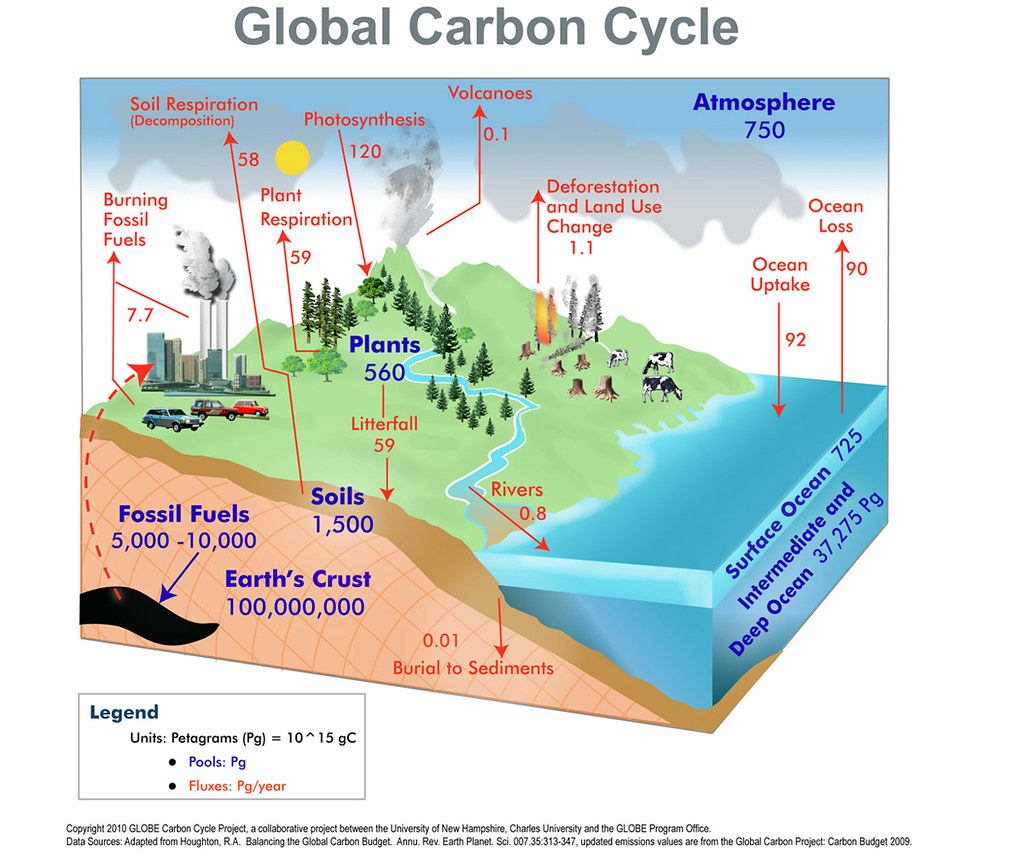
ATTP has been beating a bit on the carbon cycle, something Eli has talked about before.  (Go ahead, Google is your friend bunnies)  Some of that discussion, well it was ok, but a simple, grandmother level explanation came to Eli's mind.

There are lots of illustrations of the carbon cycle, most of them, like this one from GLOBE, with too much detail.


The carbon cycle is characterized by three times.  The first is the rapid equilibration between the three surface reservoirs, the upper part of the ocean, called the surface ocean in the figure above, the atmosphere and what Eli calls the surface biosphere, vegetation and topsoil.  There are about the same size, within quibble distance of each other, and the interchange takes about five years.  This is the subject of Eli's first post.

The second is the time needed to move carbon, mostly as animal shells falling to the bottom from the upper ocean into the deeps.  The deep ocean reservoir is much bigger than the each of the surface reservoirs, more than thirty times as much, but the time needed to move carbon from the surface ocean to the bottom of the sea is a few hundred years.

The third is the incorporation of carbon dioxide into rocks, which is really slow, like over tens of thousands or years or more.

Because things happen at different rates, one can discuss each part of the cycle separately.  Let the MOOC de Rabett start by looking at the fast processes.  A really important insight is that two of the reservoirs, the surface biosphere and the ocean, are NOT connected to each other, but are linked through the atmosphere.  A zeroth level model of this looks like


Now we can ask what happens when Exxon encourages pouring a bunch of CO2 into the atmosphere


Keep this one on your phone to explain things to your favorite uncle over the upcoming holidays.

Anybunny wanting a more "mathematical" description of this could write out a series of rate equations and solve them (Excel with Euler integration works).  In this system, Cx(t) is the amount of carbon in each of the reservoirs at time t, and kxy is the rate of exchange from reservoir x to y.  E(t) describes the rate that carbon (dioxide) is injected into the atmosphere at time t.  Note that the total amount of carbon in the three fast reservoirs is a constant


Somebunny Is Annoyed

Stoat draws Eli's attention to ACPD's review of the Hansen et al. paper

Although the timing is, not clear, the handling editor has decided to not publish the Hansen et al. paper about whose handling Eli wrote a few days ago.  On October 13, somebunny dumped a bunch of Authors Comments into the interactive review.

UPDATE:  FWIW, those comments WERE NOT THERE at 5 PM US EST on 15.10.

On reading, they appear to be more the kind of thing written as notes to structure their own thought (as in WTF is referee 3, that idiot, thinking about, than what is submitted to an editor.  This is especially true of  the response to the collaborative review of et al, which the editor said he though highly of.  
Timing issues – see below
Eemian cannot be compared to the future. Did we do that? We used the Eemian to learn things about how the climate system operates; we did not say the future would look like the Eemian.  
Extreme events are much more likely to occur after 2100 – therefore we recommend to avoid terminology such as “dangerous”. Hmm, yes, I guess that we should not be concerned about anything that happens 85 years from now – the dickens with those characters. The Dutch can migrate to Switzerland, after all.  
Explanation of mid-Eemian sea level minimum is not sound? You admit that a late Eemian sea level rise due to rapid ice melt from Antarctica is plausible. Would not the sea level have been less right before the sudden rise due to Antarctic water? Late Eemian maximum was probably at a time ~118-119 ky BP based on U-series dating, e.g., see the several sentences below from our paper. However, why are you concerned about whether there was a sea level minimum before the late Eemian sea level rise? That is seeming to lose sight of the forest for the trees. The relevant point is that there was a late Eemian sea level rise of at least a few meters.
There is a lot of repetition of comments relevant to one comment in answer to another and several other weirdnesses.  In other words, Eli thinks, well Eli is a careful cautious bunny.

There is an interesting comment on sea level rise in response to Michel de Rougemont and several others.  As to what Eli believes is Hansen's POV there is a response to John Nissen (and indirectly Peter Thorne)
As for geoengineering to adjust the albedo of the Arctic, that is an attack on a climate feedback. The task now is to address the climate forcing. When you find yourself in a hole, the first rule is “stop digging”.

Friday, October 16, 2015

An Ill Wind to Start the Weekend


Good news and seasonality in climate change polling

UPDATE:  Thanks to Lawrence Hamilton for posting a link to their analysis of multiple polls on this and related issues in PLOS ONE.


Via Climate Progress, the highest percentage of Americans since 2008, some 70%, believe climate change is happening. This particular polling series started in 2008. They don't ask about the causes or policy, just whether it's happening.

I noticed what looked like seasonality in their polling and ran numbers. Starting in fall 2009, I got 63.4% acceptance for fall versus 58.8% in the spring, so don't be surprised if numbers drop next spring. I've wondered about this before.

The poll attributes a lot of the current increased acceptance to the drought, so that might also change.

 A record high 65% of those accepting warming are "very confident" about it, which sounds like they won't be fickle. OTOH, the 2012 confidence levels were almost as high but belief still fell substantially in the next two years.

I believe there's been a substantial change in the mainstream media in recent years ending the false balance between reality and denial on climate discussions. You don't see that having an effect on this data, yet, unless this fall represents the beginning. More anecdotally I have the sense that Fox News is just barely beginning to be less terrible, so we'll have to look at future polling to see if there's an effect.

Overall, it's good news even if it's short of the 97%-plus figure where it should be, but we can't count on it lasting. If it does last, however, that will be problematic for Republicans. Right now 56% of Republican voters think warming is happening. This could peel off more non-crazy Republicans from the current leadership.

Thursday, October 15, 2015

Missed This

By way of Boing-Boing today, an explanation which passes the six sigma test from Scott Westerfeld

Of course, the mad scientists, unfairly pursuing the Exxons and Koch's of the world must be defeated lest they do something to save the world.  The Girl Genius, has joined with the forces of fossil fuel and campaign cash contributions to defeat and demean these people who can tinker with the laws of physics, well that and other stuff in our spare time.


Monday, October 12, 2015

The China Cap

Environmental Defense Fund had one of their sporadic podcasts recently, this one on the planned China cap-and-trade program (EDF has been heavily involved there). A good backgrounder.

China's future emissions are more important than America's, so the whole thing deserves more attention. One partly-valid reason why less has been said is there's nothing known about it so far. In two years it'll be in place, they say, although EDF says no one has done it that fast before. China has a pilot cap-and-trade program for "only" 250m people, so they do have experience. I didn't know prior to the podcast that China also has a cap-and-trade program for SOx, which might have helped develop their confidence.

Anyway, something to watch.

I'm looking around for info on the pilots, probably a good basis for predicting the national program. They've only been around for two years, about as long as California's program. Here's some good background, although EDF notes above that the offset program hasn't actually been used - no trades have happened. It also says utilities can't pass along costs, so the entire adjustment has to be internal instead of through reducing demand.

This says the opening price in one pilot was $4.89/tonne, not all that substantial but maybe more meaningful in a low-margin economy.

With a multi-pronged attack on carbon emissions and related pollution, cap-and-trade may be only one component, or the price may even collapse if they don't establish the right cap or a floor on prices. That's not the worst thing in the world, it would mean they could tighten up the standards.

Eli Follows Up


Eli took a peek at the interactive review for the Hansen, et al paper on sea level rise, remember, the one that found that if global temperatures rose more than 2 C, the carrot patches near the water, like Miami and Venice were soggy toast.  The editor, Frank Dentener,  has closed the open discussion and thrown the paper into the second stage of review
The authors are now expected to publish responses to the comments and reviews. Based on reviewer and contributed comments the authors will provide a revised manuscript and a detailed overview of how the comments were addressed. The editor will then decide to accept, or reject the paper, or ask for further revision, with the possibility to solicit further reviewer’s advice. This procedure is more in-line with the traditional peer-review process.
Dentener also provides a few remarks about the food fight.  First the issue of which journal the paper should have been submitted to
The multidisciplinary aspect of the paper made it difficult to chose the journal for this work, that covers paleo-climate, modern observations and climate modelling. Indeed ACP does not have strong roots in paleo-climate, while the sister journal ‘Climate of the Past’ does not address modern climate modeling.
Peter Thorne had raised the issue most strongly in his review.  The editorial judgement was that this was not a major issue by itself but required soliciting the views of expert referees across fields, which was done.  Interestingly Dentener says that the authors wanted an open discussion and review.  The motive for that, well Eli is very Fox News on that.

Of course, this gave rise to a number of comments which were not "scientifically sound".  Dentener's advice to the authors was to reply to such comments simply by referring to a textbook.  More interesting to Dentener and to Eli was the approach of six reviewers who submitted a combined review.  Dentener finds this very useful as a new model for long and complex papers and an advantage of the open discussion reviews.

The serious six, S. Drijfhout, M. Helsen, R. Haarsma, R. van de Wal, J. E. Williams and B. van den Hurk, did not much like the paper as set forth in their opening paragraph
This manuscript submitted by Hansen et al. has drawn considerable attention in both the media and among peers and scientists across disciplines. This is not a surprise, given the importance of this topic for the planet. However, to our opinion the paper and its framing in the public arena sometimes tend to cross the thin line between opinion and scientific evidence. On one hand, the evidence compiled by Hansen et al. to conclude that global warming is highly dangerous is based on rational arguments. The analysis does not contain any process that is physically impossible (albeit sometimes unlikely), nor present principally flawed interpretations of the paleo data (albeit often biased to the upper end of uncertainty measures). As such we can support the conclusions that the scenarios sketched in this paper could be interpreted as an extreme high‐end scenario that describes the upper bound of what one might expect in the coming centuries to happen with our current climate if carbon emissions continue at present‐day rate. The philosophy on which the construction of this “upper‐end” scenario is funded does not fundamentally differ from the previously released “Delta‐committee” scenario that was published by Katsman et al. (2011),  with the notion that the Hansen et al. scenario is even more extreme and unlikely to occur, that is, it resides in the end of the tail of the probability distribution of future climate change.
Anybunny interested can follow the link.  Reading between the lines Eli judges that the editor will pay serious attention to these arguments and Hansen, et al, will have to meet their challenges.

Those looking for a twist of the knife are referred to the authors response to Rud Istvan