Sunday, November 16, 2014

The Right Celebration


Prof. Monica Grady of the the Open University shows the right way to celebrate her lifetime investment when Rosetta's Philae probe landing on Comet 67P Churyumov-Gerasminko


Planetary missions and space missions in general, are a lifetime of work with a probability not zero of crashing and burning.  A lifetime of pent up hopes and a huge investment of time and reputation.  

The Sausage Grinders Tale

Friends of the GREP will be happy to ply their trade on what emerged in the G20 final statement as compared to yesterday's leaks, but Eli is interested too in the preceding paragraph, emphasis added

18. Improving energy efficiency is a cost-effective way to help address the rising demands of sustainable growth and development, as well as energy access and security. It reduces costs for businesses and households. We have agreed an Action Plan for Voluntary Collaboration on Energy Efficiency, including new work on the efficiency and emissions performance of vehicles, particularly heavy duty vehicles; networked devices; buildings; industrial processes; and electricity generation; as well as work on financing for energy efficiency.  We reaffirm our commitment to rationalise and phase out inefficient fossil fuel subsidies that encourage wasteful consumption, recognising the need to support the poor.
This really rocked Tony Abbott's boat, as reported in the Sydney Morning Herald
Mr Abbott gave an impassioned defence of coal and, reportedly, argued against inserting a line in the communique recommending the abolition of fossil fuel subsidies, an objective of the G20 for many years.
further
Mr Obama is understood to have spoken forcefully against Mr Abbott's position on fossil fuel subsidies. The final communique calls on G20 members to "rationalise and phase out inefficient fossil fuel subsidies".  
Mr Abbott had support from Saudi Arabia and Canada, but countries led by the US and Europe remained steadfast. 
"The most difficult discussion was on climate change," an EU official told reporters on condition of anonymity, Reuters reported. 
"This was really trench warfare, this was really step by step by step. In the end we have references to most of the things we wanted." 
The communique included references to taking practical measures to combat global warming and an explicit endorsement of the climate fund. 
The inclusion of a detailed passage on climate change comes despite the issue not being on the formal agenda of the G20 summit and Mr Abbott's insistence that the focus of discussions should be on economic reform.
The final text inserted and deserted some things from the leaked version that Eli blogged on yesterday in the true spirit of sausage grinding.   Interestingly in that contentious last sentence which made it in, including the green climate fund slightly changed to such as the Green Climate Fund.  Full text below
19.  We support strong and effective action to address climate change. Consistent with the United Nations Framework Convention on Climate Change (UNFCCC) and its agreed outcomes, our actions will support sustainable development, economic growth, and certainty for business and investment. We will work together to adopt successfully a protocol, another legal instrument or an agreed outcome with legal force under the UNFCCC that is applicable to all parties at the 21st Conference of the Parties (COP21) in Paris in 2015.  We encourage parties that are ready to communicate their intended nationally determined contributions well in advance of COP21 (by the first quarter of 2015 for those parties ready to do so). We reaffirm our support for mobilising finance for adaptation and mitigation, such as the Green Climate Fund.

Saturday, November 15, 2014

Sausage Making

Somebunny on the inside has been feeding the Guardian drafts of the G20 communiques.  The part on climate change started out a week ago as

We support strong and effective action to address climate change, consistent with sustainable economic growth and certainty for business and investment. We reaffirm our resolve to adopt a protocol, another legal instrument or an agreed outcome with legal force under the United Nations framework convention on climate change that is applicable to all parties at the 21st conference of the parties in Paris in 2015 
which, weak as it was, was forced through against the wishes of the Australian hosts.  This has now morphed into
We support strong and effective action to address climate change, consistent with the United Nations framework convention on climate change and its agreed outcomes. Our actions will support sustainable development, economic growth and certainty for business and investment. We will work together to adopt successfully a protocol, another legal instrument or an agreed outcome with legal force under the United Nations framework convention on climate change that is applicable to all parties at the 21st conference of the parties [COP] in Paris in 2015. We encourage parties that are ready to communicate their intended nationally determined contributions well in advance of COP21 – by the first quarter of 2015 by those parties ready to do so.
with negotiations now on a final sentence
We reaffirm our support for mobilising finance for adaptation and mitigation, including the green climate fund.
The Australians are not happy.

UPDATE from the Guardian:  In another example of how bad the environmental situation in China is
the Finance Minister Zhu Guangyao, told reporters at the G20 on Saturday that China would work hard to ensure its emissions peaked before 2030. He said that if the Chinese economy developed too fast for the environment to sustain “we must make adjustments to our policies in a timely way so we can minimise the impact on our environment”
Coal is the plague.

Tuesday, November 11, 2014

Breaking-US and China Reach Agreement on Limiting Greenhouse Gas Emissions

The US and China have reached agreement on limiting greenhouse gas emissions.  The bottom lines (and they are of necessity different) is that China will cap emissions by 2030 or earlier and generate 20% of its energy without fossil fuels.  The US has agreed to cut emissions by 26 to 28% below 2005 levels by 2025.

The devil is always in the details, but this is an interesting first step towards a Montreal solution to limit climate change which, of necessity, must be asymmetric.  Each country takes a step forward, mostly but not exactly, in the same direction.  In the US, negotiations with Republicans appear more difficult.

The Whitehouse press release made some interesting points:

3.     Today, the Presidents of the United States and China announced their respective post-2020 actions on climate change, recognizing that these actions are part of the longer range effort to transition to low-carbon economies, mindful of the global temperature goal of 2℃
David Victor and Charles Kennel enjoyed that one
5.     The global scientific community has made clear that human activity is already changing the world’s climate system. Accelerating climate change has caused serious impacts. Higher temperatures and extreme weather events are damaging food production, rising sea levels and more damaging storms are putting our coastal cities increasingly at risk and the impacts of climate change are already harming economies around the world, including those of the United States and China. These developments urgently require enhanced actions to tackle the challenge.
Hmm, guess there is a consensus about the science that the policy makers have figured out
6.     At the same time, economic evidence makes increasingly clear that smart action on climate change now can drive innovation, strengthen economic growth and bring broad benefits – from sustainable development to increased energy security, improved public health and a better quality of life. Tackling climate change will also strengthen national and international security.
and the economics.

There is a  fact sheet on the agreement

Monday, November 10, 2014

The Montreal Solution

There has been an ethically lacking attempt by the usual suspects, Lomborg, Pielke, the Breakthrough folk and now Matt Ridley to claim that coal is necessary for the developing world to prosper and we will all be so rich in the future that doing nothing now about climate change does not matter.  It is interesting that those who care not a fig for the poor spend so much time arguing for their right to burn coal, but, quite obviously this is merely a ruse to allow some world class greenie bashing.

It is a mistake to allow this to go unchallenged and indeed it is easy to show how threadbare it is.  Even Twitter has enough characters to call it out.

First, climate change underway today mostly hurts the poor. It is clear that any assessment shows that the countries that are going to be most hurt by climate change are the poorest countries. Every attempt at an integrated assessment model, the IPCC reports and more shows this.  By opposing immediate action on climate change Lomborg, Pileke and Ridley are hurting the poorest.

Second, fossil fuel as an energy source is characterized by relatively low capital costs and high operational costs. Wind, solar, hydro and nuclear the reverse. If fools like Lomborg and Ridley really wanted to help the poors they would be advocating for donation by the developed world to carry those initial capital costs and increased energy efficiency so the poors were not subject to eternal thralldom under the coal and oil industry.

Third, a point made by Stephan Gardiner that the claims about the sweet bye and bye are merely pious hopes that larger economy will allow future generations to deal with an exacerbated climate problem.  If climate change limits economic growth, there is no larger economy, and even if there is a larger economy, it may not be enough to deal with the chaos associated with climate disruption. The Dark Ages in Europe were not nearly as pleasant as Roman times.

But Eli is a generous bunny so consider, if you will, their argument that coal is necessary for development and it would be unethical to oppose development of the poorest nations. Well, if this were 1800 perhaps, but let us concede it just to be nice. The Montreal Protocols under which freons were phased out provide a fine solution, the developed world goes first, drops coal like a hot rock right now and the underdeveloped and developing world follow on at a later time.

Now some, not Eli to be sure, might suspect that the tears being whined for the poor developing countries not being able to use coal are a beard but that would not be nice, would it.

As to the costs of coal, consider China which is moving as fast as it can away from coal because of the half MILLION deaths each year from air pollution and here are some picture postcards .

Sunday, November 09, 2014

Picture Postcards

About twenty years ago, just after the collapse of the DDR Eli and Ms. Rabett found themselves on a cold winter night in the middle of Erfurt Germany.  There was what first appeared to be fog in the air but it was not exactly pleasant to breathe, and Ms. Rabett was not enjoying the taste.  There were halos around the street lamps, everything was surreal and then the lights went out.  Over the entire city.

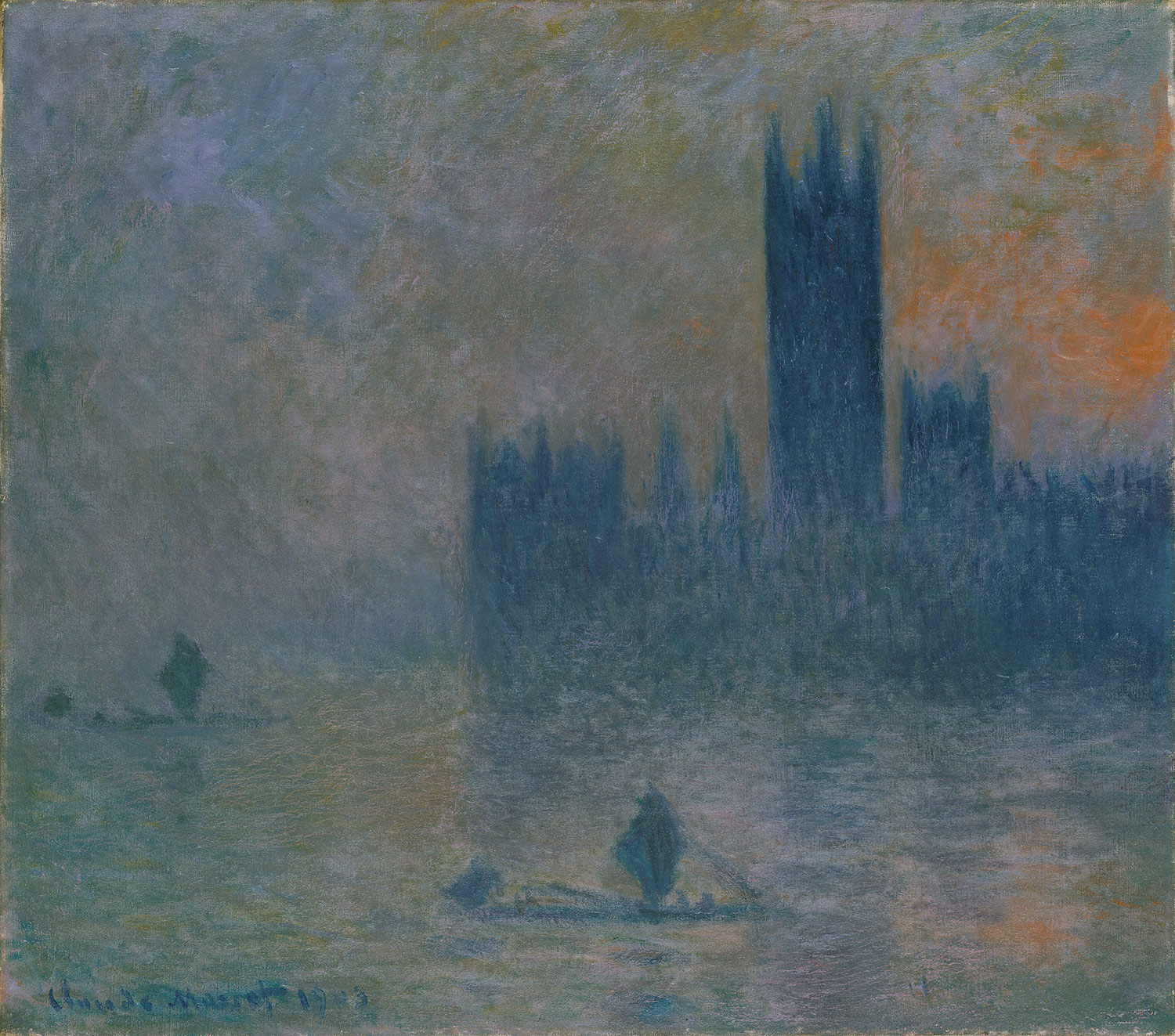
The Rabett thought that it reminded him of something.  Indeed it did, Monet's pictures of the Houses of Parliament


Before this experience Eli had thought that the pictures were simply the result of an impressionist take coupled with bad eyesight.  It was not, it was the reality of burning coal for heating and industry.  If bunnies search out photographs of London during the early 1950s a time of killer (like thousands) smog in London the same pictures emerge, although the colors are lacking


and today, well today it is Beijing's turn


and, of course Shanghai


The Rabett visited both during the early 1990s on his tour of polluted cities.  Erfurt was a useful clue as to what was going on.

Eli, of course, is an old bunny, who grew to rabetthood in New York City, in the age when, again, coal was the primary fuel for heating.  The Rabett remembers two things.  First how grumpy Dad and Grandpa were about having to get up in the middle of the night and adjust the fire when kicked out of bed by Mom and Grandmom Rabett, second, the soot on every building.  In the 60s and 70s people started to wash their brick and stone houses.  it was astounding.

The recent nonsense from the Ridleys and Lomborgs about coal being the fuel of development brings back not so fond memories.  And, oh yes, coal mine owners have a richly deserved reputation.  Not for kindness to their workers and the rest of us.


Tuesday, November 04, 2014

Deja Vu All Over Again

A number of folks have face palmed at Roger Jr.'s latest observation on the IPCC summary report, expressed in 140 characters or less


AndThenThere'sPhysics is chewing this one over, trying to figure out what Roger Really Meant. 
I engaged briefly in a discussion between Michael Tobis – who appears to be one of the more thoughtful people involved in the climate debate – and Roger Pielke Jr – who, in my view, is not. Michael was trying to get Roger to clarify his position. Needless to say it didn’t go well. Roger accused people of being childish and of Trolling. To be fair, I happen to agree with Roger that much of the online climate debate is indeed very childish. If, however, he thinks he’s some kind of mature influence, then I think he’s sorely mistaken (to be clear, though, I’m certainly not suggesting that I am either). 
Roger’s response was essentially to read his books. Apparently, if we did that we’d understand his views. Well, there are a lot of books in the world. I’d certainly like some kind of sense that I’m not going to be wasting my time. All indications, so far, are that I would be.
 Ethon could have told ATTP, that there is no there there, and the only fitting response to Roger is to ignore him, or make light japes about Roger's incredible ignorance of political science and public policy.  Indeed, as to drive the point home, Richard Tol showed up to play drums in Roger's duet, although, to be honest, Roger stayed away

Now how, young bunnies could Ethon know such things.  Well simple, the Pielkes have a limited but oft times effective playbook and Roger specializes in immature twaddle, as, of course, does Richard.  For example, consider that tweet, and then consider Young Roger's take on the effect if the tobacco companies fight against science which, had there been twitter at the time, would have been tweet
In the battle over smoking efforts to deny a link between smoking and health risks seems to have been completely a lost effort.
continuing
This begs the question -- why has anti-smoking advocacy been so successful over time? The throwaway answer that increasing scientific certainly is the key does not seem to jibe with this data.
As Eli said at the time the problem with this whole line of reasoning is that it is built upon a falsehood. The tobacco industry used advertising, public relations campaigns, Potemkin science, litigation, and any other method it could find to maintain revenues. Deaths were collateral damage. This is no secret to anyone who reads the newspapers let alone science journals. The mortality data and the data on tobacco use and its relationship to advertising both pro and con is readily available to anyone who makes the smallest effort to search. The Potemkin science allowed all of the other efforts to go forward, providing a screen against the imperative necessity of eliminating tobacco that were being uncovered by medical research. The tobacco companies were the successful ones, with all the facts against them, they delayed action for decades, but in the postmodern Pielke World, there are no facts. 

In the context of the IPCC reports, it is important to understand that the Surgeon General's Reports eroded the position of the tobacco companies and built up a mass of evidence that was used in private lawsuits and lawsuits by the Attorney Generals of many states that eventually collapsed the dis-information program of the tobacco companies and lead to the Tobacco Settlement.  That action opened up the Tobacco Archive whose contents showed the massive efforts to discredit science, some of which indeed was beyond belief

Eli awaits Roger complaining that his specific policy proposals have not been discussed. True enough, why waste valuable time discussing immature twaddle.  Tomorrow comes.

Friday, October 31, 2014

Brian Schmidt has a video


UPDATE:  Developing Story  see below

Eli's friend, Brian Schmidt is running for re-election to the Santa Clara Valley Water District Board.  Brian has been endorsed by the San Jose Mercury News and much of the other media in the area, but his opponent is rich, and, well probably not much constrained.

Take a look at the video and, if you are in the area, please vote for Brian


UPDATE:  As shown in the video, a scurrilous mailer was sent to voters in the Santa Clara Valley by an organization called the Neighborhood Empowerment Coalition that operates, among other things an astroturf website.  It turns out that, as shown by its registration CA Form 460 the Neighborhood Empowerment Coalition is a creature of a rather scurrilous lawyer in Long Beach California, by the name of Gary Crummitt, and said Gary Crummitt has a reputation, not a good one.

Crummitt has been cited multiple times by the California campaign finance watchdog agency, the Fair Political Practices Commission, and astroturfing mailers is amongst his tricks of the trade.

So Eli wonders what Gary Kremen, Brian's opponent has to do with this mailer.

Thursday, October 30, 2014

Harde Is A Very Wet

There has been some discussion in the comments about Hermann Harde's papers purporting to show that carbon dioxide is the tiniest knob controlling the climate.  Well, bunnies know that Richard Alley differs, but Eli's point was that Harde overestimates the relative humidity at altitude and this obviously increases the role that water vapor plays in his calculations (make no mistake it plays a huge role in real life) and underestimates the effect that carbon dioxide plays in the greenhouse effect.

Just to be clear, Eli does agree with Pekka and Tom that the text dealing with how to calculate raditative transfer in the atmosphere is a fine introduction.  However, long years of gazing at complex spectra lead Eli to see clearly that the water vapor peaks in Harde's calculated emission spectra were way too high.

Some doubts have been expressed.

To put these at rest, first look at Figure 1 from Harde's paper in teh Open Journal of Atmospheric and Climate Change


Compare this with the relative humidity calculated from AIRS satellite data from the NASA Giovanni DAAC


Harde is a factor of 2-3 too high.

The interesting thing is why, and the clue to that can be found in the article which Ray Pierrehumbert wrote and which Eli pointed to in the comments to the original Wet Post, but not the part that he quotes here
So what really determines the water vapor content of the free troposphere? It is easiest to think about this problem in a Lagrangian sense, tracking the water content of an air parcel as it wanders about the atmosphere. The fluctuating water content of the parcel results from a balance between the rate at which water is added to the parcel against the rate at which water is removed. Water vapor is removed either by condensation or by diffusion into a neighboring drier air parcel. Let us suppose for the moment that diffusivity is so low that the latter mechanism is unimportant. In that case, water vapor is removed when the air parcel wanders into a region where the local saturation specific humidity is lower than the current specific humidity of the parcel, at which time the specific humidity is reset to the lower local saturation value and the balance is rained out. The net result is that the specific humidity of an initially saturated parcel after time Ï„ is equal to the minimum encountered along the trajectory during that time. By definition, this is a non-increasing function of Ï„, though there will be long periods of time over which the minimum remains constant between those times at which new minima are encountered.
Any attempt to use equilibrium thermodynamics to calculate relative humidity in the troposphere outside the marine boundary layer (where it is saturated) is doomed. 


Wednesday, October 29, 2014

All Wet


The well named Hockeyschtick (did Eli say something about nyms?) has pulled a piece out of either by  Herman Harde.  To set the stage, Harde, of course, is a professor at the Helmut Schmidt University in Hamburg, aka the Bundeswehr Univesitaet.  His presence there also is at least a strong clue about who invited Murry Salby to give a talk last year and Harde is a luminary in the German denial of the possibility of really bad climate change group EIKE.  

Eli wrote something about this in 2011 when Harde was all the rage, but Ceist has noticed a few things, about the latest, namely that it is spreading like Ebola amongst the blogs of denial of climate change, now known as the blogs of denial of the possibility of really bad climate change, or DPPRBC for short, so Eli thought he would take a look.

Indeed the original of which Eli said that while the treatment of radiative transfer was nice, there were some things missing, like a few layers of atmosphere has been filed on.  Prof. Harde has continued to learn about atmospheric physics and published a few papers and a book.  So Eli, being a RTFR type of bunny went and read them starting with the original, an abstract for the 2011 EGU conference, a, what looks like self published, book that appeared in 2011, and finally a paper that appears in the International Journal of Atmospheric Sciences last year and something else  that appeared in 2013 in thepredatory press, in this case the Open Journal of Atmospheric and Climate Change.  Ceist can tell you about that journal

LOL! Thought I'd share something hilarious. I just looked up the Service address of Scientific Online Publishing

498 W. Alton St., Nashville, IL 62263, UNITED STATES

It’s a single family home in a residential area in Nashville Illinois. It shares the same address as a Chinese company which sells anticorrosive paint.

Directions - Fangdai Wen - SINA COVA - 498 W Alton St , nashville, IL, 62263

Nothing suspicious about that publisher at all. *grin*
but Eli is a much more serious bunny.


 Experience has shown the Rabett to first examine conclusions and assumptions before diving into the hieroglyphics, aka the math.  He has Nick Stokes and Deep for that.  So the first thing that popped out was Figure 18 from the IJAS paper showing total upwelling radiation in 12.5 km altitude (blue)  and emission of only the atmosphere by water vapour and CO2 (green). Surface radiation is shown as pink line.

Eli thought deep thoughts about this, well maybe not, but there are a couple of things that pop out.  First, that seems awfully wet as shown by the water rotational lines to the left of the CO2 peak.  To check Eli hied himself over to David Archer's new and updated MODTRAN window and ran a 12.5 km view.  Looking below there appears to be a lot less water vapor.


Well, OK, it appears that Prof. Harde has decreased the effect of carbon dioxide by drenching the atmosphere.  Nothing new in that.  As somebunnies may remember, our friend Miskolczi took the water out by using the wrong version of TIGR, the dry early one, to justify his shenanigans.  Maybe Harde simply borrowed a cup.

If somebunny objects that Eli is using a model (MODTRAN) for comparison, look at the spectrum measured from space by Nimbus in the tropical Pacific


BTW, Eli grabbed that from Willard Tony's place.  (the nipple in the CO2 spectrum is the Q branch and the reason it appears is from emission higher up in the stratosphere

Hermann Harde is all wet


Saturday, October 25, 2014

Vaccine Dysfunction

Vaccine denial, more accurately refusing to take vaccines or allow one's children to do so, is indeed a symptom of Dunning-Krugar syndrome, Those seeking a reason why something awful has happened to their children, especially autism are easy prey to self promoters such as Andrew Wakefield, and let Eli be frank, for others it is a living. As David Dunning points out we are "unbridled pattern recognizers and profligate theorizers " especially when there is no there there. Respectful Insolence deals with the disinformers on a daily basis.

The hippie bashers view this as a suckiness of the left, but it is not so simple.  The Council on Foreign Relations has constructed an interactive map of dysfunction, showing the number of cases for such things as measles and whopping cough


South Asia and Africa are in particularly bad shape, if nothing else driven by poverty and the shallow reach of immunization programs.  It emerges that the US has way too many cases of whooping cough, with a small number of, but preventable measles cases, not just on the east and west coasts (where the most people live) but also in the staunch heartland, wherever that is, such as Kansas.  The UK is full of measles epidemics.  Thank you Andrew Wakefield.

Friday, October 24, 2014

Confident Idiots


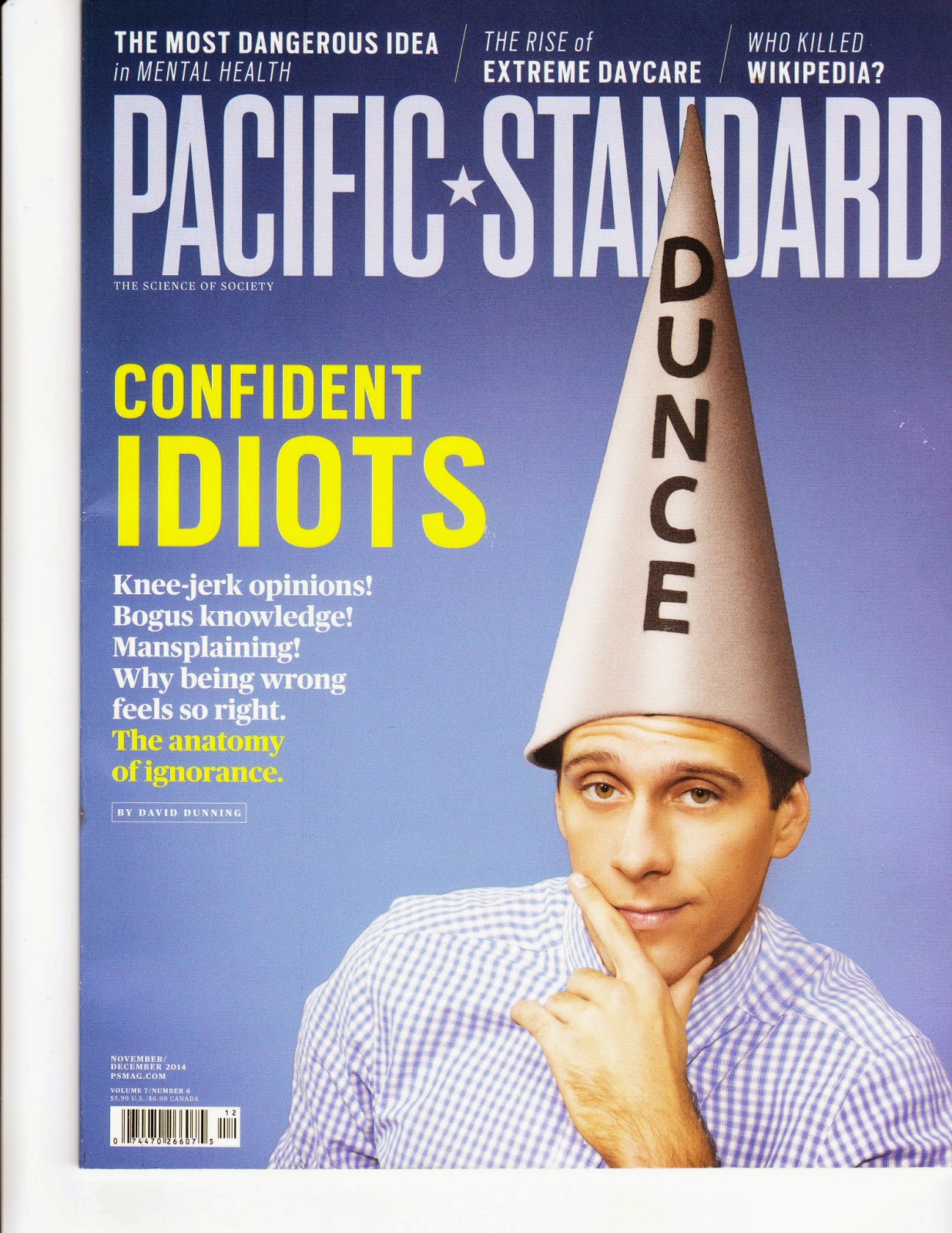
One of the privileges of being an old bunny is that you get to sit in a whole lot of medical and dental offices and read the odd piece of literature that is lying about, assuming there is no wifi.  So Eli was sitting in his endodontic dentist's office (the good ones are the champ anal-obsessives on Earth, which the bunnies will know if they ever had a root canal) and he grabbed something with a guy in a dunce cap on the cover and the headline and if the bunnies look real close, the author of the headline article is David Dunning of Dunning Kruger.  Information may have an urge to be free but publishers don't see it that way.  The interested may have to purchase the magazine, because it does not look like it will be made easily available

Justin Kruger was the graduate student  whose work has become half of a blogbyword and the original can be found on line, in 97 copies more or less.  Eli would be surprised if a friend of his has not read all of them. . . .
 
Dunning, is not full of sunshine on the issue

Kruger  and I published a paper that documented how, in many areas of life, incompetent people do not recognize -- scratch that, cannot recognize -- just how incompetent they are, a phenomenon that has come to be known as the Dunning-Kruger effect.  Logic itself almost demands this lack of self-insight:  for poor performers to recognize their ineptitude would require them to possess the very expertise they lack.  To know how skilled or unskilled you are at using the rules of grammar, for instance, you must have a good working knowledge of those rules, an impossibility among the incompetent.  Poor performers -- and we are all poor performers at some things -- fail to see the flaws in their thinking or the answers they lack. 
What's curious is that, in many cases, incompetence does not leave people disoriented, perplexed, or cautious.  Instead the incompetent are often blessed with an inappropriate confidence, buoyed by something that feels to them like knowledge
To Eli, self awareness, knowing when to listen to others is a great and hard won gift.  Also knowing when to ignore them, but that is the same thing.  Dunning has studied the unaware for a long time
An ignorant mind is precisely not a spotless, empty vessel, but one that's filled with the clutter of irrelevant or misleading life experiences, theories, facts, intuitions, strategies, algorithms, heuristics, metaphors and hunches that regrettably have the look and feel of useful and accurate knowledge.  This clutter is an unfortunate by product of one of our greatest strengths as a species.  We are unbridled pattern recognizers and profligate theorizers.  Often our theories are good enough to get us through the day, or at least to the age when we can procreate.
The most difficult problem is when a person's subjective world view corresponds to their fantasies.  Dunning is more than a little bit pessimistic about whether there is anything to be done about this.  Education, e.g. exposing people to information which conflicts with their world view does not work well, especially when the INTERNET cacophony is shouting in the other ear.
 If repeating the misbelief is absolutely necessary, researchers have found it helps to provide clear and repeated warnings that the misblief is false.  I repeat false.
One thing, according to Dunning, that does work is to show that the clutter contradicts the believers world view in some way, for example that care for the Earth is central to religious belief.  Another is to massage the self worth of the clutteree before discussing reality with them.  Dunning closes by pointing out that wisdom is knowing one's limits.

Wednesday, October 22, 2014

I'm Sorry, So Sorry


Now that everybunny and weasel has had their say about the twitter dustup at the Royal Society Meeting on arctic sea ice Eli feels compelled to leave the building.  As to taking a position, the Rabett is closest to Victor Venema,
I do understand that the speaker feels like people are talking behind his back. He is not on twitter and even if he were: you cannot speak and tweet simultaneously. Yes, people do the same on the conference floors and in bars, but then you at least do not notice it. For balance it should be noted that there was also plenty of critique given after the talk; that people were not convinced was thus not behind his back.
tweeting from a meeting is perilous, not really necessary, and the heat of the tweet, can lead to hurt feelings. In this case Prof. Wadhams was excised, enough that he formally complained to the Royal Society.   Wadhams, of course, made a fool of himself by going after one of the tweeters, Gavin Schmidt, not only getting Gavin's position wrong, but in his complaint, misspelling the name of the NASA Administrator, Chuck Boulden
“To: Maj.-Gen. Charles F. Brandell,Jr.
Administrator, NASA”
That must have gone down a treat especially when Gavin puts the polite knife in pointing out the mistake.  Our Gavin and friends then responded with a detailed fisking.  Stoat put it fine
A combo of the death cycle and the methane, coupled with a not-understanding-social-media, leads to… Well, I’ll point you to Reply to letter & email from Prof Peter Wadhams, dated 28 September 2014, and subsequent email from Prof Wadhams, dated 30 September 2014, concerning the use of Twitter during a recent Royal Society Arctic Sea Ice meeting and also the SUPPLEMENTARY INFORMATION Complaint to Royal Society about social media use at the discussion meeting: Arctic sea ice reduction: the evidence, models, and global impacts which you should go off and read. Back? Jolly good.
Much of the back and forth concerned whether Wadhams was off his nut or not and whether the tweets were beyond the pale, but to Eli this misses the point.

There are two kinds of apologies.  The first is Eli was wrong and you were right Eli apologizes.  Never happens of course because Eli is never wrong, or at least not very often.  The other is dear Ms. Rabett, Eli never meant to hurt you and is deeply sorry.  He apologizes and will try and make up for that.  Often happens. 

From this one concludes that Gavin Schmidt, Sheldon Bacon and Mark Brandon are not deeply in love with Peter Wadham, or have much respect for his opinions on arctic sea ice.

Sunday, October 19, 2014

Rick Piltz of Climate Science Watch Has Died


Word comes that Rick Piltz of Climate Science Watch has died.  It is one of the sadnesses of living to watch those you like and respect die.  In a strange way Rick left his statement of being at Climate Science Watch just before he went into the hospital, responding to one of the usual suspects who was trying a double Dunning-Kruger with backflips, just the sort of thing Rick hated:
"I did my graduate study in political science and my undergraduate in experimental psychology, at Michigan, long ago. I listen to leading climate scientists, I know leading climate scientists. I would never pass myself off as one.  
I have been focused first and foremost on the problem of global warming and climatic disruption since Jim Hansen testified in 1988. I came to that interest, as with other environmental, natural resource, and energy issues I have worked on for the past 35 years, primarily from the policy side. I spent four years on the professional staff of the House Committee on Science, Space, and Technology, and 10 years in a senior staff position in the U.S. Global Change Research Program Coordination Office here in Washington (that's the $2 billion multiagency program that supports the research and observing systems on climate and global change).  
During those years I became very attuned to what I came to refer to as the "collision" between the world of climate science and the realities of Washington politics. I saw how politicians in Washington used, misused, and denied what scientists were telling them, and how difficult it was to make this essential communication channel function productively.  
So at this point I know considerably more science than most people in the arena of policy and politics, and more about the latter than most scientists. My project, and whatever contribution it makes, is primarily aimed at government accountability in national policymaking. I have an analysis and an approach for doing that, and Climate Science Watch is the vehicle via which I and various collaborators express that.  
At this point, I think the discourse about climate change, certainly at the power elite level, is shifting, or has shifted, from what we might call the science-policy nexus, toward questions about economics, business, politics, energy policy, national security planning, and so forth. I can deal with that and that's where our attention is moving, I think.  
Of course there are many important scientific questions about the physical climate system to research, and I spent quite a few years doing what I could to encourage bipartisan support for a strong research program, regardless of people's policy disagreements. But this is not a science education and debate site, and the discourse about unresolved research issues on the physical climate system are well-argued in many other venues by people with serious qualifications.
But when Rupert Murdoch and the Wall Street Journal put out a piece with a "take no action" slant on the eve of a big UN climate summit and climate movement rally, I take what the WSJ is doing as essentially a political gesture. They print only 'skeptic' or 'contrarian' pieces, there's no real balance in their coverage, they are trying to frame a political narrative for the corporate elite. When there's an opportunity to post something with an alternative view, that raises questions about what they've published, I can do that. I don't have to be able to resolve the science issues in order to do it."
Rick will be missed.


Winner of the Ridenhour Prize for Truth-Telling (2006).

Wednesday, October 15, 2014

Does Africa Need Telephone Poles

Eli, being Eli, has been excessively annoyed by the trolls at the Breakdown Institute.  True, they are excellent trolls, whose mission in life is to demand the impossible and denigrate the possible, a tried and true tactic if your purpose is to block all progress and, indeed they do appear to be prospering.

But never mind.  If you really must, go read their twitter blather.  Eli enjoys trolling the trolls a bit, and you might too.

However, the real point of this post is to point out that thanks to modern progress there now are cell phones which have made it possible to erect a functioning telecommunications, entertainment, information and banking systems in very rural and very poor areas including the megaslums of third world cities.  Eli would venture so far as to say that we have tools to electrify about every hut on the planet, if, by that you mean a light or two, a cell phone, and smart cell phones are pretty much mainframe computers compared to mainframe computers in the 1970s (remember the 1401 JohnM, first computer Eli ever programmed).  As anybunny walking through the streets or fields knows there is all sorts of educational and entertaining stuff that can be seen through small screens and if you must have a computer there is always as Raspberry PI.

White LEDs and even compact fluorescents have brought down the amount of energy that has to be generated for lighting, and lighting is no small part of what makes life worth living (ask Abraham Lincoln) and of energy use.  That Nobel Prize was well deserved.  Maybe even some refrigeration.  Refrigerators, insulation and compressors have become more effective and there might even be nanohelp for thermoelectrics.  A small solar array, a small windmill, maybe a bigger village windmill and a couple of storage batteries is the way to the good, or at least much better, life.

Which brings Eli to the point, the point, or rather points that one can read in an IEA report on energy use and needs and Africa.  In dense urban areas and even between then telephone poles carrying power from a central distribution system can be the most economical.  However, Eli senses a certain optimism that in very poor areas those poles and the wires on them are going to stay up for long, a point that the report itself makes in describing oil harvesting in the Niger Delta.

Still, once you have to put up a long line to reach a small village, things change radically


and the graph on the left shows by how much.  The graph on the right has a more interesting point for the Lomborg's of the world, who are claiming that Africa needs coal (like a hole in the head, sub-Saharan Africa will be hit harder by climate change than any other area, and even Tol agrees on that, as does just about every other IAM purveyor).  The major cost per MWh of fossil fuel is the cost of the fuel.  The amount of capital needed to build the generator is less than 5% or so.  However, for solar PV, small hydro, and small wind capital costs are more than ~80% of the cost of power, operating costs are maybe the other 20%.  Even now solar and wind are less expensive than fossil fuel, and they will be much less so in the future.  They are orders of magnitude more deployable and not as subject to mayhem.  Moreover, efficient modern lighting, telecommunications, cooling, other conveniences and necessities don't have large power draws.

That means that if anyone, are you there Bjorn, how about you Michael Shellenberger, really wanted to help Africa electrify they would be pushing investment by the developed countries to provide cheap to operate solar PV, small hydro and small wind to African communities, not coal and fossil fuel burning plants with expensive and constant fuel costs and the need of a hard to maintain electrical grid.

Saturday, October 11, 2014

Tuesday, October 07, 2014

Eli Is Happy to Announce

That the San Jose Mercury News has strongly endorsed Brian Schmidt for the Santa Clara Valley Water District 

He is informed, diligent and ethical. And he's not afraid to talk about ideas in public. We like that in a public official.
Eli agrees.

Saturday, October 04, 2014

So David Rose, Tamsin Edwards, and Tony Watts Walk Into Nick Lewis' Bar


is the start of a hilarious joke, yet Eli lacks a punch line.  Sophie Yeo writes of a dinner thrown by Nick Lewis
Twelve scientists and sceptics have met privately to discuss how to suck the venom out of the climate change debate.

It was one of science’s strangest social events to date.
Eli enjoys British arch expressions well put, but hilarity ensues
 Some of the best known names in the climate debate – including Mail on Sunday journalist David Rose, blogger Anthony Watts, and Met Office scientist Richard Betts – shared salmon and civilities at a dinner party last month.
Sou writes daily of Willard Tony's lack of self awareness and Eli's suspicion is that Tamsin Edwards must be a distant descendent of Emile Coue, still, in the face of world class competition David Whitehouse brings the house down in a quote fed to Yeo
“Both sides are really fed up with the outrageous alarmists who are not representing science properly. Both don’t like those who shout about it and call people names and take a polarised point of view,” says David Whitehouse from the sceptic thinktank The Global Warming Policy Foundation.
Eli, Eli is simply not up to dealing with this, so the Bunny outsources to Paul Krugman writing about Nick Lewis' ilk
When the going gets tough, the people losing the argument start whining about civility. I often find myself attacked as someone who believes that anyone with a different opinion is a fool or a knave; as I’ve tried to explain, however, that’s mainly selection bias. I don’t spend much time on areas where reasonable people can disagree, because there are so many important issues where one side really is completely unreasonable.
for example, whether the rise in the airborne fraction of CO2 has been caused by humans.  Still, Krugman is right and he is right when he continues
 Relatedly, obviously someone can disagree with my side and still be a good person. On the other hand, there are a lot of bad people engaged in economic debate — and I don’t mean that they’re wrong, I mean that they argue in bad faith.
Perhaps in this context a word change or two but given the cottage industry in trying to beat back the numerous bad faith arguments made in denial of our changing our only planet and its climate not for the better, the Rabett might point out, why yes, bad faith arguments are everywhere

Illustration looking glassed from Stephen Kade Illustration blog

Wednesday, October 01, 2014

Eli Is Busy

Go read Ray Pierrehumbert in Slate on the Koonin follies

Let’s imagine you are a smoker and go to the doctor with a variety of troubling physical complaints. She tells you, “Well, a lot of these troubles are typically associated with smoking, but you don’t have cancer yet and the fact is we don’t know everything about the precise biochemical pathways that connect smoking to cancer, and anyway there’s always the chance you’ll get emphysema before you get cancer.” If you were to apply Koonin’s reasoning to this situation, your response would be, “OK, Doc, I’ll wait to give up smoking until you can tell me exactly how it will kill me and when.” 
Climate science is settled enough (Bunnies read it here) to provide the policy guidance that matters most, namely that there is an urgent need for halting, and eventually reversing, the worldwide growth in carbon dioxide emissions. At a time when essentially nothing effective is being done, it is pointless to fret, as Koonin does, about exactly how much reduction is optimal—the clear answer from climate science is: “The more the better, the sooner the better, and whatever we actually do is apt to be less than what is really needed, though worth doing nonetheless.” Major policy decisions are routinely made in economic and national security areas in the face of far greater uncertainty than prevails in climate science.
and Stefan Rahmstorf at Real Climate explains why the recent jeremiad by David Victor and Charles Kennel advocating giving up on the 2 C limit is hogwash rooted in ignorance (physicist type)
Victor  & Kennel claim the 2 °C guardrail was “uncritically adopted”. They appear to be unaware of the fact that it took almost twenty years of intense discussions, both in the scientific and the policy communities, until this limit was agreed upon. As soon as the world’s nations agreed at the 1992 Rio summit to “prevent dangerous anthropogenic interference with the climate system”, the debate started on how to specify the danger level and operationalize this goal. A “tolerable temperature window” up to 2 °C above preindustrial was first proposed as a practical solution in 1995 in a report by the German government’s Advisory Council on Global Change (WBGU). It subsequently became the climate policy guidance of first the German government and then the European Union. It was formally adopted by the EU in 2005.
However, Eli believes that, at least as far as the US Government is concerned 3 C is the new 2 C, first the speech by the Director of the Office of Management and Budget, Shaun Donovan, covered at RR
Looking ahead, leading estimates suggest that if we see warming of 3° Celsius above preindustrial levels, instead of 2°, we could see additional economic damages of approximately 0.9 percent of global output per. Our Council of Economic Advisers puts this figure into perspective – 0.9 percent of estimated 2014 U.S. GDP is approximately $150 billion. 
Last week, Eli went to a symposium at the Brookings institution about the economic effects of climate change moderated by Robert Rubin and featuring Jacob Lew, US Treasury Secretary.  Lew too indicated that the administration's planning is based on a 3 C temperature increase.  2 C is a done deal
By its nature budget projections are backwards looking.  So as we go through a decade of dramatic weather experiences there is more and more being built into the projections as you see in the size of the disaster relief fund that has grown dramatically over the last decade.   I am not sure it encompases every risk out there but it is catching up.  GDP, as you know better than I, is a complicated model that is imperfect but does bring in both direct and indirect effects with a very high degree of utility.  The projections I referred to that the Council economic advisers did that looks at the impact of three degrees versus two degrees increase in temperature on global GDP reflects the indirect impact of climate through the GDP model.  
People so high in government don't say such things by accident.  Lew summarized
if the debate is about how bad it is going to be,  but we know it is going to be bad that is a enough of a case to act.  The fact that there is no uncertainty about the direction and legitimate debate about the exactly how bad it is shouldn't be a reason not to act
Michael Greenstone, the third member of the panel and a environmental economist at the University of Chicago, actually broke in on Lew to state the real consensus:
There is a line that people have that there is clear consensus among scientists.  I think there is one thing that people don't fully appreciate.  There is a consensus among the economists about what to do about it.  That ranges all the way to Milton Friedman to fill in your favorite left-wing economist who writes for the New York Times.  There is a clear consensus about what to do.  That is when you are engaged in activity that is harming other people, that activity should be pricey.  We should not have a society where it is OK for me to dump garbage in the former secretary's yard.

Tuesday, September 30, 2014

Enough of This PC1 Nonsense, Time for Something Important


Sometimes a bunny just has to answer a tweet nothing