Sunday, April 14, 2013

The Origin of the Two Most Annoying Things in the World

nonono. not the regrets of James Delingpole's mom, or even the "what have I done note" from Chris Monckton's Latin tutor, to name the two most annoying Brit twits, but the blinK, which as any sane bunny might imagine, was born in a bar

Back in 1994 I was a founding engineer at Netscape, prior to that I had written the Lynx browser, which predated all of the other popular browsers at that time.    Lynx had been and still is a text only browser and is commonly used in a console window on UNIX machines.   At Netscape we were building software that used a graphical user interface and could express vastly more text styles and layouts as well as images and other media.   We spent a lot of time thinking about the future of the web and new technologies that would enable new classes of documents, applications and uses.    A few examples of those thoughts were, HTML Tables, SSL for secure communications, Plugins for extensions, and JavaScript to enable dynamic HTML.

Sometime in late summer I took a break with some of the other engineers and went to a local bar on Castro street in Mountain View.   The bar was the St. James Infirmary and it had a 30 foot wonder woman statue inside among other interesting things.    At some point in the evening I mentioned that it was sad that Lynx was not going to be able to display many of the HTML extensions  that we were proposing,  I also pointed out that the only text style that Lynx could exploit given its environment was blinking text.    We had a pretty good laugh at the thought of blinking text, and talked about blinking this and that and how absurd the whole thing would be.     The evening progressed pretty normally from there, with a fair amount more drinking and me meeting the girl who would later become my first wife.

 Saturday morning rolled around and I headed into the office only to find what else but, blinking text.
There is good news tho, the blinK may be going away but not before claiming a few more victims.  On the other hand, Comic Sans will be with us as long as there are poster sessions.


Biodiversity


This week's Science Friday had a segment with Lincoln Brower, an entomologist' entymologist who studies the monarch butterfly.  The monarch population is collapsing faster than the Arctic ice cap, with the area of their wintering grounds in Mexico going from 52 acres to less than 3 in twenty years.  In Brower's words
"In previous years we had seventeen sites with colonies, this year eight of those sites had zero butterflies, and the rest of them had very few butterflies.   Only one of the colonies had significant numbers.  My worry is that they are winking out one by one and they may not be able to recover"
There are several reasons for this, among them that the Oyamel forest is being thinned which exposes the area under the canopy and makes it harder for the butterflies to shelter from winter frost in the high forest.  Monarchs have an absolutely crazy life cycle.  Simplified, overwintering butterflies in Mexico (there are also populations in California, and they ain't in good shape judging from the last few times Eli was on the Monterey Peninsula) leave Mexico in late March and head for Texas, where they feed on milkweed and create a new generation.  The new generation is short lived, and starts the migration north to the Great Lakes region and the east coast.  They, in turn, lead to two other short lived generation, with the fourth and final one being the one that migrates back to Oyamel and overwinters.  You can follow this on Journey North, a science activity for young and old.  Another great site to learn more is Monarch Watch.

Monarch larvae are fussy eaters, depending on milkweed the way that pandas depend on bamboo.  It is the only thing that they feed on in that stage of their lives.  This has made them indirectly vulnerable to GMOs.  The introduction of Roundup Ready crops has lead to broadcast spreading of Roundup, which kills everything EXCEPT the Roundup Ready crops, including the milkweed (and also nectar yielding plants which does nasty things for pollinators).  This breaks the Monarch's lifecycle.

Roundup Ready GMOs are creating food deserts for Monarchs and many other species.  Not only those that enrich our lives, but others that we depend upon.

Saturday, April 13, 2013

Good Business


From the Exxon Hates Your Children group.
  1. Exxon must hate your children because their business model depends on drilling for more and more of the fuels that cause climate disruption, even though fossil fuel companies have already discovered significantly more oil, gas and coal than scientists say we can safely burn. They are creating climate chaos every day — and they’re getting rich doing it.. . .

  2. Exxon must hate your children because, for years, they spent millions funding a coordinated campaign to create confusion about climate science, which slowed the move towards a more sustainable future. Now Exxon (finally) admits that climate change is a problem, but…
    • They say they can’t predict what will happen, and
    • Therefore they will continue business as usual.. . .

  3. Exxon must hate your children because they and other fossil fuel companies send campaign contributions to candidates for Congress, and in turn, they get massive subsidies…at the expense of more important causes. For every one dollar Big Oil spends on political contributions, they get $59 back in subsidies — a 5800% rate of return. . . .

  4. Exxon must hate your children because climate change threatens the future of all of our children, and they seem to just ignore it.

Thursday, April 11, 2013

Nil Nisi Thatcher

Many Americans are bewildered by the mixed reception that Baroness Thatcher's death has received in the United Kingdom.  Having lived in England for a year or so during her time as Prime Minister, Eli will refrain from commenting on her political career, but there was something he wrote over at the Curry Shack that is worth repeating.   Curry posted remarks from Michael Kelly of the Oxburgh panel

During Mrs Thatcher’s period as Prime Minister, UK science was squeezed hard, and I would argue came out of it better, leaner and fitter. Like dieting, it is not a healthy permanent state, but its absence is definitely unhealthy. In times of plenty, one ‘lets a thousand flowers bloom’ and in tough times, one redoubles the effort to exploit the stock of recently acquired new knowledge, rather than generate more new knowledge and leave it unexploited. This makes sound economic sense. It is the point I made in a lecture (sponsored by Intel) to the Irish Academy of Engineering in Dublin in December 2011.

Michael Kelly is completely wrong about what Thatcher and the conservative government did to research at British universities but the story is instructive.

The first move was to arbitrarily declare all of the polytechnics (locally focused teaching institutions) universities in 1992. This greatly increased the pool of those who could compete for support. Of course, the amount of support stayed the same or went down and the polys now unis didn’t get anything near the level of support needed to move into the research university ranks.

The “response” was to institute departmental rankings, the effect of which was to kill research at many of the older (red bricks) universities as with some exceptions they did not come top of the pile. Almost no departments in the former polytechnics were able to compete and thus received little research funding, while departments at the “best” places, Oxbridge and such, got more of the pie.

A number of very good research groups were left high and dry by this especially since assessment was done by department and not research group. Eli pointed out that the entire farce was a poisoned pawn at the time to friends at both the polys and unis. Eli is Cassandra.

Wednesday, April 10, 2013

A List of Links

UPDATES GALORE BELOW:)

Eli has lost his jump, and pretty much ain't got much these days (wait until tomorrow) but there are a couple of things the bunnies might be amused by

First, a number of FAQ like objects about Marcott et al., nothing really new but short summaries to send to your uncle rabetts who always send you stuff from Chris Monckton or Rush Limbaugh (btw, Chris seems to be waking up to the fact that his grift is not paying well anymore).

Dana at Skeptical Science has a summary, which points out the cleft stick that Willard Tony and Steve are on.  If there really were sharp jumps and falls in the GLOBAL climate (please, Eli knows about Greenland), then climate sensitivity is way high, in Myles Allen uniform prior territory

Rick Piltz at Climate Science Watch posts the FAQ from Climate Nexus

And, of course, the Real Climate response by Shaun A. Marcott, Jeremy D. Shakun, Peter U. Clark, and Alan C. Mix

But let us not forget Sou who has been having his way with Willard Tony (that one esp) and Steve

-----------------------------

Lucia reminded Eli of the new industry claiming copyright infringement to hold innocents up.  Invented by the record industry to block downloading this has developed into a living for grifters (there's that word again).  Rank Exploits has had bad thoughts for one Linda Ellis, who has been supporting herself by threatening those who use a rather soapy poem she wrote in funeral handouts and thus, he was alert when he came across a similar case written up int the LA Times, basically a law firm that supported itself by suing people who downloaded pornographic films and a judge who is in the process of telling them to take it and shove it.

Which, of course, led to a blog, popehat,  which is enjoying obsessing about the same, which in turn, lead to a truly ROTFLMAO case

Colin Purrington made an error in judgment.
His error was this: he believed that simply because he had created something himself — specifically, a helpful guide for creating scientific posters — that it was safe to go about asking other people not to appropriate it for their own profit.
Colin was wrong. This is America, Colin. What were you thinking?
See, Colin saw that an outfit called the Consortium for Plant Biotechnology Research was using some of his language in appendices to its grant applications. Colin, as is his practice, sent a wry missive asking that they stop, with a humorous coda:
If you can cover the shipping charges, I would be grateful if you to send me the head of the person who did this.
Except that CPBR hired a butcher from Arnold and Porter (expensive DC law firm) to respond.  CPBR through the lawyer, David Metzger claimed that they had created the material in 2005 and it was Colin Purrington who had violated the copyright.  As Eli always tells the bunnies, RTFR, because Purrington had been posting versions of the material since 1997 and his 2004 version is mighty close to what CPBR wrote.

However, in keeping with the traditions of internet trolls everywhere, Metzger claims that his clients were super threatened by Purrington asking to have someone's head Fed Exed to them
This language was interpreted by CPBR’s staff as a physical threat against their personal safety. Should you make any further similar threats, CPBR staff will have no choice by to contact authorities to protect themselves.
UPDATE:  For anyone interested in how this is done by professionals, consider the case of head on a pike Loomis (the head was attached to Wayne LaPierre, head of the National Rifle Association.  As far as Eli knows it is still attached).

 Retraction Watch has ordered popcorn, the Chronicle of Higher Education has put the pot on
I called the main number for the Consortium for Plant Biotechnology Research and was told that the president and chairman, Dorin Schumaker, was not available and might not be available for weeks. Schumaker is the only paid employee listed on the nonprofit’s most recent available Form 990 tax filing (her salary, according to the filing, is $213,964). I then called a number listed for a Dorin Schumaker in St. Simons Island, Ga., where the consortium is based. The person who picked up the phone declined to answer questions and hung up when asked if she was Dorin Schumaker. The consortium’s lawyer, David Metzger, also hung up on me. In a follow-up e-mail, he said he was abiding by his client’s wishes.
As for Purrington
Personally, I’d like (1) a check from them that fully covers my legal costs, (2) a written apology from the  CEO that is posted on their home page for 1 year, (3) a message emailed to all past proposal applicants and research directors stating that Appendix 5 was plagiarized from my site, and (4) an all-expense paid trip to St Simons Island, Georgia for me and my family, to compensate us for the pain and suffering that their bullying has caused.  And about that last one — we better end up having a damn good time on St Simons Island.  No poison in the soup, or anything like that!  Or maybe (5) $150,000 in damages, for each of the years that they infringed upon my copyright?? Oh, and (6) it goes without saying that they can never, ever use my material in the future…so if you are on their mailing list and get the next announcement, please send me a copy if you see my text in Appendix 5 again (I’ll send you cookies if you’re the first!). Finally, (8) I think it would be good to have the plagiarizer fired — that amount of plagiarizing in college would get you expelled for a semester, and is equally inexcusable in the private sector…there should be consequences.
UPDATEMore links
https://www.techdirt.com/blog/?tag=colin+purrington
boingboing.net/2013/04/08/consortium-for-plant-biotechno.html 

UPDATE Colin wants a favor
This is where you come in. Or could come in, if you want. My personal El Guapo has a budget in the hundreds of millions of dollars, and they apparently have every intention of pursuing litigation. So even though they plagiarized from me, they could ultimately get my site taken down if I run out of money before they do, a likely outcome of the litigation. So how can I defeat El Guapo? I can sew! Actually, that’s true (I own two sewing machines), but that’s not going to help me in this situation, regrettably. The only thing I can do is use this darn blog to defeat them. That’s where you come in. What I’d really appreciate is for people with influence to help advertise this situation so that CPBR feels the scrutiny of taxpayers, and, by extension, the scrutiny of politicians who give CPBR its millions in yearly allocations. That’s right: CPBR is using some of those funds to hire expensive lawyers to file fraudulent copyright infringement claims. If you pay taxes on April 15, you should be outraged. So if you can Tweet this post to your followers, my situation might eventually get known by those in D.C. who vote on such distributions of government funds. And if you don’t Tweet or Facebook, but know important people, please consider calling them. And then email me so that I can properly thank you.
 Eli only knows some bunnies, but the rest of you are free.  Ethon will do his bit

MORE UPDATES:  But of course, the mystery deepens.  CPBR has sent out the trolls in the comments at BoingBoing from yumtacos
 If you do a bit more digging, you may see suggestions that Ms. Schumacher's organization thinks they own his intellectual property precisely because they administered and funded the research grant that covered its creation via his university.
to which dr replied
As this was evidently created as part of his instructional activity, the only possible claimant would be the college, but Swarthmore has formal intellectual property policy that explicitly defaults the rights to such work to the faculty member.
Purrington had prereplied in any case
Actually, I've applied to a few granting agencies for plant biotechnology research (not from CPBR, though) and also spent a year away from Swarthmore College at a major biotech corporation that is a member of CPBR.  Wouldn't surprise me at all if CPBR first found my website via my research on safety of genetically modified crops. If you want sample, please see http://www.ncbi.nlm.nih.gov/pu....
 As quantum mechanics, life is not only stranger than Eli thinks, it is stranger than Eli can think

A temporary end to bliss

With a rare exception or two, I've been blissfully ignoring Roger Pielke Jr's recent stuff for the last year or so as he slid into irrelevance. As long as I didn't read his stuff, I could keep open the possibility that he was doing something useful.

Or not, regarding the Marcott paper. The Oglaf comic is great though, but highly inappropriate.

Others have handled it, (Eli shows up in the comments at the link), but I'll just add the parallel I see between this and how James Annan spotted the Pielkean confusion between detection and estimation of climate change effect on disasters, way back when in 2006.* Back then, people were trying to estimate what aspect of disasters were climate change-related, which Pielke denounced as failing to scientifically detect climate change in disasters. They weren't doing detection until more recently, as the science improved and disaster dice started rolling 13s.

IOW:

RPJr: You say X (percent of disaster damages) proves Y (climate change)
Rest of humanity:  No, I said assuming Y, here's our estimate of X.
RPJr.: You're wrong to say X proves Y!

(paraphrasing, not actual quotes)

It's the same issue or even less valid with RPJr and the post-1850 hockey stick/wheelchair component in Marcott. The paper is very clear in that they're not attempting to prove the current rise in temps via proxies. They even warn you not to consider their estimate robust, and they indicate the modern record they add is not theirs.

I agree that the press release could be clearer, but also agree with Stoat that it doesn't matter. It's like a paper examining Mars' orbit around the sun, where a press release might confuse a reader to think it also was about the fact that earth orbits the sun. There's no controversy about whether the earth orbits the sun. And the paper's clear.

So, just more of the same from RPJr.


*I think I spotted it too but could never find where I wrote it, thus reducing my own claim to a bitter, bitter footnote.

Tuesday, April 09, 2013

Meta-analysis in the middle

My general view both in general and as a policymaker in my small local-office pond is that a widely held (few expert dissenters) and strongly held (high confidence) consensus position might as well be a fact as far as the policymaking is concerned. A contradictory study is just that, a study. If it turns out to be accurate, then the consensus will eventually fracture soon enough and create problems for policymakers, but there's no need or even a rational way for policymaking to jump the gun.

In the gray zone between just one study and a consensus is the meta-analysis, and I'm still trying to figure out what policymakers should do with them. If the meta-analysis reinforces the consensus position - say, Oreskes' review of scientific abstracts on climate change - then it's just a helpful tool in examining the consensus. OTOH, if the meta-analysis seems to point in a different direction - say, Choi et al. on adverse neurological effects of high-fluoride exposure in China and Iran - that presents a bit of a problem.

My assumption, generally, is that the consensus should be handling this. The main Canadian health research arm, Health Canada, looked at a lot of the same studies and reached a different conclusion:

These studies were included in the review conducted by the Expert Panel on fluoride convened by Health Canada in 2007. Despite the consistency in the results from these studies, the panel agreed that the weight of evidence does not support a link between fluoride and IQ deficit. There are significant concerns regarding the available studies, including quality, credibility, and methodological weaknesses, such as the lack of control for confounding factors, the small number of subjects, and the dose of exposure (Health Canada, 2008). Most of these studies performed in China were also included in the reviews conducted by other organizations and/or committees, which also mentioned that the significance of these studies is uncertain (IPCS, 2002; ATSDR, 2003; NRC, 2006).
I think Health Canada is probably closer to showing what the fluoride consensus is than Choi, although I think there's reason to believe the consensus, that therapeutic levels of fluoridated water are generally safe, isn't as solid as the climate consensus. Worth noting one difference between meta-analysis and consensus is the meta-analysis is only as good as the meta-analyst, while consensus hopefully has a broader base.

Maybe the consensus will change, but this is what we've got.

Friday, April 05, 2013

History Licking Its Chops to Judge George Bush

America's most accurate news organization interviews History

“And if you think I’m going to miss my shot to examine the bastard’s denial of climate change through the lens of contemporary scientific consensus, then you’ve got another fucking thing coming,” the perpetually growing branch of knowledge added.
History went on to say that it had already sized up numerous aspects of the Bush legacy for in-depth scholarly appraisal, admitting that it was eager to “have its way” with Bush’s stances on stem cells, drilling in the Arctic National Wildlife Refuge, the near doubling of the national debt . . . .
 More at the link

Thursday, April 04, 2013

Hoping history rhymes

Before Heartland Institute made real trouble, and maybe taking a more prominent role than the US Chamber in fighting climate action, the Global Climate Coalition once united a wide range of big corporations to fight the legislative bad fight in Washington. Wiki says, wrongly, that it died in 2002 because:

A major scientific report on the severity of global warming by the IPCC in 2001 led to large-scale membership loss.
I don't think that's right - instead of beautiful science, it was a realistic alternative that killed the beast. GCC had been around since 1989, and the 1991 and 1996 IPCC reports had plenty of science sufficient to kill its mission if GCC had been open to science.  What was new and different instead was Pew Foundation's establishment in 1998 of the Business Environmental Leadership Council to engage businesses in real solutions to climate problems. BELC succeeded despite its acronym in providing a forum for climate realist companies to get involved in legislation, and then gradually peeled off members from GCC:
Some of the exiting companies, such as BP Amoco, Shell, and Dupont, joined a progressive new group, the Business Environmental Leadership Council, now an organization of some 21 corporations. This new outfit, founded by the Pew Center on Global Climate Change, says, “We accept the views of most scientists that enough is known about the science and environmental impacts of climate change for us to take actions to address its consequences.”
I'm sure that there was a lot more going on behind the scenes that eased companies out of GCC and into BELC. Having something like BELC around meant there were people who did this easing as their job. And now everything is perfect! Okay, it's not, but denialism at the corporate level has to hide itself quite a bit more.

The US Chamber continues to be a problem, but here's hoping that history will rhyme.

Get Their Attention

There is a bad joke which describes how a farmer buys a donkey at the fair after being told that the animal was obedient.  About five minutes later the farmer returned complaining to the seller that the donkey had simply stopped on the road and would not move.  The wrangler, nodded picked up a bat and walked with the farmer to the place the animal had stopped.  Walked about it twice and hauled off and clonked the donkey between the eyes, remarking, first you have to get his attention.

Media Matters prints eight tips from scientists on covering polar bear survival.  The last flare up was driven by the usual idiots on the appearance of a new book by your ignoramous of the day, Zak Unger.  Eli will only print the first of the eight tips which pretty much show where Mr. Unger was coming from

1. Anecdotal Evidence Doesn't Trump Scientific Evidence.

In February, Fox News repeatedly promoted a book by firefighter Zac Unger on his time in Churchill, Manitoba to claim that "the polar bears are doing just fine." Even though bears in that region are actually among the subpopulations in decline, Fox News suggested that the book undermined climate science. Dr. Andrew Derocher, a scientific advisor to Polar Bears International, called that premise "flawed" and told Media Matters that "scientific literature shows very clearly the loss of sea ice in the satellite record and the projections (many many scientific papers) show that the future will be particularly challenging for polar bears as the sea ice disappears." He added, "I've worked on polar bears for 30 years and the changes are incredibly easy to see but as scientists, we don't just look at bears, we measure them and analyze the data."

Stirling criticized Unger for "a very sad piece of deliberately misleading and dishonest writing" that "tells only parts of the story that suit him." Similarly, Derocher said it was "unfortunate" when "someone who clearly doesn't understand a subject well botches up the science." Furthermore, media should not rely on anecdotal information when there is "a lot of data" on sea ice and polar bear body condition. He added:
The book you mentioned was written by someone who spent a few months in 1 place with his family talking to people. What I did on my last trip to Kentucky doesn't qualify me to rewrite the history [of] the eastern US. I've worked on polar bears for 30 years. Many of my colleagues for even longer. You don't go to a plumber for heart surgery but when it comes to polar bears "everybody is an expert". In science, an expert has to demonstrate expertise. Hanging around in Churchill for a few months talking to the locals doesn't qualify as an expert. Our last paper on polar bears in Conservation Letters had something like 200 years of cumulative polar bear expertise. How it can be that media put the scientific perspective on par with a casual observer is beyond me.
In fact, some reports that rely on polar bear sightings to conclude they are doing "fine" may be unwittingly underscoring the urgency of sea ice melt. As lost habitat drives bears from their hunting grounds, they sometimes wander into towns and garbage dumps. This may lead to more contact with humans, and an overall impression that polar bears are abundant, even to the point of being a nuisance. In fact, as Dr. Steven C. Amstrup, a former polar bear project leader at the U.S. Geological Survey (USGS), told Media Matters, a bear sighting in a new place "probably means the bears are having a hard time making a living where they used to make a living."
Mr. Unger and his friends clearly need some bashing.

Wednesday, April 03, 2013

Eli Appreciates James Hansen

James Hansen retired today as Director of the Goddard Institute for Space Science.  Justin Gillis summarizes the political and policy nexus that motivated Hansen to retire.  This was Hansen's decision impelled by his concern for the future.

There have been many descriptions of Hansen's contributions to climate science, some of them even at Rabett Run, but Eli would like to point to yet another facet of a remarkable career:  GISS.

GISS was founded in 1961 to accommodate Robert Jastrow who did not want to move down to DC to join NASA Goddard Space Flight Center.  The emphasis as shown by their publications was on space studies and planetary science.  The world is a small place, at least at certain levels, and Jastrow, together with Fred Seitz and William Nierenberg founded the Marshall Institute, which starting from when it was founded led a push back against climate science. 

Jastrow was (Eli hears) forced to resign in 1981, running afoul of civil service rules, at which point Hansen, who had come to GISS in 1967 as a post doc, became director.  By that time Jim Hansen's interests had shifted away from the morning star, Venus, to the most important planet, the Earth, and he changed the emphasis at GISS and assembling a great team.  Eli has often wondered about how the relationship between Jastrow and Hansen shaped the denial of the Marshall three about human driven climate change.  It is also fitting that Hansen has won the Nierenberg Prize for science in the public interest.

NASA by nature is a funny beast.  As is the case for most federal laboratories, it has more contractors than civil servants.  GISS is exceptional, only ~20% of the staff is civil service.  That means that a budget has to be raised each year to fund them.  The total staff including civil servants today is about 140.   Ones that the bunnies are most familiar with include Andy Lacis, David Rind, Drew Shindell, Gavin Schmidt, and Hansen's close collaborators Makiko Sato and Reto Ruedy. 

Because Hansen is not a gifted orator, his delivery being kind of Iowa flat, he is easy to underestimate but his appointment as Director of GISS at a relatively early age, his negotiation of the NASA shark tank over thirty years, the way in which he destroyed the 2005 attempt to muzzle him, are testimony to his mastery.   Further, Hansen has displayed a rare ability to capture political and press attention for the issue of climate change starting with congressional testimony in the 1980s and continuing today with his use of non-violent protests to mobilize opposition to the Keystone Pipeline.  Hansen has always been three steps ahead of his detractors. 

Two short stories capture Hansen's style.  When Steve McIntyre started to download the entire GISSTemp data base, in a convincing imitation of a DOS attach which locked others out and was in turn dumped by the webmaster, McIntyre raised an almighty whine.  Hansen's reaction?
There are some desperate characters trying to make a mountain out of a mole hill.
and
Do we want to lower ourselves to debating with a court jester? Of course that's what he wants.

I don't have a strong preference as long as it is not taking a significant amount of my time.

I have not read the stuff you are referring to [McIntyre's whinge to Town Hall], but as I recall, as soon as I was told about the matter, I said that he was welcome to the data
The second may be apocryphal.  When told that a colleague after much work and study had concluded that, yes, Hansen was right and climate change was a major problem, Hansen, as Eli recalls replied something like "That's good, but what is he going to do about it?"

And that is the question that James Hansen answered today.

Tuesday, April 02, 2013

The Nanny Often Knows Best

John Stuart Mills' On Liberty is the basis of western political thought,  or at least the non authoritarian version.  According to Mills

The only purpose for which power can rightfully exercised over any member of a civilized community, against his will is to prevent harm to others.  His own good, either physical or mental, is not a sufficient warrant.  he cannot rightfully be compelled to do or forbear because it will be better for him to do so, because it will make him happier, because in the opinion of others, to do so would be wise or even right.
Eli's attention has been drawn to a book by Sarah Conly, Against Autonomy:  Justifying Coercive Paternalism reviewed by Cass Sunstein.  To Conly and Sunstein Mill's point of view can only stand if it is empirically justified that each is the best judge of their own good. 
Mill’s claim has a great deal of intuitive appeal. But is it right? That is largely an empirical question, and it cannot be adequately answered by introspection and intuition. In recent decades, some of the most important research in social science, coming from psychologists and behavioral economists, has been trying to answer it. That research is having a significant influence on public officials throughout the world. Many believe that behavioral findings are cutting away at some of the foundations of Mill’s harm principle, because they show that people make a lot of mistakes, and that those mistakes can prove extremely damaging.
 There are many arguments supporting Sunstein's proposition sustained by research on the subject.  People overestimate their own capacities, underestimate risks, concentrate on the present to the cost of the future and cannot be expert on all of the issues upon which decisions need be made.  Still following Conly
There are those, however rare, who continue to think that all paternalistic constraints are unjustified - who would prefer a world without prescriptions for medicines, seat belts, or limits on interest rates, whatever the human costs.  For those who reject any paternalistic attempt to help people avoid the results of their own ignorance or poor choices , no argument may avail;  they may have a fundamentally different, and I would argue, morally unjustified, sense that people deserve to suffer for their own mistakes.  
Beyond this, in a world where people interact, there have to be paternalistic rules, if only to keep us from each others throats.  Conly stresses that paternalism implies a reciprocal duty to help others.  In her view it is not morally justified to leave others to suffer, something that Mills' requires, but paternalism involves us all in social interactions, the natural state of humans. 

Conly emphasizes that people confuse means and ends, they treat their decisions about means with the things they actually want and this is one place where paternalism can help people get what they want, for example health, by paternalistic limitations on what they do, for example, smoking and drinking. 

While the Adam and Eve is deeply ingrained in western culture, humans evolved in tribes where survival required mutual support and subjugation of autonomy.  Our increased control of our environment has opened up the possibilities of increased autonomy, but unlimited autonomy as we have seen degrades the environment upon which our autonomy depends. 

So it's a balancing act and it is easy to go too far in either direction, but to pretend that there is no ethical, historical, biological or economic justification either for autonomy or for paternalism is corrupt.  The old saw is that your freedom ends at the Bunny's ears, but the problem is that in an increasingly tangled world that boundary is not easy to find.

Monday, April 01, 2013

The Sea Is Not Flat

One of the surprising things is that the sea is not flat, but there are places where sea level is lower than others, rising faster than others or slower.  Mostly bunnies just look at the averages, but the money, just as with temperature and precipitation changes is local.

Turns out that the northeast US coast, from Cape Hatteras on north up to Maine is the so called Northeast Hot Spot (NEH) and the rate of sea level rise since 1950 or so is three times the global. Sallenger Doran and Howd explore the "Hotspot of accelerated sea level rise on the Atlantic coast of North America".  Turns out it's not all bad news because

In the late twentieth century, sea levels were relatively low along the North American east coast, particularly north of Cape Hatteras8,9. Sea-surface gradients sloped down towards the coast away from the Gulf Stream and its continuation to the northeast, the North Atlantic Current10. The sharp pressure gradients balance the Coriolis force to sustain these narrow and strong geostrophic currents, leading to low coastal sea levels.
But the recent rate of change in this area is large.  The figure to the left shows the Sea Level Rise Differences from 1970-2009 along the coast, that on the right shows the SLRD time series for start years from 1894 to 1970.  The former has a length of 115 years, the latter 40 years.


Saturday, March 30, 2013

Bridge Building

Eli grew up in Brooklyn and one of the things he particularly was fond of, other than Flatbush carrots, was biking down to and across the Brooklyn Bridge.  The story of the Roeblings and especially Emily Warren Roebling at Scandalous Women is worth reading

I’ve always found the story of Emily Warren Roebling inspiring, because it’s a story of how a woman came into her own and learned what she was capable of through adversity.  It’s also a deeply moving love story. When Washington Roebling was unable to continue hands-on work as chief engineer, his wife Emily worked tirelessly to relay his wishes to the workers, and to keep the vision that father and son had worked long and hard to achieve.   This was during the late 19th century, when the idea of a woman being able to understand complex mathematics or science, was unheard of.  Many men(and women) believed that women’s brains weren’t developed enough or that they were too weak. The idea that a woman could be even partly responsible forbuilding one of the world’s marvels was just too ridiculous to contemplate.  Without Emily’s perseverance and faith, Washington Roebling might have been replaced, and the history of the Brooklyn Bridge would have turned out much differently.
(continued)


Friday, March 29, 2013

Melting Ice and Cold Weather

UPDATE:  After reading this see the update at the bottom for more or just go over to Neven's place

Translated from an article by Stefan Rahmstorf  [] are translation notes

The media are debating if the decrease in  Arctic ice  is related to this winter's cold weather in Germany. This post discusses the most recent current research about this including the most important figures from relevant studies.

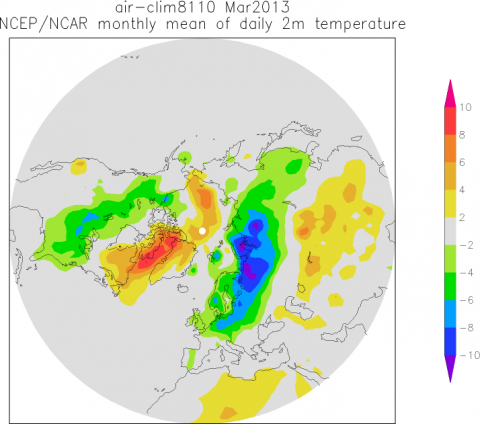
First, what does the unusual temperature distribution observed this March actually look like? Here is a map showing the data (up to and including March 25, NCEP / NCAR data plotted with KNMI Climate Explorer):

 
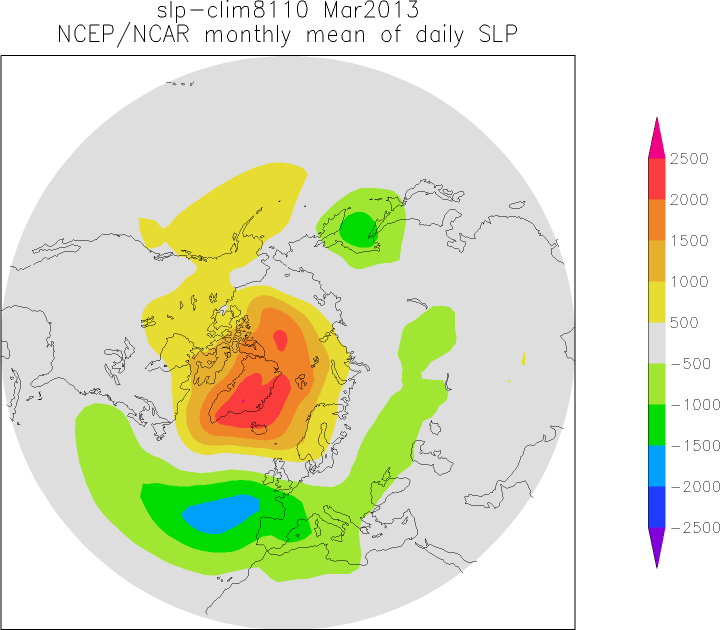
Freezing cold in Siberia, reaching across northwestern Europe, unusually mild temperatures over the Labrador Sea and parts of Greenland and a cold band diagonally across North America, from Alaska to Florida. Averaged over the northern hemisphere the anomaly disappears - the average is close to the long-term average. Of course, the distribution of hot and cold is related to atmospheric circulation, and thus the air pressure distribution. The air pressure anomaly looks like this:


There was unusually high air pressure between Scandinavia and Greenland. Since circulation around a high is clockwise [anticyclone], this explains the influx of arctic cold air in Europe and the warm Labrador Sea. 

Arctic sea ice

Let us now discuss the Arctic sea ice.  The summer minimum in September set a new record low, but also at the recent winter maximum there was unusually little ice (ranking 6th lowest - the ten years with the lowest ice extent were all in the last decade). The ice cover in the Barents sea was particularly low this winter.  All in all until March the deficit was  about the size of Germany compared  to the long-term average.

Is there a connection with the winter weather?  Does the shrinking ice cover influence the atmospheric circulation, because the open ocean strongly heats the Arctic atmosphere from below?  (The water is much warmer than the overlying cold polar air.) Did the resulting evaporation of sea water moisten the air and thus lead to more snow? These questions have been investigated by several studies in recent years.

Petoukhov and Semenov, JGR 2010

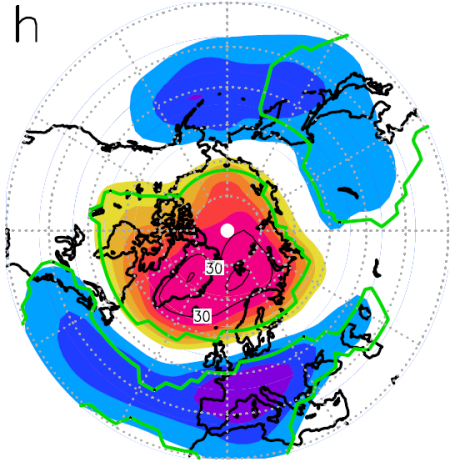
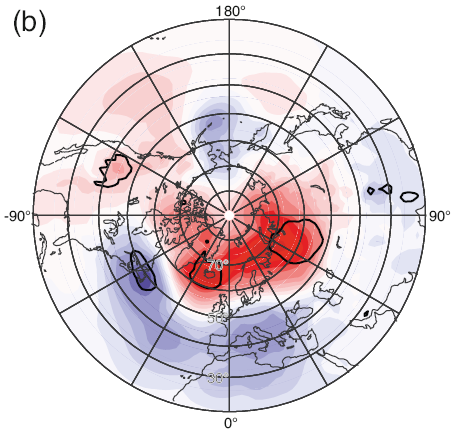
These two scientists from the Potsdam Institute and the Leibniz Institute of Marine Sciences in Kiel used the ECHAM5 atmospheric model.  As a boundary ondition in a series of simulations they reduced ice cover in the Barents and the adjacent Kara Seas. With a medium sized reduction in ice volume similar to what we now see they calculated the anomaly in the pressure distribution shown below (they also examined what would happen for a complete loss):


Thus, abnormally high air pressure between Scandinavia and Greenland. Leading to the following temperature anomaly:


Cold from Siberia to Western Europe and a heat bubble centered on Labrador - quite similar to the temperatures this March.

Jaiser et al., Tellus 2012 

Our colleagues from the Alfred Wegener Institute, together with U.S. researchers, examined the question of whether one finds this relationship in observational data. For this purpose, they investigated the correlation between the distribution of air pressure and ice cover in an analysis of their covariance. They concluded: 
Our analysis suggests that Arctic sea ice concentration changes exert a remote impact on the large-scale atmospheric circulation during winter 
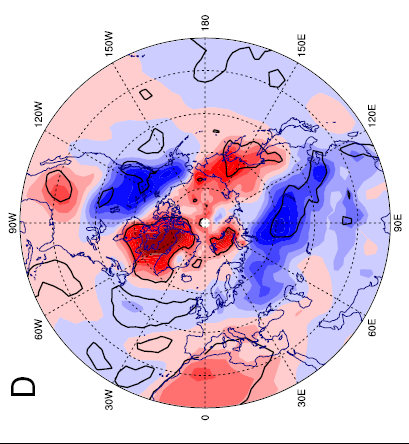
The following graph from this work shows how the distribution of air pressure in winter changes between phases of low and high fall-ice cover in the Arctic:


You can see that low ice cover correlates with high pressure in the Arctic winter, again between Scandinavia and Greenland - just as in the model calculations of Petoukhov and Semenov. (Jaiser et al do not show temperature maps)

Liu et al., PNAS 2012

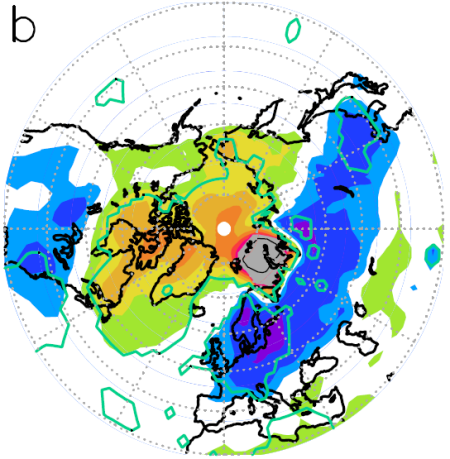
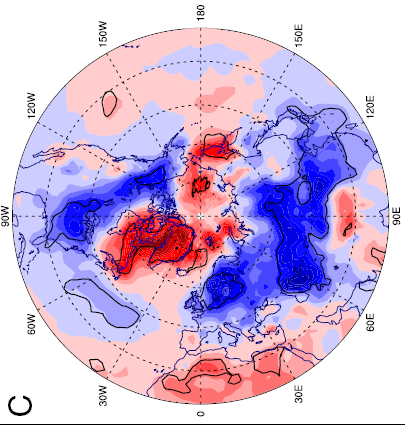
Next on the dance card is a study which appeared shortly thereafter by researchers from the U.S. and China, which approached the problem from both sides: model simulations and data analysis. The following map shows the linear regression between less ice cover in autumn and the temperature in winter:


Again, these temperature anomalies are similar to the two shown above, the temperature map for this March and that from the model of Petoukhov and Semenov.

An observed correlation (as in this diagram and in Jaiser et al.) is still not a causal connection, therefore Liu et al. also made a series of model calculations, but with a different model (the American model from NCAR). Further, they calculated a larger ensemble (20 runs with varying initial conditions), which makes the results statistically more robust. As a boundary condition in the model they took the observed reduction of the ice cover in the Arctic and calculated ensembles with or without the ice decrement. The result of these simulations for the temperature is as follows:

Again cold in Siberia and Europe, warmer over the Labrador Sea, and a cold band across North America. From the model, we know that it's not just a correlation, but a causal relationship: In the model setting the prescribed ice cover results in cold temperatures over Europe, just as in Petoukhov and Semenov. The associated air pressure maps are also similar. 

Liu et al. also have dealt with whether alternatively the Arctic Oscillation (AO) or the North Atlantic Oscillation (NAO) could explain the temperature anomalies.  They showed that these natural oscillations lead to different spatial patterns and inter-annual fluctuations - they ruled out the AO and NAO as causes. 

They also have examined the relationship with snow and come to the conclusion that additional open water in the Arctic humidifies the air, leading to increased snowfall.  The snowpack is important because even the strong March sun can hardly heat up snow-covered land; the white surface simply reflects the sun's rays. According to Liu, et al.
 We conclude that the recent decline of Arctic sea ice has played a critical role in the recent cold and snowy winters. 
However, the taz quoted [German paper] yesterday the spokesman of the German Weather Service [DWD in German] as saying that if there was a direct relationship with the sea ice cover,  the entire winter would have to be very cold in Germany.  I think this trivial argument with which he would like to wipe from the table the climate research results shown above is pretty embarrassing for the DWD.  Of course open water in the Arctic  does not prevent stochastic weather variability.  There will always be warm and cold periods. In all these studies it comes down to changing probabilities in the prevailing weather patterns: Petoukhov and Semenov estimate that the probability of cold winter extremes could triple, that is even in the Abstract. One wonders whether the DWD representative has read the relevant studies at all - and if not, why he feels the urge to comment on them in the media. Unfortunately, it has a certain tradition that meteorologists dealing with weather, are not familiar with climate science. 

In my view, the above studies provide strong evidence for a link between Arctic ice loss due to global warming, more frequent winter high pressure, especially over the Atlantic-European part of the Arctic, and an associated influx of cold air to Europe. As we have often seen in recent winters - for example in a spectacular way in the first half of February 2012

Still this is still not settled science - the studies are relatively new and need to be discussed intensively in the professional community and confirmed by further research, or perhaps called into question. This is the normal process of scientific debate, through which at the end findings are distilled which are robust and widely accepted, such as the fact that our emissions of greenhouse gases warm the climate. 

P.S. (29.3.) I see now that the climate lie detector has put its finger on the beautiful article in Welt Online, which a few days ago once again presented the proverbial "Russian scientists who predict an ice age" warning of a "freezing pig cycle".  There is no better way of actually disproving that solar fluctuations are to blame, when even diehard "climate skeptics" can not find any more respectable arguments. This time, even sponsored by Gazprom (for real!).  Anyone interested in the subject of climate and sun: could read What role does the sun play? [Maybe Eli will translate some day for some carrots]

References

Jaiser R, Dethloff K, Handorf D, Rinke A, Cohen J (2012) Impact of sea ice cover changes on the Northern Hemisphere winter atmospheric circulation.Tellus Series A-Dynamic Meteorology and Oceanography 64th doi: 10.3402/tellusa.v64i0.11595

Liu JP, Curry JA, Wang HJ, Song MR, Horton RM (2012) Impact of declining Arctic sea ice on winter snowfall. Proceedings of the National Academy of Sciences of the United States of America 109 (11) :4074-4079th doi: 10.1073/pnas.1114910109

Petoukhov V, Semenov VA (2010) A link between reduced Barents-Kara sea ice and cold winter extremes over northern continents. Journal of Geophysical Research-Atmospheres 115th doi: 10.1029/2009jd013568

UPDATE:  R Gates at Neven's Sea Ice Blog
There are certainly two dynamics at play in the "weirding" of this winter's weather, but before discussing them, it would probably be good to understand that we are in a new regime of climate and therefore weather patterns, and thus, the weather is only weird compared to some former regime. In other words-- weird is the new norm, and it will be weird in the future not to have blocking patterns and associated extremes that come with climate change.

But back to the two big dynamics at work in this winter's NH winter. The first is of course the big SSW [Sudden Stratospheric Warming]  event that took place in early January. This event was not unlike the big SSW events of 2009 and 2006. The polar vortex was shattered and the normal westerlies over the Arctic reversed and cold air from the east has been generally circulating over N. Europe for several months. The SSW event from January, in addition to breaking down the vortex and warming the stratosphere over the Arctic, brought downwelling air actually all the way from the mesosphere down into the stratosphere and created higher pressure all the way down to the troposphere. . . .  In short, the SSW event from January has had lingering repercussions far beyond the original rapid stratospheric temperature spike. [continued]

Thursday, March 28, 2013

What Is Science?

To be honest Eli don't often agree with KT but K said something profound down below

No, and I think you'll agree with me here: it's a science and we ought to hold it to exactly the same standards as any other.

You really don't 'get' science.

There are no standards and there are no rules, except possibly for the journals, and the journal publications do not define science - they just report some of it. In fact, there is no real definition of science, there are just devices that can be fabricated repeatably that do actual work, and the work itself, which reveal insights to you, if it happens to be communicated to you by way of print or any other media, or in the form of product devices, which you can then use to do your own 'science'. It's a cumulative self correcting collective effort with parts that rise and fall according to the whims and funding of the investigators. You should try it sometime, you might like it. You can even incorporate some of its methods into your daily life.
The auditors just don't get it. 

Wednesday, March 27, 2013

Laughing at those who laugh at science

Chris Mooney had one of his usual good Point of Inquiry shows back in November that I just caught, an interview with Michael Gordin, who wrote The Pseudoscience Wars. Gordin considers the idiot Velikovsky to be one of the originators of modern pseudoscience. Astronomers of the time tried denouncing him, tried ignoring him, and then Carl Sagan even tried engaging and refuting his nonsense one step at a time. None of it worked. Instead, just as science advances one funeral at a time, pseudoscience sometimes gets scrubbed away one funeral at a time. Nobody cares about Velikovsky any more.

It's still unclear how to handle idiotic attacks on science. A latest idiotic attack by people who don't understand science and therefore respond by laughing at it, is an attack stating the study of evolution of duck genitalia is so stupid that it's funny. At the link, Carl Zimmer disposes of the idiots, but I think he's using Carl Sagan's technique of engaging and refuting them on the facts. As Sagan found out, that doesn't really work.

Eli's trick has been to engage, refute, and laugh at the science deniers. I think it's worth a shot but I don't know if it'll work, and I've not quite figured out the right tone to take myself. I've also tried engage, don't refute, just bet them, but that hasn't gone all that far. I can't figure out how to bet people who laugh at the scientific value of biology experiments, so maybe just laughing at those people is the best bet right now. The experiment of figuring out how to handle pseudoscience will have to continue.

Bernard J Has Another Suggestion

It has come to Eli's attention that some of the bad bunnies don't think much of the Marcott Wheelchair curve.  Bernard J has another suggestion.

AND A GREAT EASTER FOR ALL IN  BUNNYLAND 
FROM RABETT RUN

My carbon or yours?

So our water district staff presented how they thought we could reach carbon neutrality by 2020. Depending on how you do the numbers, we became carbon neutral without even trying.

A lot depends on this:


(Full presentation via scrolling to March 26 2013, Item 4.1)

That's how much energy's used to cradle-to-grave a water drop from the Sierras to the outflow of a wastewater treatment plant. My district is a water wholesaler - we handle the first three steps, and then a water retailer (either a private company or city government) buys the water from us, gets it to the end user, and picks it up from there to a sewage treatment plant. You can see the main energy use is the end user, mainly because they heat it. Our staff argues that end use is by the end user, not our responsibility, and I said I'd have to chew on it. Any thoughts? Possibly relevant is that the vast majority of water we sell them never gets heated, so that end use figure conflates some very high and much lower energy using water together.

This is important not only because it says we're not causing that lion's share of energy use, but because our water conservation programs are focused on end users, so reducing their usage could be counted as an offset. That gets us to carbon neutrality pretty easily if you accept numbers that no one's really going to accept, but still more easily than I expected even with more realistic assumptions.

In other news, the Army Corps of Engineers is drawing a reasonable amount of tax money from our county but not funding many flood control or San Francisco Bay restoration projects. You can hear what passes for a "concerned statement" on my part below:

Get Microsoft Silverlight

If the link's bad, click here, go to March 26 2013, and the video segment is from 1:57:50 to  1:59:04.

Should Eli Believe His Lying Eyes or Makarieva

James reminds Eli of  Makarieva et al in Atmospheric Chemistry and Physics as well as featuring on several blogs.  One can summarize the entire thing by noting that Makarieva claims that winds are formed when water vapor condenses decreasing the gaseous volume.  Were this the major process, air would move inwards towards the area where the condensation occurred.  Most others point out that the release of energy from the heat of condensation will blow the air outwards.  That's the summary

There was an almost infinite amount of mathturbation about this including the original paper, and Dr. Makarieva was very, well, insistent.

Eli OTOH is a member of the reality based community.  The Rabett likes to look at what is going on and figure out what it means before turning the math crank.  Recently Ms Rabett dragged Eli off into the mountains where he could actually watch the clouds form.  He could tell you what happened, but in this world we have the video.

 
There are lots more of these on You Tube and in all of them when the cloud forms it expands, the condensed water vapor provides an excellent tracer of the process,

So who should the bunnies trust.